Tag Archives: Interiors

Opening Night at the Opera and Museum Sickness

Last year when I attended the Salzburger Festival by myself, I wondered how the glitz and glamour compared with our backyard gala. I satisfied my curiosity when we attended the opening night of the 94th season of the San Francisco Opera last night. The glitz and glamour were definitely there, but in limited supply.

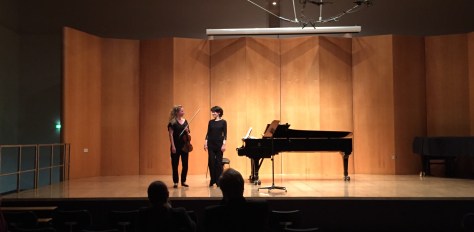
Here are a couple of pre-opera performance shots:

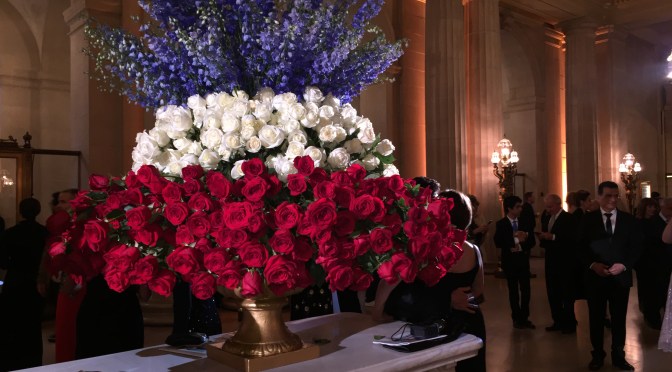
Nevertheless, the SF Opera House is always an exciting and beautiful venue to visit. Thanks to Dede Wilsey, the grand dame of arts in San Francisco, the lobby was decked out in a magnificent red, white and blue flower arrangement and the interior of the opera house was draped to reflect the French theme of “Andrea Chenier”.

While it holds over 3,000 seats, the opera house is on the order of NY Met’s capacity at 3800 seats. The Semperoper in Dresden is half that size, with only 1500 seats and Vienna is similar to Dresden’s with 1700 seats. The SF Opera still feels more intimate and reminiscent of the European opera houses because of its Beaux Arts design than the Met’s spartan Sixties Modern style.

The only difference between Opening Night and other performances, aside from excitement in the air and a bit of a Halloween-like “dress like someone else you always wanted to be” atmosphere, were two distinguishing marks. There were speeches beforehand by the President of the Board and an introduction to the new General Manager of the SF Opera. It felt a bit like going to a Chinese wedding, where you had to sit through two hours of speeches before getting food. Fortunately, it lasted only ten minutes or so.

Before the performance, we sang the Star-Spangled Banner. That was another first for me, at least at an opera performance. I couldn’t help but think about Colin Kapernick and the debate he has aroused from this simple tradition. I snuck a look around the room and behind me to see if anyone had the courage to protest. But no, everyone complied.

You probably can’t tell from the photos, but the photographer has taken painstakingly edited views of the evening. We have our own distinct American style of casualness and innovation that needs to be appreciated. Nevertheless, I’m making plans to return to Salzburg as soon as I can. The schedule of events is announced in March next year.

Andrea Chenier is an opera about the French Revolution sung in Italian. Younghoon Lee was the star of the evening. He replaced Jonas Kaufman as Don Jose in “Carmen” at the NY Met last year. While Lee’s voice is very powerful and technically impressive, I felt that he still lacked the performance quality and passion that I enjoyed in Kaufmann’s performances.

Many of you may be wondering where I have been since returning from our third world trip. I finally got organized and signed up as a full time City College of San Francisco student! It has been a bit of a jolt realizing that there are so many bureaucratic steps to getting recognized as an individual with unique needs. I had forgotten that UC Berkeley had taught me how to be a master of administration, and not necessarily a master of any academic pursuit.

Still, the old battle skills kicked in. I managed to get signed up for figure drawing, Intermediate German, and two cinema classes. It’s probably over the top and overcommitting myself, but that seems to be my style these days.

I decided to try the local city college approach to language training for a variety of reasons. Arriving at a class of over 40 students was a bit disarming, I’d have to admit. After sorting out various levels and stages of German language training, the instructor assured us that she could manage. She adeptly split us into 4 groups. Two for beginners, two for intermediate.

Each group is subdivided into “academic” and “practical” students. She whizzed her way through the system and found another classroom, where she toggles between two groups of students in each room. Like the star of “Bewitched”, she magically flies between rooms giving instructions to each and sprinkles “can do” grammar dust on us in between. It strangely works, at least for the time being. Admittedly, this is an extreme switch from the clockwork 12 students in Germany or the monastic tutorial. More on this method to madness later.

In one of the cinema classes, I am writing a “how to” film script. I decided to do mine on “museum sickness”. A certain close friend is afflicted with this strange phenomenon that strikes unfailingly each time we go to a museum. It miraculously subsides once we are about a mile away and well outside the possibility of ever returning to the premises. Some of you may wonder why I coin “travels with myself…”…and now you have a pretty good idea.

Doing a bit of online research has been fascinating and entertaining. My topic, “how to avoid Museum Sickness” is derived from information I collected from the museums I visited in the past year, such as:

1. The Dresden Hygiene Museum, where they offer portable stools for visitors.
2. The Rijksmuseum in Amsterdam, that displayed a curious chair known as the Stendhal Chair” for museum goers to decompress when being overwhelmed. A variation of a confessional, this chair has a flip door in front of the seat so you can sit down and avoid eye contact with others when you are seated inside! (You may have seen this earlier in January 2016 when Melissa and I were in Amsterdam)

The Stendhal syndrome is a defined condition related to becoming disoriented while in a museum. Apparently Mark Twain experienced this phenomenon when traveling by ocean liner across the Atlantic to Europe, then immediately going to one of the famous museums. He became dizzy and sick from the overstimulation.

Another version of museum sickness is called “synesthesia”, a condition of mixed sensations–where one modality affects another, such as audial effects transferring to visual, or from form to color. I wondered how prevalent this condition was or whether it was purely hypothetical in nature. Obviously, more research will bear this out. In the mean time, I am completing my assignment in script format. Get your fancy dress ready to attend the Oscars!

Since my posts are down to monthlies until I am traveling again, I’ll keep you posted on my educational progress. I hope all of you continue to live and learn, to keep the fire burning in the attic…

Days 61-63: Kusatsu Hot Springs, Japan

I’ve been following a few blogs every now and then. Not often, rather infrequently, just out of curiosity, and to see the style of postings. Mine tend to be pretty straightforward, while I find many blogs pontificate, pyschoanalyze, or philosophize about the meaning of life. I am not trained to do any of those, so I try to steer clear. However, today brought new meaning to life. Staying in a real ryokan, or Japanese style inn, has renewed my ability to appreciate and understand life. That’s a pretty tall order, considering the whirlwind of activities that I have thrust myself into over the past couple of months. But slowing down and being in an exquisitely beautiful area has given me cause to pause and reflect.

Good things come to those who wait. I guess it’s hard to see all the offerings life has before each of us. As we grow older, we are able to differentiate and discriminate. Many think that growing old is a sad process but I am finding it to be uplifting–not always, but the quality of what we see is so different. Once you have perspective on many experiences, you draw from them and can detect what is bitter and what is sweet.

We should have realized what an occasion coming to Kusatsu Hot Springs was going to be. Once we arrived at the bus terminus from the train station (3 hours travel west from Tokyo by 2 bullet trains), we asked the information counter how to reach our hotel. All I had was an address in Japanese. We asked if we could walk there. “Of course,” said the receptionist. “But I can call the hotel and they will come to pick you up. Just have a seat in the lounge and they will find you shortly”. Sure enough, within 5 minutes an older gentleman appeared to whisk us in a van to the hotel about 5 minutes away. Now that’s what I call service.

From the arrival at the entrance to the ryokan, we knew it was going to be special. Soft voices, infinite courtesies, and true hospitality catch our attention. Maybe after Russia and even Mongolia we are sensitive to the manner in which humans greet each other. Not so much the degree of warmth as the presence or absence of it.

The Japanese have the hospitality covered. In this case, it’s a business. But so are the Marriotts and the Goyo Travels (our guide company in Mongolia) and the Zemzuchinas (our hotel in Vladivostok). Everyone makes the effort, but no one knows respect for the customer like what we are getting here.

We were shown to our Japanese style room. Every detail in the room is exquisite–from the carved and lacquered wooden post that trace the inherent knots and wood grain, to the miniaturized proportions and tea service in the room. Every detail is taken into consideration. I don’t know where I heard this before but the thought of “economy, purpose and delight” come to mind.

After casing out every joint (literally, the choice of thickness for wood trim, the depth of niches, the size off doors, the thinness of wood recess handles, etc etc, we tore ourselves out of the room and to the house baths. The hot springs eternal here. As one of the many features, you go to separate quarters for men and women to wash down , then soak in tepid splendor.

Our dinner, with the complete set (see menu), was another version of perfection. I’m not sure how you can produce and consume every item on a menu but they produced and we consumed. They only thing we could do afterwards was roll over and flop into bed from overconsumption. Bad for the heart but great for the head. Anthony Bourdain was right to say the best food in the world is Japanese.

The early morning concert of birds reminded me of how Japan is or was, a tropical island. The wide leafed bamboo, lotus roots, and array of bird life are evidence. The Japanese not only have nature in their DNA, but in their history. It leaves me very envious that the Chinese were not as able to inhale the environment the way the Japanese have. Despite the disarming blight everywhere, the shibui or exquisite beauty seems to well compensate for the shortcomings.

Finally, a brief visit to the art gallery adjacent to the hotel reinforced Japanese compatibility with the sublime modern:

A Note on Travels with Myself and Others

I have been pondering my recent travels. They seem to gravitate on the 38th parallel north or somewhere between 35-40 degrees latitude. It’s not an accident that the San Francisco Bay Area (I was born in Oakland, across the bay), lies on this imaginary line. I probably mentioned that a year or two ago when I traveled along the Silk Road in Uzbekistan, and how everything felt so natural and comprehensible to me.

The beets, carrots, peas and potatoes were reminiscent of home. The Mediterranean climate is easy to get hitched to, but people do not associate it with further flung places like Beijing or Tokyo. The 38th parallel traces through of course Greece, Italy and Turkey, but also parts of China and Japan, Iraq, Iran, and Uzbekistan.

Granted, the culture and weather are different, but I still regard these environments as hospitable and liveable. You can read more about the countries along the 38th degree north here:
https://en.m.wikipedia.org/wiki/38th_parallel_north.

The Japanese have an infinite respect and appreciation of the environment. It is highly cultivated, but created for the enjoyment of all. They are natural at landscape design, architecture, and planning. Nothing less than awesome is what I’ve just witnessed on a brief morning walk behind the ryokan. This post is for you, Sara and Jim (my professors at Berkeley, to whom I am eternally grateful), and all my Japanese friends).

I have been contemplating what’s next. I’ve toyed with the idea of visiting countries along the ring of fire, but I haven’t convinced myself just yet. Alternatively, I considered tackling the countries along the 38th parallel south. To my dismay, it touches two countries where I have already been: Australia and New Zealand. That leaves Chile and Argentina on the list.

For a video on Vladivostok, click here:https://youtu.be/_i4E0wh-b9k

Days 50-51: Mongolia 4

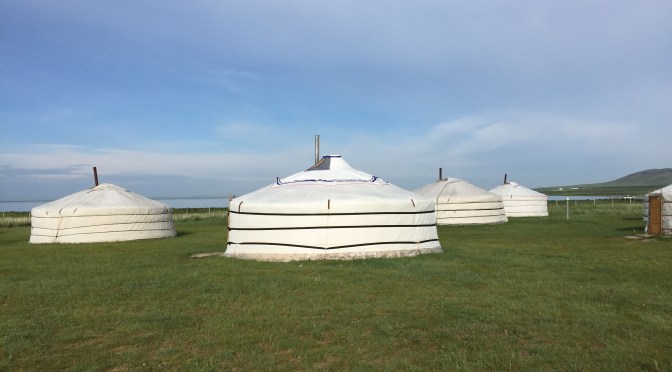
We are in Day 5 of ger living. Despite its challenges, the variety of gers has allowed us to get a full flavor of ger living. Our last ger included a stay along one of the largest fresh-water lakes in Mongolia. While rudimentary, it gave us a feeling of staying at Lake Tahoe, Mongolian style.

The many incredible, pristine pastoral landscapes we encountered traveling off-road by Land Cruiser included frequent herds of sheep, goats, horses and cattle. These are free-range animals, owned by herders who live in nearby gers, and have no fences. The animals get rounded up at the end of the day and know who and where their friends and family are. We had a full court press of the domestic animal world with a few wild ones and migrating birds for flavor.

The Erdene Zuu Monastery was founded in 1586 and is the first Buddhist monastery in Mongolia. The religion came from India and Tibet in the 12th Century. The grounds of the Monastery are preserved as a museum. The adjacent complex is a working temple. The temple was built over the palace built by Ugudei Khan, and materials were taken from the ruins.

The Kharkhorin Museum presented a fascinating series of maps showing the the history of Mongolia. If you are curious, please click on these to see more; if not, skip this section.

The Chinese Han Dynasty successfully fought back the Xiong Nu empire in Northwest China, and early portions of the Great Wall were built to deter the Xiong Nu from advancing further. (Remember Mu Lan? She was fighting the Xiong Nu!) You can read more about the ruins of the early Great Wall in my posts from Turpan in August 2013.

In the following series, you will learn more about the history of the great Chinggis Khan (1162-1227), one of his sons Ugudei Khan (1186-1241), and his grandson Kubilai (1215-1294). The maps attached are in some ways easier to read than the ones above, as they show the flow of conquests. Take a look at the arrows and dates on the maps and the extent of their conquests in the span of a century! The influence of the Mongols reached as far west as Iran, Iraq and Turkey.

In the same museum where early 8th Century Turkic memorials were preserved, a tomb for servants contained miniature figures similar to those found in Xian. They had Han Dynasty characteristics similar to the figures we enjoyed seeing in Dunhuang Museum in Northwest China. They had unique, expressive faces and lively gestures in their bodies. Apparently these were not created in a tomb for any noble, but were offerings by servants. The size of the figures, gold, and ceramic pieces were not large enough to represent those that were buried with those a leader.

Day 39: Bauhaus in Dessau, A UNESCO World Heritage Site

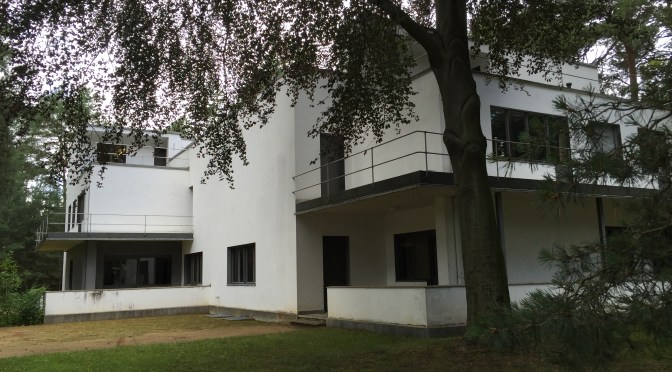
The trip to the Bauhaus in Dessau was one of my all-time favorites. This is what brought me to architecture and design! The words and pictures may not express what led me to lifelong learning about these topics, but I hope you will be able to decipher what has been my passion developed from the Bauhaus approach.

The Bauhaus began in 1926, when Walter Gropius started a school for integration of art, design, craftsmanship, and industrial production. He hired faculty such as Moholy-Nagy, Klee, and Feininger to teach students design principles that brought all of these components together. As artists and craftsmen themselves, they attempted to synthesize form and function. They even taught students how to breathe deeply, and to eat healthy! Unfortunately, the Bauhaus was short lived. It was terminated in 1933 after having been moved from Weimar to Dessau in 1926.

There is too much to talk about here, so I will allow the photos to speak for themselves. I also want to get these fresh impressions to you right away. Architects will recognize the precedents established by this workshop from nearly 100 years ago. The designs are still alive and timeless. All the details, down to the mechanisms for operating windows, the insets of door knobs to receive the rounded handles, storage units, and the perfectly cast concrete floors are exquisite.

The various wings of the building group work areas, school, common areas, dorm rooms, and faculty offices. Rooms were very generously proportioned, but devoid of details. That doesn’t mean that details weren’t taken into consideration. Every visual element was carefully controlled, down to the furniture design, lighting, and hardware. All the modern examples you see today stem from this seminal group’s design teachings. I loved the performing arts center Marcel Breuer prototype chairs. They were functional, with flip seats, beautiful, and very comfortable!!

On a separate tour, the faculty houses were presented. They have been renovated after destruction during WWII and in phases during the Sixties and Nineties. Houses viewed included the Walter Gropius House, the Moholy-Nagy house, the Schlemmer House, and the Kandinsky/Klee house.

See more of the faculty houses below. In the Klee house, he added his own personality and colors on different walls of each room, and also added gold trim to doors and window frames.

You can read more about the Bauhaus here: https://en.wikipedia.org/wiki/Bauhaus. There are some slight variations with dates. I have based mine on the information provided by the German guide (that’s not to say I got them right!) There are a triplicate of sites for the Bauhaus: Weimar, Dessau and Berlin. You can read about the other museum visits in earlier posts for Weimar (in May this year) and in Berlin. If you have questions about the information provided in my blog, please check on line sources for further information.

Days 27-29: Deutsches Reichstag and Pergamon Museum

Our day began with a tour of the Reichstag Building. Angela Merkel meets regularly with the German Parliament here. Designed by Norman Foster, the building contained many symbolic elements: the preserved inscriptions by Russian soldiers who arrived on May 5, 1945; the cases of each Parliament member including Hitler, Himmler, and Angela Merkel; and a non-denominational meditation room that is used by members of Parliament before major discussions or decisions. Models of the building and the city helped to orient us.

Three parties sit in the chambers: the CDU (majority), the SPD, and the Green Party. Other representatives of committees attend the sessions, and the public inside the chambers is able to comment on discussions or decisions. Angela-Baby sits at the very front behind the table for four members. The seating is generally open and does not designate fixed locations for Parliament members.

IMG_2682

This was my second opportunity to photograph the impressive dome of the Reichstag. It has a historic display at the base, a view of the city, and a circular path to the top. Our guide explained to us that the building was 80% efficient for energy purposes, but the ventilation system had not performed as expected. Our last visit was proof that the dome can be an oven. It was stifling inside and we felt like we were being cooked in a George Forman grill!

It was much more climate-friendly this time.  Overall, the building provided necessary and significant symbolic features that help visitors to capture their understanding and appreciation of the new German parliamentary process.

The Pergamon Museum featured two major installations: the Ishtar Gate and the Hellenistic Facade. The Ishtar Gate is a reconstruction of the original approach in Babylon. The older, worn tiles are original, but the brighter blue ceramic tiles are reproductions. The scale of the original approach and beautiful animal reliefs were impressive.

Since the museum is under construction, many of the artifacts were not available. The museum focuses on ancient history.

Day 9: Goethe’s House and Garden House

Goethe’s House in Weimar is one of the two major attractions in this historic city (the other being Schiller’s House). Goethe’s holistic approach to philosophy, art, nature, and writing may have influenced the Bauhaus movement a hundred years later. (See yesterday’s post on the Bauhaus).

Goethe’s famous novel, “The Sorrows of Werther”, is a story about his affection for Charlotte Ernster (nee Buff). It sparked a viral interest in love stories in his day and may have caused a string of suicides mimicking the author’s drastic solution to a spurned love affair. Goethe was known to have had affairs with Charlotte von Stein among others. He eventually married a commoner Christiane after having a child out of wedlock with her.

Love is a featured topic of the Goethe Museum. Idealized, romantic love and even forbidden and erotic love were themes in Goethe’s writings. Goethe captured and explored human emotions that previously were suppressed or seldom expressed. Read some of the written explanations below.

Goethe was quite the Renaissance man. In addition to writing plays, poems, and about philosophy, Goethe was also an artist. He had a curiosity about the natural world, and became an anatomist, geologist, and horticulturalist.

Goethe’s home gives a glimpse into his personal life and work environment. Goethe paid particular attention to storage of artifacts and documents.  The custom-designed cases kept collections organized and accessible.  Books, coins, geological samples, and artwork were stored so they could be quickly presented and shared with visitors.

I could imagine being very satisfied and happy working there. Following Goethe’s perfect schedule, I would power through emails and blog posts in the morning, tinker a bit in the garden, have the main meal around 2pm, and cap each day with a nap in the afternoon!  Below are some of the enticing rooms and garden perspectives.

In the Park along the Ilm River, the Garden House served as Goethe’s getaway where the writer could escape his social and administrative responsibilities and focus on writing. Not too shabby either.

The “high horse” chair was custom designed so he could sit and write for long hours. The tall yoke rested his ample belly, and could easily support other elephants in the room. As a craftsman cum designer, he would have been an ace at the Bauhaus.

Day 8: Anna Amalia Library and Weimar City Castle

Weimar was once the hub of intellectual and political life in Germany. It still captures much of the imagination of aspiring writers, musicians, architects and playwrights. On my return visit to the Musikhochschule (High School for Music) last night, I savored an array of passionate violin student performances.

image

Stumbling into the National Library in Vienna last year was a thrilling experience. Naturally, I was curious to compare the Anna Amalia, a research library in Weimar for German literature from the Enlightenment to the late Romantic Period. While much smaller, this Rococo design was equally exciting, but more intimate.

You can watch a video of the library here:

The next stop on a day-long tour of local sights was the former residence of the Grand Duchy of Saxony-Weimar-Eisenach. Known as the Weimar City Castle, it now houses a collection of Cranachs, German Impressionists, and painters from the Weinar Art School.

Dinner with the locals:

image

Day 2-3: Dresden Neumarkt

One of the reasons I return to Dresden annually is to stay at one of my favorite hotels in the world. Located on the Neumarkt square around the corner from the famous domed Frauenkirche, this hotel  can be identified in the header above. Look for the yellow building and the  fourth one in the series of reconstructed Baroque buildings in the center of the header photo. This gem beats any Air BNB hands down for price, location, and amenities. The unit is at the very top, where two small dormer windows peak out at the roof level.

The hotel is also centrally located within a stone’s throw of the famous Semperoper, where we attend many of the concerts and opera performances, as well as numerous museums and attractions.

After a quick outing to Bad Schandau located in “Saxon Switzerland”, we headed over to the Semperoper for a delightful performance of Tsaichovsky and Rachmaninoff, performed by the Amsterdam Concertgebouw Orchestra. Kristine Opelais, an accomplished and upcoming star, sang from Eugene Onegin and Puccini.

Day 76: Chicago to Santa Fe, NM and the Amtrak vs. TME Report


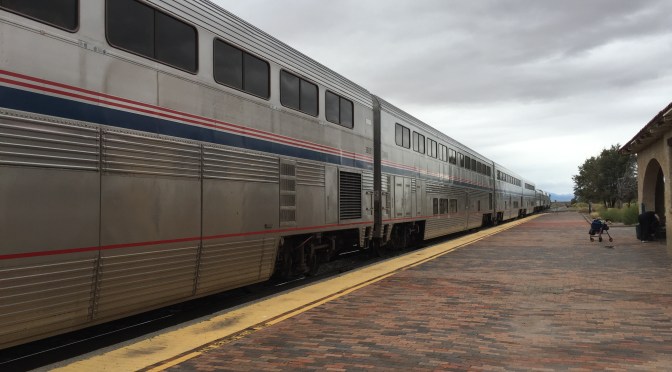
After setting off from Chicago late in the afternoon, we enjoyed an idylllic train ride plying the Midwest from Illinois through Missouri, Kansas, Colorado, and New Mexico. We passed the Mighty Mississippi and wheat fields to enjoy a peaceful sunset.

On arrival, we had a look around the city and enjoyed a sunset the following evening from our hotel roof deck. See view above.

Preliminary Evaluation of the Amtrak vs. Trans-Siberian Express (TSE)

As for the evaluation between Amtrak and the Trans-Siberian Express (TSE) a la Trans-Mongolian Express portion (TME), here’s my interim report below.

If you recall, on Day 71 I established a self-inflicted competition between the American Amtrak system and the Trans-Siberian Express (TSE). You may be confused when I refer to the Trans-Mongolian Express (TME). The TME is a significant portion of the TSE, and differs only in the start point. the TSE begins in Vladivostok on the eastern coast of Russia. The TME begins in Beijing and traverses through Mongolia to Moscow, where both the TSE and TME meet. See map below.

Transsiberianmap

If you are not particularly interested in either, skip this post as it will be a bit long-winded, self-admittedly, and only for those die-hard train afficinados.

Here are comments based on the original criteria I established:

1. On Time Record

So far, the two long haul trips we have taken on Amtrak (Philadelphia to Chicago, Chicago to Santa Fe (Lamy), NM) have been on time or early, and the shorter legs through New England have been on time or slightly delayed. Trains on the TME were either on time or early, but we were not able to verify the arrivals or departures due to fuzzy time zone changes (!!)

2. Comfort (Bed strength, ability to rock a baby to sleep and keep them there; access to lights, camera, action; no annoying overhead PA system used at free will for the comfort of the system and not the passenger; and good padding and ergonomics for blogging)

Beds on Amtrak are comfortable, non-formed foam pads over two seats pushed together in the roomettes, with an overhead bunk that does not allow you to sit up straight. One passenger complained about the pillows and beds being too flat, but seating ergonomics and padding seem fine in both systems. Beds on Amtrak are in the direction of travel, whereas the TME beds were perpendicular to the direction of travel. Not sure either makes much difference in terms of rockability, but the Amtrak trains definitely sway more at the top due to the double-height cars. Most of the sleepers were on the upper level so more passengers would experience the sway, so I’d give Amtrak a negative point for this.

There are more stops at night on Amtrak due to the higher population along the route, so it may appear to be slightly more disruptive at night. However, the train starts and stops are smoother on Amtrak compared with the Chinese bump-and-grind at each stop. The Chinese trains did not appear to have any or much cushioning between cars so they slammed into each other when the trains departed or arrived at each station.

Lighting and controls were sufficient on both systems so no particular comments. In contrast, the use of the PA system was notable on Amtrak. The dining car made repeated comments about availability, MIA’s, and hours of operation; there were none on the Chinese cars (perhaps because there were so few or no passengers! or the multiple languages spoken by passenger on the train would render the effort fruitless). We did take a Chinese train on a different trip last year that piped overly loud and annoying announcements and music on their PA system. At one point, the speakers were disconnected (i.e. ripped out) to our car by a passenger and it seemed to take care of the problem.

3. Service (attentive staff, no back talk or attitude–i.e. Courteous; visible but not obtrusive; professional but not hollow friendly delivery of information)

As you know, we found the service on the Chinese trains to be very good, but that’s because we spoke Chinese. I am not sure foreigners would find the staff as friendly. Surprisingly, the Amtrak staff have been generally friendly and attentive. They must have improved their customer service training since we took the trains a generation ago. There are still vestiges of the long-timer staff person here and there who crack canned jokes every now and then, or a raspy voice yelling out instructions by someone who cumulatively earned the distinctive voice quality. Overall, both appear to be genuine in intent and concern.

4. Cleanliness (no spit on counters; toilet paper unfailingly in supply; Windows you can see through; stainless upholstery and carpets)

Well, can’t say I went looking, so I didn’t find any gross evidence in either system. In general, the toilets in the Chinese trains were not well attended, but in defense of the system, we were only 2 of 3 passengers in our car. There were four toilets available in one Amtrak sleeper car for some 24 rooms; only one toilet and one washroom per car on the Chinese train. You can do the math.

Toilet supplies were plentiful on Amtrak, nada on the Chinese trains. Bring your own.

Windows were a little soiled on Amtrak. Hard to see through some windows on Chinese cars.

Upholstery on Chinese cars were old but clean; no carpeting in rooms.
I noticed a few stains on the blankets of the Amtrak, and maybe on the carpeting. The concierge announced that shoes are required on all Amtrak trains.

5. Food (real food; reasonable prices; no cheap shots using lots of salt and sugar; no bar codes on wrapping; cold beer; wine list; nuking; no plastic, polystyrene, or jewel boxes)

Food to date on Amtrak was decent, and better than I remembered. When you book a sleeper you get free meals. Dinner options included salmon fillet, steak, chicken, or pasta. The only disappointing aspect were the frozen vegetables.


Hard to compare the food from the Russian dining car. The food appeared to be freshly cut and prepared, and although small portions, the food was fresh, tasty and healthy. Gee Kin’s vote for the staff’s home-cooked pasta and meat buns unfortunately do not qualify for this evaluation of customer-consumed food. Interestingly, I asked Sean, our Amtrak attendant, what he did for food. He immediately remarked that the food on the train was unhealthy for service staff. Assuming that they ate it frequently, the food would take a toll on your weight and BMI. The food is included in their benefits, but he mentioned that he beats it over to Whole Foods whenever he gets in to Seattle. Staff stock up on their own food but are not allowed to bring anything requiring refrigeration. That poses some limitations, but he said they work around it (wink, wink). Occasionally the house chefs make family meals for the staff and they really appreciate it.

I am copying and pasting the earlier post comments for convenience and adding any additional notes or changes.

Pros of the Trans Mongolian Express:
1. Decent food in the Russian dining car at reasonable price
2. Service in the sleeping car was very good and attentive by the two attendants assigned to our car (even though we and one other woman were the only passengers in the car after Ulan Bator!)
3. The compartment was tidy and toilet at the end of the car was adequate.


Cons for the Trans Mongolian Express (TME)
1. The tracks are not universal in Mongolia thereby requiring wheels to be changed on every car going between China and Russia through Mongolia
2. The trains do not have Internet access
3. The schedule and arrival times at any station were a mystery due to fluctuating time zones

Pros for Amtrak trains
1. The trains are very comfortable
2. The trains have Internet access (10/7 correction: none on the long hauls!!)
3. The information for time, stops and scenic opportunities is helpful (10/7 update: excellent handouts available at every seat)


Cons for Amtrak
1. Service staff are surly (10/7 update: I would delete this comment that was based on historical experience)
2. Stations are antiquated (10.7 update: true, but they have installed First and Business Class lounges with internet access that overnight passengers can use)
3. Seating is not reserved (10/7 update: all seats are reserved on the long-hauls)

This report includes two long hauls:
1. Washington DC to Chicago on the Capitol Ltd.;
2. Chicago to Santa Fe, New Mexico on the Southwest Chief;

The last report will include the third and final leg:
Santa Fe to Los Angeles (continuation of the Southwest Chief), then the Coast Starlight train from LA to San Francisco.

Day 62: New York City, New York (continued)

Today was a continuation of yesterday’s whirlwind tour of galleries and museums, directed by two friends and ardent museum-goers. We started with a visit to the new Whitney Museum, that has been relocated from the Upper East Side to the Meatpacking District adjacent to the popular Highline. It was exciting to see an expanded display of America’s best that included many women and artists from different ethnicities. Galleries are organized and grouped by themes.

The featured painting above is entitled “Saigon” by Peter Saul, 1967. It shows the raping, death and destruction from that horrible war. You can go to the link below and find an audio presentation about it given by a museum guide.

The freshly minted building by Renzo Piano:


Photos above:
1. Sculpture by Ruth Asawa, San Francisco’s own
2. New York, 1955
3. Jackson Pollack
4. Rothko Painting indicating Tragedy, Ecstasy and Doom
5. Photographer in front of painting by Krasner, who was the wife of Pollack. After he died, she continued to paint but converted from small scale to large scale in his barn studio.


Normally, I roam the galleries looking for only the artists I recognize. Near the end of the visit, I made an effort to find three artists whose work I did not know. See those above for Cy Twombly, Alma Thomas, and Elizabeth Murray. So many contemporary artist represented in this vast collection can be intimidating and overwhelming, but I found that determining a small number for myself was manageable, energizing and educational. It didn’t stop me from continuing to look for those old shoes, however, for comfort’s sake!

IMG_9466
The Whitney specializes in American Art and has been a big supporter of providing classes for artists.

For more about this exhibition that closes on Sept. 27, “America is Hard to See” go to http://whitney.org/Exhibitions/AmericaIsHardToSee

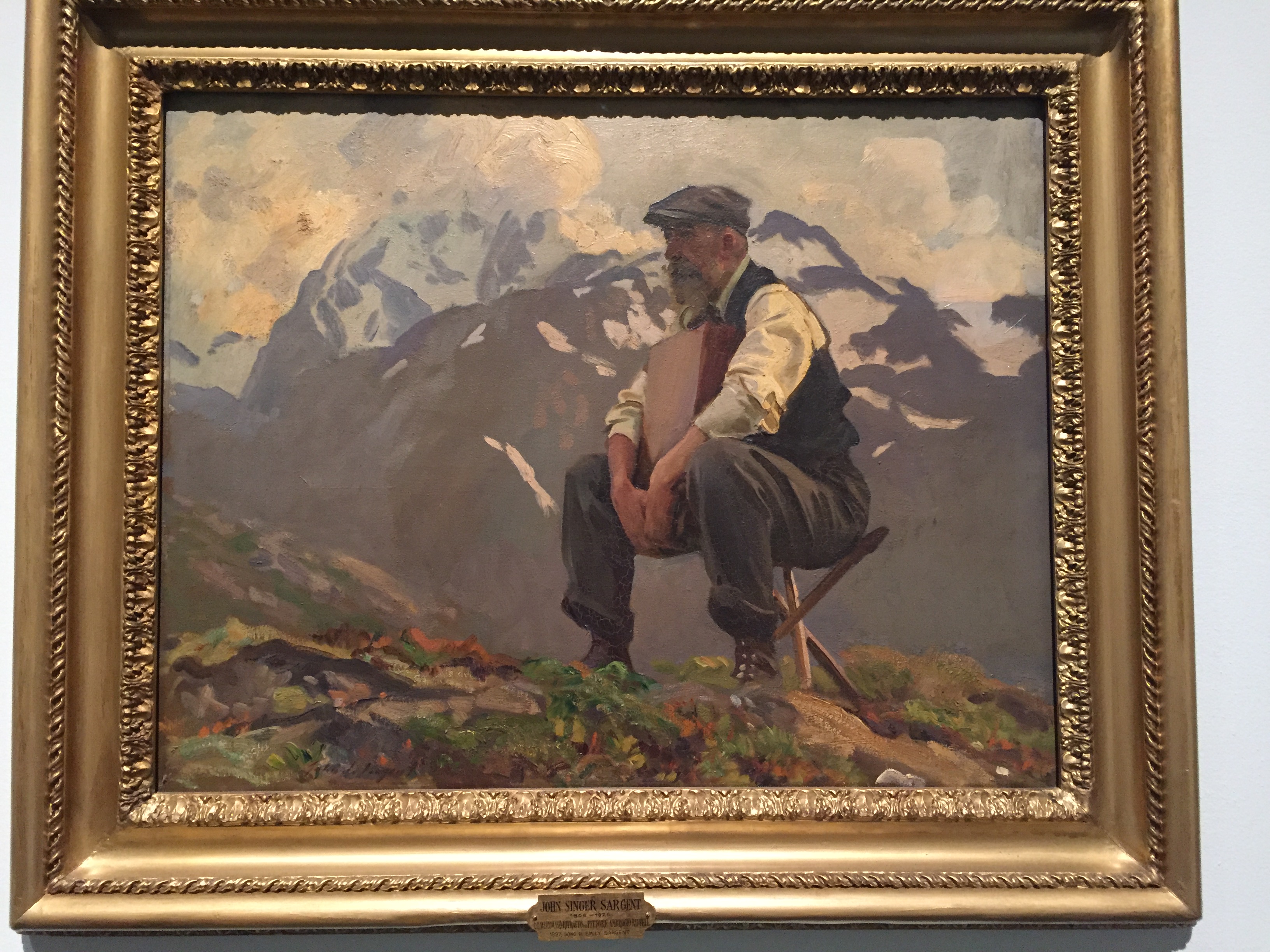
If this exhibition at the Whitney wasn’t enough, the gods must have been crazy to allow me go to another major museum in town. The Metropolitan Museum was having a major exhibition on John Singer Sargent’s “Artists and Friends”. He was born in Europe to American parents and had extensive connections to highly influential individuals, artists, and musicians in Paris, London, and throughout Europe.

Here are a few of my favorites. They are dedicated to Sargent fan Tony (if you are out there):

Full Size Portraits

Head Portraits

This one’s for you Helena:

Simplon Landscape
Simplon Landscape

For more about this exhibition “Artists and Friends”, go to http://www.metmuseum.org/about-the-museum/press-room/exhibitions/2015/sargent

And last but not least, for Isa who asked:
These are televised screen shots from the Pope’s visit last night at St. Patrick’s Cathedral. We weren’t there, but our host was late to dinner after attending the mass. We were watching TV and checking for him in the audience. The Pope seemed like a pretty nice person.