One of the reasons I return to Dresden annually is to stay at one of my favorite hotels in the world. Located on the Neumarkt square around the corner from the famous domed Frauenkirche, this hotel can be identified in the header above. Look for the yellow building and the fourth one in the series of reconstructed Baroque buildings in the center of the header photo. This gem beats any Air BNB hands down for price, location, and amenities. The unit is at the very top, where two small dormer windows peak out at the roof level.
The hotel is also centrally located within a stone’s throw of the famous Semperoper, where we attend many of the concerts and opera performances, as well as numerous museums and attractions.
After a quick outing to Bad Schandau located in “Saxon Switzerland”, we headed over to the Semperoper for a delightful performance of Tsaichovsky and Rachmaninoff, performed by the Amsterdam Concertgebouw Orchestra. Kristine Opelais, an accomplished and upcoming star, sang from Eugene Onegin and Puccini.
Today’s major events included a performance at the Concertgebouw of Handel’s Water Music by the Berlin Alte Musik Orchestre. The instruments included a harpsichord, lute, and old horns and wooden flutes from the time when the music was created.
Fortunately we sat in the front row for 20 Euros and could hear the delicate instruments while observing the performers on the podium six feet above us and from the feet up! It was very enjoyable and worthwhile to share some of my musical interest with my daughter at a precious point in time.
Our main activity was tackling the Rijksmuseum. Despite our assumption that many Bosch, Breughels and other Dutch masters would be there, there were only a few Rembrandts, Vermeers, and a smattering of landscape painters.
See above, from top left to right:
Vermeer, Woman with a Love Letter
Peter de Hooch, Woman with Child in a Pantry, c. 1656-1660
Rembrandt, Selfie
Rembrandt, the Night Watch
Van Everdingen, Young Woman Warming her Hands, c. 1644-1648
Chinese Porcelains
The day before we drove through Antwerp, a city that was occupied by the Spanish in the 17th Century, to Gent. Melissa worked at De Superette last year doing a stage and learned how to bake bread. The photos show the head baker putting the bread in the molds that Melissa also used to learn bread making.
See below:
1. De Superette Exteriors
2, 3, 4. De Superette Interiors
Below,
5. Bakery Entrance
6,7. Foam Potatoes, pulled pork, and poached egg with marinated shaved mushroom
8. Daughter Melissa, with head chef Rose and Head Baker Biggie
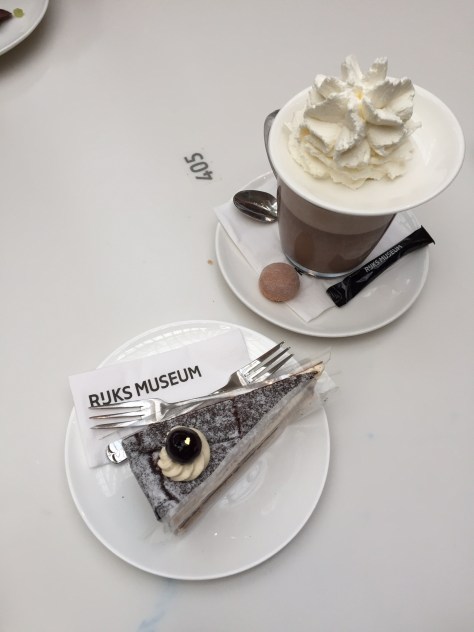
At the end of the day today, we enjoyed signature Dutch hot chocolate and cerise torte at the Rijksmuseum Cafe after a long and productive venture.
Note: we’re heading to Berlin tomorrow, see you there!
The Chicago Cultural Center (formerly the Chicago Public Library) is currently hosting the Architectural Biennale. Modeled after the Venice Biennale for art, it showcases creative architectural ideas and structures submitted by many countries. Programs will continue throughout the season until the end of the year. I would highly encourage anyone interested in architecture to visit Chicago this year.
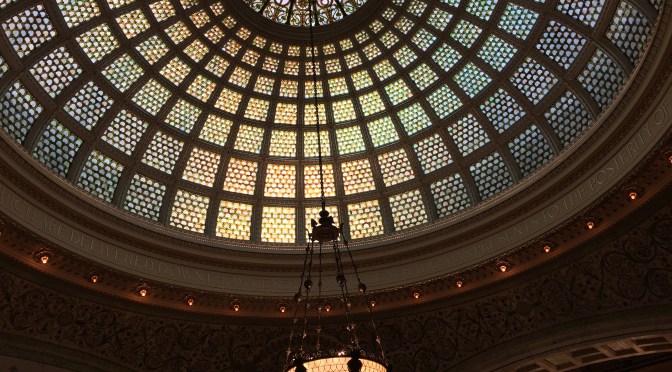
A free noontime concert enticed me to spend an hour at one of the magnificent exhibition rooms that house one of the most beautiful domes in the world.
Dome
Quote in Tile
Mosaic Tile at Entry
Dome
The Biennale hosted many interesting exhibitions, but one we specifically went to see was on workplace design. See the model of different ways to sit, stand, and work in the cutouts and the video screen shot below:
Sitting and Standing options
Sitting and Standing options
Irregular Planes-Video
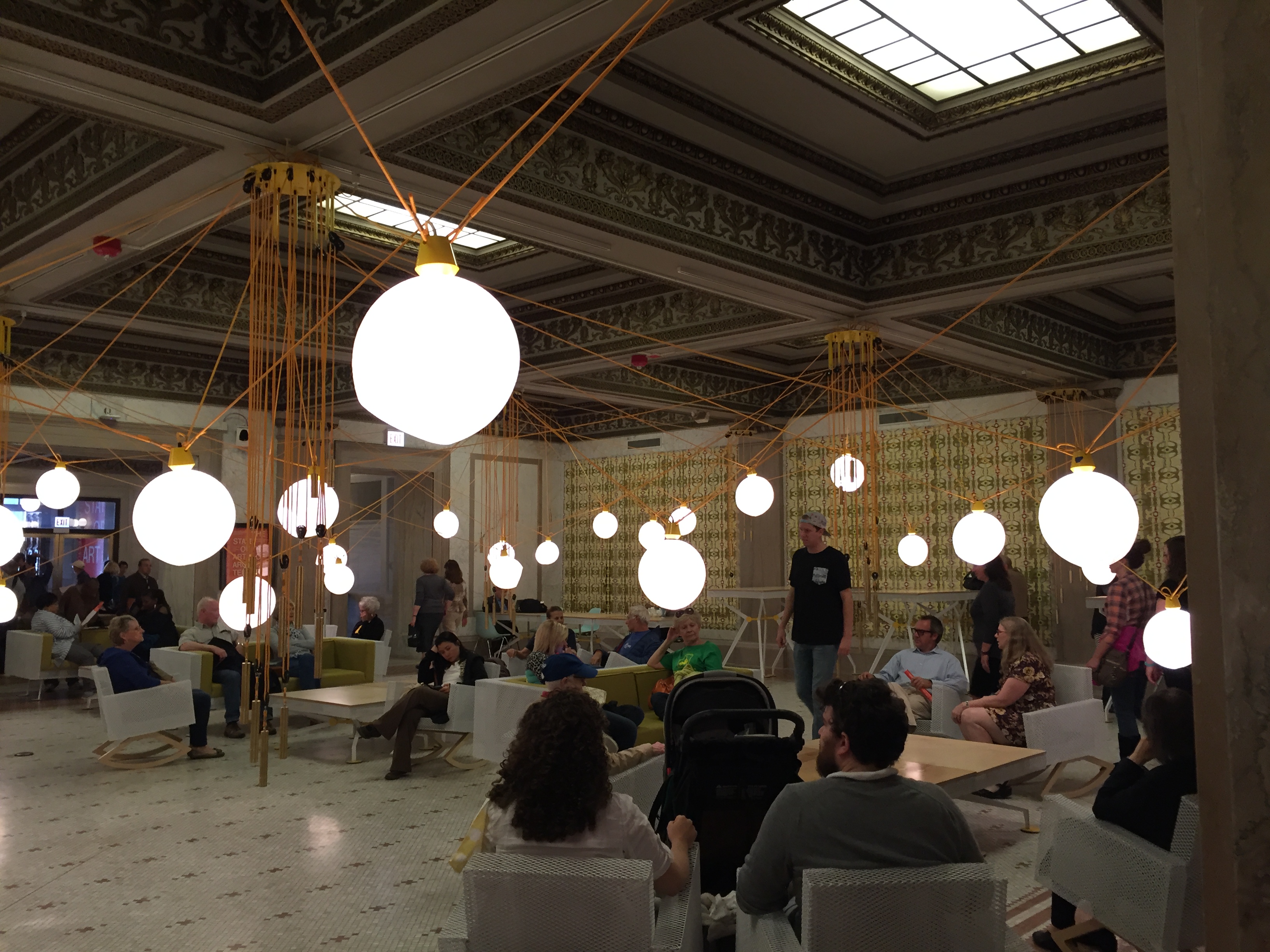
And the lobby area utilized flexible lighting that could be height adjusted with weights, and flexible drop in workspaces for visitors.
Before embarking on our journey from Chicago to Santa Fe, I was able to catch a final glimpse of the Chagall’s “Four Seasons” Murals at the Chase Tower Plaza:
Three opera performances in a row may sound ridiculous, but my weekend in New York was virtually spent at Lincoln Center doing just that. When you start to recognize the cleaning staff and where the women’s bathroom lines are non-existent during intermissions, it’s time to get a life. Nevertheless, I indulged myself and got my opera fix good enough for a year. Turandot’s staging was monumental and an “only at the Met” extravaganza. The cryptic story refers to the son of Timur and Samarkand, where the Sogdians ruled. The mythical princes, land and story must have been based on Central Asian history and the Silk Route trade that I discovered in modern-day Uzbekistan last year. (See 2014 posts on Samarkand). Learning this small piece of information helped me to connect and appreciate the historical setting for the opera.
Unfortunately, most of the production still felt unable to reconcile the fairy-talish Chinoiserie and stilted Chinese operatic dance movements with historical perspective. Despite many Asian attendees in the audience, I wondered if they were any better able to accept the strange mix. I wished I had seen Zhang Yi-Mou’s production of this opera in Beijing. The famous Chinese director utilized a cast of thousands and staged it in the Bird’s Nest Stadium
a few years ago.
The story is based on the princess demanding her suitors to answer three riddles to win her. If they didn’t, they got the QCECK (sound effect, with an abrupt horizontal hand Slash at the neck). I may need to dig further into the opera’s history and Puccini later to find a decent answer to my own riddle.
Turandot Curtain Call
Turandot Curtain Call
Photos, above: curtain calls for Turandot crew
Earlier in the day, I saw Anne Boleyn. Although the first half was a bit dull and heavy, the second half made up for it with a gripping unfolding of events and thrilling arias. Sandra Radvonovsky as Anne Boleyn and Jamie Barton as Jane Seymour were captivating together. See the curtain call below.
Last but not least, a visit to a New York institution: the local bagel shop. Lox and cream cheese on an everything bagel…perfecto!!
For my old and new friends and fellow opera lovers, here are photos of the Mighty NY Metopera evening of Il Trovatore, with superstars Anna Netrebko and Dmitri Hvorostovsky.
In the most moving part of the evening, Hvorovosky was showered with yellow roses during his curtain call. He was recently diagnosed with a brain tumor and had cancelled all performances in July and August. He had only returned to perform with Anna Netrebko for three performances of Il Trovatore after positive treatment. You can read more about him on his website at:http://hvorostovsky.com/
Anna Netrebko, who played Leonora, was sublime, and Hvorostovsky was courageous and powerful. Delora Zajick, who played Azucena, and Yonghoon Lee, who played Manrico, were both well received.
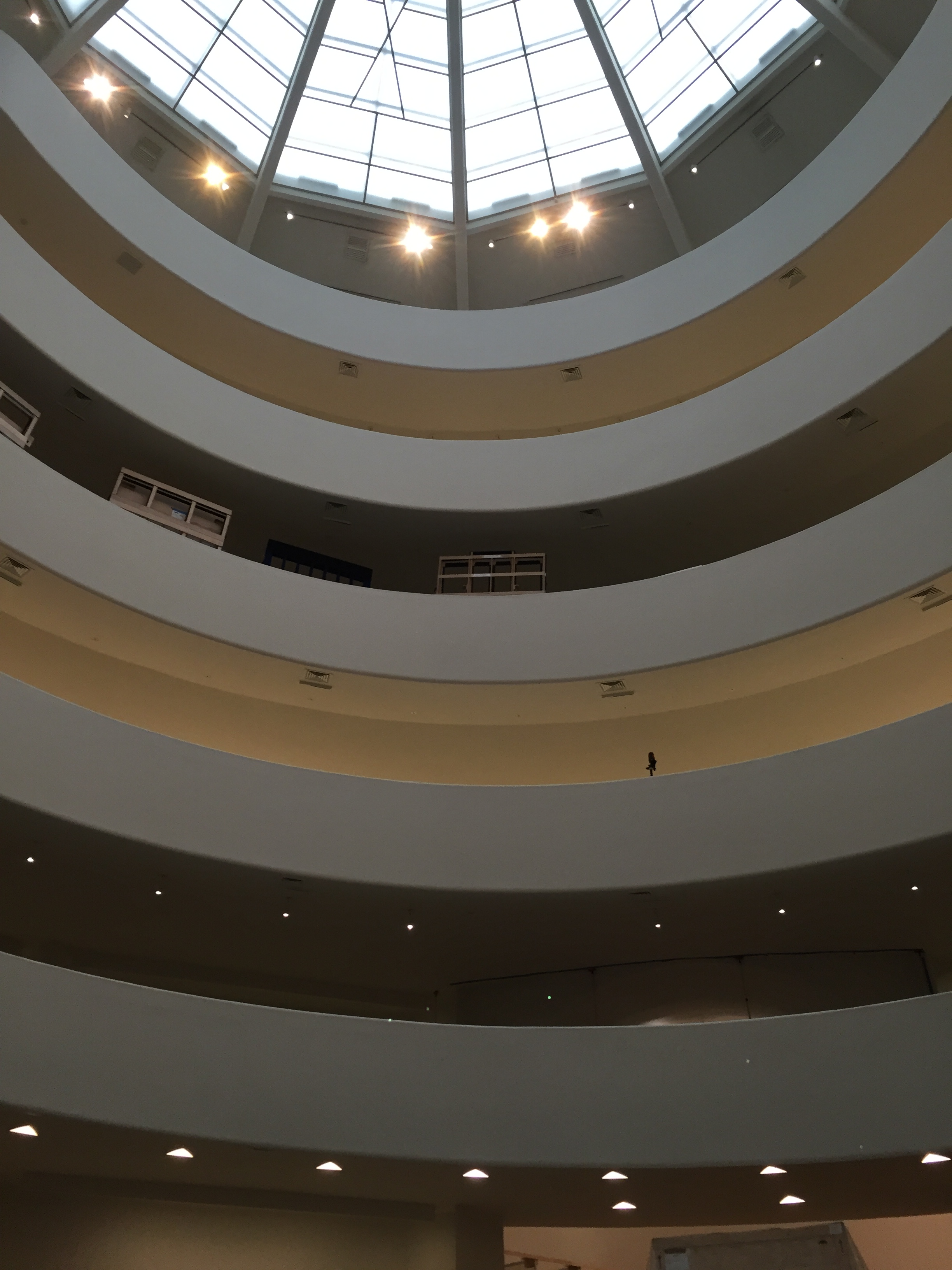
Earlier in the day, we took a short walk to the Guggenheim Museum to see a highly recommended Doris Salcedo exhibition. Doris is a courageous artist who asks questions about trauma caused by colonialism, racism, and social injustice in her native Colombia and other countries through her work.
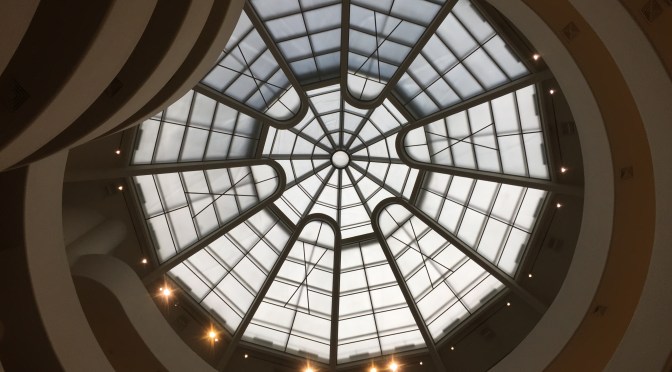
Interior Corkscrew
This museum was designed by Frank Lloyd Wright, ca. 1959.
Most of the museum was closed during an installation of an exhibition. You can read more about this controversial museum at the time it was being designed and constructed at http://www.guggenheim.org/new-york/about/frank-lloyd-wright-building
A Flor de Piel, 2014
Wooden Armoires with Concrete and Steel
Shirts
Silk Thread and Burnt Needles
1. A Flor de Piel, 2014: Based on a burial shroud, this fabric is an homage to a nurse who was tortured and murdered in Colombia.Its enormous undulating fabric is painstakingly stitched together from chemically preserved rose petals–a material replet with romantic associations that at the same time mimics the appearance of flayed skin.
2. Wooden Armoires with Concrete and Steel: Between 1989 and 2008, Salcedo created an expansive body of work forged from pieces of domestic furniture with concrete poured in them, as if to immobilize and be muted by grief. The furniture represents the families of those who have died and their silent mourning.
3. 11 Stacks of Shirts with Rebars evoke an image of violent incursion
4. Disremembered, 2014: Woven from strands of silk thread, these works take the form of garments that would harm rather than protect the wearer. The shimmering forms hover on the edge of visibility, in an expression of the artist’s interest in representing the experience of loss through the shifting lens of memory.
For more information, go to Doris Salcedo at guggenheim.org/Salcedo. (These descriptions are excerpts from the Doris Salcedo exhibition material at the Guggenheim)
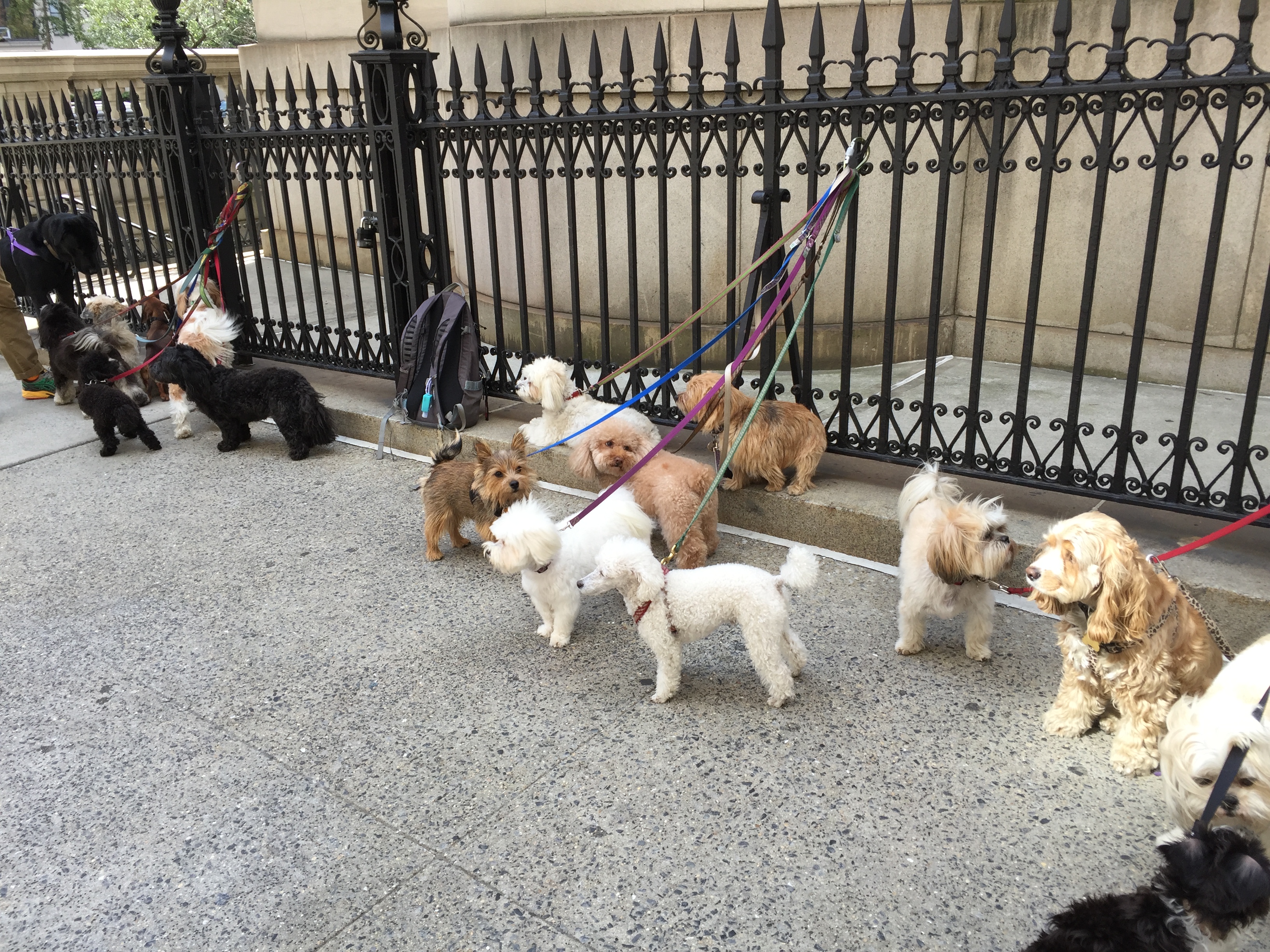
On our walk back, we passed the Doggie Day Care Parade.
Available for your visual pleasure Only in New York.
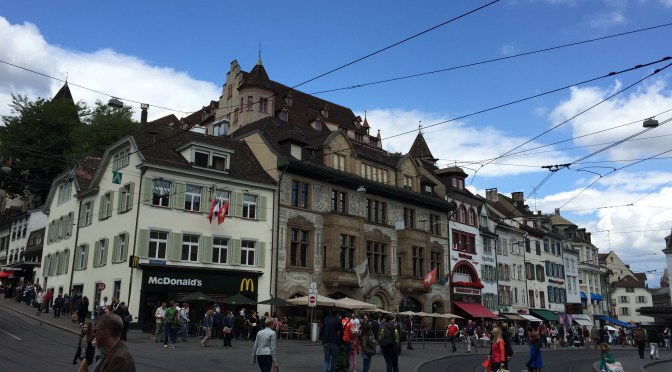
Three Walking Tours were available in the heart of the city and we decided to take the architectural tour. Many of the buildings in the city were designed by Herzog and Meuron. Basel has bragging rights to a number of world famous architects, including Zaha Hadid, Frank Gehry, Richard Meier, Tadao Ando and another of their own native sons, Mario Botta.
It’s interesting to note that both Botta and Herzog and De Meuron designed museums in San Francisco but are known in Switzerland for many other building types. The prevalence of American architects may be due to the development of the biotech industry in this area and its partnerships with American firms. Many of the buildings featured on the architectural guide were biotech companies such as Roche and Novartis.
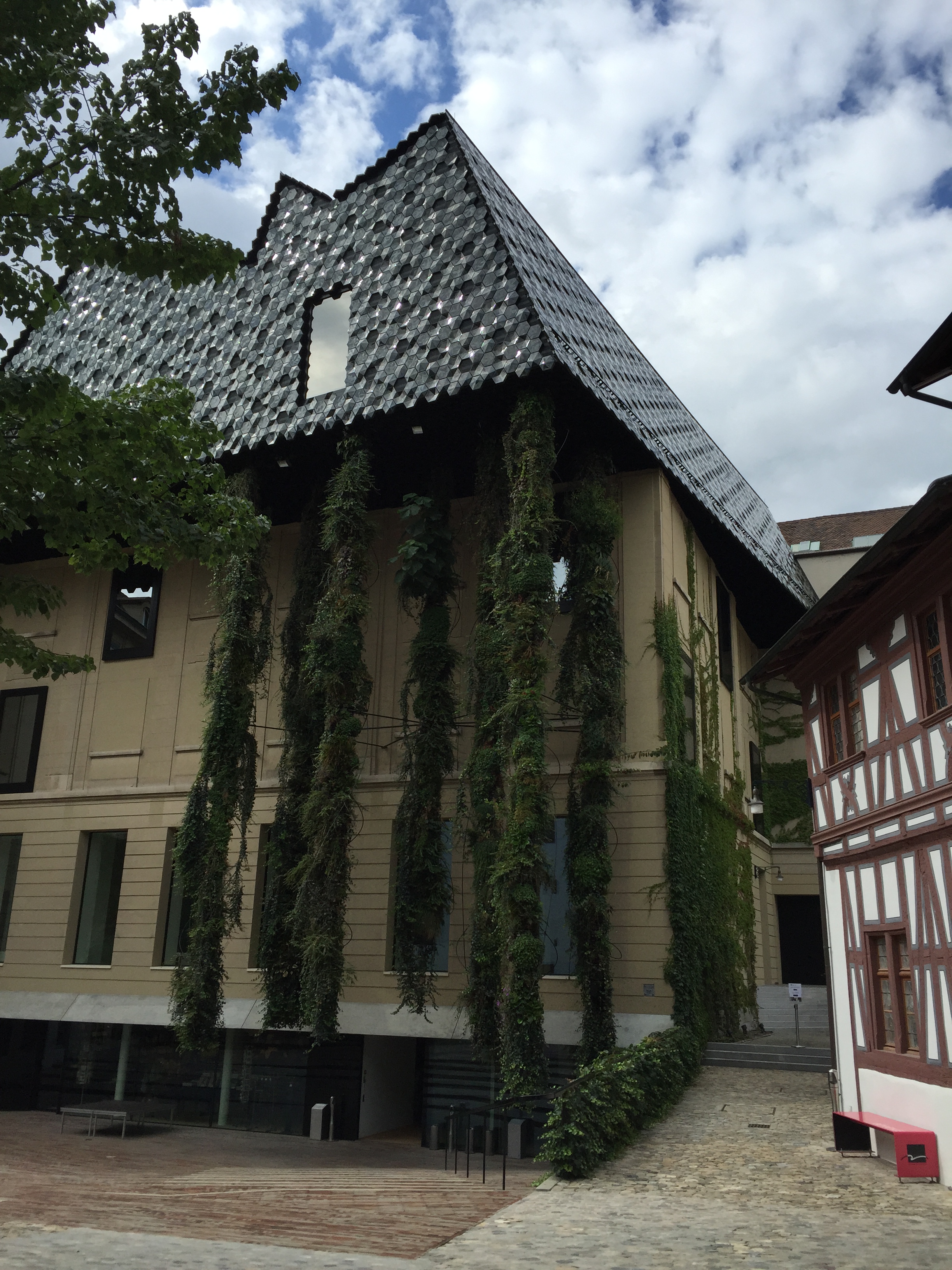
The vertical extension of Basel Museum of Culture was designed by Herzog and De Meuron. The textural pattern of hexagons reflected the irregular shape of the plaza facing the museum. They were in both convex and concave shapes. The giant hanging plants at the entrance reminded me of the seaweed forest at the Monterey Bay Aquarium, where they swayed gently in the breeze.
The De Young Museum in San Francisco, also designed by Herzog and De Meuron, is one of my favorite buildings. I love the mottling effect of the exterior copper panels on the inside of the building and how it imitates the light coming through trees in Golden Gate Park. The huge canopy at the entrance also reminds visitors of the deep shadows in the park.
The Basel museum featured an exhibit on opium that sparked a lively conversation with my hosts in Brunnen. My grandfather had died of an addiction to this deadly plant. The museum collection included all the history, plant production, implements and literary figures who were influenced by opium (including one of my relatives, Lin Biao). The saddest part of course was the Opium Wars and the treaty ports imposed on China as a result of the wars. The exhibition was very thought-provoking and a moving educational experience.
Swiss Cheese, Salad, and Potato for Raclette
Our final evening was topped by the famous Swiss specialty “Raclette”, a fondue-like dish of Swiss cheese toasted with onion and spices on a grill, then spread with a miniature wooden scraper onto the top of sliced potatoes.
After saying goodbye to my dear friends in Switzerland, I was looking forward to my next big adventure. I will be taking a German language and culture class for the next two weeks in Schwabisch Hall, Germany, and can’t wait to spread out my meager belongings during this time.
My friends Helena and Hans took good care of me and showed me a local’s view of Switzerland. I am very grateful to them for their generosity and appreciate their care and attention during my stay there.
This week I traveled across the beautiful country of Switzerland, from Brunnen on the shore of the Vierwaldstättersee near Lucerne to the French speaking area of Valais near Sion .
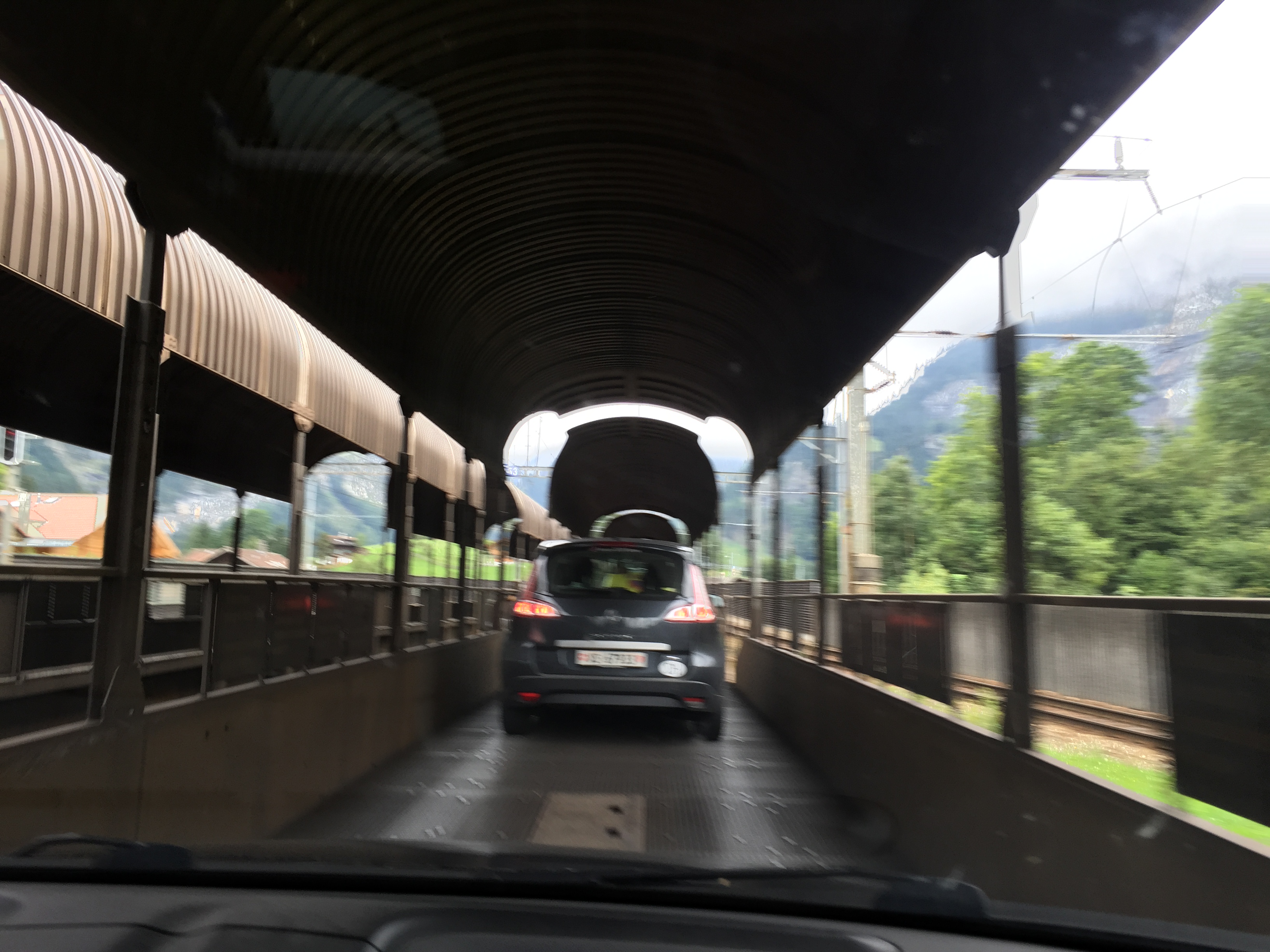
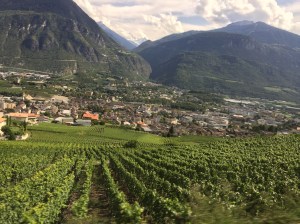
We took a car train through a deep tunnel in the mountains to the valley. Also known as Wallis in German, Valais is a serious wine growing region with a patchwork of vineyards etching the south-facing sides of the valley and flatter terraces of the north side. It was in the middle of the Autumn harvest, and the carpet of vineyards provided a lush green for the eyes and sheer pleasure for the palette. After a much appreciated day “at home” at my friend’s home built with straw walls for insulation, I met another friend who was working in the French speaking area. Marie had a friend visiting from Der Wolf in Belgium, and together we went to the medieval castle on the hilltop in Sion. Afterwards, we had a delicious lunch al fresco at Restaurant L’Enclos de Valère. Upon returning to Sierre, I took the bus back to where I was staying halfway up the hill from Sierre and near the resort area of Montana.
Marie with friends in Sion
Marie enjoying the castle view
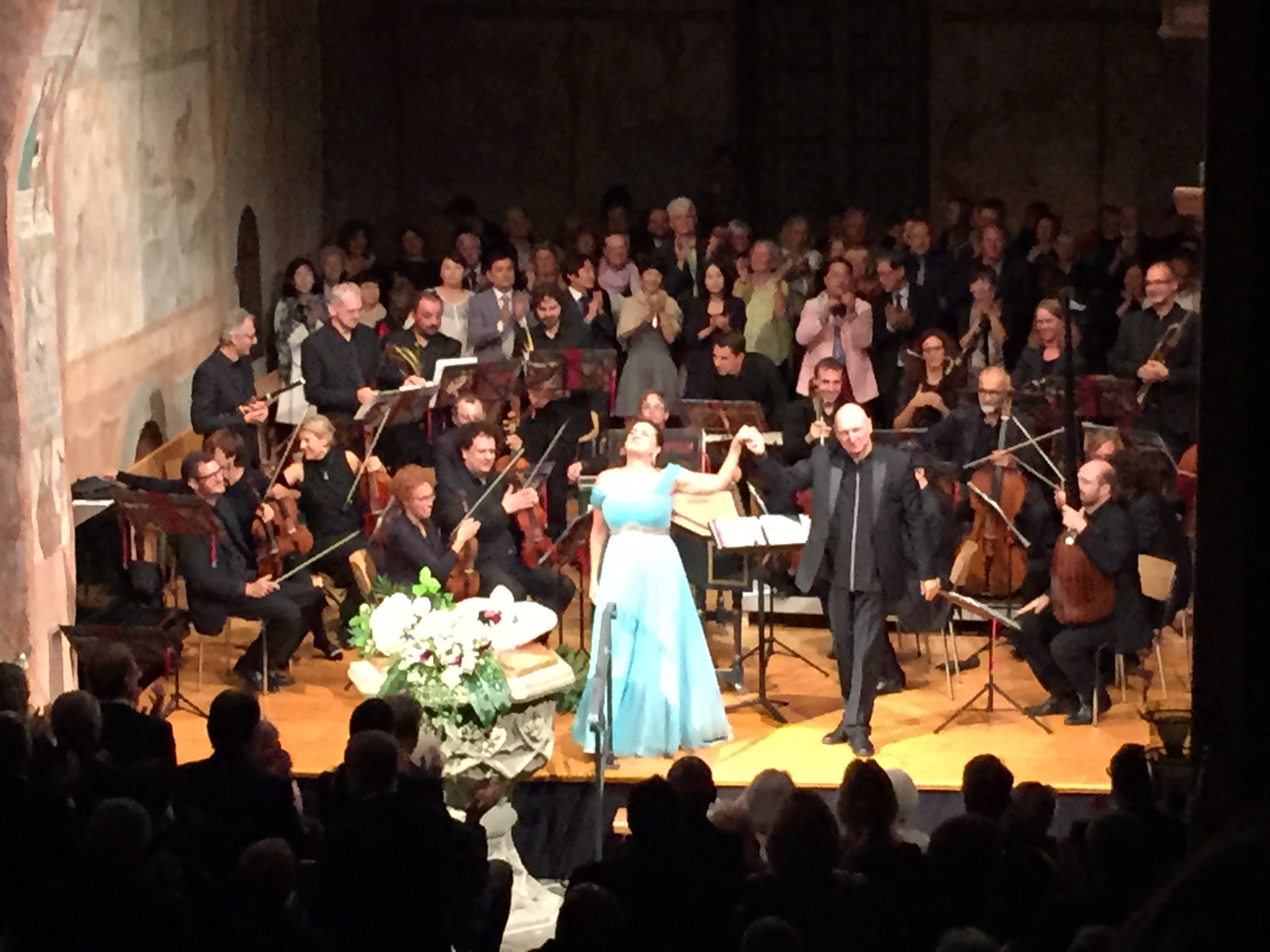
Later that evening, Hans, Helena and I attended a performance by world-famous opera diva Cecilia Bartoli in a small church in Gstaad. It was a two-hour ride by car to get there, but well worth the intimate venue and Cecilia’s delivery of beautiful baroque music by Vivaldi and others. It was performed by I Barocchisti, an orchestra specializing in this type of music, using original instruments from that period. Both Cecilia Bartoli and I Barocchisti performed in Iphigenie en Tauride, an opera I saw recently in Salzburg.
Time to reflect on St. Florian, the Augustinian monastery outside Linz, Austria, where I spent my last three days. At first it seemed very grim and austere, but by the time I left I felt the urge to return. It has its undeniable charm, and the offerings in the area were far beyond my expectations. The biggest draw, although I did not do it, was the Bruckner Weg, or Symphonie Weg. I described it earlier, but it’s hard to describe how excited I was by it. It combines my love of walking and music!
It’s a great way to learn about the music of a composer who was so dedicated to organ music, he wanted to be buried under the church of St. Florian. And indeed, here’s a picture of his crypt in the basement!
I was able to discover this grand old monastery and its historical treasures that are now under appreciated and forgotten. The library holds over 140,000 volumes and about 4,000 are original books before the printing press was invented.
Other treasures were the performances in the cathedral itself. I took many videos of the two daily performances and the mass at six jsut to record the music. I guess it wasn’t really a mass because the monks all came out and chanted for about 20 minutes and there was very little audience participation. I got really curious about the Augustinians. Here’s a description if what I read in Wikipedia:
The interesting part was about their psyche. It indicated that monks were high on the masculine scale but also had a very high preponderance towards female qualities of neuroticism and detail. Wow. What a combination. I wondered if I was material for monkhood??
In any event, that minor piece of information got me to thinking what could have motivated these men to join the order. I was surprised to learn that Martin Luther was an Augustinian before he protested against the Catholic order and the papal Bulls. Eventually, he got married.☺️
Others like him must have suffered some hardship or divine inspiration. The Augustinians also have hermits too, so their monastery is a perfect place to try out the lifestyle. I wondered how Herman’s Hermits picked their name.
As the monks left the cathedral, I couldn’t help but study each face. Hmm, older, tall, and pretty handsome for their age. Is that where all the men have gone? I’m searching for my single lady friends.
It all starts to come together. All the glorious trimmings at the expense of the people. But it was interesting to see the development of the environment and understand the conflicts that were subsequently caused by it.
Here are some more views:
Main Hall for Receptions
Elegant Place Settings
Ceiling for the Bored
Confessional Rooms
cellar sculptures
Christians found on site
I mentioned some of the wonderful paths and “wanderings” available throughout Austria and Germany earlier. Switzerland probably has an awesome offering, but I haven’t heard about them yet. Although I was unable to do Jacob’s Way to Santiago de Compostela (my 19 days were already numbered), the Bruckner Way or the Symphonie Way (the museum at the far end was closed for the month of August), I took a short walk a mile away to the Hohenbrunn Schloss. It was blazing saddles, so I had to shade-spot along the path. Before arriving, I stopped to enjoy looking back at St. Florian in the distance beyond the road (pictured in the header).
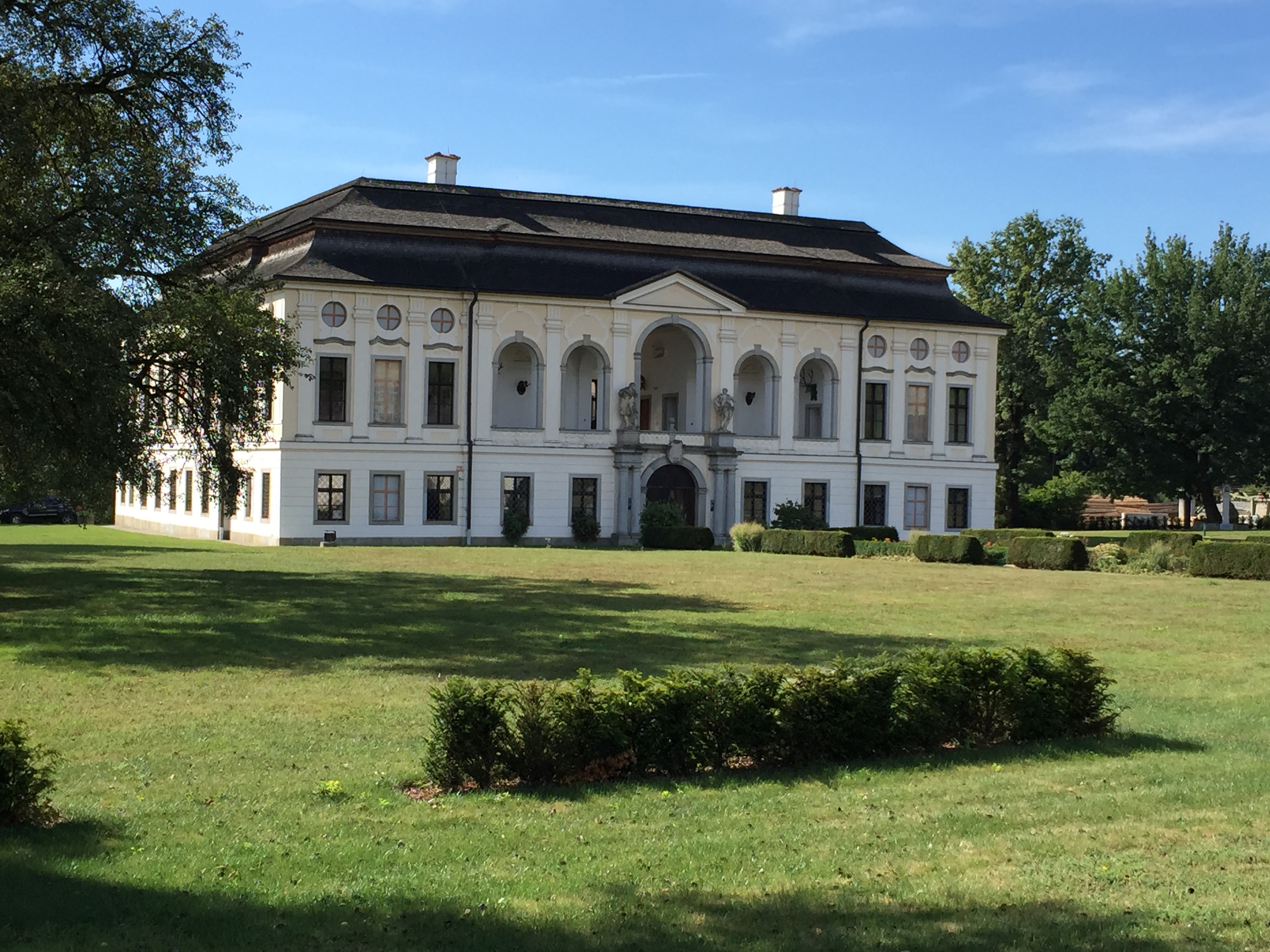
Hohenbrunn, shown below, is some version of a hunting lodge built between 1722 and 1732. No one was there except me, and for a few quid I could see the entire place to myself, unaccompanied. At first it seemed a little creepy, as it felt like someone had just occupied it and left the water running somewhere. And all those guns. The one I took the picture of was one-of-a-kind. It actually is used for shooting ducks on a boat, so the boat supports the long barrel. I’ve captioned a few of the other photos that struck my fancy as I pranced through.
Front of House
Security System
Family Tree
Woodstock in the Back
The up close and personal with the animals got a little weird. They all seemed to be having Gary Larson conversations with each other, wondering where all the human pets had disappeared to. I felt like Ben Stiller in “A Night at the Museum.”
I told them there wasn’t enough room!
Grr! If you don’t watch out you’ll end up like me!
We need wi-fi here!!!
No, save the fat kid for Sunday Dinner!”
I know I just saw him…
Despite my digs at the culture in and around St. Florian, it was really pretty sweet. It took a bit of courage and good faith to come here on my own, but I stayed in contact with my support staff. I am nearly half way through my journey, and as many of you know it is not about the destinations but the process of getting there.
At times I wondered what I was doing. When I finally played my on-line music appreciation class that I brought along with me, I realized that this is real-time learning. I can hear and relate to music that is being performed. I ironically was at the point of learning about “Baroque” as in Bach vs. “Classical” music by Beethoven. That was awesome!
I hope I can convince any of you to come back with me to St. Florian. The surrounding area is luscious and vibrant, and you feel the freedom to explore at your own pace. It’s heavenly to hear the organ and Bruckner here. And yes, I am a little sad to leave.
Featured photo at top: Hoenbrunn Schloss, in St. Florian near Linz, Austria
As a contrast to my onslaught of cultural cities, I decided to take a different path and stay at a monastery in Linz, Austria.
First Arrival View of St. Florian
Organ Performance at St. Florian Church
My first glimpse of the monastery was breathtaking, after a short but determined path uphill through a winding path. The landscape in the area is exquisite, with rolling hills and tenderly groomed patches of yellow and green plots. You would never leave here if you were from this area, I thought.
The monastery has rooms for visitors at a reasonable price, and has daily performances of one of the most magnificent organs in Europe. The highlight will be another (gulp) mass in the evening with an organ performance.
Anton Bruckner, who was an organist and composer, is a native son of the area. There is now a connection between Ansfelden, where Bruckner was born, and the Augustinian cathedral at St. Florian, where he was a choir boy. You can read about him: https://en.m.wikipedia.org/wiki/Anton_Bruckner
A billboard advertising the Bruckner Way is located on a path outside the monastery. It lights up each path you select among several different paths. You can view the Google image below. “Wanderers” can choose from the more mild “running shoes” paths and those for more advanced “hikers”. Trips run any where from 5-20 km.
The walk even has an MP3 player for hire that has all 12 Bruckner symphonies on it, so you can listen to it while you are on the trail. You can also arrange for a taxi to take you back if you only want to do a one-way trip. I thought that this was an excellent idea and wished this system that is available throughout Europe were established in the U.S.
Route along Bruckner Weg
Patchwork Landscape
Billboard with Path Options
This path forms part of the “Jacob’s Way” and leads a pedestrian all the way to Santiago de Compostela in Spain. I googled it and you can do it in a mere 19 days from here. If you “boots are made for walking” here’s a place to use them.
This walk was one I had always contemplated, until I realized why they advised carrying a poncho.
1. In and around Vienna: St. Stephen’s Cathedral and Plaza area (also featured image), and a street scene near Mozart’s House in Vienna. Notice the wide contrast in architectural styles, right in the cultural center of the city.
St. Stephen’s from the side
Interior of St. Stephens
Side Street to Mozart’s House in Vienna
2. The Albertina and a collection of Modern Art from Carl Djerassi
These are only a few of the works I liked in particular, from his extensive collection that include Lichtenstein, Warhol, Gerhard Richter, and Klee.
3. The Vienna Opera House: from an evening of Mozart music.
Now, after three “variety shows” of operatic music and concert pieces featuring Mozart and Strauss, I can hear the difference. Strauss added alot of drums and brass but also contrasted these boomers with sweet melodies. They are a crowd pleaser and I admit I became mesmerized by the rhythm and tunes. Unfortunately, the opera is closed in August so there are no regular performances. If you come in August you are stuck with the tourist track.













 After a much appreciated day “at home” at my friend’s home built with straw walls for insulation, I met another friend who was working in the French speaking area. Marie had a friend visiting from Der Wolf in Belgium, and together we went to the medieval castle on the hilltop in Sion. Afterwards, we had a delicious lunch al fresco at Restaurant L’Enclos de Valère. Upon returning to Sierre, I took the bus back to where I was staying halfway up the hill from Sierre and near the resort area of Montana.






 travelswithmyselfandothers.com