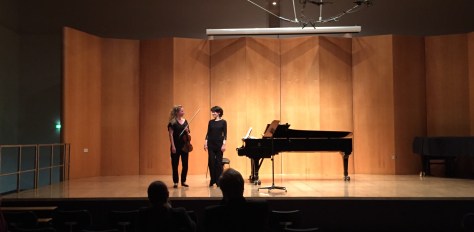
Weimar was once the hub of intellectual and political life in Germany. It still captures much of the imagination of aspiring writers, musicians, architects and playwrights. On my return visit to the Musikhochschule (High School for Music) last night, I savored an array of passionate violin student performances.
Stumbling into the National Library in Vienna last year was a thrilling experience. Naturally, I was curious to compare the Anna Amalia, a research library in Weimar for German literature from the Enlightenment to the late Romantic Period. While much smaller, this Rococo design was equally exciting, but more intimate.
Goethe dictating to his secretary
Bust of Schiller
Duke Friedrich
You can watch a video of the library here:
The next stop on a day-long tour of local sights was the former residence of the Grand Duchy of Saxony-Weimar-Eisenach. Known as the Weimar City Castle, it now houses a collection of Cranachs, German Impressionists, and painters from the Weinar Art School.
If there ever were a sacred place of pilgrimage for me, it would be the Bauhaus in Weimar. Created by Walter Gropius around 1921, this school combined the best of internationally recognized artists with master craftsmen in Germany. The school was intended to teach design and architecture rather than fine art. The artists taught form, shape, and color, and the craftsmen trained students to technically perfect their designs and products.
In the following photographs and explanations from the exhibit, you will get a sense of the development of graphic design and architecture that still feels applicable and relevant today. These photos are just a small sampling of the my favorite exhibits. A new museum is planned in the future.
Free Play created by Alma Siedhoff-Buscher, 1899-1944
On our last day in Berlin, we started the morning with breakfast at the Coffee House for Literature. Located in a pre-war building on Fasanstrasse just south of the Zoological Garden stop and near the Uhlanstrasses Metro Station, this famous coffee house rivalled that of the Cafe Einstein in Kurfürstendam, where writers, poets and intellectuals gathered over addictive coffee. We ventured into one of the Berlin galleries listed in Art Forum, but the exhibition was very tiny and not as fruitful as our visit to another recommendation at Kunstraum Kreuzberg on Marienplatz earlier in the week.
We made it just in time to Potsdamer Platz to attend a free noontime concert at the Berlin Philharmonic Concert Hall. The symphony was not performing due to the holiday schedule. Instead, we were able to listen to a short Mozart chamber music performance. On the program, parents are reminded that lunchtime concerts are not aimed explicitly at children, and therefore should only bring children who are able to remain “quietly seated for approximately 45 minutes”. That seemed very reasonable and successful as a message.
Lucas Cranach, Der Jungbrunnen, 1546
Brueghel, Die Kreuztragung, 1606
Hals, Malle Babbe, 1633/35
Vermeer, Young Lady with a Pearl Hairband
Vermeer, the Wine Glass, c. 1661/62
We battled the elements during most of our short visit to Germany and Holland, and this day was no exception. We decided to take a short walk to the Culture Forum, where the Gemälde Gallery of the Staatliche Museum of Berlin is located. It is a huge repository of art and it held major exhibitions on the Botticelli Renaissance and Albrecht Durer. Surprisingly, we found more Vermeers, Bosches, Brueghels, and Rembrandts here than those in the Rijksmuseum. We realized that the Dutch Masters were scattered throughout Europe and that the paintings by native sons were not necessarily displayed in their host countries.
John Ruskin, after Botticelli
Ingres, after Botticelli
Degas, after Botticelli
Willam Morris, after Botticelli
The Botticelli exhibition compared many other artists’ work that emulated the classical Botticelli Venus. She served as a model and inspiration for many other artists, from Neo-Classicists such as Ingres to Elsa Schiaparelli, a dress designer. For me, I found the latter day 19th Century renditions by John Ruskin and William Morris, early leaders of the Arts and Crafts Movement in England, the most interesting. You can see the rich textures of the Morris tapestry already creating the signature pattern that later became so famous in the Liberty of London wall coverings.
I found myself particularly attracted to exhibitions that compare and contrast two different artists’ work. They seem to provide a lesson in comparative world history and painting that I otherwise wouldn’t discover. I am also becoming more comfortable with and more whetted to art museums as a cultural and intellectual experience. I have an opportunity to learn history in a visual way that is easy and interesting for me. The excellent curating and wealth of material certainly enhance these comparisons in the few museums we visited on this trip.
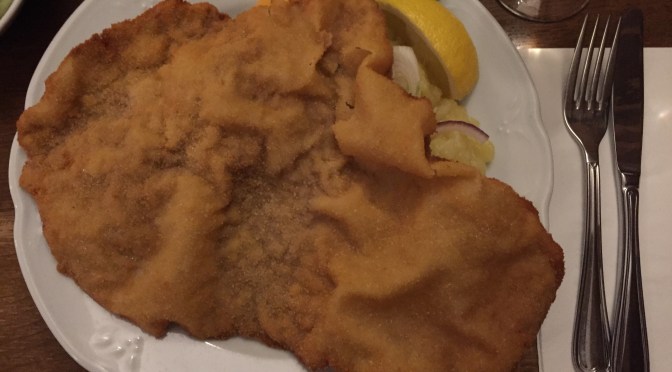
By the end of the day, we were pretty wiped. Nevertheless, my professional food guide was relentless and targeted a German restaurant as gesture to my insatiable appetite for things German for the finale. Sadly, it was closed for the holiday cleaning! We went to the next best, an Austrian restaurant famed for its Wiener Schnitzel. If you look closely at the photo above, you will notice that the regular fork looks out of scale with the schnitzel on the plate. That’s because the schnitzel was super-sized!
The day before, we beat it back from Amsterdam to hit a local Kreuzberg Turkish restaurant.
Apologies for the delay in this final Berlin post. I will be upgrading my site to continue posting the next trip, but have most likely reached the cap for free webhosting after two years with this posting! Stay tuned for the 2016 upgraded version…
…for now, we are sad to leave this vibrant and exciting city on the move. Until next time…Tschuss!! VV.
PS: Happy Martin Luther King, Jr. Holiday from Bodega Bay!!
Today’s major events included a performance at the Concertgebouw of Handel’s Water Music by the Berlin Alte Musik Orchestre. The instruments included a harpsichord, lute, and old horns and wooden flutes from the time when the music was created.
Fortunately we sat in the front row for 20 Euros and could hear the delicate instruments while observing the performers on the podium six feet above us and from the feet up! It was very enjoyable and worthwhile to share some of my musical interest with my daughter at a precious point in time.
Our main activity was tackling the Rijksmuseum. Despite our assumption that many Bosch, Breughels and other Dutch masters would be there, there were only a few Rembrandts, Vermeers, and a smattering of landscape painters.
See above, from top left to right:
Vermeer, Woman with a Love Letter
Peter de Hooch, Woman with Child in a Pantry, c. 1656-1660
Rembrandt, Selfie
Rembrandt, the Night Watch
Van Everdingen, Young Woman Warming her Hands, c. 1644-1648
Chinese Porcelains
The day before we drove through Antwerp, a city that was occupied by the Spanish in the 17th Century, to Gent. Melissa worked at De Superette last year doing a stage and learned how to bake bread. The photos show the head baker putting the bread in the molds that Melissa also used to learn bread making.
See below:
1. De Superette Exteriors
2, 3, 4. De Superette Interiors
Below,
5. Bakery Entrance
6,7. Foam Potatoes, pulled pork, and poached egg with marinated shaved mushroom
8. Daughter Melissa, with head chef Rose and Head Baker Biggie
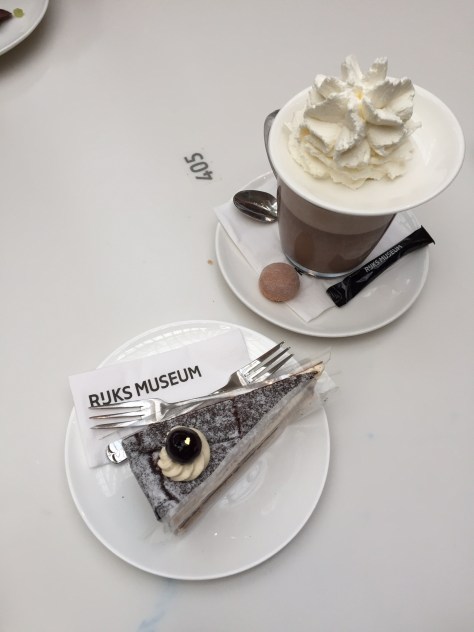
At the end of the day today, we enjoyed signature Dutch hot chocolate and cerise torte at the Rijksmuseum Cafe after a long and productive venture.
Note: we’re heading to Berlin tomorrow, see you there!
As part of our Thelma and Louise descent on N. Europe in the dead of winter, Melissa and I drove through wind, sleet and snow (no hail) to reach Amsterdam. To an art history major like Melissa, this city is the museum capital of the world. The thought of tackling the Van Gogh, Rijksmuseum, Stedelijk, and Hermitage museums in one visit is daunting enough to send you to dreamland or the loo. (More about that later)
In any event, I had plenty on my mind. Our first major stop today was the Van Gogh Museum.
We were lucky enough to descend on a major exhibition between Edvard Munch and Van Gogh. The curators had a field day placing each major Van Gogh next to a relevant Munch and comparing them. The artists’ styles vary greatly but their humanism and emotionally charged social commentary were consistently similar.
Borrowed from the Museum in Oslo, the Munch collection was vast. It saved a trip to Oslo in this exhibit alone, but the two artists’ work side by side was overwhelming.
The painting itself was described as a sudden turning of the sky to blood orange. The subject was reacting to the scream caused by the sky and by putting his hands to his face. He was not the creator of the scream, as most of us would think, but it also has that effect.
Van Gogh had a completely different version of a similar setting. (See below, an example of the comparisons and contrasts between these two famous painters’ work).
Van Gogh scene adjacent to Munch’s Scream
Aside from following intricate comparisons, I was having my own wonderings. Did Klimt borrow the Kiss from Munch? Munch’s piece, also entitled the Kiss, comes from 1902, followed by Klimt’s piece around 1908. What’s your guess?
The Kiss by Munch
The Kiss by Klimt
The deep dark leaves depicted by Van Gogh reminded me of one of Melissa’s paintings. Similar in color and cool density, the leaves seemed to reflect the mood and style of Van Gogh’s masterpiece!
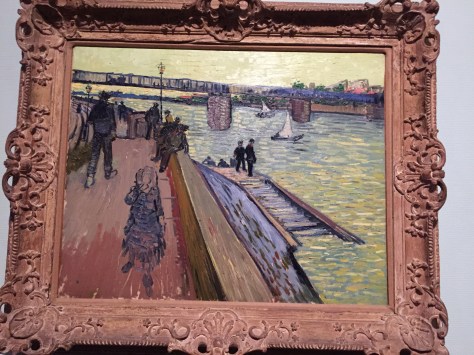
Another jog in my now cluttered memory bank was the recent Asian Art Museum exhibition of Western art influenced by Japanese artists. The Van Gogh Museum version contained a room with a Van Gogh painting juxtaposed next to Hiroshige’s bridge. Very similar to the recent Asian Art Museum exhibition. Hmm, not bad for making connections…one of my favorite pastimes.
The takeaway from this museum is the vastness of Van Gogh’s efforts to learn and do art. His strokes convey his internal struggle to communicate and reach the viewer. His subjects command awareness and commitment. His peasant families, landscapes and simplicity in living demonstrate his earnestness and conversion from living a bourgeois life (his father was a pastor and his brother a successful art dealer) to becoming an active conveyor of life and living. Here’s one guy who made his avocation his profession!
You can read more about the exhibition here:
And now about the loo. Grubby hubby Gee Kin gets museum sickness whenever we spend too much time browsing and pausing in museums. Initially, he made a dive into the men’s room after about twenty minutes of forking over his hefty share of the entrance fee. Slowly, he is overcoming his immun-deficiency and increasing his brain mass (not tolerance) for visual institutions and the intellectual challenges they offer. After a successful visit to the Hermitage in St. Petersburg last summer, he can proudly claim that he is in remission.
Sadly, I discovered a device at the Van Gogh today that might have saved Gee Kin his misery. It’s known as a Stendhal box.
Developed for museum goers in ecstasy, this chair with a shroud around it (there’s a wooden door to cover your view after you sit inside) can help you to decompress at the end of a raptured experience at the museum! While some may believe this to be comic relief, the confessional certainly could have treated Gee Kin with a refuge from torture and spared him another trip to the loo.
Our fruitful day ended with dinner at De Kas, located on a lake in town. The greenhouse and lab environment was an unusual setting to showcase its hydroponic food production that short-circuits farm to table in an entertaining and palatable way. The single menu included vegetable forward and crunchy appetizers, mushroom consommé, field fowl, and cheese plate or tarte tatin for dessert.
OK, this was an unplanned visit to my favorite adopted country. My daughter Melissa is between jobs and after contemplating Morocco or Mexico City, we agreed that Berlin was not a bad option for interesting food, art and culture.
Our first of two weeks revolved around a number of upcoming new restaurants, galleries that are open over the holiday break, and special performances.
After stalking many of Europe’s best venues, I learned that there are impresarios who descend on famous sites such as the Berlin Philharmonic. When the orchestra is off, they lease the facilities. Many of the promotions cater to local tourists from France, Italy and Eastern Europe.
The usual Swan Lake, Mozart masterpieces, and Strauss waltzes are offered, but are not part of the regular program. While we did partake in a Russian ballet company performance, it takes a bit of close navigation to understand who is producing what and when.
Nevertheless, we enjoyed seeing a bit of traditional ballet contrasted with a modern version by Duarto/Kylian, two contemporary choreographers. The latter audience was much younger and local, while the former was stocked with a mostly tourist audience.
There are museums and galleries galore here, probably too numerous to count. For that, Berlin beats Mexico City hands down. We tackled the Pergamon earlier over the weekend with friend Vladimir from Meissen with some difficulty, as the Museum Island is still being renovated and access to each museum is limited.
Yesterday we covered art galleries in the Prenzlauer and Kreuzberg areas that included the Institute for Contemporary Art and the Kunstraum Kreuzberg. Old schoolhouses have been repurposed for gallery use as well as after school music and arts programs. A decent cafe in each allows visitors to enjoy the environment while warming up to the cold chill (and now snow) outside.
The Kennedy clan are well known to Berliners, almost more than to Americans. Aside from JFK’s famous quote, he was known to protect West Berlin from succumbing to the Communists in East Berlin. A small but significant historical detail.
The Xmas Markets were fun to explore and finally experience. The “gluhwein” tastes better than it sounds, and is merely what we call mulled wine. And the stollen or Xmas cake leaves a bit to be desired, particularly when traveling with a pastry chef.
The hip new food fare here, however, has been delightfully innovative, inexpensive, and thoughtful. While not always successful (veggies a bit on the raw side), the intent on making food healthy, delicious and beautifully pleasing to the eye is very evident. While not a foodie myself, I am swept up by the company I am keeping. Traveling with one can cause you to get into the picture pretty fast. Take a look at some of the plates: my favorite was the avocado and red beets on toast. Easy enough to make me want to make it as soon as I return home..
For the wannaknows, we hit Lokal, Industry Standard, and Horvath.
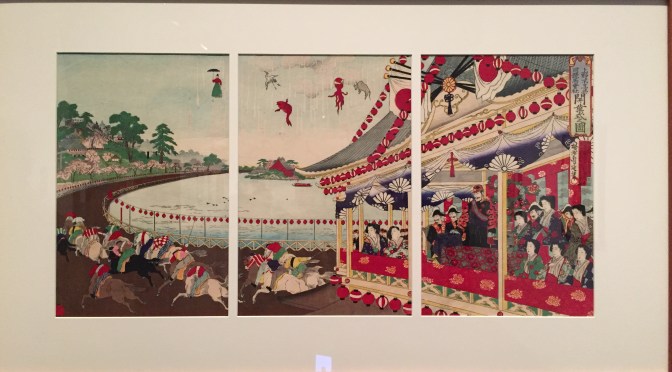
In a current exhibition at the Asian Art Museum, you can view some interesting comparative paintings between the Hiroshige woodblock prints and famous Impressionists like Van Gogh, Matisse, and Monet. Europeans were fascinated by Japanese artists and emulated these new discoveries. While the pieces by well-known Western painters are limited in number, the exhibition certainly provided a good case for the Japanese inspiration from which the Europeans drew.
Hiroshige Woodblock
Female Princess Character
Japanese Box
Many of the wood blocks by Hiroshige, although small scale and delicate, had very intriguing themes. At the upper left photo, the woodblock depicts a lively scene with trees swaying in the wind and someone chasing after his hat. This scene is one of a series of woodblocks that recorded towns and villages between two major cities. Each one was unique so villagers could distinguish their town from others.
The close-ups close to the picture plane of portraits were also imitated by Westerners eager to draw from sources little known at the time. See the portrait of a Japanese Female Princess character in middle photo above. Japanese decorative arts were also widely copied and emulated, as seen in the photo, above right. While imitation is the greatest form of flattery, I wondered what the Japanese artists thought of Westerners’ borrowing of original ideas. There certainly weren’t copyright infringement laws in place at the time, so it was anyone’s game.
Regardless of the historical backdrop and lingering questions, the exhibition was very enlightening and presented much food for thought. Here are a few comparisons, that show the early precedents of Japanese art followed by paintings of Western artists:
Japanese Warrior Character
Van Gogh
Japanese Bridge Scene
Bridge from Monet’s Garden
Lower Scene showing haystack
Van Gogh’s Haystacks
Japanese Mother and Child
Under the Chestnut Tree by Mary Cassatt
Both the Jugenstijl movement (see my post on Mucha in Prague from May, 2015) and the Art Nouveau style in Europe (see St. Petersburg posts in September 2015), as well as the Arts and Crafts Movement in England, were heavily influenced by Japanese prints and decorative arts. Similarly, Frank Lloyd Wright was heavily affected by Japanese design (see FLW in Chicago post, October 2015).
See the inspiration for the graphic designs for Tiffany and other poster art here:
Note: My apologies for not recording the titles or names of the Japanese pieces. While many of the woodblocks in the exhibition were attributed to Hiroshige, there may be other artists whose names I did not note.
For a video on the Goethe Institute at Schwäbisch Hall, where I took a German class for two weeks on language and culture, see here:
On an early morning walk, I was amazed at the amount of abundant sculpture and outdoor art in this small, aesthetic town. Landscaping, architectural elements, and artwork were integrated to give a deep sense and appreciation of the arts.
Throughout residential and commercial neighborhoods, you can find extensive use of the old adobe mud brick and plaster walls. They provide a consistent look and a unique quality to Santa Fe. The sense of time and place are established by this pattern. Newer walls surrounding buildings have a timeless quality, with updated elastomeric coatings that expand and contract with extreme weather conditions.
Decorated entryway Rooftop
Adobe walls typical in all areas
Low Curved walls surround old and new buildings
The wealth of galleries and museums are easily accessible within the city. The Georgia O’Keefe museum was just around the corner from our hotel. Although I am not a fan of her work, I learned to appreciate the life of O’Keefe and the meaning behind her work. She led an avant-garde lifestyle with her husband and photographer Albert Stieglitz in New York before settling in New Mexico.
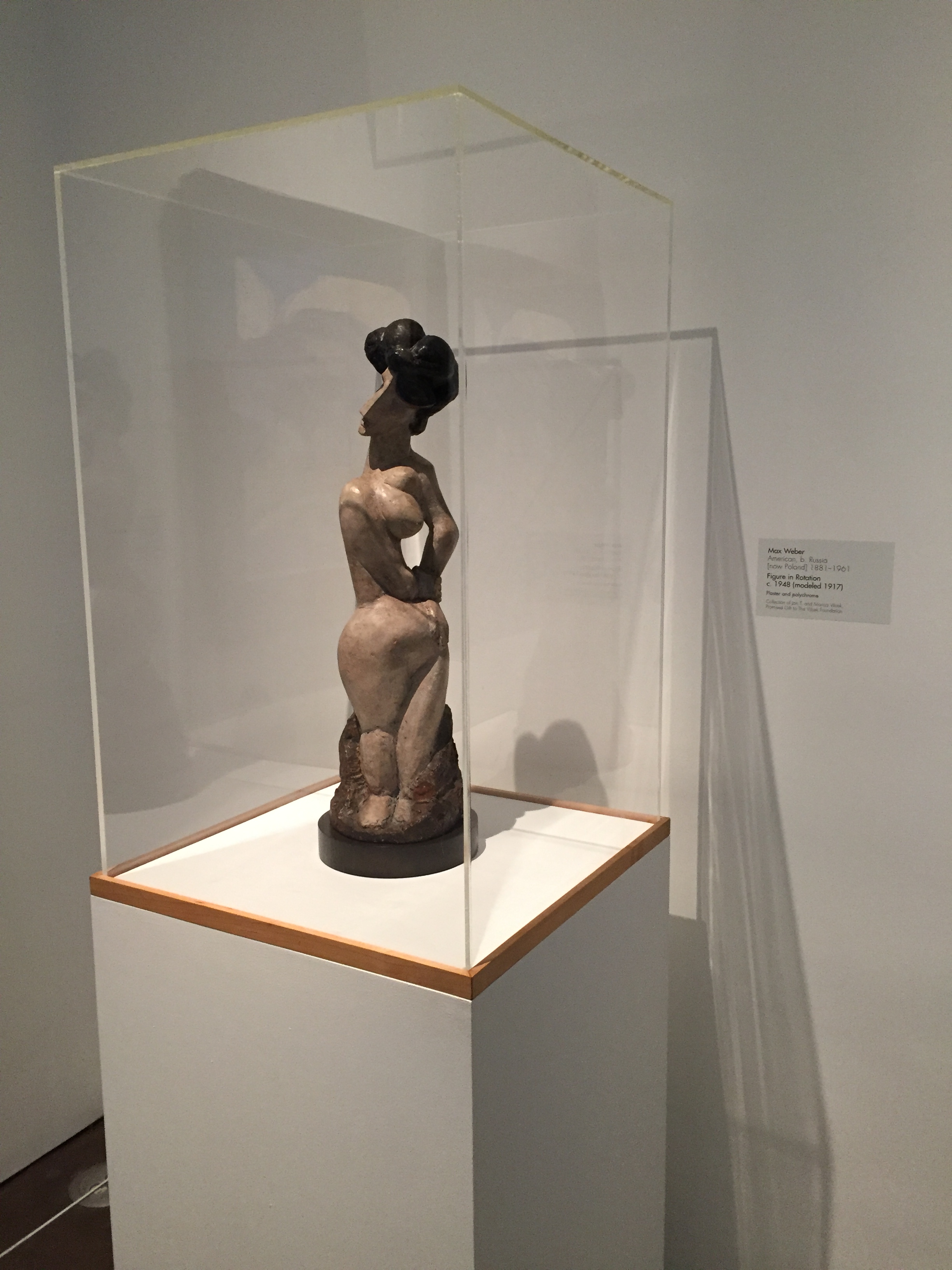
My favorite piece from the museum was a cubist sculpture by Max Weber entitled: Figure in Rotation (1948)
Later in the day we visited a collection of museums and galleries. The new Museum Hill area housed the Museum of International Folk Arts, the Museum of Indian Arts and Culture, and the Anthropology Laboratory. It is only a couple of miles from the Plaza and accessible by bus.
We visited a couple of galleries along the Canyon Road area. I was trying to track down an old friend from school who is now a famous jewelry designer in New Mexico. We were able to find a gallery that exhibited her work and were impressed with the quality of the pieces using precious stones in modern settings. You can read about her in Wikipedia at https://en.wikipedia.org/wiki/Gail_Bird_and_Yazzie_Johnson
The next day, we visited Bandelier National Monument, where some of the Ancestral Pueblo Indians settled. Known as Frijoles Creek and Canyon, this area along the Rio Grande leads to the Alcove House, where we climbed up 140′ by ladder to see the cave dwellings. The pink rock is composed of volcanic ash that formed into a crumbly rock known as tuff. This material creates pits and can be carved into larger openings.
The Chicago Cultural Center (formerly the Chicago Public Library) is currently hosting the Architectural Biennale. Modeled after the Venice Biennale for art, it showcases creative architectural ideas and structures submitted by many countries. Programs will continue throughout the season until the end of the year. I would highly encourage anyone interested in architecture to visit Chicago this year.
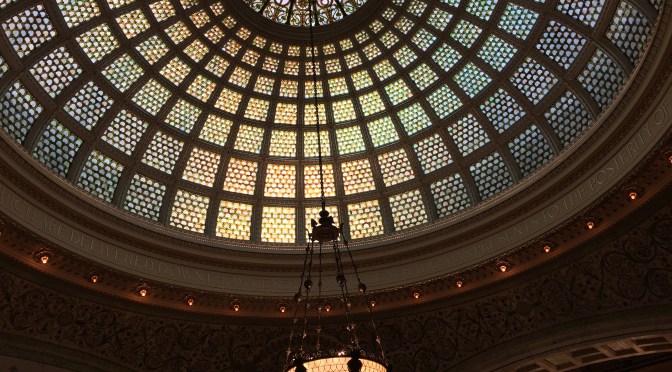
A free noontime concert enticed me to spend an hour at one of the magnificent exhibition rooms that house one of the most beautiful domes in the world.
Dome
Quote in Tile
Mosaic Tile at Entry
Dome
The Biennale hosted many interesting exhibitions, but one we specifically went to see was on workplace design. See the model of different ways to sit, stand, and work in the cutouts and the video screen shot below:
Sitting and Standing options
Sitting and Standing options
Irregular Planes-Video
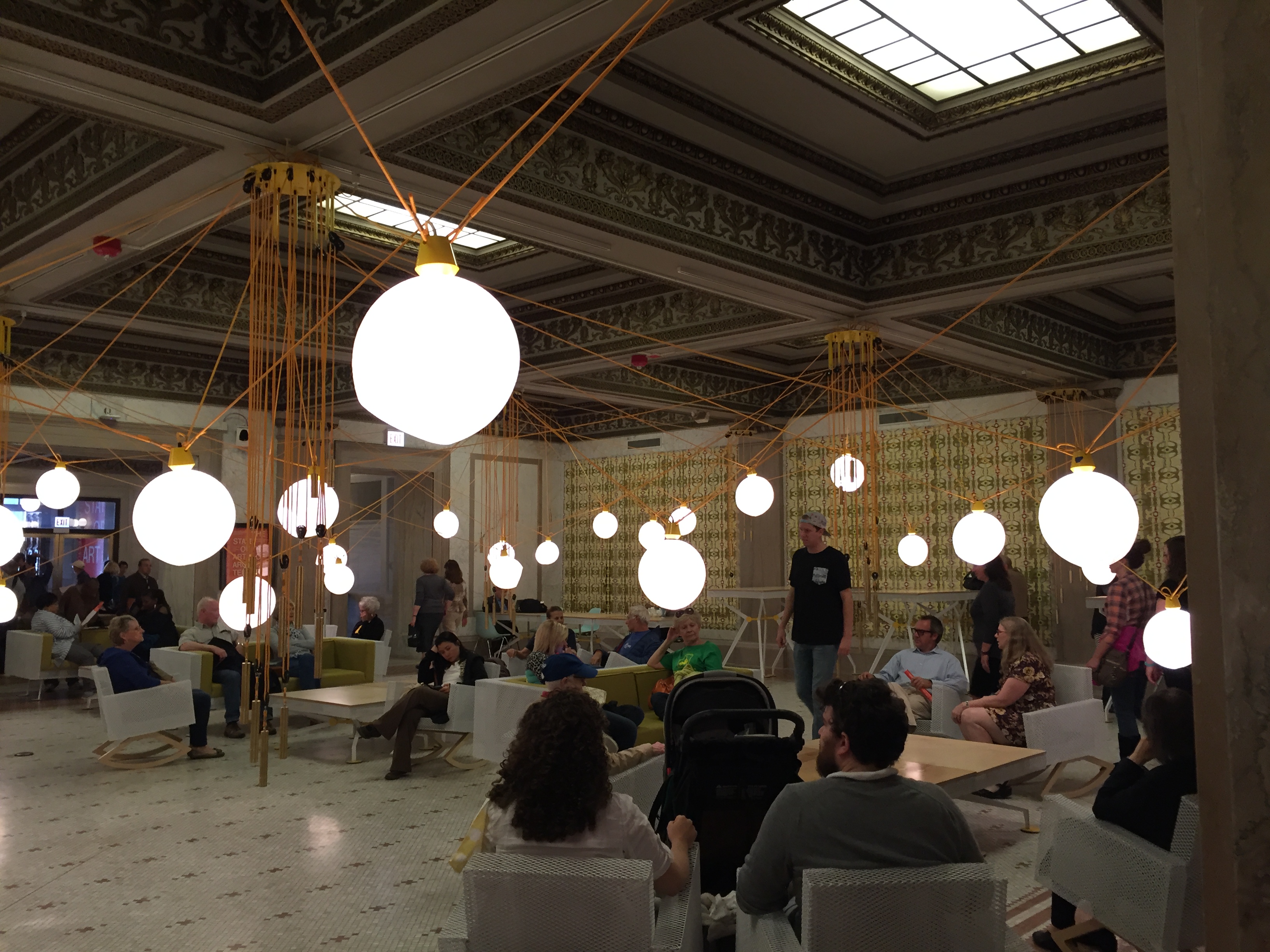
And the lobby area utilized flexible lighting that could be height adjusted with weights, and flexible drop in workspaces for visitors.
Before embarking on our journey from Chicago to Santa Fe, I was able to catch a final glimpse of the Chagall’s “Four Seasons” Murals at the Chase Tower Plaza: