Tag Archives: street scenes

Bay Area Travelswithmyselfandothers

Being back in San Francisco encourages me to continue my frequent walks throughout the city. Being situated in the southwest quadrant of the city, we can easily go in any direction–the city is merely 7 miles wide in any direction as the crow flies–and hit a water’s edge. The 7×7=49 square miles makes it easy to conquer the city by car, bus, bicycle, or walking. Whenever I can, my choice of transportation is on foot. I can accomplish a 3-5 mile walk in less than 2 hours.

Admittedly, it takes a bit of clever navigation to avoid the daunting hills of San Francisco! Tourists have been often thwarted by the steep elevations and unforgiving fog banks in California summers. Clad in bermuda shorts, tourists shiver as they study their maps. Plan views show short stretches between Fisherman’s Wharf and Downtown. In reality, going through Nob Hill requires a hefty hike in elevation of 400 feet! And that’s with a few bumps and bruises along the way, as the elevation rises and falls. It’s no wonder that tourists are stunned not only by the beauty of San Francisco, but its harsh climate and terrain as well.

For local city dwellers, I learned that there are more than the seven traditional hills in San Francisco. Here is a link to a description of the 53 reported hills if you are curious: http://sfgazetteer.com/how-many-hills-in-san-francisco.html

As a locavore, I enjoy exploring the streets of San Francisco and comparing them to the many scenes of cities I have visited throughout the world (for some reason, Prague comes to mind first). Since last October’s Halloween festivities (see Hallo Halloween from October 30, 2015 posting), I am realizing that San Franciscans LOVE decorating their Victorians and sweet homes. There is definitely pride in a little city that CAN. The more I walk, the more I notice the sweet, sensitive little details that make this city sparkle. Here are two random samples from this month’s holidays:

In addition to Valentine’s Day and Chinese New Year’s (Feb. 8 this year), San Francisco hosted the 50th Superbowl. Not being an avid sports fan, I failed to capture any photos of the carnival-like atmosphere downtown. It did preoccupy the city and drive it crazy for three weeks, so there was alot going on this month. Americans love celebrating holidays, and now it seems to extend beyond Christmas and Thanksgiving.

Aside from local city walks, husband Gee Kin and I continue to take urban walks throughout the Bay Area. After accomplishing various routes from San Francisco to Napa, Oakland to San Jose, and San Jose to San Francisco, we are now finding extensions beyond. We mapped out a route in the past couple of weeks from Petaluma to Santa Rosa. You can see the route screen shots here:

I originally planned to stay overnight at the Hampton Inn. In the past, I linked each day’s 8-12 mile walk between hotel rest points. I discovered that you can do the same with public transit points. As long as you are linked to connections back to home base, you can string transit points to each other, and easily pick up where you last left off and by paying attention to transit schedules.

Each leg was accomplished on a separate weekend day. We took Golden Gate Transit to each point of departure to link the route, so each walk was an easy day trip. The beginning and/or end of each walk was capped by a visit to a local, perhaps newly discovered restaurant as a reward! We discovered the Naked Pig in Santa Rosa, a roadside diner with all naturally produced ingredients.

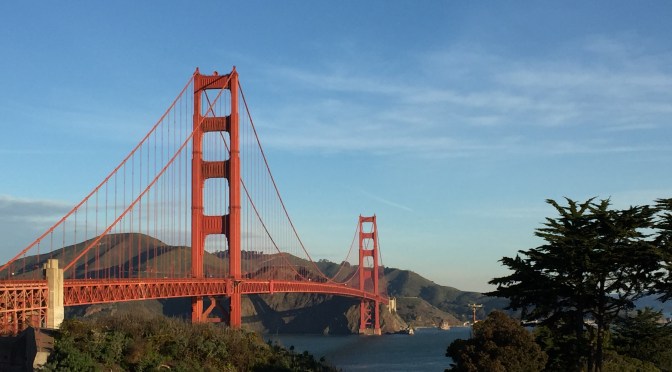
The featured photo shows another weekend walk out the door and across the Golden Gate Bridge to Sausalito. We topped our trip with a visit to Scoma’s for mussels, fries, and pink sparkling.

Next time you get good weather, think about walking out your door to a restaurant you’ve been dying to try. And don’t forget to smell the roses along the way. Let me know what you do!!

PS. Plans are underway for this summer’s travelswithmyselfandothers. Hint: Oh No! The TSE and GI AGAIN??!!

We are now able to link our Bay Area walks physically from Santa Rosa to Los Gatos. If you are interested in doing it too, see http://www.crazyladywalks.com.

Ich bin eine Berlinerin

OK, this was an unplanned visit to my favorite adopted country. My daughter Melissa is between jobs and after contemplating Morocco or Mexico City, we agreed that Berlin was not a bad option for interesting food, art and culture.

Our first of two weeks revolved around a number of upcoming new restaurants, galleries that are open over the holiday break, and special performances.

After stalking many of Europe’s best venues, I learned that there are impresarios who descend on famous sites such as the Berlin Philharmonic. When the orchestra is off, they lease the facilities. Many of the promotions cater to local tourists from France, Italy and Eastern Europe.

The usual Swan Lake, Mozart masterpieces, and Strauss waltzes are offered, but are not part of the regular program. While we did partake in a Russian ballet company performance, it takes a bit of close navigation to understand who is producing what and when.

Nevertheless, we enjoyed seeing a bit of traditional ballet contrasted with a modern version by Duarto/Kylian, two contemporary choreographers. The latter audience was much younger and local, while the former was stocked with a mostly tourist audience.

There are museums and galleries galore here, probably too numerous to count. For that, Berlin beats Mexico City hands down. We tackled the Pergamon earlier over the weekend with friend Vladimir from Meissen with some difficulty, as the Museum Island is still being renovated and access to each museum is limited.

Yesterday we covered art galleries in the Prenzlauer and Kreuzberg areas that included the Institute for Contemporary Art and the Kunstraum Kreuzberg. Old schoolhouses have been repurposed for gallery use as well as after school music and arts programs. A decent cafe in each allows visitors to enjoy the environment while warming up to the cold chill (and now snow) outside.

The Kennedy clan are well known to Berliners, almost more than to Americans. Aside from JFK’s famous quote, he was known to protect West Berlin from succumbing to the Communists in East Berlin. A small but significant historical detail.

The Xmas Markets were fun to explore and finally experience. The “gluhwein” tastes better than it sounds, and is merely what we call mulled wine. And the stollen or Xmas cake leaves a bit to be desired, particularly when traveling with a pastry chef.

The hip new food fare here, however, has been delightfully innovative, inexpensive, and thoughtful. While not always successful (veggies a bit on the raw side), the intent on making food healthy, delicious and beautifully pleasing to the eye is very evident. While not a foodie myself, I am swept up by the company I am keeping. Traveling with one can cause you to get into the picture pretty fast. Take a look at some of the plates: my favorite was the avocado and red beets on toast. Easy enough to make me want to make it as soon as I return home..

For the wannaknows, we hit Lokal, Industry Standard, and Horvath.

Viewed at the top, Swan Lake x 2.

Hallo Halloween

It’s been over two weeks since I have returned. I am finally re-acclimated to being at home and am enjoying my daily walks around the neighborhood. They help me keep the glow of my travels alive as long as possible. On one of my 3-mile hikes through the Upper Haight-Ashbury in the City, there were plenty of gobble-de-gooks and other surprises to amuse me and remind me why walking is a better way to travel and see the world.

I began to ponder the color orange. In a recent ice-breaker exercise, participants were asked to state their favorite color. Obvious “safe” answers such as “green”, “blue” or “pink” were mentioned, but few people would say their favorite color is orange! It seems to be an odd color, not quite fitting in with anything or eliciting a pleasant response.

IMG_0370From this Matisse painting posted this morning from the Barnes Foundation in Philadelphia (see my post from Day 69-70), Matisse once said “The chief function of color should be to serve expression”. The BF suggested that autumn colors should inspire how we express ourselves.

DSCF2671 I am posting a delicious photo from a Schwäbisch Hall friend, who visited Cumbria in the Lake District. It’s a good reflection of what Karen and I may have missed in Vermont this year.

Other than being associated locally with the San Francisco Giants’ Baseball team and the shocking “Clockwork Orange” movie by Stanley Kubrick, the color orange either reminds people of Fall Foliage, Halloween, or Thanksgiving. Beyond that…well, not much.

For those who are not as familiar with Halloween in the US, it is a fun and scary night with goblins, ghosts, and creepy-crawlies for kids. Children (and some adults who never grew up) dress in costumes and ply through their local neighborhood to demand from each neighbor a “Trick or Treat”…meaning you should give each child in a costume a “treat” or they will “trick” you. Most kids don’t really have a plan to take revenge on their neighbors, though. And I’m not sure whether hosts can opt to “trick” those at their doorsteps.

If you don’t answer or are not at home, you can get eggs thrown at your house, toilet paper strewn throughout the bushes, or a pumpkin smashed on the street. Older kids who did those things were intent on doing it anyway. Kids are now closely supervised by their parents on these outings. As a kid, I only remember going alone and getting sweaty from running in my home-made costume. I raced through my Crocker Highlands neighborhood in Oakland door-to-door to grab as much candy from neighbors as possible in two hours. I could easily gather one or two grocery bags full of goodies and stash enough to rot my teeth for the rest of the year.

Unfortunately, it is no longer a simple matter. Much later, our kids’ orthodontist was a real wet blanket. He collected the candy from kids who brought them in after every Halloween and bribed them with some pathetically unmemorable incentive. Crime has risen and deterred children from being able to go into their neighborhoods safely alone. It seems that kids nowadays are joining families or school groups to have private parties as an alternative to the neighborhood haunt.

But from my walk and looking for things orange, I discovered a small piece de resistance and renewal of faith for Halloween. The Upper Haight has been known to be a classic neighborhood where kids from both inside and outside the ‘hood are also welcome to visit. Even in our middle class neighborhood there are manifestations of defiance and celebrations of the spooky holiday. Maybe it takes a small community with money, iron determination to counteract current fears, or both. I could be a Scrooge and complain about how much money is being wasted and spent for no good cause. In any event, I was happy to see these expressions of home-made fun, whimsy, and creativity. I hope you enjoy them too.

Note: I will be posting an index of my 80 days around the world for those who missed specific cities. Stay tuned.

I noticed that the photos I normally take of favorite pieces from the Barnes Foundation were absent. The museum did not allow photos to be taken of artwork.

For those who continue to be interested in my wanderings, I will be making occasional posts over the next few weeks. You can always opt out if you aren’t.

Day 77-78: Art is Everywhere in Santa Fe

On an early morning walk, I was amazed at the amount of abundant sculpture and outdoor art in this small, aesthetic town. Landscaping, architectural elements, and artwork were integrated to give a deep sense and appreciation of the arts.

Throughout residential and commercial neighborhoods, you can find extensive use of the old adobe mud brick and plaster walls. They provide a consistent look and a unique quality to Santa Fe. The sense of time and place are established by this pattern. Newer walls surrounding buildings have a timeless quality, with updated elastomeric coatings that expand and contract with extreme weather conditions.

The wealth of galleries and museums are easily accessible within the city. The Georgia O’Keefe museum was just around the corner from our hotel. Although I am not a fan of her work, I learned to appreciate the life of O’Keefe and the meaning behind her work. She led an avant-garde lifestyle with her husband and photographer Albert Stieglitz in New York before settling in New Mexico.

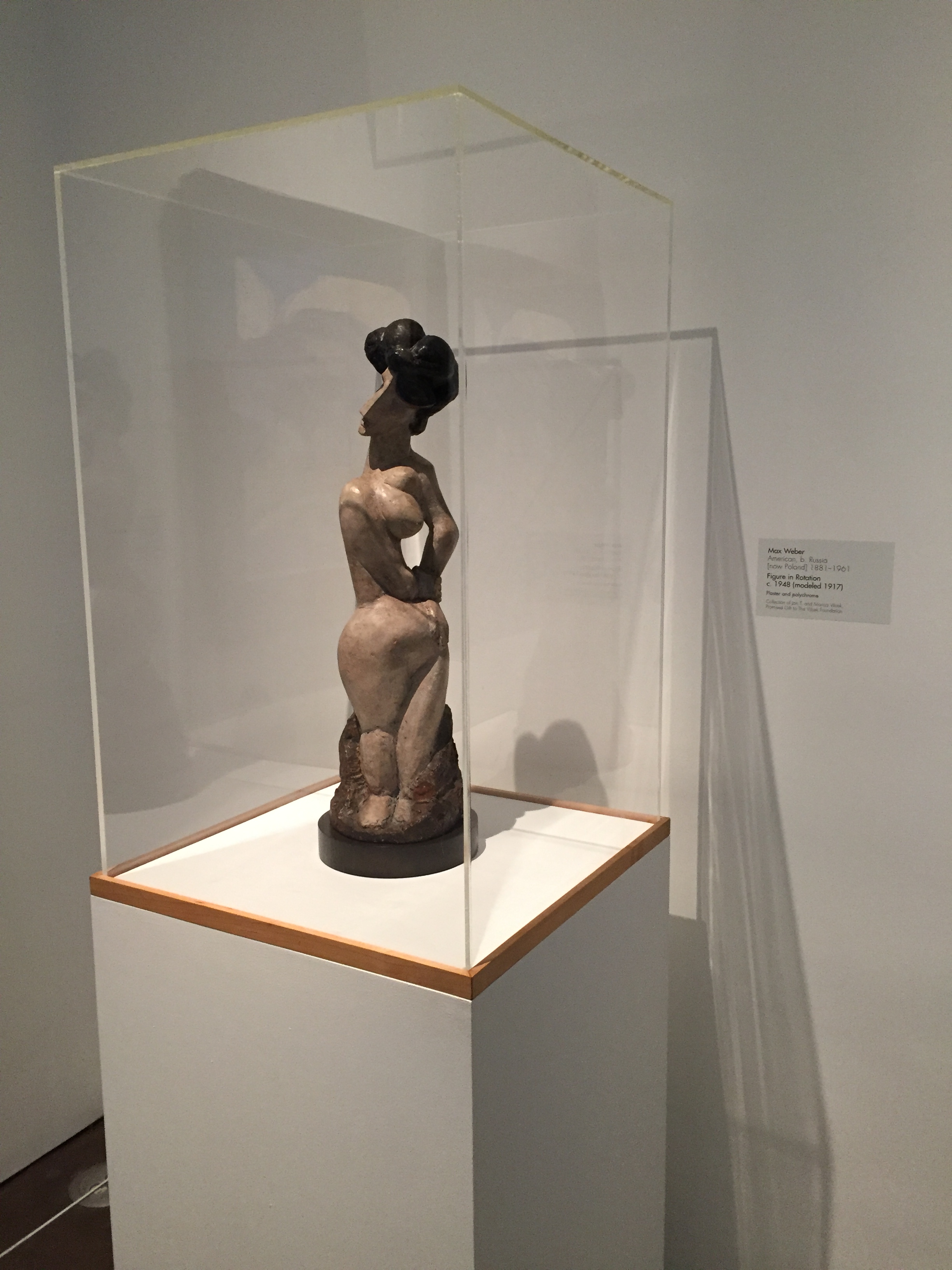
My favorite piece from the museum was a cubist sculpture by Max Weber entitled: Figure in Rotation (1948)
IMG_0240

Later in the day we visited a collection of museums and galleries. The new Museum Hill area housed the Museum of International Folk Arts, the Museum of Indian Arts and Culture, and the Anthropology Laboratory. It is only a couple of miles from the Plaza and accessible by bus.

We visited a couple of galleries along the Canyon Road area. I was trying to track down an old friend from school who is now a famous jewelry designer in New Mexico. We were able to find a gallery that exhibited her work and were impressed with the quality of the pieces using precious stones in modern settings. You can read about her in Wikipedia at https://en.wikipedia.org/wiki/Gail_Bird_and_Yazzie_Johnson

The next day, we visited Bandelier National Monument, where some of the Ancestral Pueblo Indians settled. Known as Frijoles Creek and Canyon, this area along the Rio Grande leads to the Alcove House, where we climbed up 140′ by ladder to see the cave dwellings. The pink rock is composed of volcanic ash that formed into a crumbly rock known as tuff. This material creates pits and can be carved into larger openings.

Day 66-68: Very Vermonty

After a ride Upstate on the Ethan Allen Express from Penn Station to Albany, NY, my college roommate and I rented a car and drove east toward Middlebury, Vt to go “leaf-peeping”. The only ominous problem was that this year’s weather affected the Fall foliage. Much of the greenery along the Hudson River appeared to be damaged and dried from the unusual summer heat.

Apparently it rained in June, then very little over the summer. The leaves depend on cold weather to turn color. We started seeing just a tinge of color here and there, but were not too hopeful that we would see much in the next couple of days. Instead, we resolved to enjoy the casual air, windy roads, and 55mph highways.

We stopped in an apple farm along the way, had a long leisurely lunch at the “Lobby” with Otter Creek as our view, and then strolled over to visit the glamourous Middlebury College indoor track.

All along the way, I was reminded of the history of this area. “Last of the Mohicans”, buildings with ca. 1800 etched in stone, white clapboard houses, and picture-perfect Lutheran churches are abound.

I was struck by the resemblance in parts of Germany to New England. The early 19th and 20th C. signature church steeples in the small towns dotted throughout Germany were contemporary to those built in the US. It’s amazing to think that these areas were just getting their footing at the same time Goethe and Schiller were in full tilt in Weimar. It helps me to appreciate and relate to a book I am currently reading, “Two Boston Brahmins in Goethe’s Germany”.

Only a faint blur of red dusting the wooded hills were visible around the ski resort of Killington. Instead of a gondola ride up the 4162 elevation, I opted for a rickety chair lift in this ski town. It was half the price for half the height, and probably half the time, so it appeared to be a sound if not minimal investment to me.

image
image

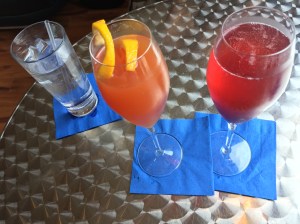
A late morning breakfast was jump-started by champagne cocktail, quiche, ravioli and finished with a delicious bacon and egg muffin sandwich cushioned with a sweet potato bed, in that order.

The next day, we left Killington to explore the Scenic Roads from Killington along Route 4 East to Woodstock, Vt. and South along Route 100 through the heart of Vermont to Wilmington. The leaves were most impressive along the Green Mountain National Forest.

We made a stop at the Shackleton Thomas Woodworking and Pottery Store, where they made hand crafted furniture and stoneware. Each item was lovingly produced in an atelier that carried on many traditional techniques.

Tomorrow we will be traveling from Albany, NY to Philadelphia, PA by Amtrak through NYC. We have ordered tickets the following day for the Barnes Foundation Collection and the Philadelphia Museum of Art, so art lovers, get ready!!

Day 63: New York City, New York (Il Trovatore and the Guggenheim)


IMG_9504For my old and new friends and fellow opera lovers, here are photos of the Mighty NY Metopera evening of Il Trovatore, with superstars Anna Netrebko and Dmitri Hvorostovsky.

In the most moving part of the evening, Hvorovosky was showered with yellow roses during his curtain call. He was recently diagnosed with a brain tumor and had cancelled all performances in July and August. He had only returned to perform with Anna Netrebko for three performances of Il Trovatore after positive treatment. You can read more about him on his website at:http://hvorostovsky.com/

Anna Netrebko, who played Leonora, was sublime, and Hvorostovsky was courageous and powerful. Delora Zajick, who played Azucena, and Yonghoon Lee, who played Manrico, were both well received.

Earlier in the day, we took a short walk to the Guggenheim Museum to see a highly recommended Doris Salcedo exhibition. Doris is a courageous artist who asks questions about trauma caused by colonialism, racism, and social injustice in her native Colombia and other countries through her work.

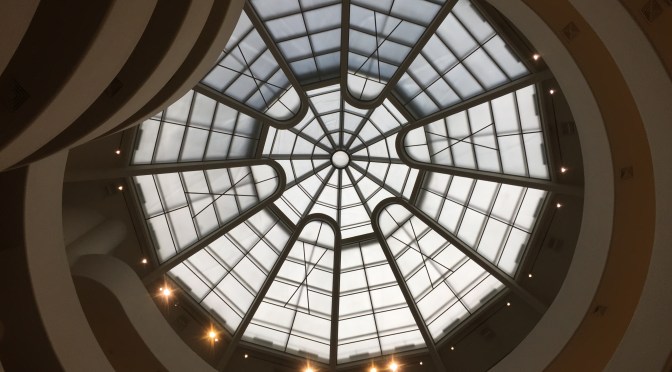
Interior Corkscrew
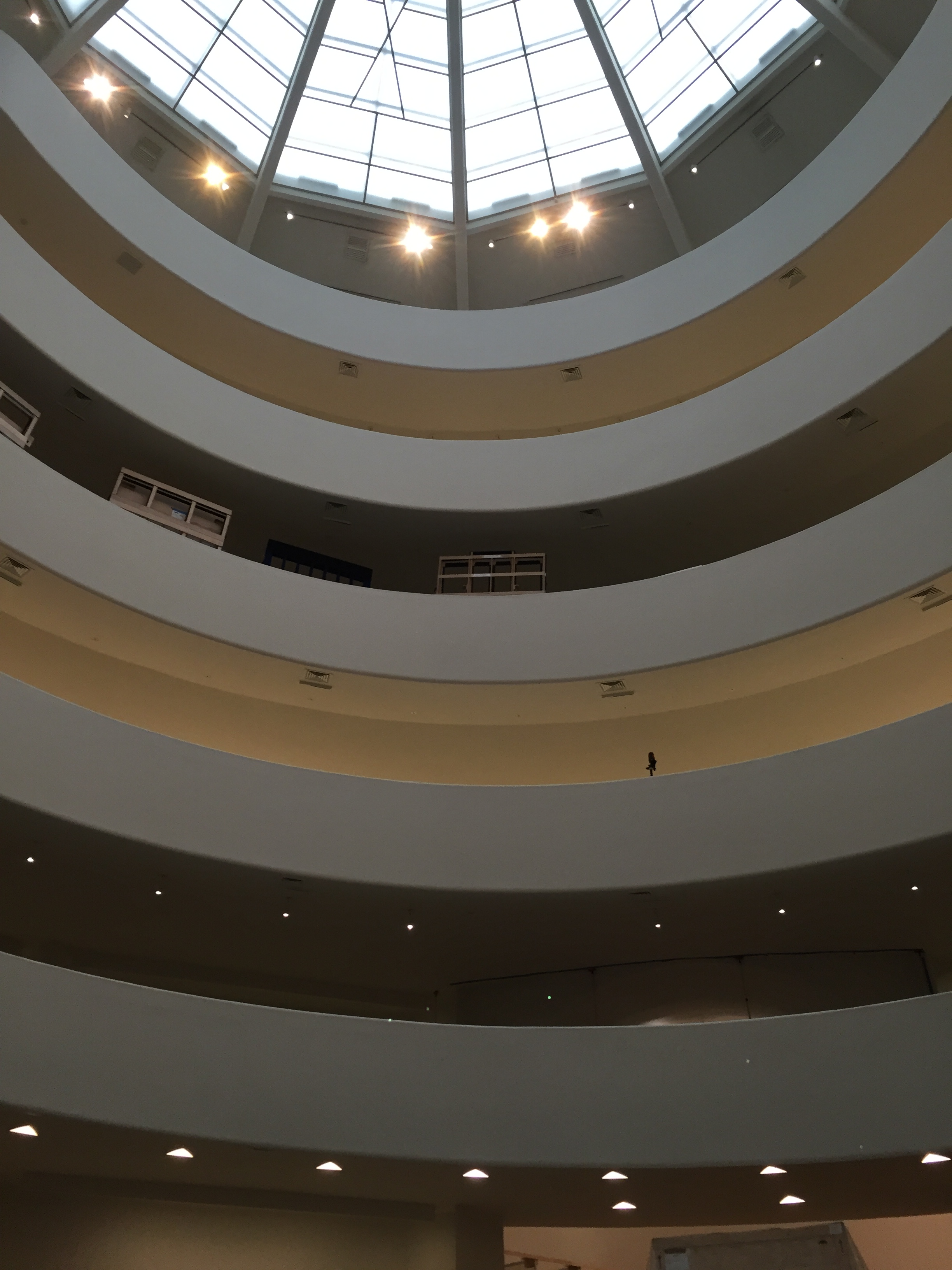
Interior Corkscrew

This museum was designed by Frank Lloyd Wright, ca. 1959.
Most of the museum was closed during an installation of an exhibition. You can read more about this controversial museum at the time it was being designed and constructed at http://www.guggenheim.org/new-york/about/frank-lloyd-wright-building


1. A Flor de Piel, 2014: Based on a burial shroud, this fabric is an homage to a nurse who was tortured and murdered in Colombia.Its enormous undulating fabric is painstakingly stitched together from chemically preserved rose petals–a material replet with romantic  associations that at the same time mimics the appearance of flayed skin.

2. Wooden Armoires with Concrete and Steel: Between 1989 and 2008, Salcedo created an expansive body of work forged from pieces of domestic furniture with concrete poured in them, as if to immobilize and be muted by grief. The furniture represents the families of those who have died and their silent mourning.

3. 11 Stacks of Shirts with Rebars evoke an image of violent incursion

4. Disremembered, 2014: Woven from strands of silk thread, these works take the form of garments that would harm rather than protect the wearer. The shimmering forms hover on the edge of visibility, in an expression of the artist’s interest in representing the experience of loss through the shifting lens of memory.

For more information, go to Doris Salcedo at guggenheim.org/Salcedo. (These descriptions are excerpts from the Doris Salcedo exhibition material at the Guggenheim)
IMG_9494
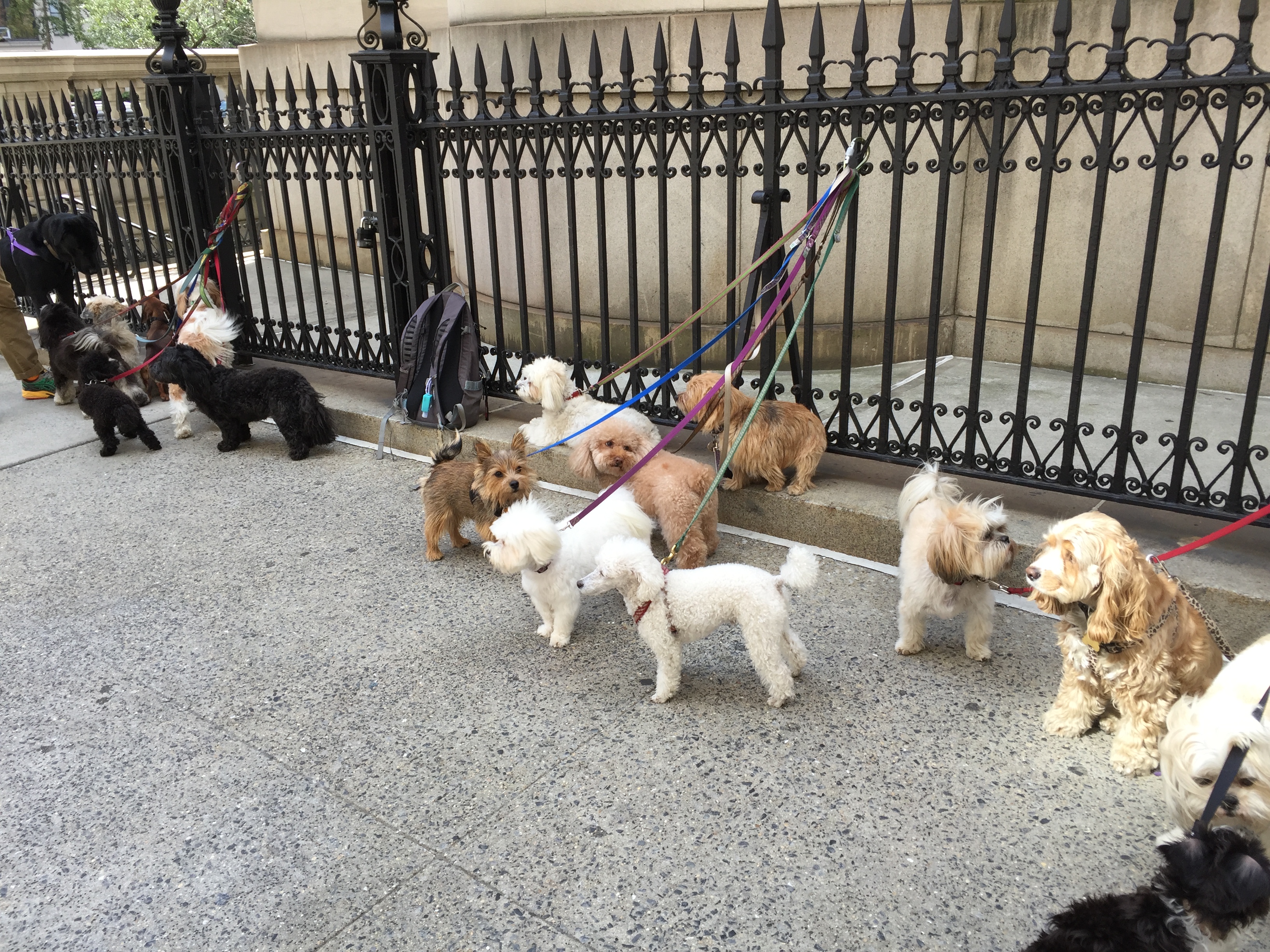
On our walk back, we passed the Doggie Day Care Parade.
Available for your visual pleasure Only in New York.

Day 58: Pause to Refresh

This is a good time to recap the first two-thirds of my 80 days around the world, since I am about to leave Germany to fly back to the US. In the past two months, I have traveled on the Trans-Mongolian Express (TME) from Beijing to Moscow, visited the Russian capital and St. Petersburg, and several cities in Austria, Switzerland, and Germany.

The next segment will be a stay in New York City and a short trip by car to see the Fall Foliage. The final leg will be the counterpart to the TME: a cross-country trip via Amtrak to Philadelphia, Chicago, Santa Fe, New Mexico, and finally back home to San Francisco.

Join me in the next few weeks as I compare cross-country trips between the U.S. and Russia!! I also look forward to seeing old friends and family.

Below is a glimpse of each stop. You can find the posts by searching the city or in the archives for July-September 2015.

Beijing: Best Hotel Experience in a traditional Chinese Hutong (Courtyard) Hotel

The Trans-Siberian (Mongolian) Express:

The Trans-Mongolian Express travels from Beijing to Moscow and is part of the Trans-Siberian Express. It connects to the Trans-Siberian Express in Ulan Bator and picks up the route that begins in Vladivostok.

Transsiberianmap

Mongolia and Ulan Bator:

Moscow and St. Petersburg:

Berlin:

Salzburger Festival Performances:

Vienna and Linz, Austria

Switzerland

For Schwabisch Hall, see recent posts.

And a few earlier posts organized by my favorite topics:

Architecture:

Food:

Artwork:

Photos may be repeated from earlier posts.

Day 55-57: Schwishin’ Schwäbisch

After the end of the Language and Cultural Program, it is difficult to come off a “high” from having made several new friends in a short time span. While others were packing their bags and moving home or elsewhere today, I decided to stay behind another day to savor a town I have called “home” for the past two weeks.

A morning walk refreshed my first senses of this sweet little town. A river runs through it, where people can still fish from it. Walks are everywhere that meander along the river and trace the town’s history. A community that cares about its environment and each other. And specialty local produce and products are made with purpose and don’t cost an arm and a leg.

Here are a few recordings of my walk this morning:

The Saturday Market was just getting ready for a big weekend celebration.

IMG_9259
Our class mascot, “Goethle” with specialty products Bratwurst, Bio-Blutwurst, and Schaschlik Guwürzsalz.

Our last two days were a little sad as friends got together for dinner and said our good-byes. While we didn’t exactly master the German language, we made some good friends, shared and learned alot from each other, and thoroughly enjoyed a successful two-week stay in Schwabisch Hall.

Day 52-54: Week Two, Schwäbisch Hall

The Goethe Institute students in our class are already embarking on the second week of the two-week language and cultural program at Schwäbisch Hall. It has flown by, with many activities, new friends, and mind busting German classes that test our memories and expectations of ourselves. It feels as if we are on the same boat, cruising down the river of life together.

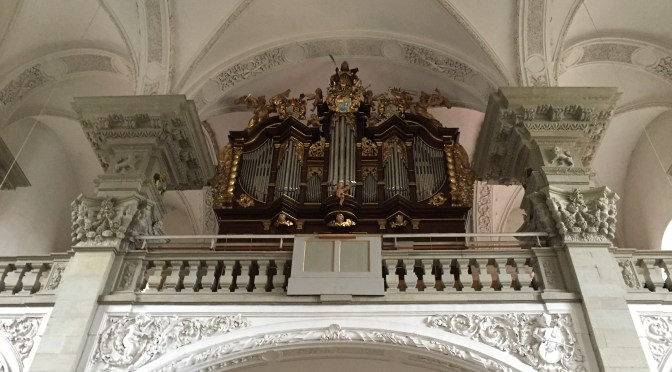
The Kloster Großcomburg and the Kirche St. Nicholas contains a rich collection of beautiful stone sculpture and elegant interiors. Clad with stone columns and capitals, plain ribbed walls and ceiling, and handsomely crafted wood pews, the Church interior and its materials seemed very modern and soothing to the eye. A beautiful stately organ was perched in the balcony ready to beckon its congregation. The church is at the top of a double-walled fortified hill, similar to the one at Schwäbisch Hall.

The ecclesiastical and royal stone figures possessed an air of confidence and stately manner. The king stands on the lions, a sign of royalty, but the queen is only allowed to stand on a dog as a sign of subordination. A stone knight looked poised, and ready to prance into the room. Its crisp, ribbed clothing was beautifully honed to perfection.

The day before, we took a full day excursion to Stuttgart and saw examples of historic buildings in the Altstadt area as well as modern, stately residential buildings with a strong Corbusier influence. With a population of 500,000, the city is built along a river and has steep hills with spectacular views similar those in San Francisco. Originally known as Bad Cannstatt, Stuttgart has a wine-growing region on the opposite side of the residential area and it was the impetus for Stuttgart’s growth. The city was bombed severely in World War II, so many of its original buildings no longer exist. Bosch, Porsche, and Mercedes-Benz are a few of its top companies.


In the afternoon we visited the Mercedes Museum. Daimler merged with Benz to create the world-wide brand of Mercedes-Benz. The classic three-pointed logo stands for the company’s products for land, sea, and air. The nine-floor, museum-quality ramped building was designed by Netherland’s Ben van Berkel and Caroline Bos’s UNStudio and features a timeline and modern history of the world since the development of the first Mercedes-Benz. Many of the classic automobiles, trucks and buses are also on display there.

In an outing the day before, a few of us were able to break into a small group and enjoy walking on one of the several Wanderwegs, or paths through and beyond Schwäbisch Hall. Despite drippy weather and overcast skies, our group encountered a field of sunflowers that brightened our day. It was a near-perfect day–only a rainbow was missing.

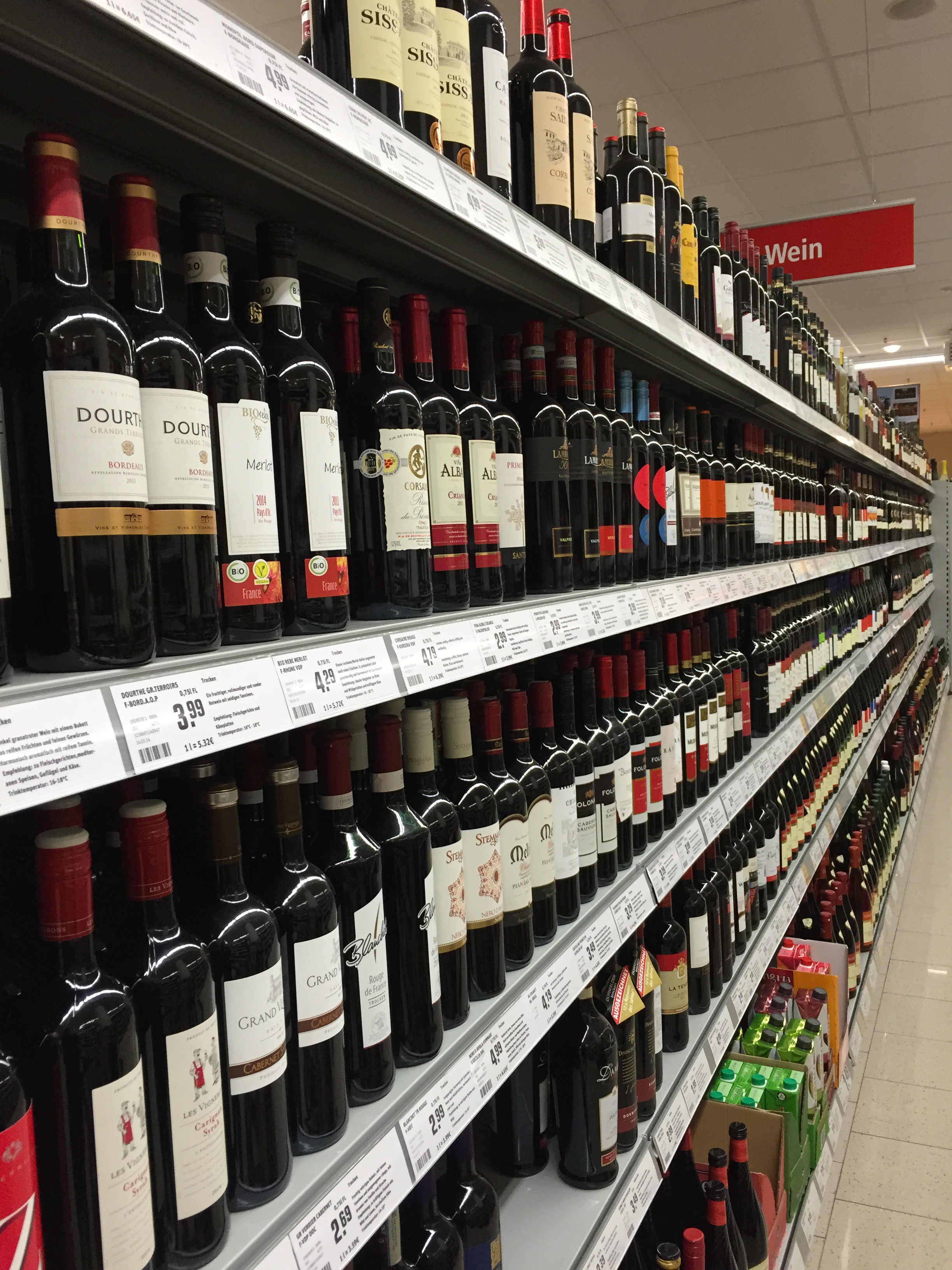
On a trip later to the supermarket, I found that wine is plentiful, with none over 6 Euros! The shelves were lined with a variety of locally produced wine. After a long search and at the end of the shelving in a “premium” section, I finally landed on a bottle of Hohenlohe Fürst Oehringen 2013 Lemberger Trocken (dry) for 9 Euros!! I tried, but I couldn’t find much for over 10 Euros.
IMG_8934

Day 51: Schwäbisch Sonntag

In preparation for my departure at the end of the week, I took a stroll through the town on my own in the afternoon. I savored the time alone, with no rushing through museums and tours. There are so many interesting paths, side streets and alleys lined with historic architecture, from medieval to modern. The city’s double walls and independent status allowed it to be spared from many battles and sieges. Thus its buildings and city were preserved.

A festival with music in the market plaza served free food and beer. Here are a few more shots that I took today.

A return to the Hällisch-Fränkische Museum gave me an opportunity to study the geology, early history of the area, and other exhibits. The city gained its prosperity and fame from the salt deposits along the river. The area was occupied by Celts and later Romans. One of the area’s well-known sculptors was Leonhart Michael, who created the moving stone relief sculpture shown below of Christ’s Crucifixion.

On a Sunday afternoon and for 90% of the time, I was alone in this beautifully crafted and presented museum. The scale models of the city and buildings reinforce how much the towns appreciate their history, architecture and planning.

A wig gallery allowed me to inspect them closely. Having heard about all the hygiene problems until the recent past, I’m sure that the wigs were developed to hide all those lice and growies on one’s head. After trying one, I was left to my own devices and was forced to take selfies of myself in drag. Sorry, you’ll never get to see them publicly.