Tag Archives: street scenes

Day 49-50: Ein Schönes Wochenende

Our “Beautiful Weekend” has begun! We started on Friday afternoon with a visit to the modern art museum, the Kunsthalle Würth. It’s a private gallery, with special exhibitions for Op Art and silver from the Victoria and Albert Museum in London. The building was designed by Danish architect Henning Larsen.

We strolled back to the main market plaza in town, past the Globe Theater, a replica of the one in England, and through the wooden bridge over the Kocher River.

On Saturday, we had an ambitious schedule for the entire day. A bus took our group of about 20 students first to Marbach am Neckar, Schiller’s birthplace. The house where Schiller was born was tiny but gave us an impression of life in this small town. Schiller was considered the “Poet of the Nation”, as he promoted freedom and the unification of the various states in today’s Germany.

If you remember, Goethe and Schiller were close friends. Much of their life’s work took place in Weimar, where we stayed for a few days earlier this year during the Dresden Music Festival. Statues of Schiller and Goethe are located in San Francisco’s Golden Gate Park.

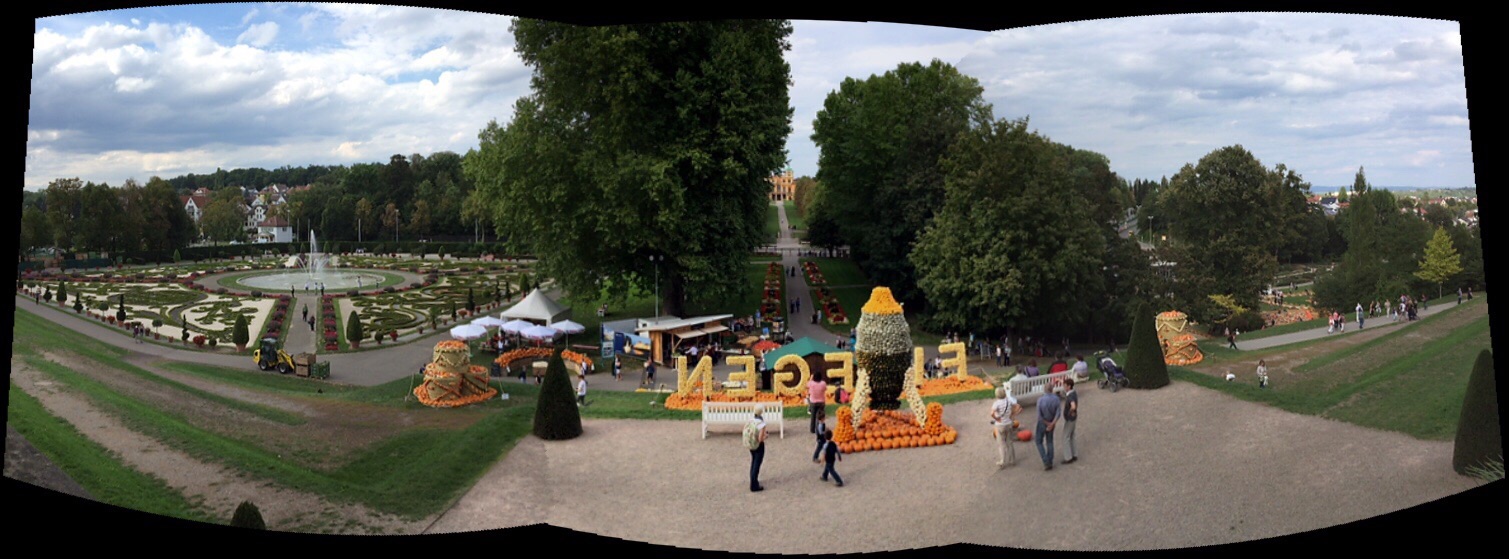
In the afternoon, we visited the baroque town of Ludwigsburg and the Ludwigsburg Palace. As a young student, Schiller lived in Ludwigsburg. Each town has its own markets, but this one surrounded by Baroque buildings was particularly enjoyable.

Germany has a strong sense of community, and each town has its special celebrations for young and old alike. This pumpkin festival, although small, reiterates the care and thought that is put into planning and implementation of each event for its citizens. It’s something I really respect and appreciate about the German culture.

I took a similar picture of the pumpkin display for a graceful older lady standing near me. When I noticed that she was struggling a bit, I asked her if she wanted me to take a picture for her. She was happy that I offered, but she was also very specific about how I should take the picture–make sure the edge of the balcony didn’t show in the picture, and get the building in the background. She declined when I asked her if she wanted a picture of herself.


image

Day 36: Zurich’s Riches

Every city on arrival has inspired me. Everything is so fresh, new, and exciting. I feel like I am abandoning the children I left behind: the cities that were so sweet, quaint, and lovely. Each one had their unique qualities, but I can’t help but look forward to the adventures in the near and present future.

Attached are some photos of a do-it-yourself city tour I took on Saturday morning. It was unbearably hot by time 2pm struck–it was well over 90 degrees. The street parade was taking place, and by time I got to the train station there were floods of celebrators, mostly young and in costumes and wigs, ready to tackle hundreds of music venues spread throughout the city. Many of the party-goers appeared to be from within Europe–Italians, Dutch, Eastern Europeans, and the like. They were ready to PAR-TEE!!

A curious contingent of Asians were in one of the small squares with yellow T-shirts promoting democracy. I thought that was a bit strange but learned afterwards that students and residents of Malaysia were protesting against their prime minister and were demanding for his resignation. He apparently was dictatorial and had mis-managed funds. Another group in yellow T-shirts were just getting out early ahead of the parade and entertaining tourists on the street.


Switzerland is frightfully expensive, so I am staying on the outskirts of town. The location feels South Peninsula-like, with many new internet and bio-tech firms concentrated in the area among spanking new housing. I noticed on my run this morning that new housing includes heavy metal louvers over each window as a standard. (even on my hotel window). It definitely helps provide shading and environmental advantages from the strong sun and temperatures here.

There was also a playroom in this new housing development. American architects have studied ideal housing in Europe consistently, yet I still do not see this level of integration for children in public or private housing in the U.S. At the same time, it would be perfect if housing can incorporate activities for seniors such as a support system for day care within the same development. Time to consider this approach and how we can get it to happen.

As a contrast, as there always are, I had to beat it to the supermarket before 9pm last night. They are closed on Sundays. I guess Americans just look like a bunch of workaholics who can’t get their lives together to avoid the food shopping on Sundays. Or else we just eat so much we run out of food every day, and need access to the Sabbath for that last beer. Maybe we should establish a one-day-a-week food-buying moratorium to curb the urge??

Day 34: St. Florian, A Closer Look

Time to reflect on St. Florian, the Augustinian monastery outside Linz, Austria, where I spent my last three days. At first it seemed very grim and austere, but by the time I left I felt the urge to return. It has its undeniable charm, and the offerings in the area were far beyond my expectations. The biggest draw, although I did not do it, was the Bruckner Weg, or Symphonie Weg. I described it earlier, but it’s hard to describe how excited I was by it. It combines my love of walking and music!

It’s a great way to learn about the music of a composer who was so dedicated to organ music, he wanted to be buried under the church of St. Florian. And indeed, here’s a picture of his crypt in the basement!image

I was able to discover this grand old monastery and its historical treasures that are now under appreciated and forgotten. The library holds over 140,000 volumes and about 4,000 are original books before the printing press was invented.

image

Other treasures were the performances in the cathedral itself. I took many videos of the two daily performances and the mass at six jsut to record the music. I guess it wasn’t really a mass because the monks all came out and chanted for about 20 minutes and there was very little audience participation. I got really curious about the Augustinians. Here’s a description if what I read in Wikipedia:

https://en.m.wikipedia.org/wiki/Augustinians

The interesting part was about their psyche. It indicated that monks were high on the masculine scale but also had a very high preponderance towards female qualities of neuroticism and detail. Wow. What a combination. I wondered if I was material for monkhood??

In any event, that minor piece of information got me to thinking what could have motivated these men to join the order. I was surprised to learn that Martin Luther was an Augustinian before he protested against the Catholic order and the papal Bulls. Eventually, he got married.☺️
Others like him must have suffered some hardship or divine inspiration. The Augustinians also have hermits too, so their monastery is a perfect place to try out the lifestyle. I wondered how Herman’s Hermits picked their name.

As the monks left the cathedral, I couldn’t help but study each face. Hmm, older, tall, and pretty handsome for their age. Is that where all the men have gone? I’m searching for my single lady friends.

It all starts to come together. All the glorious trimmings at the expense of the people. But it was interesting to see the development of the environment and understand the conflicts that were subsequently caused by it.

Here are some more views:

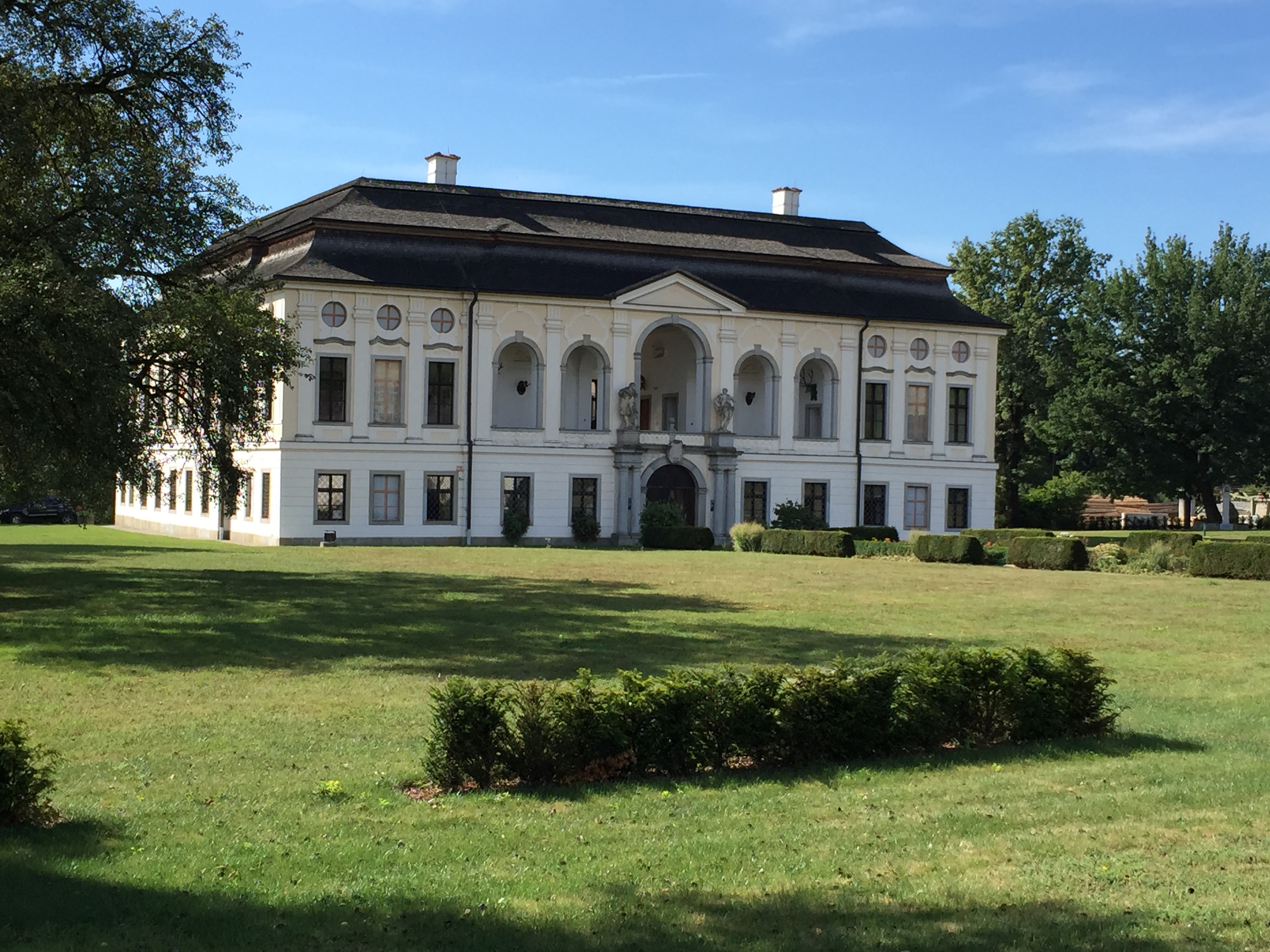
I mentioned some of the wonderful paths and “wanderings” available throughout Austria and Germany earlier. Switzerland probably has an awesome offering, but I haven’t heard about them yet. Although I was unable to do Jacob’s Way to Santiago de Compostela (my 19 days were already numbered), the Bruckner Way or the Symphonie Way (the museum at the far end was closed for the month of August), I took a short walk a mile away to the Hohenbrunn Schloss. It was blazing saddles, so I had to shade-spot along the path. Before arriving, I stopped to enjoy looking back at St. Florian in the distance beyond the road (pictured in the header).

Hohenbrunn, shown below, is some version of a hunting lodge built between 1722 and 1732. No one was there except me, and for a few quid I could see the entire place to myself, unaccompanied. At first it seemed a little creepy, as it felt like someone had just occupied it and left the water running somewhere. And all those guns. The one I took the picture of was one-of-a-kind. It actually is used for shooting ducks on a boat, so the boat supports the long barrel. I’ve captioned a few of the other photos that struck my fancy as I pranced through.

Front of House
Front of House

The up close and personal with the animals got a little weird. They all seemed to be having Gary Larson conversations with each other, wondering where all the human pets had disappeared to. I felt like Ben Stiller in “A Night at the Museum.”

Despite my digs at the culture in and around St. Florian, it was really pretty sweet. It took a bit of courage and good faith to come here on my own, but I stayed in contact with my support staff. I am nearly half way through my journey, and as many of you know it is not about the destinations but the process of getting there.

At times I wondered what I was doing. When I finally played my on-line music appreciation class that I brought along with me, I realized that this is real-time learning. I can hear and relate to music that is being performed. I ironically was at the point of learning about “Baroque” as in Bach vs. “Classical” music by Beethoven. That was awesome!

I hope I can convince any of you to come back with me to St. Florian. The surrounding area is luscious and vibrant, and you feel the freedom to explore at your own pace. It’s heavenly to hear the organ and Bruckner here. And yes, I am a little sad to leave.

Featured photo at top: Hoenbrunn Schloss, in St. Florian near Linz, Austria

Day 30b: Viennese Sights

1. In and around Vienna: St. Stephen’s Cathedral and Plaza area (also featured image), and a street scene near Mozart’s House in Vienna. Notice the wide contrast in architectural styles, right in the cultural center of the city.

2. The Albertina and a collection of Modern Art from Carl Djerassi

These are only a few of the works I liked in particular, from his extensive collection that include Lichtenstein, Warhol, Gerhard Richter, and Klee.

Read about Carl Djerassi’s possible connection to San Francisco: https://en.wikipedia.org/wiki/Carl_Djerassi, or better yet read this fascinating obituary in the Telegraph: http://www.telegraph.co.uk/news/obituaries/11384755/Carl-Djerassi-father-of-the-Pill-obituary.html. The Klees on display are part of the Djerassi Trust and has been promised to the Albertina. I wonder if there is a tug of war going on between the SF MOMA and the Albertina. It might be interesting to follow it as part of the art world’s pursuit of wealthy collectors and their endowments.

Gerhard Richter is one of Melissa’s favorite artists. The black and white portrait of a woman smoking was not obvious until I took a picture of it!

By the way, I discovered that Adolf Loos was Austrian (and Czech). Here’s some interesting information about him: https://en.wikipedia.org/wiki/Adolf_Loos.

3. The Vienna Opera House: from an evening of Mozart music.

Now, after three “variety shows” of operatic music and concert pieces featuring Mozart and Strauss, I can hear the difference. Strauss added alot of drums and brass but also contrasted these boomers with sweet melodies. They are a crowd pleaser and I admit I became mesmerized by the rhythm and tunes. Unfortunately, the opera is closed in August so there are no regular performances. If you come in August you are stuck with the tourist track.

Updated 8/23 11:10pm

Days 24-26: Salzburger Knockouts

I’ve been trying to get my dose of Salzburger Nockerl, a famous local dish made from pure egg white meringue. Unfortunately, it has eluded me so far. I either wasn’t in the right cafe that serves it, or didn’t have the 20 minutes it takes to prepare it.

Despite this oversight, I finally struck gold in many other ways on my last couple of days here. I got it all and what I love about traveling: quality architecture, quality museums, quality music, quality food, and of course, quality people! The tag posts seem to tell it all.

I’m trying to reduce and concentrate the number of posts to only a few a week (Wednesdays and weekends) so I don’t flood your email boxes. Unfortunately, it makes the posts longer.

Here’s a spread of what this richly, well-endowed, and now much appreciated little city of Salzburg has to offer. To make it a little easier, I’m including a summary so you can skip to the parts that interest you:

1. Salzburg Fortress (Festung)
2. Mozart Houses (Birthplace and Living Quarters)
3. Performances (my raison d’etre for being here, but not necessarily the most exciting)
4. Food and People


1. The Salzburg Festung, or fortress, was very informative and an excellent excursion today. Gee Kin would be proud of me-I trooped up the hill and partook of the view from the top. Because Salzburg is so overrun with tourists, the city has managed to take tourists’ needs to heart. They provide excellent displays and explanations in English (for those of us brain-dead in German). They even had a electronic kiosk soliciting feedback at the end of the tour.

There were many architectural or design features I had not seen before. Those listed are not in any particular fashion. Follow the captions for specific items. You can hover over the photos now to see the captions.


1. Stone columns honed in a fashion the way wood is turned on a stile;
2. Matching metalwork
3. Torture elements–aha! can anyone venture a guess what this contraption is?? (see below)
4. A wooden threshold that was so old and worn that it exposed the “knuckles” of the knots from the tree, like aged knuckles on a centogenarian
5. A section of real arches that shows how they were constructed.
6. A display of how they created cranes to haul stonework up the mountain.
7. A latrine that was one of the first of its kind
8. Romanesque arch construction displayed

And a few morbid items from the torture storeroom to remind us of our mortality.

Since the fortress was built in the 11th century and over a period of hundreds of years, the museum was able to trace its construction history. It was an exciting architectural exhibition of walls, innovations and construction methodology. While most of the fortress was reinforced and expanded in the 15th century, it captures the various early periods from Romanesque beginnings to High Renaissance.
2. Mozart’s Birthplace and House:


3. Performances:

The star quality of these performances have been a bit mind-boggling. The interesting point is that my favorite opera star, Jonas Kaufmann, was not at the top of his game in Fidelio. The music was deep and entrancing, but his performance was weak. The opera performances shown here were much better. These performers can really deliver full-bodied voices and their skill and dedication really shows. Audiences were very responsive and clapped heartily.


4. Food and People: On my last day here, I decided to go for the two-hour lunch instead of the evening dinner option. My lunch was celebrated at the Heimer Specery. I took my time, had a small antipasti plate of eggplant, sun dried tomato and roasted red pepper with Prosecco, followed by the house specialty, a succulent full bodied pork chop that comes from the establishment’s own piggery. Along with a glass of rose, this was the chef’s recommendation so it had better be good. And it schmecked, or tasted delicious! I had just told Gee Kin that I thought pork was often disappointing as a dinner entree. I often found it dry and uninspiring. After your third bite you wish you had ordered the branzino. Well, I wasn’t disappointed this time. This little restaurant around the corner from the Festival Hall delivered to demanding regulars and I was a beneficiary.

The night before, I took my place at another restaurant (the one I went to for lunch today was fully booked 2 nights in a row, thus the lunch decision). As I was about to hog a table for four all by my lonesome, another gentleman was looking for a single at the same time. He asked if he could join me, the very exact same time another woman came along and did the same! I was very flattered, and didn’t mind the company at all. I was even more delighted when I learned that neither of them spoke English!

The three of us ended up with a very friendly conversation, and I had a chance to practice my elementary German. It was frustrating as I could ask basic questions but never “got” the answers. They drifted to fairly complex conversations about what the two dinner partners thought of the Greek Crisis, Angela Merkel, and the operas they were seeing. The gentleman’s nephew was performing in the opera we were about to see (Angela Georghiou in Werther). He was a baritone and did very well.

What I like about traveling is connecting the dots. I was flashing on how non-English speakers must feel when they are asked questions. After a few pleasantries, a zero-tolerance policy toward any non-English speakers seems to drift into the picture. Native English speakers tend to expect everyone to speak English, even in non-English speaking countries!

Well, the tables were definitely turned here. I felt stupid, unable to respond to simple political and economic questions. While it made me more determined to learn German, it made me reflect on how hard it is for many people in many countries to master English. I certainly came to that conclusion as I realized I could only sit and muse as the two native German speakers became very engaged and animated in their conversation. Sadly, I could only plaster a smile on my face and pretend that I understood everything.

German women seem to like short spiky hair, blow-dried behind the ears. Subtle platinum highlights, or jet red. Less Gothic these days. The woman who joined me was of the subtler version, and very svelt. She worked for a pharma company in Regensburg, and drove two hours each way to come to the performances this week. The gentleman from Innsbruck was a retired German teacher. It was, despite my misgivings, really fun trying out my German with no English back-talk.

Here are a few random street shots. The urban planning and insight for local Salzburgers and tourists alike are appreciated and well used in high density pedestrianized areas borne out of necessity. Delivery trucks and taxis drive right over the fountains and gutters, and everyone shares the paths in a symbiotic way.

Day 16: St. Petersburg Architecture

Let’s take a look at St. Petersburg’s finest offerings. You can click on photos to view full-size images, and hover over each to read captions.

Above photos: St. Petersburg’s first and foremost flagship department store, similar to Harrods in London, with Art Nouveau Interiors

Photos, below: Original Singer Store (from US Singer Sewing Machine fame), now a book store, with Art Nouveau traces*

Photo, below: DLT Department Store, St. Petersburg’s newest and flashiest shopping center, ca. 2014
IMG_7442
And a potpourri of street scenes, below. For Julianne and Melissa from Dostoyevsky’s 19th C. apartment building, “Here’s lookin’ at you kids”.

*excerpt from Wikipedia
The famous Singer House, designed by architect Pavel Suzor, was built in 1902–1904 at Nevsky Prospekt in Saint Petersburg for headquarters of the Russian branch of the company. This modern style building (situated just opposite to the Kazan Cathedral) is officially recognized as an object of Russian historical-cultural heritage.

Day 14: Moscow Drum Roll: Market and Modern Art

Dorogomilovsky Market early in the morning was Gee Kin’s pick today, followed by mine–the Tretyakovskaya Modern Art “Gallery”. We managed to take the subway three stops to our first destination without getting lost. The subway had a dizzying amount of subway names–all in Cyrillic–so you have to master the alphabet or you are “TOCT”. Gee Kin showed rapid improvement from his initial blundering, “What’s that alphabet called–Acrylic?”. I’m including the subway station menu, that requires good eyesight in addition to calisthenic tongue skills.

As a “wrailwray” kinda gal, I love cracking the system. We stepped into the huge escalator tubes of travelers, stretching endless miles deep down into the bowels of the Moscow River and beyond. These were the longest escalators we have seen anywhere–they felt like at least 3 to 5 times any of the deepest tube station in London. The Russian engineers liked doing things bigger and better, and this was another showcase opportunity. We sliced and diced the station names like a Benihana master chef would, and deconstructed each one letter by letter. We followed every sign religiously. We even avoided going down one-way streams and didn’t make elbow contact with anyone.

The cars were spotless, not a crumb or grungy morning coffee spill in sight. Like all good citizens, the Moscovites rushed swiftly, politely and silently. Gee Kin noticed that commuters zoned out with fewer hand-held devices and opted more for books and magazines than their Beijing or San Francisco counterparts.

As expected, the market was also a bustle of activity, with carts being swung and navigated every which way down aisles beyond safe speed limits. You can see our fascination with an array of some familiar but also new sights: furry rabbit’s feet good luck charms, Korean kimchee specialties (a note about that later), racks of lamb and carcasses, 8 piglets without blankets, bottled and pickled everything (including grass mushrooms Gee Kin loves), and on and on. It reminded me of the bigger but less varied market in Tashkent from last year.

Next, our day was traumatized by a trip to the Modern Art “Gallery”–along the Moscow River. That was the only bearing point for the humongous site. The monumental museum (and I mean MONUMENTAL…the size of an Olympic stadium…was so big and dwarfed human context so much that it became a nightmarish experience. We dragged and slogged our way though miles of artwork. Despite the noble effort to catalogue modern art in the Soviet Union from pre-Bolshevik days to today, the museum and its fascinating history was lost and unappreciated due to the vastness and lack of selectivity of the material. Its attempt to show “everything in the warehouse” (purportedly 170,000 pieces) made it mind-numbing and exhausting.

This frustration may have been caused by sensory overload from the earlier market visit. Just getting to the building from street to front door was a chore. The gallery literally looked like a stadium complex. We weren’t quite prepared for this mental and physical workout. If you go there, be sure to dedicate one entire day for a visit. Better yet, a week. Bring your camp stove and tent but don’t get caught.

Don’t misunderstand my message. I did love the artwork. I was inspired by the sculpture more than the paintings, though. They all cried for attention. Because there were fewer pieces of sculpture, you could focus on them more easily. I found the predominance of woman’s bodies depicted in real, human ways very moving. They weren’t idealized as Venuses. They were reflections of real women, of mothers, sisters, workers. I even found a few that looked like me! Their bodies “hung out”, but their faces spoke volumes.

I couldn’t help but think about the stunning ballet performance by the prima donna from the night before. She could perform so flawlessly, and so dramatically. Her face and body spelled all the agony and torture of the dying Violetta. The sculpture of woman and child spoke to me in the same way, as did the other pieces that were chiseled and sparked to life from stone.

Aside from a few Chagall pieces that I could detect, it was difficult to find any recognizable names. We were on the lookout for a cache of Matisses, but these were all Russian artists (Chagall was a Belorus-born French artist). The French Impressionists are elsewhere in Moscow, not here, in this national repository.

And of course, near and dear to my heart, design. See my favorite pieces of artwork in the entire stadium: calligraphy on beautifully crafted plates.

Note regarding Korean community in Moscow: some came here before WWII. They were later purged to Uzbekistan, and a small population still lives there.

Day 13: Moscow Camera Roll Continued

Yesterday’s events yielded far too many photos to post. I have chosen among my favorite children and am posting them for your viewing pleasure below. Moscow has been an amazingly inspirational visit–far too few Americans have been here to partake in its rich history and treasures. I feel badly that I didn’t come sooner.

And for Moscow by Night, here are a few shots of Moscow after a brilliant performance of “La Traviata”, the ballet, we caught. Moscow is totally safe in the tourist areas we walked at night, in beautifully balmy summer, late light weather. The lights really showcase the architectural detailing of each building in its pride and splendor.

And finally, for the foodies, our dinner menu. We tried the Holodet, an aspic of chicken and duck with dill that was delicious! Apparently, it is a local creation. You can read about its history on the menu page.

It’s probably worth mentioning that I have been revising and cleaning up the early Day 1-10 posts. I renumbered the days in successive order from the beginning, added photos that should have been in the posts, and fixed typos or information that was incorrect.

If you see any major bloopers, please email me and let me know! The website should be more stable going forward, once I am in Europe and the States, so hopefully you won’s see the fits and starts from the beginning of the trip. Once again, my apologies to those who may have been confused by incomplete information.

Thanks to all for the comments and support. Once Gee Kin returns to the US, I will be traveling on my own. It feels like you are all traveling with me, especially when I hear from you! It keeps me motivated and I keep you in mind when I am looking for interesting things to post. I hope they capture your attention too!

Day 2: Beijing First Impressions

We are staying in the Northern Hutong District (Gulouyuan) of Beijing in one of the hotels preserving the traditional courtyard style residences.

A few pictures are being posted here:

1. and 2: Shop facades with spun sugar pinwheels and one-of a kind fans;

3. A contemporary noodle shop where we had our casual dinner, with “graffiti” Chinese style–neatly written post-it notes on a laundry line, notes in English and Chinese on the gyp bd.
4. Two tea cups, high-rise fashion to hold more tea, and the cutesy happy faces.
5. A beautiful retro-1930’s era entryway.

Updated: 8/6/15

German’s Food Truck

Photo, above: German (pronounced Her-Mann) and his Yelp 4.5 star rated food truck at the border in San Ysidro.

Deep fried fish, assorted seafood including mussels, octopus, shrimp and clams, and marlin on the menu.

image
The American Dream at work: creativity, innovation, and efficiency
image

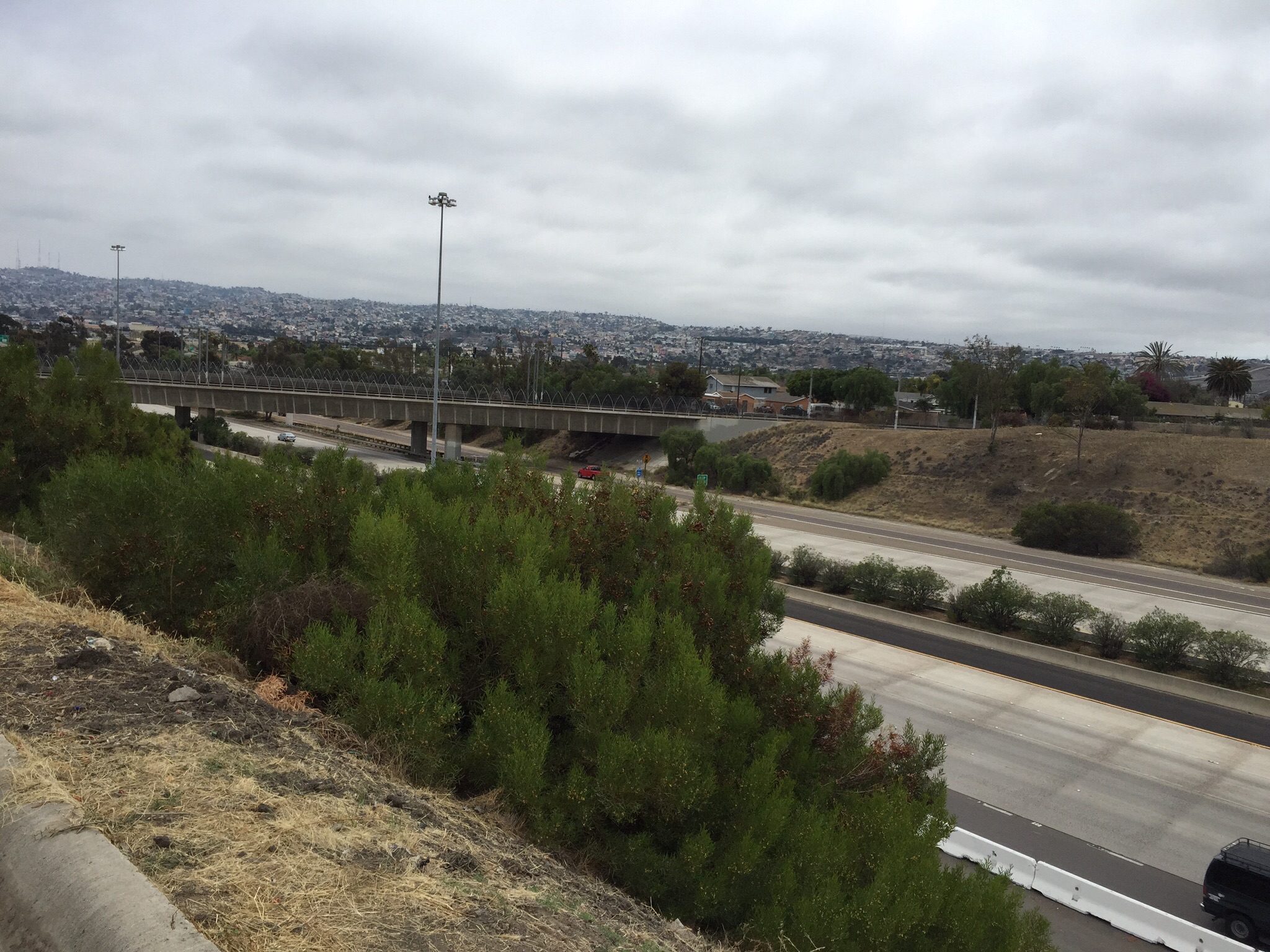
“The grass is always greener on the other side”…view of Tijuana, Mexico from San Ysidro, California.