Tag Archives: Sights

Days 18-19: Berlin Street Art

We were treated to a leisurely afternoon walk through Kreuzberg and adjacent Friedrichshain area where a solid core of artists live and work in Berlin. The river divides East and West and served as a natural boundary in the city, so it was natural for many political and artistic statements to be expressed on both sides of the divide.

Its easy to lose one’s bearings in Berlin. Streets swirl around in circles, crooked alleys, and curvy swerves around bumps. The Berlin wall never seems to be far from sight or presence, and the irregular shape of the boundary keeps you guessing which side you are on. Both today and yesterday are often spoken in the same breath, and for that it makes living here fascinating.

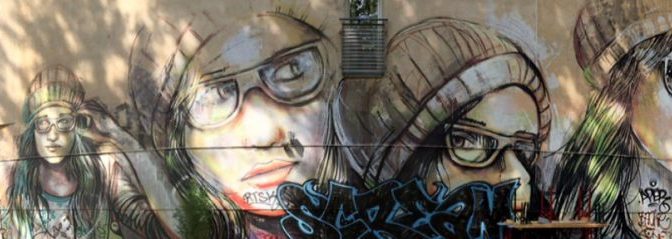
The guide who gave us the architectural tour of Potsdamer Platz shared a very balanced view of the rights and liberties taken by the street artists. While not all were political in nature, they certainly were aware of the limits of their art and how to perform. Street art is different from graffiti art. It is planned and presented for others to enjoy or experience, whereas graffiti is intended for groups within a circle or group.

Graffiti art is illegal by nature and therefore must be executed very quickly, without being caught or discovered in the act of the execution. Teams plan and execute the art, so HOW it is done is part of the excitement and danger. Art placed at the tops of buildings require complicated suspension systems, mirrors, bravado, and skill by artists.

While onlookers marvel at the daringness of graffiti artists, street art is much more deliberate and varied. As shown in the photos, there can be paint, stencils, applied images, and many other creative forms on buildings. In either case, the government and building owners have a say in whether the art stays or goes. For political and aesthetic statements, artists have to consider whether public opinion will be swayed to support their cause, or if it will suffer its own demise by being painted over or cannibalized by graffiti over it.

This tour enlightened me to public art. It may not be everyone’s cup of tea, but it certainly gave me more reason to appreciate the courage and abilities of the artists who choose this medium for expression.
IMG_2414

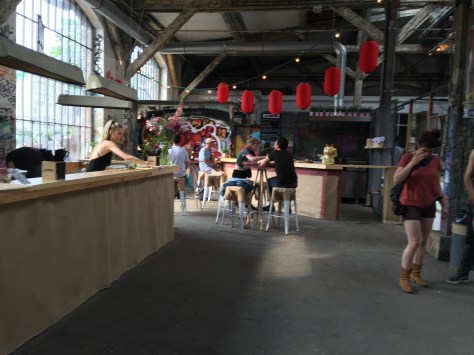
At the end of the tour, we ended up near Warschauer Strasse, a flea market and large industrial zone with old warehouses was buzzing with locals. It was a very “hip” place with innovative food and drinks offered both inside and outside. I was glad that I carry a map everywhere I go now. It’s easy to let the guides lead you, but that blocks any sensitivity training and ability to keep your bearings!

Yesterday’s tour to Potsdam and Sans Souci Palace was more tame but just as challenging. We spent the better part of a day in the blazing sun and walked over 6 miles from the local train station to the town center, the new chambers of King Friedrich the Great, and surrounding gardens.

The end of the day was capped with a Deutsche Oper performance of “Il Troubadour” (more commonly known as “Il Trovatore”). Got the best seats in the house for 15 Euros, compliments of the Goethe Institute. Below is a view of the attendees enjoying the summer-like weather before the performance at the outdoor terrace.

IMG_2387

Days 16-17: “Mr Trump: Tear Down that Wall!!

After posting “Ich bin eine Berlinerin” in January this year, I have renewed my vows for this thrilling city. This time, I am even more emphatic and feeling that I have come to greater respect and appreciation of this vibrant, active, and considerate city. I suppose you can find the opposite in any city, but at the moment I am insatiably intoxicated by Berlin and all the human effort that makes a great city livable.

The week has been packed with German lessons, getting to know other students, and walking tours of neighborhoods nearby. I comprehend about half of the commentary since they are in German, but the visual experience provides the other half. There are so many new elements of the city that I had never seen or understood in the past three visits.

After the walking tour of Berlin Mitte from the day before, the same flamboyant guide escorted us to Prenzlauer Berg. Located on the East German side, it started off as a fairly respectable residential neighborhood, with classic Parisian style facades. Our guide pointed out a few vestiges of Jewish life still visible today–a school with a synagogue behind it and some serious security bollards in front.

If you are interested in the artist honored in the sculpture above, here’s a link to Kathe Kollwitz: https://en.wikipedia.org/wiki/K%C3%A4the_Kollwitz

The later, mind-numbing residential blocks were created in the Sixties (not shown). To support the residential areas, schools were provided. The renowned and advanced development of German schools was a feature of the tour. One current-day school we stopped at has an “adult-free zone” to reduce stress for kids! Schools and a good education seemed to be a tradition and pride of former East German society.

By the Eighties, Prenzlauer Berg deteriorated to a point of neglect. No families lived in the area because the housing was outdated. The big blocks built previously were designed with only one bathroom and communal kitchen per floor. Twenty years later, no one would tolerate that standard of living. No one could afford to renovate either, so families moved elsewhere.

The guide continued to spin a story for us about how the area was rejuvenated, literally. After the fall of the Berlin Wall, everyone was so euphoric. People in the newly reunified city squatted and held parties in these abandoned buildings. Exactly nine months later…

…and now Prenzlauer is considered one of the most livable and desirable areas for families in the cities! From what was a shelled-out, deteriorated, and abandoned neighborhood, schools and other services were re-established to serve the residents. It’s transformed from what was once today’s version of Kreuzberg to Berlin’s Upper West side.

A tour of Potsdamer Platz gave another completely different dimension to my impression of the area. We had stayed there last year (after the Beijing-Moscow-St. Petersburg Trans-Siberian Express), but spent most of the time in the Tiergarten due to the scorching heat at the time.

This tour focused on the architecture of Modern Berlin, after 1989. The trail meandered through Leipziger Square and the southern end of Potsdamer between the Berlin Philharmonic and Kreuzberg. The guide explained the endless debates about how to weave the east and west portions of the city together. The debate isn’t over, but city planners, architects, and the general public exhausted themselves discussing this issue.

Some of the planning was brilliant and some dismal. What has to be appreciated is that the land was repurposed in a No Man’s Land in the middle of the city. The hype today gives faint pulse rates of a Hong Kong or Shanghai tilted on its side. I was grateful that this tour was offered as a “general” tour, even though it would have been a “specialty” tour elsewhere.

The buildings included the Arkaden, a huge modern shopping mall and fully integrated mixed use development. Residential, office, retail, entertainment are all concentrated in one place. Anchored by the Sony Center and the old Daimler site, these buildings claim WFA (world-famous architects) Helmut Jahn for the Sony Center, Renzo Piano Workshop for the Daimler site, and Richard Rogers for adjacent buildings. It’s a lively place intended for all citizens of Berlin to enjoy.

After missing the Berlin Wall tour departure today by a half an hour, I decided to do my own tour. The Mauer Park and Bernauer Strasse exhibit was literally at the next corner to my accommodation, and I had been meaning to go there. With free time on my feet, I discovered a very moving experience. Not only were the exhibits a reminder of the amazing power of humankind to solve its own problems, but the physical development and energy it took was very reassuring. Once again, I could witness modern history in a very immediate way.

IMG_2331

Trump should come to learn the history of the Berlin Wall and all its trials and tribulations before considering building one himself. I don’t think he would do what he says after he saw what it took to undo one. He should listen to one of his cronies, Reagan, to “Tear down that Wall”.

Some of the information from the displays on the Berlin Wall.

And last, but not least, a few of the ethnic shops just north of where I live. I went into one of the Arabic markets and bought cherries, loquats, poufy dried figs the size of your palm (almost, OK, maybe a fat baby’s), spargel, carrots and celery for soup for 12.75 euros.

My first and last adventure the day before with Currywurst, a national institution, was a bomb. Yucky tasteless frankfurter cut into bite-size pieces (good for the convenience and service), smothered with ketchup (bad), dusted with “curry powder” (bad), and served by Germans (what happened to the “ethnic charm”?!?). FLOP. I usually think of myself as tolerant of any fast food, but this takes the prize for low point in human culture.

Day 12-15: Burling into Berlin


IMG_2272Above: the Berlin Tower with a new base

Currently the place where I am staying is known as an “alt bau”, or an old building. I had imagined it as an old Baroque building, finely tailored and detailed, but renovated with modern conveniences. Not. I am in an old building. It will take a bit of getting used to, but it’s going to be fine.

Berlin is wired, both on coffee and devices. Everywhere, at least in the Mitte, people sit outside once the good weather appears. They pull out stools and tables from inside their coffee houses, the laundry or offices.  The coffee and the laptops follow, and nothing less than a Macbook Air. Germans like sturdiness and quality. People sit staring at an open laptop and do double duty with a smart phone in front of their computers, just like we do in San Francisco. The only difference is that they can do it in plain sight and en plein air.

Sports shoes are the hot new fashion statement. Every shop in Mitte where I am staying seems to have a full array of snappy looking shoes with white bumper guards, for not a lot of money. It does feel as if design is a high priority here, with more quality and variety in clothing and furnishings. Mitte feels like an up-and-coming St. Germaine-de-Pres. It will soon become too pricey to afford. I’d give it two to five years at the most.

My first day of class at the Goethe Institute was Monday, and I am already fully immersed. There are 12 students in my Intensive, 4-week Intermediate level class, and Herr Göbels is a mature and native German speaker. After nearly five hours of class in the afternoon from 1:15-5:45 including precious breaks, we are pretty wasted.

Above: Photos of the oldest church in Berlin, the Heilig Geist, with an artistic expression at the entry to the church.

The extensive cultural programs for students focus on the different neighborhoods in this diverse city. The first tour this morning was Berlin Mitte and the oldest section of the city. An evening lecture provided an overview of the cultural city of Weimar. Having just been there, I learned much more about Schiller, Goethe, Nietzsche, Liszt, and Wagner. Liszt had conducted Wagner’s Lohengrin in Weimar, and Richard Strauss wrote “Thus Spake Zarasthustra” based on Nietzsche’s book by the same name. There are planned field trips to Potsdam, the opera, ballet and museums, so I am a happy camper!

However, it’s back to the grindstone. I have homework and audio assignments to finish before class tomorrow! I enjoy the focus, learning about the host country, and meeting a wide spectrum of students from many countries. I highly recommend a similar program for any language learner.

I have a few shots to share of the Deutsches Historical Museum and Potsdamer Platz.  The historical museum contains a new wing that showcases the architecture of I.M. Pei. He also designed the East Wing of the National Gallery and the prominent entrance to the Louvre.

The story of the Berlin Wall  was displayed in posters at Potsdamer Platz. After going to the Stasi Museum in Leipzig, I was more curious about the events that led to Reunification in Berlin. The story is told in these words and pictures and includes a healthy (?) supply of bubble gum stuck to the old wall relics. Click on each image to increase the size and readability.

Day 11: Lively in Leipzig

The weekends in Leipzig are filled with musical activity, not only in the Concert Hall and Opera House, but everywhere in the street. Students and aspiring musicians and performers try their luck at attracting tourists and locals, in a town that welcomes crowds and causes.

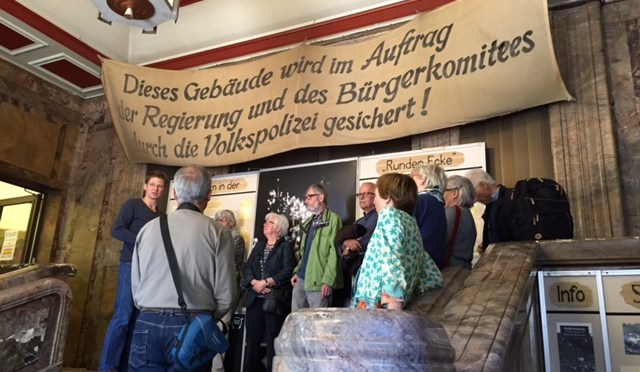
The Stasi Museum depicted life just as it was before the Reunification and explained the course of events that led up to it. It was a fascinating unfolding of momentous days in 1989, from the first peace protests, to the burning of evidence as the tides turned, to the final decision point on November 9, when the Berlin wall fell. It’s an easy date to remember as it is the reverse of 911.

The translation to the sign above reads “On behalf of the government of the Citizen’s Committee, this building will be secured by the National Police”.

I imagined all the legal papers that were needed to draft the new laws and how  the East German economy was shot into the modern world overnight. It seemed so simple, yet it must have been an overwhelming undertaking.  It took the will and determination of every German. My faith in humanity was restored and I felt grateful that such a human event could occur in my lifetime.

IMG_2128
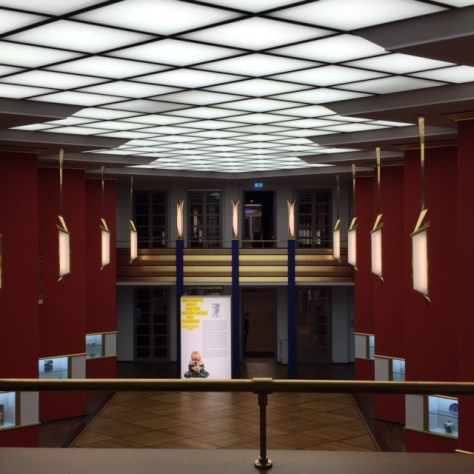
The Grassi Jugendstil atrium reinterpreted

An afternoon at the Grassi Museum was a shift back to the familiar yet unusual. There was an excellent exhibition of Flemish and Dutch glass and ceramic pieces, inspired by Asian ceramics. The incredible use of light, color and design seemed to be ingrained in the area’s artistic traditions.

While limited, the museum had an excellent display of Asian ceramics and figures. They reminded me of similar pieces I saw in Northwest China.

A collection of artifacts from Iran intrigued me. I marveled over the many pieces that I had not ever seen. I resolved to continue my comparative history studies of countries along the Silk Road. The blue porcelain pieces were reminiscent of those in China, but the metallic colors and designs were much more vibrant and intricate.

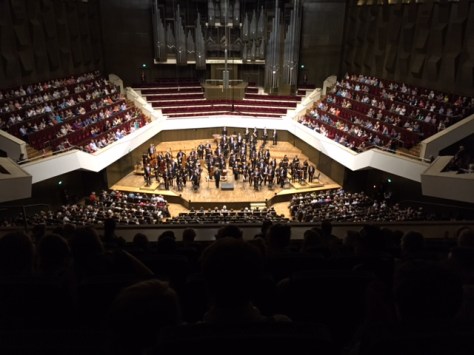
The end of the day was capped with two classical music performances. The first was a family concert at the Gewandhouse Orchestra. Herbert Blomstedt, who led the San Francisco Symphony for many years, conducted the orchestra with the Beethoven Pastorale Symphony.

IMG_2211

The second of the two concerts was held at the Schumann House, where Robert and Clara Schumann lived. A pianist performed many pieces from Beethoven, Clara Schumann’s own pieces, and those by Schumann. They were very lively and spirited pieces and a contrast to the earlier, much duller performance.

IMG_2221
Entry staircase

The simple yet elegant stairway at the entrance to the Schumann house was a lovely reminder of the integration of good design and construction in German homes. The museum is now linked with other musical sites such as the Mendelsohn and Wagner houses in Leipzig into a “Music Trail”.

IMG_2213
Community Room with motion sensitive instruments in ceiling

During the performance break, the announcer invited us to a community room and shared the research that is being done with electronic instruments generated by motion detectors. Each “spot” was keyed to an instrumental sound, such as clinks on porcelain, horns, keys, drums and bells. Using motion detectors and people walking between objects mounted in the ceiling, a series of sounds were generated. The more people moved, the more each sound was created.  The innovation could produce symphonic sound with audience participation. It was an exciting demonstration that everyone enjoyed.

Day 10: Hypezig Leipzig

A first reminder of Leipzig’s political history was evident at the main entrance to the Markt. The banner read: “Love Football. Hate Racism”. They continue to extend an open hand to refugees and warn against Neo-Nazi tendencies. Despite the loudspeakers and full police reinforcements nearby, it appeared to be a quiet, orderly, and reassuring demonstration.

Today’s demonstration was a faint reminder of the city’s history. In 1989, Leipzig sparked a series of demonstrations at the Nicholai Church that led to Reunification of Germany. You can read more about Leipzig here: https://en.wikipedia.org/wiki/Leipzig

Leipzig doesn’t have the appeal and cultural taste of Weimar, but it has music to make up for its visual shortcomings. There are a wealth of classical and rock concerts, performances, plays, and revues, and the Gewandhaus and the Leipzig Opera are world-renown. As a major trading town and international fair promoter, Leipzig seems to have picked up economically since I was last here. Many new malls, museums, and building developments have surfaced, and the economy seems to be booming.

There are still many lovely Baroque-like buildings to appreciate everywhere you turn. Intricate passageways connect positive and negative spaces to each other. The decorative elements and sturdy, well-maintained buildings are reminiscent of Prague. Newer buildings are well integrated into the urban, pedestrianized fabric of the city.

The famed Auerbach’s Keller is where Goethe purportedly wrote “Faust”. The cellar and dark interior of the restaurant spins the mind into believing that Goethe himself must have made a deal with the devil there. A couple of bronze statues at the entrance add to the dramatic air.

The Friday Market was also in full tilt and it wasn’t hard to find seasonal spargel, or asparagus. Every vendor was selling some, and it dropped dramatically from 6 Euros in the morning to only 2 Euros per kilo by midday. Fresh meat, cheese and cakes tempted the eye as well as the palate.

And, the Thomas Kirche offered a moment of peaceful reflection at the end of the day.

image.jpeg

If you want to see an experimental short film on a Leipzig mural in one of the passageways: https://www.youtube.com/watch?v=yi5GPovC2Vc. Set volume if you want to hear the Thomaskirche organ.


Day 4: More Moritzburg and Carmen

A couple of years ago my friend Hanne and Jens introduced me to Moritzburg. I had been wanting to go to King Augustus’s “Hunting Lodge” again. I got my chance when a group of us planned a half-day excursion. We mixed and matched a combination of public bus and private carriage to get there. By doing so, we had an interesting variation of conversations in German and English. International and local friends from Germany, Bulgaria, the U.S. and Switzerland got in our Sunday gear and convened in Dresden for this delightful day of history sharing, friendship, and even tail-gating.

Most of the historical significance for this private country estate centered around 1730. Similar to King Friedrich’s Sans Souci outside Berlin or the Summer Residence of Peter the Great outside St. Petersburg, Moritzburg is another opulent getaway villa. This one, however, did seem more tastefully decorated (if that can be compared). My favorite room is the dining room, where all the deer antlers are displayed. The tips of the antlers are duly recorded and ordered in the dining room from the smallest to the largest sizes (mostly 26, 28, 30 and 32). You can read more about the castle here: https://en.wikipedia.org/wiki/Moritzburg_Castle.

Curtain Calls for an evening performance of Carmen  at Semperoper below:

SF Victoriana v.2

Local friends and family know I like taking cross-town walks, so a planned lunch downtown was another excuse to make a quick 5 mile, zero-carbon footprint (except on my soles) hoof from home to table. My usual 100-minute exercise was interrupted by several scenes along the way, extending the time another 30 minutes!

My first distraction was a tiny, delicious little custom sewing shop. Laden with love and care, this local shop presented itself with a cute storefront and encourages you to peek inside. The treasure trove of lovely ingredients sparks the imagination and reminds you to think about art and what you wear.

Further along McAllister Street, between Masonic Avenue and the Civic Center, are a potpourri of beautiful Victorian homes. These are well known in San Francisco as “Painted Ladies”. They continue to mature into beautiful streetscapes that can only be fully appreciated by foot.

The heavy timber buildings were built at the turn of the century, when San Francisco was flush with wealth from the “Rush” of the Gold Rush. Local craftsmen, who must have been trained as carpenters in Europe, and artisans detailed and built custom one-of a kind residences for the nouveau riche. The gentle weather in the Bay Area allows these incredible structures to survive beyond a natural lifespan, along with the healthy, inherently bug-resistent redwood bones.

The beautiful entryways, frontages and detailing are definitely “look at me” attractions. I have driven along this route many times, but have only just come to notice and appreciate these buildings recently by walking through the neighborhood.

If you remember from last month’s February posting, I showed pictures of a house with a giant Valentine dangling outside (shown to the left below). Intrigued with the artwork at the time, I didn’t make a mental note of where it was. This time, as I walked on the same street and the block before the house, I wondered where the Valentine house had been located. No sooner had I pondered this question, when it appeared!  A new outdoor greeting for Easter was proudly displayed.

The re-discovery of the hanging artwork brought a sheer feeling of glee to me. In addition, a tiny toy mailbox was perched on the garden wall just outside the house. There were colorful sheaves of paper hanging next to it, with a dog-chewed pencil attached. A sign invited comments to the artwork! I was so inspired and delighted by this opportunity. I showered the artist with kudos for caring and sharing and stuffed my note into the pumpkin-colored mailbox.

I was late to lunch, but  glowed all day.

PS. Plans for this summer’s travels are being finalized, so stay tuned!

Japanese Art, the Western World and Bonus Video

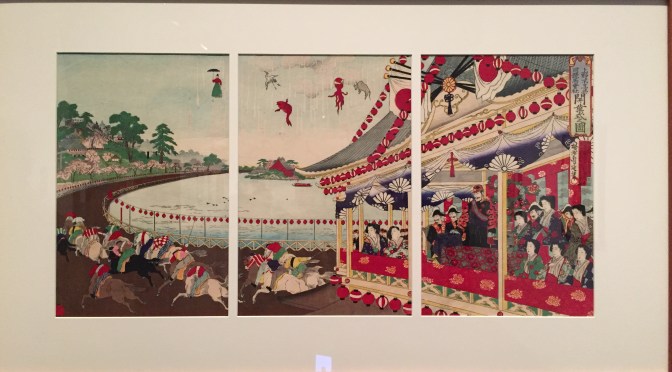
In a current exhibition at the Asian Art Museum, you can view some interesting comparative paintings between the Hiroshige woodblock prints and famous Impressionists like Van Gogh, Matisse, and Monet. Europeans were fascinated by Japanese artists and emulated these new discoveries. While the pieces by well-known Western painters are limited in number, the exhibition certainly provided a good case for the Japanese inspiration from which the Europeans drew.

Many of the wood blocks by Hiroshige, although small scale and delicate, had very intriguing themes. At the upper left photo, the woodblock depicts a lively scene with trees swaying in the wind and someone chasing after his hat. This scene is one of a series of woodblocks that recorded towns and villages between two major cities. Each one was unique so villagers could distinguish their town from others.

The close-ups close to the picture plane of portraits were also imitated by Westerners eager to draw from sources little known at the time. See the portrait of a Japanese Female Princess character in middle photo above. Japanese decorative arts were also widely copied and emulated, as seen in the photo, above right. While imitation is the greatest form of flattery, I wondered what the Japanese artists thought of Westerners’ borrowing of original ideas. There certainly weren’t copyright infringement laws in place at the time, so it was anyone’s game.

Regardless of the historical backdrop and lingering questions, the exhibition was very enlightening and presented much food for thought. Here are a few comparisons, that show the early precedents of Japanese art followed by paintings of Western artists:

Both the Jugenstijl movement (see my post on Mucha in Prague from May, 2015) and the Art Nouveau style in Europe (see St. Petersburg posts in September 2015), as well as the Arts and Crafts Movement in England, were heavily influenced by Japanese prints and decorative arts. Similarly, Frank Lloyd Wright was heavily affected by Japanese design (see FLW in Chicago post, October 2015).

See the inspiration for the graphic designs for Tiffany and other poster art here:

You can learn more about this exhibition and details of the exhibition, on display until Feb. 7, 2016 at: http://www.asianart.org/exhibitions_index/looking-east

Note: My apologies for not recording the titles or names of the Japanese pieces. While many of the woodblocks in the exhibition were attributed to Hiroshige, there may be other artists whose names I did not note.

For a video on the Goethe Institute at Schwäbisch Hall, where I took a German class for two weeks on language and culture, see here:

Day 79: A Recap of 80 Days Around the World

Here are a summary string of my favorite headers, from the panoramic shots posted:

Map of the Trans-Mongolian Express from Beijing to Moscow (see featured image above). Note the Purple line for portion of Trans-Mongolian Express that links to the Trans-Siberian Express (red line).

Beijing and Mongolia:

Moscow and St. Petersburg:

Berlin

Salzburg, Vienna, and St. Florian (Linz)

Switzerland

Schwäbisch Hall and Stuttgart

New York, Vermont

Philadelphia, Chicago

Santa Fe, New Mexico
cropped-img_0202.jpg
cropped-img_0211.jpg

Day 77-78: Art is Everywhere in Santa Fe

On an early morning walk, I was amazed at the amount of abundant sculpture and outdoor art in this small, aesthetic town. Landscaping, architectural elements, and artwork were integrated to give a deep sense and appreciation of the arts.

Throughout residential and commercial neighborhoods, you can find extensive use of the old adobe mud brick and plaster walls. They provide a consistent look and a unique quality to Santa Fe. The sense of time and place are established by this pattern. Newer walls surrounding buildings have a timeless quality, with updated elastomeric coatings that expand and contract with extreme weather conditions.

The wealth of galleries and museums are easily accessible within the city. The Georgia O’Keefe museum was just around the corner from our hotel. Although I am not a fan of her work, I learned to appreciate the life of O’Keefe and the meaning behind her work. She led an avant-garde lifestyle with her husband and photographer Albert Stieglitz in New York before settling in New Mexico.

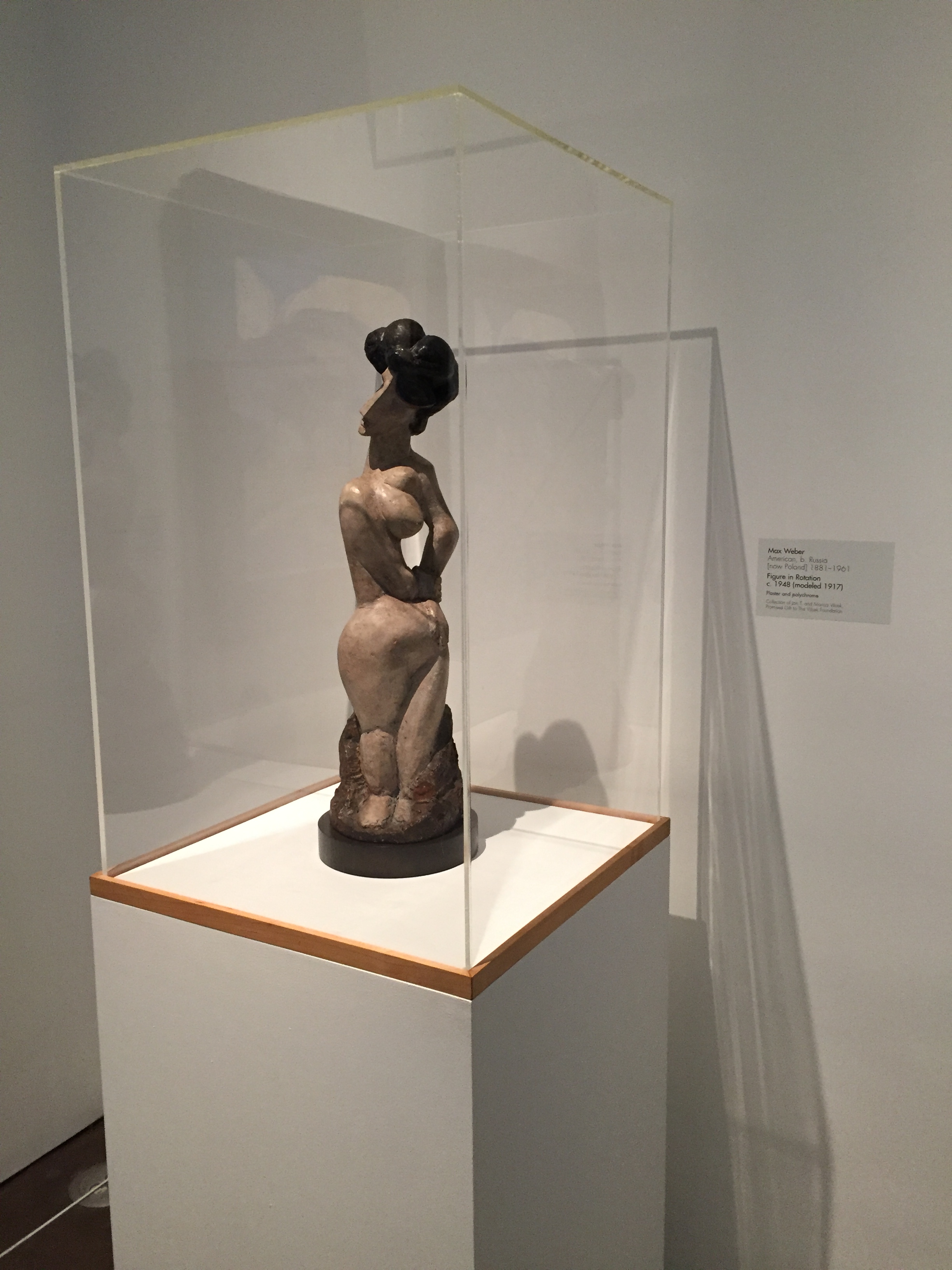
My favorite piece from the museum was a cubist sculpture by Max Weber entitled: Figure in Rotation (1948)
IMG_0240

Later in the day we visited a collection of museums and galleries. The new Museum Hill area housed the Museum of International Folk Arts, the Museum of Indian Arts and Culture, and the Anthropology Laboratory. It is only a couple of miles from the Plaza and accessible by bus.

We visited a couple of galleries along the Canyon Road area. I was trying to track down an old friend from school who is now a famous jewelry designer in New Mexico. We were able to find a gallery that exhibited her work and were impressed with the quality of the pieces using precious stones in modern settings. You can read about her in Wikipedia at https://en.wikipedia.org/wiki/Gail_Bird_and_Yazzie_Johnson

The next day, we visited Bandelier National Monument, where some of the Ancestral Pueblo Indians settled. Known as Frijoles Creek and Canyon, this area along the Rio Grande leads to the Alcove House, where we climbed up 140′ by ladder to see the cave dwellings. The pink rock is composed of volcanic ash that formed into a crumbly rock known as tuff. This material creates pits and can be carved into larger openings.