Tag Archives: Sights

Days 50-51: Mongolia 4

We are in Day 5 of ger living. Despite its challenges, the variety of gers has allowed us to get a full flavor of ger living. Our last ger included a stay along one of the largest fresh-water lakes in Mongolia. While rudimentary, it gave us a feeling of staying at Lake Tahoe, Mongolian style.

The many incredible, pristine pastoral landscapes we encountered traveling off-road by Land Cruiser included frequent herds of sheep, goats, horses and cattle. These are free-range animals, owned by herders who live in nearby gers, and have no fences. The animals get rounded up at the end of the day and know who and where their friends and family are. We had a full court press of the domestic animal world with a few wild ones and migrating birds for flavor.

The Erdene Zuu Monastery was founded in 1586 and is the first Buddhist monastery in Mongolia. The religion came from India and Tibet in the 12th Century. The grounds of the Monastery are preserved as a museum. The adjacent complex is a working temple. The temple was built over the palace built by Ugudei Khan, and materials were taken from the ruins.

The Kharkhorin Museum presented a fascinating series of maps showing the the history of Mongolia. If you are curious, please click on these to see more; if not, skip this section.

The Chinese Han Dynasty successfully fought back the Xiong Nu empire in Northwest China, and early portions of the Great Wall were built to deter the Xiong Nu from advancing further. (Remember Mu Lan? She was fighting the Xiong Nu!) You can read more about the ruins of the early Great Wall in my posts from Turpan in August 2013.

In the following series, you will learn more about the history of the great Chinggis Khan (1162-1227), one of his sons Ugudei Khan (1186-1241), and his grandson Kubilai (1215-1294). The maps attached are in some ways easier to read than the ones above, as they show the flow of conquests. Take a look at the arrows and dates on the maps and the extent of their conquests in the span of a century! The influence of the Mongols reached as far west as Iran, Iraq and Turkey.

In the same museum where early 8th Century Turkic memorials were preserved, a tomb for servants contained miniature figures similar to those found in Xian. They had Han Dynasty characteristics similar to the figures we enjoyed seeing in Dunhuang Museum in Northwest China. They had unique, expressive faces and lively gestures in their bodies. Apparently these were not created in a tomb for any noble, but were offerings by servants. The size of the figures, gold, and ceramic pieces were not large enough to represent those that were buried with those a leader.

Day 49: Mongolia 3

While we basked in the luxury of a “free range day” where we explored the wide open countryside at a leisurely pace, we still had time to take in another UNESCO World Heritage site. The Orkhon River Valley was a prime location for burials that grouped together large flat steles in round or rectangular shapes. Another spot showed exposed granite stones weathered over time with petroglyphs still evident.

The Land Cruiser allowed us to enjoy the off-road traveling comfortably. Otherwise, it would have been a Russian van that was just as sturdy but a rough ride. Along the way we encountered herds of free-range sheep, cattle, goats, and horses. Many birds also migrate to Mongolia over the summer and travel as far as South Africa.

The photos don’t do any justice to the huge 360 degree views that take your breath away. The clean air is also hard to swallow, especially after Beijing!

Look for next station after Ulaan Baatar: Lake Baikal and Irkutsk, Russia!

Day 48: Mongolia 2

This will be short. We spent the afternoon with a Mongolian herder family. It was alive with activity, including milking cows and horses (for mare’s milk), corralling animals, racing with boys, tasting fermented mare’s milk and curd dessert, and playing with the family’s newborn baby.

The family included an award-winning horse racer (30 years old), his wife (29 years old), his two boys (8 and 6), and the newborn (1 month old)

Our capable guide could milk the cows and horses and had many other talents, but we were thoroughly impressed when she could milk cows and horses without any difficulty! Our driver could wrestle and win races against 5 boys all at once!

Days 45-47: Mongolia 1

After the last posting on Beijing, I didn’t realize that leaving Ulaan Baatar was going to cap access to the internet for awhile. Therefore, you are receiving a rather long, delayed post. The itinerary through Central Mongolia was on and off-road, to ger camps without internet access. It was both a blessing and a curse.

But more importantly, a little background on the vast country of Mongolia. It is a flat, diamond shaped country the size of Western Europe. It is sandwiched between Russia and China and therefore must maintain good relations with these giants.

The growing season is only four months during the summer, and the entire country is shrouded in snow in the winter. Its harsh environment requires the mere 3 million people to rely heavily on family, community and each other. The limited good weather impacts all development, repairs and activity to a very short season.

Why come to Mongolia? Here are three reasons: to learn about the past, present, and future. The history of Genghis Khan, the first ruler who united the tribes, is a fascinating one. His descendants, including Kublai Khan continued to rule during the Mongolian Dynasty for two hundred years, from 1200-1400. Most of the expansionist period was during the first fifty years, when the grandsons who were posted to the outer reasons conquered as far west as Hungary and beyond. 1 in 200 men in the world have the DNA directly attributed to this prolific ruler Genghis and his descendants.

Following the Yuan or Mongol Dynasty that ruled most of Eurasia and China, the Ming defeated the Yuan at their capital in Beijing, and then the Manchurians (Ching Dynasty) ruled over China and Mongolia. With Russian help, Mongolia defeated the Ching Dynasty and became an independent country in 1921.

The second reason for coming to Mongolia is the environment. Mongolia, unlike China today, is still a pristine and pure environment. Nothing can be more contrasted than flying from Beijing to Ulaan Baatar (the correct spelling). The pollution and stifling heat of Beijing disappears and the crystal clear skies and bright sun of Mongolia appear. Ecotourism is being promoted here today and the Mongolians are very proud of their country. They know that the world is their oyster and they have every intention of protecting it.

The future is the third reason. Mongolia has huge mineral resources. Mining is one of its biggest industries, and tourism is growing despite its short season. With such a small population, Mongolia’s GDP has been growing at a rate of 10-15% over the past several years, twice the pace of China. While Mongolia is still considered a basically agricultural, nomadic land, it will experience phenomenal change.

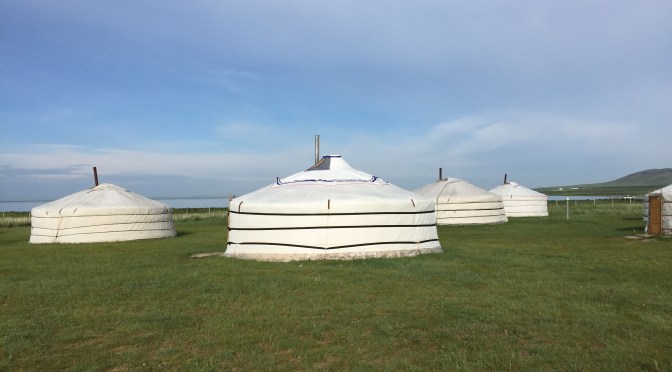
Many people are still nomadic herdsmen, and they still live in the traditional ger, or round huts. They are constructed of wooden supports, felt padded walls, and can be easily assembled. A pot belly stove in the middle heats the room, and all the basics of living are contained within the ger: cooking, eating, sitting, sleeping, and storing. Oops, except for the toilet.

Everything has been hunky-dory in the ger camps where we have been staying for the past few days (we’re in No. 2 of 5). Toilets in the first ger were banked below the dining hall, not unlike those you would find at the UC Blue and Gold Camp in Pinecrest, CA. The second ger ratcheted up the ante to an outhouse, with a tastefully decorated Mongolian tent over the pair for easy identification. You could use the sawdust at free will. I was getting into the flow, with one minor detail. It rained this morning.

Imagine the scene for dressing (everything was set in place in advance the night before inside the ger), with even an umbrella. Contending with Mother Nature in order to let Mother Nature contend with you was a challenge. In the end, it wasn’t as bad as it sounded. You just felt all thumbs and big toes in the execution. When in Rome, do as the Romans, as they say.

But I digress. Back to Mongolia. The first afternoon of our private tour was devoted to the National History Museum in the middle of Ulaan Baatar. The museum traced the beginnings in the Fourth Century BC to the present day. Photographs are not allowed there or during the performance of traditional Mongolian singers and dancers. The main display I wanted to capture was the map of the conquests by Genghis Khan and his grandsons. They occurred over a very short time span of fifty years, and mostly in a ten year period between 1215-1225.

In the morning of Day 2, we visited the largest Buddhist monastery in Mongolia. Mongolia is 98% Buddhist, so the religion plays an important part in daily life as well as its history. Buddhism came to Mongolia via the Tibetan monks. Today’s monks come from all over the country to study and chant at this monastery.

Later in the morning, we left the capital city to visit a shaman. Shamanism, or contact with the spirits through a medium, is also practiced in Mongolia. If an individual wanted to send a message to the gods, he or she went to a shaman. The shaman did not give advice but only transferred the information back and forth.

IMG_3561 3

This shaman explained to us that she was “struck” by both a desire and calling only after being confronted a number of times. After her husband died and she was sick, she eventually consented. She very patiently and proudly explained her roots and the people she served.

Her room was laden with offerings to the gods and spirits, both good and bad. Offerings included cheese, curd, dried nuts, fruits and dishes of food. Unfortunately, I didn’t get the answer to a question I had in mind. Her next appointment was already waiting and time ran out.

In the afternoon the driver and our guide took us on and off road in search of the Przewalski horses. They run wild and are the ancestor to today’s domesticated horses. They are shorter, stockier and more muscular than the Arabian horses we are accustomed to seeing. They are named after the Russian who discovered them and helped to return them to their native land. They were an endangered species, but due to good management, they can now be allowed to proliferate in a protected environment. It felt a little bit like whale watching, but we were able to find a pack of six in the distance.

The vast green virgin landscape stretches literally for miles and as far as the eye can see. Occasionally there are pigs, and sheep dotted throughout the landscape. The herdsmen know where their herds are located and round them up at the end of the day. They are branded and the larger animals are used for milk and transportation.

The next day, the landscape suddenly rose in elevation, with mountains in the background to nearly 4,000 meters (12,000 ft!). Eventually a sandy desert mixed with small grass emerged. There are many small, Gobi-like deserts throughout Mongolia, and we headed for one of them. The camels that reside here are two-humped, and can carry up to 800 lbs. They can travel without water for a month and without food for up to two months. (See featured photo above)

The distances between sites are vast in this huge country, and few roads are sealed. It takes nearly three hours to travel 100 miles, due to hazardous pits in the road or sandy roads. We were surprised that the driver only had to refuel once in the three days we were driving. While we weren’t used to sitting in the car for such long hours, we were grateful that the Land Cruiser was very sturdy and capable of handling bumps, muddy pits, and stream crossings.

Today’s drive took three hours off-road to a beautiful valley known as the Orkhorn Valley. Rain and inclement weather has deterred our camel and horse back riding, but we have been able to see the beautiful lush green, unspoiled countryside in its natural state.

(Ed note: Apologies for delays and disjointed editing in post. Limited or unpredictable access to internet make posting a challenge! It was quite refreshing to be off the grid, were it not for my anxiety about posting. I finally decided to let it go, so hope you will understand and appreciate how some of the rest of the world lives. Gee Kin did catch one of the monks using his smart phone under his sleeves at the temple. He was playing chess. One of the daughters we met with the herder family confessed that she missed the internet in town. It’s a changing world….)

Days 33-34: Berlin Dome and Comic Opera in Berlin

The Berliner Dome, like the Berlin TV Tower, shares a prominent place in the city’s skyline. And, like the Tiergarten, this visit gave me a chance to slow down and absorb its inherent beauty . While it is a “Protestant” Church and not a “Catholic” church, it nevertheless was highly ornate in its presentation. In 1905, it was a last gasp for the Prussian monarchy. It was restored in the 1990s.

The main chancel apse had three impressive panels showing the birth, cruxifiction, and resurrection of Christ. A large organ in the niche to the left made me want to return to hear it one day. The basement was a bit creepy as it held the crypts of many of the Hollenzollern lineage, including that of King William Friedrich (1861).

I subjected myself to an adventure at the Comic Opera, where I saw Massenet’s “Cedrillon”. It was loosely based on the story of Cinderella, so a bit of a ho-hum with nice music. The cast was subtly baudy (if that’s possible). It reminded me of the opera-goers’ version of Beach Blanket Babylon in San Francisco. The chorus or corps de ballet definitely provide the tongue-in-cheek comic element. Despite top-notch singing and a pretty good stage set, it’s not everyone’s cup of tea.

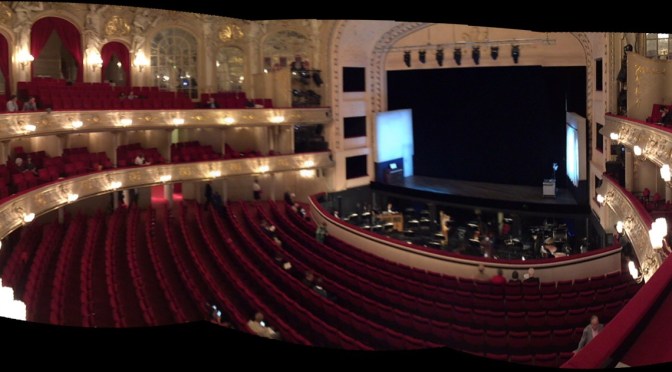
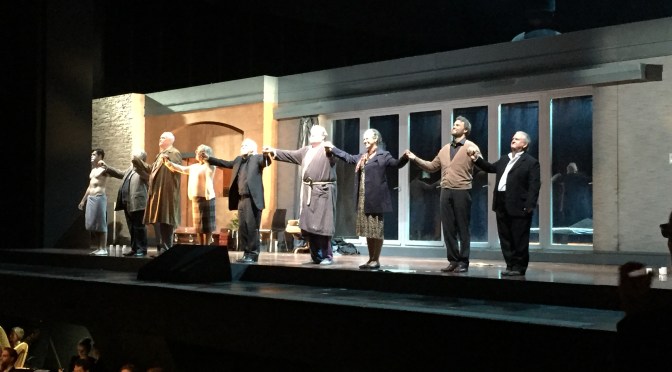
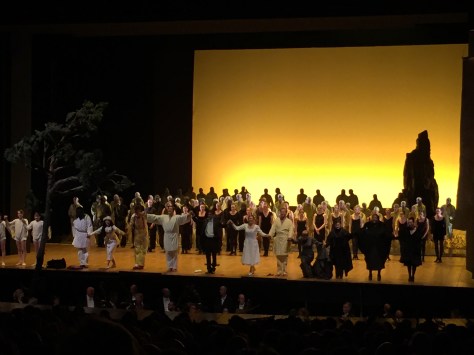
The opera house itself was worth seeing. It still conveyed the grandeur and aura of the past,  but sadly was a bit shabby and in need of a face lift. A surprise inspiration were large video screens in the lobby, that show current performances and cast lists. Cedrillon is replicated here. The last photo below shows the actual evening’s cast and curtain call.

In keeping with the comic opera theme, I found a few amusing moments in my month’s travels in Berlin:

Photos, above:

1. Upper Left: Temporary repair work in front of a subway elevator: An example of solid German engineering and construction????

2. Upper Right: A vending machine in Alexander Platz that sells books. Either this is wishful thinking (although 9-10 Euros not a bad deal) or the rest of the world hasn’t caught on yet. It does give me reassurance that Germany is a unique country and its tradition of the the printed page endures. Long live Gutenberg, the Bible, and romance novels spearheaded by Goethe!!

By the way, vending machines do not mean markup. For convenience, the Ritter wafer packets are only .90 Euros in the machine, but 1.10 Euros in shops. You can often find what you need, when you need it, without getting ripped off.

3. Lower Left:  Fußball and all its trappings are the rage here, especially this month during the Euro Cup finals. It’s hard not to get excited about teams like Spain, Portugal, Slovakia, Ireland, Turkey, Belgium and Germany, of course.

4. Lower Right:  Y-U-C-K!!!! I’ve had to stare at this every day in my U-tube station. They finally censored it this week with tasteful black and white, wordless Annie Lebowitz-type photo panels, but I strangely found myself missing the former grossness.


Day 31: Jewish Life in Berlin

Berlin is starting to recognize its Jewish history and the part it plays in understanding the city today. Friday morning’s tour was led by our guide, Matthias Rau, from the Prenzlauer Berg and Berlin Mitte tours. We started at one of three Jewish cemeteries in Berlin. A reproduction of the headstone of Moses Mendelssohn is located in the cemetery (see photos below, upper left). He was one of the major leaders of the Jewish community in Berlin in the 18th Century. If you are interested, you can read more about Moses Mendelssohn here: https://en.wikipedia.org/wiki/Moses_Mendelssohn

Only some of the stonework with inscriptions were salvaged at the cemetery. The grave sites are covered with ivy.

Photos above:

1. Upper Middle Left: The site of the “missing house” is used to identify Jews who had lived in the building. Tags on adjacent buildings indicate where each family lived and are stark reminders of the lives that disappeared.

2. Upper Middle, Right: Brass plated tiles with inscriptions of names of Jewish people who lived in the area are found throughout Berlin. Organized by a private foundation, this effort identifies individuals, their birthdates, where they died, and when. Most of the inscriptions we saw identified Auschwitz as the place of death. (We later noticed plates in Kreuzberg.)

3. Upper right: A tribute to Regina Jonas, the first woman rabbi in Berlin. She was part of the Jewish liberal sector.

4. Lower Left and Lower Middle: The New Jewish Synagogue (1866, Oranienstrasse 30) was the center of the Jewish community (also wooden doorway from Entrance) .

5. Lower Right: Augustus Strasse, where the Jewish School (shown in photo on the left) was located. It now is used for community space, the Kennedy Center, and other public facilities (Pauly Saal Restaurant and Mogg, a cafe, are located in the building).


Day 30: Tiergarten and Tosca

A walk in the park doesn’t sound very exciting, except that it was very calming and soothing. After many days on the go, this small guided tour was a refreshing green window into another discovery of Berlin’s treasures.

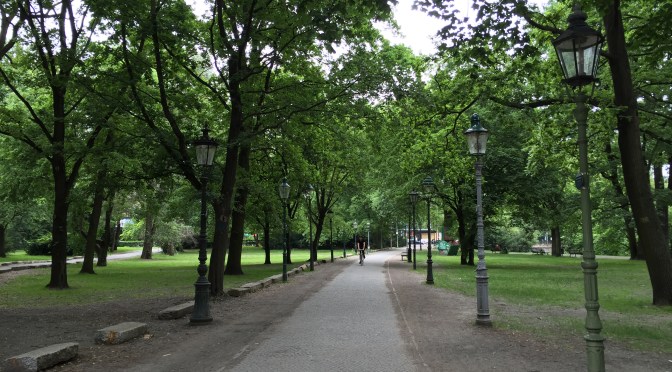
The path at the entrance from the Tiergarten subway stop displayed the many variations of gas lanterns donated to Berlin from other cities (featured image at top). Each one was unique, and I was delighted to find Dresden’s contribution. Each city was proud to showcase its industrial development skills. Sadly, vandalism and limited funds have caused the historic elements to deteriorate.

Although the park is known as “Tiergarten” for “Animal Park”, there are no animals here. They reside in the adjacent Zoological Park. The Tiergarten was originally the private grounds for King Friedrich’s hunting pleasure. The garden was a pit stop between Charlottenburg Palace and the king’s residence in the center of Berlin.

cropped-img_27201.jpg

Among the many monuments and statues in the park, there was a tribute to the King’s hunting days (see photos and header reposted above). Gee Kin and I had discovered this curious pair of statues last year on our visit to the Tiergarten. The park was, and is, a welcome respite to the unbearable heat that can surprise the city. Another pair of statues made tribute to the king and queen. The king was clad in street clothes rather than in his official military regalia. The “street cred” represented his love of the casual, private retreat of the park .

Photos, in gallery, above:

  1. Upper Left: One of the many extensive and romantic paths in the park, designed by landscape designer Peter Joseph Lenne. He created the grand Prussian master plan for the park. He was so successful, that he was able to live on a street in the park named after him in his own lifetime!
  2. Upper Right: A stele monument to the cities that donated trees grown in the park. The park was damaged in WWII and wood was chopped down for firewood.
  3. Middle Photo: The Spanish Embassy is one of the few buildings located in the park. Many other embassies are located along the park but not inside. Spain was one of the few countries with a strong relationship with Germany (along with Austria, Italy, and Japan)
  4. Lower Left: Monument to Victoria: the “Big Star” (Große Stern) was  strategically placed along the 300 year-old east-west axis. The road through it was intended to emulate the Parisian boulevards and widened in the Third Reich.
  5. Lower Right:  This view of the park is a completely man-made version of nature. The images of Claude Lorraine’s paintings and other Romanticists were popular at the time, and this was Lenne’s golden opportunity to do his client good. He even built an artificial island (in the distance in the middle of the photo). The lakes were designed as “mirrors” to reflect the sky and land around it. He did a pretty good job. I wouldn’t be surprised if Frederick Law Olmsted didn’t use this as a model for Golden Gate Park. The German designer followed and copied English landscape design, however, so I don’t know which chicken or egg came first.

A lakeside beer garden is a place where both Berliners and tourists can enjoy a leisurely day in the park. They even have dancing here, but I don’t think they have discovered Tai Chi yet.

IMG_2713
Lakeside Bier Garten


A pretty decent performance of Tosca at the Deutsche Oper was hard to beat for 15 Euros, thanks to being a student of the Goethe Institute.

IMG_2744

Day 25-26: Berlin in 24 Hours+

I opted out of a boat trip on the Spree and a tour of Potsdam Babelsberg with the Goethe Institute this weekend for my own individualized tour. Here’s the daytime version of my itinerary on Saturday:

10:00: Meet friends from the Goethe Institute for Brunch at Sud Bloc, a Turkish Restaurant in Cottbus Tor.

12:00: Attend The International Design Festival. It was a tough choice between the 9th Berlin Art Biennale and this one, but my priorities and practicality surfaced simultaneously. Besides, the Biennale is here for another couple of weeks. It shows what a fantastic city this is for art and artists. Below are a few of the displays that were presented at Kraftwerk, a huge warehouse/industrial building in Berlin Mitte near the Heinrich-Heine Station.

14:30: Walk through trendy streets in the Mitte near Rosenthaler Platz. The KW Institute for Art, one of the Biennale centers, is located on Augustus Strasse. It parallels another delightful alley, Linienstrasse, that is sprinkled with cafes, one-of-a-kind handmade items, and art galleries. I had a red lentil and avocado sandwich with a German rose wine across the street at the old Jewish school. Melissa and I saw the Kennedy Exhibition there in January this year.

IMG_2593

16:00: Stop at my Air BNB on Brunnenstrasse for a cake and coffee break.

17:00: Visit the Bernauer Strasse wall exhibit (see posting from last week)

18:00: Alexanderplatz pit stop, with a Afrikaner Festival food and entertainment in high gear.IMG_2594

19:45: Performance of the Return of Tobias, an Oratorium by Joseph Haydn at the Elizabeth Church around the corner from where I am staying.

This was a bonus performance. Since I was so tired, I was debating about whether to go. The performance was sold out, but seating behind the orchestra was available for 5 euros! I could enjoy the full choir, orchestra, and professional quality opera singers and kick my shoes off at the same time. The performance began with actors at the cemetery a couple of blocks away, setting the stage for the story. Everyone returned to the church, where the full story, singing, and beautiful music in an intimate setting unfolded. A delightful close to an exhausting day.

The following day’s activities started with alot of guilt-laden German studying, but in the afternoon I treated myself to a brilliant performance of “Tristan und Isolde” by Richard Wagner at the Deutsche Oper. The marathon performance lasted 5 hours, from 4pm until 9pm. (Only the Meistersinger at the SF Opera was longer at 6 hours). Needless to say, the German stiff upper lip in me kicked in. In classic behavior, when in Berlin, do as the Berliners do.

The opera was very moving and emotionally draining–one of the best I have ever seen. To top it off, there was a standing ovation. That was a thrill. First to see a heart-pounding performance, then to witness genuine, never-ever inflated gratitude offered by a hard-core, German audience.

By purchasing student rush tickets an hour before, I am able to procure the best seats available (5th row from the stage, 9th seat in from the end) for 15 euros (thanks to the Goethe Institute). The only minor inconvenience being so far forward is having to tilt my head up to read the double subtitles in German and English. That’s hardly a problem or complaint for what I am getting! At these prices, the immense difference in cost of opera tickets pays for my four-week German class!!

Days 22-24: Bauhaus Precedents and German History after WWII

The sponsored tours and activities at the Goethe Institute this week were varied and intense.

First, an architectural tour led us outside the city, and to Mexicoplatz, where precedents to Early Modern and Bauhaus styles were still visible. Dr. Carola Veit, who also led two previous architecturally-oriented tours (Potsdamer Platz and the Street Art in Kreuzberg), was our guide. Known as Zehlendorf, this area became a wealthy residential community when Germany’s nouveau riche industrialists built large country houses in the area. Streets and areas were named after cities or countries in South America.

Muthesius studied philosophy and traveled extensively in Asia and Europe. A country house by Muthesius borrowed from the English style that combined garden with building. Designed for entertaining clients, the house included a large dining area, a music room, a separate room for women to drink tea after dinner, and one for men to play cards and smoke. A large catering kitchen was separated from the house to reduce smell and accommodate deliveries. The family’s quarter were located on the floor above the rooms used for guests. (see photo collection below, upper right)

This was one of the first houses developed in Germany utilizing the concept of “form follows function”.  Very little external decoration was used as a departure from previously built homes. Many of the former houses borrowed from many styles and were eclectic in nature. As the industrial class emerged and artists became more prominent, the new design approach respected and encouraged more radical new ideas in architecture.  He was also involved in the design of Hellerau, a garden city outside Dresden. You can read more about Muthesius in https://en.wikipedia.org/wiki/Hermann_Muthesius and my posting on Hellerau from August 2013.

The project in a forested setting shown in the photo at the lower left was developed between 1926-1932 and was known as “Uncle Tom’s Cabin”. In the 20’s after the first World War, families were very poor and suffered from lack of housing. Bruno Taut attempted to develop decent multi-family housing for families with social and drug problems. Rooms were small, but units had bathrooms, kitchen, and good natural light. The garden was in the back of the development away from the street. All ground floor units had access to the garden, and upper units had individual balconies. Bright “parrot” colors were applied on exterior facades. (see photo below, lower right)

Bruno Taut and his younger brother Max collaborated on projects together and were among the first of the early Modern architects in Berlin. They also married sisters! He went to Moscow in 1932, lived in Japan for awhile, then emigrated to Turkey where he died in 1938.

Two houses nearby were developed by Mies van der Rohe. (Photos above, upper left and bottom left). A wealthy family hired Mies to build a Prussian style house. Mies struggled with the client’s request, but was able to finesse the design by expanding the windows.  In his second house, he made a stronger connection between the outer garden and the interior space. In addition to creating large windows, he added an exhibition space for the client’s art collection and reduced the floor to floor height. Today, the complex is a school for handicapped children.

IMG_2539

The next evening, I attended a lecture that covered German History after World War II. I can’t say that I understood everything in German, but the handouts summarized three periods: from 1945-1948; 1949-1958; and 1961-1972. In the first phase after the war, the international powers divided and dominated geographic areas of Germany and Berlin. In the second phase, the Stalin and the Soviets controlled East Germany and East Berlin; and in the last phase the Khruschov-Kennedy era, the Warsaw Pact led to the building of the Berlin Wall.

One of the more interesting graphics from the lecture showed wagon trains of Germans evacuating Poland and Baltic States after the war.

The very next morning we were offered a follow-up tour of the lecture. “On the Tracks of the National Socialists”, we made stops at the Holocaust Memorial, the site of Hitler’s bunker, and a huge government building built in the 60’s. It was a perfect way to bring perspective on the previous night’s facts.

Standing at the Brandenburg Gate, our guide introduced the development of the Nationalist movement. Albrecht Speer, the Chief Architect and Art Minister for the Nazis, had visions for a new German state. Designated as Germania, this massive new complex in Berlin would become the center of the world. A palace bigger than Versailles was planned there just next to the Brandenburg Gate. 180,000 people could fit inside the building for events.

This massive scheme was never built. Because Berlin was so heavily bombed, many of the new buildings were not built until after reunification in the 90’s. Some buildings look older because they duplicated the original buildings.

The Holocaust Memorial shown above was designed in 1980s by Peter Eisenman, an American architect. The exterior memorial is abstract in honoring the 6 Million Jews who died. Below the memorial, there are four rooms in the museum: one is empty for reflection; the second one is dedicated to the history of the Jewish people; the third one has names of each person who died with his or her biography; and fourth one has a map of places where Jews were deported. The museum serves as an important resource and research center.

Nearby, we stood over a parking lot where Hitler lived his last days in a bunker below. The movie “Marriage of Eva Braun” depicted the grim experience. He had married his secretary only a month before. Goebbels and his family were also in this bunker. Determined to have his children die as Nazis, he gave them cyanide pills before he and his wife killed themselves.

Because Hitler burned to death in the bunker after he committed suicide, no remains were found. Even his teeth were apparently missing. Our guide gave us a few thoughts on the Hitler’s whereabouts. There were a number of conspiracy theories. One was that he fled to Argentina. Another theory was that the Russians, who operated a major center in Magdeburg, took his remains there or buried them in the river. Of course neither theory has been proven.

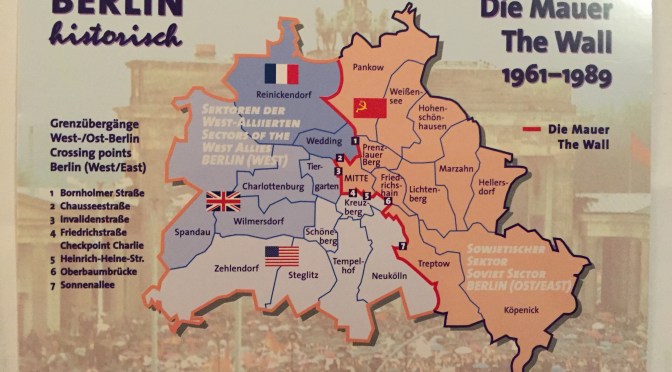
The history of Berlin is very complicated. In order to help me navigate around the city and understand the physical location of the Berlin Wall, I purchased a postcard of the borderline between East and West. At a granular scale, it is very confusing and intriguing, what parts were where.

You can see that the wall circles around Mitte, the heart of the city. I live just at the edge of the line identified as Number 2 on the postcard. Bernauer Street is where a park is located to commemorate the wall. Communities and neighborhoods that were divided by the wall show a noticeable difference in the architecture, quality, and development stage. Large tracts of land are either left abandoned, waiting for development, or they have already been developed. It really keeps one guessing what happened and curious about both the history and the future.

And if the past few days didn’t have enough activity, here’s one for the opera lovers: the curtain call for the Magic Flute at the Deutsche Oper, another Goethe Institute sponsored event.

IMG_2564 4

(In Banner above: Topography of Terror, a display about the Stasi. See https://en.wikipedia.org/wiki/Topography_of_Terror)

(Note: Apologies for the length and delay of this post. There may be a few factual errors that are being checked for accuracy).

Post updated: 6/7/16

Days 20-21: Neues Museum, Berlin

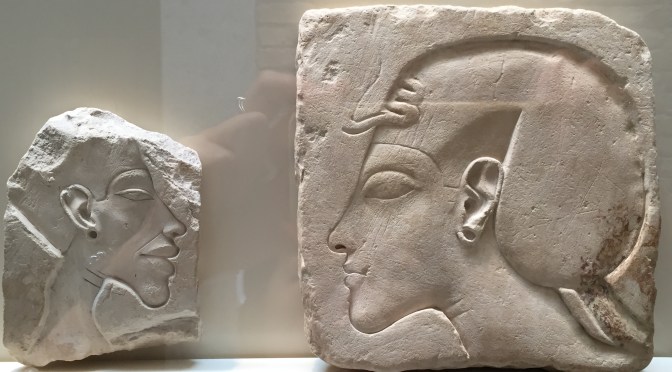
What can I say, except that this exhibition blew me away! Mostly from 2400-1200 B.C (Middle and Late Kingdoms). Queen Nefertiti’s head is here, but not reproducible. Exquisitely beautiful. Figures were lively and not as stiff as most representations of Egyptian art. They spark the curiosity and desire to learn and understand more. Enjoy the photos and captions where available.

Addenda: Deutsche Bank Modern Art Installation and Marx/Engels Statue, from two separate tours.