Tag Archives: Sights

Day 12-15: Burling into Berlin


IMG_2272Above: the Berlin Tower with a new base

Currently the place where I am staying is known as an “alt bau”, or an old building. I had imagined it as an old Baroque building, finely tailored and detailed, but renovated with modern conveniences. Not. I am in an old building. It will take a bit of getting used to, but it’s going to be fine.

Berlin is wired, both on coffee and devices. Everywhere, at least in the Mitte, people sit outside once the good weather appears. They pull out stools and tables from inside their coffee houses, the laundry or offices.  The coffee and the laptops follow, and nothing less than a Macbook Air. Germans like sturdiness and quality. People sit staring at an open laptop and do double duty with a smart phone in front of their computers, just like we do in San Francisco. The only difference is that they can do it in plain sight and en plein air.

Sports shoes are the hot new fashion statement. Every shop in Mitte where I am staying seems to have a full array of snappy looking shoes with white bumper guards, for not a lot of money. It does feel as if design is a high priority here, with more quality and variety in clothing and furnishings. Mitte feels like an up-and-coming St. Germaine-de-Pres. It will soon become too pricey to afford. I’d give it two to five years at the most.

My first day of class at the Goethe Institute was Monday, and I am already fully immersed. There are 12 students in my Intensive, 4-week Intermediate level class, and Herr Göbels is a mature and native German speaker. After nearly five hours of class in the afternoon from 1:15-5:45 including precious breaks, we are pretty wasted.

Above: Photos of the oldest church in Berlin, the Heilig Geist, with an artistic expression at the entry to the church.

The extensive cultural programs for students focus on the different neighborhoods in this diverse city. The first tour this morning was Berlin Mitte and the oldest section of the city. An evening lecture provided an overview of the cultural city of Weimar. Having just been there, I learned much more about Schiller, Goethe, Nietzsche, Liszt, and Wagner. Liszt had conducted Wagner’s Lohengrin in Weimar, and Richard Strauss wrote “Thus Spake Zarasthustra” based on Nietzsche’s book by the same name. There are planned field trips to Potsdam, the opera, ballet and museums, so I am a happy camper!

However, it’s back to the grindstone. I have homework and audio assignments to finish before class tomorrow! I enjoy the focus, learning about the host country, and meeting a wide spectrum of students from many countries. I highly recommend a similar program for any language learner.

I have a few shots to share of the Deutsches Historical Museum and Potsdamer Platz.  The historical museum contains a new wing that showcases the architecture of I.M. Pei. He also designed the East Wing of the National Gallery and the prominent entrance to the Louvre.

The story of the Berlin Wall  was displayed in posters at Potsdamer Platz. After going to the Stasi Museum in Leipzig, I was more curious about the events that led to Reunification in Berlin. The story is told in these words and pictures and includes a healthy (?) supply of bubble gum stuck to the old wall relics. Click on each image to increase the size and readability.

Day 11: Lively in Leipzig

The weekends in Leipzig are filled with musical activity, not only in the Concert Hall and Opera House, but everywhere in the street. Students and aspiring musicians and performers try their luck at attracting tourists and locals, in a town that welcomes crowds and causes.

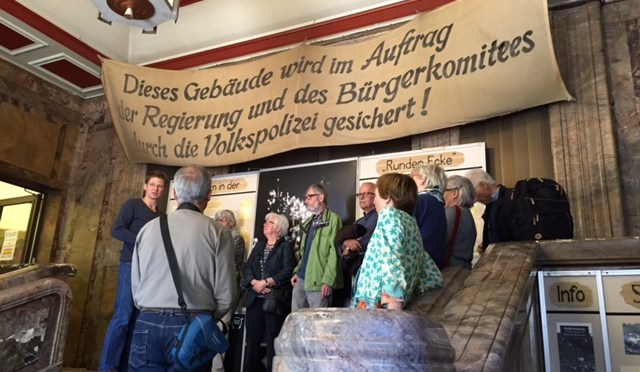
The Stasi Museum depicted life just as it was before the Reunification and explained the course of events that led up to it. It was a fascinating unfolding of momentous days in 1989, from the first peace protests, to the burning of evidence as the tides turned, to the final decision point on November 9, when the Berlin wall fell. It’s an easy date to remember as it is the reverse of 911.

The translation to the sign above reads “On behalf of the government of the Citizen’s Committee, this building will be secured by the National Police”.

I imagined all the legal papers that were needed to draft the new laws and how  the East German economy was shot into the modern world overnight. It seemed so simple, yet it must have been an overwhelming undertaking.  It took the will and determination of every German. My faith in humanity was restored and I felt grateful that such a human event could occur in my lifetime.

IMG_2128
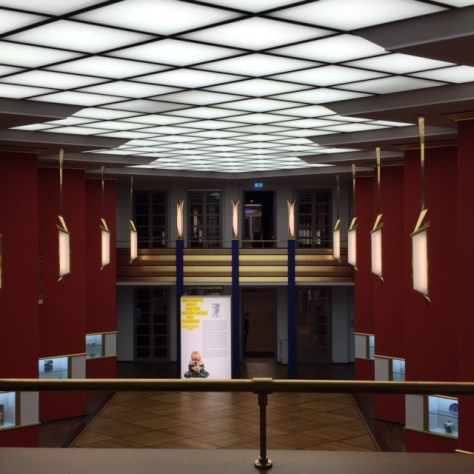
The Grassi Jugendstil atrium reinterpreted

An afternoon at the Grassi Museum was a shift back to the familiar yet unusual. There was an excellent exhibition of Flemish and Dutch glass and ceramic pieces, inspired by Asian ceramics. The incredible use of light, color and design seemed to be ingrained in the area’s artistic traditions.

While limited, the museum had an excellent display of Asian ceramics and figures. They reminded me of similar pieces I saw in Northwest China.

A collection of artifacts from Iran intrigued me. I marveled over the many pieces that I had not ever seen. I resolved to continue my comparative history studies of countries along the Silk Road. The blue porcelain pieces were reminiscent of those in China, but the metallic colors and designs were much more vibrant and intricate.

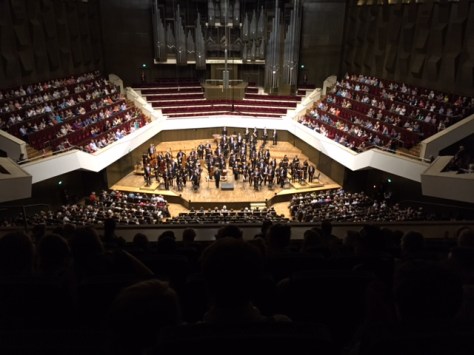
The end of the day was capped with two classical music performances. The first was a family concert at the Gewandhouse Orchestra. Herbert Blomstedt, who led the San Francisco Symphony for many years, conducted the orchestra with the Beethoven Pastorale Symphony.

IMG_2211

The second of the two concerts was held at the Schumann House, where Robert and Clara Schumann lived. A pianist performed many pieces from Beethoven, Clara Schumann’s own pieces, and those by Schumann. They were very lively and spirited pieces and a contrast to the earlier, much duller performance.

IMG_2221
Entry staircase

The simple yet elegant stairway at the entrance to the Schumann house was a lovely reminder of the integration of good design and construction in German homes. The museum is now linked with other musical sites such as the Mendelsohn and Wagner houses in Leipzig into a “Music Trail”.

IMG_2213
Community Room with motion sensitive instruments in ceiling

During the performance break, the announcer invited us to a community room and shared the research that is being done with electronic instruments generated by motion detectors. Each “spot” was keyed to an instrumental sound, such as clinks on porcelain, horns, keys, drums and bells. Using motion detectors and people walking between objects mounted in the ceiling, a series of sounds were generated. The more people moved, the more each sound was created.  The innovation could produce symphonic sound with audience participation. It was an exciting demonstration that everyone enjoyed.

Day 10: Hypezig Leipzig

A first reminder of Leipzig’s political history was evident at the main entrance to the Markt. The banner read: “Love Football. Hate Racism”. They continue to extend an open hand to refugees and warn against Neo-Nazi tendencies. Despite the loudspeakers and full police reinforcements nearby, it appeared to be a quiet, orderly, and reassuring demonstration.

Today’s demonstration was a faint reminder of the city’s history. In 1989, Leipzig sparked a series of demonstrations at the Nicholai Church that led to Reunification of Germany. You can read more about Leipzig here: https://en.wikipedia.org/wiki/Leipzig

Leipzig doesn’t have the appeal and cultural taste of Weimar, but it has music to make up for its visual shortcomings. There are a wealth of classical and rock concerts, performances, plays, and revues, and the Gewandhaus and the Leipzig Opera are world-renown. As a major trading town and international fair promoter, Leipzig seems to have picked up economically since I was last here. Many new malls, museums, and building developments have surfaced, and the economy seems to be booming.

There are still many lovely Baroque-like buildings to appreciate everywhere you turn. Intricate passageways connect positive and negative spaces to each other. The decorative elements and sturdy, well-maintained buildings are reminiscent of Prague. Newer buildings are well integrated into the urban, pedestrianized fabric of the city.

The famed Auerbach’s Keller is where Goethe purportedly wrote “Faust”. The cellar and dark interior of the restaurant spins the mind into believing that Goethe himself must have made a deal with the devil there. A couple of bronze statues at the entrance add to the dramatic air.

The Friday Market was also in full tilt and it wasn’t hard to find seasonal spargel, or asparagus. Every vendor was selling some, and it dropped dramatically from 6 Euros in the morning to only 2 Euros per kilo by midday. Fresh meat, cheese and cakes tempted the eye as well as the palate.

And, the Thomas Kirche offered a moment of peaceful reflection at the end of the day.

image.jpeg

If you want to see an experimental short film on a Leipzig mural in one of the passageways: https://www.youtube.com/watch?v=yi5GPovC2Vc. Set volume if you want to hear the Thomaskirche organ.


Day 4: More Moritzburg and Carmen

A couple of years ago my friend Hanne and Jens introduced me to Moritzburg. I had been wanting to go to King Augustus’s “Hunting Lodge” again. I got my chance when a group of us planned a half-day excursion. We mixed and matched a combination of public bus and private carriage to get there. By doing so, we had an interesting variation of conversations in German and English. International and local friends from Germany, Bulgaria, the U.S. and Switzerland got in our Sunday gear and convened in Dresden for this delightful day of history sharing, friendship, and even tail-gating.

Most of the historical significance for this private country estate centered around 1730. Similar to King Friedrich’s Sans Souci outside Berlin or the Summer Residence of Peter the Great outside St. Petersburg, Moritzburg is another opulent getaway villa. This one, however, did seem more tastefully decorated (if that can be compared). My favorite room is the dining room, where all the deer antlers are displayed. The tips of the antlers are duly recorded and ordered in the dining room from the smallest to the largest sizes (mostly 26, 28, 30 and 32). You can read more about the castle here: https://en.wikipedia.org/wiki/Moritzburg_Castle.

Curtain Calls for an evening performance of Carmen  at Semperoper below:

SF Victoriana v.2

Local friends and family know I like taking cross-town walks, so a planned lunch downtown was another excuse to make a quick 5 mile, zero-carbon footprint (except on my soles) hoof from home to table. My usual 100-minute exercise was interrupted by several scenes along the way, extending the time another 30 minutes!

My first distraction was a tiny, delicious little custom sewing shop. Laden with love and care, this local shop presented itself with a cute storefront and encourages you to peek inside. The treasure trove of lovely ingredients sparks the imagination and reminds you to think about art and what you wear.

Further along McAllister Street, between Masonic Avenue and the Civic Center, are a potpourri of beautiful Victorian homes. These are well known in San Francisco as “Painted Ladies”. They continue to mature into beautiful streetscapes that can only be fully appreciated by foot.

The heavy timber buildings were built at the turn of the century, when San Francisco was flush with wealth from the “Rush” of the Gold Rush. Local craftsmen, who must have been trained as carpenters in Europe, and artisans detailed and built custom one-of a kind residences for the nouveau riche. The gentle weather in the Bay Area allows these incredible structures to survive beyond a natural lifespan, along with the healthy, inherently bug-resistent redwood bones.

The beautiful entryways, frontages and detailing are definitely “look at me” attractions. I have driven along this route many times, but have only just come to notice and appreciate these buildings recently by walking through the neighborhood.

If you remember from last month’s February posting, I showed pictures of a house with a giant Valentine dangling outside (shown to the left below). Intrigued with the artwork at the time, I didn’t make a mental note of where it was. This time, as I walked on the same street and the block before the house, I wondered where the Valentine house had been located. No sooner had I pondered this question, when it appeared!  A new outdoor greeting for Easter was proudly displayed.

The re-discovery of the hanging artwork brought a sheer feeling of glee to me. In addition, a tiny toy mailbox was perched on the garden wall just outside the house. There were colorful sheaves of paper hanging next to it, with a dog-chewed pencil attached. A sign invited comments to the artwork! I was so inspired and delighted by this opportunity. I showered the artist with kudos for caring and sharing and stuffed my note into the pumpkin-colored mailbox.

I was late to lunch, but  glowed all day.

PS. Plans for this summer’s travels are being finalized, so stay tuned!

Japanese Art, the Western World and Bonus Video

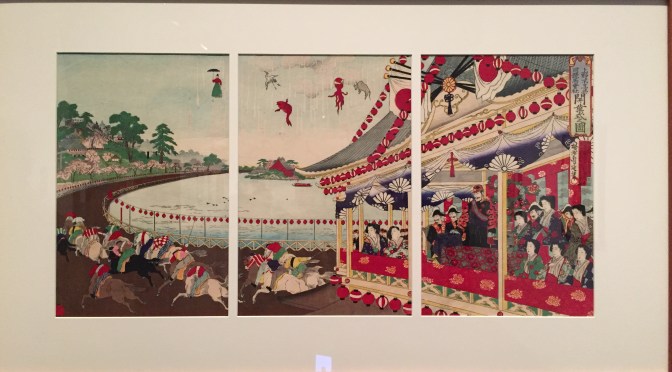
In a current exhibition at the Asian Art Museum, you can view some interesting comparative paintings between the Hiroshige woodblock prints and famous Impressionists like Van Gogh, Matisse, and Monet. Europeans were fascinated by Japanese artists and emulated these new discoveries. While the pieces by well-known Western painters are limited in number, the exhibition certainly provided a good case for the Japanese inspiration from which the Europeans drew.

Many of the wood blocks by Hiroshige, although small scale and delicate, had very intriguing themes. At the upper left photo, the woodblock depicts a lively scene with trees swaying in the wind and someone chasing after his hat. This scene is one of a series of woodblocks that recorded towns and villages between two major cities. Each one was unique so villagers could distinguish their town from others.

The close-ups close to the picture plane of portraits were also imitated by Westerners eager to draw from sources little known at the time. See the portrait of a Japanese Female Princess character in middle photo above. Japanese decorative arts were also widely copied and emulated, as seen in the photo, above right. While imitation is the greatest form of flattery, I wondered what the Japanese artists thought of Westerners’ borrowing of original ideas. There certainly weren’t copyright infringement laws in place at the time, so it was anyone’s game.

Regardless of the historical backdrop and lingering questions, the exhibition was very enlightening and presented much food for thought. Here are a few comparisons, that show the early precedents of Japanese art followed by paintings of Western artists:

Both the Jugenstijl movement (see my post on Mucha in Prague from May, 2015) and the Art Nouveau style in Europe (see St. Petersburg posts in September 2015), as well as the Arts and Crafts Movement in England, were heavily influenced by Japanese prints and decorative arts. Similarly, Frank Lloyd Wright was heavily affected by Japanese design (see FLW in Chicago post, October 2015).

See the inspiration for the graphic designs for Tiffany and other poster art here:

You can learn more about this exhibition and details of the exhibition, on display until Feb. 7, 2016 at: http://www.asianart.org/exhibitions_index/looking-east

Note: My apologies for not recording the titles or names of the Japanese pieces. While many of the woodblocks in the exhibition were attributed to Hiroshige, there may be other artists whose names I did not note.

For a video on the Goethe Institute at Schwäbisch Hall, where I took a German class for two weeks on language and culture, see here:

Day 79: A Recap of 80 Days Around the World

Here are a summary string of my favorite headers, from the panoramic shots posted:

Map of the Trans-Mongolian Express from Beijing to Moscow (see featured image above). Note the Purple line for portion of Trans-Mongolian Express that links to the Trans-Siberian Express (red line).

Beijing and Mongolia:

Moscow and St. Petersburg:

Berlin

Salzburg, Vienna, and St. Florian (Linz)

Switzerland

Schwäbisch Hall and Stuttgart

New York, Vermont

Philadelphia, Chicago

Santa Fe, New Mexico
cropped-img_0202.jpg
cropped-img_0211.jpg

Day 77-78: Art is Everywhere in Santa Fe

On an early morning walk, I was amazed at the amount of abundant sculpture and outdoor art in this small, aesthetic town. Landscaping, architectural elements, and artwork were integrated to give a deep sense and appreciation of the arts.

Throughout residential and commercial neighborhoods, you can find extensive use of the old adobe mud brick and plaster walls. They provide a consistent look and a unique quality to Santa Fe. The sense of time and place are established by this pattern. Newer walls surrounding buildings have a timeless quality, with updated elastomeric coatings that expand and contract with extreme weather conditions.

The wealth of galleries and museums are easily accessible within the city. The Georgia O’Keefe museum was just around the corner from our hotel. Although I am not a fan of her work, I learned to appreciate the life of O’Keefe and the meaning behind her work. She led an avant-garde lifestyle with her husband and photographer Albert Stieglitz in New York before settling in New Mexico.

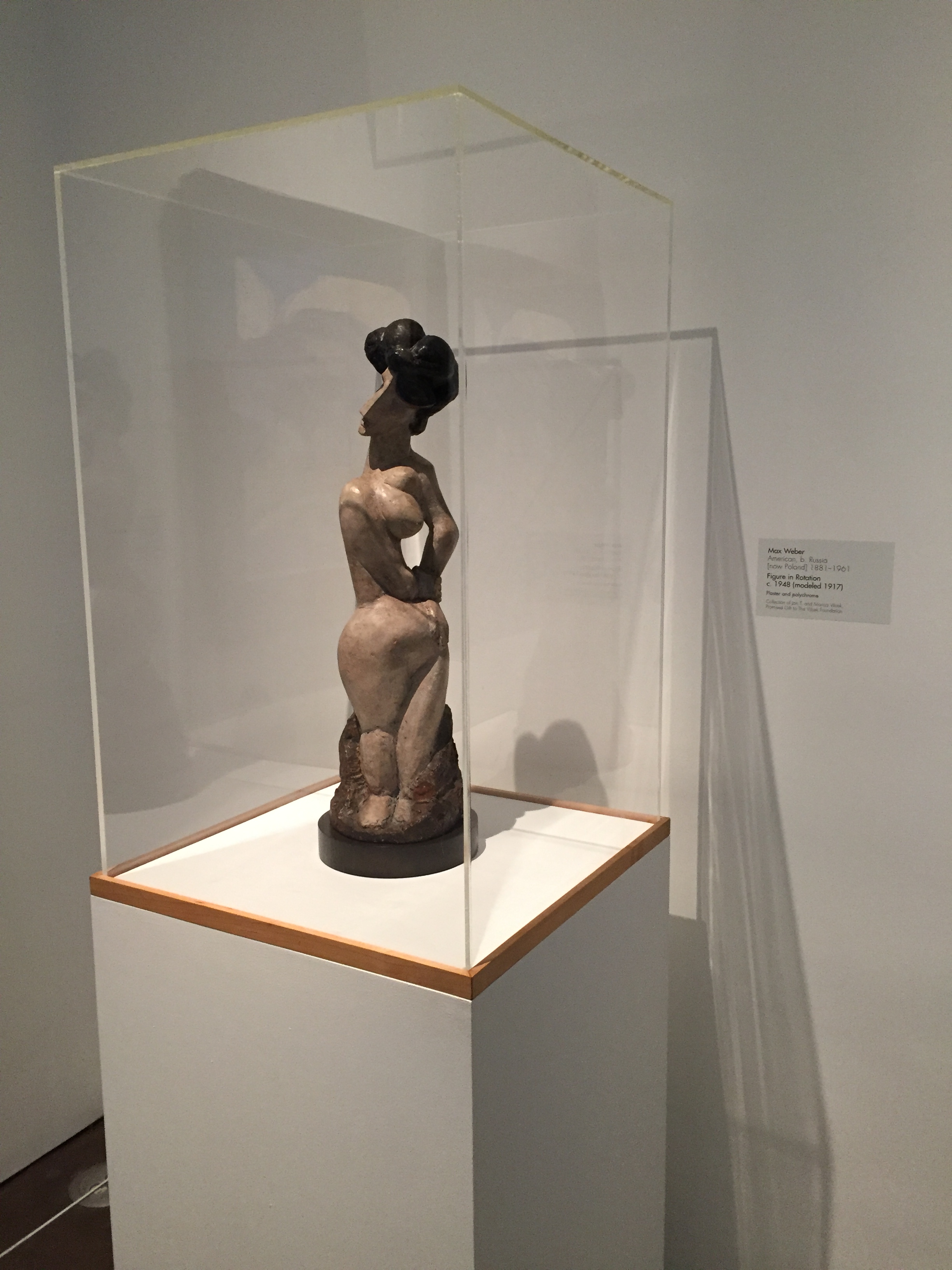
My favorite piece from the museum was a cubist sculpture by Max Weber entitled: Figure in Rotation (1948)
IMG_0240

Later in the day we visited a collection of museums and galleries. The new Museum Hill area housed the Museum of International Folk Arts, the Museum of Indian Arts and Culture, and the Anthropology Laboratory. It is only a couple of miles from the Plaza and accessible by bus.

We visited a couple of galleries along the Canyon Road area. I was trying to track down an old friend from school who is now a famous jewelry designer in New Mexico. We were able to find a gallery that exhibited her work and were impressed with the quality of the pieces using precious stones in modern settings. You can read about her in Wikipedia at https://en.wikipedia.org/wiki/Gail_Bird_and_Yazzie_Johnson

The next day, we visited Bandelier National Monument, where some of the Ancestral Pueblo Indians settled. Known as Frijoles Creek and Canyon, this area along the Rio Grande leads to the Alcove House, where we climbed up 140′ by ladder to see the cave dwellings. The pink rock is composed of volcanic ash that formed into a crumbly rock known as tuff. This material creates pits and can be carved into larger openings.

Day 76: Chicago to Santa Fe, NM and the Amtrak vs. TME Report


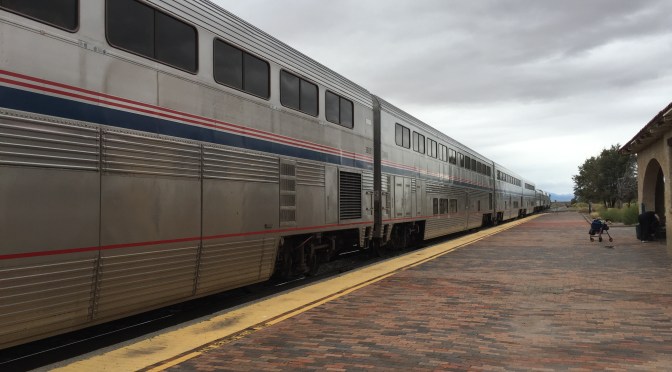
After setting off from Chicago late in the afternoon, we enjoyed an idylllic train ride plying the Midwest from Illinois through Missouri, Kansas, Colorado, and New Mexico. We passed the Mighty Mississippi and wheat fields to enjoy a peaceful sunset.

On arrival, we had a look around the city and enjoyed a sunset the following evening from our hotel roof deck. See view above.

Preliminary Evaluation of the Amtrak vs. Trans-Siberian Express (TSE)

As for the evaluation between Amtrak and the Trans-Siberian Express (TSE) a la Trans-Mongolian Express portion (TME), here’s my interim report below.

If you recall, on Day 71 I established a self-inflicted competition between the American Amtrak system and the Trans-Siberian Express (TSE). You may be confused when I refer to the Trans-Mongolian Express (TME). The TME is a significant portion of the TSE, and differs only in the start point. the TSE begins in Vladivostok on the eastern coast of Russia. The TME begins in Beijing and traverses through Mongolia to Moscow, where both the TSE and TME meet. See map below.

Transsiberianmap

If you are not particularly interested in either, skip this post as it will be a bit long-winded, self-admittedly, and only for those die-hard train afficinados.

Here are comments based on the original criteria I established:

1. On Time Record

So far, the two long haul trips we have taken on Amtrak (Philadelphia to Chicago, Chicago to Santa Fe (Lamy), NM) have been on time or early, and the shorter legs through New England have been on time or slightly delayed. Trains on the TME were either on time or early, but we were not able to verify the arrivals or departures due to fuzzy time zone changes (!!)

2. Comfort (Bed strength, ability to rock a baby to sleep and keep them there; access to lights, camera, action; no annoying overhead PA system used at free will for the comfort of the system and not the passenger; and good padding and ergonomics for blogging)

Beds on Amtrak are comfortable, non-formed foam pads over two seats pushed together in the roomettes, with an overhead bunk that does not allow you to sit up straight. One passenger complained about the pillows and beds being too flat, but seating ergonomics and padding seem fine in both systems. Beds on Amtrak are in the direction of travel, whereas the TME beds were perpendicular to the direction of travel. Not sure either makes much difference in terms of rockability, but the Amtrak trains definitely sway more at the top due to the double-height cars. Most of the sleepers were on the upper level so more passengers would experience the sway, so I’d give Amtrak a negative point for this.

There are more stops at night on Amtrak due to the higher population along the route, so it may appear to be slightly more disruptive at night. However, the train starts and stops are smoother on Amtrak compared with the Chinese bump-and-grind at each stop. The Chinese trains did not appear to have any or much cushioning between cars so they slammed into each other when the trains departed or arrived at each station.

Lighting and controls were sufficient on both systems so no particular comments. In contrast, the use of the PA system was notable on Amtrak. The dining car made repeated comments about availability, MIA’s, and hours of operation; there were none on the Chinese cars (perhaps because there were so few or no passengers! or the multiple languages spoken by passenger on the train would render the effort fruitless). We did take a Chinese train on a different trip last year that piped overly loud and annoying announcements and music on their PA system. At one point, the speakers were disconnected (i.e. ripped out) to our car by a passenger and it seemed to take care of the problem.

3. Service (attentive staff, no back talk or attitude–i.e. Courteous; visible but not obtrusive; professional but not hollow friendly delivery of information)

As you know, we found the service on the Chinese trains to be very good, but that’s because we spoke Chinese. I am not sure foreigners would find the staff as friendly. Surprisingly, the Amtrak staff have been generally friendly and attentive. They must have improved their customer service training since we took the trains a generation ago. There are still vestiges of the long-timer staff person here and there who crack canned jokes every now and then, or a raspy voice yelling out instructions by someone who cumulatively earned the distinctive voice quality. Overall, both appear to be genuine in intent and concern.

4. Cleanliness (no spit on counters; toilet paper unfailingly in supply; Windows you can see through; stainless upholstery and carpets)

Well, can’t say I went looking, so I didn’t find any gross evidence in either system. In general, the toilets in the Chinese trains were not well attended, but in defense of the system, we were only 2 of 3 passengers in our car. There were four toilets available in one Amtrak sleeper car for some 24 rooms; only one toilet and one washroom per car on the Chinese train. You can do the math.

Toilet supplies were plentiful on Amtrak, nada on the Chinese trains. Bring your own.

Windows were a little soiled on Amtrak. Hard to see through some windows on Chinese cars.

Upholstery on Chinese cars were old but clean; no carpeting in rooms.
I noticed a few stains on the blankets of the Amtrak, and maybe on the carpeting. The concierge announced that shoes are required on all Amtrak trains.

5. Food (real food; reasonable prices; no cheap shots using lots of salt and sugar; no bar codes on wrapping; cold beer; wine list; nuking; no plastic, polystyrene, or jewel boxes)

Food to date on Amtrak was decent, and better than I remembered. When you book a sleeper you get free meals. Dinner options included salmon fillet, steak, chicken, or pasta. The only disappointing aspect were the frozen vegetables.


Hard to compare the food from the Russian dining car. The food appeared to be freshly cut and prepared, and although small portions, the food was fresh, tasty and healthy. Gee Kin’s vote for the staff’s home-cooked pasta and meat buns unfortunately do not qualify for this evaluation of customer-consumed food. Interestingly, I asked Sean, our Amtrak attendant, what he did for food. He immediately remarked that the food on the train was unhealthy for service staff. Assuming that they ate it frequently, the food would take a toll on your weight and BMI. The food is included in their benefits, but he mentioned that he beats it over to Whole Foods whenever he gets in to Seattle. Staff stock up on their own food but are not allowed to bring anything requiring refrigeration. That poses some limitations, but he said they work around it (wink, wink). Occasionally the house chefs make family meals for the staff and they really appreciate it.

I am copying and pasting the earlier post comments for convenience and adding any additional notes or changes.

Pros of the Trans Mongolian Express:
1. Decent food in the Russian dining car at reasonable price
2. Service in the sleeping car was very good and attentive by the two attendants assigned to our car (even though we and one other woman were the only passengers in the car after Ulan Bator!)
3. The compartment was tidy and toilet at the end of the car was adequate.


Cons for the Trans Mongolian Express (TME)
1. The tracks are not universal in Mongolia thereby requiring wheels to be changed on every car going between China and Russia through Mongolia
2. The trains do not have Internet access
3. The schedule and arrival times at any station were a mystery due to fluctuating time zones

Pros for Amtrak trains
1. The trains are very comfortable
2. The trains have Internet access (10/7 correction: none on the long hauls!!)
3. The information for time, stops and scenic opportunities is helpful (10/7 update: excellent handouts available at every seat)


Cons for Amtrak
1. Service staff are surly (10/7 update: I would delete this comment that was based on historical experience)
2. Stations are antiquated (10.7 update: true, but they have installed First and Business Class lounges with internet access that overnight passengers can use)
3. Seating is not reserved (10/7 update: all seats are reserved on the long-hauls)

This report includes two long hauls:
1. Washington DC to Chicago on the Capitol Ltd.;
2. Chicago to Santa Fe, New Mexico on the Southwest Chief;

The last report will include the third and final leg:
Santa Fe to Los Angeles (continuation of the Southwest Chief), then the Coast Starlight train from LA to San Francisco.

Day 73: Chicago Art Institute and Millenium Park

Yesterday was spent at the Art Institute of Chicago, admiring the extensive Impressionist Collection. Among them:

Here are a few of my favorite pieces: Tang Dynasty expressive figurines and exquisite Northern Sung glazed pottery pieces:

And an architectural exhibition by David Adjaye and Associates, London

Views of the Millenium Park and City:

Second City Curtain Call:
IMG_9902