Museum of Memory and Tolerance

While Mexico City purportedly has the highest number of museums of any major city in the world, the Museum of Tolerance interested me because of its unusual topic. I was exhausted by the depth and quality of the exhibits and hope you will have a chance to visit it. More than half of the museum is devoted to the Holocaust–its development, the participants, the process, and the statistics.

There were a significant group of Jewish, Eastern European, and Russian emigres who ended up in Mexico before and after the war, just like those who came to the US. The initial exhibit defined what a genocide meant. As the exhibits progressed, more reflective time was needed for visitors to digest the information. The museum designer provided a meditation room and window views to the large interior atrium, that was decorated with a huge tree weblike sculpture. The window slots provided a framed view of the tree sculpture and provided a necessary visual and mental relief from the subject matter.

No museum can ever succeed in conveying the weight of such a heavy topic, but I felt more emotionally informed after this visit. The second half of the exhibits recorded the many variations of genocides that have occurred since WWII until now, in an attempt to prevent repeating history by informing others. The building was designed by Ricardo Legorreta.

Photos, from top, left to right:
1. Introductory Exhibit
2. Atrium Sculpture
3. Window slot at end of Holocaust exhibit, with a view of atrium sculpture.

Franz Mayer Decorative Arts Museum


1. Decoration good enough to eat! Melissa: some research for the next dessert!
2. More wisps that are convertible to edible art.
3. A vintage Mexican carved armoire in the grand style–beautiful parquet
4. Interior courtyard of museum villa–could wrestle with the Frick
5. Wood encrusted Biblioteque, oozing with impeccable spit-shined wood flooring
6. Typical posada style room lined with hand-painted tiles and dark wood furnishings.

Decorative arts are some of my favorite museums, and I am always looking for the distinct or unique if subtle characteristics that define a culture or style. Availability of local materials such as wood or stone drive the local craftsmanship. In Mexico, they had plenty of both, and a lot of history and time to perfect each to the exquisite level represented in this museum.

Mezmerizing Mexico City

Wandering around the Old town in Mexico offers endless discoveries and OMG moments. The National Cathedral (interior and exterior shots) struck me as being one of the sacred places that Mexicans throughout the country revere, much like St. Patrick’s Cathedral in NYC or Washington Cathedral. Most of the tourists were native Mexicans and very few were foreigners, at least when I was there. The over-the top ornateness is characteristic of the Mexican style, with carving craftwork handed down by indigenous people who were forced to perform.

The exteriors of the buildings in the Zocalo area were richly decorated with baked clay face tiles that preserved the old buildings and served them well. This left me wishing China had done a better job preserving not just its ancient buildings, but some of their more recent turn-of-the century tea houses and everyday genre buildings more. It made it that much more evident that “slow” development that at least respects the past creates a much richer and evident history for everyone to appreciate and from which to learn.

Photos, top, left to right:
1. Interior of National Cathedral
2. Exterior Door Detail
3. Hand painted Tile on Exterior of Building
4. hard to see, but another style of painted tile facade treatment (zoom to see)

Mexico City Marvels- 3


An evening of Rigoletto at the Palacio de Bellas Artes. Maria Callas debuted here in 1950 as Norma.
1. View of Orchestra Seating in Art Deco Interior
2. Beautiful Ceiling with tiffany-designed colored Glass Art Deco Pattern
3. Detail of Stage Frame
4. Exterior of Art Nouveau and Neo-Classical style building.

Best seat in the house Row G in the center was $55. Production and stars were excellent. I’m coming back!

Mexico City Marvels-2


I have been so impressed by the high quality design that I have seen so far. I chose Zocale Centrale hotel from Booking.com because of its location next to the old main plaza. It has been developed in an old renovated building, somewhat reminiscent of Downtown LA but much richer in architectural heritage.
To date I avoided reporting on hotels where I have stayed, but I have to make an exception here. This hotel is very impressive, not just for its ideal location, but its sensitivity to good design and exceptional value. The difference is that Mexico’s architects and designers are respected and their contributions to enhancing life seem to be widely valued. The designs are creative, whimsical and generally well thought out. Inexpensive labor supports good design with craftsmanship and ability to maintain its artifacts. Architects are keeping pace with latest technology and standards such as USGBC and LEED sustainability practices.

Here are a few examples from the Zocalo:

1. Interior atrium with beautiful lighting.
2. Toiletries organized on a stoneware dish, beside a stone soap dish with sloped drain to sink for runoff.
3. gorgeous flowers everywhere, a statement about the establishment’s attention to detail and high standards.

Mexico City Marvels-1


Photos above, from top:
1. Pedestrian Street near Zocalo Centrale Hotel area in the early morning. Streets are washed down each day to keep the area free of trash
2. Crazy architecture near Aquarium with reflective mosaic-shaped mirrors by Fernando Romero and who else? You guessed it–Frank Gehry…and Ove Arup. This Museo Soumaya was completed in 2010. Wikipedia has some great construction photos of the structure before skin was added. You architects out there–Check it out! *
3. Mid-rise Building Clad in White back-painted Glass
4. View of Commercial Hi-Rises. Judging from crane spotting In Mexico City, hi-rise construction is alive and well here. As noted in my travels (primarily in New York, London, and China), prosperity is evident everywhere as well as in MC and this city joins the chorus of excitement in new building design and thinking hard about how well these buildings will survive the test of time.*
*info added or updated 12/6/14.

Day 79+1(b): UC (University of Canterbury) Event

As a last hurrah to San Francisco and its importance in the global community, Gee Kin and I attended an event sponsored by his alma mater, the University of Canterbury in Christ Church, New Zealand. The former ambassador to the US and now the chancellor of Canterbury was promoting the University’s new buildings and developments after the recent earthquake. He was hoping to gain support among the New Zealanders in the US and was on a whistle-stop tour of 8 major US cities. He spoke to a group of us here in San Francisco, along with the NZ Vice Consul from Los Angeles.

One of Canterbury’s success stories is the engineering department. They are collaborating with UC Berkeley to develop better earthquake engineering technology. Both institutions have participated in the past in signficant earthquake engineering research. image

Other engineering departments and computer science departments have also gained recognition world-wide.

Christ Church sees itself at the cusp of new cutting edge development, both physically and virtually. Canterbury is tapping into the knowledge base of New Zealanders living in the US to help them forge new connections, create exchange opportunities, and raise funds for its programs.

While the group was small, the chancellor had an opportunity to meet and chat with everyone in an intimate setting at the Diplomat Club at the Fairmont Hotel.

Old friends Richard (who went to high school with Gee Kin and now works in the Bay Area), his wife Kris, David (Gee Kin and Richard’s instructor in Christ Church, who now lives here), and Keith were all present at the event. Unfortunately, David and Emilie, who are in Lebanon, were not able to attend.

image

Photos above:
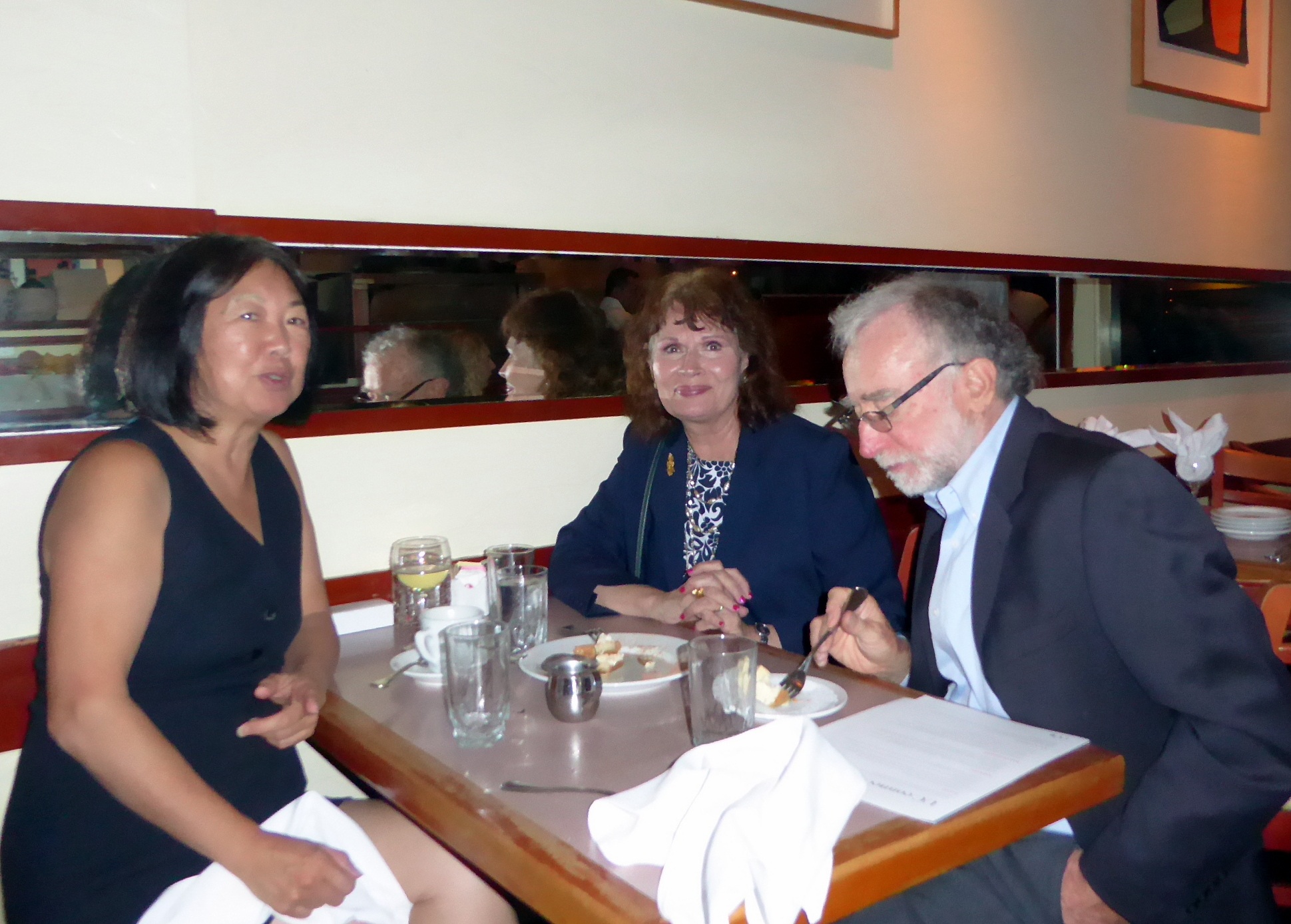
1. Gee Kin and Richard at the Nob Hill Cafe in San Francisco after University of Canterbury Event
2. Victoria, Kris, and David

Day 79+1(a): It’s the End of the World! At Least for Travelswithmyselfandothers.com

Well, all loyal family and friends,

Around the world in 68+12 days has come to an end. It has been an incredibly fruitful, deep learning and deep cleansing experience for me. I was able to get all those kinks out of my system that I carried through many years of working, and could really stretch my brain by choice to its fullest. The trip to Uzbekistan stands at the top, for its luxurious setting, those who took exceptional care of me, and its little known but amazing cultural presence.

Both the Northern and Southern portions of the Silk Road were important links to understanding the development of trade and culture between east and west. To this day, the blending of the two are sometimes indecipherable. Who was to blame? Who gets the credit? Historians will be left to answer those unanswered, or unanswerable questions.

Thanks to Gee Kin for being my translator and guide for the Northern portion. We had to wing it in many cases, but got a lot of pride and prejudice from our decisions. It was riding wild and woolly, and a lot of fun in the process. The Southern portion, with excellent guides and a tour company to iron out all the logistics in advance (including a very clumsy visa process), get a round of applause for keeping my mind, body and spirit healthy and happy.

Keeping a blog obviously has its ups and downs, but overall it served as my companion. It gave me impetus to research questions on the spot (although you may find some of my facts and entries flawed or missing backup data). I tried to keep my impressions in the forefront and timely to avoid getting bogged down and behind. With a little bit of discipline, it seemed to work and the pace was very manageable.

For anyone contemplating doing a blog, I would say it’s worth a shot. Setting up a travel itinerary with an educational intent, whether you document it or not, helps to move the interest level up a notch (as opposed to picking a spot like Mexico, Galapagos, etc. purely from a bucket list). That will compell you to look ahead each day and determine what you want to achieve in advance. Then the documentation part comes much more fluidly.

I have a lot to say about postings and where you are posting from. Technically, an average person can decipher blog formatting. What is difficult is if you get “messed with”. No more needs to be said, except that its great to be back in a free country. We shouldn’t take that too lightly. Naturally, the hotels and their claims for Internet access are really a crap shoot, but try to remember that we are not in San Francisco, where access seems to be a right and not a privilege.

My whole premise for this trip is to make connections by connecting the dots. Remember how fun it was to play that graphic game with pin points on a grid? You could claim the boxes you made. Same delight for me, and it was fun to play alone as much as it was to play with others. My all-time favorite book and quote comes from Howard’s End, and the frontispiece message, “only connect”…

Two books I will reiterate were worth reading before, during and after this trip are “the Silk Road-A New History” by Cynthia Hansen and “the Orientalist” by Pulitzer Prize winner Tom Reiss. I have thanked the donors of this latter book profusely, and for introducing me to such an enlightening book. It was totally appropriate to my wants and desires to understand where and why I was traveling. So thanks again, Leena and Jim!

I would be remiss if I failed to thank Hanni and Jens for inspiring me to study in Germany, and all of their intensive care and concern during my stay in Dresden. Knowing local residents of my favorite European city made all the difference, and they gave me confidence to make the leap into a new and welcoming environment. Viele Danke, Hanni und Jens!

So, goodbye, auf Wiedersehen und Zai Jian once more, to all friends and family who were willing and able to participate! Stay in touch, and I love you all!!

Fondly, warmly, wonderfully, gratefully, happily,

Vickie Victoria

PS. An updated index of posts will follow as my final post.

Day 78+2: Summary of Segment IV: China

Segment IV, while a continuation of China, was the Non-Silk Road portion of the trip. Gee Kin and I stayed in Szechuan 5 days with an overnight in Emei Shan. Gee Kin returned to the US after that, and I traveled solo overnight on a rail journey from Chengdu to Guangzhou. After that, my final destination was Hong Kong before heading back to San Francisco via Vancouver.

The photos are in triplets, three for each city. Most of our earlier trips to China focused on the heavily populated cities of the East Coast, namely Beijing, Shanghai and Qingdao. It was a completely different experience visiting Western China, where the food, character of the people, dialects, and temperament were distinctive.

The rapid growth of Chengdu and Guangzhou were astounding. I felt as if portions of Putong District in Shanghai were airlifted there. The noticeable presence of cranes was unavoidable, and I felt a bit like a country bumpkin trying to navigate around big complexes, malls, and huge underground systems.

Hong Kong had always had this buzz, but relative to these other cities it too felt behind in some respects. There are fewer sites to develop so the other cities appeared to be amassing more square foot on a pure volume basis. But clearly in the lapse since I had last been there (a span of perhaps 3-5 years), there had already been extensive infill projects, more electronic advertising on sides of buildings, and several new mass transit lines added.

Going back to Chengdu, it’s clearly a city on the rise. People seemed to be excited that this inland city was getting its share of development. The malls were filled with local tourists who worked hard so they could spend money. There were very few foreigners in this part of China. Even atop Emei Shan there were only a handful of foreigners among the scant groupings of local Chinese tourists. For that, it made going up the mountain a worthwhile adventure.

Guangzhou shot me into the twenty-first century. The cultural buildings near my hotel in Tian He were impressive in size and scale, but the design and quality were questionable. These buildings completed in the last few years included the Library by Japanese architects Nikken Sekkei, the Guangzhou Provincial Museum by Rocco Designs from Hong Kong, and the Guangzhou Opera House by Zaha Hadid. Clearly Guangzhou’s Bureau of Architecture was intent on putting the city on the world map and has managed to do so virtually overnight.

Taking from the concept of two pebbles, the Opera House has sweeping angles and swoops to make the spaces in between buildings dynamic. But the building already looked prematurely worn and wrinkled. The museum was a vacuous building that didn’t seem to have enough material on display and lacked any kind of soul due to its monumental size. Materials were poorly assembled and chosen. The exterior of the building, with a wavy podium ramp to the side, did not make any sense supporting a very rectilinear box with slits and window cut outs. The library seemed to have the most promise, but I was not able to spend any time inside.

At last, arriving in Hong Kong felt a bit like a Homecoming. Three sets of friends from my earlier days working in Hong Kong kept me informed and entertained during my five day visit. The protests against the government were unsettling but did not occur until the day after I left. A good proportion of the Hong Kong people felt betrayed by the British government and by the Chinese, who promised to allow free elections for leaders chosen by the people. The complaint is that the Chinese government changed the terms of the agreement.

Food of course dominated my attention in Hong Kong. Food continues to maintain a very high standard and the innovative touch was evident. While I can’t speak for HK stocks or property speculating, this is one place to bet your money. It’s a winner every time, despite everything else around you never staying the same.

I’ll leave here to allow time for you to ponder my comments. In the next couple of days, I will close out my blog. As mentioned previously, I’d be happy to hear from you and provide details of each segment if you are interested.

Real Time Creative and Independent World Travel