Day 12-15: Burling into Berlin


IMG_2272Above: the Berlin Tower with a new base

Currently the place where I am staying is known as an “alt bau”, or an old building. I had imagined it as an old Baroque building, finely tailored and detailed, but renovated with modern conveniences. Not. I am in an old building. It will take a bit of getting used to, but it’s going to be fine.

Berlin is wired, both on coffee and devices. Everywhere, at least in the Mitte, people sit outside once the good weather appears. They pull out stools and tables from inside their coffee houses, the laundry or offices.  The coffee and the laptops follow, and nothing less than a Macbook Air. Germans like sturdiness and quality. People sit staring at an open laptop and do double duty with a smart phone in front of their computers, just like we do in San Francisco. The only difference is that they can do it in plain sight and en plein air.

Sports shoes are the hot new fashion statement. Every shop in Mitte where I am staying seems to have a full array of snappy looking shoes with white bumper guards, for not a lot of money. It does feel as if design is a high priority here, with more quality and variety in clothing and furnishings. Mitte feels like an up-and-coming St. Germaine-de-Pres. It will soon become too pricey to afford. I’d give it two to five years at the most.

My first day of class at the Goethe Institute was Monday, and I am already fully immersed. There are 12 students in my Intensive, 4-week Intermediate level class, and Herr Göbels is a mature and native German speaker. After nearly five hours of class in the afternoon from 1:15-5:45 including precious breaks, we are pretty wasted.

Above: Photos of the oldest church in Berlin, the Heilig Geist, with an artistic expression at the entry to the church.

The extensive cultural programs for students focus on the different neighborhoods in this diverse city. The first tour this morning was Berlin Mitte and the oldest section of the city. An evening lecture provided an overview of the cultural city of Weimar. Having just been there, I learned much more about Schiller, Goethe, Nietzsche, Liszt, and Wagner. Liszt had conducted Wagner’s Lohengrin in Weimar, and Richard Strauss wrote “Thus Spake Zarasthustra” based on Nietzsche’s book by the same name. There are planned field trips to Potsdam, the opera, ballet and museums, so I am a happy camper!

However, it’s back to the grindstone. I have homework and audio assignments to finish before class tomorrow! I enjoy the focus, learning about the host country, and meeting a wide spectrum of students from many countries. I highly recommend a similar program for any language learner.

I have a few shots to share of the Deutsches Historical Museum and Potsdamer Platz.  The historical museum contains a new wing that showcases the architecture of I.M. Pei. He also designed the East Wing of the National Gallery and the prominent entrance to the Louvre.

The story of the Berlin Wall  was displayed in posters at Potsdamer Platz. After going to the Stasi Museum in Leipzig, I was more curious about the events that led to Reunification in Berlin. The story is told in these words and pictures and includes a healthy (?) supply of bubble gum stuck to the old wall relics. Click on each image to increase the size and readability.

Day 11: Lively in Leipzig

The weekends in Leipzig are filled with musical activity, not only in the Concert Hall and Opera House, but everywhere in the street. Students and aspiring musicians and performers try their luck at attracting tourists and locals, in a town that welcomes crowds and causes.

The Stasi Museum depicted life just as it was before the Reunification and explained the course of events that led up to it. It was a fascinating unfolding of momentous days in 1989, from the first peace protests, to the burning of evidence as the tides turned, to the final decision point on November 9, when the Berlin wall fell. It’s an easy date to remember as it is the reverse of 911.

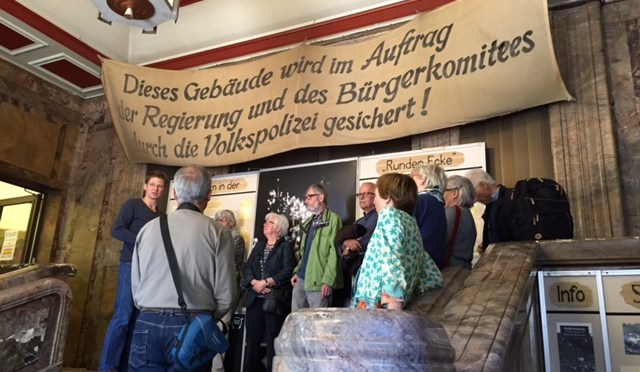
The translation to the sign above reads “On behalf of the government of the Citizen’s Committee, this building will be secured by the National Police”.

I imagined all the legal papers that were needed to draft the new laws and how  the East German economy was shot into the modern world overnight. It seemed so simple, yet it must have been an overwhelming undertaking.  It took the will and determination of every German. My faith in humanity was restored and I felt grateful that such a human event could occur in my lifetime.

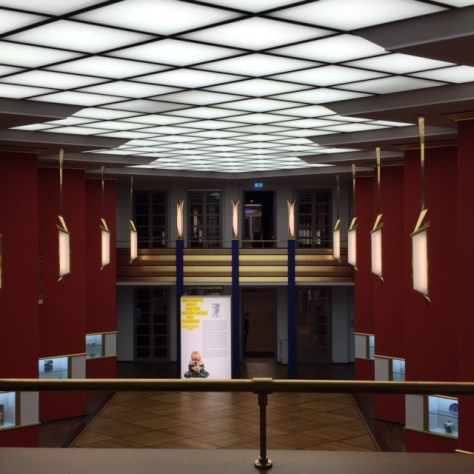
IMG_2128
The Grassi Jugendstil atrium reinterpreted

An afternoon at the Grassi Museum was a shift back to the familiar yet unusual. There was an excellent exhibition of Flemish and Dutch glass and ceramic pieces, inspired by Asian ceramics. The incredible use of light, color and design seemed to be ingrained in the area’s artistic traditions.

While limited, the museum had an excellent display of Asian ceramics and figures. They reminded me of similar pieces I saw in Northwest China.

A collection of artifacts from Iran intrigued me. I marveled over the many pieces that I had not ever seen. I resolved to continue my comparative history studies of countries along the Silk Road. The blue porcelain pieces were reminiscent of those in China, but the metallic colors and designs were much more vibrant and intricate.

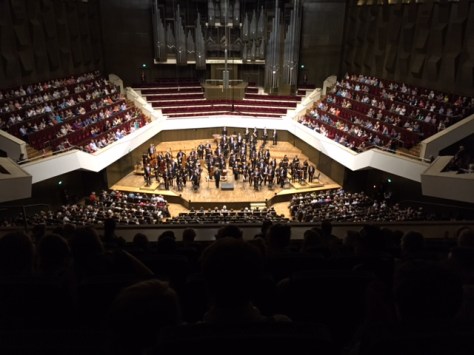
The end of the day was capped with two classical music performances. The first was a family concert at the Gewandhouse Orchestra. Herbert Blomstedt, who led the San Francisco Symphony for many years, conducted the orchestra with the Beethoven Pastorale Symphony.

IMG_2211

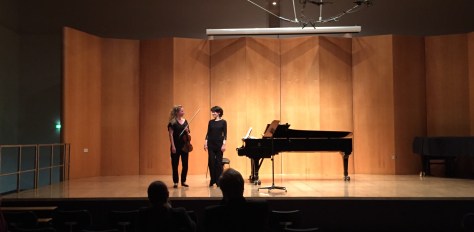
The second of the two concerts was held at the Schumann House, where Robert and Clara Schumann lived. A pianist performed many pieces from Beethoven, Clara Schumann’s own pieces, and those by Schumann. They were very lively and spirited pieces and a contrast to the earlier, much duller performance.

IMG_2221
Entry staircase

The simple yet elegant stairway at the entrance to the Schumann house was a lovely reminder of the integration of good design and construction in German homes. The museum is now linked with other musical sites such as the Mendelsohn and Wagner houses in Leipzig into a “Music Trail”.

IMG_2213
Community Room with motion sensitive instruments in ceiling

During the performance break, the announcer invited us to a community room and shared the research that is being done with electronic instruments generated by motion detectors. Each “spot” was keyed to an instrumental sound, such as clinks on porcelain, horns, keys, drums and bells. Using motion detectors and people walking between objects mounted in the ceiling, a series of sounds were generated. The more people moved, the more each sound was created.  The innovation could produce symphonic sound with audience participation. It was an exciting demonstration that everyone enjoyed.

Day 10: Hypezig Leipzig

A first reminder of Leipzig’s political history was evident at the main entrance to the Markt. The banner read: “Love Football. Hate Racism”. They continue to extend an open hand to refugees and warn against Neo-Nazi tendencies. Despite the loudspeakers and full police reinforcements nearby, it appeared to be a quiet, orderly, and reassuring demonstration.

Today’s demonstration was a faint reminder of the city’s history. In 1989, Leipzig sparked a series of demonstrations at the Nicholai Church that led to Reunification of Germany. You can read more about Leipzig here: https://en.wikipedia.org/wiki/Leipzig

Leipzig doesn’t have the appeal and cultural taste of Weimar, but it has music to make up for its visual shortcomings. There are a wealth of classical and rock concerts, performances, plays, and revues, and the Gewandhaus and the Leipzig Opera are world-renown. As a major trading town and international fair promoter, Leipzig seems to have picked up economically since I was last here. Many new malls, museums, and building developments have surfaced, and the economy seems to be booming.

There are still many lovely Baroque-like buildings to appreciate everywhere you turn. Intricate passageways connect positive and negative spaces to each other. The decorative elements and sturdy, well-maintained buildings are reminiscent of Prague. Newer buildings are well integrated into the urban, pedestrianized fabric of the city.

The famed Auerbach’s Keller is where Goethe purportedly wrote “Faust”. The cellar and dark interior of the restaurant spins the mind into believing that Goethe himself must have made a deal with the devil there. A couple of bronze statues at the entrance add to the dramatic air.

The Friday Market was also in full tilt and it wasn’t hard to find seasonal spargel, or asparagus. Every vendor was selling some, and it dropped dramatically from 6 Euros in the morning to only 2 Euros per kilo by midday. Fresh meat, cheese and cakes tempted the eye as well as the palate.

And, the Thomas Kirche offered a moment of peaceful reflection at the end of the day.

image.jpeg

If you want to see an experimental short film on a Leipzig mural in one of the passageways: https://www.youtube.com/watch?v=yi5GPovC2Vc. Set volume if you want to hear the Thomaskirche organ.


Day 9: Goethe’s House and Garden House

Goethe’s House in Weimar is one of the two major attractions in this historic city (the other being Schiller’s House). Goethe’s holistic approach to philosophy, art, nature, and writing may have influenced the Bauhaus movement a hundred years later. (See yesterday’s post on the Bauhaus).

Goethe’s famous novel, “The Sorrows of Werther”, is a story about his affection for Charlotte Ernster (nee Buff). It sparked a viral interest in love stories in his day and may have caused a string of suicides mimicking the author’s drastic solution to a spurned love affair. Goethe was known to have had affairs with Charlotte von Stein among others. He eventually married a commoner Christiane after having a child out of wedlock with her.

Love is a featured topic of the Goethe Museum. Idealized, romantic love and even forbidden and erotic love were themes in Goethe’s writings. Goethe captured and explored human emotions that previously were suppressed or seldom expressed. Read some of the written explanations below.

Goethe was quite the Renaissance man. In addition to writing plays, poems, and about philosophy, Goethe was also an artist. He had a curiosity about the natural world, and became an anatomist, geologist, and horticulturalist.

Goethe’s home gives a glimpse into his personal life and work environment. Goethe paid particular attention to storage of artifacts and documents.  The custom-designed cases kept collections organized and accessible.  Books, coins, geological samples, and artwork were stored so they could be quickly presented and shared with visitors.

I could imagine being very satisfied and happy working there. Following Goethe’s perfect schedule, I would power through emails and blog posts in the morning, tinker a bit in the garden, have the main meal around 2pm, and cap each day with a nap in the afternoon!  Below are some of the enticing rooms and garden perspectives.

In the Park along the Ilm River, the Garden House served as Goethe’s getaway where the writer could escape his social and administrative responsibilities and focus on writing. Not too shabby either.

The “high horse” chair was custom designed so he could sit and write for long hours. The tall yoke rested his ample belly, and could easily support other elephants in the room. As a craftsman cum designer, he would have been an ace at the Bauhaus.

Day 8: Anna Amalia Library and Weimar City Castle

Weimar was once the hub of intellectual and political life in Germany. It still captures much of the imagination of aspiring writers, musicians, architects and playwrights. On my return visit to the Musikhochschule (High School for Music) last night, I savored an array of passionate violin student performances.

image

Stumbling into the National Library in Vienna last year was a thrilling experience. Naturally, I was curious to compare the Anna Amalia, a research library in Weimar for German literature from the Enlightenment to the late Romantic Period. While much smaller, this Rococo design was equally exciting, but more intimate.

You can watch a video of the library here:

The next stop on a day-long tour of local sights was the former residence of the Grand Duchy of Saxony-Weimar-Eisenach. Known as the Weimar City Castle, it now houses a collection of Cranachs, German Impressionists, and painters from the Weinar Art School.

Dinner with the locals:

image

Day 6-7: From Bauhaus to Your House

If there ever were a sacred place of pilgrimage for me, it would be the Bauhaus in Weimar. Created by Walter Gropius around 1921, this school combined the best of internationally recognized artists with master craftsmen in Germany. The school was intended to teach design and architecture rather than fine art. The artists taught form, shape, and color, and the craftsmen trained students to technically perfect their designs and products.

In the following photographs and explanations from the exhibit, you will get a sense of the development of graphic design and architecture that still feels applicable and relevant today. These photos are just a small sampling of the my favorite exhibits. A new museum is planned in the future.

Day 5: A Musical Scavenger Hunt

Sunday was a Dresden Music Festival Day, with three very different musical events scheduled in one day. This may seem like a bit of overkill, but the main objective was to maximize our time in Dresden while visiting and searching for different venues spread throughout the city.

Our first treasure took place at the Semperoper. The Andrej Hermlin Swing Dance Orchestra played many popular Glenn Miller big band tunes, including “In the Mood” and “Chattanooga Choo-Choo”.  The music immediately got everyone tapping their feet, and the German fondness for American music was clearly evident in a rare standing ovation. Viola Manigk and a local group known as the Skylarks provided vocal backups.

in the afternoon, we took a ferry ride across the Elbe River to the Pillnitz Palace about a half hour away to hear the Dresden Boys’ Kreuzchoir. Due to rain, it was moved from a serenade on the green to indoors at the Weinbergkirche. We managed to find this hidden spot, but only after a long search.

imageAlong the way back to Pillnitz, I discovered a collection of my favorite rooftop “eyes” on a single building alluringly blinking back at me. There were too many to count, but they reminded of the “one-, two-, and third-eye blind” roof windows recorded in the neighborhood of Loschwitz when I was studying in Dresden in 2014. It was definitely the bonus find for the day.(You can see the two-eyed version in the collection of photos for Day 75+5 in 2014 noted below).

A 230-year-old Camellia tree is a magnificent feature of Pillnitz Palace.  The tree, in all its splendor, is kept in a huge moveable glass and steel-framed atrium in the winter. The cover is carefully transferred on rails to protect the tree from the cold and frost, and then removed again in the Spring. We managed to zip past this grand dame and hoped that its longevity would continue. (You can read more about Pillnitz and the tree here: https://en.m.wikipedia.org/wiki/Pillnitz_Castle

On our final musical “find” for the day, we captured an evening piano recital at the Grosse Garten. The modern interpretation of birds was difficult to appreciate, especially when real birds were chirping at twilight just outside. Similar to Golden Gate Park in San Francisco, the Grosse Garten is much loved and appreciated by the locavores for its accessibility and refreshing green expanse. We were both lost and confounded on this exhaustive day, but it wasn’t anything that a good Vietnamese dinner afterwards couldn’t soothe.

Day 4: More Moritzburg and Carmen

A couple of years ago my friend Hanne and Jens introduced me to Moritzburg. I had been wanting to go to King Augustus’s “Hunting Lodge” again. I got my chance when a group of us planned a half-day excursion. We mixed and matched a combination of public bus and private carriage to get there. By doing so, we had an interesting variation of conversations in German and English. International and local friends from Germany, Bulgaria, the U.S. and Switzerland got in our Sunday gear and convened in Dresden for this delightful day of history sharing, friendship, and even tail-gating.

Most of the historical significance for this private country estate centered around 1730. Similar to King Friedrich’s Sans Souci outside Berlin or the Summer Residence of Peter the Great outside St. Petersburg, Moritzburg is another opulent getaway villa. This one, however, did seem more tastefully decorated (if that can be compared). My favorite room is the dining room, where all the deer antlers are displayed. The tips of the antlers are duly recorded and ordered in the dining room from the smallest to the largest sizes (mostly 26, 28, 30 and 32). You can read more about the castle here: https://en.wikipedia.org/wiki/Moritzburg_Castle.

Curtain Calls for an evening performance of Carmen  at Semperoper below:

Day 2-3: Dresden Neumarkt

One of the reasons I return to Dresden annually is to stay at one of my favorite hotels in the world. Located on the Neumarkt square around the corner from the famous domed Frauenkirche, this hotel  can be identified in the header above. Look for the yellow building and the  fourth one in the series of reconstructed Baroque buildings in the center of the header photo. This gem beats any Air BNB hands down for price, location, and amenities. The unit is at the very top, where two small dormer windows peak out at the roof level.

The hotel is also centrally located within a stone’s throw of the famous Semperoper, where we attend many of the concerts and opera performances, as well as numerous museums and attractions.

After a quick outing to Bad Schandau located in “Saxon Switzerland”, we headed over to the Semperoper for a delightful performance of Tsaichovsky and Rachmaninoff, performed by the Amsterdam Concertgebouw Orchestra. Kristine Opelais, an accomplished and upcoming star, sang from Eugene Onegin and Puccini.

Day 1: Ready…Set…

Hi Everyone,

Are you ready for the travelwithmyselfandothers.com third world trip?!? It’s about to begin in less than 24 hours! Follow along my path of travel through Germany for a month and a half. I’ll be joining friends for the Dresden Music Festival first, revisit Weimar and Leipzig, then spend a month in Berlin studying German at the Goethe Institute.

After that, I meet up with hubby Gee Kin in Beijing to revisit Mongolia, Russia, and Japan to complete my 80 days around the world. It’s a follow-up tour from last year, where we took three-fourths of the Trans-Siberian Express (the Mongolian portion) from Beijing to Moscow.

This year, we are completing the full TSE route from Irkutsk, Russia to the east coast border town of Vladivostok. We are curious to see if it is a boom town full of economic activity. In case you’re not sure, just ask Sarah Palin! She can see what’s going on from her living room window!!

After that, we’ll fly to Japan to decompress on an ancient highway that connected Kyoto to Edo. It’s in the middle of Honshu, where we’ll also visit Matsumoto Castle, Nagano, and hot springs in the area.

Not much visuals to share yet, except for a weather report that I keep on my phone of all the upcoming cities (not necessarily in that order). See below.

Hang on, and hope you enjoy the ride with me. Write if you get a chance, I love hearing from you! (If you find the email notifications annoying, you can always opt out and follow manually by visiting the website directly at https://travelswithmyselfandothers.com/

Auf Wiedersehen, Viele Gruße, and Tschuss!!

VickieVictoria

IMG_1579

Real Time Creative and Independent World Travel