Category Archives: 2015

Day 63: New York City, New York (Il Trovatore and the Guggenheim)


IMG_9504For my old and new friends and fellow opera lovers, here are photos of the Mighty NY Metopera evening of Il Trovatore, with superstars Anna Netrebko and Dmitri Hvorostovsky.
In the most moving part of the evening, Hvorovosky was showered with yellow roses during his curtain call. He was recently diagnosed with a brain tumor and had cancelled all performances in July and August. He had only returned to perform with Anna Netrebko for three performances of Il Trovatore after positive treatment. You can read more about him on his website at:http://hvorostovsky.com/

Anna Netrebko, who played Leonora, was sublime, and Hvorostovsky was courageous and powerful. Delora Zajick, who played Azucena, and Yonghoon Lee, who played Manrico, were both well received.

Earlier in the day, we took a short walk to the Guggenheim Museum to see a highly recommended Doris Salcedo exhibition. Doris is a courageous artist who asks questions about trauma caused by colonialism, racism, and social injustice in her native Colombia and other countries through her work.

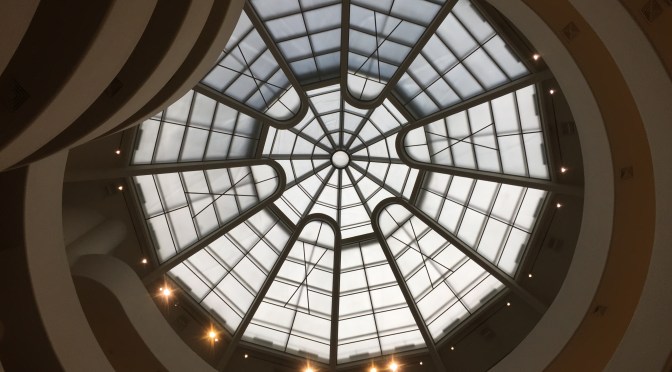
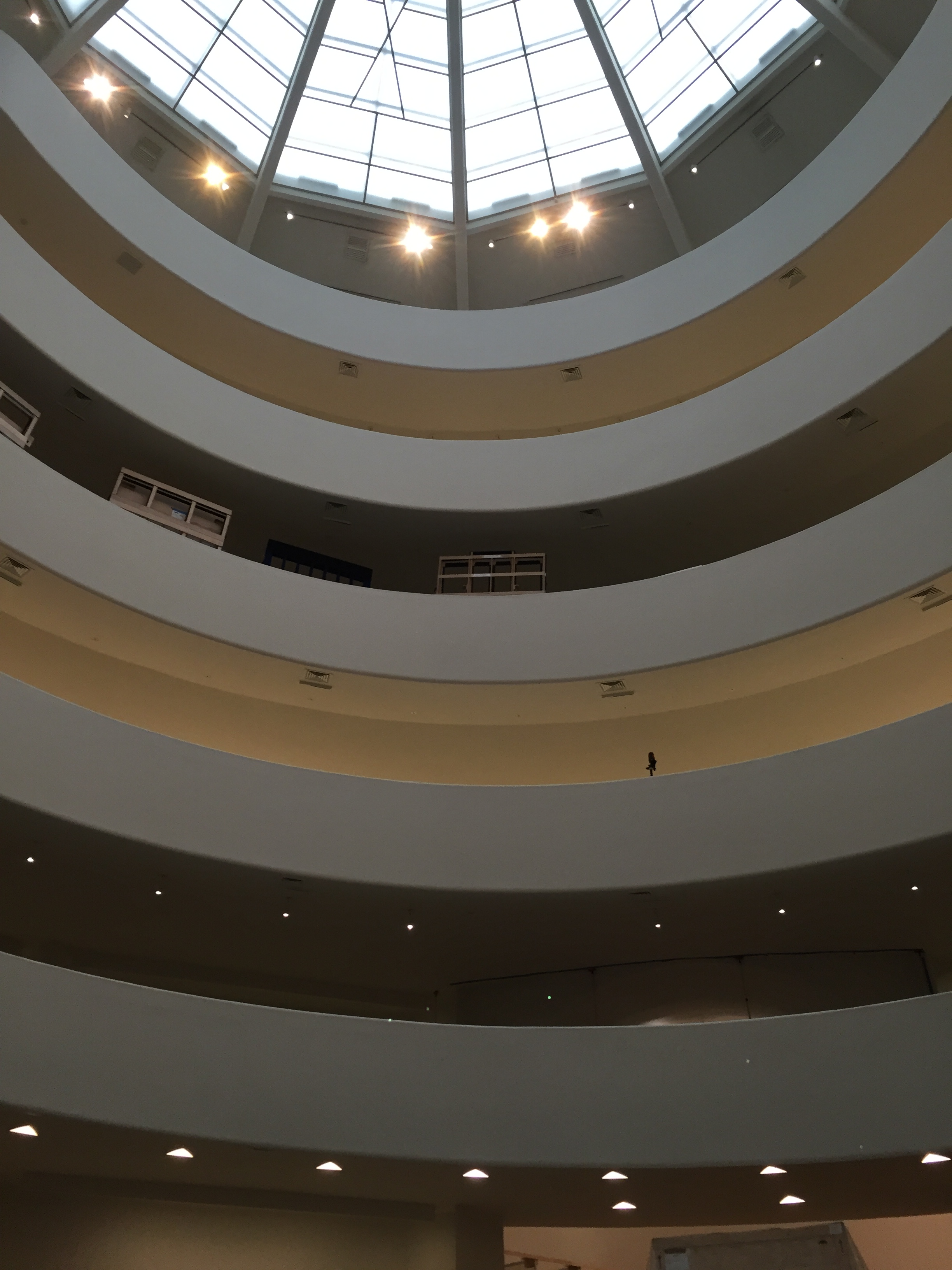
Interior Corkscrew
Interior Corkscrew

This museum was designed by Frank Lloyd Wright, ca. 1959.
Most of the museum was closed during an installation of an exhibition. You can read more about this controversial museum at the time it was being designed and constructed at http://www.guggenheim.org/new-york/about/frank-lloyd-wright-building


1. A Flor de Piel, 2014: Based on a burial shroud, this fabric is an homage to a nurse who was tortured and murdered in Colombia.Its enormous undulating fabric is painstakingly stitched together from chemically preserved rose petals–a material replet with romantic  associations that at the same time mimics the appearance of flayed skin.

2. Wooden Armoires with Concrete and Steel: Between 1989 and 2008, Salcedo created an expansive body of work forged from pieces of domestic furniture with concrete poured in them, as if to immobilize and be muted by grief. The furniture represents the families of those who have died and their silent mourning.

3. 11 Stacks of Shirts with Rebars evoke an image of violent incursion

4. Disremembered, 2014: Woven from strands of silk thread, these works take the form of garments that would harm rather than protect the wearer. The shimmering forms hover on the edge of visibility, in an expression of the artist’s interest in representing the experience of loss through the shifting lens of memory.

For more information, go to Doris Salcedo at guggenheim.org/Salcedo. (These descriptions are excerpts from the Doris Salcedo exhibition material at the Guggenheim)
IMG_9494
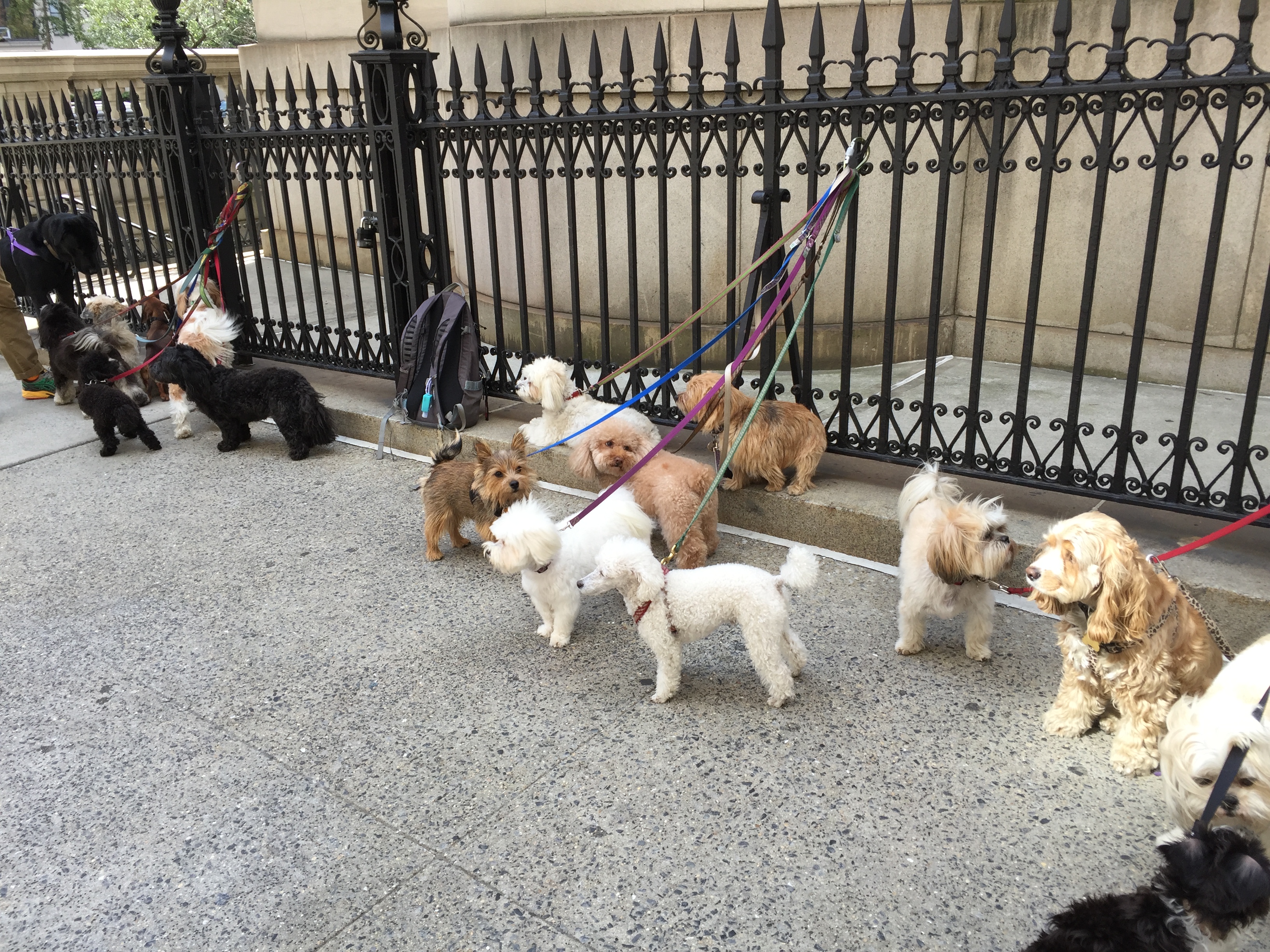
On our walk back, we passed the Doggie Day Care Parade.
Available for your visual pleasure Only in New York.

Day 62: New York City, New York (continued)

Today was a continuation of yesterday’s whirlwind tour of galleries and museums, directed by two friends and ardent museum-goers. We started with a visit to the new Whitney Museum, that has been relocated from the Upper East Side to the Meatpacking District adjacent to the popular Highline. It was exciting to see an expanded display of America’s best that included many women and artists from different ethnicities. Galleries are organized and grouped by themes.

The featured painting above is entitled “Saigon” by Peter Saul, 1967. It shows the raping, death and destruction from that horrible war. You can go to the link below and find an audio presentation about it given by a museum guide.

The freshly minted building by Renzo Piano:


Photos above:
1. Sculpture by Ruth Asawa, San Francisco’s own
2. New York, 1955
3. Jackson Pollack
4. Rothko Painting indicating Tragedy, Ecstasy and Doom
5. Photographer in front of painting by Krasner, who was the wife of Pollack. After he died, she continued to paint but converted from small scale to large scale in his barn studio.


Normally, I roam the galleries looking for only the artists I recognize. Near the end of the visit, I made an effort to find three artists whose work I did not know. See those above for Cy Twombly, Alma Thomas, and Elizabeth Murray. So many contemporary artist represented in this vast collection can be intimidating and overwhelming, but I found that determining a small number for myself was manageable, energizing and educational. It didn’t stop me from continuing to look for those old shoes, however, for comfort’s sake!

IMG_9466
The Whitney specializes in American Art and has been a big supporter of providing classes for artists.

For more about this exhibition that closes on Sept. 27, “America is Hard to See” go to http://whitney.org/Exhibitions/AmericaIsHardToSee

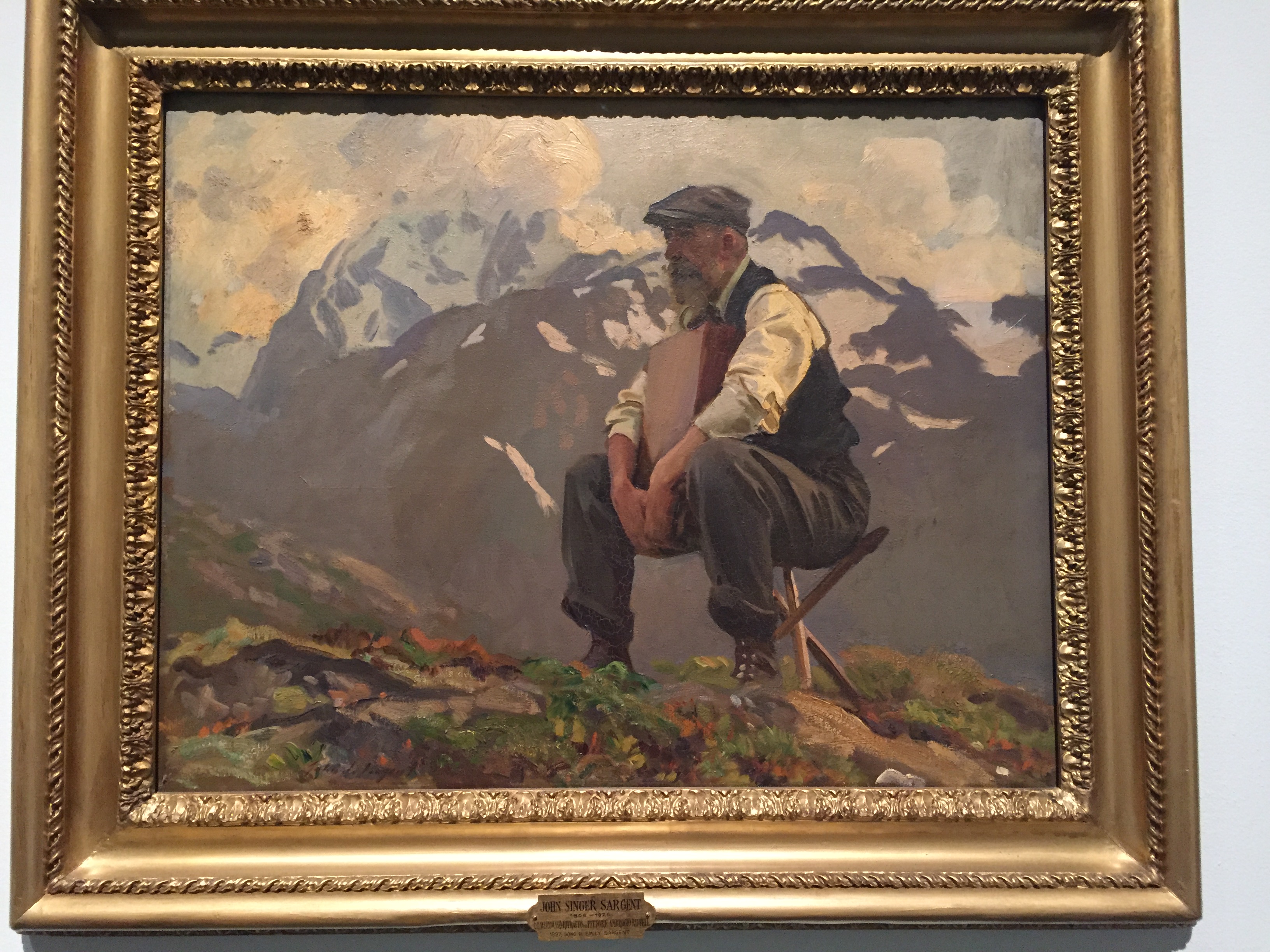
If this exhibition at the Whitney wasn’t enough, the gods must have been crazy to allow me go to another major museum in town. The Metropolitan Museum was having a major exhibition on John Singer Sargent’s “Artists and Friends”. He was born in Europe to American parents and had extensive connections to highly influential individuals, artists, and musicians in Paris, London, and throughout Europe.

Here are a few of my favorites. They are dedicated to Sargent fan Tony (if you are out there):

Full Size Portraits

Head Portraits

This one’s for you Helena:

Simplon Landscape
Simplon Landscape

For more about this exhibition “Artists and Friends”, go to http://www.metmuseum.org/about-the-museum/press-room/exhibitions/2015/sargent

And last but not least, for Isa who asked:
These are televised screen shots from the Pope’s visit last night at St. Patrick’s Cathedral. We weren’t there, but our host was late to dinner after attending the mass. We were watching TV and checking for him in the audience. The Pope seemed like a pretty nice person.

Day 60-61: New York City, New York

Attached are a few photos of the Picasso Sculpture Exhibit currently at the MOMA:

From a dozen gallery visits the following morning:

Lunch

Tour of World Trade Center Area

Cruise on the Hudson in 130′ Yacht

Room with a View-New York City Skyline looking North

Day 59: Ich Erinnere Mich…

In addition to afternoon walks to various museums and sights sponsored by the Goethe Institute, I put in my daily walk to and from the guest house to the Institute. I became very fond of my own personal “Schwabisch Weg” in either direction, as this tiny trek was only for a two-week duration but seemed different and fairy-talish every time I took it.

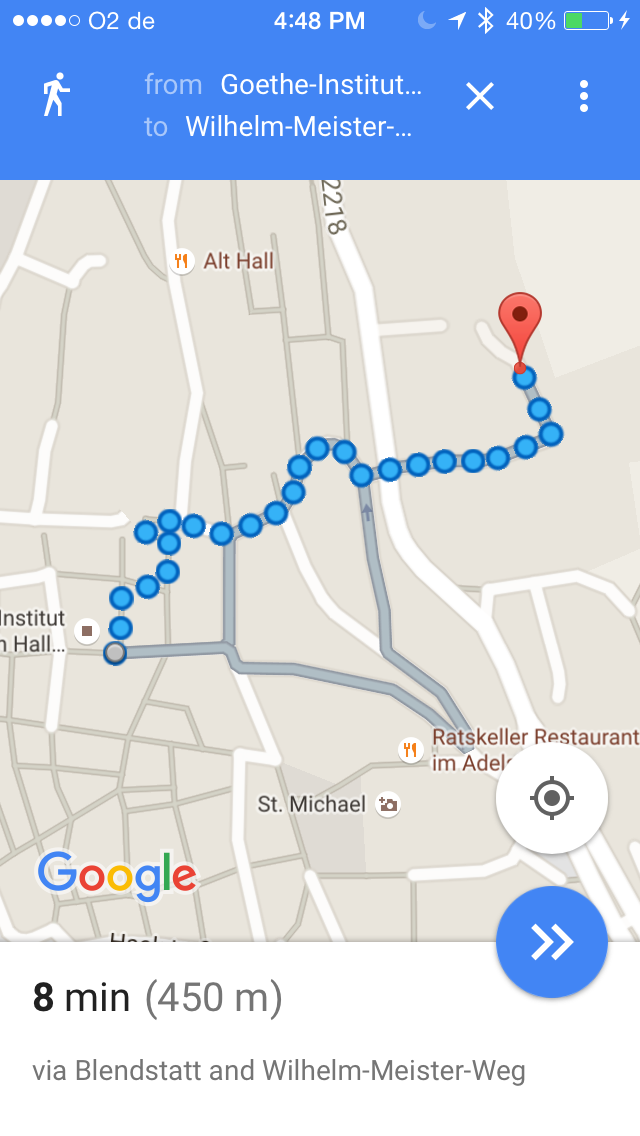
From the map attached, you can see that there are multiple ways to accomplish getting there. Initially, I got lost more than once, in my inimitable way of trying to find shortcuts. They usually led to dead-ends (any life lessons here?) but somehow I managed to dig my way out of innocuous tribulations for the benefit of a hearty trial.

IMG_9273

While only 8 minutes each direction according to Google Maps, it actually takes longer.

As you exit the building and the guest house, you must go in the opposite direction (ie, north or up in the map) from the destination, along a very narrow and heavily traveled route, to cross the road. The traffic is erratic and unpredictable, thus the need for a subterranean crossing. Some liked dashing across the road, but I decided that a little more exercise wasn’t going to hurt and others wiser than me thought it was safer. It occurred to me that I could make someone pretty miserable if they hit me by mistake, but whoever thinks of that?? I must be getting senile, or more considerate in my old age!

The Grundschule am Langen Graben, a grade school, adjacent to our living quarters, is paired with what looks like a private upper school for the older students. I first noticed it with the traffic signs decorated by school children reminding everyone of its precious cargo (as we used to refer to kids being transported in the U.S.) The signs were made by students, and the adorable naive drawings, life-size, were good reminders to adults and drivers to mind the crossing for children.

After navigating past the very official automatic barricade and the stainless steel man-gate, you can make your way past the private vehicular entrance to the public tunnel under the road. It’s a bit dark and uninviting, but it’s perfectly safe day or night. The cold concrete and functional features don’t ask anyone to dally, except for more student artwork of life-size kids lined up in a row to remind you of the little people in the area.

Once past this threshold is another set of steps. It threads through the Landrat Building, a pretty innocuous modern government admin building for Migrants. I imagined that one day soon that building would be overwhelmed, but as of yet had not seen any impact of the refugees coming in. I could only identify the access with an auto insurance company logo. That reminded me of one of our class lessons in “Versicherheit”, or insurance, that is so essential for survival in Germany.

Immediately after, you link into a quick swoop down a cobbled, winding street clad with modern housing over small scale retail. The shops offer natural wool-made products, a shoe maker, photography studio, and candy. A furniture store connected to the building with the auto insurance broker displays Scandinavian style Futon lounges and L-shaped sectional seating for $450.00. You wonder if they are still selling the original goods from the 60’s or whether they are a retro-snap–for that price it’s a bargain.

Steps are necessitated by a gradual downward grade toward the river. Remember the entry steps outside St. Michael’s Cathedral, facing the river. It’s a good stage for theater, dance, and musical events.

We carry on to the Big Steps. Modernized to fit a little town on the move, this wide, stone-surfaced series of three or more flights straight down the hill make you hesitate and think twice before tackling it. It is laden with broken glass from the previous weekend’s teenage brawl. Maybe better dealing with the clean-up than the guns or mindless violence we see in the States, I say to myself.

You can opt for the glitzy glass elevator if you don’t have the stamina to tackle the straight shot down the stairs. A bit hard to find, the vertical tower gleams in open space by itself. The only problem is how to get to it. Once you figure it out, the path to it has another challenge. The open steel grating to let water through is a bit unsettling. Don’t look down, or you might get vertigo. Innate trust in engineering calls on you. You have a momentary dilemma–should I go back and take the tumbling steps, or tiptoe over the grating to avoid any vibration and looking down?

Once down toward the river and near the Institute, you have one of three ways to the classroom. You can go either to the right up the alley then around the courtyard in the middle of a U-shaped building, or to the left up the alley and up a flight of stairs outside. The middle route, where I normally went under the arch into the complex, by-passed an immigrant beggar every day. I avoided this path as it made me feel guilty that I hadn’t supported this person in need.

The Goethe Institute was located in a renovated building that formerly was a hospital. In the middle of the hospital was a chapel. It was apparent that the chapel was an integral part of the hospital operations. When the hospital was no longer needed or moved, the chapel was repurposed into a gathering and meeting space for the Institute. The outdoor courtyard, or hof, surrounding the building, provided a social activity space. A few inexpensive tables and chairs were enough to become an inviting and lively atmosphere for students.

While the trips back and forth to the Institute were rushed many days, it was short and sweet enough to help me appreciate the history and quality of the environment. It’s a memory that I hope I have captured and can preserve for a long time.

Day 58: Pause to Refresh

This is a good time to recap the first two-thirds of my 80 days around the world, since I am about to leave Germany to fly back to the US. In the past two months, I have traveled on the Trans-Mongolian Express (TME) from Beijing to Moscow, visited the Russian capital and St. Petersburg, and several cities in Austria, Switzerland, and Germany.

The next segment will be a stay in New York City and a short trip by car to see the Fall Foliage. The final leg will be the counterpart to the TME: a cross-country trip via Amtrak to Philadelphia, Chicago, Santa Fe, New Mexico, and finally back home to San Francisco.

Join me in the next few weeks as I compare cross-country trips between the U.S. and Russia!! I also look forward to seeing old friends and family.

Below is a glimpse of each stop. You can find the posts by searching the city or in the archives for July-September 2015.

Beijing: Best Hotel Experience in a traditional Chinese Hutong (Courtyard) Hotel

The Trans-Siberian (Mongolian) Express:

The Trans-Mongolian Express travels from Beijing to Moscow and is part of the Trans-Siberian Express. It connects to the Trans-Siberian Express in Ulan Bator and picks up the route that begins in Vladivostok.

Transsiberianmap

Mongolia and Ulan Bator:

Moscow and St. Petersburg:

Berlin:

Salzburger Festival Performances:

Vienna and Linz, Austria

Switzerland

For Schwabisch Hall, see recent posts.

And a few earlier posts organized by my favorite topics:

Architecture:

Food:

Artwork:

Photos may be repeated from earlier posts.

Day 55-57: Schwishin’ Schwäbisch

After the end of the Language and Cultural Program, it is difficult to come off a “high” from having made several new friends in a short time span. While others were packing their bags and moving home or elsewhere today, I decided to stay behind another day to savor a town I have called “home” for the past two weeks.

A morning walk refreshed my first senses of this sweet little town. A river runs through it, where people can still fish from it. Walks are everywhere that meander along the river and trace the town’s history. A community that cares about its environment and each other. And specialty local produce and products are made with purpose and don’t cost an arm and a leg.

Here are a few recordings of my walk this morning:

The Saturday Market was just getting ready for a big weekend celebration.

IMG_9259
Our class mascot, “Goethle” with specialty products Bratwurst, Bio-Blutwurst, and Schaschlik Guwürzsalz.

Our last two days were a little sad as friends got together for dinner and said our good-byes. While we didn’t exactly master the German language, we made some good friends, shared and learned alot from each other, and thoroughly enjoyed a successful two-week stay in Schwabisch Hall.

Day 52-54: Week Two, Schwäbisch Hall

The Goethe Institute students in our class are already embarking on the second week of the two-week language and cultural program at Schwäbisch Hall. It has flown by, with many activities, new friends, and mind busting German classes that test our memories and expectations of ourselves. It feels as if we are on the same boat, cruising down the river of life together.

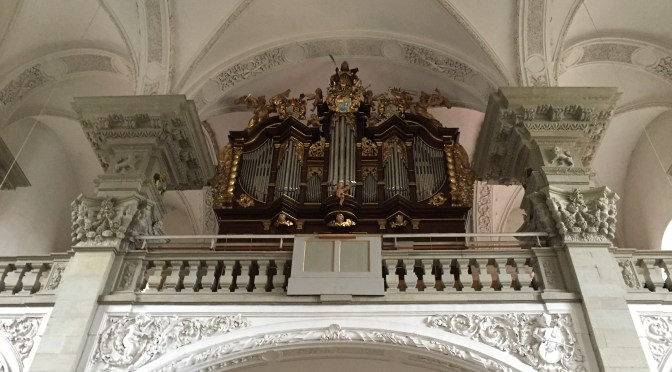
The Kloster Großcomburg and the Kirche St. Nicholas contains a rich collection of beautiful stone sculpture and elegant interiors. Clad with stone columns and capitals, plain ribbed walls and ceiling, and handsomely crafted wood pews, the Church interior and its materials seemed very modern and soothing to the eye. A beautiful stately organ was perched in the balcony ready to beckon its congregation. The church is at the top of a double-walled fortified hill, similar to the one at Schwäbisch Hall.

The ecclesiastical and royal stone figures possessed an air of confidence and stately manner. The king stands on the lions, a sign of royalty, but the queen is only allowed to stand on a dog as a sign of subordination. A stone knight looked poised, and ready to prance into the room. Its crisp, ribbed clothing was beautifully honed to perfection.

The day before, we took a full day excursion to Stuttgart and saw examples of historic buildings in the Altstadt area as well as modern, stately residential buildings with a strong Corbusier influence. With a population of 500,000, the city is built along a river and has steep hills with spectacular views similar those in San Francisco. Originally known as Bad Cannstatt, Stuttgart has a wine-growing region on the opposite side of the residential area and it was the impetus for Stuttgart’s growth. The city was bombed severely in World War II, so many of its original buildings no longer exist. Bosch, Porsche, and Mercedes-Benz are a few of its top companies.


In the afternoon we visited the Mercedes Museum. Daimler merged with Benz to create the world-wide brand of Mercedes-Benz. The classic three-pointed logo stands for the company’s products for land, sea, and air. The nine-floor, museum-quality ramped building was designed by Netherland’s Ben van Berkel and Caroline Bos’s UNStudio and features a timeline and modern history of the world since the development of the first Mercedes-Benz. Many of the classic automobiles, trucks and buses are also on display there.

In an outing the day before, a few of us were able to break into a small group and enjoy walking on one of the several Wanderwegs, or paths through and beyond Schwäbisch Hall. Despite drippy weather and overcast skies, our group encountered a field of sunflowers that brightened our day. It was a near-perfect day–only a rainbow was missing.

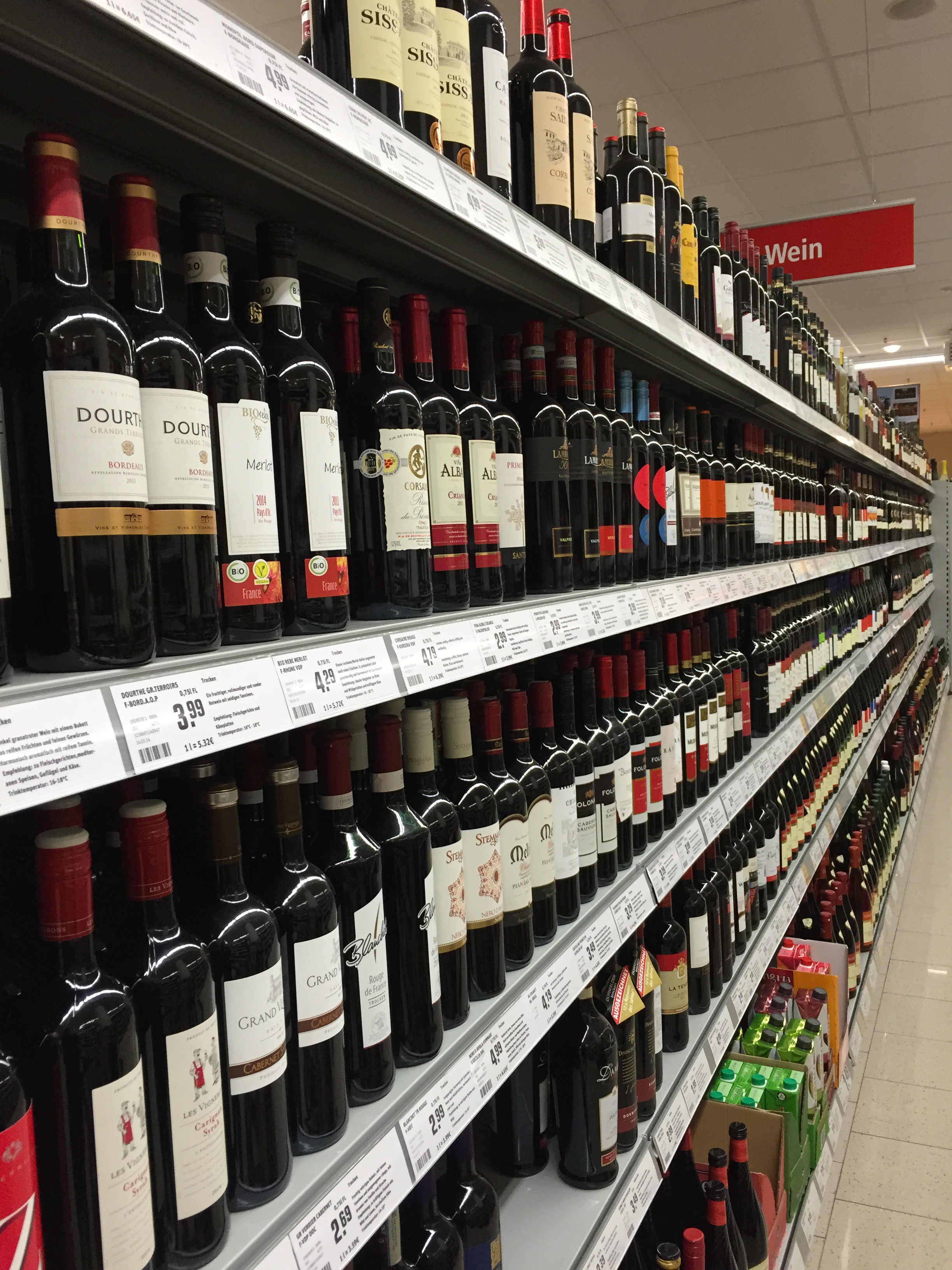
On a trip later to the supermarket, I found that wine is plentiful, with none over 6 Euros! The shelves were lined with a variety of locally produced wine. After a long search and at the end of the shelving in a “premium” section, I finally landed on a bottle of Hohenlohe Fürst Oehringen 2013 Lemberger Trocken (dry) for 9 Euros!! I tried, but I couldn’t find much for over 10 Euros.
IMG_8934

Day 51: Schwäbisch Sonntag

In preparation for my departure at the end of the week, I took a stroll through the town on my own in the afternoon. I savored the time alone, with no rushing through museums and tours. There are so many interesting paths, side streets and alleys lined with historic architecture, from medieval to modern. The city’s double walls and independent status allowed it to be spared from many battles and sieges. Thus its buildings and city were preserved.

A festival with music in the market plaza served free food and beer. Here are a few more shots that I took today.

A return to the Hällisch-Fränkische Museum gave me an opportunity to study the geology, early history of the area, and other exhibits. The city gained its prosperity and fame from the salt deposits along the river. The area was occupied by Celts and later Romans. One of the area’s well-known sculptors was Leonhart Michael, who created the moving stone relief sculpture shown below of Christ’s Crucifixion.

On a Sunday afternoon and for 90% of the time, I was alone in this beautifully crafted and presented museum. The scale models of the city and buildings reinforce how much the towns appreciate their history, architecture and planning.

A wig gallery allowed me to inspect them closely. Having heard about all the hygiene problems until the recent past, I’m sure that the wigs were developed to hide all those lice and growies on one’s head. After trying one, I was left to my own devices and was forced to take selfies of myself in drag. Sorry, you’ll never get to see them publicly.

Day 49-50: Ein Schönes Wochenende

Our “Beautiful Weekend” has begun! We started on Friday afternoon with a visit to the modern art museum, the Kunsthalle Würth. It’s a private gallery, with special exhibitions for Op Art and silver from the Victoria and Albert Museum in London. The building was designed by Danish architect Henning Larsen.

We strolled back to the main market plaza in town, past the Globe Theater, a replica of the one in England, and through the wooden bridge over the Kocher River.

On Saturday, we had an ambitious schedule for the entire day. A bus took our group of about 20 students first to Marbach am Neckar, Schiller’s birthplace. The house where Schiller was born was tiny but gave us an impression of life in this small town. Schiller was considered the “Poet of the Nation”, as he promoted freedom and the unification of the various states in today’s Germany.

If you remember, Goethe and Schiller were close friends. Much of their life’s work took place in Weimar, where we stayed for a few days earlier this year during the Dresden Music Festival. Statues of Schiller and Goethe are located in San Francisco’s Golden Gate Park.

In the afternoon, we visited the baroque town of Ludwigsburg and the Ludwigsburg Palace. As a young student, Schiller lived in Ludwigsburg. Each town has its own markets, but this one surrounded by Baroque buildings was particularly enjoyable.

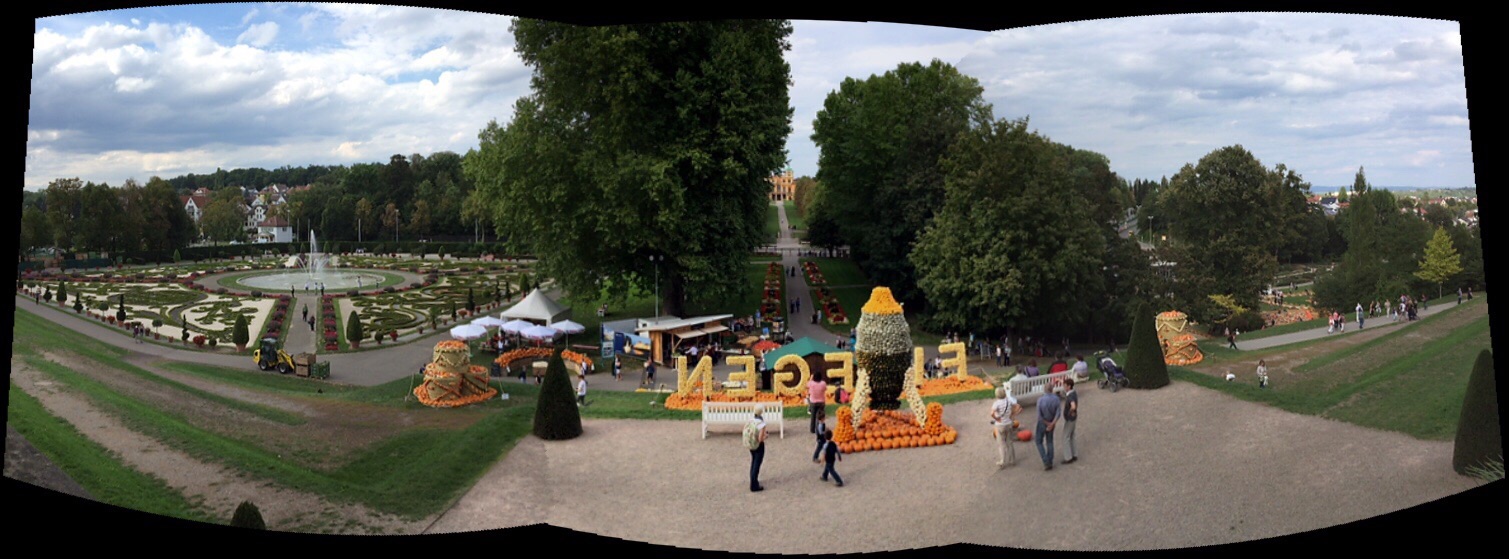
Germany has a strong sense of community, and each town has its special celebrations for young and old alike. This pumpkin festival, although small, reiterates the care and thought that is put into planning and implementation of each event for its citizens. It’s something I really respect and appreciate about the German culture.

I took a similar picture of the pumpkin display for a graceful older lady standing near me. When I noticed that she was struggling a bit, I asked her if she wanted me to take a picture for her. She was happy that I offered, but she was also very specific about how I should take the picture–make sure the edge of the balcony didn’t show in the picture, and get the building in the background. She declined when I asked her if she wanted a picture of herself.


image

Time Out: Thoughts on Austria’s Minority and Immigrant Population

Traveling on the road allows you to stay in touch or out of touch with the news. It wasn’t until my daughter informed me that there was a refugee crisis of monumental proportions happening right under my nose that I started checking the NY Times. While it has been in the German news on a daily basis, the effects of refugees haven’t been felt in the cities where I have been traveling…yet.

Ironically, I wrote the following piece below (on Day 31) when I first arrived in Vienna over two weeks ago. It got shelved because I thought there would be little interest in this topic. I decided to publish it now so I can share my thoughts about immigration in this part of the world with you. Please bear in mind that it was written prior to the events that have taken place and with little research.

It suddenly struck me when one of the students commented about his train from Vienna to Schwäbisch Hall being stopped for three hours at the border last week. He was allowed to continue travel but refugees were returned to the border of Hungary from where he had traveled. By then, I had already left Austria the week before and was in Switzerland when I first heard about the truck of refugees that were discovered.

Day 31: Thoughts on Austria’s Minority and Immigrant Population

Austrians speaking German. Turkish speaking German. Africans and Asians speaking German? I am finding a fascinating array of backgrounds and experiences among the resident population here and in Germany.

One of my first conversations with an immigrant living in Europe was back in China. Gee kin and I were on a train going from Shanghai to Huang Shan, a beautiful mountain with misty Chinese landscapes like the ones you see in paintings (except they really look like that).

We met a young college student who was going to Germany to learn German. It struck us as very odd. Coming here today clarifies for me this person’s intent from twenty years ago. The Chinese diaspora (which, let’s face it, must be by numbers relative to the population in China the biggest in the world) is an endless tale of the supply and demand chain. Chinese provide excellent skilled and unskilled labor to each country, and the Chinese immigrants can raise their children in relative peace and prosperity.

Once you arrive in Vienna, the capital of Austria, you can’t but notice the large minority population resident in this country. How did they come here? What is it like to live here as an immigrant? Do they see a future here?

The evidence of this is not by the tourists swarming these European cities, but by the stroller population. There are young African mothers, Middle Eastern mothers, Chinese and Asian mothers, with kids. They get on and off the underground and the buses that I am taking. They aren’t tourists; from their conversations they live here.

I am attaching a site that helps to put perspective on my questions: http://www.migrationpolicy.org/article/austria-country-immigration. I had also overlooked the Eastern European immigrants and their conflicts. Granted, this article is dated and didn’t seem to address the influx of Middle Eastern population that came subsequently, but it gives an overview of immigration in Austria at the time it was written.

I had a funny experience going to the Mozart concert the other night at the opera house. I purchased a ticket to an all-Mozart “variety show” so I could see a performance and the Vienna opera house. The musicians and attendants were all dressed up in Mozart-era costumes. Some employees touting tickets to tourists were Middle Easterners wearing white powdered wigs. It seemed silly, until you realized it was a job.

Austria has always had a fixation on wealth and the privileged class, just as the US has become (thanks to Austria’s namesake Arnold Schwarzneggar and others like him). And because of immigration in the past 50 years, Austria is now facing similar integration and assimilation issues that plagued the US since the Sixties.

In the mid-70’s, I came to Vienna on a tour with my mother and sister. Two young Indian sisters on the tour asked me to accompany them to visit their relatives in a refugee camp outside Vienna. Because I purportedly spoke German, they asked me to join them. While I wasn’t of much assistance, it was an eye opener for me. The camp consisted of people packed in tents and blanket plots, as densely placed as those at San Francisco’s Opera in the Park.

As Ugandan natives, their relatives were being purged from their own country during one of Idi Amin’s brutal campaigns. Although they were S. Asian by descent, they had never lived or been to India. Fifty years later, refugees like these are no longer refugees. Very few were ever repatriated to countries they claimed, such as the UK, US or other developed country. Although once “temporary” refugees, they are now second and third generation residents of Austria. They are no different from my history in America. Yet I wonder whether these new Austrians have the same benefits and respect in their country that I receive in the U.S.

For Middle Eastern immigrants, the recent influence is evident in Austrian hotels. Visitors who come here to visit relatives watch Aljizeera and a number other Middle East stations, which are represented on Cable TV. Their presence is noticeable in the hotel lobbies, where they visit with relatives. You realize how many more people are traveling back and forth between these parts of the world and Europe than in the US.

While these are all random impressions, they form a pattern. It raises questions about whether these once immigrants and now residents are integrated into society and being treated fairly. The US is no shining example, but perhaps it has had the advantage of dealing with immigration over a long time and many nationalities. Maybe there were a few good men to contribute to this cause.

As a small country of 8 million people, Austria’s proximity to the Middle East and Africa makes it a destination for immigrants. Germany, with 80 million residents, is in a similar situation. After I struck a conversation with a bus driver going to the monastery today in Linz where I was staying, I asked him whether he needed to speak English to many tourists. He remarked, “No. Turkish.” When I pursued why that answer, he said, “just a joke.”

Austria will have to tackle this problem now, as it unfolds.