Tag Archives: Sights

Days 67-68: Tokyo Weekend

Returning to Tokyo has allowed us to recover from the many trains and buses we have taken inland to the east. We perched ourselves in an Air BNB for a few days in an unusual area of Tokyo–a mere twenty minutes from the center of town, but in wide open swaths of fresh sea breezes to the south away from the high density high rises.

Known as Tennozu Isle, the new metro station is tucked between new high tech buildings, the  Tokyo University of Marine Science and the Samezu Sports Park. It feels like Mission Bay in San Francisco, and the UCSF campus where I worked. There is a core of ex-pats floating around the streets, and a Jonathan’s Fast Food Restaurant complete with American food AND Japanese dishes AND Chinese noodles AND Pizza AND Ice Cream AND Wine, etc., etc. If you died here, you’d have gone to Fast-Food Heaven, Japanese-Style.

It was strangely sensational and comforting to know that all these types of food could be found in one establishment. This place could solve any problems with getting the shakes over a fast-food deficiency.

Our foray to stock up on provisions led us to the Aoen Supermarket Basement of the Department Store in the area. It felt like a Ranch 99 gone big-time, hitting the mall in a high-rise scene and grown up with the big boys. The aisles were wide, the shelves well stocked with everything Japanese and Western, and it looked like Moscone Center or a convention center packed with Japanese food.

I felt a bit conflicted with food choices–sashimi with glassy flesh so fresh you could almost see through them; an entire case of seaweed options; and a whole dairy case of varying tofu densities. There were fresh octopus suckers, endless ginger and daikon variations, and rows upon rows of pickled cabbages. How can you decide what to buy when you’re too busy figuring out why you never set eyes on these items to this extent before?

After finally forcing ourselves to make a few decisions for dinner and buying ‘way too much to carry, we dragged our booty back to the apartment. It was only 15 minutes by foot but that’s only easy when you’re not lugging 30 pounds. We dragged our flimsy bags through the door. We savored a simple home-cooked meal of Teriyaki Salmon and salad with lemon dressing.

Speaking of food, we had lunch near Tokyo Station in the G-Zone, where we watched the local chef prepare hand made soba. These are the buckwheat noodles that are famous in Matsumoto. Here are two chef versions, one preparing the dough, and one cutting:

The handsome chef at the end was making and serving his own soba in Kusatsu, the hot springs village we visited earlier last week. When I showed him my video original, he graced my compliment with a shot of the finest iced sake I have ever sipped.

When we passed the Sports Park in Tennozu, we noticed the commotion ahead of us. A baseball game was in full tilt, complete with Little Leaguers in full regalia playing their hearts out. I would like to dedicate this clip to Kanji Hishinuma, my friend Iyoko’s son. He is a baseball fan and follows the American teams on Youtube.

I couldn’t complete the Japanese segment of my trip without mentioning the toilets. The designers of the equipment must be commended. No doubt anyone visiting Japan will remark on the cleanliness and impeccable care and detail of keeping public facilities spotless. Pardon my imprudence over raising this topic for those who might be sensitive or offended, but you cannot overlook the novelty if you come to Japan.

See photos below, left to right:

  1. A child’s booster seat mounted in the corner of the women’s rest room, so women can use the toilet with their babies and toddlers;
  2. An ordinary toilet, with palm-activated flush sensors. The more deluxe and typical versions have squirts for your bottom, warm seats, and, get this: amplified simulated waterfall sounds activated by the water flushing through the system. (Are we being confronted by a toilet fetish here?!?)
  3. Great design for toilets, with beautiful, cleanable surfaces, flush or recess-mounted baby changing stations, and perfectly operable hardware (they always close with a “click” so you know it’s closed!)
  4. Okay, this one’s not in the toilet but a device in a restaurant. Can you guess what it is? My answer will be in the next post!

Day 64-66: Nakasendo Highway and Matsumoto Castle

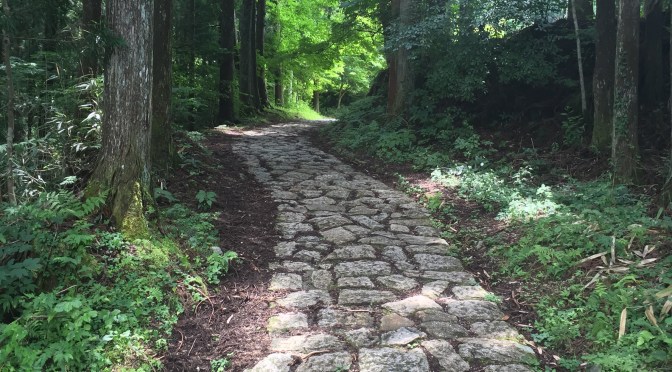
After traveling for over two months in Europe and Asia, the culminating event was walking along the Nakasendo Highway in Japan. An ancient highway for over 400 years to provide communication between Kyoto and Edo (present-day Tokyo), this route was used by messengers, tradesmen, and government officials.

Between postal stations and forest paths, much of the route is annotated with historical features. Literary references to famous Japanese writers and haiku poems about the physical environment were identified along the path, as well as religious shrines, military battles and scenic spots.

After scant Japanese and English translations at railway stations, the information transfer magically yielded maps and schedules. We were handsomely rewarded with instructions for a 500-meter change in elevation, three-hour walk through Magome Pass from Tsumago to Magome. We traverse gorgeous lush pine, maple and bamboo forests, deep glades and gushing river streams, and gently seductive waterfalls for an exhilarating experience.

We fell in love with this area surrounding Matsumoto. Although we had never heard about it before, it is famous for trekking, skiing, soba and sake. They all seem to fit well together.

I have been in such awe of the natural beauty of this area that it tempers my entire voyage to date. While my travels have been unabashedly Euro-centric to date, I am being severely challenged by this newly rediscovered Asian culture.

The Japanese have a deep, rich history and its status as an advanced industrialized country is impressive. Together, Japan has a lot going for it.

See the gallery below for a random assortment of shots in Magome and Tsumago, both prosperous villages at the time of their development and renovated, and the delightful walk between.

At the end of a day of hiking, we stayed at a ryokan in the lovely hilltop village of Magome.

Matsumoto

Our day was packed with three hours of  travel and three trains between Kusatsu Hot Springs to Matsumoto Castle.

Not being a Japanese speaker, I find that traveling in Japan is challenging. However, with a wealth of information available on line and at tourist information counters at stations, one can manage. Good travel skills like speaking slowly, waiting for stilted English to emerge, and a lot of body language and gestures definitely help.

The castle was built over 400 years ago in the Bunraku Period (1593-1594) and is Japan’s oldest existing castle tower. It is designated as a national Treasure. Take a look at the impressive stone foundations.

There were three moats surrounding the castle to slow down invaders. Shelves were constructed to release stones against soldiers attacking the castle. Guns eventually replaced bows and arrows used as weapons from the towers.

You can climb up steep steps to the top of the sixth level for a view of the Japanese Alps.  The castle and grounds  are impeccably preserved.

image

The sleek and elegant Bullet trains have transported us seamlessly between points, making it a pleasure to travel in Japan. Little English is (admittedly) spoken outside of Tokyo, but there are enough minimal signs to direct you to the right trains. Patience and fortitude pay off in one of the safest, most courteous countries in the world.

Day 60: My Sunday with Vladi

Amidst overcast skies, our leisurely Sunday urban hike in Vladivostok charted us from the top of the Primorskiy peninsula South to the very tip where a lighthouse was accessible by foot. There were great views of the city and the Golden Bridge from the shoreline.

Photo, above: Bombed out cars, buses, metal shrapnel, rusted everything waiting for weeds to infest them like modern-day Mayan ruins are prevalent along the road

Photos, below:

  1. Along the same road, luxury high rises and private villas scramble to be completed first along the narrow coastline
  2. Yachts parked along the west side of the peninsula
  3. Soviet artwork at the Swim Center

The width of the path at the narrowest spot was merely a meter wide, with shores of the water on both sides lapping gently like a puppy’s breath. A wedding party made a special effort, spike heels and all, to make it to the very end of the peninsula.

Our walk, about four miles in each direction, gave us an up-close-and-personal view of life in an up-and-coming Russian city. Everyone wants to enjoy life, life life freely, and have peace. We’ve enjoyed our stay in Russia, and although brief, it gave us a glimpse of a very misunderstood country.

For my foodie friends: a walk down the street from our hotel yielded a chance surprise. The environment was elegant and the food was, as we have found, carefully prepared, presented, and excellently proportioned to a small audience. This starter was herring, beet and vegetable salad, with a kicker. Like dry-fried beans, the dry-fried beets had a great texture complementing the fresh ones! They were crispy on the outside, and dissolved to a chewy, macaroon texture inside. Dinner for two with entree, salad/dessert, and wine was only $50!

We are preparing for our travel to Tokyo, Japan. After an overnight stay in the city, we will be heading out to the countryside to Kusatsu, an area with hot springs, on the way toward Nagano City west of Tokyo. You’ll be hearing more soon!

Day 59: Vladivostok, Russia

Here are some first views of Vladivostok coming from the north by train on arrival at sunset the night before:

Dinner at Three Brothers across from the hotel, complete with live American jazz music for $30 for both of us with wine

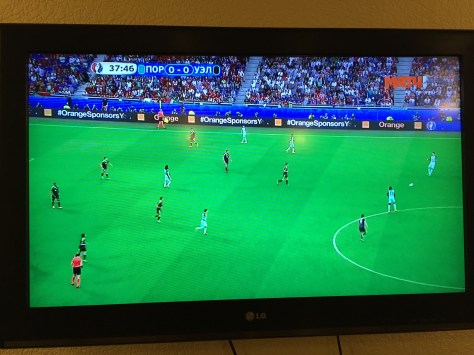
Evening Entertainment: Portugal vs. Wales with Rinaldo scoring 1 of 2 goals

IMG_4475

If you were visiting Vladivostok for the first time like we were, you could start an early morning walk at the Friday morning Central food market:

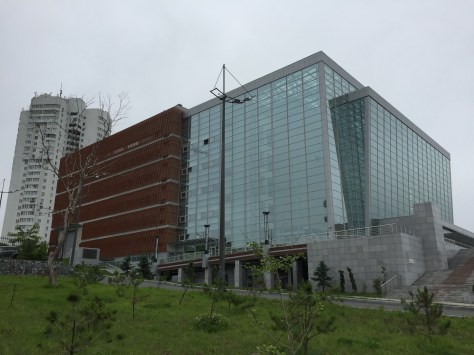
You can take a minibus to the new Mariinskiy Opera and Ballet Theatre. It is hosting the first International Piano Competition at the end of this month. I predict that it will be a great draw for concerts, ballet and opera in the future. You might consider taking a trip to attend this magnificent new venue and the emerging new productions and stars that will perform here!

After that, you can catch a bus back to the city and stop at the Lookout Point over the new Golden Bridge completed in 2012. Does the design look familiar to you?

IMG_4541

Later in the day, get your cultural brains in gear and visit the Primorie Art Gallery. When we attended, it was showing an exhibition of Russian Art from 1700-1900. We were intrigued with the very personal touches of each painting, that may have reflected or imitated more famous Western paintings of the same era. Sargent, Picasso, and Matisse came to mind.

There were also a number of startling paintings that represented new subjects seldom seen in paintings of the same era. Chinese or Muslim figures were represented in historical settings that required more context and explanation. Unfortunately, all paintings were titled in Russian or limited English.

At the end of the day, kick back and have dinner at the Three Brothers for evening meal. This was our return visit from the night before. The outdoor dining was perfect for the cool balmy weather of Vladivostok. The city is very similar to San Francisco, with hills, coastal fog, city views everywhere, and a lively ambience. We’re in love with this city of 2 Million!! This city is destined to be a big tourist destination in the next 10 years, so come soon.

Day 56-58: TSE in Transit

Good Morning Everyone

We boarded the eastern section of the Trans Siberian Express (TSE) the night before, so today is the second of three days on the train from Irkutsk to Vladivostok.

Irkutsk is positioned on the west side of Lake Baikal. As mentioned earlier, Lake Baikal is the deepest and oldest lake in the world. These may be little known or insignificant details to most people, except that it was one of the engineering obstacles in building the TSE. Although much of the construction required laying track along the 5880 miles or so, the section along Lake Baikal required blasting, going through narrow gorges, and swampy terrain. Now there is talk about a joint venture between China and Russia to build a high-speed version of the route.

Until then, I will enjoy what has been produced to date. The views of the eastern route have changed, from five of the six continuous days last year through Siberian birch forests and saggy wooden rooftops to brighter, open grassland sprinkled with wildflowers among pine and birch forests along the Amur River. There are twice as many stops on this eastern leg of the TSE (only about a quarter of the distance from Ulaan Baatar to Moscow). We were pleased to see a more vibrant side of the Russian landscape.

The people have been curious. We have had limited contact with Russians, and the language has definitely been a deterrent. We were finally able to connect with one of the guides at the Irkutsk City Museum by using broken French on both sides. So my five years of French in high school finally paid off, after trying English, German and Chinese in futility.

Virtually no one on the train speaks English, with one exception. We met a gentleman who lived in the Grand Canary Islands in the dining car yesterday. He was Austrian, originally from Innsbruck, and owned and operated a small, up-scale restaurant in the Canaries. He was taking a four-month break (low season in the summer in the Canaries, as most tourists go there in the winter) with his wife and was traveling through Eurasia by train.

In the Eighties, he made twenty films on different cities and countries in the world for an Austrian television series at a clip of one a week. San Francisco was one of the cities, so his eyes sparkled when we told him we came from there.

His current route took him from Vienna to Minsk, then Moscow, then Ulaan Baatar. After spending a week in Mongolia, they were heading in the same direction we were, to Vladivostok. We are finding that the travelers we meet along the way have substantive histories and travel background.

Other than 2-3 staff, this couple has been running a small high quality restaurant for over 30 years. The gentleman and head chef had been trained in a cooking school from the age of 14 to 17. When he turned 18, he left his home to start a successful business and wound up in the Canaries.

Every year, he and his family (the couple has a 17-year-old son) traveled to Africa, South America, and Asia. They loved traveling with their son as he was growing up. Alas, their son has finally decided to do his own thing this year. Although we have yet to meet the wife, the chef indicated that she was very sad about this change. We could certainly commiserate with him over this shift in no longer sharing family travel.

We realized that the depth and breadth of these travelers are fascinating stories. It took an hour-long conversation to get the facts and stats straight. They unfold slowly, with each question leading to another. This couple was planning to continue after Vladivostok to North Korea, take the ferry from Vladivostok to S. Korea, train from Beijing to Hong Kong, then back home. They planned all of their own travel routes and visas. I didn’t feel so crazy about my traveling itinerary after all. I found that it was often topped by other creative travelers.

The older couple on the hour-long minibus to Lake Baikal were another pair of experienced travelers. They lived in Doha as boomerang teachers and were doing the TSE after Mongolia to Moscow. They had lived and taught in Bonn, Germany for three years and loved Germany. They recommended going on safari through Kenya, Tanzania, or Botswana. After a week in Mongolia off-road, it sounded tantalizing and achievable.

The third group of savvy travelers we met during another dining car conversation going from Ulaan Baatar to Irkutsk. The young 30-ish fluent English speaker was originally from Mexico, living in Beijing, and owned an adventure travel company. He planned tours for ex-pats and locals living in the Beijing area, and could switch between Iran ski trips to scuba diving on Hainan Island. He was in Mongolia for the first time keeping an eye on a tour group led by a guide from his company.

One of his tour members was an older woman from North Carolina. She was teaching music in Beijing and was hopeful one of her emerging students could become world-famous. Like the rest, this woman was friendly, energetic, and ready to tackle any adventure along the path of travel.

The similarity between all three groups were the fact that they were ex-pats living abroad and eaking out a pretty good life. Whether young or old, these individuals were searching for ways to experience the world in as many ways as possible. I felt strangely at home with them. Being more visual, I find that seeing the world helps me to learn about it much quicker than through books.

Unfortunately, our encounters with the Russians have not been as promising as we hoped. The language barrier is obviously the main obstacle, but we found their demeanor a bit clipped and uninviting. I’m sure that under different circumstances it would be better.

We landed in a four-berth compartment on a wager that last year’s similar booking would get a private compartment without having to pay for it. Wrong. We are sharing the accommodation with a Russian mother and her 12-year-old son, who were a bit beside themselves when we invaded the space at 9pm in the evening.

We are still waiting for them to warm up to us, and to recognize that we are in this together for the next three days. The carriage is full, and despite cheery hellos in Russki and English we are still experiencing downward facing glances. We are now more appreciative of the friendly unassuming Americans, who have everything to share and are aware that they have everything to gain in doing so.

Due to the high density of the population, the Chinese in their inimitable way are also quick to engage despite their rude and crude behavior. They are not afraid to be embarrassed. Imagine Americans going to Mexico in the first generation of travel beyond our borders. Transfer that experience to Chinese traveling to Russia.

IMG_4449

Day 55: Sadly, Irkutsk, Russia

Here’s a gallery of unpreserved historical and old buildings in Irkutsk. Both the Trubetsky and the Irkutsk Historical Museums that we visited today did not allow photos inside, so these are exterior shots only.

You can really get a sense of how bleak and gruesome it was living through a winter in Siberia. Around 1830 in St. Petersburg,  nobles tried to revolt and lead a coup against the Russian empire. They failed, were put into hard labor camps, then exiled to Siberia. Their wives and children were left to follow and look after them, at their own expense.

Known as the Decembrists for the month of the revolt, the anti-imperialists are now finally given due respect for their travails. Trubetsky was one of the survivors who was allowed to live out his life in Irkutsk. His wife had died and was buried here,  so he chose to remain where her grave was. The museum is located in the home where he lived out the remainder of his life.

Irkutsk has a short history of only 355 years. I find it surprising that American history predates the one here. We are so easily surpassed by any country in Europe. It’s not surprising that few humans would contemplate ever living here.

The state of disrepair and condition of the city were depressing. At a site we passed, old Russian artillery and tanks were on display in a neglected area overrun with weeds. Once a building was built, it never seemed to be maintained or repaired to extend its life.

The harsh weather of Siberia shows how difficult and impractical it was to make sufficient repairs in the few good months of the year. It seems that everyone needed to spend the time recovering from the previous winter and enjoy the few days of sunshine, rather than toil to gain a simple pride of place.

Relevant to this conversation, the construction of the Trans Siberian Railroad was another example of how difficult it was to build anything. Stretching nearly twice the length of the US, the railroad took 25 years to build. The area around Lake Baikal was particularly difficult. Here’s more information about the construction around Irkutsk:http://www.irkutsk.org/fed/transsib.html.

Sadly, Irkutsk didn’t have the vibrancy and can-do  energy of Mongolia. It seems to be bogged down by its climate, corruption and inertia. It may be harsh judgment, and I can not speak from an impression of the city. Gee Kin travels for understanding, while I travel for enjoyment. It’s hard to do either here.

Going off the grid for three days or more. Will try to report from Vladivostok next. Apologies in advance if you are having trouble accessing the website. It’s been erratic and unpredictable. Hopefully this will be fixed by time I reach Japan. Thanks for your patience!

Day 53-54: One Degree of Engagement (Lake Baikal, Russia)

Looking back at our week in Mongolia, it has been exhilarating and life-changing. I try to think of similar experiences, and although the trip we took to Montana came to mind, it seemed to be a far cry in comparison. Imagine Montana being the size of the US with the same density of population and that would give you an impression of what Mongolia is like.

I am attaching the Wikipedia reference for those who are curious: https://en.wikipedia.org/wiki/Mongolia. In this quick search, I learned that Mongolia is in fact the most sparsely populated country in the world. It’s no wonder that we felt the impact (or lack thereof) of human habitation on the planet here. We wondered if this wasn’t a good place to start if you wanted to live on the moon.

The low density means that people who live in Mongolia depend on each other. Gee Kin explained some of the details in the last post. For me, it was a reassuring vote for humanity. You learn to trust and rely on those around you. Just like the herder family in the video, you do everything for each other. We had a beautiful day and authentic experience with the herder family and our guides.

I am reposting the video from yesterday for those of you were unable to view it. I inserted the punchline in the back, so hope you will enjoy this revised version.

And…just to close out a few stray thoughts on Mongolia, here is a copy of the map of the Mongol Empire, showing Genghis Khan and Family’s Conquests in a few fell swoops:

FullSizeRender 71.jpg

Onward to Irkutsk, Russia

Our 18 month Russian visas from last year made it easy to take another trip into Russia this year. We hadn’t really planned on it, but coming to Mongolia made it irresistible to continue through Russia east to Vladivostok. We came north first by train from Ulaan Bataar (see spiffy Mongolian train above), then in a few days will be heading to the East Coast to on the last leg of the Trans-Siberian Express.

We heard that there were 19th Century wooden buildings in Irkutsk, so went towards an area for dinner that reminded me of Cannery Row in Monterey or Jack London Square in Oakland. It was an easy walk on a Saturday afternoon and many locals were heading in the same direction toward the mall.

We found a pretty decent restaurant with equal flair to any Bay Area restaurant:

Dinner with wine was only $40.00!

Listvaynka Village, Lake Baikal

Our main adventure the following day headed us in the direction of Lake Baikal, the oldest and deepest (about a mile deep) fresh water lake in the world. After gawking at the seaside crowd, we had pilaf and smoked fish for lunch in Listvaynka Village. It was refreshingly cool and a little bit of Sausalito in Eastern Russia.

The Sunday Weekend market in Lake Baikal featured smoked fish.

The bus back to Irkutsk put is in front of the city’s Sunday Market. It was very similar to the huge market that I saw two years ago in Tashkent, Uzbekistan. Uzbekistan produces much of the fresh vegetables and fruits for Russia, Mongolia, and other Central Asian and Asian countries.

On the way to Lake Baikal, about an hour outside Irkutsk, we met two Canadian travelers. They were a sturdy pair–active seniors who were working as educators in Doha and traveling throughout the world. In case you were wondering what’s happened to baby boomers, they are out of the woodwork and into the world again. Maybe not on the $5 a day like we did in the late 60’s, but resilient as ever.

They can do a mean Ritz Carlton on demand as easily as a backpacker’s hostel–for a few days, at least. I like to think of myself as being able to do both, but I tend to be more of a middle-of-the-roader. Our trip to Mongolia, on the other hand, was certainly a safari of sorts, but with fewer wild animals.

Our new-found friends told us a story about someone they met in Mongolia who was on a Guinness Book of Records pursuit for the most number of countries visited in the shortest amount of time. The 27-year old female traveler had already been to 130 of the 196 countries and is taking three years to complete the task. She spent most of her time obtaining visas and on the internet and had company endorsements.

I calculated that it would take about five days per country. At the minimum, all she had to do was to record the GPS point at the airport on her phone and get a visa stamp. I’m sure that she is doing more than that, but regardless, what a journey! It captured my imagination. I decided that I had met her through one degree of separation.

Day 52: Mongolia 5 (Herder Video, Guest Post, and Tips)

Mongolian Herder Video

Thoughts on Mongolia

Coming to Mongolia has been a philosophy class. What is “progress”? What is a “fulfilling life”? What should be the relationship of humans to the rest of the earth?

Thousands of years ago, much of the world was like present-day Mongolia: a few humans herding livestock from one location to another pursuing better pastures and decent weather. Then came the development of intensive agriculture; people stopped moving around and started living closer to each other. And we are now where we are.

Obviously, Mongolia is not thousands of years behind the rest of the world. But there ARE very few people, only 3 million living in an area the size of Western Europe. And as many as 30% of the population are still herders, living in “gers” that they move with the seasons. There are no fences. Their animals are allowed to roam and graze on lands naturally covered with native plants. Their livestock provide much of their food: meat and dairy. Their days are regulated by the hours of daylight, and their year is regulated by the seasons. The land and their animals provide life. This is their mantra.

All this is going to change. But Mongolia has a chance to do development right. It’s as if God is giving humans another chance – to not screw it all up this time round.

I don’t know what Mongolia is going to be like in 20 years. But as the population increases, there will be more constraints on the herding, nomadic way of life. Massive factory farms and open-pit mines already are fencing off areas from grazing.

A law that was passed a few years ago that entitled every adult Mongolian to 0.7 hectare of land will eventually have to end. Mongolians don’t write wills; the descendants decide among themselves how to divide up any inheritance. As Mongolians become wealthier and family members live further apart, lawyers are going to come into their own.

I like modern living. This past week in Mongolia has reinforced my appreciation of indoor plumbing, being able to eat foods other than meat and dairy, and security from wind, rain, bugs and wild animals. But there are other things I could do without.

If I had a chance to start human development all again, I would make choices. Mongolians have a chance to make theirs.

Gee Kin Chou, June 29, 2016

12 Tricks for Mongolian Ger Survival

I just realize that my posts have been pretty dry and humorless in the past few months. It’s hard to laugh with yourself unless you are reminded at times. Now that I have a traveling partner, we share the perspective on how we travel–the good, the bad, the fun, the pain. Laughter is the best medicine to get you through all situations.

Here are a few pointers for those contemplating a stay in a ger. There’s nothing like creating a list from real life experience.

  1. Duck your head when entering the low door opening. Oops, didn’t someone already warn me about that!?!
  2. Ask for extra blankets regardless of 90 degree weather in the daytime. Temperatures changes dramatically at night. ( hey, I thought I asked earlier?)
  3. Have the stove heated twice a day. Once before bedtime around 8 pm and once around 7 am before (thinking about it then is too late) you get up. The guide or staff will ask, but make sure it is customized to your waking and sleeping hours! It needs to be timed to when you are undressing and dressing. Notify staff or guide in advance if they don’t ask. This is your only option as there is no other thermostat in the room.(where ARE they?)
  4. Wear hiking boots , not just for hiking but for getting to the outdoor loos in knee high wet grass in the middle of the night and 6″ deep puddles during rain (Damn, I thought this was going to be a walk in the park?)
  5.  Use the futon or comforter as a sleeping bag and roll the edges around your body to eliminate air gaps (and bugs…or am I getting paranoid?)
  6. Use the long tongs for wood  from the stove for removing large black beetles from the sides of tent
  7. Do not be deterred by rain snow sleet or hail. Use garbage cans, trays, and water bottles during the time you are inside to catch any of the above that may inadvertently enter your ger.
  8. Fondle the felt when you first enter the ger. It will reassure you that you will be kept warm, away from most bugs except those that crawl under the gaps through the ground or fly in through the door or opening at the roof plastic. Don’t be disheartened by silly rodents that run over the tops of the ger roof or the moths that cluster outside the skylight plastic. They provide a sweet symphony to lull you to sleep. The felt also protects you from heat and inclement weather. (If you want to know what direction you are facing, the ger doors always face south.)
  9. Decide if you want light by leaving the door open or bugs flying around  the ger before bed. You get both if you leave the door open. Remember that if bugs have a hard time getting out if they manage to get in.
  10. Keep your voice down. If you hear others in the next ger, they can hear you.(Oops ! Have I been shouting? Remember whatever you say comes back to you in a round chamber)
  11. Avoid spending any brain power on the dung being used in the stove as the material contrary to common thought does not smell. If firewood is used, appreciate how far it has come to a neighborhood near you. The smell is only temporary as the stove will not be burning except when you are dressing. (unless you are crazy enough to come outside of the tourist season).
  12. Should you not find any hooks mounted in the walls, simply drape your clothing over any surface areas. Use the chair seats or backs, headboards or beds, and tables in the room. Avoid stuffing clothing between the cross slats in walls or structural ribs in the ceiling as they may cause the ger to collapse.

Above all, remember that Mongolians have been living in gers for centuries and the ger camps are providing you with this experience. They don’t need our advice on advancing civilization. They ruled it for over 200 years and have survival in their DNA.

(ed.note: please send us your comments! We appreciate any and all feedback on your impressions of our travels throughout Eurasia. Emails or comments here are appreciated and welcome!! Keep them coming so we can keep going! Thanks to all for those who have written during this journey.)

After today, our next venture will be in Eastern Russia, through Lake Irkutsk and Vladivostok by train, followed by Tokyo and the Nakasendo Highway. Stay tuned and travel with us.

A note to the newbies: This is my third, around-the-world, live (except for technical glitches), real time journey. As an architect, my interests are in Planning, Design, and Architecture professionally; archaeology, anthropology, art history, and travel generally; Silk Road history, opera, culture and food emotionally; and everything in between.

Days 50-51: Mongolia 4

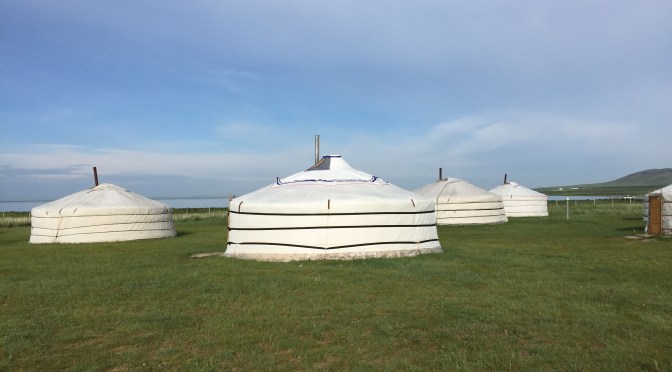
We are in Day 5 of ger living. Despite its challenges, the variety of gers has allowed us to get a full flavor of ger living. Our last ger included a stay along one of the largest fresh-water lakes in Mongolia. While rudimentary, it gave us a feeling of staying at Lake Tahoe, Mongolian style.

The many incredible, pristine pastoral landscapes we encountered traveling off-road by Land Cruiser included frequent herds of sheep, goats, horses and cattle. These are free-range animals, owned by herders who live in nearby gers, and have no fences. The animals get rounded up at the end of the day and know who and where their friends and family are. We had a full court press of the domestic animal world with a few wild ones and migrating birds for flavor.

The Erdene Zuu Monastery was founded in 1586 and is the first Buddhist monastery in Mongolia. The religion came from India and Tibet in the 12th Century. The grounds of the Monastery are preserved as a museum. The adjacent complex is a working temple. The temple was built over the palace built by Ugudei Khan, and materials were taken from the ruins.

The Kharkhorin Museum presented a fascinating series of maps showing the the history of Mongolia. If you are curious, please click on these to see more; if not, skip this section.

The Chinese Han Dynasty successfully fought back the Xiong Nu empire in Northwest China, and early portions of the Great Wall were built to deter the Xiong Nu from advancing further. (Remember Mu Lan? She was fighting the Xiong Nu!) You can read more about the ruins of the early Great Wall in my posts from Turpan in August 2013.

In the following series, you will learn more about the history of the great Chinggis Khan (1162-1227), one of his sons Ugudei Khan (1186-1241), and his grandson Kubilai (1215-1294). The maps attached are in some ways easier to read than the ones above, as they show the flow of conquests. Take a look at the arrows and dates on the maps and the extent of their conquests in the span of a century! The influence of the Mongols reached as far west as Iran, Iraq and Turkey.

In the same museum where early 8th Century Turkic memorials were preserved, a tomb for servants contained miniature figures similar to those found in Xian. They had Han Dynasty characteristics similar to the figures we enjoyed seeing in Dunhuang Museum in Northwest China. They had unique, expressive faces and lively gestures in their bodies. Apparently these were not created in a tomb for any noble, but were offerings by servants. The size of the figures, gold, and ceramic pieces were not large enough to represent those that were buried with those a leader.

Day 49: Mongolia 3

While we basked in the luxury of a “free range day” where we explored the wide open countryside at a leisurely pace, we still had time to take in another UNESCO World Heritage site. The Orkhon River Valley was a prime location for burials that grouped together large flat steles in round or rectangular shapes. Another spot showed exposed granite stones weathered over time with petroglyphs still evident.

The Land Cruiser allowed us to enjoy the off-road traveling comfortably. Otherwise, it would have been a Russian van that was just as sturdy but a rough ride. Along the way we encountered herds of free-range sheep, cattle, goats, and horses. Many birds also migrate to Mongolia over the summer and travel as far as South Africa.

The photos don’t do any justice to the huge 360 degree views that take your breath away. The clean air is also hard to swallow, especially after Beijing!

Look for next station after Ulaan Baatar: Lake Baikal and Irkutsk, Russia!