Tag Archives: Museum artwork

Day 62: New York City, New York (continued)

Today was a continuation of yesterday’s whirlwind tour of galleries and museums, directed by two friends and ardent museum-goers. We started with a visit to the new Whitney Museum, that has been relocated from the Upper East Side to the Meatpacking District adjacent to the popular Highline. It was exciting to see an expanded display of America’s best that included many women and artists from different ethnicities. Galleries are organized and grouped by themes.

The featured painting above is entitled “Saigon” by Peter Saul, 1967. It shows the raping, death and destruction from that horrible war. You can go to the link below and find an audio presentation about it given by a museum guide.

The freshly minted building by Renzo Piano:


Photos above:
1. Sculpture by Ruth Asawa, San Francisco’s own
2. New York, 1955
3. Jackson Pollack
4. Rothko Painting indicating Tragedy, Ecstasy and Doom
5. Photographer in front of painting by Krasner, who was the wife of Pollack. After he died, she continued to paint but converted from small scale to large scale in his barn studio.


Normally, I roam the galleries looking for only the artists I recognize. Near the end of the visit, I made an effort to find three artists whose work I did not know. See those above for Cy Twombly, Alma Thomas, and Elizabeth Murray. So many contemporary artist represented in this vast collection can be intimidating and overwhelming, but I found that determining a small number for myself was manageable, energizing and educational. It didn’t stop me from continuing to look for those old shoes, however, for comfort’s sake!

IMG_9466
The Whitney specializes in American Art and has been a big supporter of providing classes for artists.

For more about this exhibition that closes on Sept. 27, “America is Hard to See” go to http://whitney.org/Exhibitions/AmericaIsHardToSee

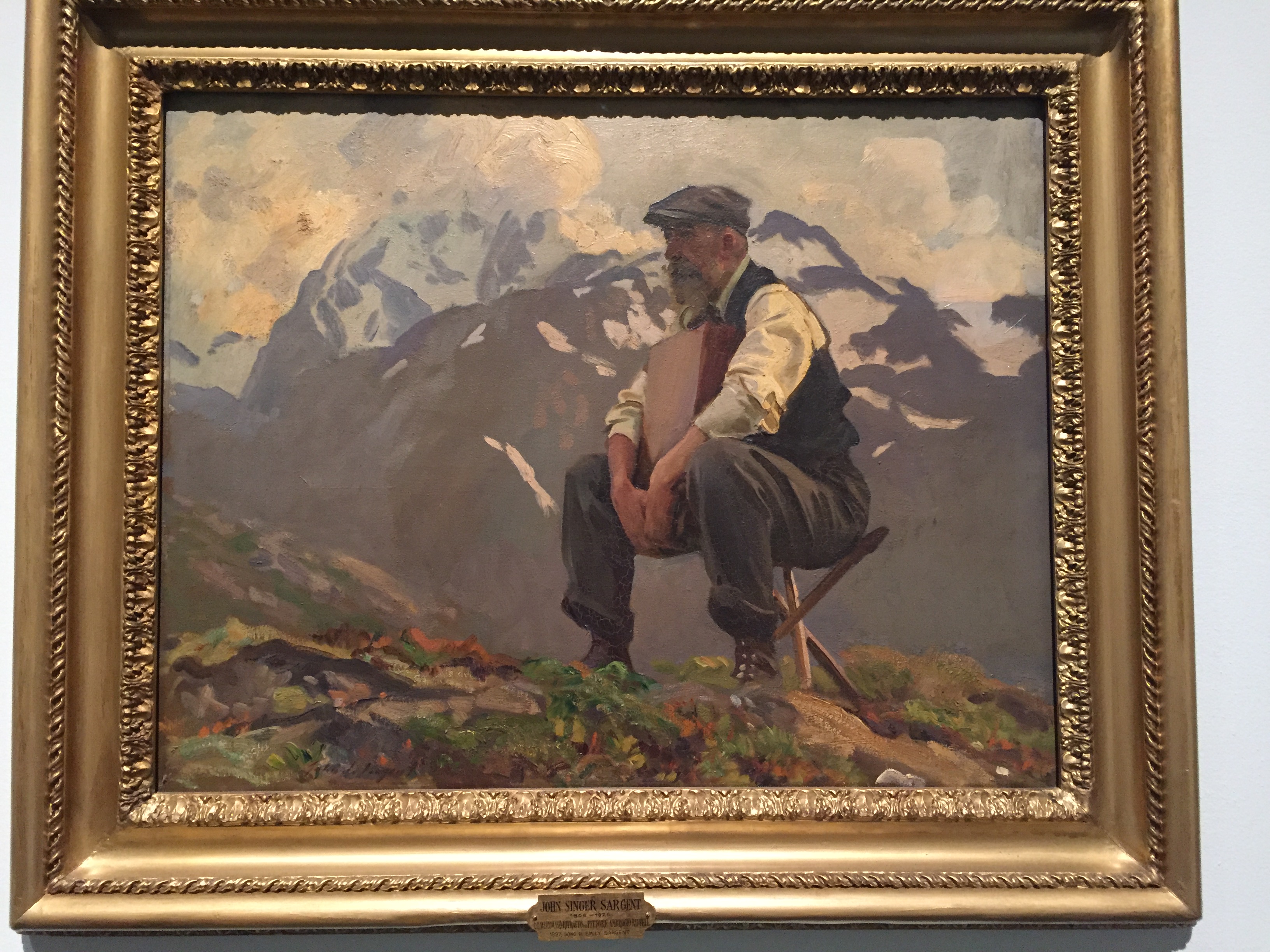
If this exhibition at the Whitney wasn’t enough, the gods must have been crazy to allow me go to another major museum in town. The Metropolitan Museum was having a major exhibition on John Singer Sargent’s “Artists and Friends”. He was born in Europe to American parents and had extensive connections to highly influential individuals, artists, and musicians in Paris, London, and throughout Europe.

Here are a few of my favorites. They are dedicated to Sargent fan Tony (if you are out there):

Full Size Portraits

Head Portraits

This one’s for you Helena:

Simplon Landscape
Simplon Landscape

For more about this exhibition “Artists and Friends”, go to http://www.metmuseum.org/about-the-museum/press-room/exhibitions/2015/sargent

And last but not least, for Isa who asked:
These are televised screen shots from the Pope’s visit last night at St. Patrick’s Cathedral. We weren’t there, but our host was late to dinner after attending the mass. We were watching TV and checking for him in the audience. The Pope seemed like a pretty nice person.

Day 60-61: New York City, New York

Attached are a few photos of the Picasso Sculpture Exhibit currently at the MOMA:

From a dozen gallery visits the following morning:

Lunch

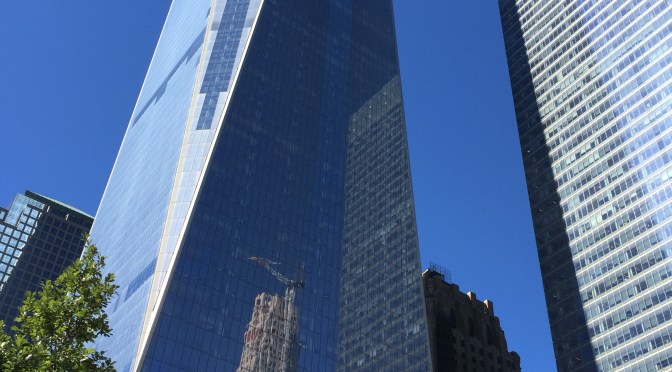
Tour of World Trade Center Area

Cruise on the Hudson in 130′ Yacht

Room with a View-New York City Skyline looking North

Day 51: Schwäbisch Sonntag

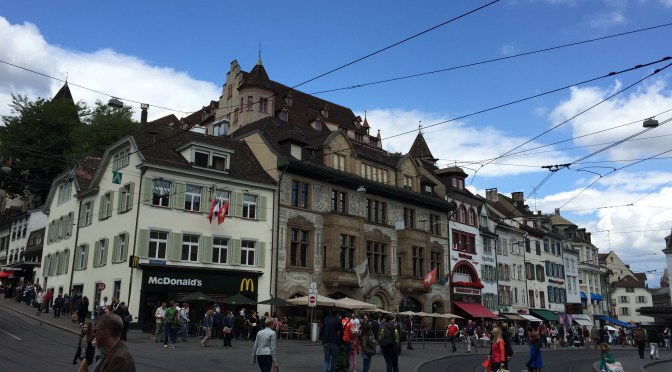
In preparation for my departure at the end of the week, I took a stroll through the town on my own in the afternoon. I savored the time alone, with no rushing through museums and tours. There are so many interesting paths, side streets and alleys lined with historic architecture, from medieval to modern. The city’s double walls and independent status allowed it to be spared from many battles and sieges. Thus its buildings and city were preserved.

A festival with music in the market plaza served free food and beer. Here are a few more shots that I took today.

A return to the Hällisch-Fränkische Museum gave me an opportunity to study the geology, early history of the area, and other exhibits. The city gained its prosperity and fame from the salt deposits along the river. The area was occupied by Celts and later Romans. One of the area’s well-known sculptors was Leonhart Michael, who created the moving stone relief sculpture shown below of Christ’s Crucifixion.

On a Sunday afternoon and for 90% of the time, I was alone in this beautifully crafted and presented museum. The scale models of the city and buildings reinforce how much the towns appreciate their history, architecture and planning.

A wig gallery allowed me to inspect them closely. Having heard about all the hygiene problems until the recent past, I’m sure that the wigs were developed to hide all those lice and growies on one’s head. After trying one, I was left to my own devices and was forced to take selfies of myself in drag. Sorry, you’ll never get to see them publicly.

Day 43: Basel, Switzerland

Three Walking Tours were available in the heart of the city and we decided to take the architectural tour. Many of the buildings in the city were designed by Herzog and Meuron. Basel has bragging rights to a number of world famous architects, including Zaha Hadid, Frank Gehry, Richard Meier, Tadao Ando and another of their own native sons, Mario Botta.

It’s interesting to note that both Botta and Herzog and De Meuron designed museums in San Francisco but are known in Switzerland for many other building types. The prevalence of American architects may be due to the development of the biotech industry in this area and its partnerships with American firms. Many of the buildings featured on the architectural guide were biotech companies such as Roche and Novartis.

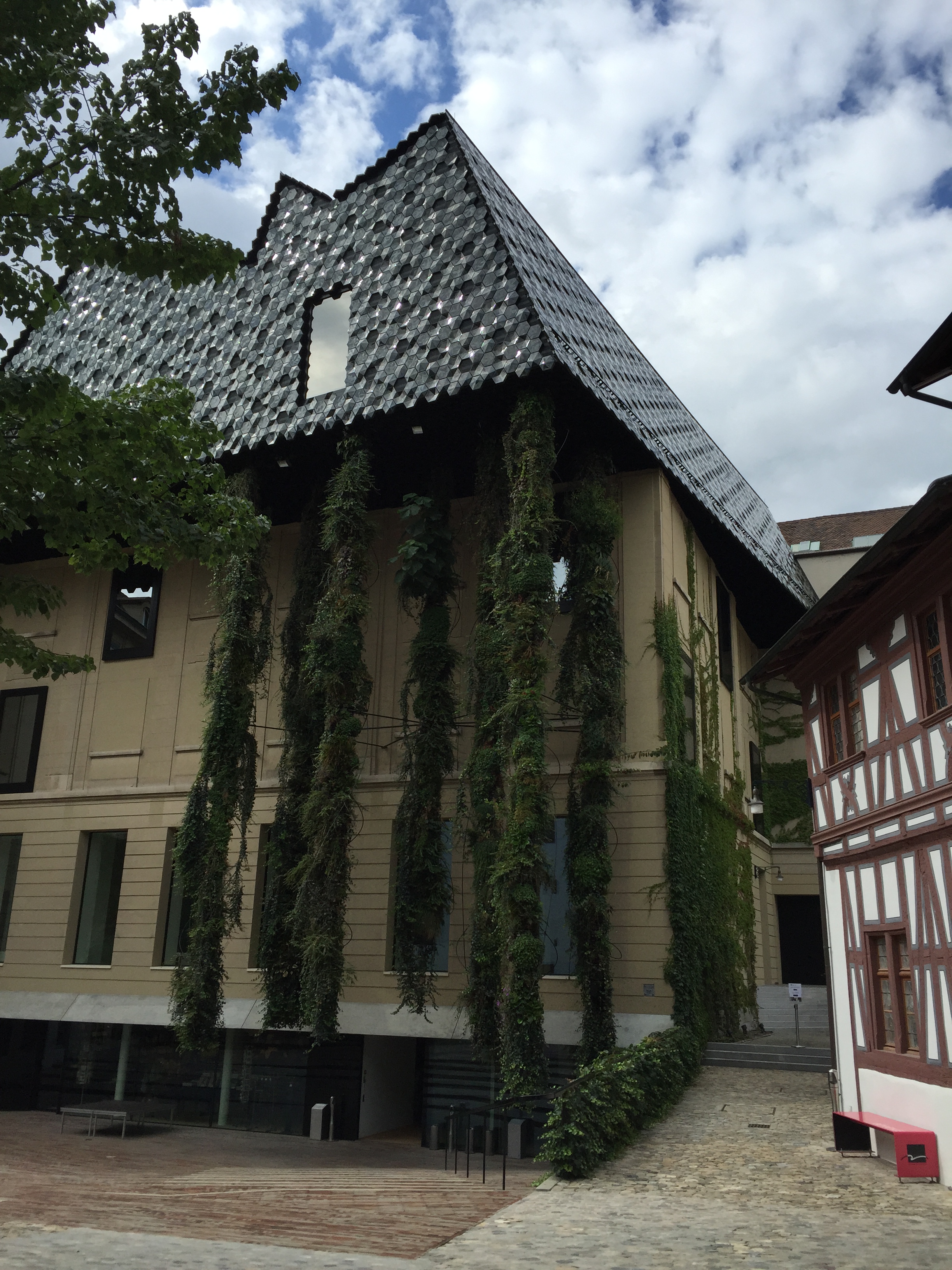
IMG_8671


The vertical extension of Basel Museum of Culture was designed by Herzog and De Meuron. The textural pattern of hexagons reflected the irregular shape of the plaza facing the museum. They were in both convex and concave shapes. The giant hanging plants at the entrance reminded me of the seaweed forest at the Monterey Bay Aquarium, where they swayed gently in the breeze.

The De Young Museum in San Francisco, also designed by Herzog and De Meuron, is one of my favorite buildings. I love the mottling effect of the exterior copper panels on the inside of the building and how it imitates the light coming through trees in Golden Gate Park. The huge canopy at the entrance also reminds visitors of the deep shadows in the park.

The Basel museum featured an exhibit on opium that sparked a lively conversation with my hosts in Brunnen. My grandfather had died of an addiction to this deadly plant. The museum collection included all the history, plant production, implements and literary figures who were influenced by opium (including one of my relatives, Lin Biao). The saddest part of course was the Opium Wars and the treaty ports imposed on China as a result of the wars. The exhibition was very thought-provoking and a moving educational experience.

Swiss Cheese, Salad, and Potato for Raclette

Our final evening was topped by the famous Swiss specialty “Raclette”, a fondue-like dish of Swiss cheese toasted with onion and spices on a grill, then spread with a miniature wooden scraper onto the top of sliced potatoes.

After saying goodbye to my dear friends in Switzerland, I was looking forward to my next big adventure. I will be taking a German language and culture class for the next two weeks in Schwabisch Hall, Germany, and can’t wait to spread out my meager belongings during this time.

My friends Helena and Hans took good care of me and showed me a local’s view of Switzerland. I am very grateful to them for their generosity and appreciate their care and attention during my stay there.

Day 37-39 Exuberant Brunnen, Zurich’s Blicks, & Lucerne’s Concerns

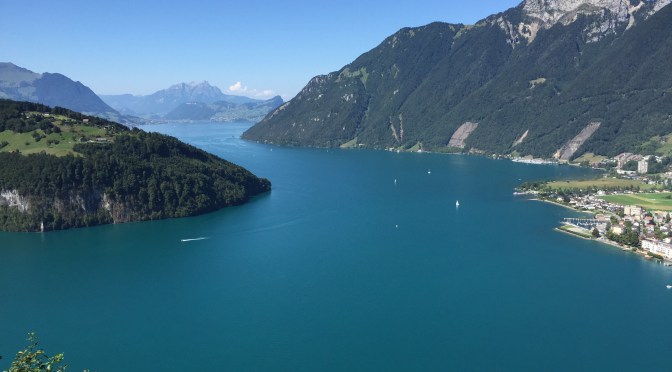
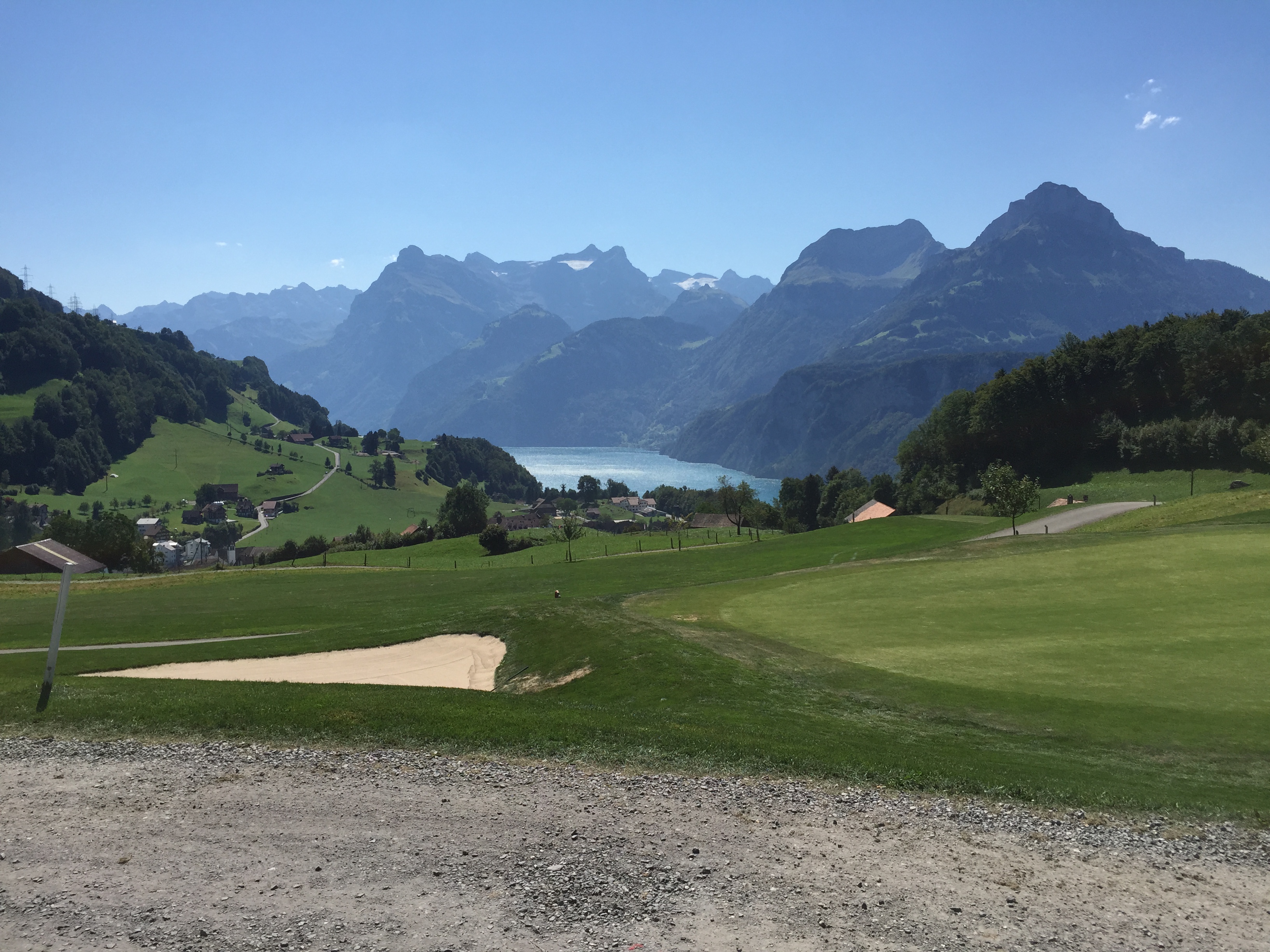
After reaching near the halfway point of my travels, I am pausing to refresh and staying with friends in the Zurich area. The town of Brunnen lies on the shores of Vierwaldstättersee, which is basically a collection of four lakes that form Lake Lucerne. We took a lovely hike halfway up the mountain yesterday, and despite the blazing heat in exposed areas (of the land, that is), my friend Helena and I enjoyed a leisurely walk with breathtaking views of the string of lakes below.
IMG_8531 2
We chowed at the golf course situated halfway up the mountain. Being careful to avoid flying golf balls, we pondered the merits of golfing. I was reminded of my experience with Gee Kin playing for the first time in Napa, California. Neither of us had really played golf before but the Weekend package offered a free round of golf on the green. We hacked away and tore up the green, laughing so hard we ached afterwards. Despite trying our best, our shots were pitiful and were a sore reminder how much skill it takes to be good at anything. I don’t think we are going to be playing, or be allowed to play, for any time again, soon, or ever.

But…back to Switzerland where, regardless of the golfing, the idyllic landscape surrounded by dizzying heights and crystal clear waters waxes one poetic. See the featured photo above and some additional panoramas taken from the boat to Lucerne below.

The day before was spent at the Kunsthaus in Zürich. By now, you have seen many of these artists’s works in other museums I have visited throughout Europe, America, and Russia. See if you can identify the following famous artists from the collection at the Kunsthaus:

Some of the tags are left on the enlarged photos, but don’t look if you want to try guessing.
1.
2.
3.
4.
5.

And a couple of sculptors:

1.
2.

The point is that the Kunsthaus had a full spread of famous artists. It was thoroughly enjoyable and worth visiting. A few of my stray favorites here, the latter from the Sammlung Rosengart in Lucerne:


I always notice any historical renderings of Dresden, so this one caught my eye right away. The Kreuzkirche was destroyed by Prussian cannonade during the Seven Years’ War around 1700, and this was a rare accounting of its condition.

The Rosengart Collection is a much smaller, focused gallery that specialized in two artists, Picasso and Klee.

The photo of Paloma reminds me of a cartoon that Gee Kin loved. It showed a kid bringing home his art project from school with a grade of F on it. He had drawn a face with a profile on it. What the teacher didn’t know is that the parents really looked like that (as in Picasso’s faces). the parents were looking at the picture and couldn’t understand what was wrong with the picture and why their son failed. Maybe Paloma had the same problem!

Day 30b: Viennese Sights

1. In and around Vienna: St. Stephen’s Cathedral and Plaza area (also featured image), and a street scene near Mozart’s House in Vienna. Notice the wide contrast in architectural styles, right in the cultural center of the city.

2. The Albertina and a collection of Modern Art from Carl Djerassi

These are only a few of the works I liked in particular, from his extensive collection that include Lichtenstein, Warhol, Gerhard Richter, and Klee.

Read about Carl Djerassi’s possible connection to San Francisco: https://en.wikipedia.org/wiki/Carl_Djerassi, or better yet read this fascinating obituary in the Telegraph: http://www.telegraph.co.uk/news/obituaries/11384755/Carl-Djerassi-father-of-the-Pill-obituary.html. The Klees on display are part of the Djerassi Trust and has been promised to the Albertina. I wonder if there is a tug of war going on between the SF MOMA and the Albertina. It might be interesting to follow it as part of the art world’s pursuit of wealthy collectors and their endowments.

Gerhard Richter is one of Melissa’s favorite artists. The black and white portrait of a woman smoking was not obvious until I took a picture of it!

By the way, I discovered that Adolf Loos was Austrian (and Czech). Here’s some interesting information about him: https://en.wikipedia.org/wiki/Adolf_Loos.

3. The Vienna Opera House: from an evening of Mozart music.

Now, after three “variety shows” of operatic music and concert pieces featuring Mozart and Strauss, I can hear the difference. Strauss added alot of drums and brass but also contrasted these boomers with sweet melodies. They are a crowd pleaser and I admit I became mesmerized by the rhythm and tunes. Unfortunately, the opera is closed in August so there are no regular performances. If you come in August you are stuck with the tourist track.

Updated 8/23 11:10pm

Day 28: Schonbrunn to Apfel Strudels

Today’s adventure was to Schonbrunn Palace, the summer residence of the Hapsburgs. The featured image above is the SIDE of the palace, not the main elevation. That’s about 5 times the width of this view. As mentioned earlier, this tops Versailles in my mind. The Austrians, in the tour guide’s words: are “crazy”. The palace tour provided proof of the royalty’s propensity towards personality disorders. There were numerous amusing stories and morbid details. The guide repeated several times “don’t believe what you see in the palace—it’s all an illusion”, referring to the wooden chandeliers painted to look like solid gold, pictures of important dignitaries who were not present at an event, and elaborate settings that even the royalty couldn’t hack.


Among the many amusing stories were those about hygiene and infestation. Thanks to the Catholic Church, the priests promoted the idea that bad men smaller than the eye could see existed in the water. They could get into your pores through water and make you die. For thats reason alone and for 400 years no one wanted to wash. They only took baths once or twice a year. Slowly through a catholic edit they were able to wash once a month.

For that reason, so much death and dying occurred. Infant mortality was very high; the queen and women spent many years bearing children, many of whom died in infancy. Out of 15-20 children, only 2-4 would survive. During this time, someone you knew either died of smallpox, influenza, or the plague before 35. The fact that some people, let alone royalty, lived to 50 years old would be considered our present-day octogenarians or older.

The concept of the “flea Market” comes from one of the few activities that both rich and poor engaged in. During that time, monkeys were used to deflea and delouse inhabitants. All people were living and breathing biosystems infested with organisms that bred on the human body. The average person’s idea of a spa day was going to the market where they could get deloused or be rid of fleas in public. The monkeys ate the lice and fleas, and everyone was entertained in the process. The royalty didn’t do it in public venues, but had their own monkeys trained to do the same for them. It made me itching to watch someone I know partaking in this purging and richly satisfying event.

The pompadours and hair styles of the royalty often weighed more than several pounds, as they were from many years of growth from their own hair. In order to wash their hair, it took a lot of planning, help from others and a full day’s activity. Like washing, this was another once-to-twice a year event, because of the difficulty in organizing the cleaning (there were plenty of other distractions and more interesting things to do than this). They also had to wait an entire day for the hair to dry—sorry, no Vidal Sassoon dryers were on hand.

Obviously, I was inspired and paid more attention to this tour than others in the past. I guess this one of gore and filth really appealed to me and reminded me that I didn’t want to be one of the royalty anyway. I gave the tour guide 5 stars, though.


I’m attaching a few off-the beaten track photos I took while cruising the grounds.
image
I indulged in apple strudel at lunchtime and had that AHA moment. The dough is stretched like pizza to make it chewy, and they add breadcrumbs to the apples to soak up the liquid. I was reading the recipe from a cookbook I bought for that purpose and realized that I was eating what I was reading. So here it is to share with you. I am also attaching a recipe for Salzburger Nockerl for those of you who were wondering what I was talking about.


A few of VV’s Random, Spur-of-the-Moment World-Wise Travel Tips:

1. The supermarket is your friend. Find the nearest one as soon as you can, and buy fruits and vegetables for salads to maintain your diet. It can at least balance the rich foods you will be pigging out on in the restaurants. Eating out is often cheaper than eating healthy, so you have to swim upstream on this.
2. Do your own laundry. After not having any options in Russia, I finally started washing my own laundry. I managed to avoid this for a long time, even on all my travels. But now I am borrowing Gee Kin’s tips to use bath gel or shampoo to wash my underwear and even my designer jeans. I finally resolved that it takes less time to do this on Day 1 of a five-day hotel stay and have plenty of time for the items to dry out, than searching for and going to a laundry. You will find creative ways to hang garments on clothes hangers, such as any door knobs or projections in the hotel room—even on lamp shades!
3. Take public transit. Forget taxis, unless you are in a jam. I love cracking the entire bus and mass transit system if there is one.
4. Stay cool. Stay in the shade whenever you are at those palace grounds, walking 3 miles to the gazebo. Wear a wide brimmed hat and check your path before you move. Don’t follow tourists who are notoriously stupid about these types of things.
5. Save a screen shot of your arrival point to the hotel. Its often easy to forget. If you are taking public transit your phone is not often connected to wifi at the train station or airport. You can also show these at tourist information counters where you want to go, and point to it if you don’t speak the language.
6. Get a phrase guide for the country you are visiting off-line on your phone. Use it to practice while you are on the road.
7. Use wi-fi only in the hotels and turn off your cellular phone coverage. Check your provider in advance for options to cellular access but only if needed.
8. Bring bandaids for sore feet.
9. Find the biggest, flattest royal grounds to walk or run 3 miles every chance you can get.
10. Can’t make it to 10, so it’s the Top Nine.

Some are obvious, some are not. The ones at the top are from the fact that I have battled with these for years as a world traveler, tried to avoid them, and then finally resigned myself to facing the music. No magic bullets. Some learn faster than others.

Days 24-26: Salzburger Knockouts

I’ve been trying to get my dose of Salzburger Nockerl, a famous local dish made from pure egg white meringue. Unfortunately, it has eluded me so far. I either wasn’t in the right cafe that serves it, or didn’t have the 20 minutes it takes to prepare it.

Despite this oversight, I finally struck gold in many other ways on my last couple of days here. I got it all and what I love about traveling: quality architecture, quality museums, quality music, quality food, and of course, quality people! The tag posts seem to tell it all.

I’m trying to reduce and concentrate the number of posts to only a few a week (Wednesdays and weekends) so I don’t flood your email boxes. Unfortunately, it makes the posts longer.

Here’s a spread of what this richly, well-endowed, and now much appreciated little city of Salzburg has to offer. To make it a little easier, I’m including a summary so you can skip to the parts that interest you:

1. Salzburg Fortress (Festung)
2. Mozart Houses (Birthplace and Living Quarters)
3. Performances (my raison d’etre for being here, but not necessarily the most exciting)
4. Food and People


1. The Salzburg Festung, or fortress, was very informative and an excellent excursion today. Gee Kin would be proud of me-I trooped up the hill and partook of the view from the top. Because Salzburg is so overrun with tourists, the city has managed to take tourists’ needs to heart. They provide excellent displays and explanations in English (for those of us brain-dead in German). They even had a electronic kiosk soliciting feedback at the end of the tour.

There were many architectural or design features I had not seen before. Those listed are not in any particular fashion. Follow the captions for specific items. You can hover over the photos now to see the captions.


1. Stone columns honed in a fashion the way wood is turned on a stile;
2. Matching metalwork
3. Torture elements–aha! can anyone venture a guess what this contraption is?? (see below)
4. A wooden threshold that was so old and worn that it exposed the “knuckles” of the knots from the tree, like aged knuckles on a centogenarian
5. A section of real arches that shows how they were constructed.
6. A display of how they created cranes to haul stonework up the mountain.
7. A latrine that was one of the first of its kind
8. Romanesque arch construction displayed

And a few morbid items from the torture storeroom to remind us of our mortality.

Since the fortress was built in the 11th century and over a period of hundreds of years, the museum was able to trace its construction history. It was an exciting architectural exhibition of walls, innovations and construction methodology. While most of the fortress was reinforced and expanded in the 15th century, it captures the various early periods from Romanesque beginnings to High Renaissance.
2. Mozart’s Birthplace and House:


3. Performances:

The star quality of these performances have been a bit mind-boggling. The interesting point is that my favorite opera star, Jonas Kaufmann, was not at the top of his game in Fidelio. The music was deep and entrancing, but his performance was weak. The opera performances shown here were much better. These performers can really deliver full-bodied voices and their skill and dedication really shows. Audiences were very responsive and clapped heartily.


4. Food and People: On my last day here, I decided to go for the two-hour lunch instead of the evening dinner option. My lunch was celebrated at the Heimer Specery. I took my time, had a small antipasti plate of eggplant, sun dried tomato and roasted red pepper with Prosecco, followed by the house specialty, a succulent full bodied pork chop that comes from the establishment’s own piggery. Along with a glass of rose, this was the chef’s recommendation so it had better be good. And it schmecked, or tasted delicious! I had just told Gee Kin that I thought pork was often disappointing as a dinner entree. I often found it dry and uninspiring. After your third bite you wish you had ordered the branzino. Well, I wasn’t disappointed this time. This little restaurant around the corner from the Festival Hall delivered to demanding regulars and I was a beneficiary.

The night before, I took my place at another restaurant (the one I went to for lunch today was fully booked 2 nights in a row, thus the lunch decision). As I was about to hog a table for four all by my lonesome, another gentleman was looking for a single at the same time. He asked if he could join me, the very exact same time another woman came along and did the same! I was very flattered, and didn’t mind the company at all. I was even more delighted when I learned that neither of them spoke English!

The three of us ended up with a very friendly conversation, and I had a chance to practice my elementary German. It was frustrating as I could ask basic questions but never “got” the answers. They drifted to fairly complex conversations about what the two dinner partners thought of the Greek Crisis, Angela Merkel, and the operas they were seeing. The gentleman’s nephew was performing in the opera we were about to see (Angela Georghiou in Werther). He was a baritone and did very well.

What I like about traveling is connecting the dots. I was flashing on how non-English speakers must feel when they are asked questions. After a few pleasantries, a zero-tolerance policy toward any non-English speakers seems to drift into the picture. Native English speakers tend to expect everyone to speak English, even in non-English speaking countries!

Well, the tables were definitely turned here. I felt stupid, unable to respond to simple political and economic questions. While it made me more determined to learn German, it made me reflect on how hard it is for many people in many countries to master English. I certainly came to that conclusion as I realized I could only sit and muse as the two native German speakers became very engaged and animated in their conversation. Sadly, I could only plaster a smile on my face and pretend that I understood everything.

German women seem to like short spiky hair, blow-dried behind the ears. Subtle platinum highlights, or jet red. Less Gothic these days. The woman who joined me was of the subtler version, and very svelt. She worked for a pharma company in Regensburg, and drove two hours each way to come to the performances this week. The gentleman from Innsbruck was a retired German teacher. It was, despite my misgivings, really fun trying out my German with no English back-talk.

Here are a few random street shots. The urban planning and insight for local Salzburgers and tourists alike are appreciated and well used in high density pedestrianized areas borne out of necessity. Delivery trucks and taxis drive right over the fountains and gutters, and everyone shares the paths in a symbiotic way.

Day 19: Day of Reckoning

We’re leaving Moscow today, heading for Berlin and the Western World as we know it. Russia feels more Eurasian and part of the Asian Continent than Europe in many ways. It has been a fascinating foray into the Russian culture, environment, and history.


I am posting a few miscellaneous views of Moscow from the Kremlin Armoury and from on our last day here. Gee Kin has finally mastered his fourth word, uttering Hello! and Good bye! in one conversation. We are now aware of what it takes for foreigners to say “Ni Hao!” in Chinese, and the tables are turned. I am sure the Russians are wincing as we did when others spoke to us in elementary Chinese greetings.


Photos, above:
1. View of State Historical Museum, where some of the relics below are located.
2. GUM Department Store, a shining example of restored buildings in Moscow Center
3. View of Red Square from shopping street

Photos below, from inside the State Historical Museum:

We are sad to leave and feel woefully lacking in knowledge about any of Russia’s cultural treasures. Other than what we read in the local paper or magazine articles, we never pursued any information beyond the information we were fed. I suddenly discovered Wikipedia and Biography.com on this trip and have been using it regularly to search for all the Russian writers and composers that have been mentioned in guides.

I am passing a few on for those of you who are also curious: For Tsaichovsky:
http://www.biography.com/people/pyotr-ilyich-tchaikovsky-9503375#synopsis
It is interesting to note that Tsaichovsky was also a music critic. While he considered Beethoven a worthy composer, he was critical of Brahms, Schumann and Wagner. Anna Netrebko often sings in and promotes Tsaichovsky’s “Eugene Onegin” opera around the world.
For Pushkin: https://en.m.wikipedia.org/wiki/Alexander_Pushkin
For Borodin (remember “Stranger in Paradise” from Kismet?):
https://en.m.wikipedia.org/wiki/Alexander_Borodin
Dostoyevsky:https://en.m.wikipedia.org/wiki/Fyodor_Dostoyevsky
Prokofiev: https://en.m.wikipedia.org/wiki/Sergei_Prokofiev
I asked our guide about Baryshnikov. He made a face as if I mentioned a pariah. He is a persona non-gratis. Remember, he defected while on tour with the Bolshoi? Oops. No monuments to him, unfortunately.

The next chapter of my travels will focus on Germany, Austria and Switzerland until the end of the month. Now that the uncharted portion of my trip is over, I’ll be posting every few days instead of daily. If you are getting too many emails, you can adjust your settings to unsubscribe, and you can always check in after that by going directly to http://www.travelswithmyselfandothers.com. Please continue to send me your comments when something strikes you! I love hearing from you!
Day 17b: An Impressionistic Kiss and Make-up with the Hermitage

Something was amiss in our visit to the Hermitage. We were told that the Impressionist paintings had been moved to another building. After the unpleasant visit on the first day, we were discouraged from going any further.

We decided to return today. The newly renovated building, in all its splendor, contained works from the Shchukin collection that included most of the French Impressionists and many more. The experience was completely different. We could take our time, enjoy each piece of work at our own leisure, and be among very few tourists or other visitors.

The General Staff Building is outside the Hermitage complex and was opened in June this year. They are still trouble shooting the building, so few people seem to have any information on what it is. This worked to our advantage, although there were no audio guides available. A visitor center was being prepared to handle a much larger volume of visitors, but it had not been implemented in the Hermitage complex yet. We appeared in the middle of this transition.

Here are a few of my favorite Matisses and Picassos from the Shchukin collection. They are absent titles and dates, except for those where I made notes.


You can read more about the collection here: https://en.wikipedia.org/wiki/Sergei_Shchukin.

Period interiors were impeccably detailed and displayed:

A separate Art Nouveau exhibition displayed gifts to the Russian Royal Family:


IMG_7535