Tag Archives: Food

Day 53-54: One Degree of Engagement (Lake Baikal, Russia)

Looking back at our week in Mongolia, it has been exhilarating and life-changing. I try to think of similar experiences, and although the trip we took to Montana came to mind, it seemed to be a far cry in comparison. Imagine Montana being the size of the US with the same density of population and that would give you an impression of what Mongolia is like.

I am attaching the Wikipedia reference for those who are curious: https://en.wikipedia.org/wiki/Mongolia. In this quick search, I learned that Mongolia is in fact the most sparsely populated country in the world. It’s no wonder that we felt the impact (or lack thereof) of human habitation on the planet here. We wondered if this wasn’t a good place to start if you wanted to live on the moon.

The low density means that people who live in Mongolia depend on each other. Gee Kin explained some of the details in the last post. For me, it was a reassuring vote for humanity. You learn to trust and rely on those around you. Just like the herder family in the video, you do everything for each other. We had a beautiful day and authentic experience with the herder family and our guides.

I am reposting the video from yesterday for those of you were unable to view it. I inserted the punchline in the back, so hope you will enjoy this revised version.

And…just to close out a few stray thoughts on Mongolia, here is a copy of the map of the Mongol Empire, showing Genghis Khan and Family’s Conquests in a few fell swoops:

FullSizeRender 71.jpg

Onward to Irkutsk, Russia

Our 18 month Russian visas from last year made it easy to take another trip into Russia this year. We hadn’t really planned on it, but coming to Mongolia made it irresistible to continue through Russia east to Vladivostok. We came north first by train from Ulaan Bataar (see spiffy Mongolian train above), then in a few days will be heading to the East Coast to on the last leg of the Trans-Siberian Express.

We heard that there were 19th Century wooden buildings in Irkutsk, so went towards an area for dinner that reminded me of Cannery Row in Monterey or Jack London Square in Oakland. It was an easy walk on a Saturday afternoon and many locals were heading in the same direction toward the mall.

We found a pretty decent restaurant with equal flair to any Bay Area restaurant:

Dinner with wine was only $40.00!

Listvaynka Village, Lake Baikal

Our main adventure the following day headed us in the direction of Lake Baikal, the oldest and deepest (about a mile deep) fresh water lake in the world. After gawking at the seaside crowd, we had pilaf and smoked fish for lunch in Listvaynka Village. It was refreshingly cool and a little bit of Sausalito in Eastern Russia.

The Sunday Weekend market in Lake Baikal featured smoked fish.

The bus back to Irkutsk put is in front of the city’s Sunday Market. It was very similar to the huge market that I saw two years ago in Tashkent, Uzbekistan. Uzbekistan produces much of the fresh vegetables and fruits for Russia, Mongolia, and other Central Asian and Asian countries.

On the way to Lake Baikal, about an hour outside Irkutsk, we met two Canadian travelers. They were a sturdy pair–active seniors who were working as educators in Doha and traveling throughout the world. In case you were wondering what’s happened to baby boomers, they are out of the woodwork and into the world again. Maybe not on the $5 a day like we did in the late 60’s, but resilient as ever.

They can do a mean Ritz Carlton on demand as easily as a backpacker’s hostel–for a few days, at least. I like to think of myself as being able to do both, but I tend to be more of a middle-of-the-roader. Our trip to Mongolia, on the other hand, was certainly a safari of sorts, but with fewer wild animals.

Our new-found friends told us a story about someone they met in Mongolia who was on a Guinness Book of Records pursuit for the most number of countries visited in the shortest amount of time. The 27-year old female traveler had already been to 130 of the 196 countries and is taking three years to complete the task. She spent most of her time obtaining visas and on the internet and had company endorsements.

I calculated that it would take about five days per country. At the minimum, all she had to do was to record the GPS point at the airport on her phone and get a visa stamp. I’m sure that she is doing more than that, but regardless, what a journey! It captured my imagination. I decided that I had met her through one degree of separation.

Day 48: Mongolia 2

This will be short. We spent the afternoon with a Mongolian herder family. It was alive with activity, including milking cows and horses (for mare’s milk), corralling animals, racing with boys, tasting fermented mare’s milk and curd dessert, and playing with the family’s newborn baby.

The family included an award-winning horse racer (30 years old), his wife (29 years old), his two boys (8 and 6), and the newborn (1 month old)

Our capable guide could milk the cows and horses and had many other talents, but we were thoroughly impressed when she could milk cows and horses without any difficulty! Our driver could wrestle and win races against 5 boys all at once!

Days 42-44: Beijing Bites

I went out looking for water and accidentally found this pedestrianized area around the corner from the hotel. It’s in Wangfujing and just next to the Imperial Palace in Central Beijing.  (You can click on photo for captions).

Above, see the variety of food from street vendors.

Below, the vendors where I bought items to sample and the food repackaged for dining at the hotel apartment (chestnuts, sticky rice in Coconut, Tripe, and refried mini-pork buns).

The next day, I took an afternoon stroll in the neighborhood at the “Forbidden City”, or Imperial Palace. Having been here multiple times, I could finally absorb and appreciate its grandness and scale. From the outer to the inner courtyards, each progressive complex of buildings paced you from the formal to more intimate parts of imperial life.

Details and interiors of the latter half of the Imperial Palace are below. I did my best to allow the hoards of tourists from deterring my own personal enjoyment. It did flash across my mind, however, about the last encounter with the floods at the Hermitage in St. Petersburg last year. I couldn’t excuse the cruise ships for unloading here this time. I gave way to the primarily Chinese tourists who may have come from the outer reaches to finally see the centuries of human capital used to build the empire, or maybe like me, were just taking a stroll around the block.

In the evening, we made our obligatory stop to the Peking Duck Restaurant, again, only steps from the hotel on Wangfujing:

After Dresden as a pit stop, Beijing was a rallying point to meet husband Gee Kin and travel partner for the rest of the trip.  We leave for Ulan Bator (Mongolia) on Friday morning, so the highlight of the second half of this 80 day adventure is about to begin.

Days 37-38: 48 Hours in Berlin

For the next two to three days, I am indulging in completely free and independent personal pleasures. After a month of military-style training and discipline during  my German class, I am free from academic obligations. I am racing around to the last few spots that I missed on my own, then the final 24 hours will be a day trip to Dessau. I’ll be visiting the historic Bauhaus Workshop, School and Houses there, and I will make a separate post for that.

Hours 1-24: Berlin Free Day 1

The Berlin Biennale has been in full swing this month. To catch up, I made a pilgrimage to Fasanenstrasse, a small, elegant street near the Zoological Gardens and Uhlanstrasse Station. A few of the galleries promoted in the Art Forum “picks” are located here, including the Galerie Kornfeld, that was showing “The End of Flags” by Hubert Scheibl.

The Bucholz Gallery, where Melissa and I visited in January, presented the work of Wolfgang Tillmans. He was born in Remscheid in 1968. His work covered photographs of his studio and the accumulation of paper.

Not particularly inspiring, but I found the gallery itself much more exciting. It is a historic, protected building with beautiful Art Nouveau tendrils on the ceiling, panels over doorways, and in the carved oak staircase in the vestibule.

Contrasted with the stark white walls, it was easy to appreciate the delicacy and the artistry in the original building decoration. Contrary to my altbau where I am staying, this is what I would consider a classy version. There are also some really elegant auction houses and galleries promoting collector books and Asian antiques, gorgeous art nouveau jewelry and beautiful period silver by Georg Jensen and Henry Van de Velde.

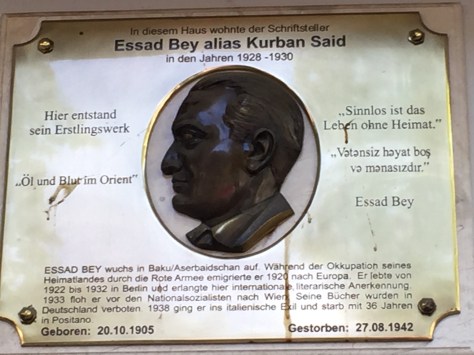
After walking down the street and looking for a memorial plaque for Essad Bey or Nussibaum, I was very happy to discover it directly across the street from the Cafe for Literature and the adjacent Museum for Kathe Kollwitz. The Berlin literati must have hung out in this neighborhood. It felt like the Montparnasse area of Paris, except more compact.

IMG_3047

Essad Bey was a journalist who was both Jewish by birth and Muslim by election. He had a fascinating life history that is chronicled in the New York Times bestseller by Tom Reiss, “The Orientalist”. I was surprised that my German teacher had read the book when I told him it was my favorite book . Some of you have heard from me already about how much I loved this book.

Born in Lake Baku, where one of the first oil discoveries was made, Bey lived an early riches to rags life. His family escaped after the Bolshevik Revolution to Turkey, then Paris, and eventually he was educated in Germany.  He became a journalist, was writing histories of Hitler and Mussolini, fell out of grace, and then died a tragic death. It’s a fascinating book where fiction and reality are often obscured.

Later in the morning, I walked about a mile east to KDW, Berlin’s version of Harrods or Galeries Lafayette. The top floor is devoted to gourmet food, with stations that offer a variety of seafood, meat, and a host of regional specialties. Up until now, I haven’t put much (or any) focus on eating. This was my opportunity to catch up.

The cases proudly presented cheese, sausages, and brot (bread). I looked for anything unique from the other gourmet food halls, but could only find wiener schnitzel and kartoffel stations. If you are into German food, you can get the gourmet version here. I succumbed to the bratwurst, senf (mustard) and sauerkraut, just as a show of loyalty. While this wasn’t exactly a pilgrimage to the annals of gourmet dining, I could still enjoy the German culinary ernestness. I bought a sample of Niederegger’s marzipan from Lubeck after hearing about it in my German class.

Hour 25-48: Berlin Free Day 2

The Bauhaus Archive in Berlin was high on my list of places to visit. The exterior was odd, with the north-facing skylights a prominent feature of the design of the building. Thankfully,  a new museum is underway. After 883 international entries, a Spanish architect won the competition and beat out an American. You can see the entries, if you are interested, here: http://c4c-berlin.de/projekte/bmd-de/

The existing exhibition still contained all of my favorite things: design philosophy and principles from inception to reality; creative thinking; and highest quality craftsmanship. I was thoroughly engrossed and listened to every post on the audio guide (not a small feat, especially since it was in the afternoon!). Again, it reinforced my passion and dedication to good design.

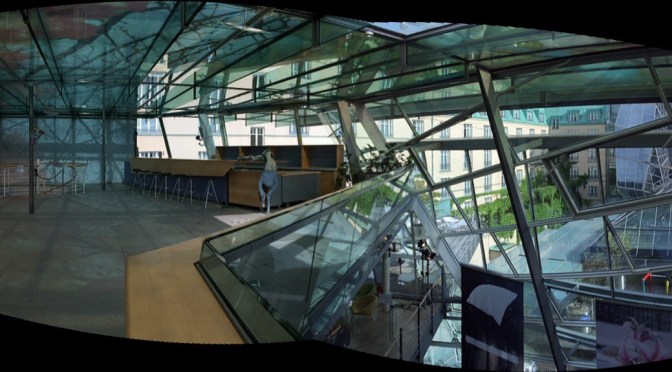
The Ninth Annual Berlin Biennale, as mentioned earlier, is underway this summer. In addition to the KW Center for Contemporary Art, the main anchor is at the Academy for Art, just inside the Brandenburg Gate. The exhibition in combination with the interior of the building was crazy beautiful and disgustingly fascinating. I couldn’t decide which photos to include, so here is a mix-match of both exhibits and building features (renovated by Beynisch Architects from Stuttgart in 2005):

Click on the photos above for captions.  You can also increase the images by clicking on the series.

The terrace featured a virtual reality presentation. I stood in line for the 3-4 minute scene that was pretty entertaining and worthwhile. The scene showed the view from the top of Brandenburg Gate, fogged up, then dove to an underwater sequence. The person in the lower left photo is bending over to look through the viewer underwater.

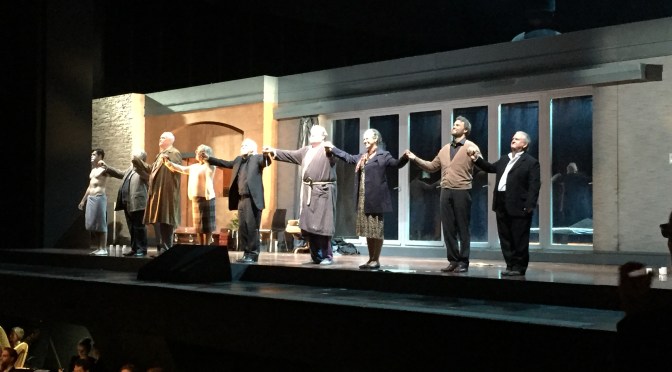
The evening was topped off with a final opera. The Deutsche Oper unveiled a new production of the “Die Entführung aus dem Serail” by Mozart. If you remember what a rogue and rock star Mozart was in his day (drinking, women, and wild living), this production really conveyed that. They brought the days of Mozart to contemporary status, complete with nudity, sniffing cocaine, and searching for home (a la ET).

Initially, I didn’t want to go, as I had seen an old video of this opera. It was very hoaky and racist. One of the opera students in the GI had seen a preview of the preview and recommended it to me. She emphasized that it had been updated and was worth seeing. She was right, but there were still a few questionable moments in the opera left over from Mozart that were hard to accept or eradicate.

The bare naked bodies were less surprising to me, as “Tristan und Isolde” earlier had unveiled their own version of nudity. I’m not sure it’s becoming a trend for opera, but I wondered how the old ladies at the opera took these scenes in. They didn’t seem to raise any eyebrows, from what I could decipher. Everyone, including me, stayed WIDE AWAKE. If that’s one way to get a more alert audience, it definitely worked.

The story line is simple–a group of young people get captured by an extra terrestrial and are sent to a far away land. They try to find their way back. In the mean time, they are living a fast and senseless life with sex, drugs and videotapes. They search for a way back. It was a great production, very hip, and very well received. Look for this updated opera with fantastic music and even a few “Queen of the Night” arias sprinkled in for extra amusement.


Note: look for the curtain call with the scantily clad girls–some of them only put on underwear in the final scene!!

Day 25-26: Berlin in 24 Hours+

I opted out of a boat trip on the Spree and a tour of Potsdam Babelsberg with the Goethe Institute this weekend for my own individualized tour. Here’s the daytime version of my itinerary on Saturday:

10:00: Meet friends from the Goethe Institute for Brunch at Sud Bloc, a Turkish Restaurant in Cottbus Tor.

12:00: Attend The International Design Festival. It was a tough choice between the 9th Berlin Art Biennale and this one, but my priorities and practicality surfaced simultaneously. Besides, the Biennale is here for another couple of weeks. It shows what a fantastic city this is for art and artists. Below are a few of the displays that were presented at Kraftwerk, a huge warehouse/industrial building in Berlin Mitte near the Heinrich-Heine Station.

14:30: Walk through trendy streets in the Mitte near Rosenthaler Platz. The KW Institute for Art, one of the Biennale centers, is located on Augustus Strasse. It parallels another delightful alley, Linienstrasse, that is sprinkled with cafes, one-of-a-kind handmade items, and art galleries. I had a red lentil and avocado sandwich with a German rose wine across the street at the old Jewish school. Melissa and I saw the Kennedy Exhibition there in January this year.

IMG_2593

16:00: Stop at my Air BNB on Brunnenstrasse for a cake and coffee break.

17:00: Visit the Bernauer Strasse wall exhibit (see posting from last week)

18:00: Alexanderplatz pit stop, with a Afrikaner Festival food and entertainment in high gear.IMG_2594

19:45: Performance of the Return of Tobias, an Oratorium by Joseph Haydn at the Elizabeth Church around the corner from where I am staying.

This was a bonus performance. Since I was so tired, I was debating about whether to go. The performance was sold out, but seating behind the orchestra was available for 5 euros! I could enjoy the full choir, orchestra, and professional quality opera singers and kick my shoes off at the same time. The performance began with actors at the cemetery a couple of blocks away, setting the stage for the story. Everyone returned to the church, where the full story, singing, and beautiful music in an intimate setting unfolded. A delightful close to an exhausting day.

The following day’s activities started with alot of guilt-laden German studying, but in the afternoon I treated myself to a brilliant performance of “Tristan und Isolde” by Richard Wagner at the Deutsche Oper. The marathon performance lasted 5 hours, from 4pm until 9pm. (Only the Meistersinger at the SF Opera was longer at 6 hours). Needless to say, the German stiff upper lip in me kicked in. In classic behavior, when in Berlin, do as the Berliners do.

The opera was very moving and emotionally draining–one of the best I have ever seen. To top it off, there was a standing ovation. That was a thrill. First to see a heart-pounding performance, then to witness genuine, never-ever inflated gratitude offered by a hard-core, German audience.

By purchasing student rush tickets an hour before, I am able to procure the best seats available (5th row from the stage, 9th seat in from the end) for 15 euros (thanks to the Goethe Institute). The only minor inconvenience being so far forward is having to tilt my head up to read the double subtitles in German and English. That’s hardly a problem or complaint for what I am getting! At these prices, the immense difference in cost of opera tickets pays for my four-week German class!!

Days 16-17: “Mr Trump: Tear Down that Wall!!

After posting “Ich bin eine Berlinerin” in January this year, I have renewed my vows for this thrilling city. This time, I am even more emphatic and feeling that I have come to greater respect and appreciation of this vibrant, active, and considerate city. I suppose you can find the opposite in any city, but at the moment I am insatiably intoxicated by Berlin and all the human effort that makes a great city livable.

The week has been packed with German lessons, getting to know other students, and walking tours of neighborhoods nearby. I comprehend about half of the commentary since they are in German, but the visual experience provides the other half. There are so many new elements of the city that I had never seen or understood in the past three visits.

After the walking tour of Berlin Mitte from the day before, the same flamboyant guide escorted us to Prenzlauer Berg. Located on the East German side, it started off as a fairly respectable residential neighborhood, with classic Parisian style facades. Our guide pointed out a few vestiges of Jewish life still visible today–a school with a synagogue behind it and some serious security bollards in front.

If you are interested in the artist honored in the sculpture above, here’s a link to Kathe Kollwitz: https://en.wikipedia.org/wiki/K%C3%A4the_Kollwitz

The later, mind-numbing residential blocks were created in the Sixties (not shown). To support the residential areas, schools were provided. The renowned and advanced development of German schools was a feature of the tour. One current-day school we stopped at has an “adult-free zone” to reduce stress for kids! Schools and a good education seemed to be a tradition and pride of former East German society.

By the Eighties, Prenzlauer Berg deteriorated to a point of neglect. No families lived in the area because the housing was outdated. The big blocks built previously were designed with only one bathroom and communal kitchen per floor. Twenty years later, no one would tolerate that standard of living. No one could afford to renovate either, so families moved elsewhere.

The guide continued to spin a story for us about how the area was rejuvenated, literally. After the fall of the Berlin Wall, everyone was so euphoric. People in the newly reunified city squatted and held parties in these abandoned buildings. Exactly nine months later…

…and now Prenzlauer is considered one of the most livable and desirable areas for families in the cities! From what was a shelled-out, deteriorated, and abandoned neighborhood, schools and other services were re-established to serve the residents. It’s transformed from what was once today’s version of Kreuzberg to Berlin’s Upper West side.

A tour of Potsdamer Platz gave another completely different dimension to my impression of the area. We had stayed there last year (after the Beijing-Moscow-St. Petersburg Trans-Siberian Express), but spent most of the time in the Tiergarten due to the scorching heat at the time.

This tour focused on the architecture of Modern Berlin, after 1989. The trail meandered through Leipziger Square and the southern end of Potsdamer between the Berlin Philharmonic and Kreuzberg. The guide explained the endless debates about how to weave the east and west portions of the city together. The debate isn’t over, but city planners, architects, and the general public exhausted themselves discussing this issue.

Some of the planning was brilliant and some dismal. What has to be appreciated is that the land was repurposed in a No Man’s Land in the middle of the city. The hype today gives faint pulse rates of a Hong Kong or Shanghai tilted on its side. I was grateful that this tour was offered as a “general” tour, even though it would have been a “specialty” tour elsewhere.

The buildings included the Arkaden, a huge modern shopping mall and fully integrated mixed use development. Residential, office, retail, entertainment are all concentrated in one place. Anchored by the Sony Center and the old Daimler site, these buildings claim WFA (world-famous architects) Helmut Jahn for the Sony Center, Renzo Piano Workshop for the Daimler site, and Richard Rogers for adjacent buildings. It’s a lively place intended for all citizens of Berlin to enjoy.

After missing the Berlin Wall tour departure today by a half an hour, I decided to do my own tour. The Mauer Park and Bernauer Strasse exhibit was literally at the next corner to my accommodation, and I had been meaning to go there. With free time on my feet, I discovered a very moving experience. Not only were the exhibits a reminder of the amazing power of humankind to solve its own problems, but the physical development and energy it took was very reassuring. Once again, I could witness modern history in a very immediate way.

IMG_2331

Trump should come to learn the history of the Berlin Wall and all its trials and tribulations before considering building one himself. I don’t think he would do what he says after he saw what it took to undo one. He should listen to one of his cronies, Reagan, to “Tear down that Wall”.

Some of the information from the displays on the Berlin Wall.

And last, but not least, a few of the ethnic shops just north of where I live. I went into one of the Arabic markets and bought cherries, loquats, poufy dried figs the size of your palm (almost, OK, maybe a fat baby’s), spargel, carrots and celery for soup for 12.75 euros.

My first and last adventure the day before with Currywurst, a national institution, was a bomb. Yucky tasteless frankfurter cut into bite-size pieces (good for the convenience and service), smothered with ketchup (bad), dusted with “curry powder” (bad), and served by Germans (what happened to the “ethnic charm”?!?). FLOP. I usually think of myself as tolerant of any fast food, but this takes the prize for low point in human culture.

Day 10: Hypezig Leipzig

A first reminder of Leipzig’s political history was evident at the main entrance to the Markt. The banner read: “Love Football. Hate Racism”. They continue to extend an open hand to refugees and warn against Neo-Nazi tendencies. Despite the loudspeakers and full police reinforcements nearby, it appeared to be a quiet, orderly, and reassuring demonstration.

Today’s demonstration was a faint reminder of the city’s history. In 1989, Leipzig sparked a series of demonstrations at the Nicholai Church that led to Reunification of Germany. You can read more about Leipzig here: https://en.wikipedia.org/wiki/Leipzig

Leipzig doesn’t have the appeal and cultural taste of Weimar, but it has music to make up for its visual shortcomings. There are a wealth of classical and rock concerts, performances, plays, and revues, and the Gewandhaus and the Leipzig Opera are world-renown. As a major trading town and international fair promoter, Leipzig seems to have picked up economically since I was last here. Many new malls, museums, and building developments have surfaced, and the economy seems to be booming.

There are still many lovely Baroque-like buildings to appreciate everywhere you turn. Intricate passageways connect positive and negative spaces to each other. The decorative elements and sturdy, well-maintained buildings are reminiscent of Prague. Newer buildings are well integrated into the urban, pedestrianized fabric of the city.

The famed Auerbach’s Keller is where Goethe purportedly wrote “Faust”. The cellar and dark interior of the restaurant spins the mind into believing that Goethe himself must have made a deal with the devil there. A couple of bronze statues at the entrance add to the dramatic air.

The Friday Market was also in full tilt and it wasn’t hard to find seasonal spargel, or asparagus. Every vendor was selling some, and it dropped dramatically from 6 Euros in the morning to only 2 Euros per kilo by midday. Fresh meat, cheese and cakes tempted the eye as well as the palate.

And, the Thomas Kirche offered a moment of peaceful reflection at the end of the day.

image.jpeg

If you want to see an experimental short film on a Leipzig mural in one of the passageways: https://www.youtube.com/watch?v=yi5GPovC2Vc. Set volume if you want to hear the Thomaskirche organ.


Bay Area Travelswithmyselfandothers

Being back in San Francisco encourages me to continue my frequent walks throughout the city. Being situated in the southwest quadrant of the city, we can easily go in any direction–the city is merely 7 miles wide in any direction as the crow flies–and hit a water’s edge. The 7×7=49 square miles makes it easy to conquer the city by car, bus, bicycle, or walking. Whenever I can, my choice of transportation is on foot. I can accomplish a 3-5 mile walk in less than 2 hours.

Admittedly, it takes a bit of clever navigation to avoid the daunting hills of San Francisco! Tourists have been often thwarted by the steep elevations and unforgiving fog banks in California summers. Clad in bermuda shorts, tourists shiver as they study their maps. Plan views show short stretches between Fisherman’s Wharf and Downtown. In reality, going through Nob Hill requires a hefty hike in elevation of 400 feet! And that’s with a few bumps and bruises along the way, as the elevation rises and falls. It’s no wonder that tourists are stunned not only by the beauty of San Francisco, but its harsh climate and terrain as well.

For local city dwellers, I learned that there are more than the seven traditional hills in San Francisco. Here is a link to a description of the 53 reported hills if you are curious: http://sfgazetteer.com/how-many-hills-in-san-francisco.html

As a locavore, I enjoy exploring the streets of San Francisco and comparing them to the many scenes of cities I have visited throughout the world (for some reason, Prague comes to mind first). Since last October’s Halloween festivities (see Hallo Halloween from October 30, 2015 posting), I am realizing that San Franciscans LOVE decorating their Victorians and sweet homes. There is definitely pride in a little city that CAN. The more I walk, the more I notice the sweet, sensitive little details that make this city sparkle. Here are two random samples from this month’s holidays:

In addition to Valentine’s Day and Chinese New Year’s (Feb. 8 this year), San Francisco hosted the 50th Superbowl. Not being an avid sports fan, I failed to capture any photos of the carnival-like atmosphere downtown. It did preoccupy the city and drive it crazy for three weeks, so there was alot going on this month. Americans love celebrating holidays, and now it seems to extend beyond Christmas and Thanksgiving.

Aside from local city walks, husband Gee Kin and I continue to take urban walks throughout the Bay Area. After accomplishing various routes from San Francisco to Napa, Oakland to San Jose, and San Jose to San Francisco, we are now finding extensions beyond. We mapped out a route in the past couple of weeks from Petaluma to Santa Rosa. You can see the route screen shots here:

I originally planned to stay overnight at the Hampton Inn. In the past, I linked each day’s 8-12 mile walk between hotel rest points. I discovered that you can do the same with public transit points. As long as you are linked to connections back to home base, you can string transit points to each other, and easily pick up where you last left off and by paying attention to transit schedules.

Each leg was accomplished on a separate weekend day. We took Golden Gate Transit to each point of departure to link the route, so each walk was an easy day trip. The beginning and/or end of each walk was capped by a visit to a local, perhaps newly discovered restaurant as a reward! We discovered the Naked Pig in Santa Rosa, a roadside diner with all naturally produced ingredients.

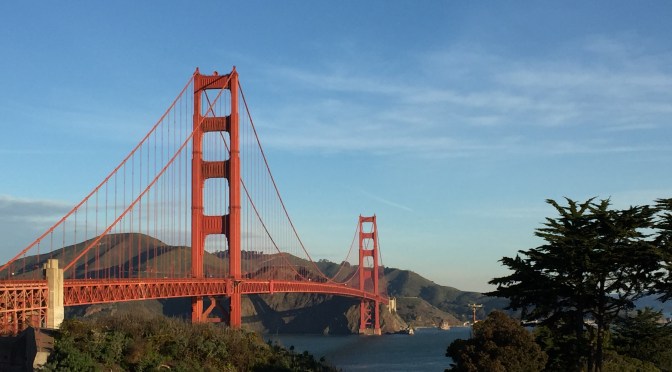
The featured photo shows another weekend walk out the door and across the Golden Gate Bridge to Sausalito. We topped our trip with a visit to Scoma’s for mussels, fries, and pink sparkling.

Next time you get good weather, think about walking out your door to a restaurant you’ve been dying to try. And don’t forget to smell the roses along the way. Let me know what you do!!

PS. Plans are underway for this summer’s travelswithmyselfandothers. Hint: Oh No! The TSE and GI AGAIN??!!

We are now able to link our Bay Area walks physically from Santa Rosa to Los Gatos. If you are interested in doing it too, see http://www.crazyladywalks.com.

Bye-Bye to Berlin

Dear Followers,

On our last day in Berlin, we started the morning with breakfast at the Coffee House for Literature. Located in a pre-war building on Fasanstrasse just south of the Zoological Garden stop and near the Uhlanstrasses Metro Station, this famous coffee house rivalled that of the Cafe Einstein in Kurfürstendam, where writers, poets and intellectuals gathered over addictive coffee. We ventured into one of the Berlin galleries listed in Art Forum, but the exhibition was very tiny and not as fruitful as our visit to another recommendation at Kunstraum Kreuzberg on Marienplatz earlier in the week.

We made it just in time to Potsdamer Platz to attend a free noontime concert at the Berlin Philharmonic Concert Hall. The symphony was not performing due to the holiday schedule. Instead, we were able to listen to a short Mozart chamber music performance. On the program, parents are reminded that lunchtime concerts are not aimed explicitly at children, and therefore should only bring children who are able to remain “quietly seated for approximately 45 minutes”. That seemed very reasonable and successful as a message.

We battled the elements during most of our short visit to Germany and Holland, and this day was no exception. We decided to take a short walk to the Culture Forum, where the Gemälde Gallery of the Staatliche Museum of Berlin is located. It is a huge repository of art and it held major exhibitions on the Botticelli Renaissance and Albrecht Durer. Surprisingly, we found more Vermeers, Bosches, Brueghels, and Rembrandts here than those in the Rijksmuseum. We realized that the Dutch Masters were scattered throughout Europe and that the paintings by native sons were not necessarily displayed in their host countries.

The Botticelli exhibition compared many other artists’ work that emulated the classical Botticelli Venus. She served as a model and inspiration for many other artists, from Neo-Classicists such as Ingres to Elsa Schiaparelli, a dress designer. For me, I found the latter day 19th Century renditions by John Ruskin and William Morris, early leaders of the Arts and Crafts Movement in England, the most interesting. You can see the rich textures of the Morris tapestry already creating the signature pattern that later became so famous in the Liberty of London wall coverings.

I found myself particularly attracted to exhibitions that compare and contrast two different artists’ work. They seem to provide a lesson in comparative world history and painting that I otherwise wouldn’t discover. I am also becoming more comfortable with and more whetted to art museums as a cultural and intellectual experience. I have an opportunity to learn history in a visual way that is easy and interesting for me. The excellent curating and wealth of material certainly enhance these comparisons in the few museums we visited on this trip.

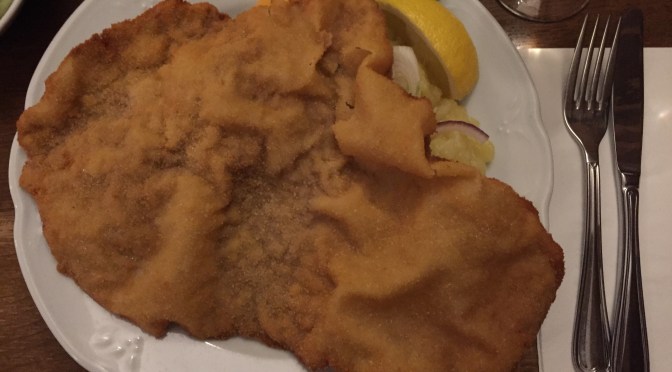
By the end of the day, we were pretty wiped. Nevertheless, my professional food guide was relentless and targeted a German restaurant as gesture to my insatiable appetite for things German for the finale. Sadly, it was closed for the holiday cleaning! We went to the next best, an Austrian restaurant famed for its Wiener Schnitzel. If you look closely at the photo above, you will notice that the regular fork looks out of scale with the schnitzel on the plate. That’s because the schnitzel was super-sized!

IMG_1134

The day before, we beat it back from Amsterdam to hit a local Kreuzberg Turkish restaurant.

Apologies for the delay in this final Berlin post. I will be upgrading my site to continue posting the next trip, but have most likely reached the cap for free webhosting after two years with this posting! Stay tuned for the 2016 upgraded version…

…for now, we are sad to leave this vibrant and exciting city on the move. Until next time…Tschuss!! VV.

PS: Happy Martin Luther King, Jr. Holiday from Bodega Bay!!

More Amsterdam and Gent, Belgium

Today’s major events included a performance at the Concertgebouw of Handel’s Water Music by the Berlin Alte Musik Orchestre. The instruments included a harpsichord, lute, and old horns and wooden flutes from the time when the music was created.

Fortunately we sat in the front row for 20 Euros and could hear the delicate instruments while observing the performers on the podium six feet above us and from the feet up! It was very enjoyable and worthwhile to share some of my musical interest with my daughter at a precious point in time.

Our main activity was tackling the Rijksmuseum. Despite our assumption that many Bosch, Breughels and other Dutch masters would be there, there were only a few Rembrandts, Vermeers, and a smattering of landscape painters.

See above, from top left to right:

  1. Vermeer, Woman with a Love Letter
  2. Peter de Hooch, Woman with Child in a Pantry, c. 1656-1660
  3. Rembrandt, Selfie
  4. Rembrandt, the Night Watch
  5. Van Everdingen, Young Woman Warming her Hands, c. 1644-1648
  6. Chinese Porcelains

The day before we drove through Antwerp, a city that was occupied by the Spanish in the 17th Century, to Gent. Melissa worked at De Superette last year doing a stage  and learned how to bake bread. The photos show the head baker putting the bread in the molds that Melissa also used to learn bread making.

See below:
1. De Superette Exteriors
2, 3, 4. De Superette Interiors


Below,
5. Bakery Entrance
6,7. Foam Potatoes, pulled pork, and poached egg with marinated shaved mushroom
8. Daughter Melissa, with head chef Rose and Head Baker Biggie

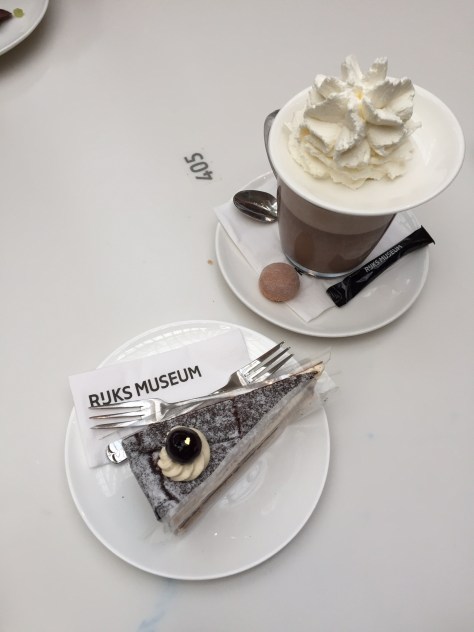
At the end of the day today, we enjoyed signature Dutch hot chocolate and cerise torte at the Rijksmuseum Cafe after a long and productive venture.

image.jpg

Note: we’re heading to Berlin tomorrow, see you there!