Tag Archives: Food

Days 24-26: Salzburger Knockouts

I’ve been trying to get my dose of Salzburger Nockerl, a famous local dish made from pure egg white meringue. Unfortunately, it has eluded me so far. I either wasn’t in the right cafe that serves it, or didn’t have the 20 minutes it takes to prepare it.

Despite this oversight, I finally struck gold in many other ways on my last couple of days here. I got it all and what I love about traveling: quality architecture, quality museums, quality music, quality food, and of course, quality people! The tag posts seem to tell it all.

I’m trying to reduce and concentrate the number of posts to only a few a week (Wednesdays and weekends) so I don’t flood your email boxes. Unfortunately, it makes the posts longer.

Here’s a spread of what this richly, well-endowed, and now much appreciated little city of Salzburg has to offer. To make it a little easier, I’m including a summary so you can skip to the parts that interest you:

1. Salzburg Fortress (Festung)
2. Mozart Houses (Birthplace and Living Quarters)
3. Performances (my raison d’etre for being here, but not necessarily the most exciting)
4. Food and People


1. The Salzburg Festung, or fortress, was very informative and an excellent excursion today. Gee Kin would be proud of me-I trooped up the hill and partook of the view from the top. Because Salzburg is so overrun with tourists, the city has managed to take tourists’ needs to heart. They provide excellent displays and explanations in English (for those of us brain-dead in German). They even had a electronic kiosk soliciting feedback at the end of the tour.

There were many architectural or design features I had not seen before. Those listed are not in any particular fashion. Follow the captions for specific items. You can hover over the photos now to see the captions.


1. Stone columns honed in a fashion the way wood is turned on a stile;
2. Matching metalwork
3. Torture elements–aha! can anyone venture a guess what this contraption is?? (see below)
4. A wooden threshold that was so old and worn that it exposed the “knuckles” of the knots from the tree, like aged knuckles on a centogenarian
5. A section of real arches that shows how they were constructed.
6. A display of how they created cranes to haul stonework up the mountain.
7. A latrine that was one of the first of its kind
8. Romanesque arch construction displayed

And a few morbid items from the torture storeroom to remind us of our mortality.

Since the fortress was built in the 11th century and over a period of hundreds of years, the museum was able to trace its construction history. It was an exciting architectural exhibition of walls, innovations and construction methodology. While most of the fortress was reinforced and expanded in the 15th century, it captures the various early periods from Romanesque beginnings to High Renaissance.
2. Mozart’s Birthplace and House:


3. Performances:

The star quality of these performances have been a bit mind-boggling. The interesting point is that my favorite opera star, Jonas Kaufmann, was not at the top of his game in Fidelio. The music was deep and entrancing, but his performance was weak. The opera performances shown here were much better. These performers can really deliver full-bodied voices and their skill and dedication really shows. Audiences were very responsive and clapped heartily.


4. Food and People: On my last day here, I decided to go for the two-hour lunch instead of the evening dinner option. My lunch was celebrated at the Heimer Specery. I took my time, had a small antipasti plate of eggplant, sun dried tomato and roasted red pepper with Prosecco, followed by the house specialty, a succulent full bodied pork chop that comes from the establishment’s own piggery. Along with a glass of rose, this was the chef’s recommendation so it had better be good. And it schmecked, or tasted delicious! I had just told Gee Kin that I thought pork was often disappointing as a dinner entree. I often found it dry and uninspiring. After your third bite you wish you had ordered the branzino. Well, I wasn’t disappointed this time. This little restaurant around the corner from the Festival Hall delivered to demanding regulars and I was a beneficiary.

The night before, I took my place at another restaurant (the one I went to for lunch today was fully booked 2 nights in a row, thus the lunch decision). As I was about to hog a table for four all by my lonesome, another gentleman was looking for a single at the same time. He asked if he could join me, the very exact same time another woman came along and did the same! I was very flattered, and didn’t mind the company at all. I was even more delighted when I learned that neither of them spoke English!

The three of us ended up with a very friendly conversation, and I had a chance to practice my elementary German. It was frustrating as I could ask basic questions but never “got” the answers. They drifted to fairly complex conversations about what the two dinner partners thought of the Greek Crisis, Angela Merkel, and the operas they were seeing. The gentleman’s nephew was performing in the opera we were about to see (Angela Georghiou in Werther). He was a baritone and did very well.

What I like about traveling is connecting the dots. I was flashing on how non-English speakers must feel when they are asked questions. After a few pleasantries, a zero-tolerance policy toward any non-English speakers seems to drift into the picture. Native English speakers tend to expect everyone to speak English, even in non-English speaking countries!

Well, the tables were definitely turned here. I felt stupid, unable to respond to simple political and economic questions. While it made me more determined to learn German, it made me reflect on how hard it is for many people in many countries to master English. I certainly came to that conclusion as I realized I could only sit and muse as the two native German speakers became very engaged and animated in their conversation. Sadly, I could only plaster a smile on my face and pretend that I understood everything.

German women seem to like short spiky hair, blow-dried behind the ears. Subtle platinum highlights, or jet red. Less Gothic these days. The woman who joined me was of the subtler version, and very svelt. She worked for a pharma company in Regensburg, and drove two hours each way to come to the performances this week. The gentleman from Innsbruck was a retired German teacher. It was, despite my misgivings, really fun trying out my German with no English back-talk.

Here are a few random street shots. The urban planning and insight for local Salzburgers and tourists alike are appreciated and well used in high density pedestrianized areas borne out of necessity. Delivery trucks and taxis drive right over the fountains and gutters, and everyone shares the paths in a symbiotic way.

Days 20-22: Planes and Boats and Trains

Such has been our busy week of flying from Moscow to Berlin, taking a hydrofoil to Peterhof from Moscow, and the train from St Petersburg to Moscow. We enjoyed the Sapsan train the best, which turns out to be the same as the ICE train I am taking from Berlin to Salzburg. We assumed the Russian premier long distance train was its opportunity to showcase Russian engineering, but it looked suspiciously similar to the German trains.
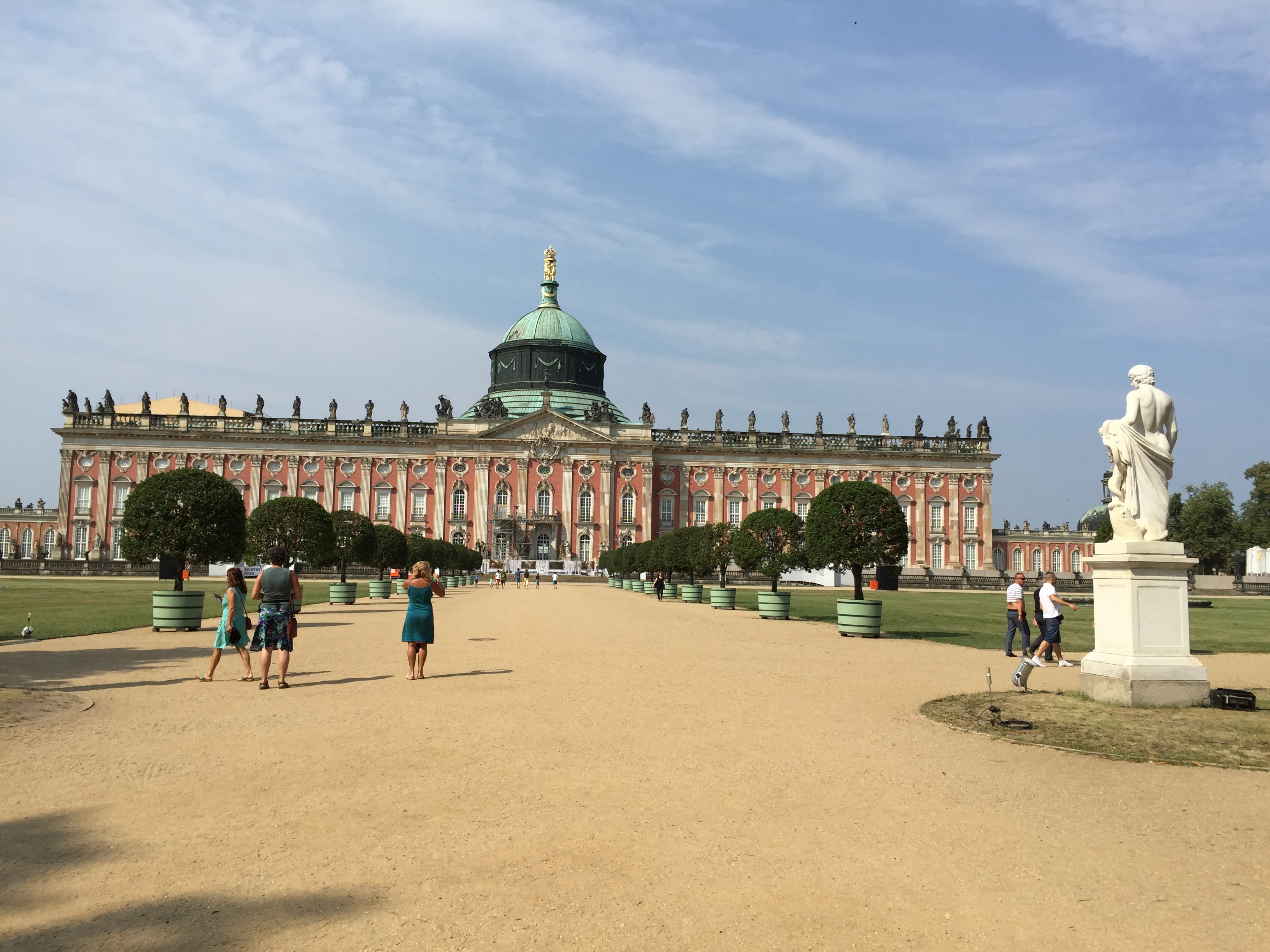
IMG_7686Yesterday, on Gee Kin’s last full day in Berlin, we took a day excursion by local train to Sans Souci Palace in Potsdam. We didn’t visit the palace as most visitors do, but took a three-mile walk between Sans Souci and Charlottenborg Palaces in the scant shade of 99 degree weather. A UNESCO world heritage site, Potsdam was the chosen site for the summer palace of King Friedrich. Here’s a Wiki link: https://en.wikipedia.org/wiki/Sanssouci

The event planners were preparing for the Sommernacht at the palaces the following day. It sounded like a wonderful celebration of German classical music in a beautiful venue, but unfortunately we were leaving. It would be worth coming back one day for the festivities and fireworks in this elegant location.

In our 36 hours in Berlin, we had launched our stay with a leisurely walk in the neighborhood of Potsdamer Platz, through the zoological garden in the middle of the city. It was calming and provided time for us to reflect on all the Siberian landscapes we had just traversed.

Those of you who know us are aware that we like long urban walks, 5-10 miles a stretch. This was yet another “walk in the park”. (For the curious, I have a website, http://www.crazyladywalks.com, that provides detailed information on Bay Area walks). It may seem pricey to go halfway around the world for a walk, but these are the most memorable and enjoyable ones to us.

We managed to balance the rest of our three days with local tours and attractions. We found a good Turkish restaurant in the more local area around the Zoo. Gee Kin slugged out on the museum track so we did a Young European concert with the Kiev Orchestra last night.

Sandwiched in between our morning walk and the evening concert, we visited the Reichstag dome. Being one of the hottest days ever in Berlin, we wondered how we got ourselves into this predicament. Masses of local tourists had come from all over the world to the Reichstag for their German civics lesson, on this one day. We not only fried at every pit stop, but then we were sous-vide under the dome, which resembled the George Forman griller.


Nevertheless, it was still fun to see and experience Norman Foster’s masterpiece. Luckily for you, the photos can never effectively convey temperature. But I guarantee you, the open vents in the building were insufficient ventilation for the once-in-a-hundred years heat wave. My dead straight hair went curly and the wood on our paper fans are permanently warped from this day at the Bundestag.

Three activities in one day’s 99-degree weather may be asking for trouble. Gee Kin’s alternative was to go to some delightfully soothing, air-conditioned art museum and he picked this?? Granted, the tour to Reichstag was pre-booked. We had failed to do this a few years back on our first trip to Berlin around 2012. And I was a day off on the booked date. Being our last day, we were not going to forego these paid-in-advance commitments so we had no choice but to go. So our last day was a bit of a marathon but it was penance for our lethargy the first 48 hours.

As mentioned, we went to a concert at the Konzerthaus Berlin, in a renovated building in a lively area in the middle of the city. But that’s not saying much, as everything seems to be in the middle of the city. Rome and San Francisco feel intimate like this, but not Moscow or Paris. Those are honking huge BIG cities, that dwarf your existence. That may be due to the six-plus-lane wide ribbons of thoroughfares used for pomp and circumstance.


I am at this very moment passing through Bamberg, where Gee Kin and I first discovered Cameron Carpenter. He is an amazing Curtis-trained contemporary organist who can do both classical and popular music. Some of you saw his performance at the SF Symphony Hall last year. He is one of our favorite new artists.

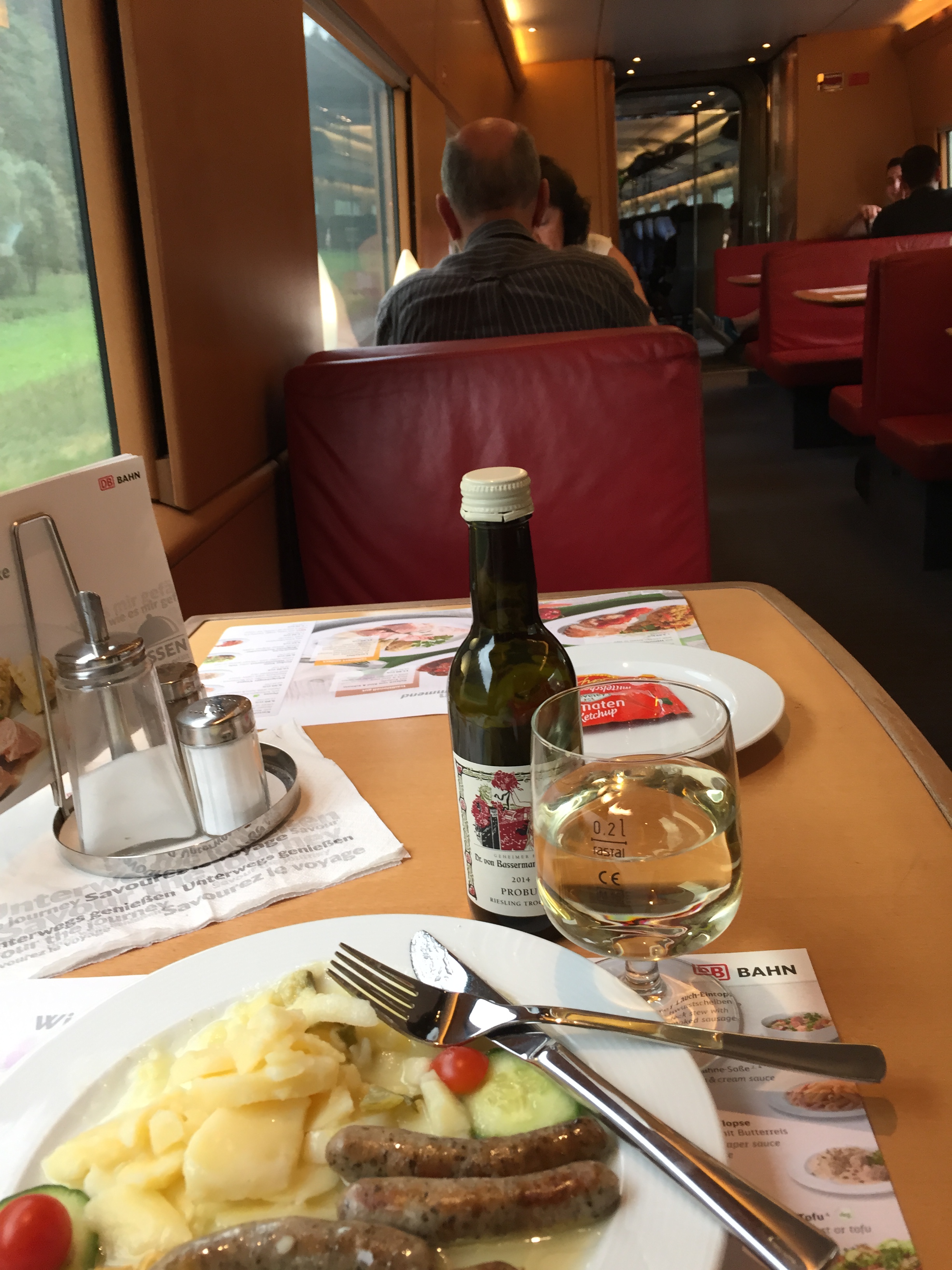
I am sitting in the dining car for lunch, noshing on bratwurst and cold potato salad. (See photo). IMG_7743The quality of food is less important to me thanthe total experience–environment, ambience, and PEACE. This was it, enough for me to write all of this discreetly in a maple-veneer and leather-lined carriage. Prices were reasonable by American standards. I had my .2ml wine (a bit more from the split bottle but you can measure if you want from the mark on the glass), entree and dessert with coffee, with a priceless view and free opera music via my IPhone to boot! To me, this beats a table at French Laundry.

Am heading to the Salzburger Festival and will post from there in a few days. Til then, stay wet (not dry
for SFers) and cool (for Deutschers). Clouds on the horizon.

Day 14: Moscow Drum Roll: Market and Modern Art

Dorogomilovsky Market early in the morning was Gee Kin’s pick today, followed by mine–the Tretyakovskaya Modern Art “Gallery”. We managed to take the subway three stops to our first destination without getting lost. The subway had a dizzying amount of subway names–all in Cyrillic–so you have to master the alphabet or you are “TOCT”. Gee Kin showed rapid improvement from his initial blundering, “What’s that alphabet called–Acrylic?”. I’m including the subway station menu, that requires good eyesight in addition to calisthenic tongue skills.

As a “wrailwray” kinda gal, I love cracking the system. We stepped into the huge escalator tubes of travelers, stretching endless miles deep down into the bowels of the Moscow River and beyond. These were the longest escalators we have seen anywhere–they felt like at least 3 to 5 times any of the deepest tube station in London. The Russian engineers liked doing things bigger and better, and this was another showcase opportunity. We sliced and diced the station names like a Benihana master chef would, and deconstructed each one letter by letter. We followed every sign religiously. We even avoided going down one-way streams and didn’t make elbow contact with anyone.

The cars were spotless, not a crumb or grungy morning coffee spill in sight. Like all good citizens, the Moscovites rushed swiftly, politely and silently. Gee Kin noticed that commuters zoned out with fewer hand-held devices and opted more for books and magazines than their Beijing or San Francisco counterparts.

As expected, the market was also a bustle of activity, with carts being swung and navigated every which way down aisles beyond safe speed limits. You can see our fascination with an array of some familiar but also new sights: furry rabbit’s feet good luck charms, Korean kimchee specialties (a note about that later), racks of lamb and carcasses, 8 piglets without blankets, bottled and pickled everything (including grass mushrooms Gee Kin loves), and on and on. It reminded me of the bigger but less varied market in Tashkent from last year.

Next, our day was traumatized by a trip to the Modern Art “Gallery”–along the Moscow River. That was the only bearing point for the humongous site. The monumental museum (and I mean MONUMENTAL…the size of an Olympic stadium…was so big and dwarfed human context so much that it became a nightmarish experience. We dragged and slogged our way though miles of artwork. Despite the noble effort to catalogue modern art in the Soviet Union from pre-Bolshevik days to today, the museum and its fascinating history was lost and unappreciated due to the vastness and lack of selectivity of the material. Its attempt to show “everything in the warehouse” (purportedly 170,000 pieces) made it mind-numbing and exhausting.

This frustration may have been caused by sensory overload from the earlier market visit. Just getting to the building from street to front door was a chore. The gallery literally looked like a stadium complex. We weren’t quite prepared for this mental and physical workout. If you go there, be sure to dedicate one entire day for a visit. Better yet, a week. Bring your camp stove and tent but don’t get caught.

Don’t misunderstand my message. I did love the artwork. I was inspired by the sculpture more than the paintings, though. They all cried for attention. Because there were fewer pieces of sculpture, you could focus on them more easily. I found the predominance of woman’s bodies depicted in real, human ways very moving. They weren’t idealized as Venuses. They were reflections of real women, of mothers, sisters, workers. I even found a few that looked like me! Their bodies “hung out”, but their faces spoke volumes.

I couldn’t help but think about the stunning ballet performance by the prima donna from the night before. She could perform so flawlessly, and so dramatically. Her face and body spelled all the agony and torture of the dying Violetta. The sculpture of woman and child spoke to me in the same way, as did the other pieces that were chiseled and sparked to life from stone.

Aside from a few Chagall pieces that I could detect, it was difficult to find any recognizable names. We were on the lookout for a cache of Matisses, but these were all Russian artists (Chagall was a Belorus-born French artist). The French Impressionists are elsewhere in Moscow, not here, in this national repository.

And of course, near and dear to my heart, design. See my favorite pieces of artwork in the entire stadium: calligraphy on beautifully crafted plates.

Note regarding Korean community in Moscow: some came here before WWII. They were later purged to Uzbekistan, and a small population still lives there.

Day 13: Moscow Camera Roll Continued

Yesterday’s events yielded far too many photos to post. I have chosen among my favorite children and am posting them for your viewing pleasure below. Moscow has been an amazingly inspirational visit–far too few Americans have been here to partake in its rich history and treasures. I feel badly that I didn’t come sooner.

And for Moscow by Night, here are a few shots of Moscow after a brilliant performance of “La Traviata”, the ballet, we caught. Moscow is totally safe in the tourist areas we walked at night, in beautifully balmy summer, late light weather. The lights really showcase the architectural detailing of each building in its pride and splendor.

And finally, for the foodies, our dinner menu. We tried the Holodet, an aspic of chicken and duck with dill that was delicious! Apparently, it is a local creation. You can read about its history on the menu page.

It’s probably worth mentioning that I have been revising and cleaning up the early Day 1-10 posts. I renumbered the days in successive order from the beginning, added photos that should have been in the posts, and fixed typos or information that was incorrect.

If you see any major bloopers, please email me and let me know! The website should be more stable going forward, once I am in Europe and the States, so hopefully you won’s see the fits and starts from the beginning of the trip. Once again, my apologies to those who may have been confused by incomplete information.

Thanks to all for the comments and support. Once Gee Kin returns to the US, I will be traveling on my own. It feels like you are all traveling with me, especially when I hear from you! It keeps me motivated and I keep you in mind when I am looking for interesting things to post. I hope they capture your attention too!

Day 12: Moscow Tour Time

Red Square
Red Square
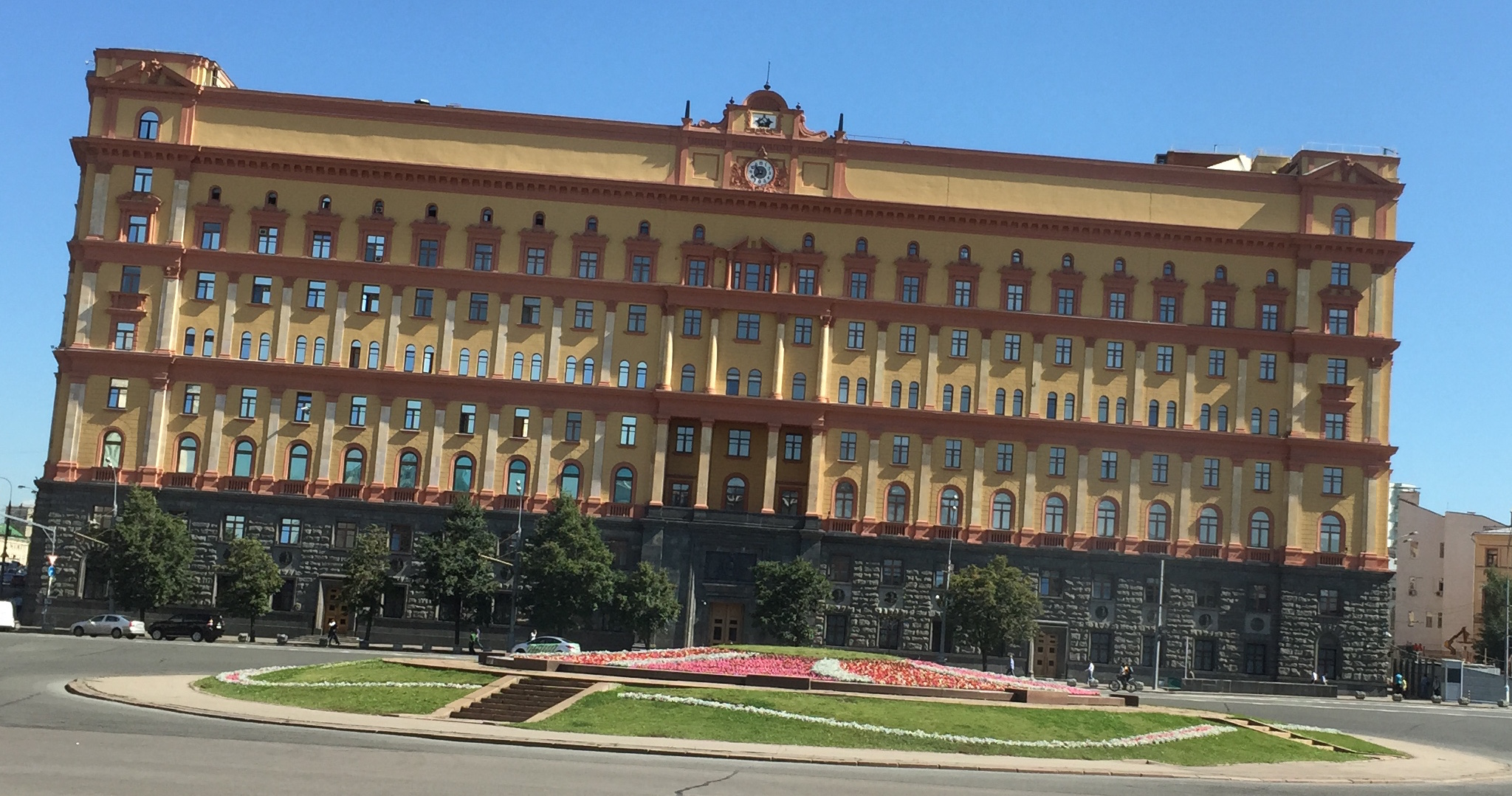
KGB after a bottle of vodka

Yesterday was a busy “play tourist” day, covering most of Red Square including the Eastern Orthodox St. Basil’s Cathedral, with its colorful onion domes; one of the most beautiful parks in the world just outside the Kremlin walls (see header if it is current); and Tym Department Store with its turn-of-the-century splendour (it has an enclosed galleria like the one in Milano).


Meals have been incredibly exciting and contrary to stereotypical notions of Russian food. Like most big cities around the world, you can find state-of-the-art contemporary food for nouvelle tastes. We found a great lunch place near the hotel called “Fresh”, with inventive vegetarian dishes. I had a salad of quinoa, avocado and greens, and Gee Kin had one with buckwheat, tomatoes, grilled spinach, sweet potatos, and mung bean sprouts. Both were served with olive oil and a delicious miso/rice vinegar, soy sauce, and mint dressing.

For dinner, we ventured into the Arbatskaya area and landed on an original crab-and-caviar menu with Prosecco for under $50! From Kamchatka, the crab is Russia’s equivalent of the Alaskan King Crab. Gee Kin thinks perhaps the oil boom brought on alot of high end quality food demands but the ruble devaluation has made the prices here a bargain. Come soon while Russia is on sale.

See pop-up captions above to sights we visited today.

Follow up to my own question the other day: why does it seem so long to lunch time on the TME and always an hour away?

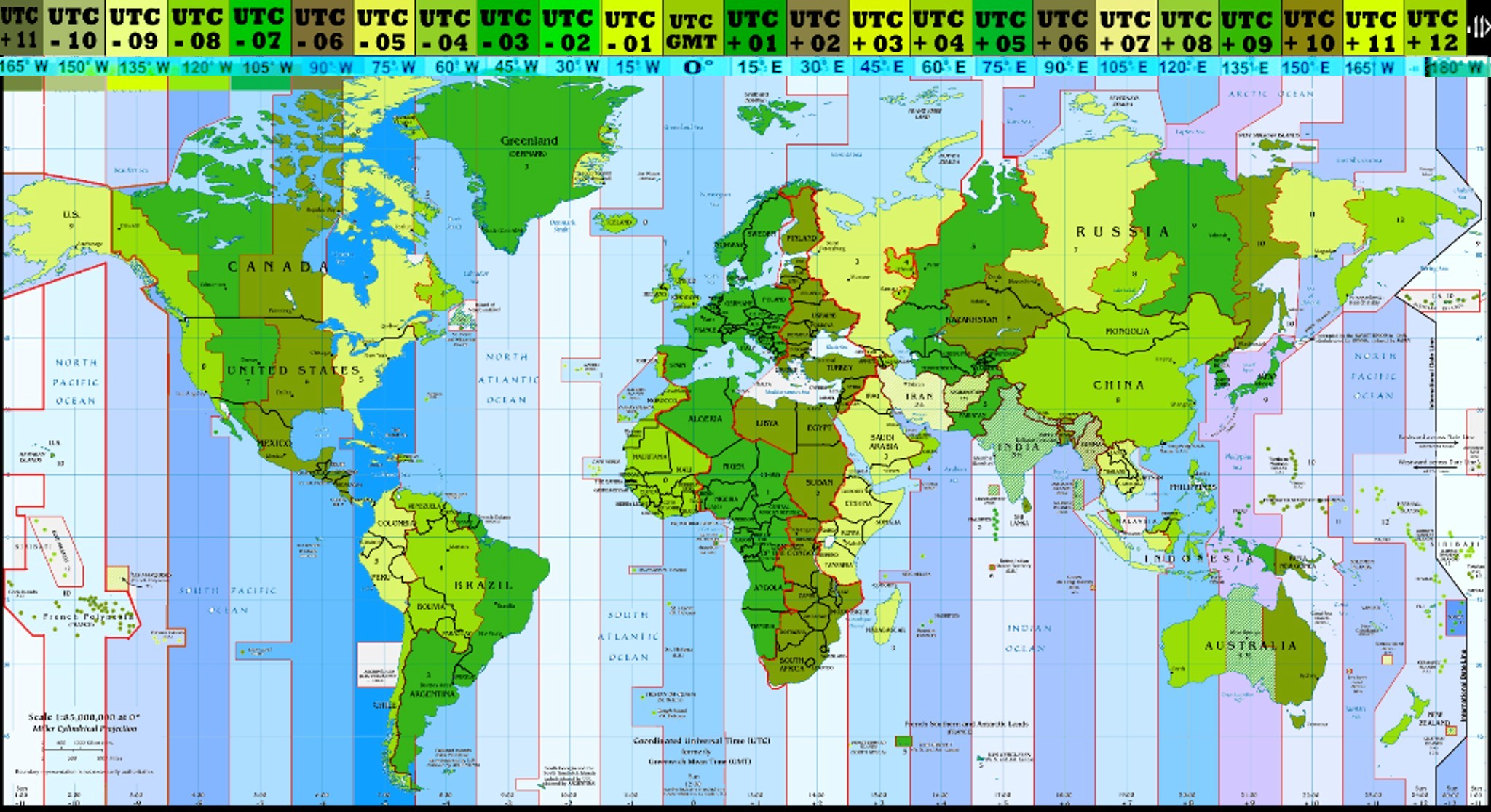
Take a look at the up to six time zone changes, from Beijing to Ulan Bator in Mongolia, then across Siberia to Moscow. Many of the westernmost cities such as Kirov, Novgorod, and Ekaterinaburg along the train trip follow Moscow time to avoid confusion. However, as the crow flies westward, the time zones are less dramatic on a train than those when flying. Jet lag is reduced, but the time warp messes with your brain and metabolism like a slow drag. Also notice how tidy (and tiny) our US times zones are compared to those in Russia. Russia visually looks and feels alot like Canada somehow when you compare the two countries on the map.

World Time Zones
World Time Zones

Day 11: Moscow Smackers

I am posting a few photos of our first half-day arrival in Moscow. The food photos were taken near the Bolshoi Theatre along Tsverskaya and Bolshaya Dmitrovka.

For the foodies:

Photos, above:

1 and 2: Our dinner at a nearby cafe, yielding yummy fettucine versions with tomatoes, pine nuts and arugula, and eggplant, tomatoes, and crab;

3. Blackberry mousse with chocolate and strawberry/kiwi/truffle tartlets along with dinner reading;

4 and 5: Pastry shop with blackberry deep dish pies and piggie rolls with apple filling (my breakfast pick)

6. Chilled caviar on tap with black sturgeon (6000 rubles–you work out the exchange rate) and red salmon roe for about 2000 rubles

For the curious:

Day 8b: Food on the TME

It’s hard not to comment on one of man’s eternal pursuits—food. From our standpoint, the food served in dining cars has been OK, not the greatest, but it is convenient and not as bad as its reputation. Last night we had our second meal in the Russian Dining car—pretty empty both times for some mysterious reason. We had a “square meal” with roast chicken, tomatoes and cucumbers on the side. Gee Kin had a beef stew in a small bowl. The meals were small, but then we realized that this is more indicative of the rest of the world, and not the kind of portions you get in big fat America. The earlier one was similar, but we both had grilled salmon and I added some borscht out of curiosity.

The more fascinating aspect of food is how the attendants eat. Our two attendants took care of us, but they took care of themselves too. As we headed to our dining car last night, we had to transcend 5 cars, including both second class luxury and soft sleepers. Each pantry was occupied by one of the two attendants of each car. They were preparing their own meal, and each one was preparing the exact same dish. Some were slightly ahead of others, but they were preparing jaio zi for themselves and their other teammate!

Apparently, the car attendants are supplied the same ingredients for each trip at the beginning. From Beijing on, they use the meat and vegetables to prepare a fresh homemade meal. The washroom we used every day was a store room for their food. We could see the plastic bags of peppers and tomatoes (see photo if it’s loaded). Note that the counter above is used for charging our devices. This use competes for attention in this room along with daily washing and the precious food storage for the attendants.

We were jealous of the attendants’ ability to prepare food in their pantries (off limits to travelers), but were intrigued with their consistency. Each car’s attendants were doing the same thing—one minded the tasks for maintaining the car while the other cut meat, chopped it, and wrapped jiao-zi (dumplings) in probably less than an hour. It’s a bit of a monastic order, as we learned that many of the attendants have worked on the job for twenty years or more.

I pondered what the Amtrak crew did in a similar situation. Nothing seems to be more stark in contrast. I hope to investigate what American train attendants do for their own needs and how they do it. It reinforces China’s focus on food. #1. I don’t think it compromises safety or service to customers, but it does make a statement about what a society deems to be important in life.

After spending a lifetime learning many languages, some better than others, I ran into one of my first communication barriers. We met the woman sharing our car today. She didn’t speak any English, German, French, Cantonese or Mandarin. And we didn’t know a stitch of Mongolian or Russian (aside from the three words we just taught ourselves). A lost Golden opportunity, despite warm smiles both ways.

Latest flash: Gee Kin managed to take a picture of the Baozi (Like Cha Siu Bao, but with wild grass picked on the side of the railway line, garlic, and scrambled egg) in our car today. The attendant then surprised us later with a gift of one to each of us! A delicious treasure to behold!!

Saturday, August 1, 2015

Day 4a: Last Impressions-Beijing

FullSizeRender 9Today was visiting Day with Gee Kin’s former professor in Hydraulic Engineering at Tsinghua University. We spent a leisurely day with him and his wife, who is also a professor in Water Resource Engineering. Gee Kin spent a year at Miyun Dam outside of Beijing in 1976 with his professor and other students. They were repairing the massive dam that was damaged by the Tangshan earthquake and that supports Beijing’s population.

The Tsinghua campus is now a bustle of activity and has the energy and flow of Stanford. Google-type buses were everywhere, and students, researchers, post-docs all sped by with focused purpose.

We had an elaborate lunch of Peking Duck, pickled web’s feet, chestnuts and Shanghai cabbage, whole steamed fish, braised pork belly, dry-fried bamboo shoots and green beans, and numerous fruits and sweet desserts.

Since this is the day before our train trip begins, we are taking it easy in this huge metropolis. We trained ourselves to use the new Metro Subway and took several lines each way to become fully versed in one of the largest systems in the world. It was built in only in less than 10 years and is indicative of China’s focus on their infrastructure systems. This is a huge achievement for the country.

More importantly, we observed how kind people were to one another. Passengers were always courteous and apt to get up for elderly people or women with young children. There was no need to provoke a response. It made me proud to be among the Chinese people (the ethnic pride thing in me kicks in!) and I was surprised at these small acts of human kindness within such a massive population. I wondered how often that happened on SF Muni or BART.

We spent the rest of the afternoon enjoying our neighborhood, where there are many traditional and creative shops to bend the mind (and the pocketbook!). This area has always hosted clever shops, and this new version is only an extension of the past.

It remains to be seen how well we will be able to communicate once we are on the train tomorrow. You may not hear from me for five days or the entire time I am on the train, although the Internet is purportedly available.

If you are interested in seeing more photos of the Courtyard hotel, please go to their website at http://www.Courtyard7.com. They can also be found in Tripadvisor and Booking.com, where I do a lot of my searches for accommodations. I don’t normally talk about hotels, but this one is truly one of a kind. I encourage you to look at the photos of the hotel.

Updated 8/6/15

La Vie en La V en La J

Meeting a long-lost friend for dinner in La Jolla proved to be a royal So-Cal experience. After being picked up in a limo at the hotel, I was whisked to the Med at La Valencia Hotel for the evening sunset and an ocean view table. While catching up and talking non-stop til I was hoarse, we shared lovely courses of sea bass and garden vegetables highlighted by a local Foley Chardonnay.

In our conversation, we decided that Barcelona gets high marks for its liveliness, 24-hour living, and Miro scenery, while Sorrento despite many tourists was one of my top picks in Europe for its intimacy and striking setting.

We made plans to meet in Berlin to catch the art scene or go to an opera together in the near future. This weekend gave me multiple opportunities to renew old friendships and to discover many common interests through our conversations. If you haven’t made the effort, please think about getting in touch with someone you haven’t seen for a while. It’s one of the best investments you can make, and don’t forget: life is short.

In case you were wondering, the chauffeur advised me, “We people refer to the hotel as La V”. I was promptly returned to my hotel for a good night’s sleep…to dream about the magic carpet chauffeur-driven car and to kick-start the endorphins by conjuring up the next trip. These thoughts brought a perfect ending to this stimulating, fun-filled weekend to San Ysidro, La Jolla, and Pine Valley.

A Lazy Day in Pine Valley

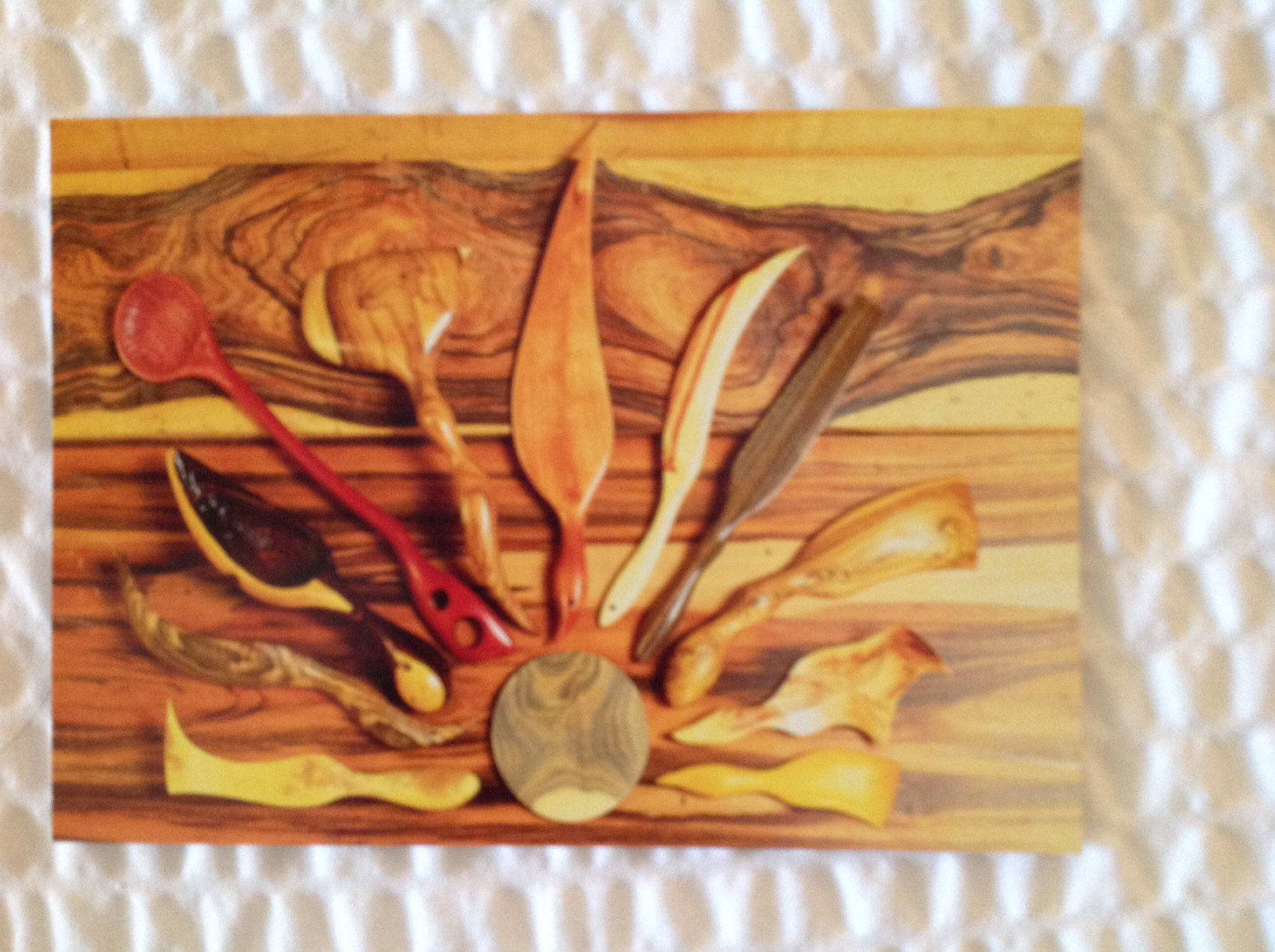
We took it easy this morning. After a leisurely cup of cappuccino, we walked to the corner of town to visit Tryyn Gallery, where the owner, Bill, hones beautiful pieces of wood into spoons. He finds the inherent beauty in each piece of exotic wood and turns each piece into both functional items as well as works of art.
imageWe got into an extended conversation about the huge bamboo section that was inside the glass display cabinet. Bill explained that the roots at the outside tip of the piece had been cut and sanded down, and that the tip was the bottom of the root. We had a difference of opinion and believed that the tip pointed up and outside. Which way do you think the tip faced–up or down? Our initial research only confused us more.

Later in the morning were taken on a breathtaking tour of Pine Valley. It is deep in the Cleveland National Forest. We followed an old fire lane up into the hills of manzanita, live oaks, sage and agave plants. The hillsides were laden with thick growth from two weeks of rain, an unusual occurrence this late in Spring season. You can see the panoramic view of the valley in the header above.

After our venture into the hills where we had walked the previous day, we made a stop for lunch at a local saloon. Not too much was going on, except that the counters were made of shellacked half-logs and the seats were even bigger sections of logs. Sorry, guys, no foodie shots available here (you are being spared). A couple of relics served (or didn’t serve) us, in an area where you could hunt, if you used a bow and arrow.