Tag Archives: Design

Day 9: Goethe’s House and Garden House

Goethe’s House in Weimar is one of the two major attractions in this historic city (the other being Schiller’s House). Goethe’s holistic approach to philosophy, art, nature, and writing may have influenced the Bauhaus movement a hundred years later. (See yesterday’s post on the Bauhaus).

Goethe’s famous novel, “The Sorrows of Werther”, is a story about his affection for Charlotte Ernster (nee Buff). It sparked a viral interest in love stories in his day and may have caused a string of suicides mimicking the author’s drastic solution to a spurned love affair. Goethe was known to have had affairs with Charlotte von Stein among others. He eventually married a commoner Christiane after having a child out of wedlock with her.

Love is a featured topic of the Goethe Museum. Idealized, romantic love and even forbidden and erotic love were themes in Goethe’s writings. Goethe captured and explored human emotions that previously were suppressed or seldom expressed. Read some of the written explanations below.

Goethe was quite the Renaissance man. In addition to writing plays, poems, and about philosophy, Goethe was also an artist. He had a curiosity about the natural world, and became an anatomist, geologist, and horticulturalist.

Goethe’s home gives a glimpse into his personal life and work environment. Goethe paid particular attention to storage of artifacts and documents.  The custom-designed cases kept collections organized and accessible.  Books, coins, geological samples, and artwork were stored so they could be quickly presented and shared with visitors.

I could imagine being very satisfied and happy working there. Following Goethe’s perfect schedule, I would power through emails and blog posts in the morning, tinker a bit in the garden, have the main meal around 2pm, and cap each day with a nap in the afternoon!  Below are some of the enticing rooms and garden perspectives.

In the Park along the Ilm River, the Garden House served as Goethe’s getaway where the writer could escape his social and administrative responsibilities and focus on writing. Not too shabby either.

The “high horse” chair was custom designed so he could sit and write for long hours. The tall yoke rested his ample belly, and could easily support other elephants in the room. As a craftsman cum designer, he would have been an ace at the Bauhaus.

Day 6-7: From Bauhaus to Your House

If there ever were a sacred place of pilgrimage for me, it would be the Bauhaus in Weimar. Created by Walter Gropius around 1921, this school combined the best of internationally recognized artists with master craftsmen in Germany. The school was intended to teach design and architecture rather than fine art. The artists taught form, shape, and color, and the craftsmen trained students to technically perfect their designs and products.

In the following photographs and explanations from the exhibit, you will get a sense of the development of graphic design and architecture that still feels applicable and relevant today. These photos are just a small sampling of the my favorite exhibits. A new museum is planned in the future.

Hallo Halloween

It’s been over two weeks since I have returned. I am finally re-acclimated to being at home and am enjoying my daily walks around the neighborhood. They help me keep the glow of my travels alive as long as possible. On one of my 3-mile hikes through the Upper Haight-Ashbury in the City, there were plenty of gobble-de-gooks and other surprises to amuse me and remind me why walking is a better way to travel and see the world.

I began to ponder the color orange. In a recent ice-breaker exercise, participants were asked to state their favorite color. Obvious “safe” answers such as “green”, “blue” or “pink” were mentioned, but few people would say their favorite color is orange! It seems to be an odd color, not quite fitting in with anything or eliciting a pleasant response.

IMG_0370From this Matisse painting posted this morning from the Barnes Foundation in Philadelphia (see my post from Day 69-70), Matisse once said “The chief function of color should be to serve expression”. The BF suggested that autumn colors should inspire how we express ourselves.

DSCF2671 I am posting a delicious photo from a Schwäbisch Hall friend, who visited Cumbria in the Lake District. It’s a good reflection of what Karen and I may have missed in Vermont this year.

Other than being associated locally with the San Francisco Giants’ Baseball team and the shocking “Clockwork Orange” movie by Stanley Kubrick, the color orange either reminds people of Fall Foliage, Halloween, or Thanksgiving. Beyond that…well, not much.

For those who are not as familiar with Halloween in the US, it is a fun and scary night with goblins, ghosts, and creepy-crawlies for kids. Children (and some adults who never grew up) dress in costumes and ply through their local neighborhood to demand from each neighbor a “Trick or Treat”…meaning you should give each child in a costume a “treat” or they will “trick” you. Most kids don’t really have a plan to take revenge on their neighbors, though. And I’m not sure whether hosts can opt to “trick” those at their doorsteps.

If you don’t answer or are not at home, you can get eggs thrown at your house, toilet paper strewn throughout the bushes, or a pumpkin smashed on the street. Older kids who did those things were intent on doing it anyway. Kids are now closely supervised by their parents on these outings. As a kid, I only remember going alone and getting sweaty from running in my home-made costume. I raced through my Crocker Highlands neighborhood in Oakland door-to-door to grab as much candy from neighbors as possible in two hours. I could easily gather one or two grocery bags full of goodies and stash enough to rot my teeth for the rest of the year.

Unfortunately, it is no longer a simple matter. Much later, our kids’ orthodontist was a real wet blanket. He collected the candy from kids who brought them in after every Halloween and bribed them with some pathetically unmemorable incentive. Crime has risen and deterred children from being able to go into their neighborhoods safely alone. It seems that kids nowadays are joining families or school groups to have private parties as an alternative to the neighborhood haunt.

But from my walk and looking for things orange, I discovered a small piece de resistance and renewal of faith for Halloween. The Upper Haight has been known to be a classic neighborhood where kids from both inside and outside the ‘hood are also welcome to visit. Even in our middle class neighborhood there are manifestations of defiance and celebrations of the spooky holiday. Maybe it takes a small community with money, iron determination to counteract current fears, or both. I could be a Scrooge and complain about how much money is being wasted and spent for no good cause. In any event, I was happy to see these expressions of home-made fun, whimsy, and creativity. I hope you enjoy them too.

Note: I will be posting an index of my 80 days around the world for those who missed specific cities. Stay tuned.

I noticed that the photos I normally take of favorite pieces from the Barnes Foundation were absent. The museum did not allow photos to be taken of artwork.

For those who continue to be interested in my wanderings, I will be making occasional posts over the next few weeks. You can always opt out if you aren’t.

Days 24-26: Salzburger Knockouts

I’ve been trying to get my dose of Salzburger Nockerl, a famous local dish made from pure egg white meringue. Unfortunately, it has eluded me so far. I either wasn’t in the right cafe that serves it, or didn’t have the 20 minutes it takes to prepare it.

Despite this oversight, I finally struck gold in many other ways on my last couple of days here. I got it all and what I love about traveling: quality architecture, quality museums, quality music, quality food, and of course, quality people! The tag posts seem to tell it all.

I’m trying to reduce and concentrate the number of posts to only a few a week (Wednesdays and weekends) so I don’t flood your email boxes. Unfortunately, it makes the posts longer.

Here’s a spread of what this richly, well-endowed, and now much appreciated little city of Salzburg has to offer. To make it a little easier, I’m including a summary so you can skip to the parts that interest you:

1. Salzburg Fortress (Festung)
2. Mozart Houses (Birthplace and Living Quarters)
3. Performances (my raison d’etre for being here, but not necessarily the most exciting)
4. Food and People


1. The Salzburg Festung, or fortress, was very informative and an excellent excursion today. Gee Kin would be proud of me-I trooped up the hill and partook of the view from the top. Because Salzburg is so overrun with tourists, the city has managed to take tourists’ needs to heart. They provide excellent displays and explanations in English (for those of us brain-dead in German). They even had a electronic kiosk soliciting feedback at the end of the tour.

There were many architectural or design features I had not seen before. Those listed are not in any particular fashion. Follow the captions for specific items. You can hover over the photos now to see the captions.


1. Stone columns honed in a fashion the way wood is turned on a stile;
2. Matching metalwork
3. Torture elements–aha! can anyone venture a guess what this contraption is?? (see below)
4. A wooden threshold that was so old and worn that it exposed the “knuckles” of the knots from the tree, like aged knuckles on a centogenarian
5. A section of real arches that shows how they were constructed.
6. A display of how they created cranes to haul stonework up the mountain.
7. A latrine that was one of the first of its kind
8. Romanesque arch construction displayed

And a few morbid items from the torture storeroom to remind us of our mortality.

Since the fortress was built in the 11th century and over a period of hundreds of years, the museum was able to trace its construction history. It was an exciting architectural exhibition of walls, innovations and construction methodology. While most of the fortress was reinforced and expanded in the 15th century, it captures the various early periods from Romanesque beginnings to High Renaissance.
2. Mozart’s Birthplace and House:


3. Performances:

The star quality of these performances have been a bit mind-boggling. The interesting point is that my favorite opera star, Jonas Kaufmann, was not at the top of his game in Fidelio. The music was deep and entrancing, but his performance was weak. The opera performances shown here were much better. These performers can really deliver full-bodied voices and their skill and dedication really shows. Audiences were very responsive and clapped heartily.


4. Food and People: On my last day here, I decided to go for the two-hour lunch instead of the evening dinner option. My lunch was celebrated at the Heimer Specery. I took my time, had a small antipasti plate of eggplant, sun dried tomato and roasted red pepper with Prosecco, followed by the house specialty, a succulent full bodied pork chop that comes from the establishment’s own piggery. Along with a glass of rose, this was the chef’s recommendation so it had better be good. And it schmecked, or tasted delicious! I had just told Gee Kin that I thought pork was often disappointing as a dinner entree. I often found it dry and uninspiring. After your third bite you wish you had ordered the branzino. Well, I wasn’t disappointed this time. This little restaurant around the corner from the Festival Hall delivered to demanding regulars and I was a beneficiary.

The night before, I took my place at another restaurant (the one I went to for lunch today was fully booked 2 nights in a row, thus the lunch decision). As I was about to hog a table for four all by my lonesome, another gentleman was looking for a single at the same time. He asked if he could join me, the very exact same time another woman came along and did the same! I was very flattered, and didn’t mind the company at all. I was even more delighted when I learned that neither of them spoke English!

The three of us ended up with a very friendly conversation, and I had a chance to practice my elementary German. It was frustrating as I could ask basic questions but never “got” the answers. They drifted to fairly complex conversations about what the two dinner partners thought of the Greek Crisis, Angela Merkel, and the operas they were seeing. The gentleman’s nephew was performing in the opera we were about to see (Angela Georghiou in Werther). He was a baritone and did very well.

What I like about traveling is connecting the dots. I was flashing on how non-English speakers must feel when they are asked questions. After a few pleasantries, a zero-tolerance policy toward any non-English speakers seems to drift into the picture. Native English speakers tend to expect everyone to speak English, even in non-English speaking countries!

Well, the tables were definitely turned here. I felt stupid, unable to respond to simple political and economic questions. While it made me more determined to learn German, it made me reflect on how hard it is for many people in many countries to master English. I certainly came to that conclusion as I realized I could only sit and muse as the two native German speakers became very engaged and animated in their conversation. Sadly, I could only plaster a smile on my face and pretend that I understood everything.

German women seem to like short spiky hair, blow-dried behind the ears. Subtle platinum highlights, or jet red. Less Gothic these days. The woman who joined me was of the subtler version, and very svelt. She worked for a pharma company in Regensburg, and drove two hours each way to come to the performances this week. The gentleman from Innsbruck was a retired German teacher. It was, despite my misgivings, really fun trying out my German with no English back-talk.

Here are a few random street shots. The urban planning and insight for local Salzburgers and tourists alike are appreciated and well used in high density pedestrianized areas borne out of necessity. Delivery trucks and taxis drive right over the fountains and gutters, and everyone shares the paths in a symbiotic way.

Day 14: Moscow Drum Roll: Market and Modern Art

Dorogomilovsky Market early in the morning was Gee Kin’s pick today, followed by mine–the Tretyakovskaya Modern Art “Gallery”. We managed to take the subway three stops to our first destination without getting lost. The subway had a dizzying amount of subway names–all in Cyrillic–so you have to master the alphabet or you are “TOCT”. Gee Kin showed rapid improvement from his initial blundering, “What’s that alphabet called–Acrylic?”. I’m including the subway station menu, that requires good eyesight in addition to calisthenic tongue skills.

As a “wrailwray” kinda gal, I love cracking the system. We stepped into the huge escalator tubes of travelers, stretching endless miles deep down into the bowels of the Moscow River and beyond. These were the longest escalators we have seen anywhere–they felt like at least 3 to 5 times any of the deepest tube station in London. The Russian engineers liked doing things bigger and better, and this was another showcase opportunity. We sliced and diced the station names like a Benihana master chef would, and deconstructed each one letter by letter. We followed every sign religiously. We even avoided going down one-way streams and didn’t make elbow contact with anyone.

The cars were spotless, not a crumb or grungy morning coffee spill in sight. Like all good citizens, the Moscovites rushed swiftly, politely and silently. Gee Kin noticed that commuters zoned out with fewer hand-held devices and opted more for books and magazines than their Beijing or San Francisco counterparts.

As expected, the market was also a bustle of activity, with carts being swung and navigated every which way down aisles beyond safe speed limits. You can see our fascination with an array of some familiar but also new sights: furry rabbit’s feet good luck charms, Korean kimchee specialties (a note about that later), racks of lamb and carcasses, 8 piglets without blankets, bottled and pickled everything (including grass mushrooms Gee Kin loves), and on and on. It reminded me of the bigger but less varied market in Tashkent from last year.

Next, our day was traumatized by a trip to the Modern Art “Gallery”–along the Moscow River. That was the only bearing point for the humongous site. The monumental museum (and I mean MONUMENTAL…the size of an Olympic stadium…was so big and dwarfed human context so much that it became a nightmarish experience. We dragged and slogged our way though miles of artwork. Despite the noble effort to catalogue modern art in the Soviet Union from pre-Bolshevik days to today, the museum and its fascinating history was lost and unappreciated due to the vastness and lack of selectivity of the material. Its attempt to show “everything in the warehouse” (purportedly 170,000 pieces) made it mind-numbing and exhausting.

This frustration may have been caused by sensory overload from the earlier market visit. Just getting to the building from street to front door was a chore. The gallery literally looked like a stadium complex. We weren’t quite prepared for this mental and physical workout. If you go there, be sure to dedicate one entire day for a visit. Better yet, a week. Bring your camp stove and tent but don’t get caught.

Don’t misunderstand my message. I did love the artwork. I was inspired by the sculpture more than the paintings, though. They all cried for attention. Because there were fewer pieces of sculpture, you could focus on them more easily. I found the predominance of woman’s bodies depicted in real, human ways very moving. They weren’t idealized as Venuses. They were reflections of real women, of mothers, sisters, workers. I even found a few that looked like me! Their bodies “hung out”, but their faces spoke volumes.

I couldn’t help but think about the stunning ballet performance by the prima donna from the night before. She could perform so flawlessly, and so dramatically. Her face and body spelled all the agony and torture of the dying Violetta. The sculpture of woman and child spoke to me in the same way, as did the other pieces that were chiseled and sparked to life from stone.

Aside from a few Chagall pieces that I could detect, it was difficult to find any recognizable names. We were on the lookout for a cache of Matisses, but these were all Russian artists (Chagall was a Belorus-born French artist). The French Impressionists are elsewhere in Moscow, not here, in this national repository.

And of course, near and dear to my heart, design. See my favorite pieces of artwork in the entire stadium: calligraphy on beautifully crafted plates.

Note regarding Korean community in Moscow: some came here before WWII. They were later purged to Uzbekistan, and a small population still lives there.

A Lazy Day in Pine Valley

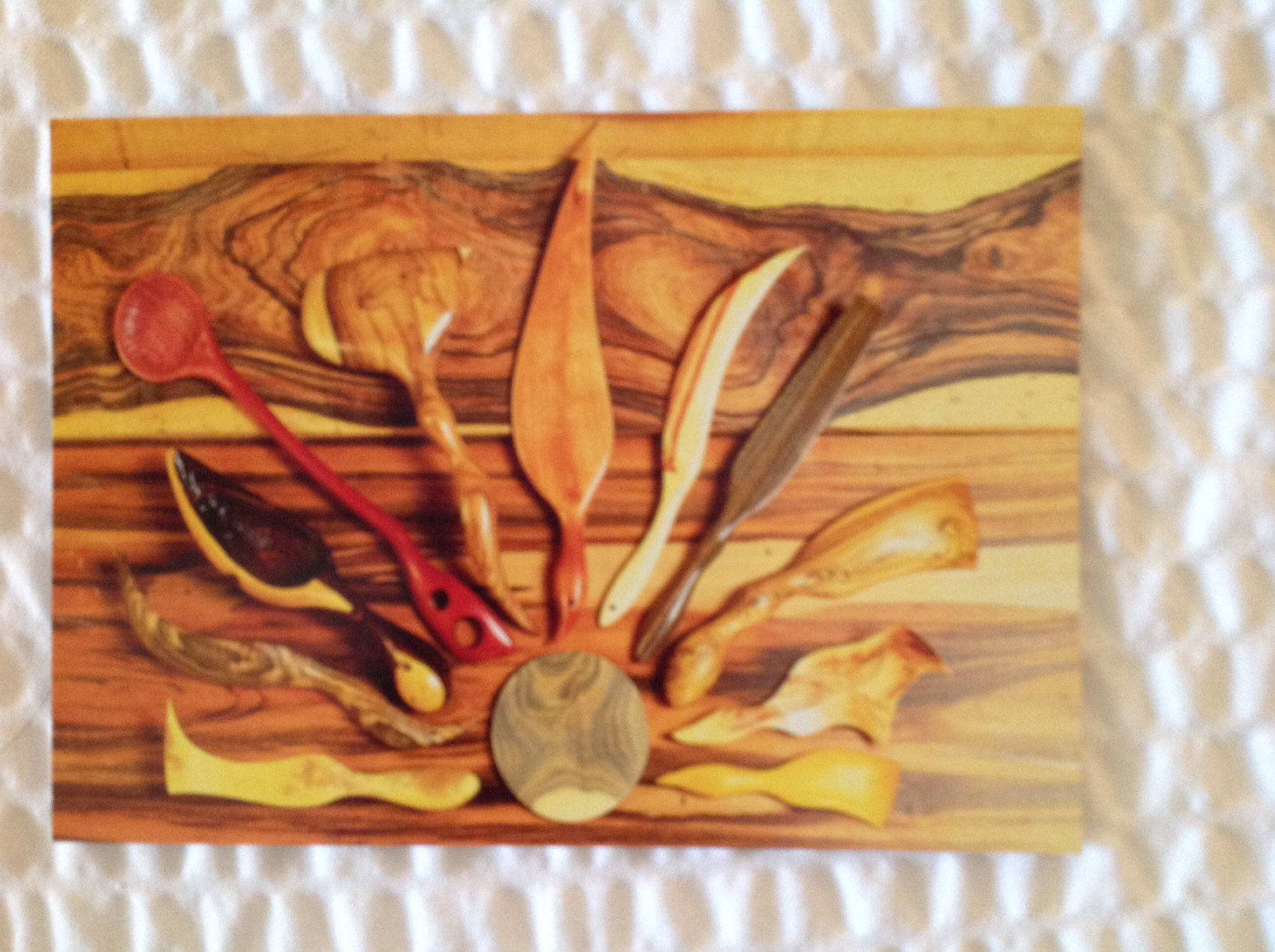
We took it easy this morning. After a leisurely cup of cappuccino, we walked to the corner of town to visit Tryyn Gallery, where the owner, Bill, hones beautiful pieces of wood into spoons. He finds the inherent beauty in each piece of exotic wood and turns each piece into both functional items as well as works of art.
imageWe got into an extended conversation about the huge bamboo section that was inside the glass display cabinet. Bill explained that the roots at the outside tip of the piece had been cut and sanded down, and that the tip was the bottom of the root. We had a difference of opinion and believed that the tip pointed up and outside. Which way do you think the tip faced–up or down? Our initial research only confused us more.

Later in the morning were taken on a breathtaking tour of Pine Valley. It is deep in the Cleveland National Forest. We followed an old fire lane up into the hills of manzanita, live oaks, sage and agave plants. The hillsides were laden with thick growth from two weeks of rain, an unusual occurrence this late in Spring season. You can see the panoramic view of the valley in the header above.

After our venture into the hills where we had walked the previous day, we made a stop for lunch at a local saloon. Not too much was going on, except that the counters were made of shellacked half-logs and the seats were even bigger sections of logs. Sorry, guys, no foodie shots available here (you are being spared). A couple of relics served (or didn’t serve) us, in an area where you could hunt, if you used a bow and arrow.

Day 34(b): Fourth Eye Blind

image

image

image

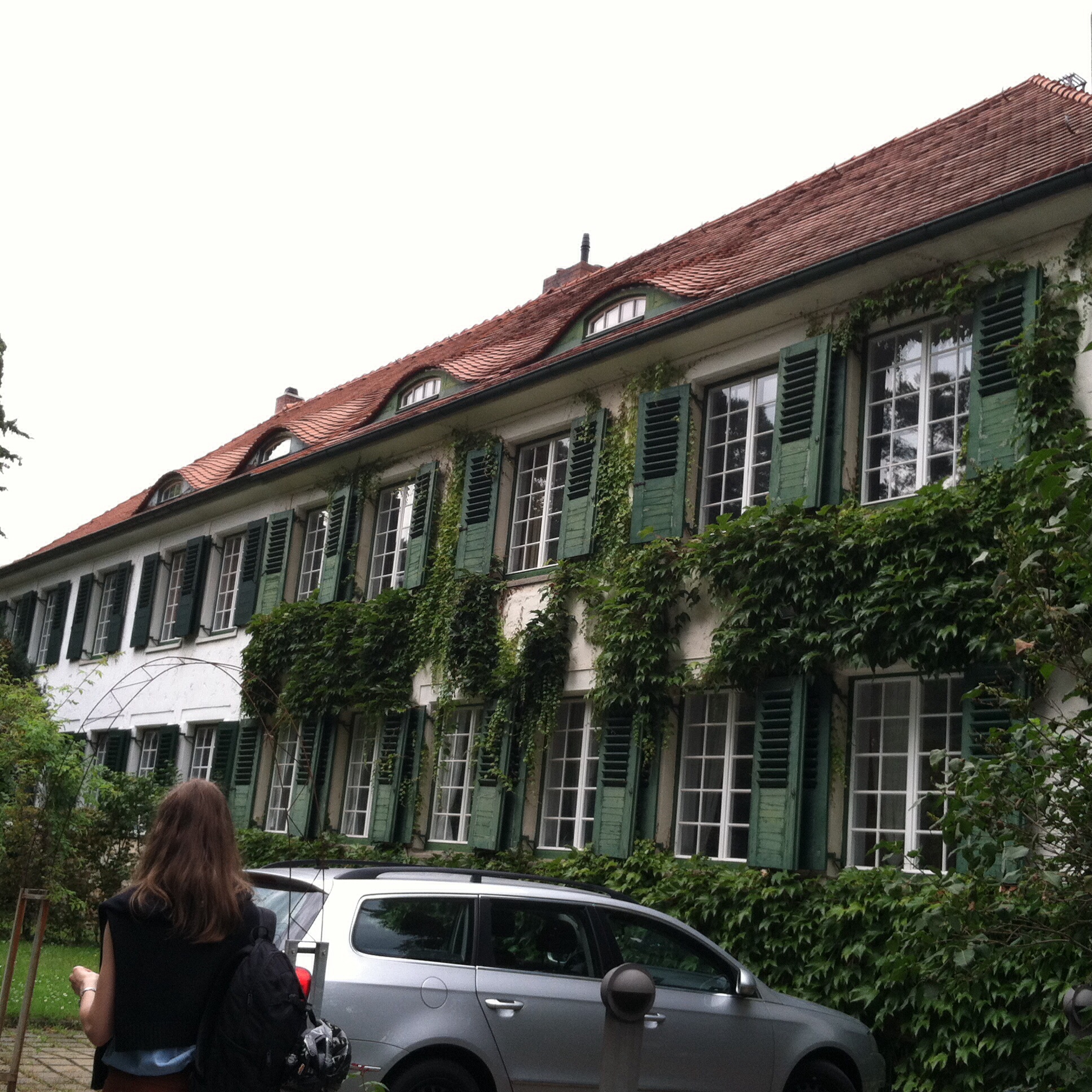
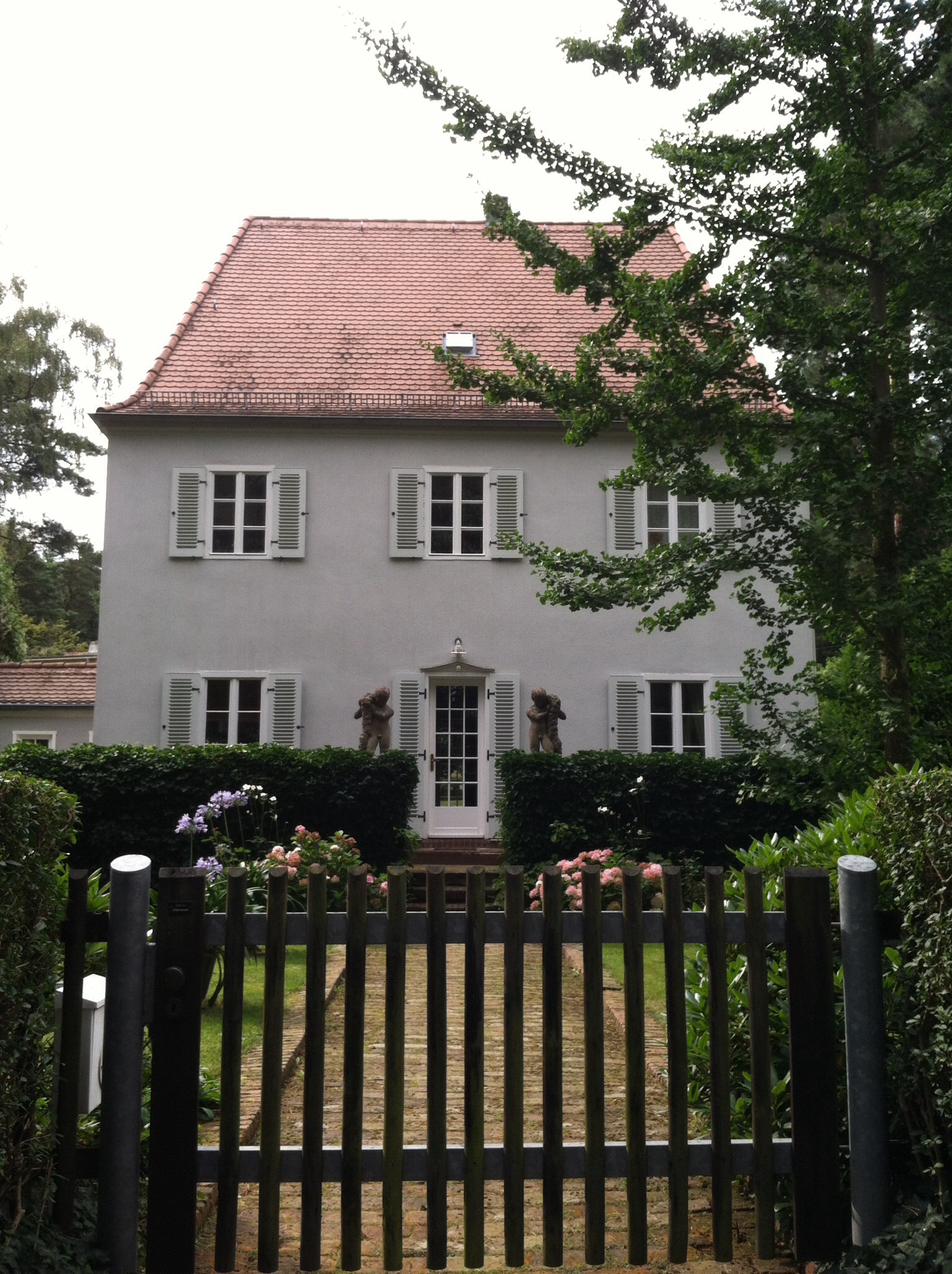
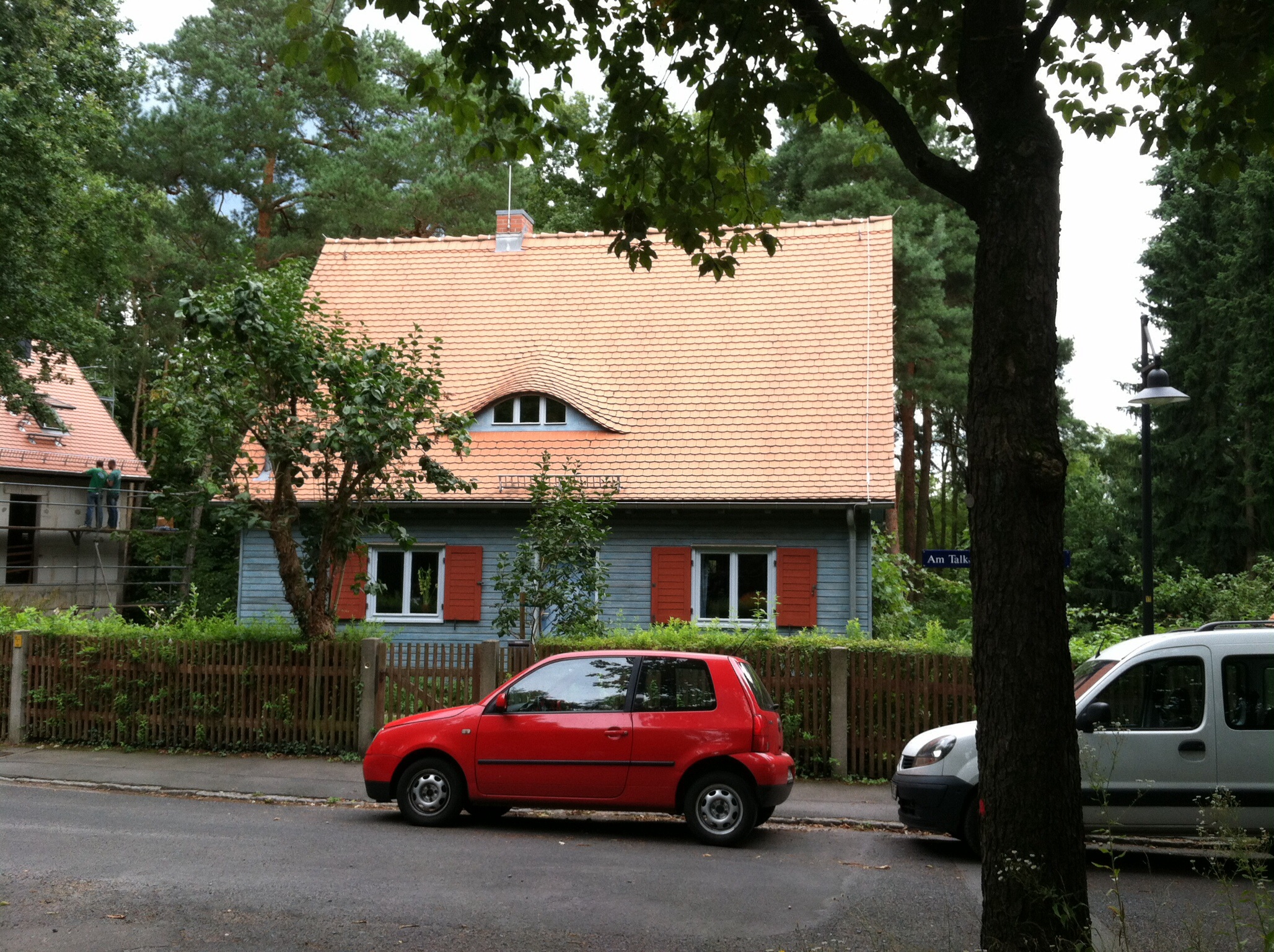
Ever since I discovered the blinking rooftops of Dresden, I got fixated on roof planes and how the German designers reconciled them. They do seem to take an inordinate amount of effort, load and space. My only conclusion is that the the tradition to go high and mighty has resulted in some of these new design dilemmas. The Protestant church steeples in every community make you feel as if you are in a throwback to Middle America. The Germans had problems shaking the dramatic effect of Gothic cathedrals. I am having fun going on scavenger hunts for these curious design solutions for pitched roofs. With only a few days before I leave I may have to wait for the next trip to Germany. I am including a few more roofscapes that intrigued me in Hellerau. This is for Pam, who came up with the idea of the blinking eyes.
Photos, top to bottom:

1. Four eyes. Don’t know if there are more than that, I am still looking.

2. One Eye. Proportion to roof plane seems crazy, but they really wanted that window there. But let’s not overdo it, they thought.

3. One Eye. Better version of previous post, just counting.

(In case you missed the previous one, check the Day 24: Third Eye Blind”. It was my first discovery of the blinking eyes.)

Day 31: VW Factory Tour

imageimageimageimageimage

Photos, from Top, left to right:

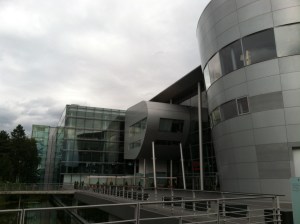
1. the Exterior of the VW Factory, designed by Gunter Henn at the end of 1998. While not necessarily the first of its kind to showcase the production of vehicles in Germany, the building is representative of the pride that Germany takes in one of its signature products and namesakes.

2. By using primarily glass curtain wall, the facility brings incredible light into the facility for its occupants. Located in the area around a major green space (Grosser Garten), however, presented different issues. Birds cannot detect the building due to its transparency. Special sound effects were added so birds think that the territory of the building is already claimed.

3.The conveyor belt for the “assembly line”. These cars were pre-assembled in other parts of Germany. Cars are transported here for final finishing to showcase the most interesting visual effects of the production line for customers. Unfortunately, we were not able to see the actual movement of the line due to the scheduled 3-week “Urlaub”. The maple butcher block flooring from Canada covered the entire ground floor area and is engineered perfectly with no gaps to the mechanical conveyor system. Work stations move with the line.

4. The showroom, where customers can test out and order custom made Phaetons.

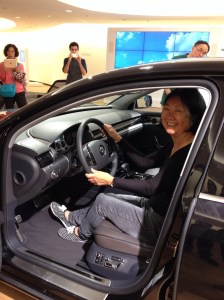
5. How did VW know that black was my favorite color? 60% of the others who buy this car think it’s tolerable too. It’s only a cool 135,000€.  I couldn’t understand why so many people were taking pictures of me.

Day 29: Lovin’ Loschwitz

imageimageimage

Helena and I spent our afternoon taking a long walk from the Carnival scene at Altstadt and Neustadt areas to Loschwitz. We strolled at a leisurely pace along the Elbe and stopped twice for lunch and a water break at restaurants with outdoor dining. We were able to catch up on a few years’ work and play between us.

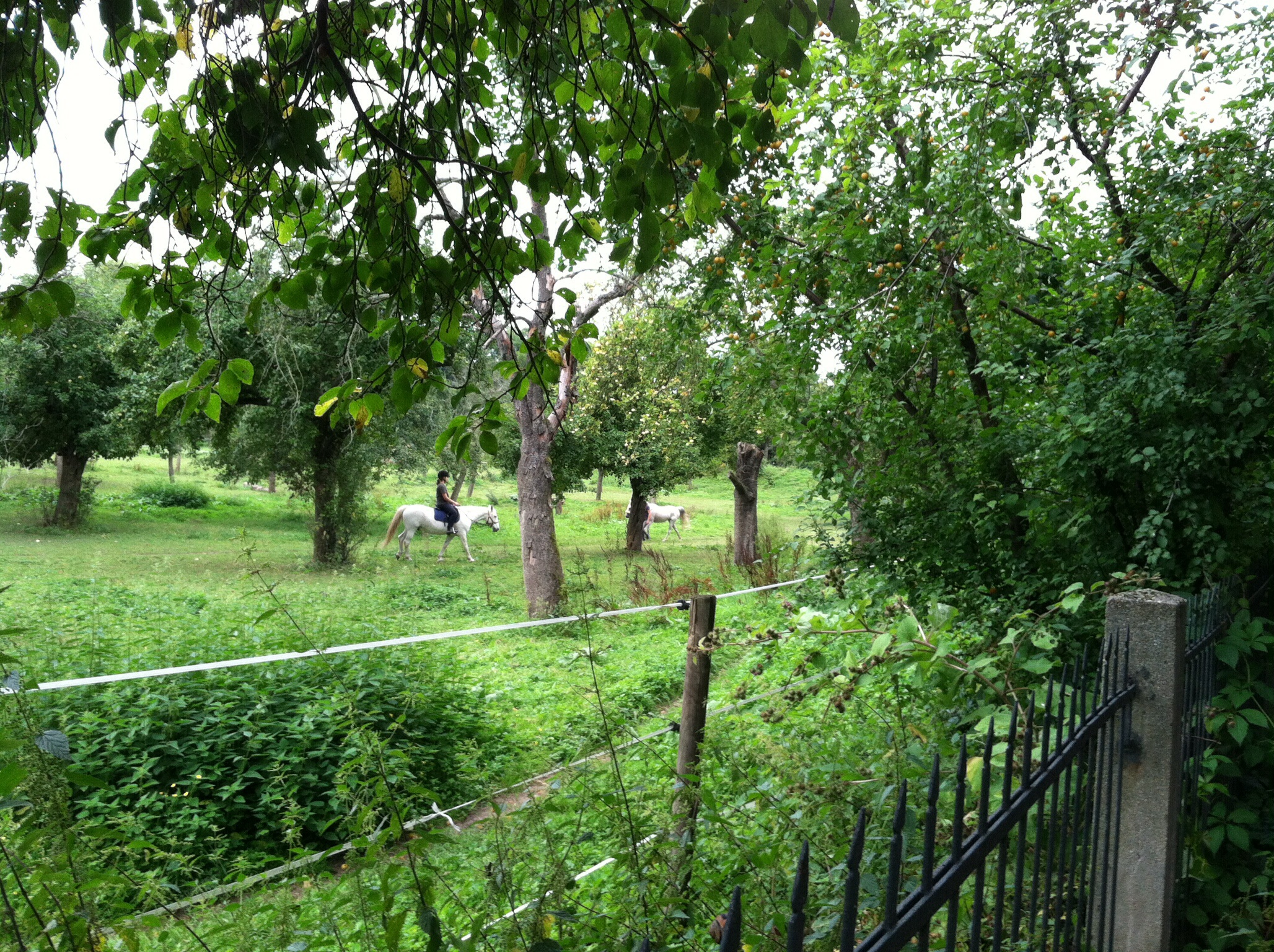
Along the way we passed a paddock not far from the riverside where horses are trained. It was amazing to see such a large yard along the river, not far from town. The lush green was reflective of large open spaces and extensive open spaces for the city’s residents.

We even managed to take in a cultural highlight of the Loschwitz area. The building in which the Leonardi museum is located was originally owned by a landscape painter. He wanted artists to be able to live and work together and dedicated the building to this cause. It was used for this purpose initially, but eventually the plan did not survive. The building has been turned into a museum for artists’ work.

If you are interested in reading more about this museum, please see http://www.leonhardi-museum.de/index.php?option=com_content&view=article&id=13&Itemid=12.

Photos, from top:

1. View of paddock near the Blue Wonder Bridge and Schillerstrasse.

2. Front facade of Leonardi Museum, with extensive German script used to decorate exterior of building. There are other examples of titles, sayings and poetry used on buildings in this neighborhood.

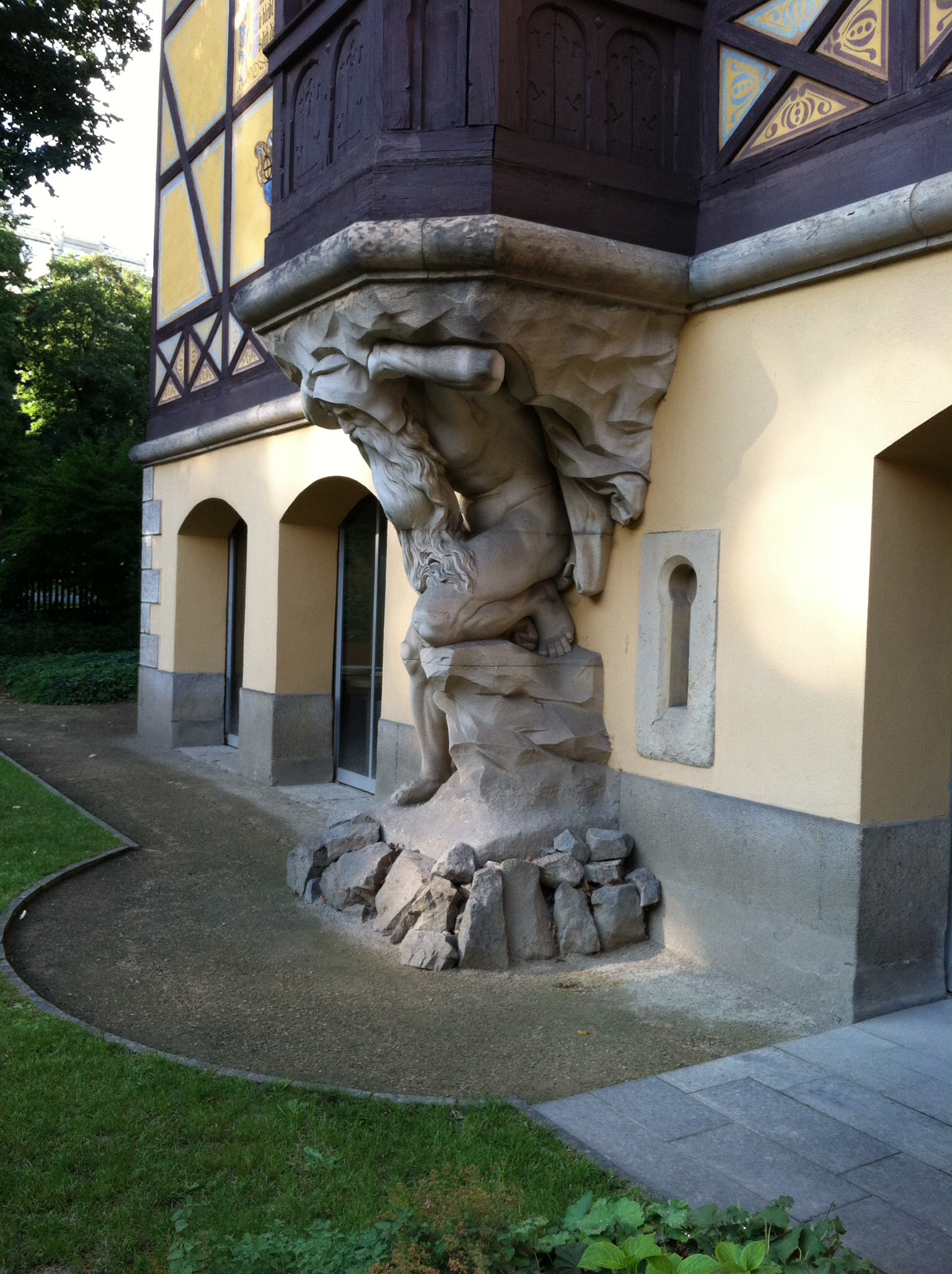
3. Detail of support.