Tag Archives: Architecture

Day 43: Basel, Switzerland

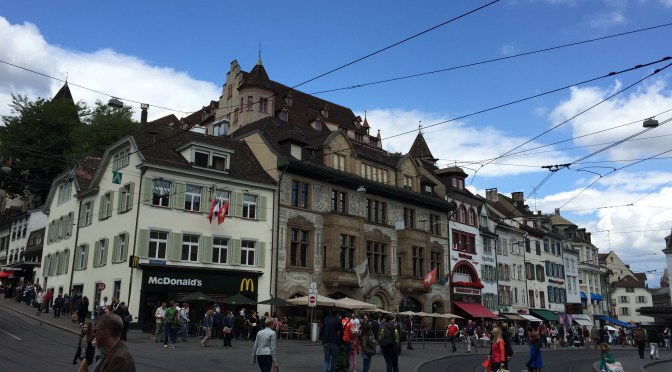
Three Walking Tours were available in the heart of the city and we decided to take the architectural tour. Many of the buildings in the city were designed by Herzog and Meuron. Basel has bragging rights to a number of world famous architects, including Zaha Hadid, Frank Gehry, Richard Meier, Tadao Ando and another of their own native sons, Mario Botta.

It’s interesting to note that both Botta and Herzog and De Meuron designed museums in San Francisco but are known in Switzerland for many other building types. The prevalence of American architects may be due to the development of the biotech industry in this area and its partnerships with American firms. Many of the buildings featured on the architectural guide were biotech companies such as Roche and Novartis.

IMG_8671


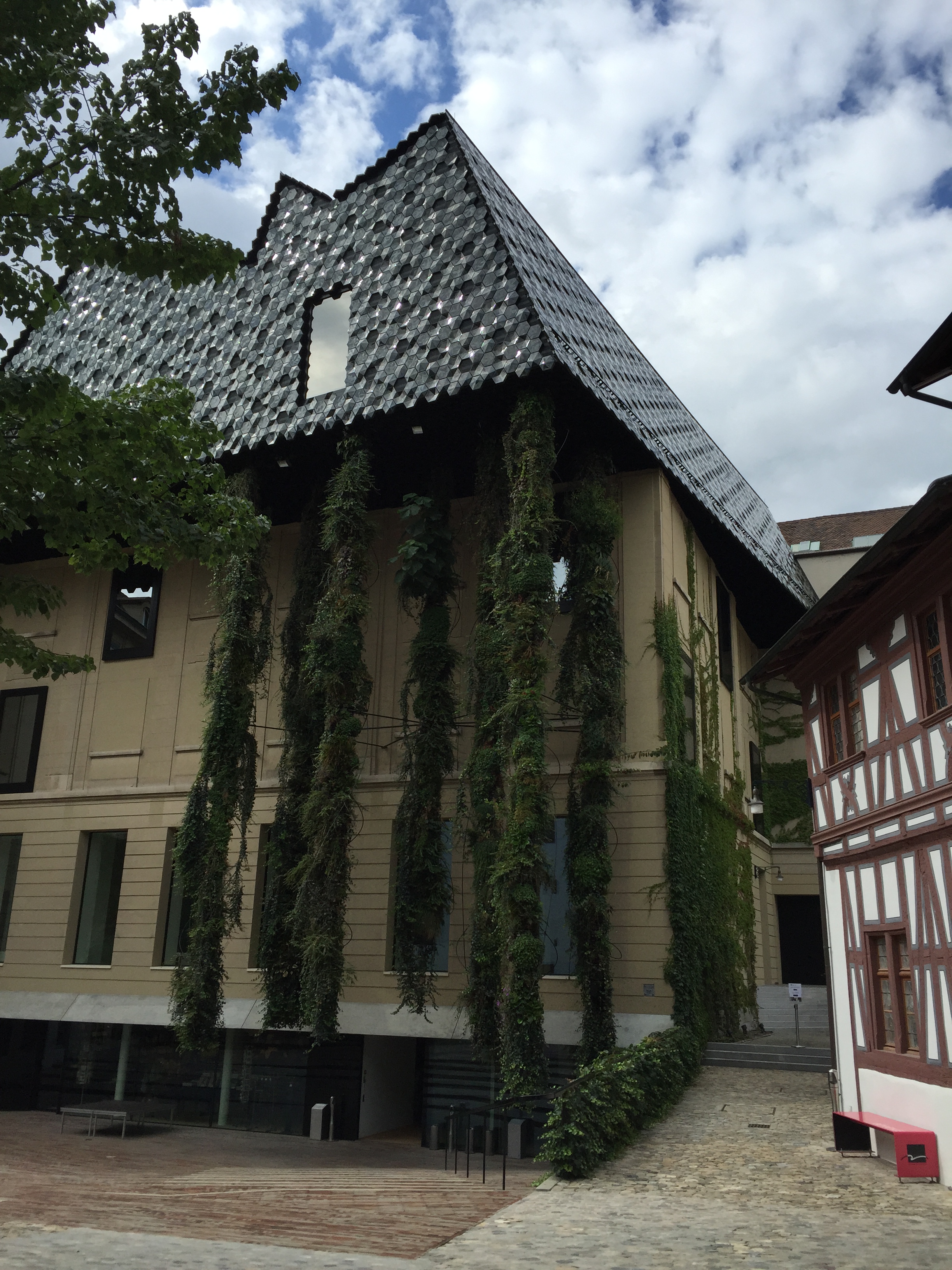
The vertical extension of Basel Museum of Culture was designed by Herzog and De Meuron. The textural pattern of hexagons reflected the irregular shape of the plaza facing the museum. They were in both convex and concave shapes. The giant hanging plants at the entrance reminded me of the seaweed forest at the Monterey Bay Aquarium, where they swayed gently in the breeze.

The De Young Museum in San Francisco, also designed by Herzog and De Meuron, is one of my favorite buildings. I love the mottling effect of the exterior copper panels on the inside of the building and how it imitates the light coming through trees in Golden Gate Park. The huge canopy at the entrance also reminds visitors of the deep shadows in the park.

The Basel museum featured an exhibit on opium that sparked a lively conversation with my hosts in Brunnen. My grandfather had died of an addiction to this deadly plant. The museum collection included all the history, plant production, implements and literary figures who were influenced by opium (including one of my relatives, Lin Biao). The saddest part of course was the Opium Wars and the treaty ports imposed on China as a result of the wars. The exhibition was very thought-provoking and a moving educational experience.

Swiss Cheese, Salad, and Potato for Raclette

Our final evening was topped by the famous Swiss specialty “Raclette”, a fondue-like dish of Swiss cheese toasted with onion and spices on a grill, then spread with a miniature wooden scraper onto the top of sliced potatoes.

After saying goodbye to my dear friends in Switzerland, I was looking forward to my next big adventure. I will be taking a German language and culture class for the next two weeks in Schwabisch Hall, Germany, and can’t wait to spread out my meager belongings during this time.

My friends Helena and Hans took good care of me and showed me a local’s view of Switzerland. I am very grateful to them for their generosity and appreciate their care and attention during my stay there.

Day 36: Zurich’s Riches

Every city on arrival has inspired me. Everything is so fresh, new, and exciting. I feel like I am abandoning the children I left behind: the cities that were so sweet, quaint, and lovely. Each one had their unique qualities, but I can’t help but look forward to the adventures in the near and present future.

Attached are some photos of a do-it-yourself city tour I took on Saturday morning. It was unbearably hot by time 2pm struck–it was well over 90 degrees. The street parade was taking place, and by time I got to the train station there were floods of celebrators, mostly young and in costumes and wigs, ready to tackle hundreds of music venues spread throughout the city. Many of the party-goers appeared to be from within Europe–Italians, Dutch, Eastern Europeans, and the like. They were ready to PAR-TEE!!

A curious contingent of Asians were in one of the small squares with yellow T-shirts promoting democracy. I thought that was a bit strange but learned afterwards that students and residents of Malaysia were protesting against their prime minister and were demanding for his resignation. He apparently was dictatorial and had mis-managed funds. Another group in yellow T-shirts were just getting out early ahead of the parade and entertaining tourists on the street.


Switzerland is frightfully expensive, so I am staying on the outskirts of town. The location feels South Peninsula-like, with many new internet and bio-tech firms concentrated in the area among spanking new housing. I noticed on my run this morning that new housing includes heavy metal louvers over each window as a standard. (even on my hotel window). It definitely helps provide shading and environmental advantages from the strong sun and temperatures here.

There was also a playroom in this new housing development. American architects have studied ideal housing in Europe consistently, yet I still do not see this level of integration for children in public or private housing in the U.S. At the same time, it would be perfect if housing can incorporate activities for seniors such as a support system for day care within the same development. Time to consider this approach and how we can get it to happen.

As a contrast, as there always are, I had to beat it to the supermarket before 9pm last night. They are closed on Sundays. I guess Americans just look like a bunch of workaholics who can’t get their lives together to avoid the food shopping on Sundays. Or else we just eat so much we run out of food every day, and need access to the Sabbath for that last beer. Maybe we should establish a one-day-a-week food-buying moratorium to curb the urge??

Day 34: St. Florian, A Closer Look

Time to reflect on St. Florian, the Augustinian monastery outside Linz, Austria, where I spent my last three days. At first it seemed very grim and austere, but by the time I left I felt the urge to return. It has its undeniable charm, and the offerings in the area were far beyond my expectations. The biggest draw, although I did not do it, was the Bruckner Weg, or Symphonie Weg. I described it earlier, but it’s hard to describe how excited I was by it. It combines my love of walking and music!

It’s a great way to learn about the music of a composer who was so dedicated to organ music, he wanted to be buried under the church of St. Florian. And indeed, here’s a picture of his crypt in the basement!image

I was able to discover this grand old monastery and its historical treasures that are now under appreciated and forgotten. The library holds over 140,000 volumes and about 4,000 are original books before the printing press was invented.

image

Other treasures were the performances in the cathedral itself. I took many videos of the two daily performances and the mass at six jsut to record the music. I guess it wasn’t really a mass because the monks all came out and chanted for about 20 minutes and there was very little audience participation. I got really curious about the Augustinians. Here’s a description if what I read in Wikipedia:

https://en.m.wikipedia.org/wiki/Augustinians

The interesting part was about their psyche. It indicated that monks were high on the masculine scale but also had a very high preponderance towards female qualities of neuroticism and detail. Wow. What a combination. I wondered if I was material for monkhood??

In any event, that minor piece of information got me to thinking what could have motivated these men to join the order. I was surprised to learn that Martin Luther was an Augustinian before he protested against the Catholic order and the papal Bulls. Eventually, he got married.☺️
Others like him must have suffered some hardship or divine inspiration. The Augustinians also have hermits too, so their monastery is a perfect place to try out the lifestyle. I wondered how Herman’s Hermits picked their name.

As the monks left the cathedral, I couldn’t help but study each face. Hmm, older, tall, and pretty handsome for their age. Is that where all the men have gone? I’m searching for my single lady friends.

It all starts to come together. All the glorious trimmings at the expense of the people. But it was interesting to see the development of the environment and understand the conflicts that were subsequently caused by it.

Here are some more views:

I mentioned some of the wonderful paths and “wanderings” available throughout Austria and Germany earlier. Switzerland probably has an awesome offering, but I haven’t heard about them yet. Although I was unable to do Jacob’s Way to Santiago de Compostela (my 19 days were already numbered), the Bruckner Way or the Symphonie Way (the museum at the far end was closed for the month of August), I took a short walk a mile away to the Hohenbrunn Schloss. It was blazing saddles, so I had to shade-spot along the path. Before arriving, I stopped to enjoy looking back at St. Florian in the distance beyond the road (pictured in the header).

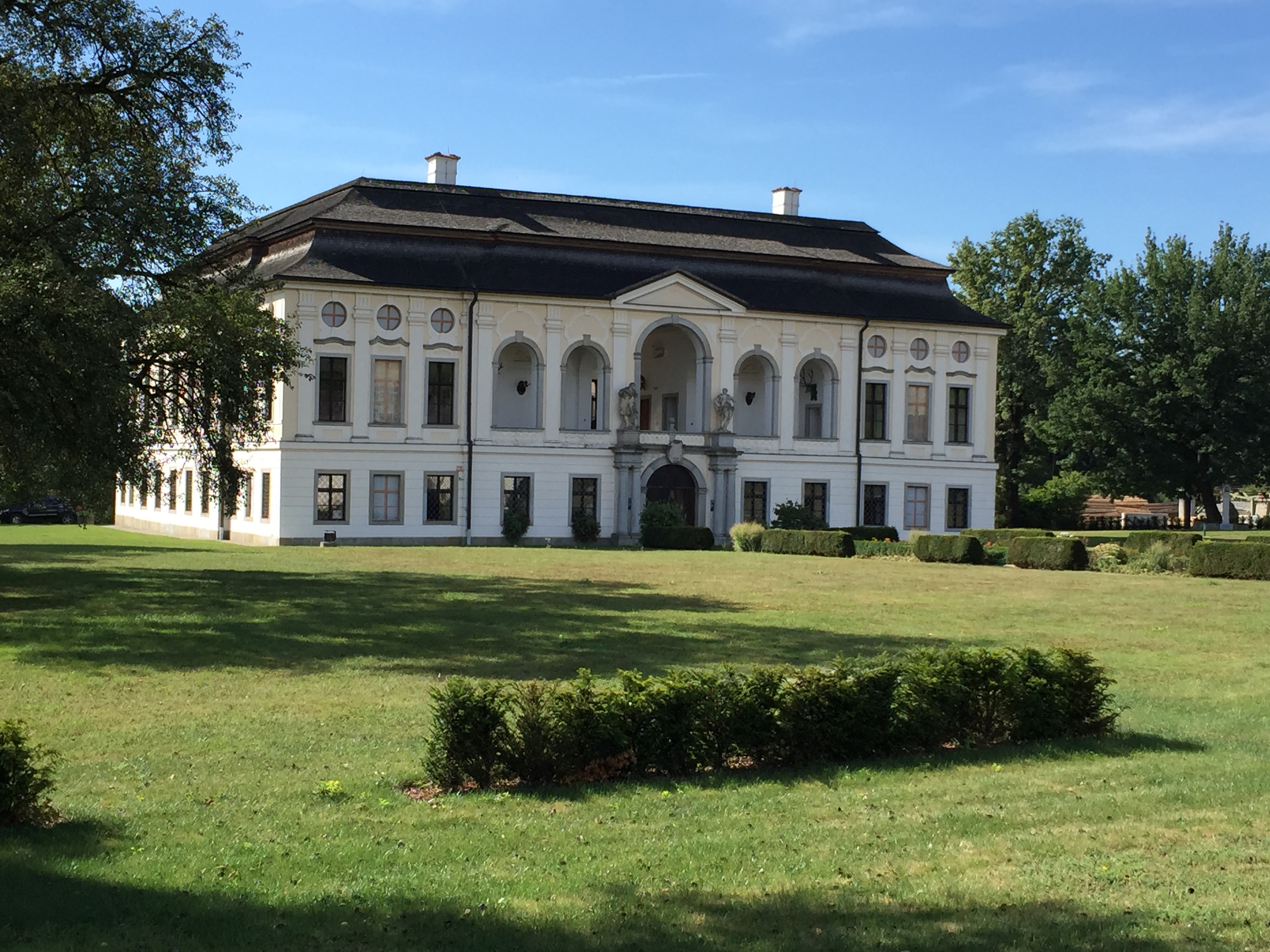
Hohenbrunn, shown below, is some version of a hunting lodge built between 1722 and 1732. No one was there except me, and for a few quid I could see the entire place to myself, unaccompanied. At first it seemed a little creepy, as it felt like someone had just occupied it and left the water running somewhere. And all those guns. The one I took the picture of was one-of-a-kind. It actually is used for shooting ducks on a boat, so the boat supports the long barrel. I’ve captioned a few of the other photos that struck my fancy as I pranced through.

Front of House
Front of House

The up close and personal with the animals got a little weird. They all seemed to be having Gary Larson conversations with each other, wondering where all the human pets had disappeared to. I felt like Ben Stiller in “A Night at the Museum.”

Despite my digs at the culture in and around St. Florian, it was really pretty sweet. It took a bit of courage and good faith to come here on my own, but I stayed in contact with my support staff. I am nearly half way through my journey, and as many of you know it is not about the destinations but the process of getting there.

At times I wondered what I was doing. When I finally played my on-line music appreciation class that I brought along with me, I realized that this is real-time learning. I can hear and relate to music that is being performed. I ironically was at the point of learning about “Baroque” as in Bach vs. “Classical” music by Beethoven. That was awesome!

I hope I can convince any of you to come back with me to St. Florian. The surrounding area is luscious and vibrant, and you feel the freedom to explore at your own pace. It’s heavenly to hear the organ and Bruckner here. And yes, I am a little sad to leave.

Featured photo at top: Hoenbrunn Schloss, in St. Florian near Linz, Austria

Day 31-33: St. Florian

As a contrast to my onslaught of cultural cities, I decided to take a different path and stay at a monastery in Linz, Austria.

My first glimpse of the monastery was breathtaking, after a short but determined path uphill through a winding path. The landscape in the area is exquisite, with rolling hills and tenderly groomed patches of yellow and green plots. You would never leave here if you were from this area, I thought.

The monastery has rooms for visitors at a reasonable price, and has daily performances of one of the most magnificent organs in Europe. The highlight will be another (gulp) mass in the evening with an organ performance.

Anton Bruckner, who was an organist and composer, is a native son of the area. There is now a connection between Ansfelden, where Bruckner was born, and the Augustinian cathedral at St. Florian, where he was a choir boy. You can read about him: https://en.m.wikipedia.org/wiki/Anton_Bruckner

A billboard advertising the Bruckner Way is located on a path outside the monastery. It lights up each path you select among several different paths. You can view the Google image below. “Wanderers” can choose from the more mild “running shoes” paths and those for more advanced “hikers”. Trips run any where from 5-20 km.

The walk even has an MP3 player for hire that has all 12 Bruckner symphonies on it, so you can listen to it while you are on the trail. You can also arrange for a taxi to take you back if you only want to do a one-way trip. I thought that this was an excellent idea and wished this system that is available throughout Europe were established in the U.S.

This path forms part of the “Jacob’s Way” and leads a pedestrian all the way to Santiago de Compostela in Spain. I googled it and you can do it in a mere 19 days from here. If you “boots are made for walking” here’s a place to use them.
This walk was one I had always contemplated, until I realized why they advised carrying a poncho.

Day 30b: Viennese Sights

1. In and around Vienna: St. Stephen’s Cathedral and Plaza area (also featured image), and a street scene near Mozart’s House in Vienna. Notice the wide contrast in architectural styles, right in the cultural center of the city.

2. The Albertina and a collection of Modern Art from Carl Djerassi

These are only a few of the works I liked in particular, from his extensive collection that include Lichtenstein, Warhol, Gerhard Richter, and Klee.

Read about Carl Djerassi’s possible connection to San Francisco: https://en.wikipedia.org/wiki/Carl_Djerassi, or better yet read this fascinating obituary in the Telegraph: http://www.telegraph.co.uk/news/obituaries/11384755/Carl-Djerassi-father-of-the-Pill-obituary.html. The Klees on display are part of the Djerassi Trust and has been promised to the Albertina. I wonder if there is a tug of war going on between the SF MOMA and the Albertina. It might be interesting to follow it as part of the art world’s pursuit of wealthy collectors and their endowments.

Gerhard Richter is one of Melissa’s favorite artists. The black and white portrait of a woman smoking was not obvious until I took a picture of it!

By the way, I discovered that Adolf Loos was Austrian (and Czech). Here’s some interesting information about him: https://en.wikipedia.org/wiki/Adolf_Loos.

3. The Vienna Opera House: from an evening of Mozart music.

Now, after three “variety shows” of operatic music and concert pieces featuring Mozart and Strauss, I can hear the difference. Strauss added alot of drums and brass but also contrasted these boomers with sweet melodies. They are a crowd pleaser and I admit I became mesmerized by the rhythm and tunes. Unfortunately, the opera is closed in August so there are no regular performances. If you come in August you are stuck with the tourist track.

Updated 8/23 11:10pm

Day 27: Vienna

My arrival in Vienna was punctuated by a performance at the Hofburg Palace, the winter residence of the Hapsburgs, to hear Viennese waltzes and Mozart arias. This was not before I made a deviation to a nearby exhibition in the adjacent building entitled: “Vienna: the World City”, that happened to be located in the Austrian National Library, one of the treasures of the world.

When Vienna was about to host a world exhibition in Vienna, Franz Josef decided in 1857 that it was time to demolish some of the old parts of the city center for a Ringstrasse, or Ring Road. As part of this development, he implemented a number of improvements for the city. Among them were the water distribution system and the Vienna Opera House. He set up a competition for the water system that was won by Suess, an Austrian geologist. Unfortunately, the architects who designed the Vienna opera house never saw its completion as one committed suicide after harsh criticism, and another died before the opera house was finished. It’s worth reading the text attached if you are interested.

You can also read a synopsis of Viennese and Austrian history that helped me get a better understanding here: http://www.vienna4u.at/history.html

The Hapsburg Empire lasted over six centuries, one of the longest reigns in European history. As a result, the grandeur of the royalty remains among the most opulent and excessive of any city I have seen. While it has been nearly 50 years since I was first in Vienna, I do not recall any other city with such a display of pomp and wealth as this one.

Ironically, back to my undeniable and insatiable consumption of culture generated by wealth and greed. That will take more than another long essay to reconcile. Maybe these travels will finally kick me of this addiction.

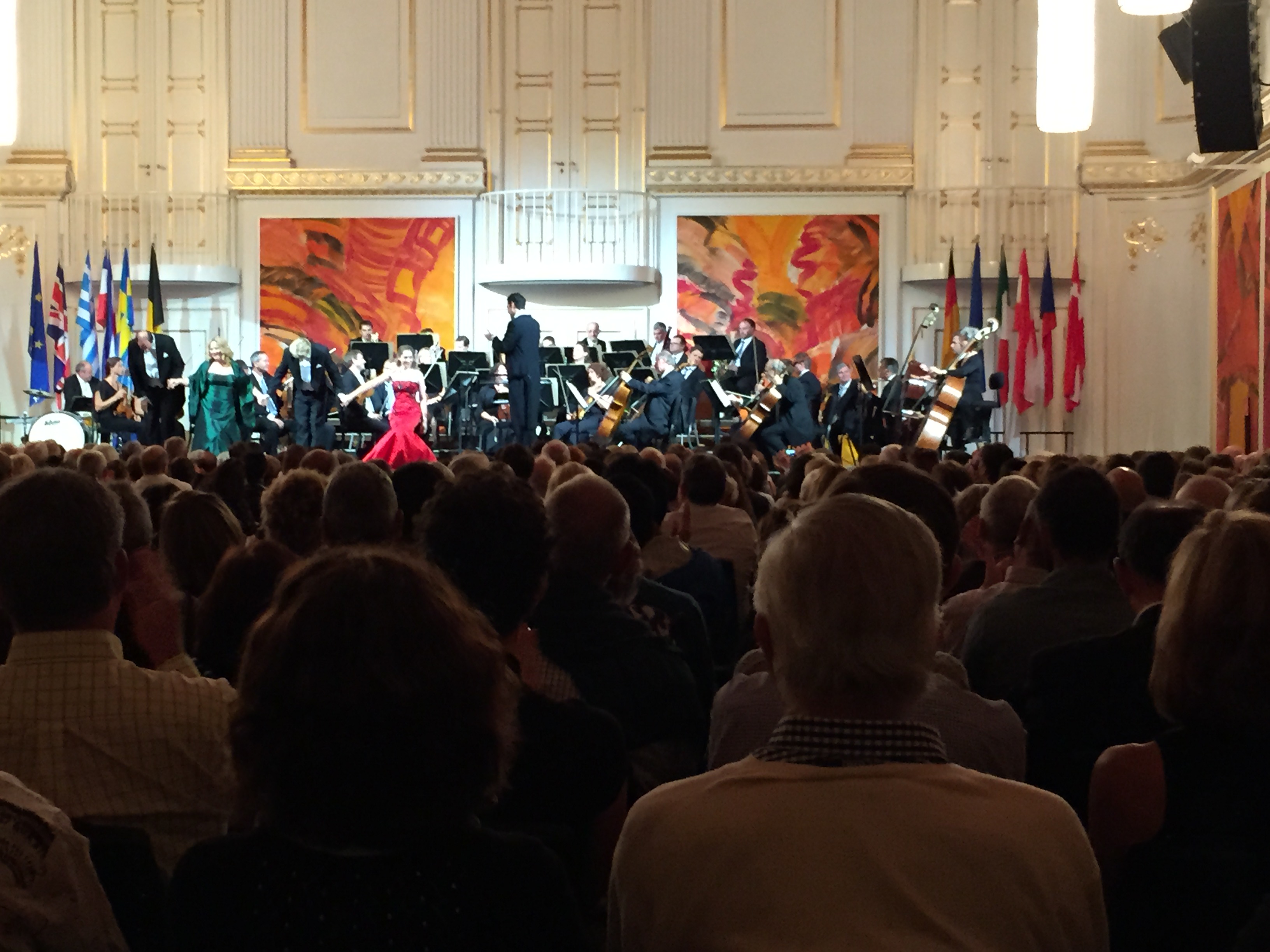
The performance was the perfect end to a long travel day: Viennese favorites Johann Strauss Walzes and Mozart operatic arias led a debonaire Andre Rieu-like conductor with a humorous flair.

IMG_7981

Days 24-26: Salzburger Knockouts

I’ve been trying to get my dose of Salzburger Nockerl, a famous local dish made from pure egg white meringue. Unfortunately, it has eluded me so far. I either wasn’t in the right cafe that serves it, or didn’t have the 20 minutes it takes to prepare it.

Despite this oversight, I finally struck gold in many other ways on my last couple of days here. I got it all and what I love about traveling: quality architecture, quality museums, quality music, quality food, and of course, quality people! The tag posts seem to tell it all.

I’m trying to reduce and concentrate the number of posts to only a few a week (Wednesdays and weekends) so I don’t flood your email boxes. Unfortunately, it makes the posts longer.

Here’s a spread of what this richly, well-endowed, and now much appreciated little city of Salzburg has to offer. To make it a little easier, I’m including a summary so you can skip to the parts that interest you:

1. Salzburg Fortress (Festung)
2. Mozart Houses (Birthplace and Living Quarters)
3. Performances (my raison d’etre for being here, but not necessarily the most exciting)
4. Food and People


1. The Salzburg Festung, or fortress, was very informative and an excellent excursion today. Gee Kin would be proud of me-I trooped up the hill and partook of the view from the top. Because Salzburg is so overrun with tourists, the city has managed to take tourists’ needs to heart. They provide excellent displays and explanations in English (for those of us brain-dead in German). They even had a electronic kiosk soliciting feedback at the end of the tour.

There were many architectural or design features I had not seen before. Those listed are not in any particular fashion. Follow the captions for specific items. You can hover over the photos now to see the captions.


1. Stone columns honed in a fashion the way wood is turned on a stile;
2. Matching metalwork
3. Torture elements–aha! can anyone venture a guess what this contraption is?? (see below)
4. A wooden threshold that was so old and worn that it exposed the “knuckles” of the knots from the tree, like aged knuckles on a centogenarian
5. A section of real arches that shows how they were constructed.
6. A display of how they created cranes to haul stonework up the mountain.
7. A latrine that was one of the first of its kind
8. Romanesque arch construction displayed

And a few morbid items from the torture storeroom to remind us of our mortality.

Since the fortress was built in the 11th century and over a period of hundreds of years, the museum was able to trace its construction history. It was an exciting architectural exhibition of walls, innovations and construction methodology. While most of the fortress was reinforced and expanded in the 15th century, it captures the various early periods from Romanesque beginnings to High Renaissance.
2. Mozart’s Birthplace and House:


3. Performances:

The star quality of these performances have been a bit mind-boggling. The interesting point is that my favorite opera star, Jonas Kaufmann, was not at the top of his game in Fidelio. The music was deep and entrancing, but his performance was weak. The opera performances shown here were much better. These performers can really deliver full-bodied voices and their skill and dedication really shows. Audiences were very responsive and clapped heartily.


4. Food and People: On my last day here, I decided to go for the two-hour lunch instead of the evening dinner option. My lunch was celebrated at the Heimer Specery. I took my time, had a small antipasti plate of eggplant, sun dried tomato and roasted red pepper with Prosecco, followed by the house specialty, a succulent full bodied pork chop that comes from the establishment’s own piggery. Along with a glass of rose, this was the chef’s recommendation so it had better be good. And it schmecked, or tasted delicious! I had just told Gee Kin that I thought pork was often disappointing as a dinner entree. I often found it dry and uninspiring. After your third bite you wish you had ordered the branzino. Well, I wasn’t disappointed this time. This little restaurant around the corner from the Festival Hall delivered to demanding regulars and I was a beneficiary.

The night before, I took my place at another restaurant (the one I went to for lunch today was fully booked 2 nights in a row, thus the lunch decision). As I was about to hog a table for four all by my lonesome, another gentleman was looking for a single at the same time. He asked if he could join me, the very exact same time another woman came along and did the same! I was very flattered, and didn’t mind the company at all. I was even more delighted when I learned that neither of them spoke English!

The three of us ended up with a very friendly conversation, and I had a chance to practice my elementary German. It was frustrating as I could ask basic questions but never “got” the answers. They drifted to fairly complex conversations about what the two dinner partners thought of the Greek Crisis, Angela Merkel, and the operas they were seeing. The gentleman’s nephew was performing in the opera we were about to see (Angela Georghiou in Werther). He was a baritone and did very well.

What I like about traveling is connecting the dots. I was flashing on how non-English speakers must feel when they are asked questions. After a few pleasantries, a zero-tolerance policy toward any non-English speakers seems to drift into the picture. Native English speakers tend to expect everyone to speak English, even in non-English speaking countries!

Well, the tables were definitely turned here. I felt stupid, unable to respond to simple political and economic questions. While it made me more determined to learn German, it made me reflect on how hard it is for many people in many countries to master English. I certainly came to that conclusion as I realized I could only sit and muse as the two native German speakers became very engaged and animated in their conversation. Sadly, I could only plaster a smile on my face and pretend that I understood everything.

German women seem to like short spiky hair, blow-dried behind the ears. Subtle platinum highlights, or jet red. Less Gothic these days. The woman who joined me was of the subtler version, and very svelt. She worked for a pharma company in Regensburg, and drove two hours each way to come to the performances this week. The gentleman from Innsbruck was a retired German teacher. It was, despite my misgivings, really fun trying out my German with no English back-talk.

Here are a few random street shots. The urban planning and insight for local Salzburgers and tourists alike are appreciated and well used in high density pedestrianized areas borne out of necessity. Delivery trucks and taxis drive right over the fountains and gutters, and everyone shares the paths in a symbiotic way.

Days 20-22: Planes and Boats and Trains

Such has been our busy week of flying from Moscow to Berlin, taking a hydrofoil to Peterhof from Moscow, and the train from St Petersburg to Moscow. We enjoyed the Sapsan train the best, which turns out to be the same as the ICE train I am taking from Berlin to Salzburg. We assumed the Russian premier long distance train was its opportunity to showcase Russian engineering, but it looked suspiciously similar to the German trains.
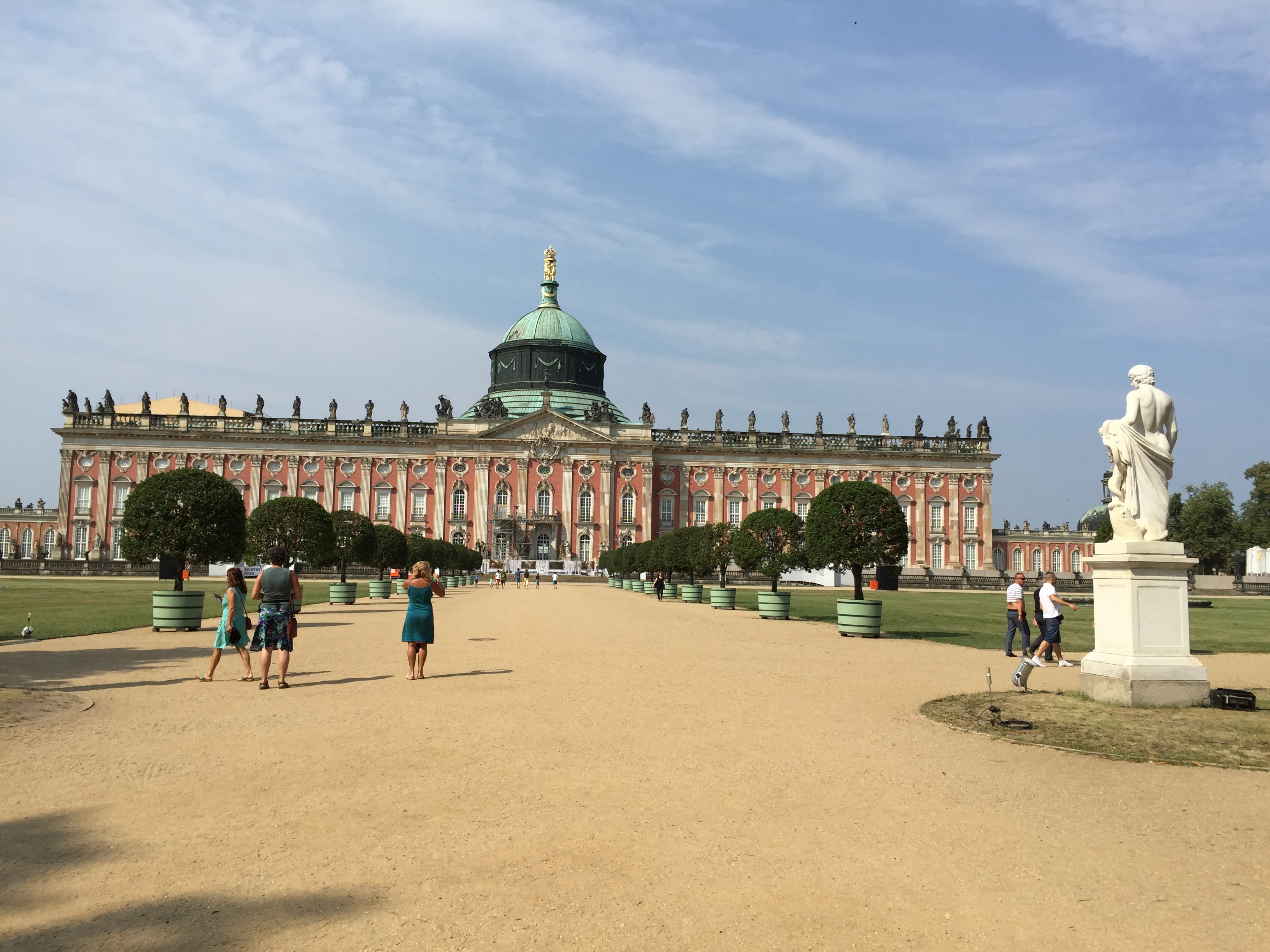
IMG_7686Yesterday, on Gee Kin’s last full day in Berlin, we took a day excursion by local train to Sans Souci Palace in Potsdam. We didn’t visit the palace as most visitors do, but took a three-mile walk between Sans Souci and Charlottenborg Palaces in the scant shade of 99 degree weather. A UNESCO world heritage site, Potsdam was the chosen site for the summer palace of King Friedrich. Here’s a Wiki link: https://en.wikipedia.org/wiki/Sanssouci

The event planners were preparing for the Sommernacht at the palaces the following day. It sounded like a wonderful celebration of German classical music in a beautiful venue, but unfortunately we were leaving. It would be worth coming back one day for the festivities and fireworks in this elegant location.

In our 36 hours in Berlin, we had launched our stay with a leisurely walk in the neighborhood of Potsdamer Platz, through the zoological garden in the middle of the city. It was calming and provided time for us to reflect on all the Siberian landscapes we had just traversed.

Those of you who know us are aware that we like long urban walks, 5-10 miles a stretch. This was yet another “walk in the park”. (For the curious, I have a website, http://www.crazyladywalks.com, that provides detailed information on Bay Area walks). It may seem pricey to go halfway around the world for a walk, but these are the most memorable and enjoyable ones to us.

We managed to balance the rest of our three days with local tours and attractions. We found a good Turkish restaurant in the more local area around the Zoo. Gee Kin slugged out on the museum track so we did a Young European concert with the Kiev Orchestra last night.

Sandwiched in between our morning walk and the evening concert, we visited the Reichstag dome. Being one of the hottest days ever in Berlin, we wondered how we got ourselves into this predicament. Masses of local tourists had come from all over the world to the Reichstag for their German civics lesson, on this one day. We not only fried at every pit stop, but then we were sous-vide under the dome, which resembled the George Forman griller.


Nevertheless, it was still fun to see and experience Norman Foster’s masterpiece. Luckily for you, the photos can never effectively convey temperature. But I guarantee you, the open vents in the building were insufficient ventilation for the once-in-a-hundred years heat wave. My dead straight hair went curly and the wood on our paper fans are permanently warped from this day at the Bundestag.

Three activities in one day’s 99-degree weather may be asking for trouble. Gee Kin’s alternative was to go to some delightfully soothing, air-conditioned art museum and he picked this?? Granted, the tour to Reichstag was pre-booked. We had failed to do this a few years back on our first trip to Berlin around 2012. And I was a day off on the booked date. Being our last day, we were not going to forego these paid-in-advance commitments so we had no choice but to go. So our last day was a bit of a marathon but it was penance for our lethargy the first 48 hours.

As mentioned, we went to a concert at the Konzerthaus Berlin, in a renovated building in a lively area in the middle of the city. But that’s not saying much, as everything seems to be in the middle of the city. Rome and San Francisco feel intimate like this, but not Moscow or Paris. Those are honking huge BIG cities, that dwarf your existence. That may be due to the six-plus-lane wide ribbons of thoroughfares used for pomp and circumstance.


I am at this very moment passing through Bamberg, where Gee Kin and I first discovered Cameron Carpenter. He is an amazing Curtis-trained contemporary organist who can do both classical and popular music. Some of you saw his performance at the SF Symphony Hall last year. He is one of our favorite new artists.

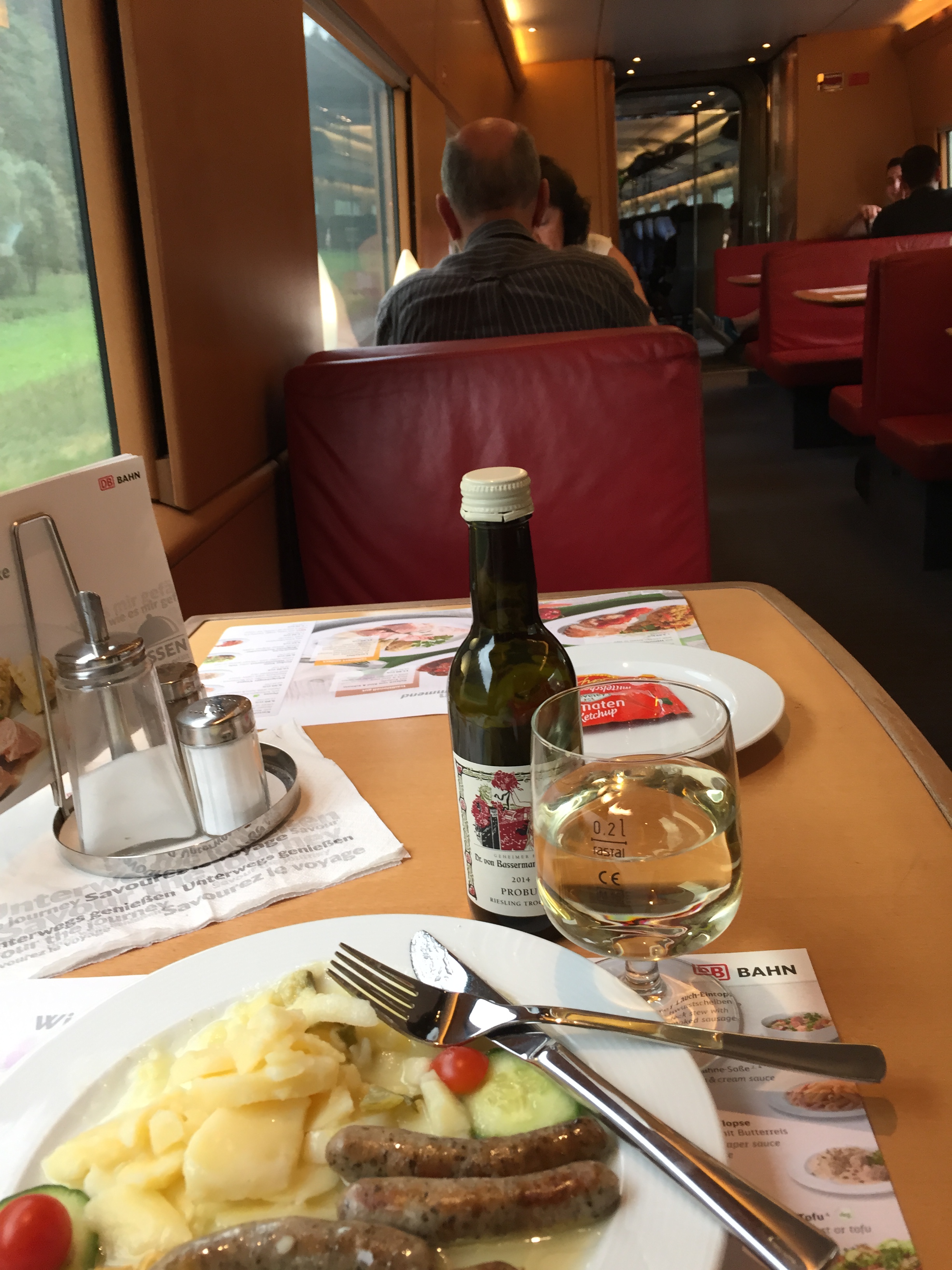
I am sitting in the dining car for lunch, noshing on bratwurst and cold potato salad. (See photo). IMG_7743The quality of food is less important to me thanthe total experience–environment, ambience, and PEACE. This was it, enough for me to write all of this discreetly in a maple-veneer and leather-lined carriage. Prices were reasonable by American standards. I had my .2ml wine (a bit more from the split bottle but you can measure if you want from the mark on the glass), entree and dessert with coffee, with a priceless view and free opera music via my IPhone to boot! To me, this beats a table at French Laundry.

Am heading to the Salzburger Festival and will post from there in a few days. Til then, stay wet (not dry
for SFers) and cool (for Deutschers). Clouds on the horizon.

Day 19: Day of Reckoning

We’re leaving Moscow today, heading for Berlin and the Western World as we know it. Russia feels more Eurasian and part of the Asian Continent than Europe in many ways. It has been a fascinating foray into the Russian culture, environment, and history.


I am posting a few miscellaneous views of Moscow from the Kremlin Armoury and from on our last day here. Gee Kin has finally mastered his fourth word, uttering Hello! and Good bye! in one conversation. We are now aware of what it takes for foreigners to say “Ni Hao!” in Chinese, and the tables are turned. I am sure the Russians are wincing as we did when others spoke to us in elementary Chinese greetings.


Photos, above:
1. View of State Historical Museum, where some of the relics below are located.
2. GUM Department Store, a shining example of restored buildings in Moscow Center
3. View of Red Square from shopping street

Photos below, from inside the State Historical Museum:

We are sad to leave and feel woefully lacking in knowledge about any of Russia’s cultural treasures. Other than what we read in the local paper or magazine articles, we never pursued any information beyond the information we were fed. I suddenly discovered Wikipedia and Biography.com on this trip and have been using it regularly to search for all the Russian writers and composers that have been mentioned in guides.

I am passing a few on for those of you who are also curious: For Tsaichovsky:
http://www.biography.com/people/pyotr-ilyich-tchaikovsky-9503375#synopsis
It is interesting to note that Tsaichovsky was also a music critic. While he considered Beethoven a worthy composer, he was critical of Brahms, Schumann and Wagner. Anna Netrebko often sings in and promotes Tsaichovsky’s “Eugene Onegin” opera around the world.
For Pushkin: https://en.m.wikipedia.org/wiki/Alexander_Pushkin
For Borodin (remember “Stranger in Paradise” from Kismet?):
https://en.m.wikipedia.org/wiki/Alexander_Borodin
Dostoyevsky:https://en.m.wikipedia.org/wiki/Fyodor_Dostoyevsky
Prokofiev: https://en.m.wikipedia.org/wiki/Sergei_Prokofiev
I asked our guide about Baryshnikov. He made a face as if I mentioned a pariah. He is a persona non-gratis. Remember, he defected while on tour with the Bolshoi? Oops. No monuments to him, unfortunately.

The next chapter of my travels will focus on Germany, Austria and Switzerland until the end of the month. Now that the uncharted portion of my trip is over, I’ll be posting every few days instead of daily. If you are getting too many emails, you can adjust your settings to unsubscribe, and you can always check in after that by going directly to http://www.travelswithmyselfandothers.com. Please continue to send me your comments when something strikes you! I love hearing from you!

Day 16: St. Petersburg Architecture

Let’s take a look at St. Petersburg’s finest offerings. You can click on photos to view full-size images, and hover over each to read captions.

Above photos: St. Petersburg’s first and foremost flagship department store, similar to Harrods in London, with Art Nouveau Interiors

Photos, below: Original Singer Store (from US Singer Sewing Machine fame), now a book store, with Art Nouveau traces*

Photo, below: DLT Department Store, St. Petersburg’s newest and flashiest shopping center, ca. 2014
IMG_7442
And a potpourri of street scenes, below. For Julianne and Melissa from Dostoyevsky’s 19th C. apartment building, “Here’s lookin’ at you kids”.

*excerpt from Wikipedia
The famous Singer House, designed by architect Pavel Suzor, was built in 1902–1904 at Nevsky Prospekt in Saint Petersburg for headquarters of the Russian branch of the company. This modern style building (situated just opposite to the Kazan Cathedral) is officially recognized as an object of Russian historical-cultural heritage.