Tag Archives: People

Days 35-36: People and Dinosaurs

It’s nearly half-way through my third world-wind trip. By Day 42, I will be heading to Beijing, to the other side of the great Eurasian continent. I’ll be meeting “mein Mann” Gee Kin there, where we will gather our senses for our flight to Ulan Bator (Mongolia). After a week-long private tour there, we’ll complete our Trans-Siberian Express train trip from last year. We’ll go from Ulan Bator to Irkutsk and Lake Baikal, then over to Vladivostok to the East Coast of Russia. Our last stop will be Japan, but more about that later.

After a month in Berlin, I haven’t mentioned the many individuals and connections I have made during my stay here. The Goethe Institute has been my anchor. Students in my class came from Israel, Iraq, Sweden, Mexico, Hong Kong, and the U.S. Two of the American students are budding opera students, so it has been fun learning more about their world of opera that is so different from being in the audience. Other friends I have made included two German language teachers from India and Finland; two gentlemen from New Zealand; and another pair of Ph.D students, one from Sardinia in Architecture and one from Tennessee in German History.

Attending nearly every extra-curricular activity has given me the opportunity to chat with a combination of these individuals as well as others. The common question everyone asks is “why are you learning German?”. Most are learning for their current or future job prospects, but few have my intentions. I tell everyone I am learning to increase my understanding of opera.

Most people find that puzzling, but if you are an opera junkie like I am, some of the best translations of opera are subtitles in German! Reading dual supertitles in German and English at the Deutsche Opera put me in rhapsody. I get the chance to follow what is being sung (also keeps me awake) and get a German language course at the same time!

Coming to Germany for the past five years to see opera and hear music reinforce my interest in learning the language. In addition to a real, primary purpose to keep my brain exercised, I am investing in a much deeper appreciation of the culture through speaking, reading and writing. I am definitely going to continue this affair and make learning German a life-long pursuit.

For my GI (that’s Goethe Institute, not Gastro-Intestinal) friends, snippits of typical exercises we did every day are below. We shuffled the tags around in groups until they lined up.

The Institute’s last and final activity to Deutsche Welle was cancelled due to illness. I love watching the broadcasts in the US, so I was very disappointed. I made alternative plans to visit the Natural History Museum, where the Guinness Book of Records’ largest dinosaur resides. I wouldn’t have gone there, had I not been introduced to the dinosaur bones at the Natural History Museum in New York City. Ross (David Schwimmer) from “Friends” played a paleontologist, and that always amused me.

The museum turned out to be a thrill. I didn’t realize that the tall head of the Brachiosaurus could only allow it to eat leaves from the canopies of trees. Dinosaurs lumbered around town due to their huge size and weight. It took a huge bio-engineering effort to move, nourish, and keep alive such a large mechanism.

Other dinosaurs in the same display could only eat things near the ground because they could not lift their heads very high. Their tails were needed as counter-weights for their elongated, skinny heads! You can read more about the Brachiosaurus and what they ate in the text below, for those interested.

Day 31: Jewish Life in Berlin

Berlin is starting to recognize its Jewish history and the part it plays in understanding the city today. Friday morning’s tour was led by our guide, Matthias Rau, from the Prenzlauer Berg and Berlin Mitte tours. We started at one of three Jewish cemeteries in Berlin. A reproduction of the headstone of Moses Mendelssohn is located in the cemetery (see photos below, upper left). He was one of the major leaders of the Jewish community in Berlin in the 18th Century. If you are interested, you can read more about Moses Mendelssohn here: https://en.wikipedia.org/wiki/Moses_Mendelssohn

Only some of the stonework with inscriptions were salvaged at the cemetery. The grave sites are covered with ivy.

Photos above:

1. Upper Middle Left: The site of the “missing house” is used to identify Jews who had lived in the building. Tags on adjacent buildings indicate where each family lived and are stark reminders of the lives that disappeared.

2. Upper Middle, Right: Brass plated tiles with inscriptions of names of Jewish people who lived in the area are found throughout Berlin. Organized by a private foundation, this effort identifies individuals, their birthdates, where they died, and when. Most of the inscriptions we saw identified Auschwitz as the place of death. (We later noticed plates in Kreuzberg.)

3. Upper right: A tribute to Regina Jonas, the first woman rabbi in Berlin. She was part of the Jewish liberal sector.

4. Lower Left and Lower Middle: The New Jewish Synagogue (1866, Oranienstrasse 30) was the center of the Jewish community (also wooden doorway from Entrance) .

5. Lower Right: Augustus Strasse, where the Jewish School (shown in photo on the left) was located. It now is used for community space, the Kennedy Center, and other public facilities (Pauly Saal Restaurant and Mogg, a cafe, are located in the building).


Day 8: Anna Amalia Library and Weimar City Castle

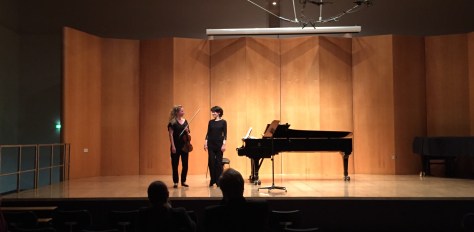
Weimar was once the hub of intellectual and political life in Germany. It still captures much of the imagination of aspiring writers, musicians, architects and playwrights. On my return visit to the Musikhochschule (High School for Music) last night, I savored an array of passionate violin student performances.

image

Stumbling into the National Library in Vienna last year was a thrilling experience. Naturally, I was curious to compare the Anna Amalia, a research library in Weimar for German literature from the Enlightenment to the late Romantic Period. While much smaller, this Rococo design was equally exciting, but more intimate.

You can watch a video of the library here:

The next stop on a day-long tour of local sights was the former residence of the Grand Duchy of Saxony-Weimar-Eisenach. Known as the Weimar City Castle, it now houses a collection of Cranachs, German Impressionists, and painters from the Weinar Art School.

Dinner with the locals:

image

Day 4: More Moritzburg and Carmen

A couple of years ago my friend Hanne and Jens introduced me to Moritzburg. I had been wanting to go to King Augustus’s “Hunting Lodge” again. I got my chance when a group of us planned a half-day excursion. We mixed and matched a combination of public bus and private carriage to get there. By doing so, we had an interesting variation of conversations in German and English. International and local friends from Germany, Bulgaria, the U.S. and Switzerland got in our Sunday gear and convened in Dresden for this delightful day of history sharing, friendship, and even tail-gating.

Most of the historical significance for this private country estate centered around 1730. Similar to King Friedrich’s Sans Souci outside Berlin or the Summer Residence of Peter the Great outside St. Petersburg, Moritzburg is another opulent getaway villa. This one, however, did seem more tastefully decorated (if that can be compared). My favorite room is the dining room, where all the deer antlers are displayed. The tips of the antlers are duly recorded and ordered in the dining room from the smallest to the largest sizes (mostly 26, 28, 30 and 32). You can read more about the castle here: https://en.wikipedia.org/wiki/Moritzburg_Castle.

Curtain Calls for an evening performance of Carmen  at Semperoper below:

Day 55-57: Schwishin’ Schwäbisch

After the end of the Language and Cultural Program, it is difficult to come off a “high” from having made several new friends in a short time span. While others were packing their bags and moving home or elsewhere today, I decided to stay behind another day to savor a town I have called “home” for the past two weeks.

A morning walk refreshed my first senses of this sweet little town. A river runs through it, where people can still fish from it. Walks are everywhere that meander along the river and trace the town’s history. A community that cares about its environment and each other. And specialty local produce and products are made with purpose and don’t cost an arm and a leg.

Here are a few recordings of my walk this morning:

The Saturday Market was just getting ready for a big weekend celebration.

IMG_9259
Our class mascot, “Goethle” with specialty products Bratwurst, Bio-Blutwurst, and Schaschlik Guwürzsalz.

Our last two days were a little sad as friends got together for dinner and said our good-byes. While we didn’t exactly master the German language, we made some good friends, shared and learned alot from each other, and thoroughly enjoyed a successful two-week stay in Schwabisch Hall.

Day 43: Basel, Switzerland

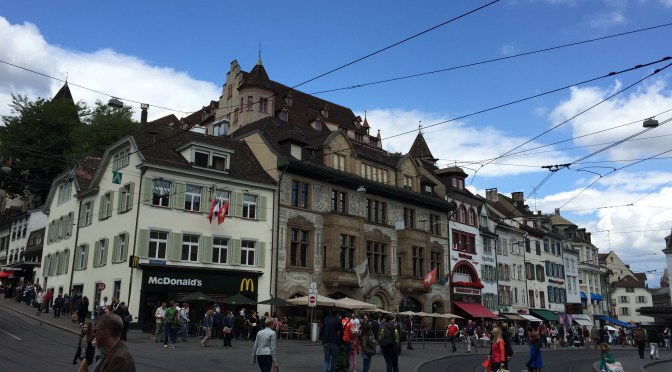
Three Walking Tours were available in the heart of the city and we decided to take the architectural tour. Many of the buildings in the city were designed by Herzog and Meuron. Basel has bragging rights to a number of world famous architects, including Zaha Hadid, Frank Gehry, Richard Meier, Tadao Ando and another of their own native sons, Mario Botta.

It’s interesting to note that both Botta and Herzog and De Meuron designed museums in San Francisco but are known in Switzerland for many other building types. The prevalence of American architects may be due to the development of the biotech industry in this area and its partnerships with American firms. Many of the buildings featured on the architectural guide were biotech companies such as Roche and Novartis.

IMG_8671


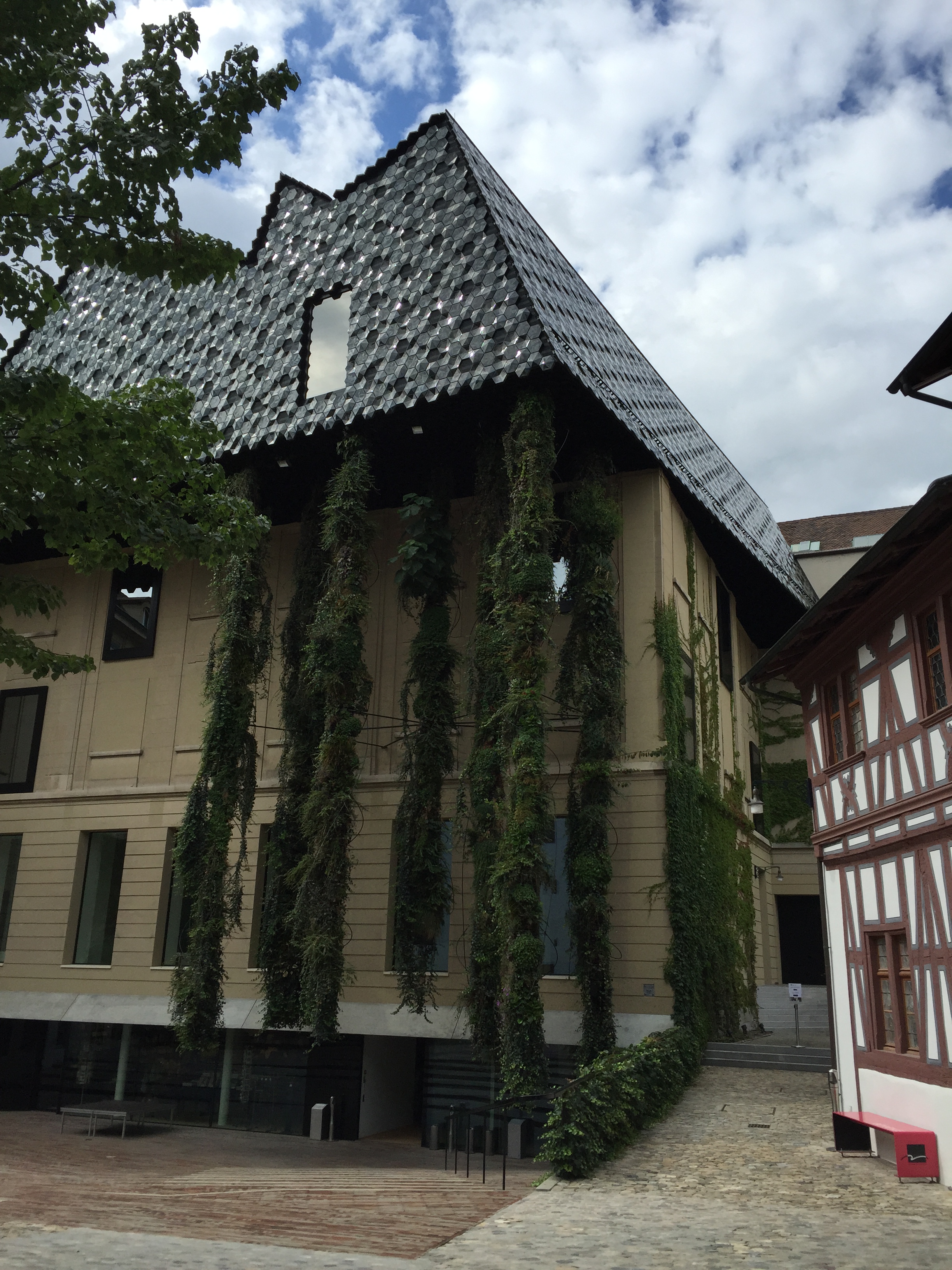
The vertical extension of Basel Museum of Culture was designed by Herzog and De Meuron. The textural pattern of hexagons reflected the irregular shape of the plaza facing the museum. They were in both convex and concave shapes. The giant hanging plants at the entrance reminded me of the seaweed forest at the Monterey Bay Aquarium, where they swayed gently in the breeze.

The De Young Museum in San Francisco, also designed by Herzog and De Meuron, is one of my favorite buildings. I love the mottling effect of the exterior copper panels on the inside of the building and how it imitates the light coming through trees in Golden Gate Park. The huge canopy at the entrance also reminds visitors of the deep shadows in the park.

The Basel museum featured an exhibit on opium that sparked a lively conversation with my hosts in Brunnen. My grandfather had died of an addiction to this deadly plant. The museum collection included all the history, plant production, implements and literary figures who were influenced by opium (including one of my relatives, Lin Biao). The saddest part of course was the Opium Wars and the treaty ports imposed on China as a result of the wars. The exhibition was very thought-provoking and a moving educational experience.

Swiss Cheese, Salad, and Potato for Raclette

Our final evening was topped by the famous Swiss specialty “Raclette”, a fondue-like dish of Swiss cheese toasted with onion and spices on a grill, then spread with a miniature wooden scraper onto the top of sliced potatoes.

After saying goodbye to my dear friends in Switzerland, I was looking forward to my next big adventure. I will be taking a German language and culture class for the next two weeks in Schwabisch Hall, Germany, and can’t wait to spread out my meager belongings during this time.

My friends Helena and Hans took good care of me and showed me a local’s view of Switzerland. I am very grateful to them for their generosity and appreciate their care and attention during my stay there.

Day 40-42: Swiss Whirlwind

This week I traveled across the beautiful country of Switzerland, from Brunnen on the shore of the Vierwaldstättersee near Lucerne to the French speaking area of Valais near Sion .
IMG_8583
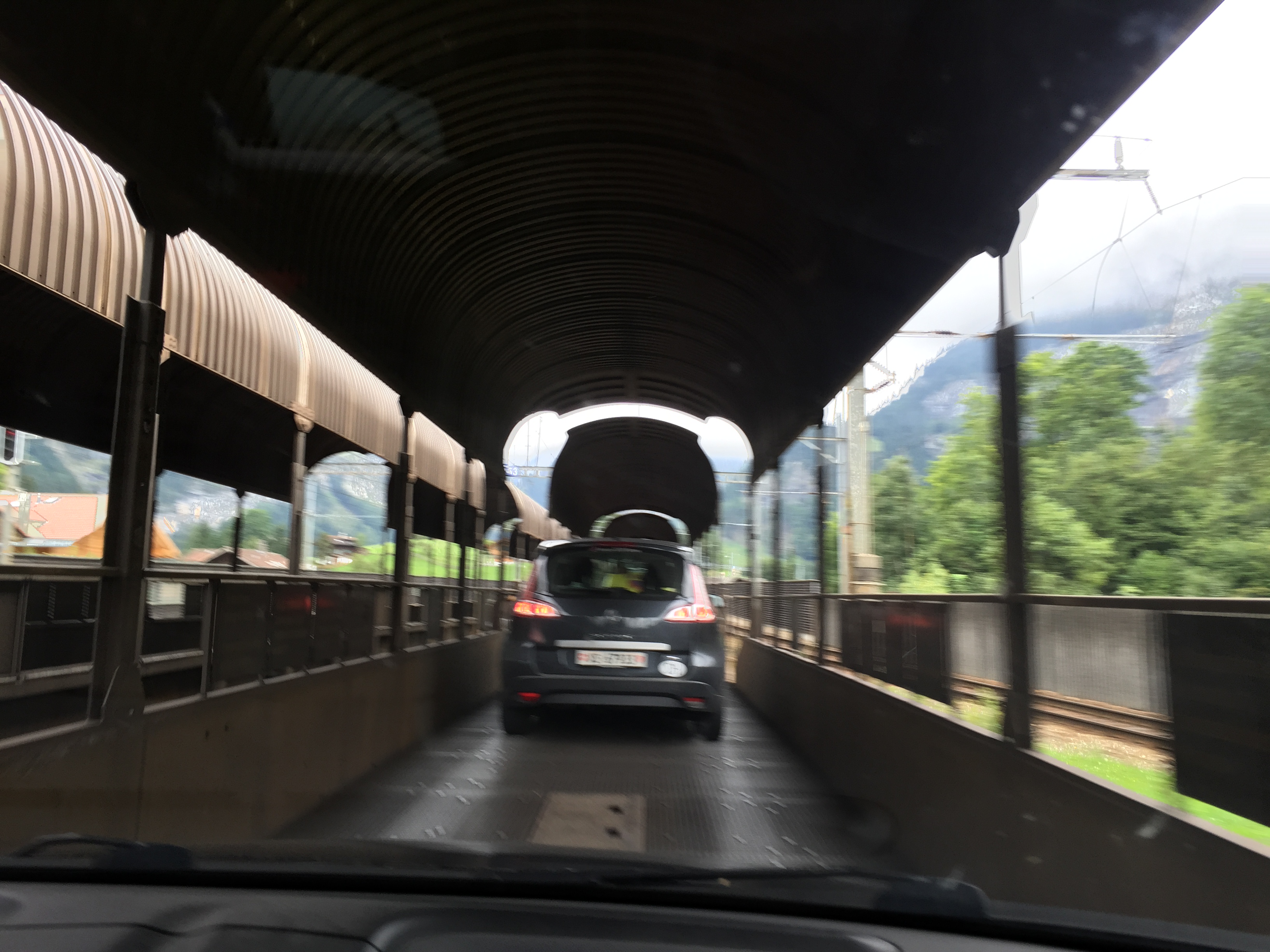
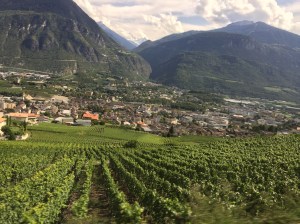
We took a car train through a deep tunnel in the mountains to the valley. Also known as Wallis in German, Valais is a serious wine growing region with a patchwork of vineyards etching the south-facing sides of the valley and flatter terraces of the north side. It was in the middle of the Autumn harvest, and the carpet of vineyards provided a lush green for the eyes and sheer pleasure for the palette.
IMG_8630After a much appreciated day “at home” at my friend’s home built with straw walls for insulation, I met another friend who was working in the French speaking area. Marie had a friend visiting from Der Wolf in Belgium, and together we went to the medieval castle on the hilltop in Sion. Afterwards, we had a delicious lunch al fresco at Restaurant L’Enclos de Valère. Upon returning to Sierre, I took the bus back to where I was staying halfway up the hill from Sierre and near the resort area of Montana.


IMG_8612

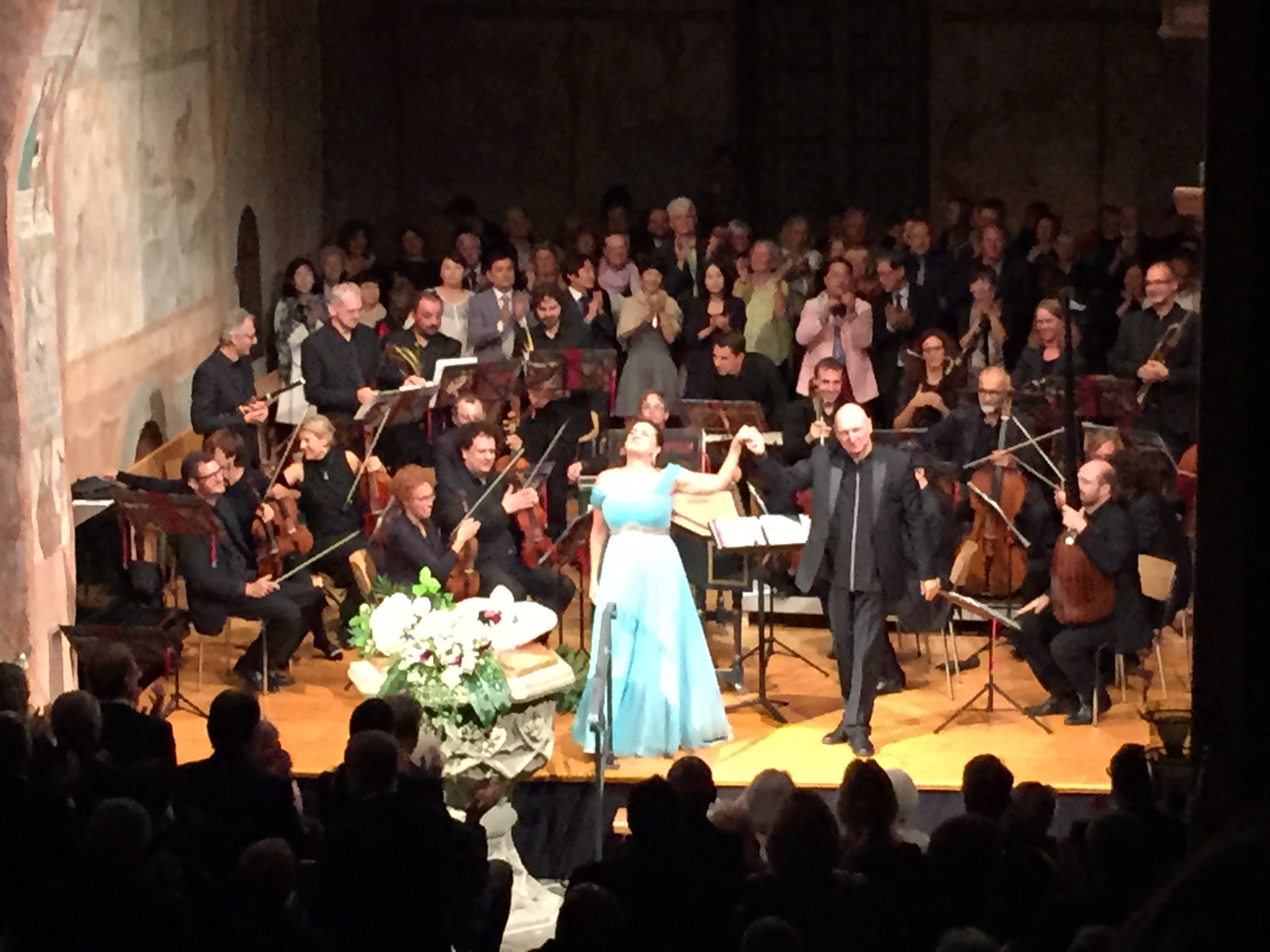
Later that evening, Hans, Helena and I attended a performance by world-famous opera diva Cecilia Bartoli in a small church in Gstaad. It was a two-hour ride by car to get there, but well worth the intimate venue and Cecilia’s delivery of beautiful baroque music by Vivaldi and others. It was performed by I Barocchisti, an orchestra specializing in this type of music, using original instruments from that period. Both Cecilia Bartoli and I Barocchisti performed in Iphigenie en Tauride, an opera I saw recently in Salzburg.
IMG_8650

Days 24-26: Salzburger Knockouts

I’ve been trying to get my dose of Salzburger Nockerl, a famous local dish made from pure egg white meringue. Unfortunately, it has eluded me so far. I either wasn’t in the right cafe that serves it, or didn’t have the 20 minutes it takes to prepare it.

Despite this oversight, I finally struck gold in many other ways on my last couple of days here. I got it all and what I love about traveling: quality architecture, quality museums, quality music, quality food, and of course, quality people! The tag posts seem to tell it all.

I’m trying to reduce and concentrate the number of posts to only a few a week (Wednesdays and weekends) so I don’t flood your email boxes. Unfortunately, it makes the posts longer.

Here’s a spread of what this richly, well-endowed, and now much appreciated little city of Salzburg has to offer. To make it a little easier, I’m including a summary so you can skip to the parts that interest you:

1. Salzburg Fortress (Festung)
2. Mozart Houses (Birthplace and Living Quarters)
3. Performances (my raison d’etre for being here, but not necessarily the most exciting)
4. Food and People


1. The Salzburg Festung, or fortress, was very informative and an excellent excursion today. Gee Kin would be proud of me-I trooped up the hill and partook of the view from the top. Because Salzburg is so overrun with tourists, the city has managed to take tourists’ needs to heart. They provide excellent displays and explanations in English (for those of us brain-dead in German). They even had a electronic kiosk soliciting feedback at the end of the tour.

There were many architectural or design features I had not seen before. Those listed are not in any particular fashion. Follow the captions for specific items. You can hover over the photos now to see the captions.


1. Stone columns honed in a fashion the way wood is turned on a stile;
2. Matching metalwork
3. Torture elements–aha! can anyone venture a guess what this contraption is?? (see below)
4. A wooden threshold that was so old and worn that it exposed the “knuckles” of the knots from the tree, like aged knuckles on a centogenarian
5. A section of real arches that shows how they were constructed.
6. A display of how they created cranes to haul stonework up the mountain.
7. A latrine that was one of the first of its kind
8. Romanesque arch construction displayed

And a few morbid items from the torture storeroom to remind us of our mortality.

Since the fortress was built in the 11th century and over a period of hundreds of years, the museum was able to trace its construction history. It was an exciting architectural exhibition of walls, innovations and construction methodology. While most of the fortress was reinforced and expanded in the 15th century, it captures the various early periods from Romanesque beginnings to High Renaissance.
2. Mozart’s Birthplace and House:


3. Performances:

The star quality of these performances have been a bit mind-boggling. The interesting point is that my favorite opera star, Jonas Kaufmann, was not at the top of his game in Fidelio. The music was deep and entrancing, but his performance was weak. The opera performances shown here were much better. These performers can really deliver full-bodied voices and their skill and dedication really shows. Audiences were very responsive and clapped heartily.


4. Food and People: On my last day here, I decided to go for the two-hour lunch instead of the evening dinner option. My lunch was celebrated at the Heimer Specery. I took my time, had a small antipasti plate of eggplant, sun dried tomato and roasted red pepper with Prosecco, followed by the house specialty, a succulent full bodied pork chop that comes from the establishment’s own piggery. Along with a glass of rose, this was the chef’s recommendation so it had better be good. And it schmecked, or tasted delicious! I had just told Gee Kin that I thought pork was often disappointing as a dinner entree. I often found it dry and uninspiring. After your third bite you wish you had ordered the branzino. Well, I wasn’t disappointed this time. This little restaurant around the corner from the Festival Hall delivered to demanding regulars and I was a beneficiary.

The night before, I took my place at another restaurant (the one I went to for lunch today was fully booked 2 nights in a row, thus the lunch decision). As I was about to hog a table for four all by my lonesome, another gentleman was looking for a single at the same time. He asked if he could join me, the very exact same time another woman came along and did the same! I was very flattered, and didn’t mind the company at all. I was even more delighted when I learned that neither of them spoke English!

The three of us ended up with a very friendly conversation, and I had a chance to practice my elementary German. It was frustrating as I could ask basic questions but never “got” the answers. They drifted to fairly complex conversations about what the two dinner partners thought of the Greek Crisis, Angela Merkel, and the operas they were seeing. The gentleman’s nephew was performing in the opera we were about to see (Angela Georghiou in Werther). He was a baritone and did very well.

What I like about traveling is connecting the dots. I was flashing on how non-English speakers must feel when they are asked questions. After a few pleasantries, a zero-tolerance policy toward any non-English speakers seems to drift into the picture. Native English speakers tend to expect everyone to speak English, even in non-English speaking countries!

Well, the tables were definitely turned here. I felt stupid, unable to respond to simple political and economic questions. While it made me more determined to learn German, it made me reflect on how hard it is for many people in many countries to master English. I certainly came to that conclusion as I realized I could only sit and muse as the two native German speakers became very engaged and animated in their conversation. Sadly, I could only plaster a smile on my face and pretend that I understood everything.

German women seem to like short spiky hair, blow-dried behind the ears. Subtle platinum highlights, or jet red. Less Gothic these days. The woman who joined me was of the subtler version, and very svelt. She worked for a pharma company in Regensburg, and drove two hours each way to come to the performances this week. The gentleman from Innsbruck was a retired German teacher. It was, despite my misgivings, really fun trying out my German with no English back-talk.

Here are a few random street shots. The urban planning and insight for local Salzburgers and tourists alike are appreciated and well used in high density pedestrianized areas borne out of necessity. Delivery trucks and taxis drive right over the fountains and gutters, and everyone shares the paths in a symbiotic way.

Day 16: St. Petersburg Architecture

Let’s take a look at St. Petersburg’s finest offerings. You can click on photos to view full-size images, and hover over each to read captions.

Above photos: St. Petersburg’s first and foremost flagship department store, similar to Harrods in London, with Art Nouveau Interiors

Photos, below: Original Singer Store (from US Singer Sewing Machine fame), now a book store, with Art Nouveau traces*

Photo, below: DLT Department Store, St. Petersburg’s newest and flashiest shopping center, ca. 2014
IMG_7442
And a potpourri of street scenes, below. For Julianne and Melissa from Dostoyevsky’s 19th C. apartment building, “Here’s lookin’ at you kids”.

*excerpt from Wikipedia
The famous Singer House, designed by architect Pavel Suzor, was built in 1902–1904 at Nevsky Prospekt in Saint Petersburg for headquarters of the Russian branch of the company. This modern style building (situated just opposite to the Kazan Cathedral) is officially recognized as an object of Russian historical-cultural heritage.

Day 4a: Last Impressions-Beijing

FullSizeRender 9Today was visiting Day with Gee Kin’s former professor in Hydraulic Engineering at Tsinghua University. We spent a leisurely day with him and his wife, who is also a professor in Water Resource Engineering. Gee Kin spent a year at Miyun Dam outside of Beijing in 1976 with his professor and other students. They were repairing the massive dam that was damaged by the Tangshan earthquake and that supports Beijing’s population.

The Tsinghua campus is now a bustle of activity and has the energy and flow of Stanford. Google-type buses were everywhere, and students, researchers, post-docs all sped by with focused purpose.

We had an elaborate lunch of Peking Duck, pickled web’s feet, chestnuts and Shanghai cabbage, whole steamed fish, braised pork belly, dry-fried bamboo shoots and green beans, and numerous fruits and sweet desserts.

Since this is the day before our train trip begins, we are taking it easy in this huge metropolis. We trained ourselves to use the new Metro Subway and took several lines each way to become fully versed in one of the largest systems in the world. It was built in only in less than 10 years and is indicative of China’s focus on their infrastructure systems. This is a huge achievement for the country.

More importantly, we observed how kind people were to one another. Passengers were always courteous and apt to get up for elderly people or women with young children. There was no need to provoke a response. It made me proud to be among the Chinese people (the ethnic pride thing in me kicks in!) and I was surprised at these small acts of human kindness within such a massive population. I wondered how often that happened on SF Muni or BART.
We spent the rest of the afternoon enjoying our neighborhood, where there are many traditional and creative shops to bend the mind (and the pocketbook!). This area has always hosted clever shops, and this new version is only an extension of the past.

It remains to be seen how well we will be able to communicate once we are on the train tomorrow. You may not hear from me for five days or the entire time I am on the train, although the Internet is purportedly available.

If you are interested in seeing more photos of the Courtyard hotel, please go to their website at http://www.Courtyard7.com. They can also be found in Tripadvisor and Booking.com, where I do a lot of my searches for accommodations. I don’t normally talk about hotels, but this one is truly one of a kind. I encourage you to look at the photos of the hotel.

Updated 8/6/15