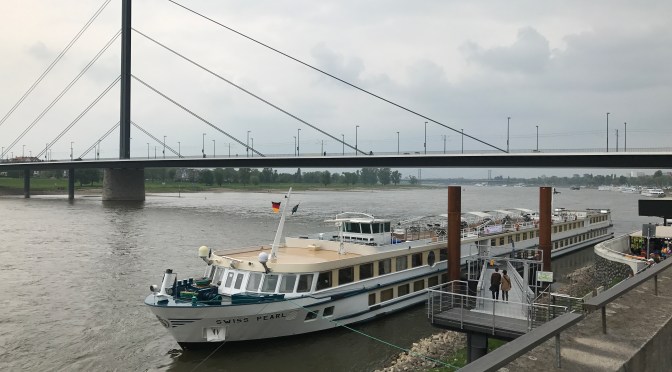
The eagle has crash landed. After an eventful day traveling from London via Brussels and Köln to Düsseldorf, I settled down to my “home” for the entire month of May, 2017. Reporting on Pretty Yende was irresistible. I apologize to those non-opera fans for obsessing on someone you might not know. But if you have heard of Pavarotti, you will soon hear Pretty Yende as a household name too.
So, Düsseldorf. My first introduction to the concept was quickly corrected by my AirBnB hostess. When she watched me unsuccessfully enter the internet access password she had given me, she reminded me that Düsseldorf needs to spelled “DuEsseldorf” to be correct. No E, no Entry to the Magic Kingdom of the Internet.. OK, right, as they say in the U.K.
The drizzly week didn’t help to motivate me to see much if the city, except to hang around the train station and the Goethe Institut, where I am taking a one month German course. This is my fourth course in four years (refer to the travel itineraries under the header for each year).
Some of my former German class buddies may be curious to hear how my class is shaping up. Students are diverse in age and nationality. One or two Koreans, Chinese, Japanese and Indonesians; Ukrainians, South Americans, Saudis, British and Americans. It’s best to avoid groups of three or more students from the same country as clumps and gangs form! I’m pretty satisfied with the collection for now, but we’ll see.
Multi-Tasking
Our first German class topic was about the brain and learning. It was a great introduction to the up-to-date, state of the art German education. It quoted the most current research, citing numerous examples of ways to retain new information. I reflected on the brain research studies Gee Kin (husband) and I will be participating in after I return to San Francisco: part of superstar Adam Gazzaley’s research on distraction and brain landscapes.
We have devoted our lives to multi-tasking to the point of distraction. While hipsters can manage and focus, it’s a bigger challenge for those of us who have built multiple careers on prior knowledge. It gives us little time to clear out the attic and the clutter is evident.
As part of learning new German vocabulary, our class was taught all the various learning styles: seeing, hearing, speaking, and a combination of speaking and movement. We should vary exercises and not be fixated on only one method. For instance, walk around and recite seven new words, but no more, for very short periods. They didn’t say it, but these suggestions are based on brain studies and the most effective ways to retain information.
We also learned in class that men learn quickly but also shut down information quicker than women. This started a lively conversation stereotyping men’s and women’s learning styles. It was too tempting to resist judgment between the sexes: one student claimed that men were smarter while women paid more attention to detail.
This naturally caused a call to arms between my new kindred English woman architect classmate and me. We exchanged some rapid eye movement and eye rolling and began to dispute the claim.
Initiated by a couple of male students from “not-so-liberated” countries, we stepped up and did what would have done Gloria Steinem proud. But in the midst of it, I felt a sad mood descending on our spirited encounter.
A few months back, I had seen a program about the Flüchtlingen (refugee) experience in Germany on Deutsche Welle, Germany’s version of Voice of America. A recent immigrant interviewed expressed his gratitude for free and public education, housing, and health care, but he noted how he was not accustomed to going to training classes with female students. I couldn’t help but flash on this observation.
I wondered what experience one of these male students had in classes with women students. While I don’t consider myself a super-feminist, I saw the huge canyon between my perspective and this classmate.
Should nations of Western Europe and the US strive to convince the world to go our way? Or are we imposing our might on others? I felt as if there was a mountain of work convincing this student that women were as good as men. Maybe women in his country just don’t ever get a chance to take men to task. Where does that put Angela Merkel, a chemical engineer, running a major country? Or maybe we should just back off?
I was grateful that I lived in the US, where you are at least free to enter the ring.
We assume that Diversity means other races and cultures but in some cases we have to remember to include women on the list.
Multi-Culturalism
Later that day in Frankfurt, I met a nice African-American woman, Carol Lynn. She had been working and living in Germany for over 35 years. She came from DC, so I couldn’t help but rave to her about the NMAAHC. She listened politely, then told me briefly about her life. Her family was already 5 or 6 generations traceable, back to the original slave owner. Her family of 9 siblings promoted many offspring, numbering over 100 members in the family and with 50 nieces!
She had many jobs working both as military and civilian personnel supporting our American presence in Germany.
I began to realize how many Americans are in Germany. Until now, most of my travel had been concentrated on Eastern Germany or in the countryside, so it was less evident. This conversation gave me perpective. Particularly for African Americans, I wondered if it wasn’t a more positive experience abroad than at home.
It’s important for all cities to embrace its members in a multicultural society. It isn’t enough for struggling minorities to merely “parallel play” and be marginalized. All cultures must be engaged in a common goal and feel that they are contributing collectively to the vibrancy of the city to which they belong.
Apropos to all of these observations and experiences, I had asked husband Gee Kin to reflect on our recent travels. Here are his thoughts, and please send us yours.
Diversity in the World’s Great Cities by Gee Kin Chou
San Francisco is considered one of the great cities of the world. However, it’s a mere village compared to two other great cities on the list: New York and London.
I’m not talking about size; I’m talking about diversity.
Within the 64 square miles of San Francisco proper, White and Asian faces dominate. Yes, Latinos and African Americans become a larger part of the picture when you expand the geography to the greater San Francisco Bay Area, but many are marginalized; African Americans in particular live in increasingly segregated communities. Africans from Africa, and Islamic headscarves are rare.
In New York, and even more so in London, a random day is likely to include contacts with several ethnicities. The shop assistant may have emigrated from Egypt, the bank teller from Nigeria, the hotel clerk from Bulgaria, the waitress in the upscale restaurant from Colombia and the electrician from Barbados. Every day encounters with ordinary people doing ordinary things. It may seem trivial but this is not the daily Bay Area experience.
I had always thought the “diversity” of the Bay Area was the future and the role model for the rest of the world. But visiting New York and London after a long hiatus has reminded me not to get too smug: San Francisco is not where it’s at. New York and London are truly GREAT cities.
Miscellany
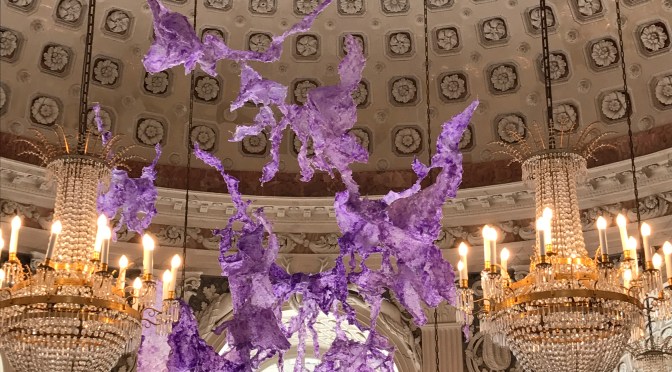
Finally, a few shots of the Frankfurt Opera interior (the new one, not the old opera house and the evening performance “Three Operas”:
It’s worth seeing something at the opera house as the intimacy, sight lines, and acoustics were fantastic.
Header Image Above: Can you guess where and what this is? It was too significant to pass up as one of the largest Gothic cathedrals in Europe. You’ll have to wait for more Dusseldorf sights next week, when friend Helena and I will do the town and attend concert events here and in Essen!
Plus: Happy Happy Birthday today to Isa!!



















 travelswithmyselfandothers.com