Tag Archives: Architecture

Unplugged in Prague

imageAfter our initial determination to attend a performance at Prague Castle, we discovered the Lebkowicz Palace where the afternoon concert was held. Rather than hitting the more popular Castle grounds, we learned that the Lebkowicz Family had a fascinating history, tracing from the Spanish King Philip of the Spanish Armada and New World fame to a modern day American family. They lost their inheritance twice, first to the Nazis in WWII and then to the Communists.

It wasn’t until the Velvet Revolution in 1989 that the Lebkowicz family fully recovered its properties in Prague. The Palace boasts the largest private collection of artwork in Central Europe that includes paintings by Bruegel, Velasquez, Cranach, and Canaletto. We followed the history in a fascinating audio guide narrated by Martin Lebkowicz himself, the American heir to the Lebkowicz family. The history transcends many historic events in European history, particularly the Thirty Years’ War.

A Chinese wedding booked part of the Palace, and this entry was decorated for the affair. The musical performance in the main room included classical hits featuring flute, piano and viola solo and trio performances. The room was recently renovated as part of the Lebkowicz Palace.
Sights and sounds around the city included views of Prague Castle, St. Vitus Cathedral exterior and interior Stained Glass Window detail, and fine examples of local Baroque architecture. The panoramic view in the header above shows the Vlatava River, Dresden’s equivalent to the Elbe River (both painted by Canaletto).
Street musicians played classical, Blue Grass and Bolivian tunes. Music in Prague is eclectic and non-judgmental. Whatever you want to hear will be here, from Pop to Classical, high-brow to low. It demonstrates the vibrancy of the city and the arts that permeate society from the past to the present.

Some initial comparisons between Dresden and Prague:
1. Both are located along a winding scenic River with many bridges.
2. Both have a historic and active musical tradition.
3. Both have a strong respect and patronage for the arts.

These are only first day impressions, more to come.

The news of the day is focused on Cameron and the Conservative Party winning the most seats in the British election!

Giddy at the Getty

J. Paul Getty was an oil magnate who traveled and learned to appreciate the antiquities of Greece and Rome. He was an avid collector and showed pieces he acquired in his Malibu mission-style ranch house. Although he lived in London most of his later life, he commissioned the Getty Villa to be built in Los Angeles to house his artwork but never saw the villa.

The Getty Villa simulates a Roman villa from Herculaneum, a town that was buried from the eruption of Mt. Vesuvius in 79 AD. While Pompeii is better known for the entire city that was excavated, the site at Herculaneum was closer to Vesuvius and was preserved intact under 65 feet of ash and lava.

The villa that Getty copied was owned by a Roman senator whose daughter was married to Julius Caesar. The senator was quite wealthy and influential, and the house was 60,000 sf. The Getty Villa is a small replica of the Roman one and contains an amphitheater for Greek plays, a peristyle or colonnade surrounding an atrium for dining and social meetings, and rooms above to house slaves.

Getty clearly got addicted to acquiring Greek and Roman artifacts. Once he accumulated all of these possessions, he had to build a museum to house them. Stephen Garrett, an architect, was hired to research, design and build the villa. Machado and Silvetti were also involved in the design of the site.


Photos, from top, left to right:
1. Entrance Plaque to the Getty
2. Detail of Greek Terra Cotta Dish, ca. 450 BC
3. Detail of Roman Sculpture, ca. 150 AD
4. Exterior Garden and Pool

The Getty Center, also built with Getty Foundation funds after Getty’s death, took more than 20 years to complete from inception to opening. It was designed expressly for the preservation of Western Art at the cost of $1 Billion and as part of a lawsuit. Family members were engaged in a bitter battle over the inheritance, and the only resolution was to build the museum. Twenty years ago, I was disappointed that funds were not devoted to building a higher education institution. The UCSF Mission Bay Campus would have cost about $1 Billion.

However, with all the museums I have visited this past year, I have revised my opinion. The Getty Center has become a vibrant and relevant educational institution on its own merits. I certainly witnessed many diverse visitors enjoying the buildings, exhibitions, and gardens. The Turner exhibition and the WWI Images special exhibition at the Research Center were both excellent and well curated. With a variety of visual aids, visitors were engaged in learning about the artists and the subject matter. For some reason I was more aware of the level of activity and engagement at both locations than what I normally notice at other museums. Both museums are free.


Photos, from top, left to right:

1. I-405 Freeway Access to Getty Center; a Monorail takes visitors from Parking Lot to Center at top of hill
2. Approach to Main Plaza
3. Main Plaza
4. Research Center. Buildings are designed by Richard Meier, a prominent New York architect. He moved to the site to determine placement of buildings. Flooring, panels and windows are designed to the architect’s signature 30″ grid. The Center opened in 2006.

Being located at the northern end of Los Angeles, the Getty Villa in Malibu and the Getty Center off I-405 are worth grouping for a day-long tour of both. Unfortunately getting to both requires a car.

Addenda:

1. Exhibit from WWI Images.Map by Walter Trier, an artist who illustrated books for Eric Kastner. Each European country is a sinister character.
2. Henry Moore Sculpture, 1983
3. Chart showing personalities of each European Country, divided by “Futurists” and traditionalists or those against progress.


1. Burl texture (see Sacto Dreamin’ video from November)
2. Super gigantic fig tree in garden of Fairmont Miramar Hotel, Santa Monica.
3. Acanthus leaves in garden at Getty Villa, similar to those represented on Corinthian columns

LA Downtown and Loca-MOCA

(The panorama above is taken in Palmdale, on the edge of the Mojave Desert. We spent the last couple of days comparing this high and dry area to that of Dunhuang and Turpan, our prior travels last September. Very similar in the moon-like landscapes and austere surroundings.)

Back to civilization…one of the signature buildings in LA is the Disney Hall, designed by Frank Gehry. It’s located on the corner of the LA Civic Center. While controversioal at the time it was built like all Gehry buildings, this fanciful building seems strangely apropos for LA.

Down the street, one of the grand old buildings preserved in its splendor is the Millenium Biltmore. This was the location of the hotel where “Pretty Woman” was filmed. An ironic building sign at a service entrance wasn’t able to practice what it preached.

More downtown hi-rises, along with the  $140 Million Broad Contemporary Art Museum under construction by Diller Scofidio + Renfro. (to read more: see http://www.kcet.org/arts/artbound/counties/los-angeles/the-broad-contemporary-art-museum-downtown-los-angeles-photos.html).

A dual screen presentation on Compton, CA, inside the Museum of Contemporary Art showed daily life and unfortunate realities of death and dying in the city since the Rodney King beating.

LA Dinner and a Cruise

I’m on a long weekend to La-La Land, with planned visits to a couple of galleries and museums.

After locating a cozy restaurant in the neighborhood (see photos of our focaccia bread with tapenade and ahi tuna appetizer) and delighting in a meal of watercress, pine nuts and parmesan salad, angel hair pasta, and hazelnut ice cream in a waffle tart, my next venture was “cruisin’ along Wilshire by foot the following day.

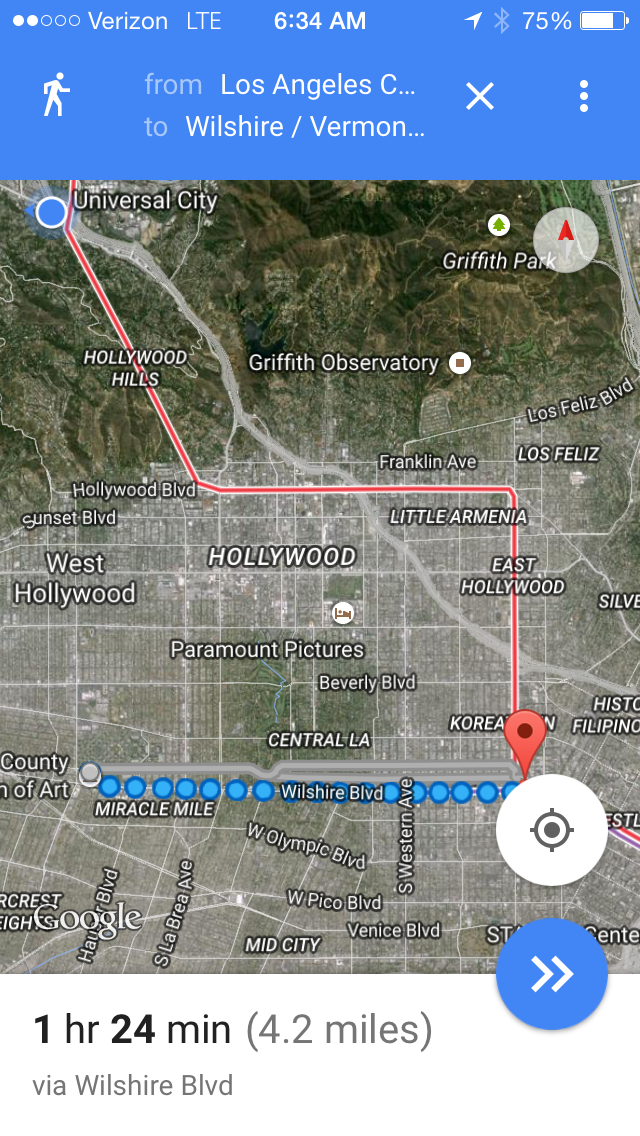
The LA Metro, located within one block of our hotel near Universal Studios, turned out to be a great option and asset. It allowed us to maintain our public transit-first approach to travel. Gee Kin took it to his business meeting and I took the red and purple line to the museum. The La Brea Tar Pits and the LACMA are located along the Museum Mile on Wilshire Avenue. The 3-4 mile walk from the Wilshire-Western Station to these destinations got me back in the groove of getting exercise while “cruisin’ along” plenty of new shops and sights. The screen shot shows the Metro route in red (without the purple extension that I took one way); the blue dotted line is what I walked.

IMG_5412

The Metro in LA, while a fairly new invention, is very accessible and easy to use. Most tourists would not consider using it, but it in fact does its job in a very modern, non-LA sort of way. It may not be your first thought, but if you give it a try you will find it’s a pretty good solution to getting around LA. While it’s still not a natural thought and takes work, it gets everyone out of their cars! So, why not??

Starting my walk with Korea town, I traversed the residential area of Wilshire Park, where the golden 30’s era chateaux and mini mansions seemed frozen in time and space. All the stars of yesteryear felt at home here. Amidst tree-lined streets (reminiscent of those in Sacramento from my November post last year), stripped palm fronds lay at the foot of stately trees like abandoned children torn from their parents. Similarly, stumpy, sagging and dated Art Deco buildings bleated for love but got little attention.


Just as I wondered if anyone had the uncool nerve to carry an umbrella in LA for sun shading, I suddenly saw someone doing exactly that. Finally, I thought, some practical minds at work. You wouldn’t be caught dead doing that in San Francisco with its perpetual foggy bottoms and rare temperature highs. The irony is that I dived into a Rite-aid to buy an umbrella but not for this purpose. I had lost an umbrella last year and heard from Gee Kin that the coveted little device came from Rite-aid. The design, size, sturdiness, and all features were priceless. (Tip for today: get one of these in your travel repertoire!) So much so that I beat it to the first Riteaid I have seen in 9 months (which happened to be in LA on this walk), faced the wrath of the cashier who stared at me like I was a stark raving idiot, and carried it around for a day in 90 degree weather (with no intention of using it for sun shading–I’m from San Francisco, after all!)

But I digress. See the next post for what I really did.

I’m in a NY State of Mind…

Although Billy Joel has been performing at Madison Square Garden, I wasn’t able to see him because he’s off during the time I’m here. Nevertheless, the weather, cultural riches, and access to all forms of public transportation have sucked me in to see it, do it, and think it just like a local New Yorker.

On a recommendation from New Yawka Peter (who lives in HK), I was inspired to head back down to Nolita’s neighbor, Chinatown. The new Museum of Chinese in America was recently coined by Maya Lin, the young architect who designed the Vietnam Vets Memorial in Washington, DC. Tracing Chinese American history and seeing the Chinese diaspora felt like going home to an old but familiar story. Just like popular Italian operas, you recognize the tunes, the stories, the characters. Only the comedic element was missing.

Nevertheless, the timeline was well presented. The history of the railroads, promises of gold, through days of war, Nationalism, and Communism in the home country were captured efficiently. I learned about the achievements of many Chinese Americans whose names were not familiar to me. They included an astronaut, a prominent AIDS researcher, and a female pilot. Maya Lin and the museum curators did a decent job highlighting the right amount of information for visitors.

Photos, from top, left to right:
1. Display area
2. Restored storefront of Chinese shop
3. Sign that bears a chilling similarity to the anti-Islamic protests currently in Germany

This museum is worth a visit, for content and the Maya Lin oeuvre. You can see and hear her talk about it at https://m.youtube.com/watch?v=976o62w45zg.

On a lighter note, the rest of my afternoon was devoted to seeing another theater production, “It’s Only a Play”, with Martin Short, Stockard Channing, and Matthew Broderick. Sorry to say, (to friend David, who was anxious to hear), that despite the big names, the script failed to keep the audience engaged. The actors were skilled at their craft, particularly my favorite Stockard Channing (from Grease and Six Degrees of Separation), but the story of the failure a Broadway play felt weak and contrived. It’s sad to think that the talents of so many were put to the task of delivering an uninspiring story, that ironically was the topic of the play.

The highlight of the evening was having a delightful dinner at Blue Hill on Washington Square with fellow architect Rik. We shared stories of being in the “order”, keeping up with the new techies, and fast-forward Chinese students. The food and service were impeccable, so definitely worth the cost of being entertained. Highly recommended.

Photos, from top, clockwise:
1. Thousand Year-old Egg and Pork Congee, Chinatown lunch
2. Mustard Relish for Bread, radishes from Stone Barn, and kohlrabi with cheese at Blue Hill;
3. Blue Hill dessert, sponge cake , apple crisp and ice cream

Coming up: Natural History Museum, Manon, and maybe the Neue Galerie on the final day in The Big Bad Apple.

Holita Nolita

I was up early today, and had a light breakfast in the hotel. The Cafe serves pastries and bagels from Balthazar and Ess-a-Bagels, both famous institutions in themselves, so I am in breakfast heaven (ironically I ordered steel cut oats!).

I headed down to Le Labo in Nolita for custom mixed fragrances from Grasse (the home of French perfumes) and ordered two scented candles and a musky flavored spray.

image

Next I managed to get a seat at Balthazar for a bar lunch of scrambled eggs and mushrooms in a puff pastry and a glass of champagne.

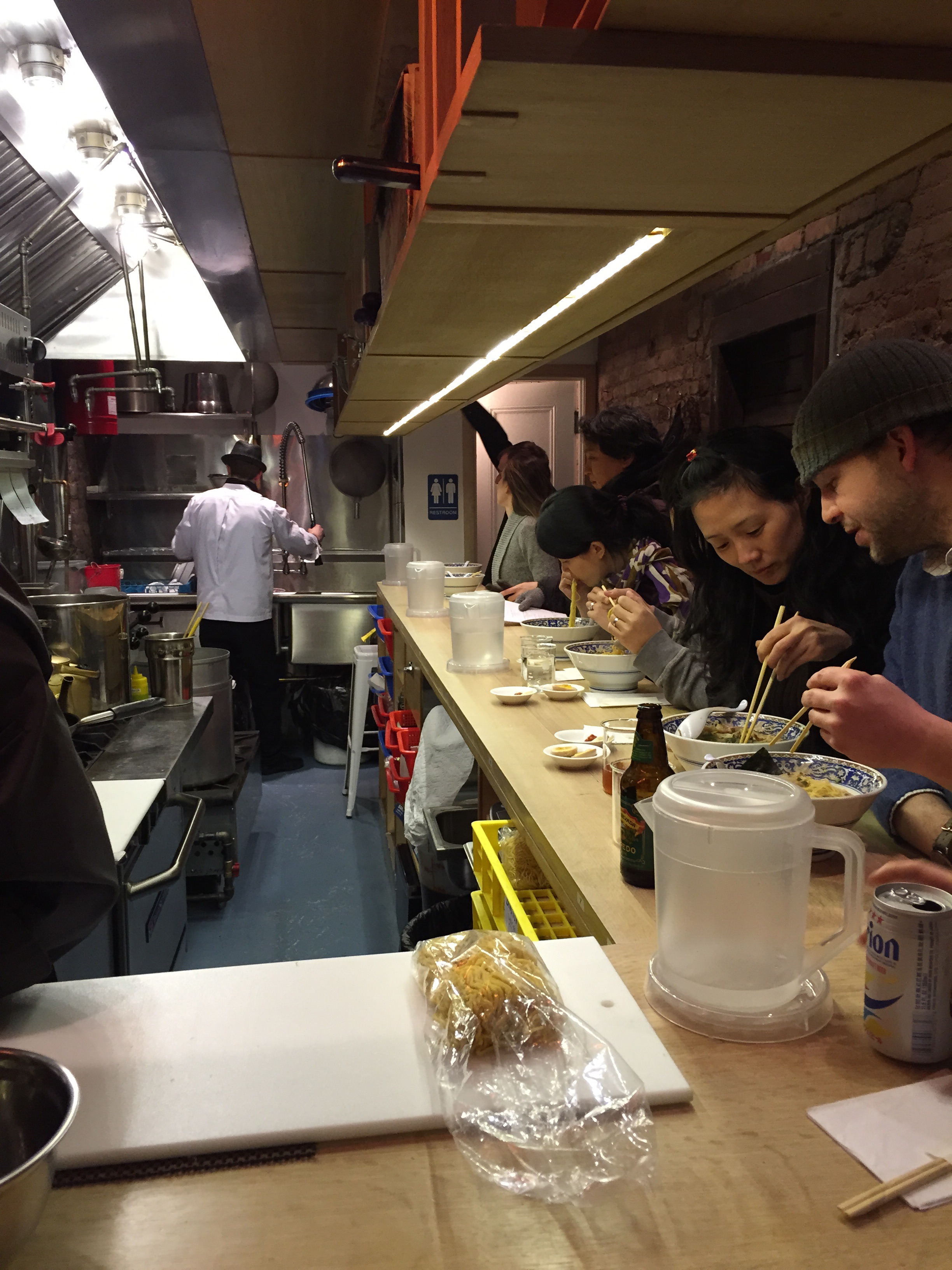
I ripped back up to the Theater District to catch “the Heidi Chronicles”, then returned by subway with relative ease to the Ramen Lab for a quick dinner. After waiting outside in line for over an hour, I finally was able to get a seat at the bar at the Ramen Lab (what’s with these “labs”?). It was worth the wait, since I wasn’t dying to get home or go anywhere else. The noodles were decent but the miso soup and the pork belly were superb. The seat at the bar was moot, as the restaurant is so small. All 10 seats are “at the bar”, with no chairs, no stools, nada.

When the chef heard I was from San Francisco, he asked me if I had heard of the Ramen Shop in Oakland. He had worked there last summer for three weeks. The hostess told me she loves Tartine and Bi-Rite. She goes there every time she’s in SF. I was tempted to ask her if she had imported the idea of long lines from there to create hype for this place.

image

image

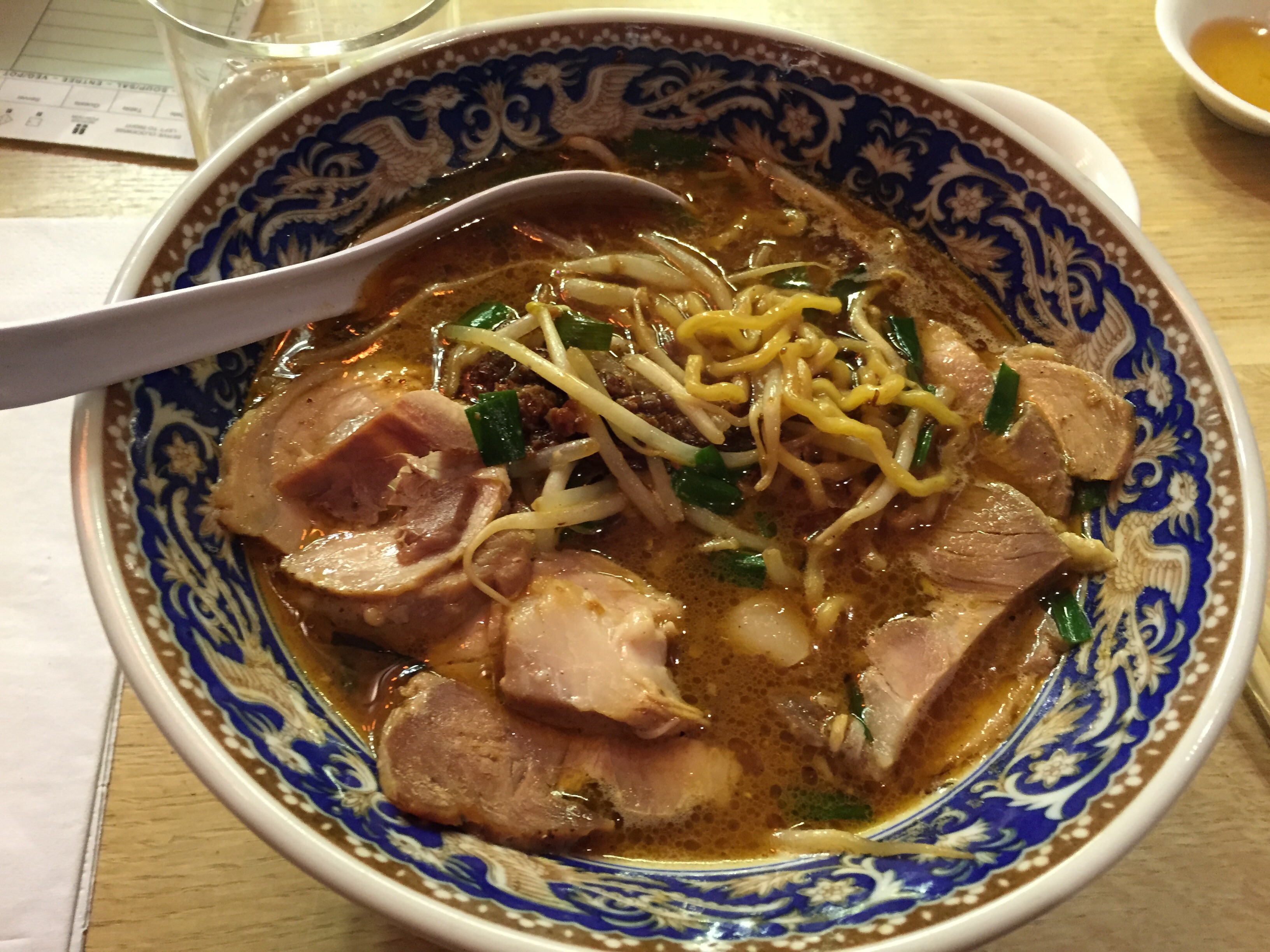
People in photo above showing the noodle bar appear to be seated, but in fact they are standing. The bowl of noodles looks innocuous, but was delicious, particularly after waiting in the cold outside for so long. A guaranteed thumbs up no matter what the food tastes like, eh? All of these food and mood shops are within walking distance of the Spring Street Station Number 6 line near NY Chinatown.

My last destination, the Storefront for Art and Architecture, was no where to be found. In its place, I discovered a spanking new building just before hitting Nolita. It looked a little out of place among the old brick warehouses along the Bowery. It turned out to be the new campus of the Cooper Union.

I ventured inside and asked whether anyone knew who the architect was. The guard and a student shrugged their shoulders and one finally out of desperation uttered that they thought it was some blankety blank architect from CALIFORNIA. The style and design looked familiar, but the name danced on the tip of my tongue. When I found out later who it was, it seemed obvious. Anyone willing to guess?!? (Hint: we have a building in San Francisco by this well-known architect).

image

image

Photos above: exterior and interior of the Cooper Union, by___.

Footnote: the Heidi Chronicles started out on a light note, but ended up being emotionally draining for me. In that respect I enjoyed it. It’s a boomer story of a woman who studied art history at Vassar (hmm…). After recounting each decade of her life with familiar friends, the lead character tries to make sense of being a woman in a male-dominated world. Maybe not for all, but I could relate to this story.

On the menu tomorrow: “It’s Only a Play” with Martin Short” and Blue Hill with Rik

Day 64: HK MTR and Vertical Cities Symposium

Hong Kong was one of my old stomping grounds, so I was particularly excited about seeing old friends. After graduating from architecture school, I arrived here with $100 left in my pocket and a determination to work here for a year. I ended up staying for seven. Gee Kin and I met in HK, and, well, the rest is history.

I’ll tell you more about the my day traveling on HK’s mass transit system and today’s seminar on Vertical Cities that I attended through the annotated photos:

1. This was the interior of the car in the MTR system. After nearly 40 years since I first worked on it while it was under construction in 1976-78, the system has held up well. I remember trying to introduce some of the BART system concepts to the British who controlled development of the system at the time. They were not interested in the BART fledgling system, which was barely 10 years old at the time. Being true colonials, the engineers preferred to utilize the London tube or British Railway system as their precedents.

Nevertheless, it’s an efficient, well-maintained system. It hardly showed any wear and tear despite its mature age. I was told that there are some delays and breakdowns that are only just beginning to appear, but the system has run well until recently. This photo is a general overview of the train interior.

2. Cell phone mania is not particular to China. 5 out of 8 were actively using their cell phones in this cluster of people. If I had taken photos in other cities I visited, they would have been similar, and maybe only nominally lower in numbers.

3. A shop, inside the MTR selling pastries. The two unusual items that caught my eye were green tea and fig rolls (that I tried) and squid ink, tomato, olive and pickle pizza (that I did not try)

4. A upshot of high rises near Garden Road.

5. Speakers at the Asian Vertical Cities Symposium sponsored by the HK American Institute of Architects at the Asia Society

6. Asia Society Walkway design by Tod Williams and Billie Tsien to protect the local bat colony near HK gardens.

7. Flower arrangement in the Asia Society Building

The symposium consisted of an afternoon of presentations by local luminaries, followed by dinner and conversation. My good friend Peter Basmajian, a local HK architect who has lived in HK over 30 years, invited me to join him at this event. I also reconnected with George Kunihiro, a fellow architectural classmate from UC Berkeley. We had not seen each other for nearly 40 years! He happened to be visiting Hong Kong from Japan, where he now works.

A few salient comments from the symposium focusing on transit-oriented, high-density vertical cities included the following:

Ken Yang from Malaysia introduced his idea of green buildings and creating continuous linear parks as developed in the Solaris Building in Singapore for an ecological solution

In designing a building as part of a competition, you have to start with something interesting for a competition and end up with something different or unexpected, as shown in the winning design for the Crown Plaza project in Sydney, Australia.

Dinner topics included table discussions on sustainability, livability, affordability, and mobility. Many of the cities discussed include those in China, India, Indonesia, Thailand and Malaysia.

Day 62(a): Race to the Top

Rome wasn’t built in a day, but maybe it should have waited to take a lesson from the Chinese. It wasn’t exactly a day, but how about 5 days? 5 years? Complete with a working mass transportation system. I thought about how many buildings I could name in Manhattan versus those I could name in Guangzhou. Many vs. one–the hotel where I am staying. What’s going on here?!?

I spent today walking around Guangzhou’s new civic center area after I visited their Guangzhou Provincial Museum (Part b of today’s posting). Initially I was very impressed by the overwhelming volume and size of the buildings. This area included the equivalent of a state museum, an opera house, a park, and a huge library. In the end, I have more questions than answers.

I wanted to go to the Guangzhou Opera House, thinking that it was, well, for Guangzhou Opera. Wrong. Upcoming performances include Angela Georgiou (I wouldn’t have minded) and the St. Petersburg Philharmonic. I decided to pass on tonight’s production the Globe’s Midsummer’s Night’s Dream for $40, cheapest seats available. So much for my fantasy to revel in those days when I went to Chinese Opera with my mother in Chinatown nearly 60 years ago.

Zaha Hadid Baby got her commission after battling against Rem Koolhaas. I guess her pebbles made a big splash. You can read more about it in http://en.m.wikipedia.org/wiki/Guangzhou_Opera_House.

After a visit to the museum, I wandered back to the hotel and many buildings caught my eye. First, in general, by the sheer size and scale. I’m posting some for your enjoyment. It feels like an arms race to the top. Who are they competing against? Other designers? Other companies? The region? Other cities in China? New York? I would love to know.

Second, I got fixated on the rooftop finishing. Having just completed the Neurosciences Building at UCSF, I know it was about mechanical screening. OK, saw a few buildings that did that. Some clearly wanted to reach to the clouds and show their mighty height with spires. Ok, get that one too. And then there are the loop de loops.

Well, you might draw your own conclusions. I get the decorative elements to provide some relief from high rise ennui. But I think I am missing something. These architects have left something out of the obvious reasons for me. Any guesses?!?

It did make me think of the little pitched roofs in Germany and the curious blinking eyes I posted back in August. They were unintentionally playful perhaps, but I am not sure I could call these responses to the transitions to sky exactly “playful”. (By the way, my fixation on cranes is also amply displayed here. They aren’t part of the decorative elements of the rooftops.)