Prague Perspectives

Here’s a potpourri of architecture, art, and street scenes from today’s walks to the National Gallery and along the Charles River:


1. The Fred Astaire and Ginger Rogers Dancing Building by Frank Gehry
2. Optional transportation across the Charles River
3. Elegant Witches’ Caps

Architectural Models by Loos and others (for the architects in the room)

Portraits by Rousseau, Matisse, and Picasso; Sculpture by Degas and Rodin

A moving tribute to a 22-year old artist


1. En Plein Air
2. Czech Donut Making


3. Witches and Goblins and Ghosts–Oh My! are everywhere in Prague (we just missed April 30, when everyone dresses up as a witch throughout the city)
4. Second Effigy in Two Days–a whimsical or warped obsession?

Note: Click on photos before for better viewing.

I’ll be on the road to Weimar tomorrow, so next post may be delayed. See you soon!

Prague Architecture & Promos


Like Dresden, Prague has a Disneyland-ish quality to it. We think of the SoCal American counterpart as fantastical, whimsical, and totally pedestrianized, and this city seems to match those descriptions. Like Disneyland, it also has hoards of tourists. For this city’s economy, tourists are no plague for Prague.

The buildings are impeccably maintained as are the streets (at least in the old town–I haven’t seen the real world by daylight anywhere yet!). It’s best to succumb to the lovely lures of the inner city and not overly scrutinize what may be beyond just yet.

Photos, from top left, counter-clockwise:
1. Tattooed Building
2. Baroque Beauty
3. Another Baroque Beauty outside hotel
4. Town Hall and Astronomical Clock in city center
5. Stone Relief on side of building
6. Effigy decorates confluence of crooked streets; impressions of Prague in 3GS: gruesome, gnarly, and Gothic.

image
Jewish Synagogue (above)

As for Prague being a musical city, it definitely is well endowed, with a twist. Tourists must run the gauntlet of mass advertising for concerts and performances held at virtually every available venue. Catholic and Protestant churches competed in the past for parishioners and compete today for music patronage. Like canned tours, it is impossible to avoid the bombardment of flyers and hawkers (not for sex, but…music???). I felt a bit sorry for those disinterested in music, like the feeling you get when you’re not a sports fan and everyone around you is a fanatic. What’s all the fuss about?!? It’s a different world.

Fortunately for us, I was a bit unprepared and the readily at-hand research saved my ogling-going on Google. Instead, we physically stumbled into an ideal performance at the Municipal Hall. Dvorak’s New World Symphony will be performed with 60 local musicians of the Czech orchestra for around 40 euros each. (Quantity, not quality matters here) It’s also easy to compare choices when ads are at every street corner.

We are about to go to a Prague State Opera performance of “Nabucco” tonight. Keep your fingers crossed. Although I bought tickets online, I wonder how many tourists got coerced into going to something at the last minute that they really didn’t want to see. As for performances in Dresden and Leipzig, they haven’t capitalized on music or pandered to tourists to the extent done here (unless I missed something before). Maybe by choice, or less desperation. Stay tuned….

Update: the Prague Opera did not disappoint…in fact, it fully redeemed my faith in coming here. The performers were stellar, the staging straightforward, and the kudos were appropriate to the performance (not overinflated as they are in the U.S. with standing ovations the norm rather than the exception).

*I couldn’t help but add a panoramic of the interior of the beautiful opera house here. The acoustics were the best of any house I have visited. It’s small, intimate, and perfectly balanced. Maybe it was sitting in dead center of the parterre that did it, but for $55 for best seats in the house it beats the Met hands down on acoustical quality and value.

imagePrague State Operahouse interior

Unplugged in Prague

imageAfter our initial determination to attend a performance at Prague Castle, we discovered the Lebkowicz Palace where the afternoon concert was held. Rather than hitting the more popular Castle grounds, we learned that the Lebkowicz Family had a fascinating history, tracing from the Spanish King Philip of the Spanish Armada and New World fame to a modern day American family. They lost their inheritance twice, first to the Nazis in WWII and then to the Communists.

It wasn’t until the Velvet Revolution in 1989 that the Lebkowicz family fully recovered its properties in Prague. The Palace boasts the largest private collection of artwork in Central Europe that includes paintings by Bruegel, Velasquez, Cranach, and Canaletto. We followed the history in a fascinating audio guide narrated by Martin Lebkowicz himself, the American heir to the Lebkowicz family. The history transcends many historic events in European history, particularly the Thirty Years’ War.

A Chinese wedding booked part of the Palace, and this entry was decorated for the affair. The musical performance in the main room included classical hits featuring flute, piano and viola solo and trio performances. The room was recently renovated as part of the Lebkowicz Palace.
Sights and sounds around the city included views of Prague Castle, St. Vitus Cathedral exterior and interior Stained Glass Window detail, and fine examples of local Baroque architecture. The panoramic view in the header above shows the Vlatava River, Dresden’s equivalent to the Elbe River (both painted by Canaletto).
Street musicians played classical, Blue Grass and Bolivian tunes. Music in Prague is eclectic and non-judgmental. Whatever you want to hear will be here, from Pop to Classical, high-brow to low. It demonstrates the vibrancy of the city and the arts that permeate society from the past to the present.

Some initial comparisons between Dresden and Prague:
1. Both are located along a winding scenic River with many bridges.
2. Both have a historic and active musical tradition.
3. Both have a strong respect and patronage for the arts.

These are only first day impressions, more to come.

The news of the day is focused on Cameron and the Conservative Party winning the most seats in the British election!

So Slow in Oslo


Welcome to the first posting on the Prague vs. Dresden Musical City Competition!

Our trip begins in Oslo. We had a day-long layover on our Norwegian Air flight (the airlines was voted the best in 2014) here, so I made reservations at Nodee Asian Cooking in advance. Fascinated by the Chinese diaspora, Gee Kin and I always like to visit Asian restaurants when we are in Europe. I decided that trying a reputable sushi establishment with emphasis on fresh fish in Scandinavia would be a good alternative to heavy meat-based Nordic food. Another couple we met on a similar escape from the airport were searching for good moose and reindeer.

We weren’t able to get reservations the last time we were in Copenhagen to Noma, deemed the world’s best restaurant. I researched comments on Eater.com, a website for foodies. I settled on Nodee based on fairly good evaluations and the fact that it was open for lunch. Although not intended to match the standard and quality of Noma, we weren’t disappointed. After a healthy 20 minute walk to whet our appetites, we found the restaurant adjacent to Frogner, a city park.

Painted in soothing mute colors with a Zen influence, the restaurant served attentively prepared and beautifully presented sushi. We chose a mixed plate of sashimi and nori sushi, and tempura-wrapped maki that you see in the photos. We easily whittled away our jet lag and time away from the din of the airport.

The restaurant staff was speaking both Cantonese in Mandarin in the background. Our waiter was a native Norwegian Chinese, whose parents immigrated to Oslo from Shanghai. It’s always intriguing to encounter Chinese in these far-flung places, and to find out what motivated them to live there. Despite their being amusing to us, we realize that we are novelties as well. Our accents and mannerisms are quickly detected as being different from native Chinese or the locals.

Going to Nodee was a great respite from the bustle of the city. We got a glimpse of the city and daily life in Oslo, and made good use of our down time while waiting for our connection to Prague. We were able to create a destination event to entertain ourselves and enjoy a decent meal without breaking the bank! You can see the menu and more at http://www.nodee.no.

Prepping for Prague

Just a quick note to let you know that I am heading for Prague and the Dresden Music Festival in the next couple of days, so look out for my postings! The trip will focus on exploring the similarities and differences between the two musically-oriented cities, and meeting old and new friends from the Goethe Institute, Germany, and Switzerland. Join the fun as I take you on a virtual tale of two cities soon….

Bouquets to Art

image

The annual Bouquets to Art exhibition at the De Young was a crowd pleaser and an eloquent pairing of floral artistry interpreting museum pieces. The flowers helped to provide a new dimension on and appreciation of a wide range of artwork, from classic paintings to three dimensional sculpture, Mayan gallery treasures, and signature Shaker furniture.

Botticelli to Braque

Friday at our local DeYoung Museum Exhibition from the Scottish National Gallery–an excellent array of the best including Impressionists. Scotland was at one time one of the wealthiest countries in the world, and this collection demonstrates its wealth and sophistication. I couldn’t resist taking pictures to capture the pieces for myself, so I thought I would share them. The exhibition will be shown until the end of May. If you are in the area, I highly recommend seeing it! The audio guide is also a worthwhile investment.
Below is a description of the Scottish painters from the exhibition.
Click on images to enlarge–these will enhance viewing and provide a better understanding of these exquisite paintings.
image

Above:
1. Allan Ramsay, Printer’s Wife
2. Portrait of Two Children, Van Dyck
3. Sir Joshua Reynolds, The Ladies Waldegrave, 1780
4. John Singer Sargent, Lady Agnew of Lochnaw,1892 (My favorite of the entire exhibition–a mesmerizing glare)

Above:
5. Sir Henry Raeburn, Colonel Altstadt MacDonnell, Glengarry Chief,1812 (Check out the regal kilt and purse here, that was preceded by pants!)
6. Sir Henry Raeburn, Rev. Robert Walker Skating on Duddington Loch, 1795
Other European painters from the National Gallery included:

Above:
7. Degas, Diego Martelli, 1879 Florentine Art critic
8. Monet, Poplars on the Epte, 1891
9. Seurat, La Luzerne St. Denis, 1884-85

Above:
10. Gauguin, Three Tahitians, 1899
11. Max Ernst, Young Girl showing the Head of her father 1927

Above:
12. Braque, The Candlestick, 1911
13. Vuillard, The Candlestick, 1900, (the artist lived with his mother who had a dressmaking and corset Shop)

IMG_5610To the left:
15. Kirchner, (member of die Brücke group, who wanted to form a bridge to the future)
Japanisches Theater 1909, from the Center Theater in Dresden. This is part of the German Expressionist movement shown at the MOMA in NYC earlier last month. I am teaching myself more about this and other periods of art history as I find examples and connect them to examples in prior exhibitions.

For a short video of Golden Gate Park from the top of the DeYoung Museum, go to https://youtu.be/GTg_BwXNyv4.

Giddy at the Getty

J. Paul Getty was an oil magnate who traveled and learned to appreciate the antiquities of Greece and Rome. He was an avid collector and showed pieces he acquired in his Malibu mission-style ranch house. Although he lived in London most of his later life, he commissioned the Getty Villa to be built in Los Angeles to house his artwork but never saw the villa.

The Getty Villa simulates a Roman villa from Herculaneum, a town that was buried from the eruption of Mt. Vesuvius in 79 AD. While Pompeii is better known for the entire city that was excavated, the site at Herculaneum was closer to Vesuvius and was preserved intact under 65 feet of ash and lava.

The villa that Getty copied was owned by a Roman senator whose daughter was married to Julius Caesar. The senator was quite wealthy and influential, and the house was 60,000 sf. The Getty Villa is a small replica of the Roman one and contains an amphitheater for Greek plays, a peristyle or colonnade surrounding an atrium for dining and social meetings, and rooms above to house slaves.

Getty clearly got addicted to acquiring Greek and Roman artifacts. Once he accumulated all of these possessions, he had to build a museum to house them. Stephen Garrett, an architect, was hired to research, design and build the villa. Machado and Silvetti were also involved in the design of the site.


Photos, from top, left to right:
1. Entrance Plaque to the Getty
2. Detail of Greek Terra Cotta Dish, ca. 450 BC
3. Detail of Roman Sculpture, ca. 150 AD
4. Exterior Garden and Pool

The Getty Center, also built with Getty Foundation funds after Getty’s death, took more than 20 years to complete from inception to opening. It was designed expressly for the preservation of Western Art at the cost of $1 Billion and as part of a lawsuit. Family members were engaged in a bitter battle over the inheritance, and the only resolution was to build the museum. Twenty years ago, I was disappointed that funds were not devoted to building a higher education institution. The UCSF Mission Bay Campus would have cost about $1 Billion.

However, with all the museums I have visited this past year, I have revised my opinion. The Getty Center has become a vibrant and relevant educational institution on its own merits. I certainly witnessed many diverse visitors enjoying the buildings, exhibitions, and gardens. The Turner exhibition and the WWI Images special exhibition at the Research Center were both excellent and well curated. With a variety of visual aids, visitors were engaged in learning about the artists and the subject matter. For some reason I was more aware of the level of activity and engagement at both locations than what I normally notice at other museums. Both museums are free.


Photos, from top, left to right:

1. I-405 Freeway Access to Getty Center; a Monorail takes visitors from Parking Lot to Center at top of hill
2. Approach to Main Plaza
3. Main Plaza
4. Research Center. Buildings are designed by Richard Meier, a prominent New York architect. He moved to the site to determine placement of buildings. Flooring, panels and windows are designed to the architect’s signature 30″ grid. The Center opened in 2006.

Being located at the northern end of Los Angeles, the Getty Villa in Malibu and the Getty Center off I-405 are worth grouping for a day-long tour of both. Unfortunately getting to both requires a car.

Addenda:

1. Exhibit from WWI Images.Map by Walter Trier, an artist who illustrated books for Eric Kastner. Each European country is a sinister character.
2. Henry Moore Sculpture, 1983
3. Chart showing personalities of each European Country, divided by “Futurists” and traditionalists or those against progress.


1. Burl texture (see Sacto Dreamin’ video from November)
2. Super gigantic fig tree in garden of Fairmont Miramar Hotel, Santa Monica.
3. Acanthus leaves in garden at Getty Villa, similar to those represented on Corinthian columns

LA Downtown and Loca-MOCA

(The panorama above is taken in Palmdale, on the edge of the Mojave Desert. We spent the last couple of days comparing this high and dry area to that of Dunhuang and Turpan, our prior travels last September. Very similar in the moon-like landscapes and austere surroundings.)

Back to civilization…one of the signature buildings in LA is the Disney Hall, designed by Frank Gehry. It’s located on the corner of the LA Civic Center. While controversioal at the time it was built like all Gehry buildings, this fanciful building seems strangely apropos for LA.

Down the street, one of the grand old buildings preserved in its splendor is the Millenium Biltmore. This was the location of the hotel where “Pretty Woman” was filmed. An ironic building sign at a service entrance wasn’t able to practice what it preached.

More downtown hi-rises, along with the  $140 Million Broad Contemporary Art Museum under construction by Diller Scofidio + Renfro. (to read more: see http://www.kcet.org/arts/artbound/counties/los-angeles/the-broad-contemporary-art-museum-downtown-los-angeles-photos.html).

A dual screen presentation on Compton, CA, inside the Museum of Contemporary Art showed daily life and unfortunate realities of death and dying in the city since the Rodney King beating.

Ooh La-La LaBrea and LACMA

My two hits for the day were the Page Museum at the LaBrea Tar Pits, and the LA County Museum.

The La Brea Tarpits contain asphalt that formed after the sea was covered over millions of years by organic trash and debris. The bubbling mass is caused by natural gas or methane, and the goo on the top is asphalt. La Brea has some of the most complete deposits in the world where many animal remains were preserved in the tar. When animals got stuck in the tar, they in turn from their scents and sounds attracted predators and birds. Eventually all the living creatures got stuck in the thick mess and died, leaving intact an entire ecosystem. While Dinosaurs existed 65 million years ago and Homo Sapiens 200,000 yrs ago, these animals found in LaBrea were much later, from 40,000 years ago. During the Ice Age these animals migrated south and settled in this area. This move might have been a fine annual sojourn were it not for getting stuck.

Photos above, clockwise:

1. Tar Pits, with occasional eruption or two
2. Display of Ice Age bison, ca. 40,000 BCE (not a dinosaur)
3. Researchers in lab studying bone fragments

In the afternoon, I decided to focus on the Islamic Art and German Expressionists at the well-endowed LA County.

I couldn’t find any traditional Islamic Art on display, but was captivated by a contemporary exhibition of Islamic artists.

Photos, from top, left to right:

1. Display of women as a topic in art (very cautiously and respectfully depicted, although one showed women being trained to scale a wall in the Police Academy in their full burkas). The Ipad in the foreground was a very effective tool available to the public to access additional information about the collection nearby and to read about the artist and the work beyond a tag and title. Seating with the Ipad also made the experience of doing and viewing art much more pleasurable.

2. Display of text describing artwork of woman viewing life through a veil
3. Tombstone of dissident who was not allowed to have a monument in the cemetary

For further reading: http://www.lacma.org/about/press/islamic-art-now-contemporary-art-middle-east

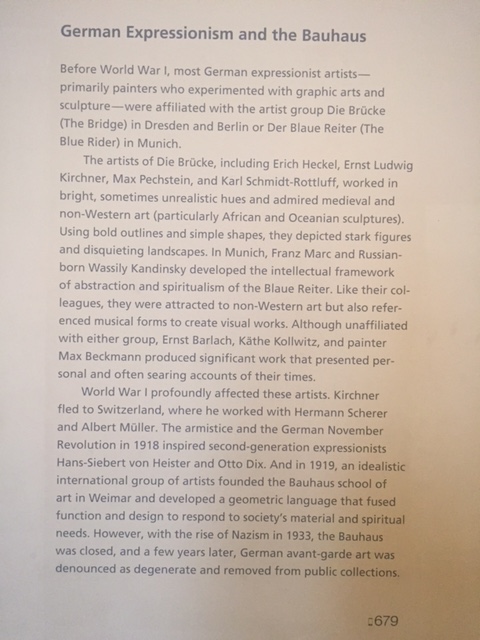
German expressionism sounds pretty dry, but like all things German there is much more depth than what meets the eye. My first introduction today perusing the LACMA collection was to Ernst Barlach. He was a graphic artist of sorts, and sculptor who tried tackling the horrors of poverty and dying. Although trained in Dresden and Berlin as a fine artist, it was his travels to Russia that affected him deeply. He drew from Goethe’s Faust and other literary contexts to depict the emotions of the suffering and the end of the world. The information provided at the exhibition is attached.

IMG_5472

IMG_5468

IMG_5471

(For further reading: http://en.wikipedia.org/wiki/Ernst_Barlach)

Other German Expressionists, like Rottluff who was instrumental in Die Brücke group and Otto Dix from die Blaue Reiter movement, moved away from the illusionary three dimensional depictions on a flat plane to more abstract forms that introduced feelings into their art. More use of color and obscuring the picture plane were techniques used, and inner feelings of fear, alienation and tragedy were common themes. The role of religion was often challenged, and an ominous premonition of bad things to come seemed evident in the short period of 1913-1925, before this type of art, considered degenerate, was banned by the Nazis in 1933. (for further reading: http://www.lacma.org/art/collection/german-expressionism).

However, there was a third and accidental discovery. I found myself looking for women artists. Initially I thought it would be nearly impossible. I was curious about the lack of noteworthy women artists mentioned in the play “Heidi Chronicles” (I saw it in NYC earlier this month). I was delighted to find several examples with relative ease. Perhaps there are female artists, albeit fewer in the earlier development of art. See those below:

1. female artist and work to be identified
2. Hannah Hoch, Picture XI Blue, 1920
3. Barbara Hepworth, Reclining Form, 1959
4. female artist and work to be identified

Real Time Creative and Independent World Travel