





So Where’s Uzbekistan? First of all, it shares a commonality with Lichtenstein. It’s doubly landlocked with no access to a seaworthy port (the Aral Sea doesn’t count, but more about that later). As mentioned in earlier posts, water was everything in the distant past as it is today.
The Soviets wanted Uz. to produce cotton so they did. They relied on a single crop to supply the former Soviet Union, so after Peristroika, Uz was in trouble, with no diversification. The government seemed to switched to mixed crops as quickly as it could, but it took a lot of water to grow cotton. That sapped the supply of water from the border river they share with Kyrgyzstan, so now they have to buy water for neighboring Tajikistan.
Traveling along the Great Silk Road today (7 hours by car from Bokhara to Kiva, another UNESCO world heritage site), I actually saw camels on the highway! That blew me away, until I saw an accident a few minutes later. There was a dead man in the crossing. His car was tipped over sideways and it looked like he was hauling some gas tanks. He looked scorched.
Otherwise, this could be a typical 90 degree summer day. Here’s the report ala Ruth Reichl Twitter style:
Cloudless sky. No smog. Gentle people. Girls walking home to lunch from school. Boys riding bikes. Huge birds with long tails. Stray oxen, cattle, donkeys, and goats. Dead flat. Power lines on horizon.
The driver has been very careful. After driving two hours with the windows closed, he rolls down window exactly one minute after I wonder why he hasn’t done so. He figured there’s no need to use the AC. (just because they say the car has AC doesn’t mean that it will be used, does it!?) But it suits me fine. There were uneven road surfaces everywhere. It took 8 hours to drive 500 km or 300 miles for what would take only 5 hours on I-5, but we’re not in California, right? On the last drive, he didn’t use the AC until the last half hour of a 4.5 hr ride. Made sense.
Driving along the Silk Road for eight hours can wax you poetic. There were prominent mounds every so often, that served as watering holes. The caravansaries were pitched nearby and served as stopover points along the Silk Road. Being dead flat seemed to make it a no-brainer for travel to progress along the way, in the way that it did. There were markers with strange clipped brushes pushed upside down to mark the way. (See photo above, markers are in mid-ground). We followed that path for half the time, then it disappeared. I pictured Gee Kin and me trekking along the path. Flat, marked path is a piece of cake so no desperate need for Google maps? Oops, no shade.
So back to Uz. There are about 30 million people here, mostly in agricultural communities. (Tashkent holds about 1/10 of the population or 3 million people, but most cities are small). It is run by Karimov, a “benevolent dictator” who has been in power for the last 23 years. Uz. Also has natural gas, uranium and is developing electricity.
Because cotton was grown here and the land absorbed so much water, the river also began to run dry and the Aral Sea that used to collect the water dried up. What used to be a port city is now sitting in the middle of a peninsula! San Francisco or Oakland suddenly becoming Stockton! It didn’t take very long so it’s definitely a word to the wise. Now they are trying to deal with all the salt in land where it used to be a lake. Less than 50% of the water is left; it used to be the fourth largest body of inland water in the world. (See photo above).
Just a few stray thoughts after yesterday’s post: I was told that Armenians were the best craftsmen and were recruited to come work on some of the buildings in Bokhara. Iranians were considered the best architects. It’s no wonder, with their attention to gardens and outdoor spaces, math and geometric skills, and beautiful interpretations of color and lighting.
As for insights on pilgrims visiting these sights: I noticed that a few visitors walked around site three times before entering the mosque or mausoleum. It was considered bad luck if you didn’t. They also rubbed sacred trees so some of the good luck would rub off, and they also practiced leaving money on the crypts. It was a way to wish for good things and have them come true.
In case you ever wondered where the fat French women were…they’re all in Uz. I can’t compare them to any Americans because there aren’t any here.
So what am I thinking? It’s hard to squeeze it out when (traveling solo) you can keep your thoughts to yourself, private and without judgment. Since we are social animals, we have the need to share and communicate, so here are a few of my thoughts:
1. Looking back, I regret not taking the History of Architecture class on Islamic Architecture. There are so many things to learn–not just the types of buildings (madrasah, mosque, and mausoleums) and their functions, but many of the basic universal design principles come from this part of the world: presence and soothing effect of water, gardens for life, and patterns for texture and interest.
2. On top of that, you get the confluence of all religions here–it’s required an encyclopedic understanding of Islamic, Judaic, Christian, and Buddhist principles, not to mention the sub-religions such as Sufi (Gee Kin, you will remember the Whirling Dervishes), Zorastrian, Baha’i, Jehovah’s Witnesses, Sunni, Shi’ite, etc. The Sufis had a major center here and while they professed to not ever promote religion for material gain, they were highly intellectual and sought to purge themselves of all materialism. They strived to reach the point of connection with God analogous to becoming a drop of water sprayed into the ocean, as my guide informed me. At that point of annihilation, they become one with God.
3. All the battles, campaigns and failed attempts are enough to remind you how interconnected the world has been. The winners and losers needed to visit the Dresden Military History Museum to be reminded that everyone loses in war. Keeping track of the huge expanse of time is disorienting, so I am concentrating on three periods to keep myself straight: Alexander the Great, around 300 AD; the Mongol Invasions that swept through and destroyed everything in its path around the 12-13th Centuries, and the Timur Reign around 1400. That is helping me to put events and building design in perspective.
4. I am satisfying my curiosity, and if anything it has raised a huge list of further reading and to-do lists. If anyone is interested or knows something about any of the above, let’s talk!
5. On money changing: no need to count your Soums( the local currency, called that for a reason); the locals will automatically calculate it for you in USD. If you don’t trust them do the math: (1 Soum=0.00043USD). I had to bring a briefcase in the local currency to pay for lunch today.
6. Weather is manageable, but need all of the following before stepping out of the hotel:
A. Sunscreen 50 count, thanks to good German biotechnology. I hate the stuff as Gee Kin will attest on my behalf, but it’s needed for the scorching heat it hit over 100 deg. F. Midday).
B. Shawl for mosque but also needed for Early and late evening Mistral-like breezes)
C. Sunhat for low angle sun in early morning
D. Sunglasses
E. Umbrella for unshaded walks–despite my black umbrella not to be found elsewhere on the street, it was a lifesaver. Needed to contend with gusty winds.
F. Lots of band aids for blisters, again compliments to the German supply system.
G. Map
Once I was prepared, fumbling around with all of this paraphernalia was the next challenge. Had to think hard to avoid a Bridget Jones moment.
oh, and of course I had to take pictures on top of it all!
7. The people of Bokhara are known to be warm and friendly. Best of all, everyone has black hair! No bleached hair in sight. Girls like wearing their hair long, straight, and shiny or tied up in buns. The young women look very svelt and have beautiful dark eyes. Seeing swarms of students in uniform at their first day of school on Tuesday after the National Holiday reminded me what Russians brought to this country: education for all.
8. As for languages, if you speak a second language, it’s probably Russki. English was for the Colomials, remember?
9. Food service: when ordering a pizza, step back. They will roll it out, let the yeast rise, and fire up the oven. It’s fresh, you just gotta wait.
10. My apologies for editorial bloopers. Some of the posts are viewed with IPhone micro text or are experiencing breakdowns and disconnects. I decided it was better to post in a timely way than to hold up another day to make edits. Special apologies to editorial friends or those who may be offended by the deterioration of the English language.


As a UNESCO World Heritage site, Bokhara has an extensive collection of Islamic Architcture.
Photos above, from top, left to right:
1. Map of the Great Silk Road: this week I am traveling along it from Tashkent to Khiva (Uzbekistan) and next week from Turpan in Northwestern China to Dunhuang.
2. the Ark (it wasn’t just Noah’s): the ceremonial grounds to the Fortress required visiting dig arises to back out after having an audience with the Amir. When the guest reached the wall in front of the exit, he knew he could turn around and leave.
3 and 4: the Ark from the exterior: big voluptuous corner and side wall fortifications
5 and 6: Samonid Mausoleum, one of the earliest remaining buildings in Bokhara, built between 9th and 10th C. Purported to be a masterpiece of world architecture and a perfect geometric form built of brick. Beautiful texture, but looked a little bit like an Irish fisherman sweater.
7. Interior Corner of Samonid Mausoleum: corner elements cleverly reconcile weight of circular dome over walls by being slightly smaller in diameter than width of square.
8. Samonid Mausoleum Tomb: both father, son, and grandson are buried in the tomb. he father’s tomb was originally in the middle, and the grandson was the third tomb, but they were they were all moved into one tomb and thus the offset position.
9. Kalyan Mosque is the largest mosque in Bokhara and second largest in Uzbekistan. The old wood columns are typical of the period and were periodically replaced.
10. Kalyan Mosque: Praying is conducted outside due to the mosque’s popularity. On Fridays, the mosque can hold up to 12,000 people. A electronic board indicates the times of prayer.
11,12, and 13: Courtyard and surrounding galleries of the Kalyan Mosque. (Header also shows overview of Courtyard, where worshippers pray)
14. Medressee Miri-Arab Madrasah: Opposite the Kalyan Mosque, this highly regarded spiritual Islamic University was built in the 16th C.


Fast facts: The population of Bokhara today is 280,000. Bokhara is the oldest city and predates the others at 2750 years old. Just for comparison, Samarkand’s population is 500,000 and Tashkent’s is 3 million.
The land is flat, considered steppe and not desert (a desert designation is devoid of vegetation, and steppe has some visible vegetation if sparse–you know, kinda like the Bay Area).
Photos, from top, left to right:
1. Nodir Devon Begi Madrassah 1623. This is one of the later buildings dedicated not to the king but a lower ranking official. By the time the buildings were dedicated to others the central govt was already in decline. The phoenix birds show Indian or Chinese influence. The face at the top was not banned at the time in artwork and different interpretations are made as to whether images are acceptable or not. The use of multicolored tile and yellow is also a late development, compared with the earlier cobalt and turquoise monochromatic schemes.
2. trading market designed and as covered market at crossroads to two streets. There were 5 built-in the city but they didn’t work so well. The earlier strip markets developed organically around neighborhoods. These did not take into account where people lived and needed the services. These trading markets are now mainly tourist attractions after they were designated for specialized trades such as metalwork or arts and crafts. Open cross ventilation makes this a very cool and sustainable place in the summer though!
3.wood door detail inside trading center
4. the water system was crucial to survival of the cities. Bokhara was considered an oasis along the trade routes and served as the seat of many governments who conquered and ruled this strategic location. Water came from the river that separates Afghanistan and Uzbekistan, but is now piped from the mountains in Tajikestan.
5. the minaret, made of bricks, shows how creative their brick craftsmen were in designing and pushing the height of these lighthouses.
6. contemporary building using wood columns and doors decoratively.
7. The earliest building in Bokhara was built below grade and preceded the Mongol invasion around the 12th c. Most buildings, particularly Islamic structures were built on top of the sites of former sacred sites, so it is likely that an earlier building preceded this one. This building is devoid of tile decoration but shows how use of brick for both structural purposes and textured walls was used very successfully, prior to the introduction of tile.
8.Detail of brick work.


Photos, from top, left to right:
1. Exterior of Afrosiab Complex, built on a hill that was then ransacked by the Mongols. Tamar worked out that it was easier and more fortuitous to get water from the lowland rather than to transport it up the hill to the fortress, at the expense of having fortifications.
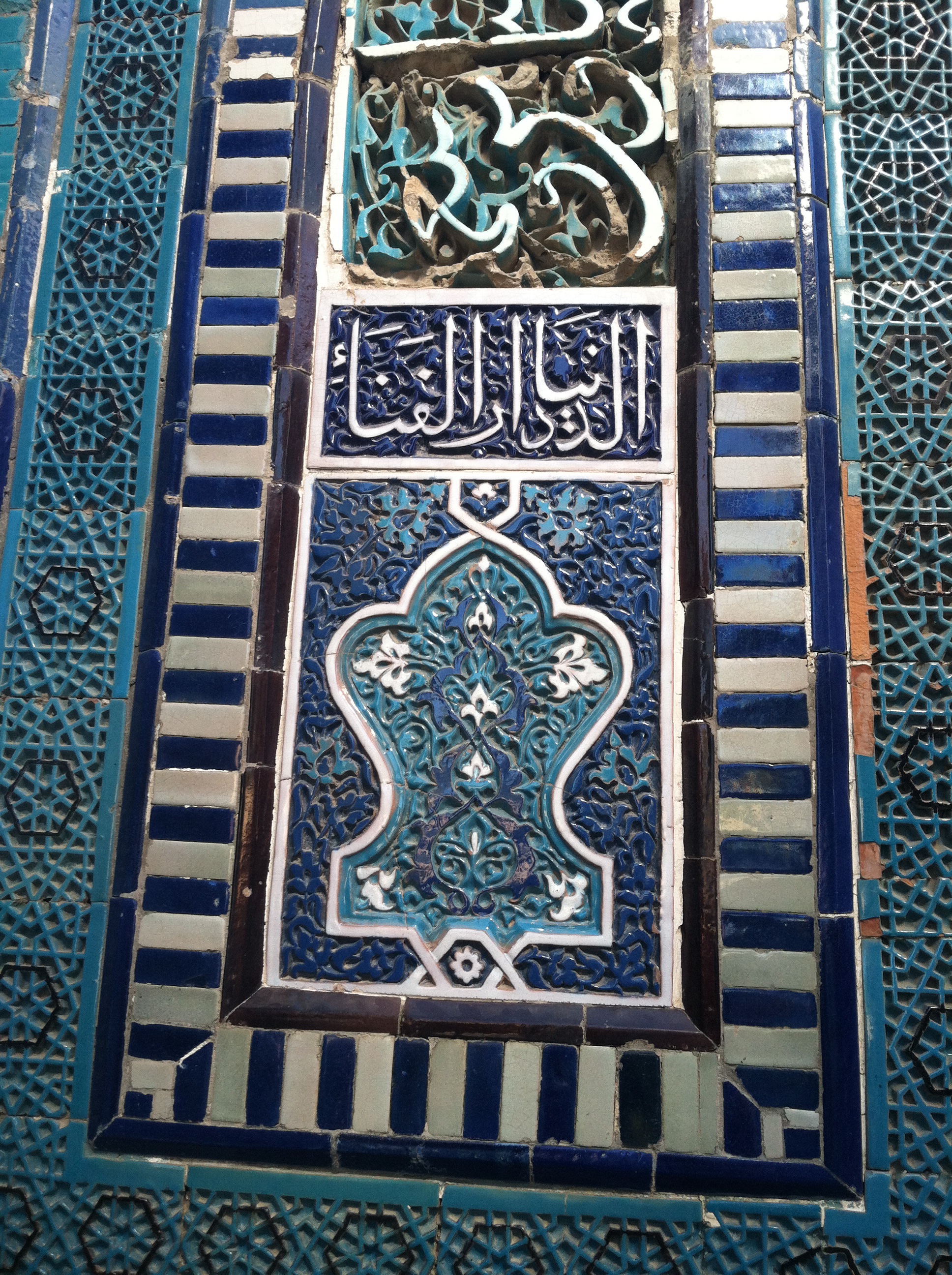
3. “The City that Defies Death” consists of mausoleums dedicated to dignitaries with a street connecting all of them to each other.
4. A decorative ceiling inside one of the domes.
5. The stalactites in the corners between the dome and the wall reinforce the dome support and provide clever decorative element to the room.
6. another dome interior, with more cobalt blue coloring.
7. Beginning of Chinese influence with fritted wood panels over windows and wall paintings
8. Detail of stone Arabic lettering before tiles replaced in between
9. Another wall detail showing intricate floral, written and geometric patterns
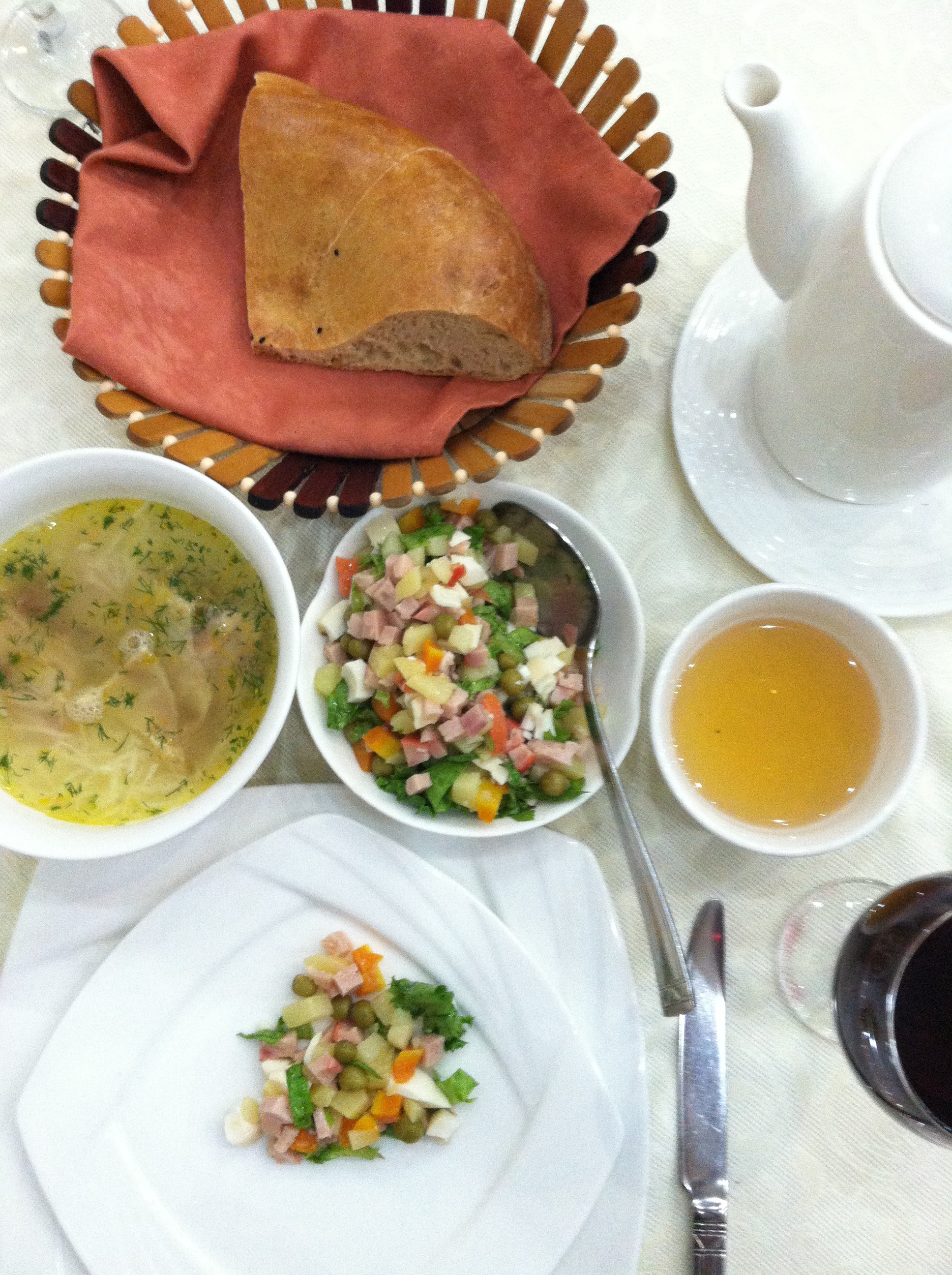
1. Similar to last nite: starter of veg salad with succulent carrots, fresh peas, bits of boiled egg white, tender potatoes, fresh lettuce, lightly flavored oil and lemon with dill–deliciously recognizable elements; chicken soup with fresh chicken chunks on the bone with rice noodle and dill; tandoori bread, and jasmine tea in chinese soup bowls. And yes, dry red wine. I could eat this as an entire meal!
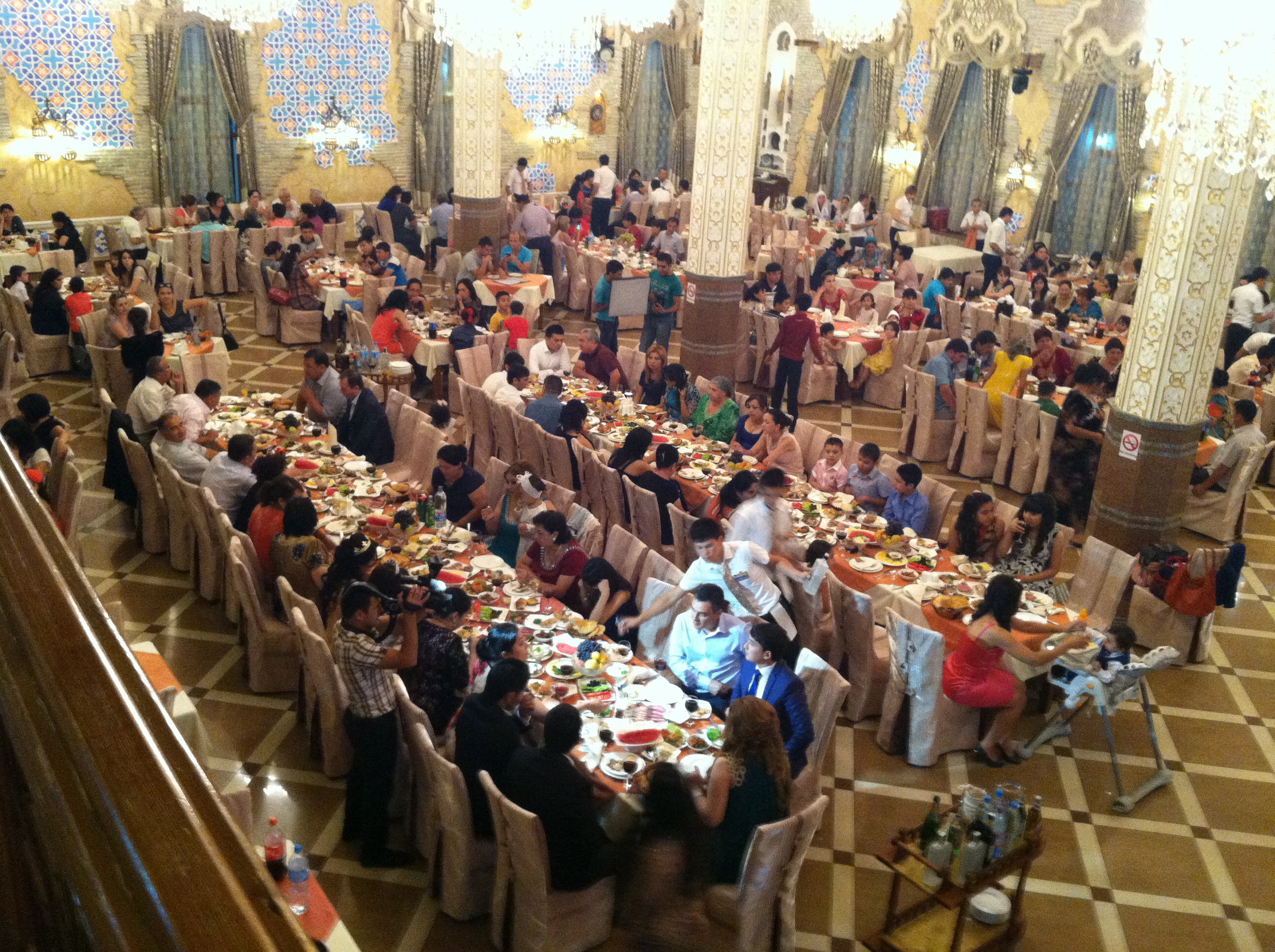
2. sorry, not my party. A banquet downstairs, with typical Uzbeki music and food.
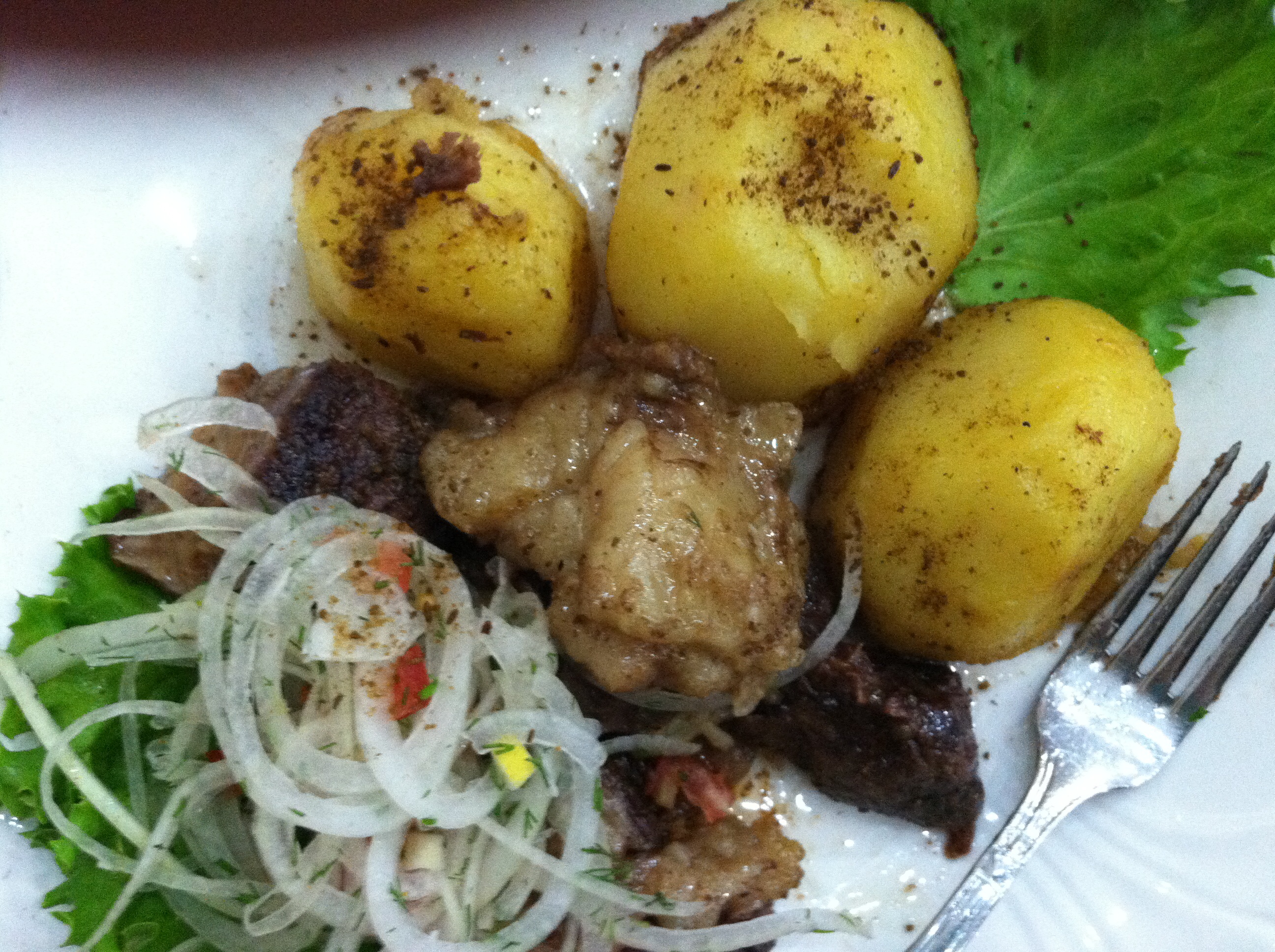
3. Perfectly braised lamb and potatos with lamb fat and marinated onions in lemon and dill on the side–piping hot and cooked to perfection–at the Samarkand Restaurant not far from my hotel.
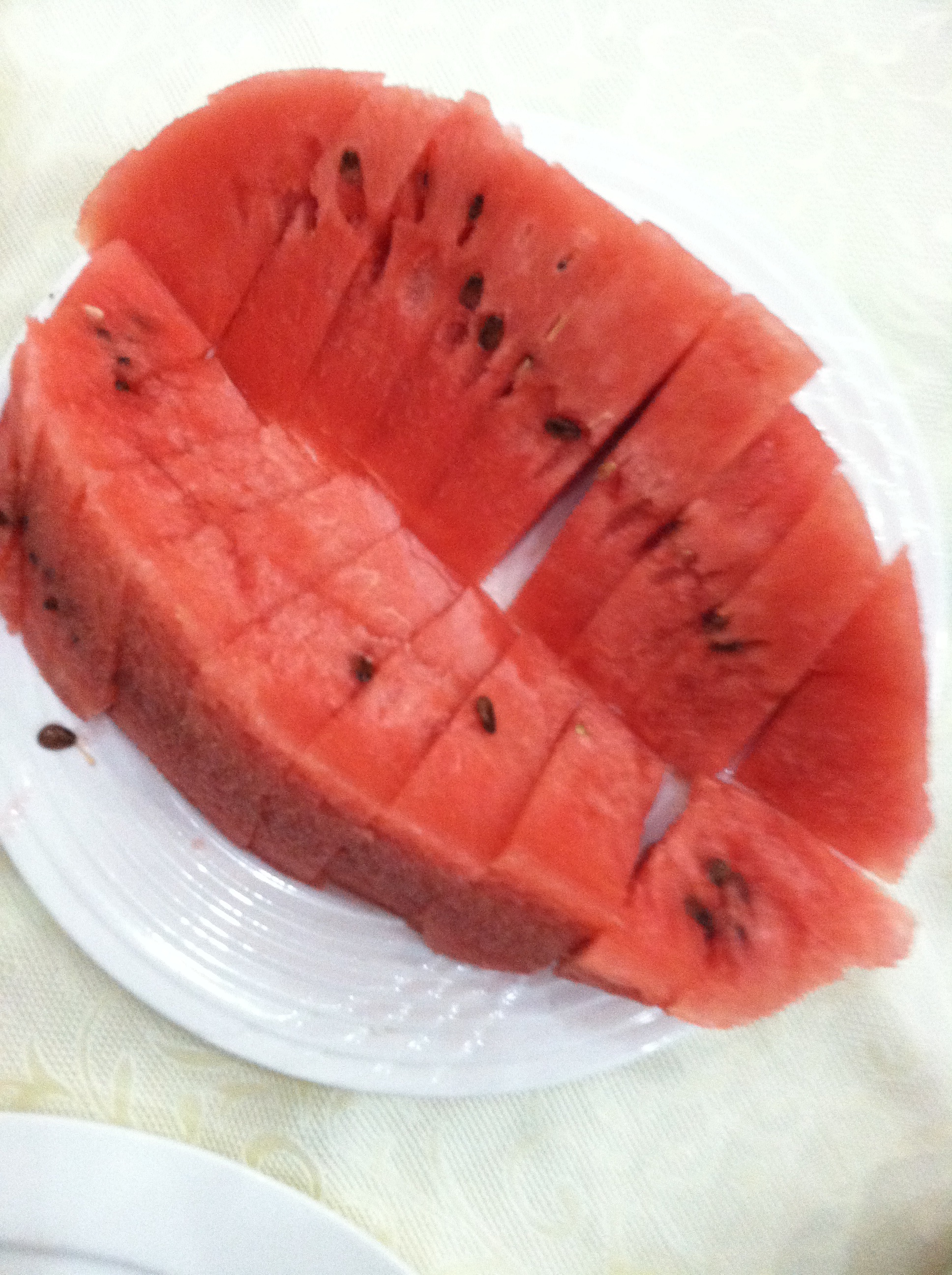
4. A whole half from the market the day before just for me! Why haven’t the Chinese figured this one out?!?

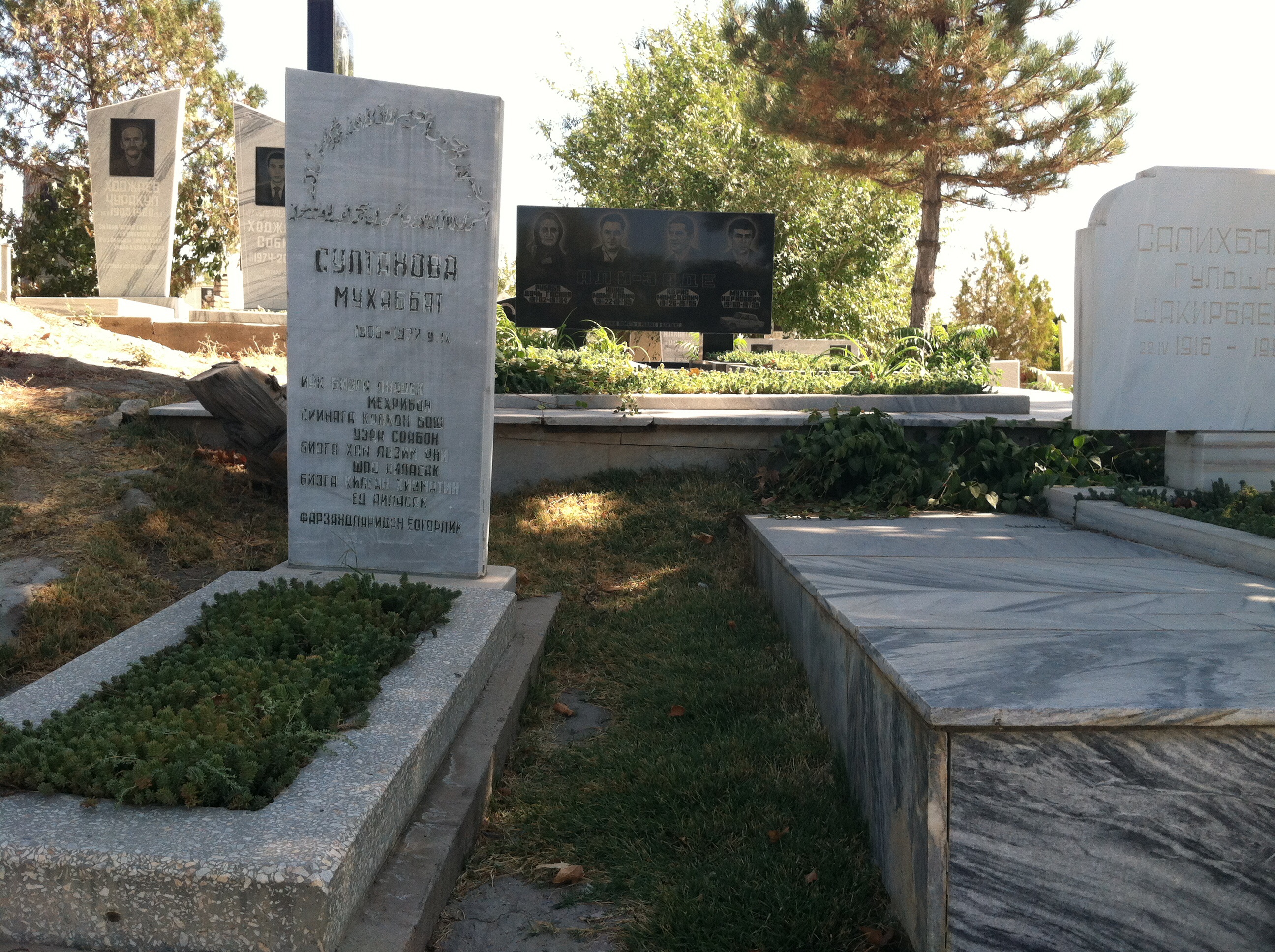
On the back of the low hill where the Mausoleums were clustered, was a contemporary cemetery. It proved to be a fascinating portrayal of how a society sees itself. The families of the recently departed wanted to make sure everyone knew how prominent their deceased relative was. Photographs are etched into tombstones: images of husband and wife, generals, academicians, politicians, and even a family of four caught in a car accident, all with the same date of death, left you with an empty feeling that you might have known these once alive individuals.
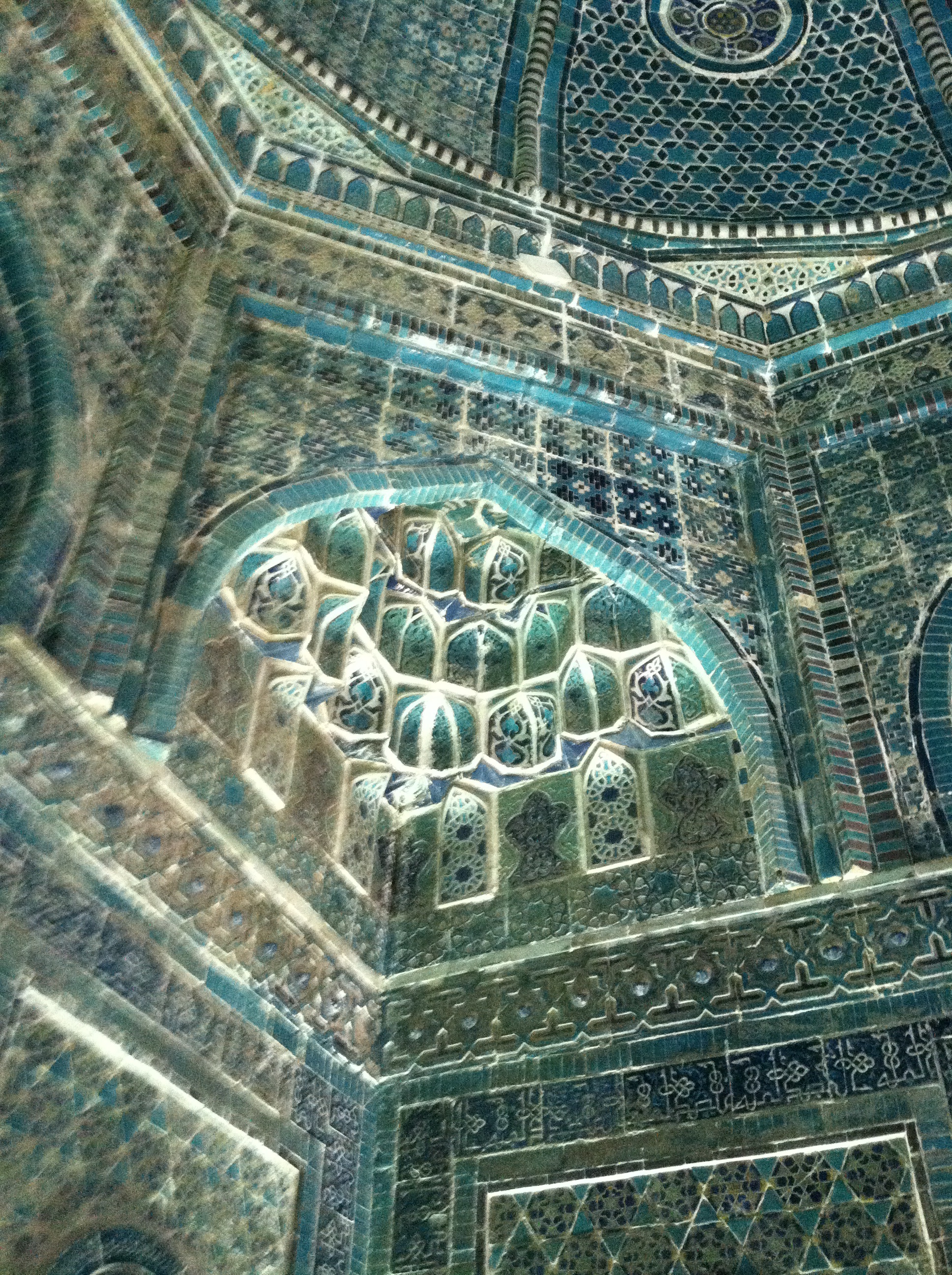
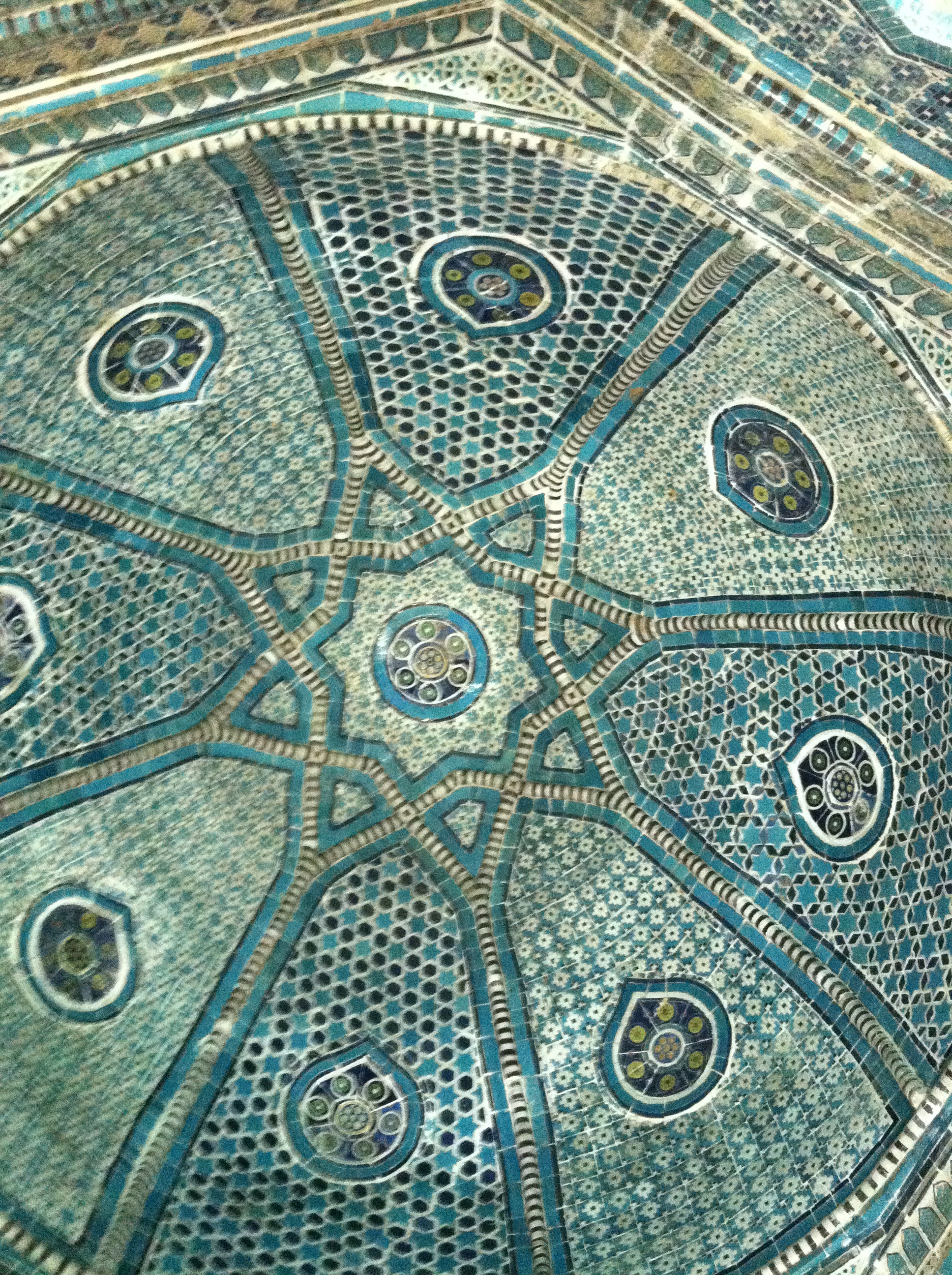
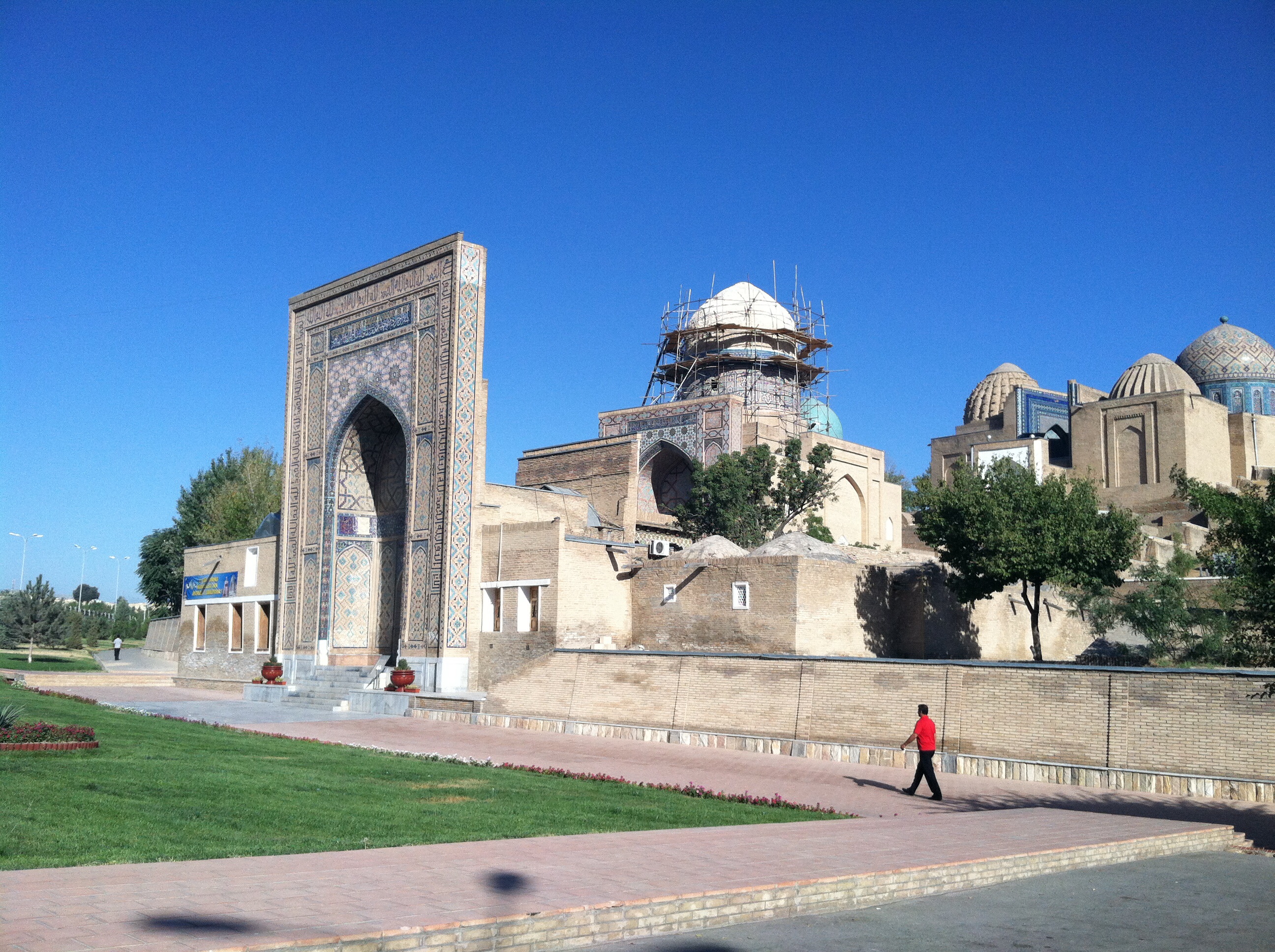

Memories of Days Gone By
The Afrasiab Hill consists of a series of mausoleums developed between the 12-15th Centuries to dignitaries who lived in Samarkand. They were designed by architects and ornately decorated in a variety of stone carvings, mosaic patterns, and exposed brick.I felt like I was seeing all the European Gothic cathedrals all in one city. It’s no wonder so many pilgrims made their way through to Samarkand just to see so many beautiful buildings in one place.
There are many beautiful and moving stories about captured princesses and war campaigns plotted and lost. Some of the passion and beauty of the period are depicted in the intricate tracery patterns that are all different. The inscriptions appear to be wise, cautionary, and quite mild mannered and respectful of the multiplicity of religious beliefs at the time of Timur (ca. 1400), who was working on promoting Islamic religion.
Photos, from top:
1. Decorative tiles on interior
2. Detail of Dome
3. Entrance to complex on the Afrisaib Hill
4. Detail of exterior cut stone and mosaic tiles
5. Exterior view from back of hill


Photos, from top:
1. Can you believe these yellow figs???
2. Bread baked in a tandoori oven
3. Spice Seller
4. Yogurt selection, one regular, one with dried red tomato and spices
5. Yogurt Balls

 travelswithmyselfandothers.com
