Midway between Tehran and Isfahan lies Kashan. One of the UNESCO World Heritage sites, the Fin Garden highlights traditional Persian landscape design with fountains, channels and reflecting pools. These design principles trace back to the 6th Century and Cyrus the Great.
Local tourists love to visit these parks. On a particularly busy “weekend” Friday, the sites were crowded but the feeling was festive. Persians are courteous and never pushy, so it always seems like you are part of the public experience, not against it. Each person, including you, is entertainment material.
Fin-e Garden, Kashan
We stopped for lunch at a restaurant where large divans or platforms shaped like a huge sofa surrounded by a low back/barricade offered guests an alternative to traditional tables. The design defined a semi-private space, where groups or families could sit cross legged, enjoy the food, but not miss out on the activity outside their spaces.
The nearby town housed merchants who became wealthy from the textiles, carpets and tile produced in the area. Door knockers on a pair of entry doors differentiated men from women arriving by the sound of the knock. That was a pretty ingenious communication device!
Tabatabaei Traditional House
Tabatabaei Traditional House
Tabatabaei Traditional House
Tabatabaei Traditional House
Tabatabaei Traditional House
Tabatabaei Traditional House
Tabatabaei Traditional House
The local bath house was an important community space and lavish design details encouraged members to use the club’s facilities!
Bathhouse, Kashan
Bathhouse
Bathhouse
I couldn’t help but to continue a few of my forays into people pictures. I was starting to get really comfortable doing this, again because the faces of the individuals are so engaging and CALM. Young girls may be a bit giddy, but overall everyone whose pictures I took were inviting, elegant and never intimidated or negative.
Below, here’s a video of the adorable little girl shown above:
Isfahan represents one of the great architectural cities of the world, and now I know why. The magnificent scale of site planning, building design and decoration are fully integrated. Many of the civic buildings surround what used to be a polo field and display the pride and beauty of Persia. (Yes, Persia and Iran is used interchangeably).
Mosque, Isfahan
In the 16th Century, the Safavids defeated the Ottomans. During this triumphant period, Shah Abbas developed this square, which is the largest in the world. Islamic art and architecture flourished with distinctive elements. The public Mosque with twin towers dominates one end of the square. The architect’s signature is written on a tile discreetly placed to the side of the building. It avoids the front face and competing with the orientation towards Mecca. If only all architects were as humble!
After designing and building the Mosque, which is now a UNESCO World heritage site, the architect went away and returned after six months. He managed to convince the king that he was waiting to see whether the massive structure, with all its solid stone, brick and tilework, would cause settlement. (Yeah, right!!)
Everyone was relieved that it hadn’t, and the architect could still get his tea in Isfahan. Maybe the architect and structural engineer for the Millennium Tower in San Francisco were taking their sabbaticals before they got the bad news.
Architect’s Signature
To the side is the private mosque, known as the Shah’s mosque. Daylighting illuminates verses on walls. As the sun rotates and casts light on various exposures, appropriate poetry is spotlighted naturally. The inside of the dome is also decorated with flecks of gold to cleverly simulate a spotlit tromp l’oeil effect.
This is only a glimpse of the many beautiful buildings with intricate floral tilework and awe-inspiring domes that are signatory to Isfahani architecture. The Shah’s Palace contained a music room with deep cutouts that made you feel as if you were inside a gigantic violin. And the Entertainment Center for the Shah displayed beautiful period paintings. While depiction of human figures was not allowed, these paintings represented non-Muslims such as Georgians or Indians. Some faces on the paintings were later marred or removed.
Persians enjoy strolling in the world-famous gardens built on the desert oasis and along the Zayandeh River. Sadly, the river is dammed to provide water to Yasd and farmers in the desert and as a result it runs dry. The Khaju Bridge that originally spanned the river is used as a leisurely stroll for Isfahanians. Local singers gather under the bridge to spar with other talented folk opera afficinados. Here’s a short video of one of the talented regulars:
While I normally focus on historic architecture and museum artwork, this trip has engaged me in taking more photos of people in the streets. I have not been shy about asking for posed photos of strangers, because they are universally handsome and graceful in their poses and demeanor. You can’t help but want to capture some of this spirit that delights visitors to Iran and endears you to the people.
Our itinerary, in case you missed it on the map and on the World Travels 2018 page of https://travelswithmyselfandothers.com, started in Tehran, then south to Shiraz. We are plying our way north to Yasd, Isfahan, and back to Tehran.
Apparently the hottest place on earth is in Iran. Fortunately, it wasn’t on the menu. We got the details from our guide as he drove us from Yasd to Isfahan. A year ago, he took a couple of people out to see sand towers that appear like high rises. He reported to the police before entering the desert and notified them that he and a tourist couple were entering the zone. If you go missing after an hour, they come to get you.
They each brought a bottle of water to drink. On arrival he began to feel faint and told the travelers that he had to leave right away. He found out afterwards that you need to drink water every few minutes in order to stay hydrated. Food shrivels once it hits high temperatures of 76 degrees C. (equivalent to 167 degrees!!)
Driving through in the car reduces some of the effect until you get out. Abdullah had the AC on but the wife insisted on having full effect of windows open. He tried not to think what would happen if his car broke down as he seldom saw anyone on the road returning.
The second time, he accompanied two male travelers who wanted to get their thrills as extreme sportsmen. Once they got in, they encountered a sandstorm, that can last anywhere from 20 minutes to an hour. Fortunately, they were on the edge of it and after it blew past they were able to see what they wanted. They tried dripping water on the stones to watch how fast the water would be sucked dry. Others were frying eggs.
He has returned the second time to be ready to escort any of you for his third foray to a place that’s hot (literally) on the adventure trail. Sorry that this is only a second-hand story, but if you are interested in more, you can go to https://www.livescience.com/19700-hottest-place-earth.html for another great story about the Lut Desert in Iran.
Speaking of water and lack thereof, here’s a picture of the water bottle we recently purchased. Being a Muslim country, Iran does not allow liquor to be drunk or sold. This plastic bottle is shaped like a flask of liquor, or even worse, it makes me think of some toxic lighter fluid or cleaning alcohol. Its shape can’t be understood, but it seems to make sense for grasping (or gasping) purposes. Maybe drinking from cases of these will be part of the desert ritual as the Rime of the Ancient Mariner searches for those precious drops.
Only 2 days left of blissful travel in a clean country with exceptionally kind and handsome people with a deep sense of their history and humanity.
Here’s a bonus video of delightful young, uninhibited girls playing in the evening. They capture the spirit of a safe and secure life. This was taken in a shopping area around 10pm at night. I feel far safer here than any country I have ever visited.
Error
This video doesn’t exist
(This post was created on April 18, 2018 and edited April 22,2018.
At the Temple of Silence, members of the Zorastrian religion placed their dead at the top of a mound and left them to the elements and vultures to decompose. After that, they treated the bones with alcohol and burned the remains.
The Temple of Fire was built to commemorate the Prophet Zarathustra. As head of the Zorastrian religion, he professed kindness and goodness to all. What was more interesting and an “Aha!” moment for us, was that “Thus Spake Zarathustra“, written by Richard Strauss and the theme song from “2001, the Space Odyssey”, originates from this prophet’s words and teachings. Zorastrianism was one of the first monotheistic religions in the world.
Bagh-e Dolat Abad, Yasd
Temple of Fire, Yasd
Zorastrians were also present in Hong Kong. I used to pass the Temple on my way to work and wondered who the members were. There are only about 200,000 members of the religious group world-wide, among which 80,000 or so are South Indians. Their presence in Hong Kong stems from the Indian population that lived there since colonial times. I can finally rest my curiosity over who this group was and where they came from.
The Friday Mosque
As in all mosques, the mullah, or head of the temple, conducts the ceremony facing Mecca, while the worshippers are aligned in rows behind him. They are encouraged to attend the mosque five times a day in groups, but more importantly on Friday, the holy day of the week. The worshippers are called to prayer every day, including before sunrise and at sunset.
The twin minarets or towers of Shiite mosques come in pairs, like this one, or in fours on the corners of a square. These are over 70 feet high and the among the tallest in Iran. Sunni minarets have one, two or even three asymmetrical towers, so you can easily differentiate which sect of Islamic religion each mosque represents. The architect of this mosque built the first minaret, and commanded his top student to build the second one. The precocious student followed his master’s design, but built two double-helix staircases to the top inside instead of the single staircase in the first tower.
Ice House and Caravansery
The ice house was a clever way to provide refrigeration in the blaring desert heat. The dome over the pool where the ice was kept allowed heat to escape through the opening at the top. The space below where the water was originally kept is now empty, but it creates an acoustically perfect space. Our guide was barely whispering in the video below, but you could easily hear his song from wherever you were standing. (Please turn up the volume to full blast if you want to hear the song more clearly)
Heading towards Isfahan, we stopped at an authentic Silk Road Caravansery. The traders and their camels rested and recuperated here, and rest stops like this are considered one of the first hotels ever established! The camels were parked in the courtyard, traders used the rooms facing the courtyard, and the hired help hung out in the dormitory space on the outer ring of the courtyard.
Water was transported here from underground canals or wells. The pools provided cool spaces (literally) to escape the heat. Washing and drinking water was stored separately from these submerged and naturally lit chambers. In this part of the world where drought is a daily worry, water was carefully stored and managed. Shops and local handicrafts are sold now in the courtyard. Our guide Abdullah, showed us his newly purchased solidarity scarf.
After a few days of jet lag, weather changes, and internet hell, we resparked our curiosity and thirst for the unknown. We visited museums, mosques, and even a madrassah, but no mausoleums yet. The last three m’s were the order of the day for Islamic architecture during my visit to Uzbekistan, but there no indications of that being the same here.
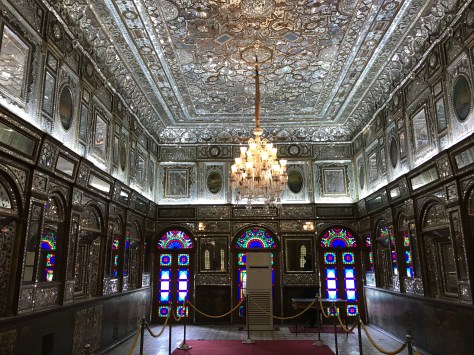
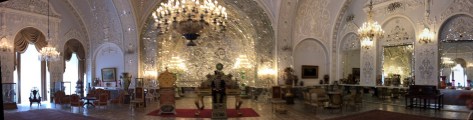
At the Golestan Palace in Tehran, a World Heritage Site, the pre-Pahlavi royalty (within the last 150 years) displayed their wealth and were over-the-top ornate. Most of the public rooms including the ceilings were covered with intricate mirror mosaics and made you feel like you were inside the Hope Diamond.
Interior with Mirrored Ceilings
The exteriors demonstrated the integration of gardens and fountains that are
famous in Iranian architecture and design, as well as the intricate mosaic work and marble carving on doors and walls.
Exterior Stonework
Garden
Reflecting Pool
The National Museum of Iran contained some of the most precious relics of the ancient world. The statue of Darius I (Xerxes I, from which an opera is based!) and a panel from the Achaemenid Period in Persepolis are shown below. For those interested, you can scale up the text included in the adjacent photos.
The bazaars in both Tehran and Shiraz contained endless boutiques in a Walmart-sized atmosphere with limited and inexpensive goods from copperware to aromatic spices.
Shiraz
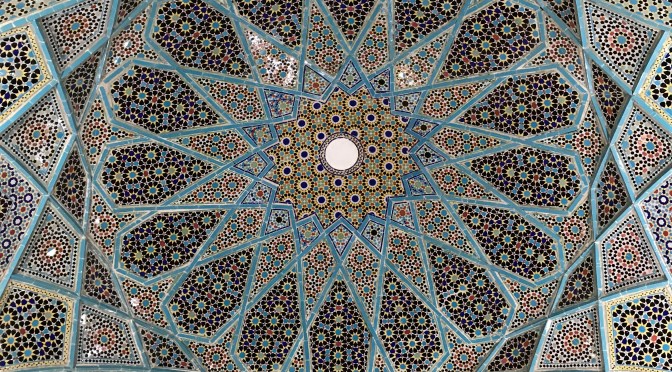
We bonded with our local guide from Shiraz after he passionately described Iran’s native son and poet, Hafez. His elegant poems are beloved by all Iranians and transcend cultures. F. Scott Fitzgerald and Goethe were known to quote his poetry. It was enough for me to determine to read some when I get home.
As we stood in the garden of the tomb of Hafez, Abdullah, our guide, explained that Shiraz is known for its wine, women, and roses. Many of us will recognize the famous wine namesake that comes from this region.
tomb of Hafez
Gardens at Tomb of Hafez, Shiraz
In the evening light, Abdullah pointed out the abundance of young couples strolling in the park, with flowers intoxicating the warm breezes. Knowing a little or a lot about the poetry of Hafez is enough to start amiable conversations and the start of a promising relationship, Abdullah surmises (maybe from experience?)
While Abdullah waxed poetic, we observed that families were out selfying just like any other society, enjoying a delicious evening, and lingering among crowds of friendly visitors.
There seems to be tremendous respect for fellow humans in Iran. So far, we have found the urban environment remarkably quiet. We stayed on busy streets in two cities and found the traffic unusually quiet. Being highly sensitive to noise, I am finding the calm, lack of noise shattering to my ears.
People glide about the streets, smiling at one another with eyes and lips, and salaam each other without exception. I’m not sure our guide has coopted us, but we sense the immense pride and confidence in the people.
Persepolis:
Just outside of Shiraz, on a wide open plain, lies the ceremonial center of Darius. Before him, Cyrus the Great created and led an impressive empire. The wooden ceilings of buildings and both palaces of Darius and his son built around 518 BC were later razed to the ground by Alexander the Great (around 330 BC), but the massive stone structures with priceless carvings remain.
Persepolis
After just having seen the great empires of Rome, Greece, Inca at Macchu Picchu and Aztec in Teotihuacan, it’s hard not to be impressed by the volume and quality of artwork in situ at Persepolis. We could not believe how much of its splendor is still present for the whole world to appreciate.
Were it not from my earliest art history lessons on ancient civilizations and curiosity on its context and meaning, I would not have made this trip.
Everything begins to fall into place, as the pieces of the puzzle assemble. My scant preparation for this trip, thanks to Francopan’s Silk Roads, a New History of the World, captures the whirlwind tour through the rise and fall of Eurasian civilizations. Iran, and more fondly, Persia by the same name, stands prominently at the helm of the Silk Road.
The artwork at Persepolis chronicles the peaceful arrival and acceptance of the local inhabitants to the new ruler. Darius followed shortly after Cyrus (within 40 years), and while not a direct descendant, they were related. Although the local Medians were conquered by Cyrus and the Archimineads, he managed a peaceful settlement and was respected for his accomplishments as a capable ruler. Darius culminated the dynastic rule with his grandiose and impressive complex at Persepolis.
Within the ceremonial entrance and grand reception areas are magnificent stone reliefs of warriors supporting the king on his throne. Rows of roundheaded conquerees alternating with the conquerors proceed to meet the king, hand in hand. Offerings from 23 nations include food, treasures and animals from surrounding areas and those as far as India.
Other friezes demonstrate the high quality of craftsmanship that preceded the Greek and Roman periods revered in history. In a splendid exemplary frieze, a bull and cow signify the end and beginning of the new year.
The symbolic meanings of birds, rings and flowers stem from the ancient monotheistic Zoroastrian and Mithras religions. They did not have a concept of God as a human, but that he lies within each of us.
Individually the symbolism of the characters presented are less significant than the collective splendor of the human mind that is left behind for all of us living creatures today to ponder.
(This post is now formatted as intended. It was created on April 17, 2018 and edited April 22, 2018).
With all my worldly possessions-and a precious visa to visit in tow, husband Gee Kin and I have just arrived in Tehran, the capital of Iran. We left behind the globalized world of Starbucks, KFC and Macdonalds, to one with brewed tea, fast food chicken legs roasting on an open fire, and lamb kebabs with bread made with pebbles for dimples. We passed tantalizing corner stores filled with pistachios and dry fruits that you buy to take to a friend’s house. Hospitality means alot here, and we can already feel it in the air.
Having just completed a marathon flight in 19 hours (San Francisco-Washington DC-Vienna-Tehran, I was glad to hit the end of the day with a hearty meal of lamb stew mascerated at the table and mixed into a tomato based soup, chicken and lab kebobs, saffron rice, yoghurt dressing, a vinegar-based eggplant sauce on the side, and bread.
Everything is not so different at first blush. Getting through immigration was a breeze and easier than stateside! Tehran has about 9 million people living here, with the active daily working population at around 14 million. Iran is a country of 80 million, about the population of Germany. The mountains just outside of Tehran are over 5,000 m, so skiing is a big attraction for tourists, who normally come from Germany, France, and Italy, but more recently even from China.
Stay tuned for more to come in art and architecture in Tehran and Shiraz, our next stop.
(This post is now formatted as intended and was created on April 15, 2018)
Last week’s challenge to draw 100 people in five days was exhausting but satisfying! It took a bit of planning, but I managed to stalk strangers at the following locations:
1. City College of San Francisco students;
2. UCSF Osher Mini-Medical School evening class;
3. Hollow Cafe on Irving Street, San Francisco with fellow artists Karen and Lorna (in sketches), and Farley’s Cafe on Potrero Hill, San Francisco
4. Sunset Library, Adult and Juvenile Divisions
5. BART late-nite transit passengers and SFO International Airport
100 People 1 Week Drawing Challenge
Budding sketch artists will tell you that stationary models are the best for sketching purposes. Subjects who move around are at free will to ruin your intentions! The worst were those at the airport, who were already crazed and erratic in behavior. The ones in classes were probably the easiest to draw. If you haven’t ever tried it, give it a shot! It keeps you focused and out of trouble.
In order to learn more about developing sketching techniques, I joined the San Francisco Sketchers. There are normally two to three meet-ups a week. The last three included drawing during the preparations for the Chinese New Year Parade, the Annual History Day at the U.S. Mint in San Francisco, and a portrait party.
Left hand gestures, 30 seconds
Domnant hand gestures, 30 second
Last week’s portrait party hosted by author Julia Kay required us to draw each other in small groups of 4-6 sketchers. We started with a 30 second blind gesture using our non-dominant hand, then with the dominant hand. Portrait sketches, as the one you see in the header, were 10-minute sketches. Totally fun, especially getting to see other interpretations of you, as well as of others in the group.
I will continue to draw, especially during future trips. It gives you an entirely different memory experience and way of looking at things.
By the way, take a look at my newly posted world trip 2018 page (on the menu at the top) for details of my upcoming travels!
Having visited many fine museums throughout the world and being an avid student of art history, I enjoy venturing beyond the usual Eurocentric and Asian collections to investigate Islamic Art. I also like to pair my interest in art with world history and Silk Road civilizations. I am currently reading The Silk Roads, A New History of the World, by Peter Frankopan. It was recommended to us by Oxford scholar Craig Clunis. It turns traditional thinking about world history on its head and is a fascinating read.
My quest for understanding the Silk Road was initiated a few years ago during my first world journey in 2014 through Northwest China and the relatively untouristic path from Dunhuang through Turfan and Urumqi to Uzbekistan (See World Travels 2014 Page). My current personal research on Iran at the opposite end of my initial travels on the Silk Road (originally named Seidene Strasse by a German academic) will hopefully culminate in a trip to Persia in the near future.
I couldn’t resist a stop at the Metropolitan Museum’s expanded and comprehensive collection of Near Eastern Artwork. I two-timed the Michelangelo exhibit, the primary purpose of my visit, that I saw with my sister in New York last month. The section includes an entire room with a soothing trickling water fountain and narrowly proportioned, elegant tracery windows made to simulate a traditional courtyard. Selected items in the collection are below, some with captions (but not all) .
Folio from Anonymous Baghdad Qur’an 1307-8
As a design major in my undergraduate days at UC Berkeley, I learned Western calligraphy styles, such as Carolingian, Uncial, and Gothic. I couldn’t help but want to master the Islamic calligraphic style that now suddenly appeared so beautiful and balanced to me. Of course, learning how to read it would be part of the goal, a simple feat…
My earliest curiosity over the wide stretches between Asia and Europe came from specific designs of “Oriental” carpets, such as Bokhara, Tabriz, Caucasian, and Isfahan. I had no idea what they meant. Lo and behold, the places where they were made exist, or once did. It was exciting for me to discover that Bokhara and Samarkand in Uzbekistan were also UNESCO world heritage sites.
Below are a representative collection of carpets in the Near East Gallery at the MET. The weavers of the Anhalt Medallion carpet (2nd from the left below) followed a paper cartoon in creating the design. The carpet is derived from the Anhalt prince of Dessau, whose ancestors may have acquired it through military campaigns against the Ottoman Turks in the late 17th C.
The Anhalt Medallion, Iran, first half of 16th C.
Porcelain was a coveted item from China. In addition to silk, these goods pwere transported along what became the Silk Road. The Sogdian traders based in Samarkand were the kings of the highway, and were adept at managing, bargaining and anticipating desirable goods along the route. In turn, cobalt and copper were brought from the Near to the Far. The beautiful calligraphy and inscription to the bowl below reads “Planning before work protects you from regret; good luck and well being”.
Bowl, Iran, 10th C.
Iran, Kashan, mid-13th C.
There were only a few sculptural ceramics but I particularly liked the whimsical and creative “bird woman” shown below.
Predatory Bird, Iran, 12-13 C.
I’m including a few of the beautiful floral-themed beauties that I discovered at the Grassi Museum in Leipzig (descriptions are in German) below, to compare with those from the MET.
The featured map above also comes from the Grassi. I could stare at maps like these forever, to contemplate and realize how little we know about the vast array of significant dots between Europe and Asia. You can’t really study the Silk Road without knowing the key place names that put them in time and order!
As an earnest and diligent student of figure drawing, I followed my art instructor’s recommendation to see the Michelangelo exhibit at the Metropolitan Museum in New York City. The drawings are culled from multiple collections, both public and private, throughout Europe and the U.S. I was enraptured by each contour, hatchline, and the shade and shadows that created three-dimensional images on a flat piece of paper. These magical acts come from a discipline unmatched by any other since Renaissance times, and I was able to view these hundred or more performances all at once.
I first joined an exclusive after-hours evening at the Met to digest and sip the information slowly. The next morning, with a courtesy admission, I was able to quickly document the exhibition so I could later savor this encounter with Michelangelo.
Here are a few visual highlights with associated text from the exhibition. They are annotated in the order that resonates the most for my interest in figure drawing:
Portraiture
The Human Figure
Early Precedents: These show how and from whom he learned. The white highlights on tone paper provide contrast and depth to the drawings.
Painting Preparation and Students
Architecture
Sculpture
Brutus
City Planning
There’s still time to see this magnificent exhibition until February 12! If you are unable to attend, I invite you to please study and relish these reproduced copies carefully. In order to share these in a timely fashion, I have not captioned or annotated every image. I hope you will nevertheless catch the whiff of Michelangelo’s development, intentions, and success. We should appreciate the wealth of information we now have at our disposal. The contributors to the exhibition are listed below. Congratulations and thanks to the Metropolitan Museum for this incredible effort.
Coming to New York in the middle of the winter sounds like a crazy thing to do, but we did. It started as a nippy 18 degrees in New York, but so far it didn’t deter any plans or ability to walk outdoors. In fact, the noticeably fewer tourists, being able to get into restaurants and museums easily, and bargain hotel rates were all incentives for risking unpredictable weather. I came with my sister to show her all my favorite sights that include the Highline, the Mighty Mets (Metopera and the Metropolitan Museum) and the Museum of Modern Art (MOMA).
We power-walked the first morning from Midtown Manhattan and bee-lined down Third Avenue to Balthazar (shown on previous posts) for a brisk three-mile stretch, then made a quick stop to see the 911 Memorial. The fountain, a bottomless pit, was a sobering reminder of that fateful day that changed America and the world forever.
The new highrise developments in the area are stunningly beautiful, including Calatrava’s Transportation Center (also in header above). We headed over to the Highline afterwards for another short walk from 23rd to 34th Streets. Being able to walk everywhere is heaven, and staying in Midtown Manhattan makes everything all the more accessible. We clocked an average of 5-7 miles per day, so felt alert and energized.
My dear friends Lisa and Dick, who have been residents of NYC for over 35 years were ready to assist with event planning. We started with dinner at Le Bateau Ivre downstairs from the Pod Hotel, tasted wine from the Chef & Sommelier glassware they brought to show us, then met the next evening for opera. Lisa was a bit skeptical of long, drawn-out operas that last well into the night, but the two short, hour-long verismo operas Cavallera Rusticana and Pagliacci were perfect to convince her that opera is a worthy investment. The music is among some of the most beautiful in opera, so there wasn’t much convincing to do.
Starring Roberto Alagna in both operas, they were emotionally satisfying and the music was glorious. His performance was bright and powerful. The story about a vaudeville troupe is a play within a play. Canio, the clown, whose wife is in love with another man, must perform his comedy act for the audience even though he is heartbroken inside. In an interview with Roberto Alagna, he commented on how relevant the story is to opera performers, but how unique it was to be sharing the lead roles with his real-life wife, Aleksandra Kurdak. (She played Nedda, Canio’s wife).
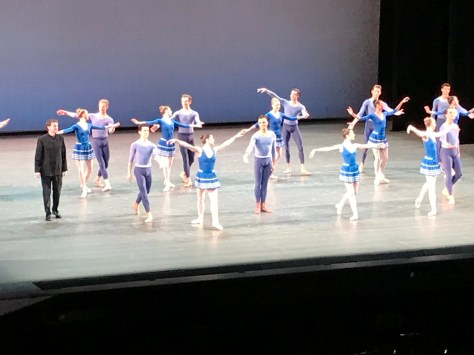
Later in the short week, we were also treated to a performance by the New York City Ballet. This time it was my turn to experience and appreciate dance through the joy of physicality combined with artistic talent.
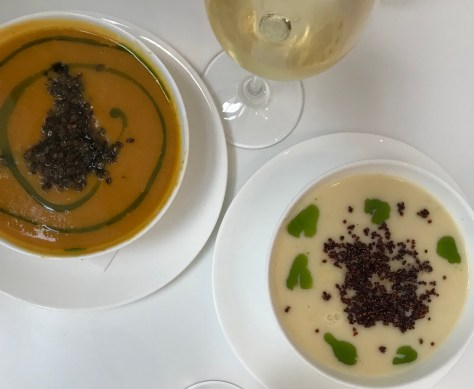
In addition to Balthazar and Ess-a-Bagel, our dining events include Bar Boulud and the Smith (both conveniently next to Lincoln Center), and Pastrami Queen at 1125 Madison Avenue on the Upper East Side. Some creative soups at the MOMA cafe filled both our eyes and appetites.
When you can park yourself at one of New York’s best kept secrets–the Pod Hotel (at 230 E. 51st Street, between 2nd and Third Avenues) for $75 a night for two in bunk beds with a shared bath down the hall, mingle with international visitors of all ages, and spare the rest for all the food and entertainment in the Big Apple–what’s not to like? I normally do not mention hotels in my posts, but for variety and voracious urban consumers like me, this is it. Originally called the Pickwick Arms, we’ve stayed in this location in NYC off and on for over 30 years. To top it off, the Pod serves Ess-a-Bagels and Balthazar almond croissants in their cafe!!
The extensive Metropolitan Museum’s exhibition of Michelangelo’s Drawings, culled from over 23 sources throughout the world, was my primary purpose in coming to New York City. The private tour I took will follow in a separate post.





 travelswithmyselfandothers.com