All posts by VickieVictoria

Intrepid traveler. Architect and appreciator of design, art, language, opera, history, and anthropology.

Day 60: the Great Railway Bizarre

image image image image

I’ve been traveling with Gee Kin by train for over a week throughout China and haven’t made much mention of the trains themselves except for the nice photos of the attendants on the night train from Turpan to Shulehe. Needless to say, it has been an experience. Since I was able to collect my thoughts on this next to final leg from Chengdu to Guangzhou, a 28-hour ride on my own, here are a few of them to share with you:

1. The Chinese trains have a few sweet touches, like flowers in the compartment, a thermos for hot water (for the instant noodles that everyone brings), table cloths, and drapes that the assistants come in and close for you at night. They also have a waste basket and a stainless steel tray for all the peanut shells and melon seeds that everyone eats on the trains to pass the time.

2. The toilets, well, are there. Modern ones with a commode. Use at your own risk. There’s a shared counter with three sinks. They close the facilities when the trains are inside stations, so you have to plan your strategy. These haven’t changed much since we did our Beijing-HK train ride for 36 hours back in 2000 with the girls.

3. You can buy tickets off the Internet through travelchinaguide.com.
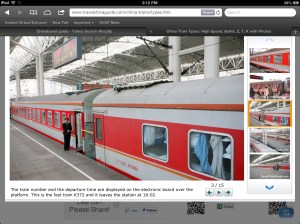
They all worked, and communication was clear. A few blips, but overall very efficient. I am attaching some photos of the K and T trains we took.
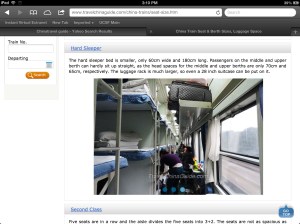
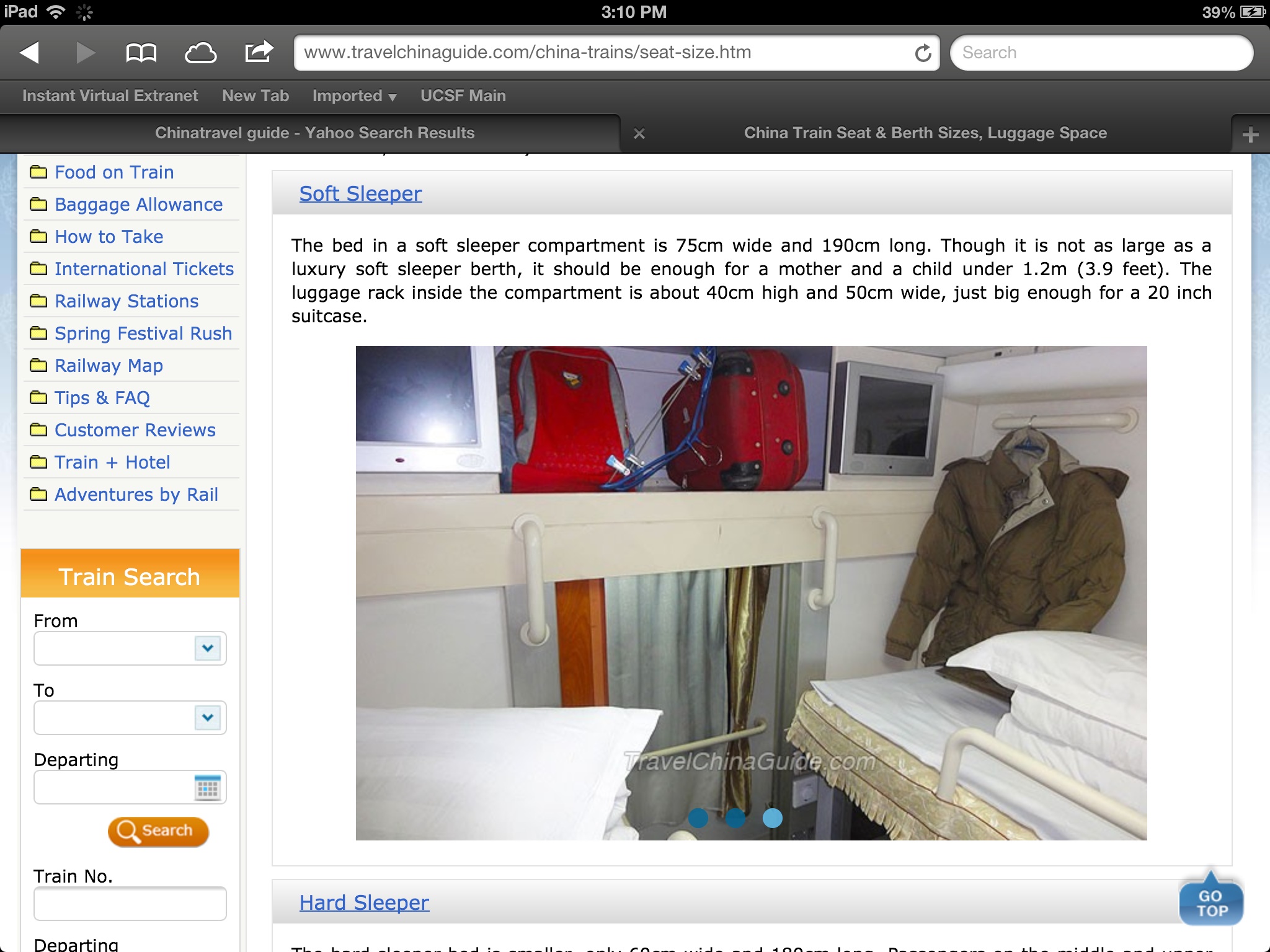
The last one was a four compartment soft berth overnighter (K), and the one Gee Kin and I took to Shulehe was a 6 compartment hard berth version (T).

4. The food service is still decent. Chinese will always manage to feed you, with recognizable elements. The dining room and the takeout food brought to your compartment were reasonable. My breakfast consisted of a hard boiled egg, chopped green beans with spices, pickled turnip, green veggie with minced meat, and congee with scrambled egg.

5. The itinerary I took from Chengdu to Guangzhou consisted of massive cities with high rises everywhere. If you were wondering where the cranes were, they are all in China. Each city is in a massive building boom. There must be more cranes in all of China than everywhere else in the world combined, or at least it feels that way. The point is that no city was recognizable by name, with the exception of Chongqing. And they were all sizeable. Where have I been??? I feel like Rip Van Winkle, who overslept…maybe 5 years?

6. Despite Chongqing whisking right past me, I did see the Chang Jiang (Yangtze River) and portions of Guizhou that were Guilinesque near Guangdong in the morning. There were still pristine rice paddies, but with high rises off in the horizon. A nuclear power plant slipped by, and many many high rises that boggle the mind. Cities the size of Hong Kong seemed to float past, one after another.

Photos, from top, left to right:

1. Breakfast in the dining car
2. aisle to sleeping compartments
3. Dining car
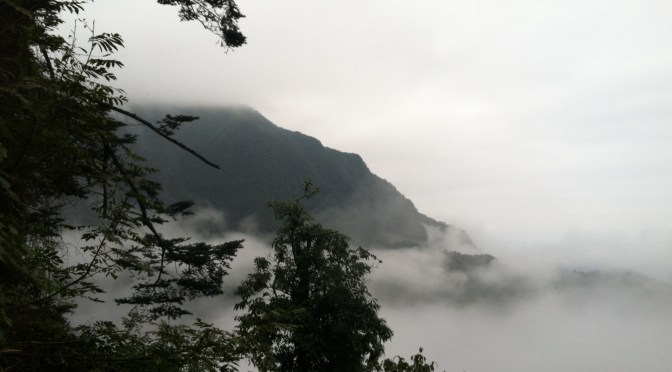
4. view of Guizhou Mountains
5. High rises in distance to paddies
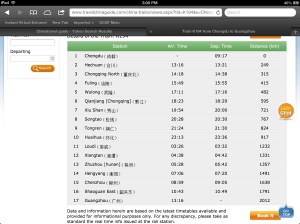
6. List of stops–most are major cities (recognize any?)
7. Screen shots of train soft berth compartment for 4
8. Screen shot of train hard berth compartment for 6 (shown earlier)
9. Screen shot of train exterior

Day 59(b): Olde World Charm on Jinli Pedestrian Street

This is Chinatown reinvented by Chinese for the Chinese. Despite being Disneylandish and very crowded, this recreation of an old street in Chengdu maintained some of its old buildings, walls and facades. It looked like a winner to the Chinese tourists, who were curious about all the vendors displaying their crafts and willing to try different food. There were plenty of demonstrations of brush painting, shadow puppets, Chinese instruments, and food preparation. I found quite a few new presentations of snacks that I had never seen before, so for me it was a worthwhile visit. And of course I was momentarily distracted by reproductions of original Chinese architectural features in the fretted windows of the shops and dining establishments.

1. Oysters and pearls
2. Jellied pudding with spicy dressing
3. Rolled rice noodles with spicy dressing
4. Bamboo with sweet rice stuffed in stalk
5. windows along restaurant
6. Hand painting
7. entrance to Jinli Street
8. vendor selling meat on skewers, dim sum and sweet rice dessert
9. Traditional windows

Day 58: …and the “Diversity in Accommodation” Award goes to….

Back in my old Campus Planning days in the 90’s, I received a dubious distinction for “Most Diverse Clothing”, and no, I wasn’t cross dressing. I could easily transform myself from slob to slick. At that time it meant wearing tee shirts before casual was in and business suits for women that weren’t dark blue imitations of what men wore except for floppy dark blue bow ties.

For this post I decided to show you the range of hotel accommodations, from Emei Shan to the following day in Fraser Suites in Chengdu.  (OK, for Emei Shan camping could be more extreme but this was in a structure–or at least purported to be one. And yes, it was in a rural, remote part of the world, with NO standards. It makes the Marriott attention to detail something you would kill for after this encounter. And there’s no comparison as far as price was concerned because we are talking two ends of the spectrum.

I never claimed to be big on luxury, but I am admittedly a bit eclectic. You can compare the living, dining, and sleeping accommodations at your own leisure. At Fraser Suites, we were able to get a free upgrade to a 1-BR suite, free buffet breakfast, and full kitchen with washer/dryer for the price of a typical chain hotel. I think you will catch the drift. The bathroom in Emei was edited so you wouldn’t see the details of the floor toilet conveniently integrated directly below the shower, but the room did have, as the Brits say “an ensuite bedroom”. We came back to Fraser Suites in Chengdu and I finally got my shower. The difference in 24 hours is what bears consideration, and what a shock it is to my system. I think I deserve a “Diversity in Accommodation Award” at least for yesterday and today.

Day 57: Scaling Emei Shan

image

At 3,000m, Emei Shan in Szechuan Province is one of the four sacred Buddhist mountains of China. We made a point to come to this area when Julianne recommended it after her trip there. Photos show some of the environment and the landscapes that “look just like a Chinese painting”…except that they are real.

Gee Kin and I climbed two of the major mountains in China in the past–Mt. Huangshan in 2000 and Tai Shan last year with Melissa, so this was our third.

Photos, from top, left to right:

1. Two wild monkeys chatting on the steps. They are prevalent in the hills around Emei Shan.

2. We stayed in accommodation halfway up the mountain in the middle of the photo. Don’t ask how we got there.

3. Xinxiang Temple

4. Along river gorge

5. Background for “a Chinese Painting”

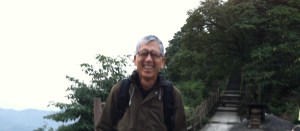
6. Gee Kin with typical steps in the background


Day 56(b): Szechuan Provincial Museum

The museums we visited are incredibly rich and excellently curated. They brought to life a renewed respect and deep appreciation for the continuity of the Chinese culture. This particular museum focused a great deal of attention on Szechuan’s formative period between the Chou and the Han periods, which were much earlier than those of other cities. The museum was laid out in sections of calligraphy, painting, pottery and bronzes.

Photos, from top to bottom, left to right:
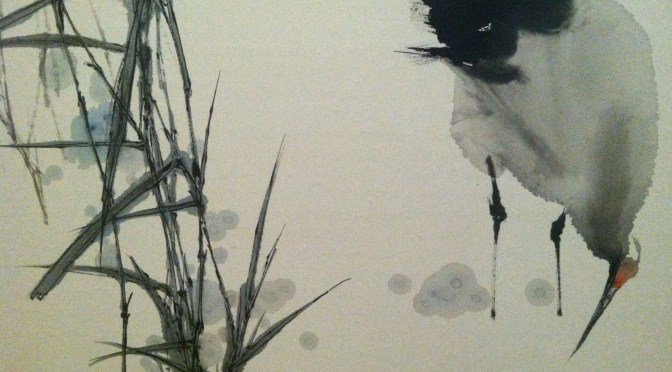
1. Contemporary painting, Red Crane
2. Contemporary Calligraphy
3. Bronze sculpture, Chou Dynasty
4. bronze bells, Chou Dynasty
5. Pottery making process
6. Han Dynasty Figurine
7. Han Dynasty Figurine
8. Han Dynasty Horse and Horseman
9. Celadon bowls
10. Museum Exterior


Day 56(a): Chengdu–A Thoroughly Modern City

imageimage

This city of 7.6 million people strikes me as being one of China’s prides–everything seems to be the latest and well done. The architecture and the people are more like Chicago than New York–better planning and friendlier. The buildings are exciting and refreshingly soft on the eye. Lots of lighting at night that’s fun to look at. The people are stylish but not over the top.

I have uploaded the missing photos from the previous posts to Instagram. Look for them at vifongit.

Attached is the fascinating history and interesting facts supporting my impression of Chengdu on Wiki: http://en.m.wikipedia.org/wiki/Chengdu

Day 55: I’m a Travelin’ (Wo)man…

…made a lot of stops..all over the world. Having completed over 80% of my 68-day itinerary, almost 25,000 miles, nearly 20 stops, numerous hotels, flights and train trips, I feel a sense of exhilaration. Top three experiences: the tour of Uzbekistan, the Northern Silk Road in China, and the German Class in Dresden (not necessarily in that order). All exceeded my expectations. Obviously the people I met in each location made each experience unforgettable.

And now…it’s time to move to the fourth and final segment of the itinerary. I’ll be continuing through Chengdu, Guangzhou, and Hong Kong. I lived there for seven years from 1976-1981, and Gee Kin and I met there, so it is a very special place for us. I can’t wait to see old friends who are still there.

In pausing, I’d like to give a lot of credit for this trip to my family for supporting me and giving me the wings to fly. They are each very special people and unique in their own ways. So a big fat smooch each to Melissa, Julianne and Gee Kin. By putting my words into actions, I hope I can be a role model for them and others.

A few quick do’s and don’ts from lessons learned in traveling solo or with friends:

1. Organize your bag according to rooms in your house and how you use things in them: BR, bath, kitchen, etc. I use a lot of kitchen implements like a set of plastic fork, spoon, and knife to do most in-room dining for those unexpected, can’t be bothered moments to avoid eating out. Plus the knife comes in handy and passes security control.
2. Pack a box of tissue flat as a pad for your Ipad or computer.Use it as you go.
3. I use a nail clipper to cut and make my own band aids. They cost pennies if you buy them uncut and in sheets and you can make them any shape you need. The nail clipper also gets you around the scissor-weapon issue at airport security.
4. Be careful when taking trams and trains. Check to make sure that you know the end destination of the line, or you may end up in a completely different part of town!
5. Never be in a hurry when checking the next train or bus schedule.
6. Never, never, never take shortcuts near train tracks.
7. Don’t be without a cell phone.
8. Never have the batteries die or be close to dead before or after you take a train in the wrong direction.
9. Never be too sure you can meet someone even after you have just confirmed that you are meeting them in an hour.
11. Do not be in a remote location where there is no cell phone coverage.
12. Do not travel when it is getting dark.
13. Never trust your own judgment.

Minor point: in having executed 4-13 above in the span of 2 hours (between 7:30 and 9:30pm at an undisclosed location), I can vouch for the necessity to avoid these incidents at any cost, particularly when they are combined. Fortunately, one additional “do”: Do trust that your friend will be patient and wait for you, even if you are a complete flake and end up being over an hour late just because you were stupid enough to think that you knew what you were doing and didn’t.

About Posting Hell: I submit to defeat. Unless you are signed into WordPress.com as a subscriber to my posts, you will probably not see the posted photos. I am having a WordPress moment. If I haven’t exasperated you with these latter day posts, try going to Instagram and checking vifongit posts for the photos from
Day 54: Dunhuang City Museum. This is an experiment.

If it works, I will continue to post photos there. The photo captions, unfortunately, may not jive with the list of captions. This may be the only alternative that will get me to the end of the trip. Let me know if this alternative via Instagram is working for you in the comments. I will really appreciate getting feedback, as I am not able to see what you are seeing for the time being.
Profuse apologies to anyone who has been frustrated by the lack of visual elements. This was unanticipated!

Day 54: Dunhuang City Museum


The Dunhuang Museum was an exciting experience, because the museum provided the history and the context for what we were seeing in the ruins the previous couple of days. Most of the development of Dunhuang occurred during the Han Dynasty, when the emperor sent troops and their generals to protect the frontier of China. At that time, Dunhuang and the area around it was the outer edge of the country. The Han general finally defeated the Hsiung Nu raiders from the North.

Following this major victory, trade needed to be controlled and taxes charged. So it stood to reason that Dunhuang occupied a very strategic position in the future success of China. As a matter of fact, the heavy control over the trade and passage through the Silk Road allowed the Han Dynasty relative peace and prosperity. The country advanced in many areas during that time.

After a period of turmoil and disorganization, the Tang Dynasty continued to maintain strong control over the passages. We visited the Mogao Grottoes in the afternoon, and while there are no photos to share the experience, the Buddha sculpture, paintings, and architecture were a clear expression of the flourishing of encounters with the outside world. Trade, language, art, and religion were being introduced, explored, challenged, and absorbed between many cultures during this time (600AD-900AD).

I am posting a few pieces from the museum that I particularly liked and found quite unusual. They seemed to be very robust and expressive, similar to the style of the better known horses of the Tang period. The Photos of Han and Tang (200BC-900AD) Museum pieces, from top, left to right:

1. Celadon plate
2. Pair of Cocks
3. Arabic lettering
4. Bronze Turtle
5. Pair of men pulling a strap
6. Expressive Figure

The new museum itself was surprisingly beautiful and excellent in its presentation of material. It was very thoughtfully and clearly laid out, and spanned everything from early neolithic implements to planning for the future generations. It will be interesting to compare pieces as well as the building with the Arab Museum of the World that I visited in Paris in July. I am inserting a couple of photos to show you how the new building interior courtyard looks. I would highly recommend this museum to anyone intending to visit this area.

Photos:

1. Slanted Door detail to match building geometry
2. Atrium Roof
3. Interior Courtyard, applying small gridded windows similar to those used in the beacon towers in Gaochang and Jiaohe

Day 53(b): Back on the Trail of the Silk Road

imageimageimage

We have been traveling in Turpan and Dun Huang for the past few days, tracking the portion of the Silk Road through Northern China. From Dunhuang, there were two routes westward. the northern route was faster but more dangerous, and the southern route was longer but easier. The easier route connected a series of oases that were 4 to 5 days apart, whereas the harder route stretched the distances between water. Traders and emissaries had to plan their strategies for survival carefully.
Aside from extreme weather conditions and access to food and water, they could not predict who they would encounter. Dunhuang was the outpost and garrison for the Han Dynasty troops. They regulated the comings and goings of each caravan and made sure that they were entitled to passage through these points. While the influence of the Sogdians from Samarkand and the current day Uighur population were prominent in Xinjiang, there appears to be reduced or little significance in the Gansu region.

The photos above are a replica of what existed on the site previously. It is difficult to reconcile original ruins that leave a lot to the imagination, with wanting to see something that is close to the conditions at the time the site was active. This site is now a museum and contains a lot of history that helps to bring the original situation to life.

If you think this looks more like a stage set, the irony is that there is a full scale working model of an ancient city in Dunhuang. It’s something like a Universal City. Crouching Tiger Hidden Dragon and other history-based films were shot there. We decided to pass on the experience.

Just a note on postings: still having problems uploading pictures and this continues to persist. Please let me know if you are still experiencing problems viewing them.