Special Guest Report: Reflections of the TME by GK Chou

As many of you know by now, I don’t let traveling alone stop my intrepid wanderings. But I love to travel with Gee Kin and others when the timing works out. On this year’s world tour, Gee Kin wanted to go on the Trans-Mongolian Express (TME). In particular, he was interested in getting a glimpse of Russia and understanding why it gets such bad press. I thought it might be interesting for you to read his own penned version of the three weeks we spent traveling through China, Mongolia, Russia and Berlin, Germany together. If any of it sounds like you heard it before–well, I plagiarized them earlier!—VV.

Since I love trains, I got what I wanted from riding the TME. I found the experience soothing and serene. It allowed me to think, to meditate and to reflect. Even if the scenery was mainly birch trees, it WAS constantly changing. I was never bored. It was good to be off-line. Sharing the experience with Vickie reminded both of us that we really don’t need a lot of stuff to be happy.

Understanding Russia was a different challenge. I only scratched the surface, but I am resolved to learn more. I regret not stopping for a few days in Siberia. I know Russia is going through difficult economic times and Moscow is not Russia. Perhaps on another trip. Speaking of stopping, going to a public toilet in Russia was a pleasant experience; “having to go” in China is still stressful.

Here are some of my quick, superficial impressions from Moscow and St Petersburg, and a couple of comparisons with Beijing with which I am more familiar. All 3 cities have humungous, clean and efficient mass transit systems (one of my “must-have” factors to be considered a “great” city). The Chinese (“my people”) seem to have pushing and shoving in their DNA; I found the Russians in crowds patient and polite. I did not see one person on the Beijing subway reading a book, newspaper or a magazine (but devices were everywhere); I noticed many Russian commuters reading hardcover books.

And OMG the women in Moscow! Nearly everyone that was on the street or that we encountered looked like a model. Even Vickie was looking ☺.

But I have come to realize what many of you probably already know. Although many Russians look “European”, Russia is not Europe — it is Eurasian.

While the feudal system was pretty much gone in most of Europe by 1500, the Russian serfs, who comprised the majority of the Russian population, were not legally emancipated until 1861, and then in a way that left most of them heavily indebted to their original masters until the October revolution in 1917. Since the reign of Peter the Great (1682-1721), Russia has wanted to be recognized and accepted as one of Europe’s major players. But because of historical, political and cultural differences, Europe (and the US for the past 100 years) has often been suspicious and demanding of its giant neighbor.

Sadly, this seems to be where things stand today. Everyone just wants peace, to be able to relax with friends and family, and a better life for their kids. I hope this current state of affairs does not turn into violence and tragedy.

Despite all the big questions that beg for more answers, my most profound memory from this trip is that of the staff of the TME. They prepared their meals from scratch every day. Nearly every time we passed their cabins, someone was chopping vegetables, mincing meat, mixing dough or making dumplings. And despite the constantly changing timezones, we knew when it was time to eat when the staff gathered together for their meals.

Yes, Chinese life revolves around preparing food and eating together. It takes up a tremendous amount of time and energy. But I don’t think this is a bad thing. Perhaps it would be a more peaceful world if all cultures did the same.
–Gee Kin Chou, August 19, 2015

Baozi made in pantry

(Ed. note: Photo is the one and only photo that inspired Gee Kin to take on his Iphone camera or any in the last 20 years that I can remember)–VV.

Day 23: The Hills are Alive…

Yesterday’s travel ended me in Von Trapp land. Out of curiosity, I googled it and got not only the history of the family from the Sound of Music fame, but also its website for their mountain resort in Vermont. I was just researching some places to stay for my upcoming Fall Foliage tour of New England and thought I’d check it out. The rooms start at $399, so I decided to pass this time around.

Back to the ranch in the Austrian Alps. Salzburg is jammed with tourists, not just for the festival, but for its stunning beauty. This small little town around the size and shape of Sausalito is having a hard time keeping up with demand. Nevertheless, it draws a huge crowd every year for this annual musical event. It is laden with big names for opera and classical music. All my favorites are here, and I can see Jonas Kaufmann, the new Andrea Bocelli-like opera divan (is that the male version of a diva?!?)

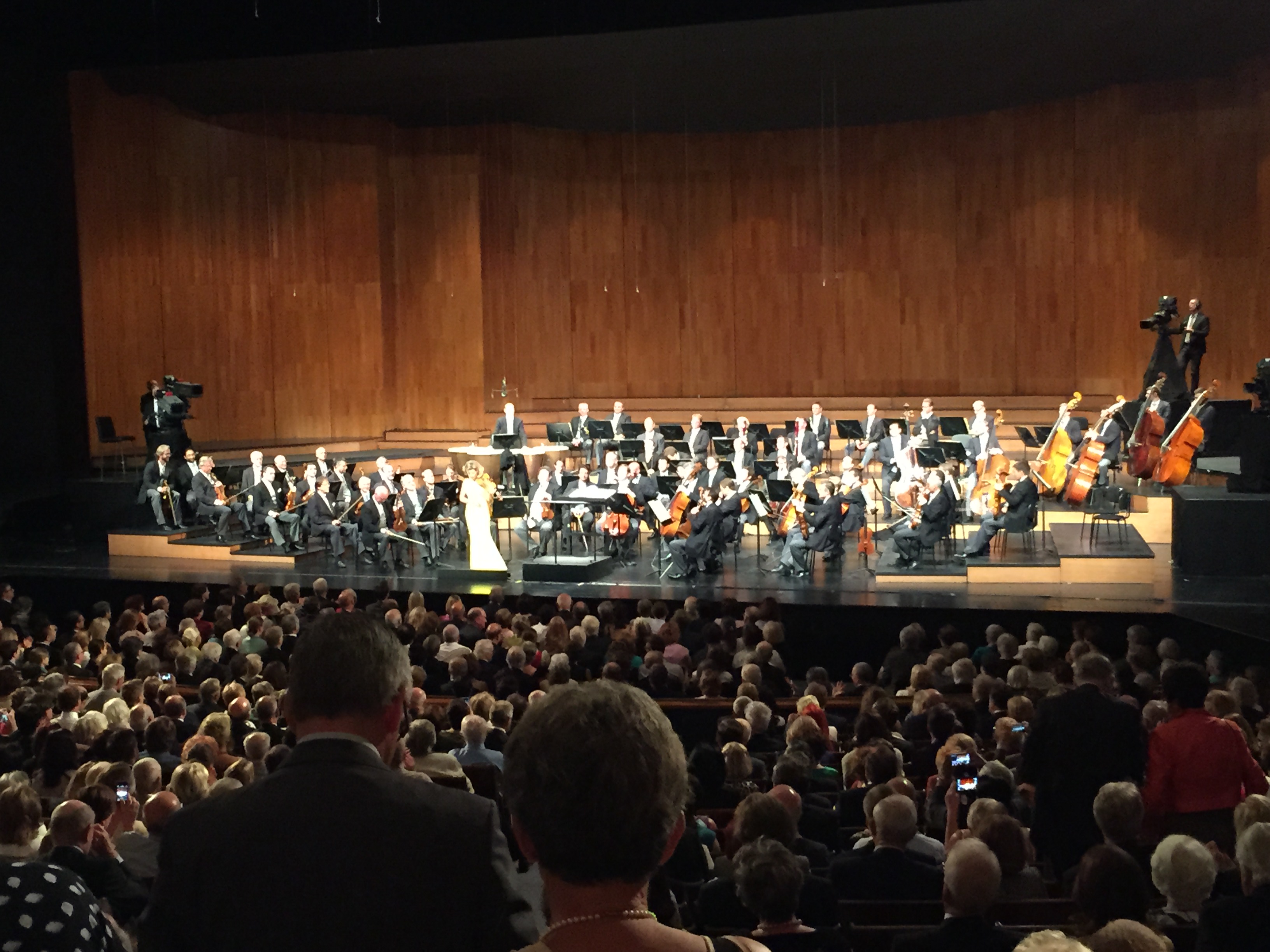
Today, the Vienna Philharmonic, Ricardo Muti and Anne Sophie Mutter are sold out. The program includes Tsaichovsky’s Concerto for Violin and Orchestra, and Brahms Symphony #2. I felt very smug to have ordered tickets before they were issued last year. It was so thrilling to see Mutter. Like others, I was sweating from holding my breath at the end. She was enrapturing and you could hear a pin drop as she reached a series of crescendos. She partnered with Muti to lead the orchestra as well as play beyond perfection.

IMG_7761She eventually earned a standing ovation, but not because the audience wasn’t sure. In true European style, the audience very deliberately withheld letting her know that they approved of her performance. And, in reply, she responded with a delayed second piece. Do you know how hard it is to get European audiences out of their seats? Unlike the Americans who are easy to please, the Europeans are very grudging with their compliments. You have to really earn your stars here.

Well, the well-healed (no typo, I mean there is alot of spa time going into this crowd) got up on their feet and gave her an ovation you would not believe. Maybe that was the reason for the delay. But that’s after they spend three minutes stamping their Bruno Maglis on the hard floor. Anne was lovely and gracious as could be. This was her kind of crowd, honed to perfection themselves. You could tell this was a huge honor to her.

Other observations of this thrilling performance…there are strictly Tattinger-sponsored champagne breaks here…no beer and pretzels. The Austrians tastefully dress to convey their age-appropriate super-wealthy reserved style. I think of myself as reasonably self-aware in my black concert dress but I felt like a slob. The 11:00am Sunday performance (ok let’s miss church today) gave the older crowd (hey, that’s me too) at least 12 hours sleep beforehand to stay awake, so everyone was frisky.


The aftermath of the concert consisted of weaving my way through the fleet of 30+ Audi S8s in front ready to whisk patrons away to an after-event. I looked for my name but they were only by number. Unfortunately, I had forgotten to retrieve the code beforehand.

Days 20-22: Planes and Boats and Trains

Such has been our busy week of flying from Moscow to Berlin, taking a hydrofoil to Peterhof from Moscow, and the train from St Petersburg to Moscow. We enjoyed the Sapsan train the best, which turns out to be the same as the ICE train I am taking from Berlin to Salzburg. We assumed the Russian premier long distance train was its opportunity to showcase Russian engineering, but it looked suspiciously similar to the German trains.
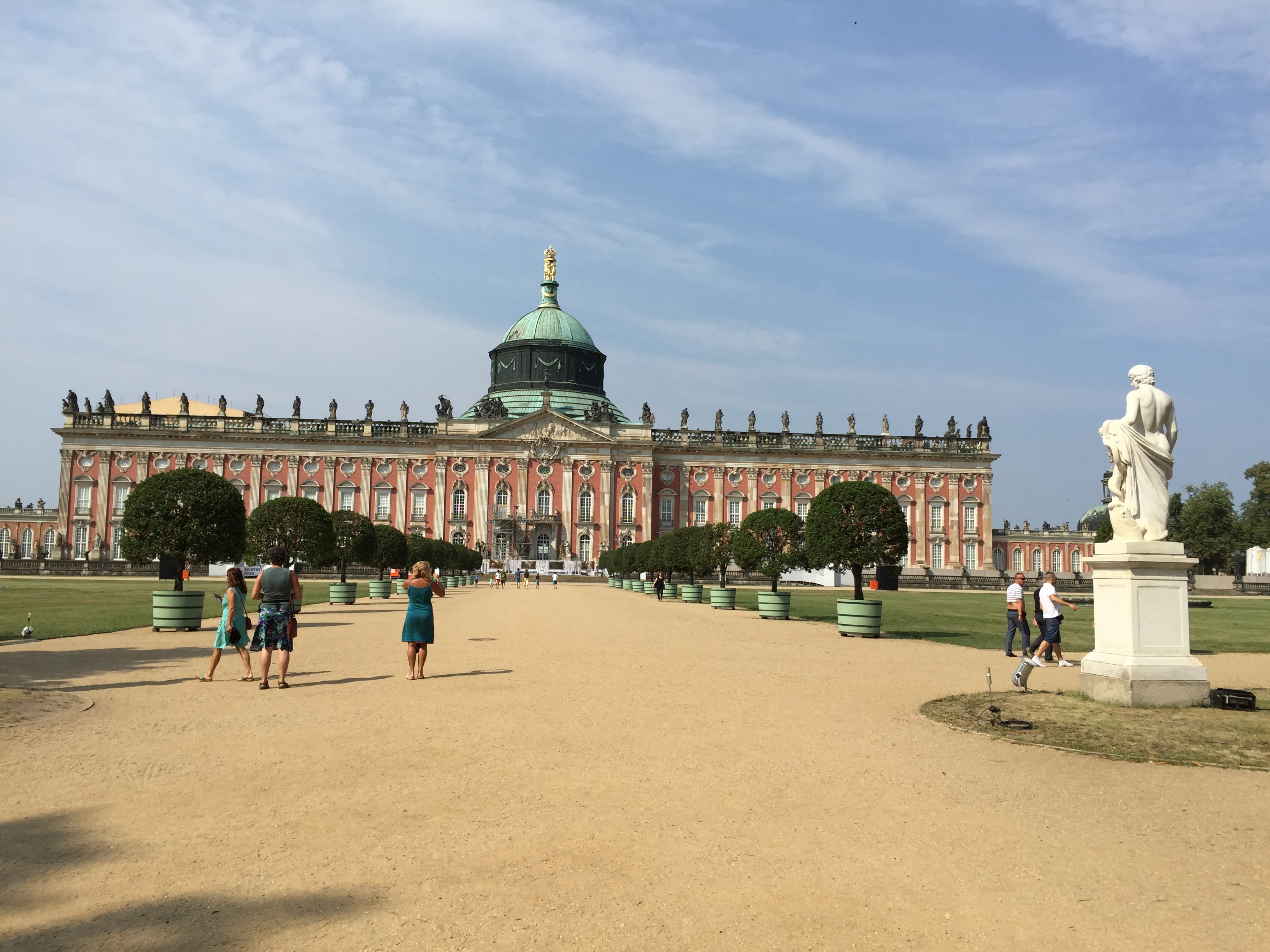
IMG_7686Yesterday, on Gee Kin’s last full day in Berlin, we took a day excursion by local train to Sans Souci Palace in Potsdam. We didn’t visit the palace as most visitors do, but took a three-mile walk between Sans Souci and Charlottenborg Palaces in the scant shade of 99 degree weather. A UNESCO world heritage site, Potsdam was the chosen site for the summer palace of King Friedrich. Here’s a Wiki link: https://en.wikipedia.org/wiki/Sanssouci

The event planners were preparing for the Sommernacht at the palaces the following day. It sounded like a wonderful celebration of German classical music in a beautiful venue, but unfortunately we were leaving. It would be worth coming back one day for the festivities and fireworks in this elegant location.

In our 36 hours in Berlin, we had launched our stay with a leisurely walk in the neighborhood of Potsdamer Platz, through the zoological garden in the middle of the city. It was calming and provided time for us to reflect on all the Siberian landscapes we had just traversed.

Those of you who know us are aware that we like long urban walks, 5-10 miles a stretch. This was yet another “walk in the park”. (For the curious, I have a website, http://www.crazyladywalks.com, that provides detailed information on Bay Area walks). It may seem pricey to go halfway around the world for a walk, but these are the most memorable and enjoyable ones to us.

We managed to balance the rest of our three days with local tours and attractions. We found a good Turkish restaurant in the more local area around the Zoo. Gee Kin slugged out on the museum track so we did a Young European concert with the Kiev Orchestra last night.

Sandwiched in between our morning walk and the evening concert, we visited the Reichstag dome. Being one of the hottest days ever in Berlin, we wondered how we got ourselves into this predicament. Masses of local tourists had come from all over the world to the Reichstag for their German civics lesson, on this one day. We not only fried at every pit stop, but then we were sous-vide under the dome, which resembled the George Forman griller.


Nevertheless, it was still fun to see and experience Norman Foster’s masterpiece. Luckily for you, the photos can never effectively convey temperature. But I guarantee you, the open vents in the building were insufficient ventilation for the once-in-a-hundred years heat wave. My dead straight hair went curly and the wood on our paper fans are permanently warped from this day at the Bundestag.

Three activities in one day’s 99-degree weather may be asking for trouble. Gee Kin’s alternative was to go to some delightfully soothing, air-conditioned art museum and he picked this?? Granted, the tour to Reichstag was pre-booked. We had failed to do this a few years back on our first trip to Berlin around 2012. And I was a day off on the booked date. Being our last day, we were not going to forego these paid-in-advance commitments so we had no choice but to go. So our last day was a bit of a marathon but it was penance for our lethargy the first 48 hours.

As mentioned, we went to a concert at the Konzerthaus Berlin, in a renovated building in a lively area in the middle of the city. But that’s not saying much, as everything seems to be in the middle of the city. Rome and San Francisco feel intimate like this, but not Moscow or Paris. Those are honking huge BIG cities, that dwarf your existence. That may be due to the six-plus-lane wide ribbons of thoroughfares used for pomp and circumstance.


I am at this very moment passing through Bamberg, where Gee Kin and I first discovered Cameron Carpenter. He is an amazing Curtis-trained contemporary organist who can do both classical and popular music. Some of you saw his performance at the SF Symphony Hall last year. He is one of our favorite new artists.

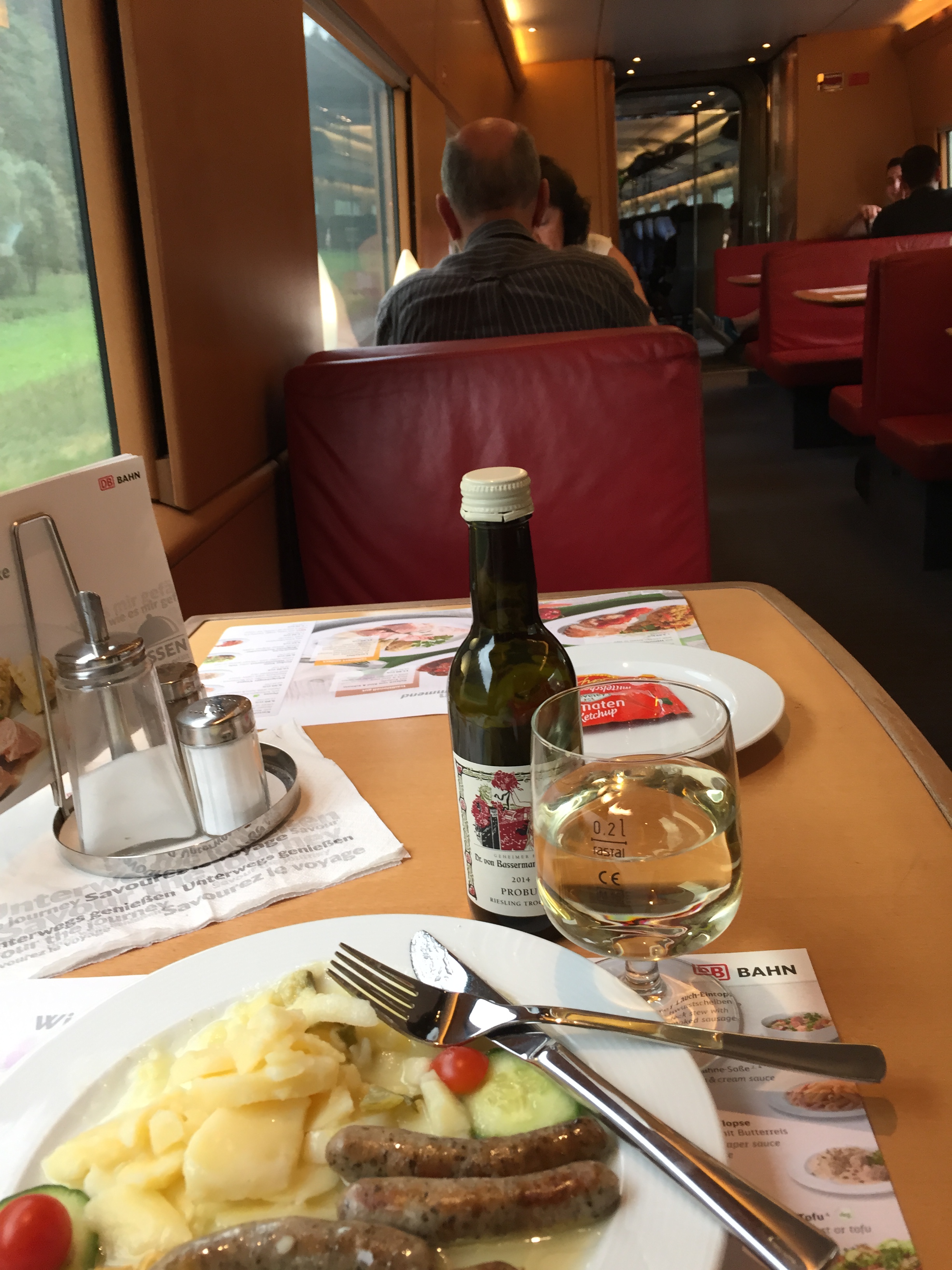
I am sitting in the dining car for lunch, noshing on bratwurst and cold potato salad. (See photo). IMG_7743The quality of food is less important to me thanthe total experience–environment, ambience, and PEACE. This was it, enough for me to write all of this discreetly in a maple-veneer and leather-lined carriage. Prices were reasonable by American standards. I had my .2ml wine (a bit more from the split bottle but you can measure if you want from the mark on the glass), entree and dessert with coffee, with a priceless view and free opera music via my IPhone to boot! To me, this beats a table at French Laundry.

Am heading to the Salzburger Festival and will post from there in a few days. Til then, stay wet (not dry
for SFers) and cool (for Deutschers). Clouds on the horizon.

Day 19: Day of Reckoning

We’re leaving Moscow today, heading for Berlin and the Western World as we know it. Russia feels more Eurasian and part of the Asian Continent than Europe in many ways. It has been a fascinating foray into the Russian culture, environment, and history.


I am posting a few miscellaneous views of Moscow from the Kremlin Armoury and from on our last day here. Gee Kin has finally mastered his fourth word, uttering Hello! and Good bye! in one conversation. We are now aware of what it takes for foreigners to say “Ni Hao!” in Chinese, and the tables are turned. I am sure the Russians are wincing as we did when others spoke to us in elementary Chinese greetings.


Photos, above:
1. View of State Historical Museum, where some of the relics below are located.
2. GUM Department Store, a shining example of restored buildings in Moscow Center
3. View of Red Square from shopping street

Photos below, from inside the State Historical Museum:

We are sad to leave and feel woefully lacking in knowledge about any of Russia’s cultural treasures. Other than what we read in the local paper or magazine articles, we never pursued any information beyond the information we were fed. I suddenly discovered Wikipedia and Biography.com on this trip and have been using it regularly to search for all the Russian writers and composers that have been mentioned in guides.

I am passing a few on for those of you who are also curious: For Tsaichovsky:
http://www.biography.com/people/pyotr-ilyich-tchaikovsky-9503375#synopsis
It is interesting to note that Tsaichovsky was also a music critic. While he considered Beethoven a worthy composer, he was critical of Brahms, Schumann and Wagner. Anna Netrebko often sings in and promotes Tsaichovsky’s “Eugene Onegin” opera around the world.
For Pushkin: https://en.m.wikipedia.org/wiki/Alexander_Pushkin
For Borodin (remember “Stranger in Paradise” from Kismet?):
https://en.m.wikipedia.org/wiki/Alexander_Borodin
Dostoyevsky:https://en.m.wikipedia.org/wiki/Fyodor_Dostoyevsky
Prokofiev: https://en.m.wikipedia.org/wiki/Sergei_Prokofiev
I asked our guide about Baryshnikov. He made a face as if I mentioned a pariah. He is a persona non-gratis. Remember, he defected while on tour with the Bolshoi? Oops. No monuments to him, unfortunately.

The next chapter of my travels will focus on Germany, Austria and Switzerland until the end of the month. Now that the uncharted portion of my trip is over, I’ll be posting every few days instead of daily. If you are getting too many emails, you can adjust your settings to unsubscribe, and you can always check in after that by going directly to http://www.travelswithmyselfandothers.com. Please continue to send me your comments when something strikes you! I love hearing from you!

Day 18: Snippits of St. Petersburg

As we leave St.Petersburg, I thought you might like to hear my impressions of this well-endowed city of approximatly 6,000,000 people (10,000,000 in the metropolitan area). Its jewels and pageantry are not lacking, and the glory of the Russian empire are embodied here. It feels distinctly Scandinavian in climate and culture, due to its position on the Baltic Sea. The city is perfect at this time of year.

Today, we took a break from the many museums and escaped from the city for a day by hydrofoil to Peterhof, the summer residence of Peter the Great. Peter chose this site around 1704 as a convenient location for his travels to and from other countries. Similar to Versailles, it has extensive gardens and palace buildings.

Gee Kin got a break from museum sickness, since it was a Monday and the palace buildings were closed. However, I did wrangle a quick, one-hour or less visit to the Treasury building. It was open and we were the only visitors in the tiny museum. Many of the gifts to and from other royalty were kept here.

It was a lovely bright, clear and breezy day. Many families were in the Palace grounds spending the day together (along with the tour groups). On the way back, Gee Kin and I enjoyed the fresh marine air along the harbor, and stopped for a drink in the park near the hotel. We sat and watched local St. Petersburgers.

We found the Russian people very tidy, well-behaved and a very handsome people. Most of the young people dressed well, with just enough flair to be noticed. We couldn’t help but prefer their tailored look with the casual one in the States. But obesity is also a problem here, due to alot of bread and beer in the diet.

I still wonder why I hadn’t made a point to come here before. It is a long way to come, and unless you join a tour it can be expensive and the visa process is prickly. But it’s such a widely misunderstood country. There needs to be more direct interaction between the US and Russia. While this problem is also the case for China, it seems oddly apparent that more people have traveled to China and have greater awareness of its culture than Russia’s. Perhaps the sheer distance between the Russia and the U.S. has caused this poor link.

The other night, we went to a Russian folk dance performance. We were very surprised that we hadn’t seen one like this before. Their costumes, style of dancing, and mannerisms were new and intriguing to us. I vaguely remember seeing some dance troupe like this on the Ed Sullivan Show when I was growing up! How could I have missed exposure to this deeply ethnic and well-preserved culture my entire life?!?

In planning for this trip, I’ll admit that I was focused on the Trans-Mongolian Express and the journey more than the two end points (Beijing and Moscow). I wasn’t fully prepared for what I was going to experience at each end. It caught me by surprise, but in a very positive way. The Russian experience was very special, since I had not been here before.

The tourist industry is still relatively undeveloped. Despite the language barrier, the Russians were very friendly and polite to us.

Many local people do not speak English so it puts the onus on the traveler to communicate in the local language. Learning the Russian alphabet and survival words are somewhat essential. You won’t get English flipped back in your face if you struggle to utter a few words in the local language. This is a place where they really appreciate your efforts, so you will be warmly rewarded.

The Russian language is based on the Cyrillic alphabet, developed by the Bulgarians. They are very proud of it. It combines letters from the Roman alphabet, Greek letters, and a few of their own doing. I kept wondering why I felt like I was on Sorority Row in Berkeley. Gee Kin and I had a blast trying to decipher words in Russian. Here are a few to amuse you. See if you can guess what the words are. I’ll give you the answers in the next post.

1. PECTOPAH
2. NHTEPHET
3. MNHNMAPKT
4. CNTNbAHK
5. HYTOPNYC
(Note: I haven’t figured out how to add the Cyrillic Alphabet to my Keyboard yet. The N is written backwards).

All in all, I have thoroughly enjoyed our visit here. I hope you will consider coming and make a point to visit this fascinating country.

Day 17b: An Impressionistic Kiss and Make-up with the Hermitage

Something was amiss in our visit to the Hermitage. We were told that the Impressionist paintings had been moved to another building. After the unpleasant visit on the first day, we were discouraged from going any further.

We decided to return today. The newly renovated building, in all its splendor, contained works from the Shchukin collection that included most of the French Impressionists and many more. The experience was completely different. We could take our time, enjoy each piece of work at our own leisure, and be among very few tourists or other visitors.

The General Staff Building is outside the Hermitage complex and was opened in June this year. They are still trouble shooting the building, so few people seem to have any information on what it is. This worked to our advantage, although there were no audio guides available. A visitor center was being prepared to handle a much larger volume of visitors, but it had not been implemented in the Hermitage complex yet. We appeared in the middle of this transition.

Here are a few of my favorite Matisses and Picassos from the Shchukin collection. They are absent titles and dates, except for those where I made notes.


You can read more about the collection here: https://en.wikipedia.org/wiki/Sergei_Shchukin.

Period interiors were impeccably detailed and displayed:

A separate Art Nouveau exhibition displayed gifts to the Russian Royal Family:


IMG_7535

Day 17a: Natives Sons and Daughters of St. Petersburg

Based on comments I received about Shostakovich and Dostoyevsky, I became curious about other famous people from this historic city.

Here’s a Jeopardy Quiz for you on a few other famous people born in St. Petersburg. Do you know the questions to these answers?

1. As a prima ballerina, her signature performance was the Dying Swan.
2. Founder of the New York City Ballet
3. This political leader served under Vladimir Putin and succeeded him as president of Russia in 2008
4. Author of the Fountainhead and Atlas Shrugged, she promoted the philosophy of objectivism
5. A Russian novelist and critic known for such novels as Lolita

Doesn’t this give you a better perspective on these individuals and how they accomplished such remarkable achievements?

Bonus Answer: he was born in Leningrad, today’s St. Petersburg, on October 7, 1952.
image

Day 16: St. Petersburg Architecture

Let’s take a look at St. Petersburg’s finest offerings. You can click on photos to view full-size images, and hover over each to read captions.

Above photos: St. Petersburg’s first and foremost flagship department store, similar to Harrods in London, with Art Nouveau Interiors

Photos, below: Original Singer Store (from US Singer Sewing Machine fame), now a book store, with Art Nouveau traces*

Photo, below: DLT Department Store, St. Petersburg’s newest and flashiest shopping center, ca. 2014
IMG_7442
And a potpourri of street scenes, below. For Julianne and Melissa from Dostoyevsky’s 19th C. apartment building, “Here’s lookin’ at you kids”.

*excerpt from Wikipedia
The famous Singer House, designed by architect Pavel Suzor, was built in 1902–1904 at Nevsky Prospekt in Saint Petersburg for headquarters of the Russian branch of the company. This modern style building (situated just opposite to the Kazan Cathedral) is officially recognized as an object of Russian historical-cultural heritage.

Day 15: The Hermitage is not for Hermits

The Hermitage is the revered museum in the world. There was always this nagging voice in the background after you’d “done” the Louvre, that there was another bigger and better collection somewhere east. For having acquired and displaying all the famous Western schools of art, from the Dutch Landscapes to Spanish portraiture to Italian Renaissance masters and beyond, the Hermitage is the big Kahuna.

Here are a few of the best. This is totally subjective, so you are in my hands.

Dresden Neumarkt, Bernardo Bellotto, 1720

Next… the rooms.


Then…my favorites. These have nothing to do with what’s important in history, but more to do with what I find unique from other museums I have seen. The only one I can relate to is the Pergamon Museum in Berlin. It had the replica of the Ishtar Gate there. It reminded me of the early beginnings of Western Art and examples of pre-European Art that I had never seen before.


IMG_7397
For me, museum visits can be a religious, sublime experience. On the less raptured end, they can be pleasant visits where you come out feeling more informed or better connected to a particular culture. Once in awhile, it can be totally hideous. Our visit to the Hermitage unfortunately was in the latter category.

Gee Kin and I tried our best to tackle the Hermitage in a respectable way. However, the huge volume of cruise ship and foreign tour groups made it nearly impossible to see and enjoy the collection. There were more people taking selfies and photos in front of paintings than I can remember. I used to be annoyed by those using audio guides and standing in front of paintings as they listened to commentary. And I was one myself.

But these swarms of tourists take museum going to a new level. It makes you rethink your entire education and reason for going to museums in the first place. I have been to plenty of museums by now, and know that the quiet times are the best for viewing. But we failed to plan out our strategy, and at a moment of weakness decided to go in the afternoon instead of waiting for the following day.

And as for the experience….well, here are a few photos of what we went through to battle the crowds for a piece of the pie. Not pretty. These were were the forged battles that took place to see and appreciate the revered art I had learned as an undergrad. The pictures trace our experience– innocuous beginning, then quickly deteriorating to life in hell. H-E-L-P!!!!


In the end, I was satisfied with four hours and 4 miles (calculated on my Apple Watch) in the museum to see the pieces I did. As usual, Gee Kin had more questions than answers. His favorite piece was indicative of his experience at the museum.(See image below)

IMG_7395

Aside from his getting chronic museum sickness, he continues to battle his problem without medication. Gee Kin thinks there are definitely better ways to give tourists without art training a quality experience.

When we took the kids through the Louvre a generation ago, I decided the best way for them to really see the voluminous collection was to focus on a few pieces that they could remember. I made a “scavenge hunt” of sorts for them. I seem to recall that one of the earliest and amazing internet sites was the material at the Alexandria Library in Egypt and the extensive art works that were catalogued there and available to the public. Remember Netscape and Mosaic, anyone?

On arrival at the Louvre, we broke into two teams and set a time limit and meeting point. Find the Venus of Milo, the Mona Lisa and a handful of other notable pieces. Gee Kin and I led our teams, ripping through the museum, literally racing. It didn’t matter what others thought of us. We wanted to win! Once we could find the handful on the list, we were exhilarated. Our girls vividly remember the fun we had at the Louvre, and the pieces they saw. Thankfully, they have each taken proper art history classes and got an understanding of the artwork they needed than from their schlocky mother. Melissa even majored in art history, so it couldn’t have been that bad an experience!

Day 14: Moscow Drum Roll: Market and Modern Art

Dorogomilovsky Market early in the morning was Gee Kin’s pick today, followed by mine–the Tretyakovskaya Modern Art “Gallery”. We managed to take the subway three stops to our first destination without getting lost. The subway had a dizzying amount of subway names–all in Cyrillic–so you have to master the alphabet or you are “TOCT”. Gee Kin showed rapid improvement from his initial blundering, “What’s that alphabet called–Acrylic?”. I’m including the subway station menu, that requires good eyesight in addition to calisthenic tongue skills.

As a “wrailwray” kinda gal, I love cracking the system. We stepped into the huge escalator tubes of travelers, stretching endless miles deep down into the bowels of the Moscow River and beyond. These were the longest escalators we have seen anywhere–they felt like at least 3 to 5 times any of the deepest tube station in London. The Russian engineers liked doing things bigger and better, and this was another showcase opportunity. We sliced and diced the station names like a Benihana master chef would, and deconstructed each one letter by letter. We followed every sign religiously. We even avoided going down one-way streams and didn’t make elbow contact with anyone.

The cars were spotless, not a crumb or grungy morning coffee spill in sight. Like all good citizens, the Moscovites rushed swiftly, politely and silently. Gee Kin noticed that commuters zoned out with fewer hand-held devices and opted more for books and magazines than their Beijing or San Francisco counterparts.

As expected, the market was also a bustle of activity, with carts being swung and navigated every which way down aisles beyond safe speed limits. You can see our fascination with an array of some familiar but also new sights: furry rabbit’s feet good luck charms, Korean kimchee specialties (a note about that later), racks of lamb and carcasses, 8 piglets without blankets, bottled and pickled everything (including grass mushrooms Gee Kin loves), and on and on. It reminded me of the bigger but less varied market in Tashkent from last year.

Next, our day was traumatized by a trip to the Modern Art “Gallery”–along the Moscow River. That was the only bearing point for the humongous site. The monumental museum (and I mean MONUMENTAL…the size of an Olympic stadium…was so big and dwarfed human context so much that it became a nightmarish experience. We dragged and slogged our way though miles of artwork. Despite the noble effort to catalogue modern art in the Soviet Union from pre-Bolshevik days to today, the museum and its fascinating history was lost and unappreciated due to the vastness and lack of selectivity of the material. Its attempt to show “everything in the warehouse” (purportedly 170,000 pieces) made it mind-numbing and exhausting.

This frustration may have been caused by sensory overload from the earlier market visit. Just getting to the building from street to front door was a chore. The gallery literally looked like a stadium complex. We weren’t quite prepared for this mental and physical workout. If you go there, be sure to dedicate one entire day for a visit. Better yet, a week. Bring your camp stove and tent but don’t get caught.

Don’t misunderstand my message. I did love the artwork. I was inspired by the sculpture more than the paintings, though. They all cried for attention. Because there were fewer pieces of sculpture, you could focus on them more easily. I found the predominance of woman’s bodies depicted in real, human ways very moving. They weren’t idealized as Venuses. They were reflections of real women, of mothers, sisters, workers. I even found a few that looked like me! Their bodies “hung out”, but their faces spoke volumes.

I couldn’t help but think about the stunning ballet performance by the prima donna from the night before. She could perform so flawlessly, and so dramatically. Her face and body spelled all the agony and torture of the dying Violetta. The sculpture of woman and child spoke to me in the same way, as did the other pieces that were chiseled and sparked to life from stone.

Aside from a few Chagall pieces that I could detect, it was difficult to find any recognizable names. We were on the lookout for a cache of Matisses, but these were all Russian artists (Chagall was a Belorus-born French artist). The French Impressionists are elsewhere in Moscow, not here, in this national repository.

And of course, near and dear to my heart, design. See my favorite pieces of artwork in the entire stadium: calligraphy on beautifully crafted plates.

Note regarding Korean community in Moscow: some came here before WWII. They were later purged to Uzbekistan, and a small population still lives there.