Tag Archives: Sights

Day 20 (b): Maxvorstadt, Munich

Enough opera for everyone?!? Well, here’s a bit of welcome relief.

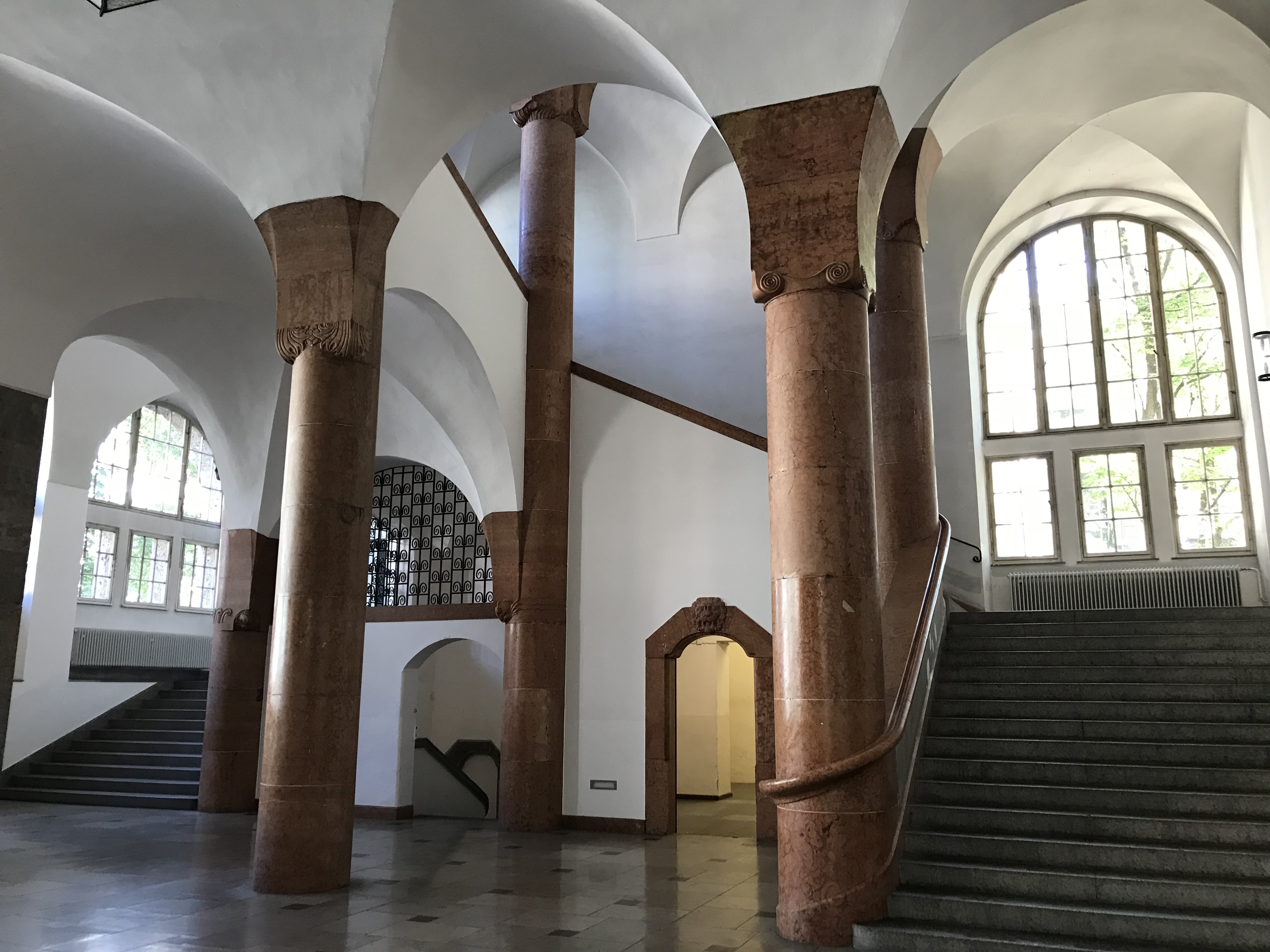
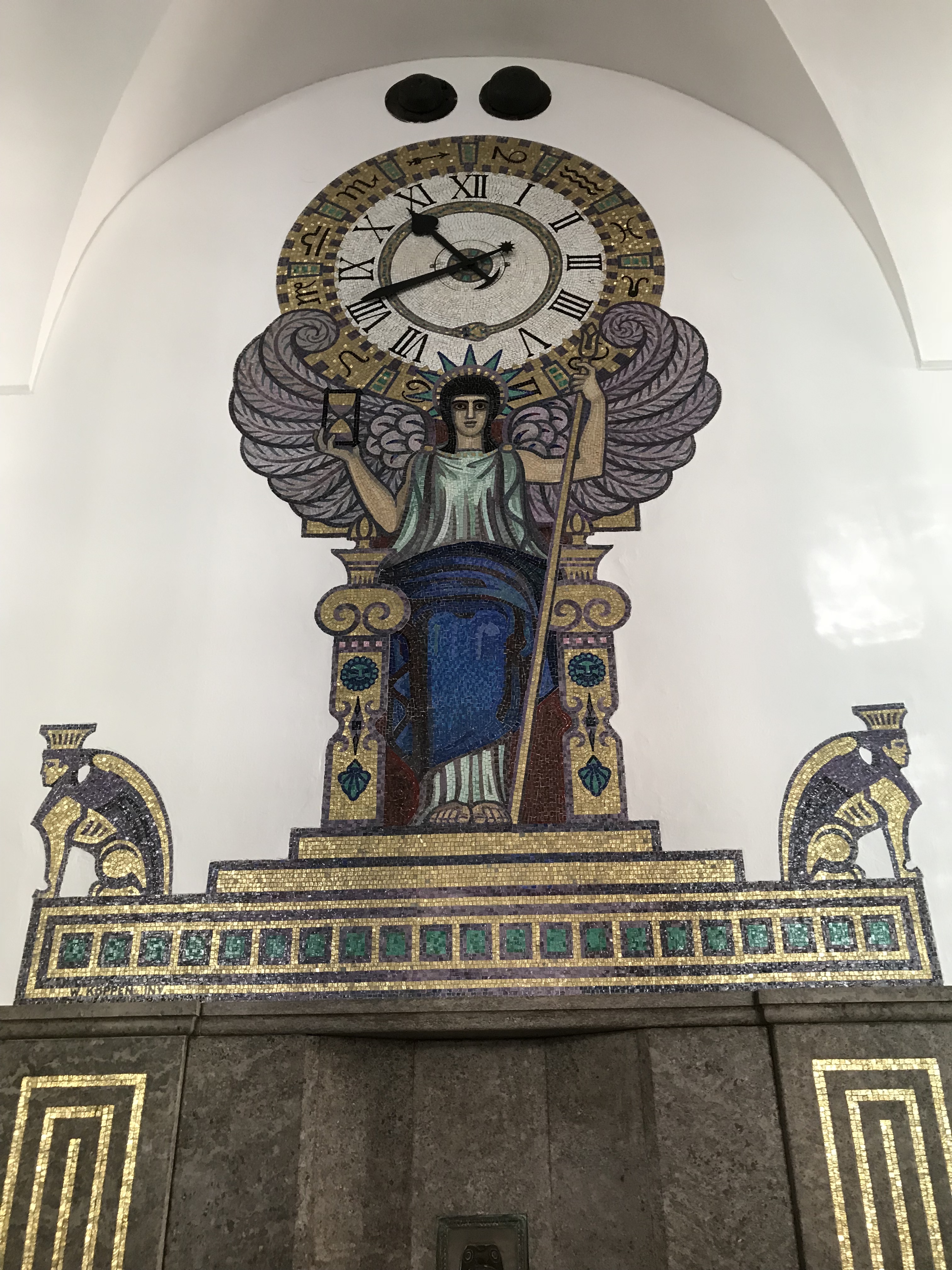
The Goethe Institute gave a tour of the Ludwig-Maximilians University Quarter that started with some historical elements of WWII. This is the university attended by Sophie Scholl, who protested the dealings of the Nazi Party. She attended the university (known as the University of Munich at the time) and was a Philosophy major there.

In 1943, she, her brother, and their friend Christoph Probst were found guilty of treason and beheaded in February 1943. The White Rose represented their movement and live roses are still posted in memoriam at sites at the entrance to the University and inside the main lobby. It gave me goose bumps after walking through the spaces she inhabited. You can read more about her here:

https://en.wikipedia.org/wiki/Sophie_Scholl

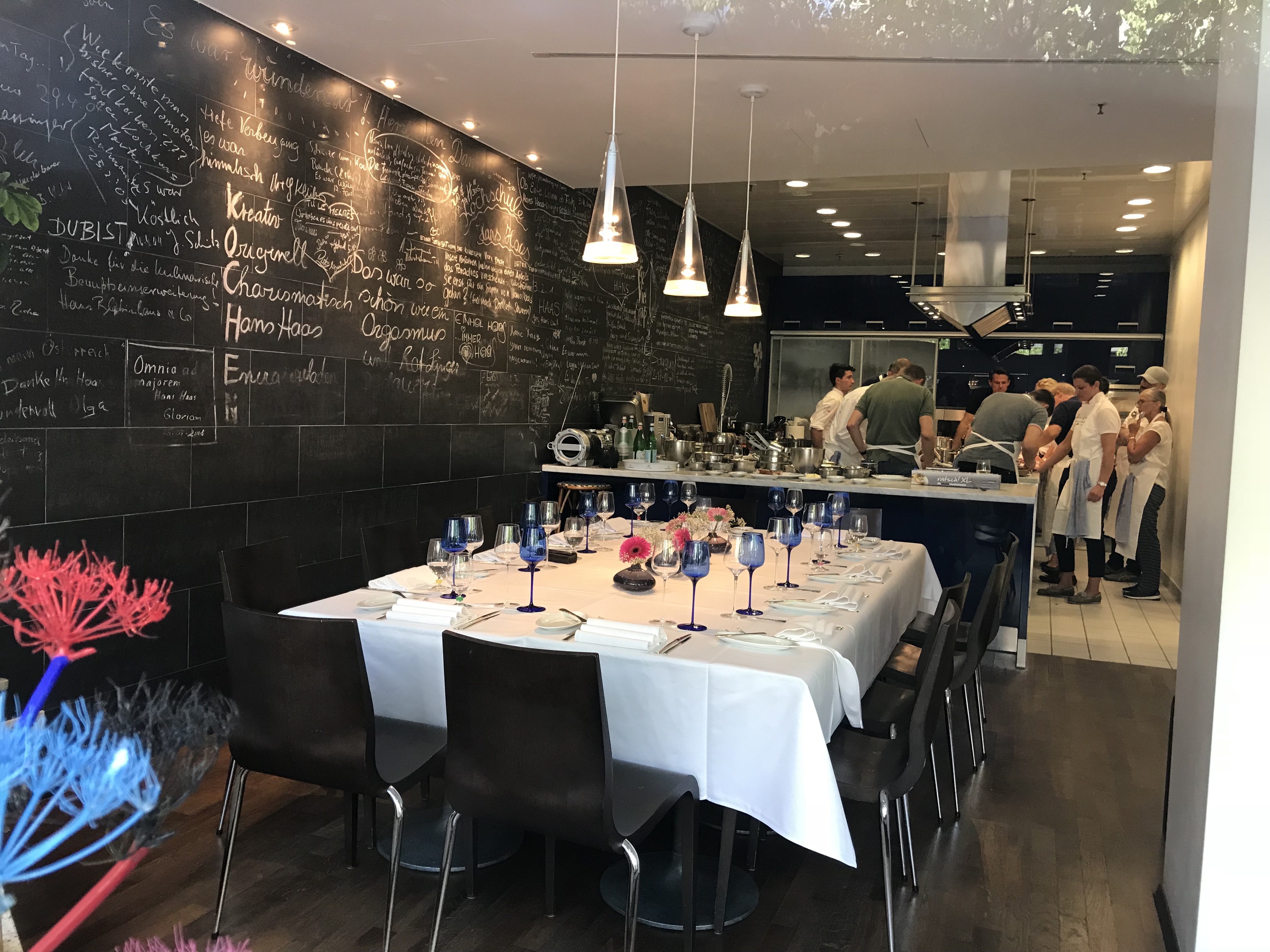
Shops around the University area provided delightful finds, that included antiquarian bookshops; quirky gourmet ice cream cafes like Verruckt, which means Crazy in German, features beer flavored ice cream and breakfast ice cream; a storefront cooking school allows you to peek in and see all the action and after-effects of food being consumed; and a specialty bike shop that has custom colors for hand made bike frames.

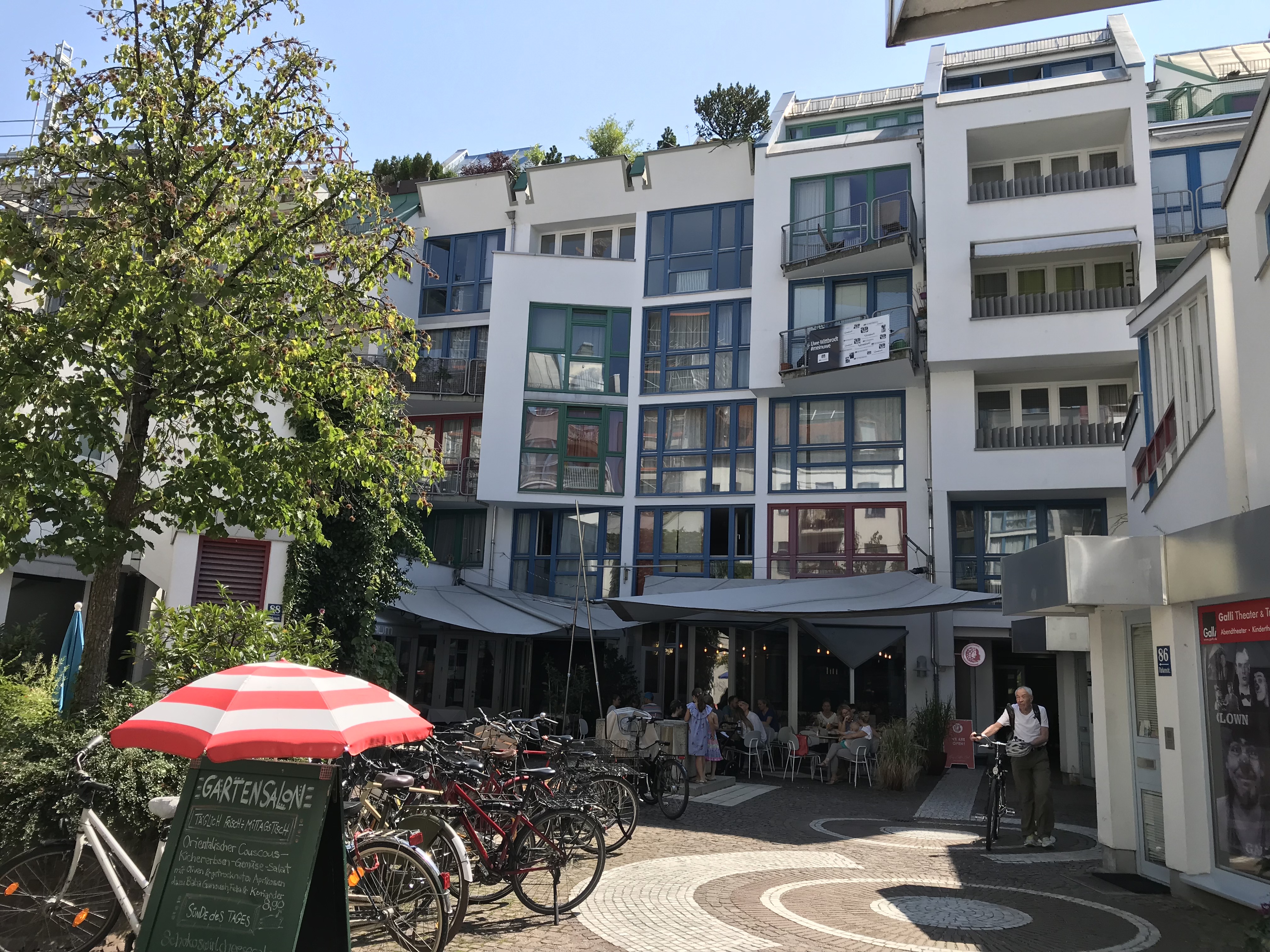
Many of the Altbaus, or old buildings, were built during the 18th and 19th Centuries.  Inner courtyards or “hofs” hide renovated or jazzy new buildings and green areas with retail spaces are tucked into the ground floor. Craftsman-quality cabinet shops and made-to-order items are plentiful and enough to delight the eye and microwave the credit card.

And from the poetry shop:

There’s more of Munich to come…

Day 14-15 Lost Worlds, Lost Messages, Lost Glasses

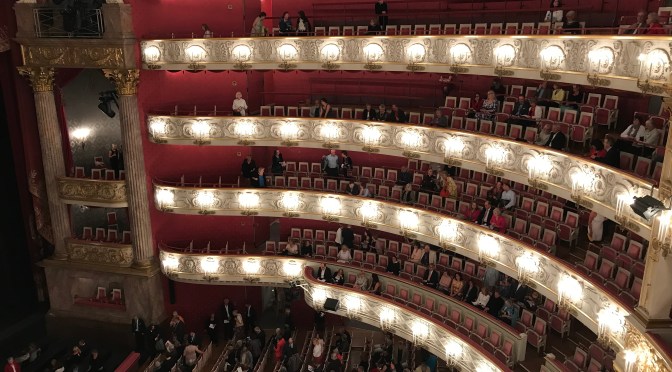
Okay, so most of you haven’t been to the Ring, Right?!? The only person I know who has been to one is my German classmate Royee, who attended the Bayreuth Ring last year. It’s not for all, as you have to either book a hundred years before you were born (similar to applying to pre-schools in San Francisco), or know the scene director personally before he was fired, to get tickets.

Germany decided to spread the wealth around and stage this year’s Ring in Munich instead of at Bayreuth. This was much more palatable, so you can enjoy a major city and still get a double dose of music and culture at the same time. I booked my tickets in November the year before so I could take German classes and see the Ring, a series of four operas, over one week. The saga searches for meaning in life, love, and happiness.

So here’s the typical setup for each opera. They start you off with the 2.5 hour version, no bathroom breaks (Das Rheingold). (see previous post). Then it progresses to 3.5 hours (Die Walküre), then 5.5 each of the last two. (Sigfried and Götterdämmerung, in the following week). You progress up to 2-40 minute breaks for good behavior.

You go in. Check out your neighbors. Decent looking, well-dressed bunch, but not too stiff. They’re not going to snore (nor are you), and each person will fit compactly into the seat they are assigned. Otherwise, it’s like getting on a 17-hour flight with you in the middle seat. The music begins and unfolds exquisitely. You are enraptured by Wagner’s ability to transcend sounds into music, words into poetry.

And then WHAT!!!???!!! A stage full of bodies and maidens prancing around the stage, as a backdrop to the principal singers’ prologues, arias, and dying laments?!? A gaggle were nude or nearly-nude, with exposed wire-strapped bras and saggy body suits. Uh-oh, it’s that German Freiheit thing again. But now they are stomping in Gothic River Dance Doc-Martin boots and shimmery, raggedy tunics as angry sisters of Brunhilde protecting their heroine (with an e)?!? Whatsup!!??!! Someone was unveiling a supposedly dead body in the background on a gurney as the singers in the foreground sang fervently to each other.

My point: Hollywood has done alot for entertainment. Granted, it’s very showmanistic, but it has simple logic. The absence of it makes you homesick even for the glitz. The Germans are intellectual, stark, and blunt. They want to make sure you get the message about the suffering. They prefer to use resources on paying personnel to be the stage props, rather than to design, plan, and build stage sets. Sorry, but the interpretation didn’t work for me.

The singers would have done better on a bare stage. It was clear the audience felt the same. It was so bad in some parts that the audience literally booed!! Despite the stellar principal singers consisting of Jonas Kaufmann (one of my favorites), Nina Stemme (from Tristan and Isolde fame at the NY Met), and Wolfgang Koch (from the Bayreuth Festival), being the primary focus, the staging distracted the audience, and nearly destroyed the beautiful music and singing. Several times I closed my eyes to block out the visuals, and wished that the message had been better delivered.

I’m not saying that I would rate the SF Opera production higher than this one, because the music and the singing was not strong. I would love to see the two companies collaborating together one day to make the most of each company’s talents, and to give the audience a performance that Wagner would be proud to see.

Here are the staid curtain calls, that don’t reflect anything expressed above, with (1) Kiril Petrenko, the highly regarded conductor of the Bayern Staatsoper:

and (2) my favorite tenor Jonas Kaufmann taking his well deserved curtain call as Sigmund:

As for more mundane activities this week, I lost my glasses and left my keys in the apartment where I was staying. I went to two “found” bureaus and discovered a treasure trove of “found” items, all neatly classified and categorized. I didn’t find my glasses, but it was a pleasure to see German efficiency at its best.

Day 11-13: Nazis, Rings, and Blue Riders

National Socialism

The National Socialism Tour hosted by the Goethe Institute was one of the most stimulating tours I have ever taken. Given by Dr. Christoph Engels, the guide provided the overview of Hitler and how Munich was a central control and rallying point for the Nazi Party.

Using Hitler’s creations for the flag, logo, and uniforms, he combined propaganda and design to seduce the populace with fanfare and drama. The frequent marches down the main thoroughfare from Marienplatz to the Odeonsplatz were displays of might and staging trials for the military. I was a bit chilled to realize that the very backdrop for the Greek Festival I attended on my first day in Munich was where Hitler conducted many ceremonies.

The monumental boulevards reminiscent of Paris contributed to the public parades of the military. Billions of dollars were donated to the Nazi Party by private citizens, who saw the salvation of Germany led by Hitler. The original headquarters of the Nazi Party still exists, and while not open to the public, it continues to host activities of the Neo-Nazi Party members.

There were three phases of recovery by the German people after the devastating reign of terror. First, there were those who experienced it, followed by the children of the war survivors. They experienced a long period of “Scham und Schuld”, or Shame and Guilt. After 1968, the third generation began to ask the grandparents what role they had in the war. These questions were difficult discussions that needed to be answered by each family.

When the official statistics about the Holocaust victims at 6,000,000 people was mentioned, a couple of my classmates from Russia and the Ukraine noted that there were many more Russians killed by Stalin before and after WWII. They wanted to put history in perspective with their experience and knowledge. They also noted that the war itself saved many Russians from starvation and death caused by Stalin.

Munich Opera Festival

The Ring by Richard Wagner is a 17-hour epic, presented in a series over four days. The 2.5 hour, no-break opera in German subtitles was a challenge.  I had prepared myself for the “real thing” after seeing my first Ring at the SF Opera last month.

The difference between the two? San Francisco spent alot more effort in the production, the acting, the stage sets, but the singing was weak. Munich was the opposite. The stage sets were minimal, but Munich delivered some of the best singing I have ever heard. The opera house is smaller than San Francisco’s, and the singers must have their voices perfectly calibrated to the acoustical capabilities of the house. It didn’t hurt to have estatically beautiful music for both, thanks to Wagner.

And here’s a clip of how it looked from the audience during the curtain call. You would have to turn your sound up to full volume (but don’t do it!) to capture the thunderous foot stomping that Germans do in addition to clapping. The gesture is highly successful because: 1. you don’t have to stand up and drop the program in the process while still being able to respond spontaneously; 2. you don’t block others behind you who don’t want to stand or have a different opinion; and 3. It gets your entire body stimulated and the blood flowing so you can remember to get up to leave!

Lenbach Museum

Last week, good friend Helena had suggested going to the Lenbach Museum during her visit here. Unfortunately, we weren’t able to fit everything in. She has pretty good taste in choosing museums, so I decided to venture there on a free morning. I combined a trip to load up on German sketch books at an art supply store near the museum area with a visit to the Lenbach.

I could only remember that Helena had told me about something Blue that was on display there. After all, Helena and I had just seen Vermeer’s Woman in Blue Reading a Letter the week before, right? At first, I thought it was the Blue Wonder, then I remembered, no, that’s a bridge in Dresden. After I ripped through a gaggle of galleries searching for the missing identity, I finally asked the guide where the Blue Rider was located. His answer: they’re everywhere! I was perplexed at first, then realized that its…a movement.

The collection generated a lively FaceTime conversation with my German language partner in the Bay Area. Being an art history aficionado, he set me straight. The text may be hard to read, but if you are interested, you can view it on a monitor. They’re all yours, Jim!

San Diego: Anatomy of a Paella and More than a Walk in the Park

After our return home from Iran, we slowly adapted back to California living. To help us do this, we took a quick weekend trip to San Diego to spend a day with friends in the countryside. The highlight was a huge “paella cookout”, that became a super-sized version of a cooking demonstration.

ANATOMY OF A PAELLA


In a nutshell, you follow these steps (as shown in photos above):

1. Heat lots of olive oil in a large shallow pan.
2. Add and cook marinated boneless chicken thighs.
3. Add onions and garlic.
4. Add water, saffron and rice.
5. Add mussels.
6. Add shelled prawns, clams and frozen peas.

Here are a couple of tantalizing videos for you, about the chorizo sausage used (you might need to step up the volume):


And the fait accompli!


Try this at home, on the stovetop!

MORE THAN A WALK IN THE PARK

The next day, we took a leisurely, 5 mile walk to and from Balboa Park. It was filled with museums, outdoor sculpture, a huge plaza for people watching, yoga, and even a botanical garden!


The walk to and from included a couple of pedestrian bridges. I didn’t realize that the San Diego terrain, in true California coast style, not only consisted of water and mountains, but deep craggy canyons in the middle of the city. Creative connections between hills and over valleys provide pedestrians with interesting and sometimes challenging routes. As in San Francisco, the gridded streets from the map are deceptive and can often put walkers in a dead end or facing a steep, but fitful incline.


The Botanical Garden provided a calming respite from the city’s bountiful activities within Balboa Park. The families enjoying the beauty of the late Spring bloom reminded me of the parks we enjoyed in Iran.


And there were even a couple of interesting developer-architect buildings to ponder and appreciate through the streets of San Diego:


Kool in Kashan

Midway between Tehran and Isfahan lies Kashan. One of the UNESCO World Heritage sites, the Fin Garden highlights traditional Persian landscape design with fountains, channels and reflecting pools. These design principles trace back to the 6th Century and Cyrus the Great.

Local tourists love to visit these parks. On a particularly busy “weekend” Friday, the sites were crowded but the feeling was festive. Persians are courteous and never pushy, so it always seems like you are part of the public experience, not against it. Each person, including you, is entertainment material.

We stopped for lunch at a restaurant where large divans or platforms shaped like a huge sofa surrounded by a low back/barricade offered guests an alternative to traditional tables. The design defined a semi-private space, where groups or families could sit cross legged, enjoy the food, but not miss out on the activity outside their spaces.

The nearby town housed merchants who became wealthy from the textiles, carpets and tile produced in the area. Door knockers on a pair of entry doors differentiated men from women arriving by the sound of the knock. That was a pretty ingenious communication device!

The local bath house was an important community space and lavish design details encouraged members to use the club’s facilities!

I couldn’t help but to continue a few of my forays into people pictures. I was starting to get really comfortable doing this, again because the faces of the individuals are so engaging and CALM. Young girls may be a bit giddy, but overall everyone whose pictures I took were inviting, elegant and never intimidated or negative.

Below, here’s a video of the adorable little girl shown above:

(This post was created on April 20, 2018)

Post Cards from Macchu Picchu, Peru and Easter Island, Chile

As many of you know, I have been learning how to extract a latent energy in my brain to draw. Here are a few of the sketches I made during my trip to Macchu Picchu and Easter Island.

I’m including a video I edited for a film editing class project on Peru that will give those of you interested in the life and challenges there:

Join me and fellow architect and daughter next week when we will be visiting Chicago for a long weekend. See you then!!

Day 9-10: Easter Island Moai

A full day of sightseeing led me to the various Moai on the Eastern side of the island. The Akahanga Quarry where the stone for the Moai were carved and extracted was a graveyard of sorts for the stones themselves. They were in various stages of completion: some were still in situ, some were being transported, and some were never to reach their intended sacred sites. The characteristic topknots for hair were gathered in one spot, as the red stone was normally placed separately from the body on top of the basalt.

I loved pondering how each sculptor decided on the eyes, nose, and mouth for each piece. Most of the bodies included full torsos, but no legs. Their hands were placed below their bellies, with long fingernails indicating royalty. The long ears of the royalty were evident, as there were no short-eared Moai (see previous post).

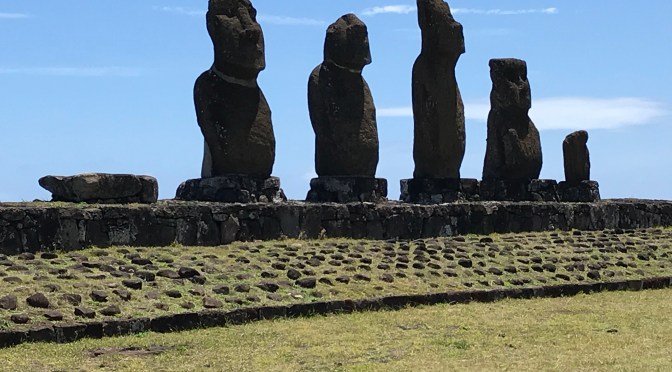
Behind the quarry are caves where people hid during wars and invasions. Next, we reached the highlight of the 15 Moai at Ahu Tongariki.  The guide explained in detail how the moai were carved out of bedrock, transported to a site where the dead were buried, and then erected with great teamwork and collaboration.

The Easter Islanders had a long term vision of creating these images to protect successive generations. It took incredible energy, creativity, and determination to plan, design and execute such monumental exercises. The photos above do not convey the extensive area where they were situated. See video below (apologies for the wind–you may need to turn your volume down to reduce the noise)

Error
This video doesn’t exist

A Japanese construction company helped to sponsor the UNESCO world heritage site, after it exhibited one of the Moai in Japan. Many of the Moai that were toppled were turnd upright and restored so they can be appreciated in their orignal splendor.

I returned to the Te Moana Restaurant in town for an another adventurous dining experience. This time I ordered whole fish, and was delighted with this pair on a bed of mashed tuber:

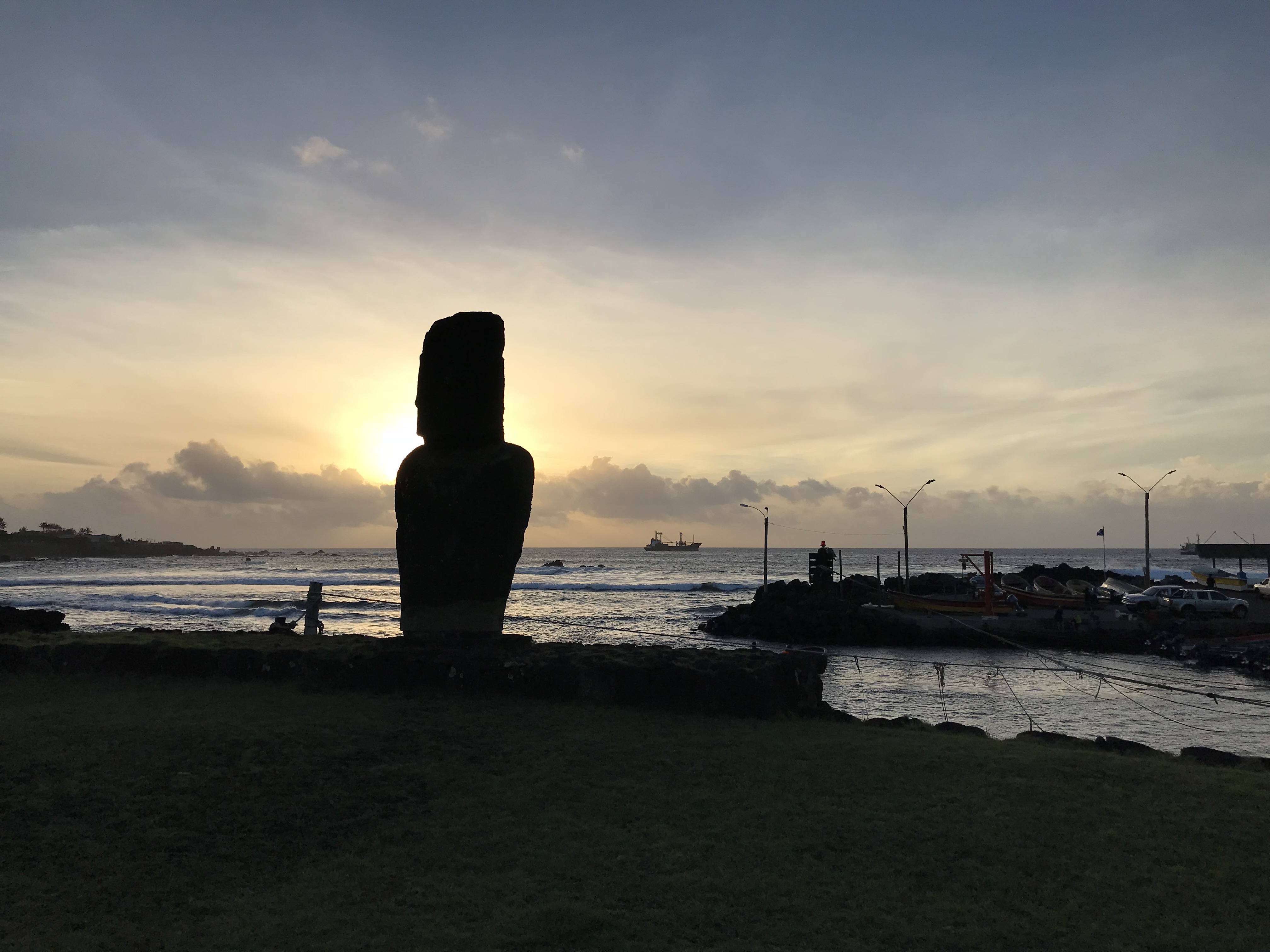
My sunset view at dinner gave me time to reflect on all the amazing human achievements from the past. Even better, I caught the last rays behind the Moai at the harbor just a block away from my hotel.  It symbolized another successful completion of travels with myself and others to two of the most magnificent places in the world. I hope you enjoyed traveling with me!

IMG_9513

Day 7-8: from the Mountain to the Sea…Macchu Picchu to Isla de Pascua

You may have heard of French Polynesia, but Spanish Polynesia?!? Combining Polynesia with Chilean culture is wild! Coming from the mountains of Macchu Picchu to the Moai at Easter Island is even more extreme and precious. These two UNESCO world sites are different but so spectacular in their own ways. The only two flights per day to Easter Island come from either Tahiti or Santiago, Chile.

Jared Diamond’s book, Collapse, inspired me to visit Easter Island. The Polynesians came here by following birds on catamaran-type boats. Initially, they found the land unoccupied and fish plentiful. Easy fishing along the shoreline didn’t last as the population burgeoned. As they needed longer boats to go further offshore to catch fish, they cut down more of the trees on the island to make the boats.  An entire tree was needed to make longboats.

Within a short time the wood was depleted, and they no longer had the resources to sustain fishing. It is a sad but true chain of events. It is also a reminder of our vulnerability as humans. Combined with tribal wars resulting from too little to go around, the Polynesian society on Easter Island thrived and then disintegrated in less than 500 years (between 800-1200AD).

The Moai are the main feature on the Isla de Pascua. The huge basalt and tufa sculptures look amazingly modern and timeless. After they were carved directly out of bedrock, they were transported to a sacred site and placed on platforms (ahu). They faced away from the ocean to protect their descendants from the ocean. Only ruling families were allowed to have moai (nearly 400 of them in existence today). They were not officially blessed until the obsidian and coral eyes were place on the heads.

Most of the “long-eared” early arrivals ran the show. They ruled the latecomers, who were short-eared. The Longears had status in society because they got to Easter Island first (sound familiar?). They made slaves of the Shortears. The Shortears weren’t allowed to build moai to protect their families but probably did all the work for the Longears to haul and erect the finished stone.

The Anthropology Museum on the island provided an excellent explanations on the history and construction of the Moai. There are wooden sculptures made of makoi wood that remind me of the Mayan figures that are highly individualized and animated.

Throughout the island, there are many artistic interpretations of moai by local contemporary artists. Some were more successful than others, but the spirit and pride in the culture lives on.

A sample of the island’s incredible flora are shown below.

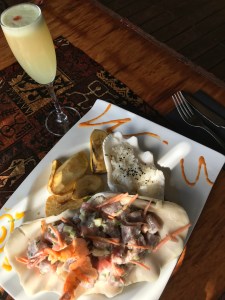
And I have to post a full size photo of my dinner with myself and an outstanding plate of tuna ceviche, roasted tuber, and fried banana, assisted by a glass of famous Pisco Sour at Te Moana Restaurant:

Day 5-6(b) Sacred Valley, Cusco, Peru

Peru’s lack of distinguishable modern architecture is more than made up by its warm and friendly people, their genuine desire to help others, and a long history that does a country proud. Everything seems harder to accomplish here, yet the people are undaunted by physical hardships and challenges.

Cusco lies on a plateau in the highlands, so everything is downhill from there. After adapting to the 11k high altitude in Cusco, each 1K descent towards the 9K Sacred Valley and 8k level at Macchu Picchu feels noticeably easier. I can breathe normally. Not being a mountaineer, I have never focused so much on elevation before. I paid more attention to these stats than to rainfall or temperature in the area!!

We made stops along the way to visit an alpaca/llama (pronounced yama) farm, a weaving group, and a market in Pisac. (See photos above). Our foodies will note the wide array of fruits and vegetables as well as colors–a good sign of healthy eating.

Speaking of colors, Peruvians love bright colors. As demonstrated by the rainbow flag, it represents the people of the highlands. The familiar stripes and ribbons of color seem to aptly reflect the nature and personality of the Peruvian people.

The coca plant is used extensively as a tea to ward off high altitude sickness and one can survive on it alone for five days by chewing the leaf. You drink coca tea here to overcome altitude sickness.

There are over 2500 types of potato grown in Peru of the 3500 varieties known throughout the world. One type has alot of eyes, and as the story goes, if a young girl falls in love with someone, she will tell whether she will marry him by how well she peels one of these potatoes. If she peels it flawlessly, she’ll win her guy, but if she doesn’t….well the eyes will cry the tears for her!

Many of the ruins throughout the Sacred Valley, particularly the fortress at Ollantaytambo, are dress rehearsals for the big Kahuna, Macchu Picchu.The massive sandstones were hewn along the edges to perfection and carved to fit the next/last one as if the stone were extruded from some supersize tube of frosting, only to dry perfectly, without gaps or mortar in place. Hard to believe how these stones were cut, and the ability seem beyond human skills.

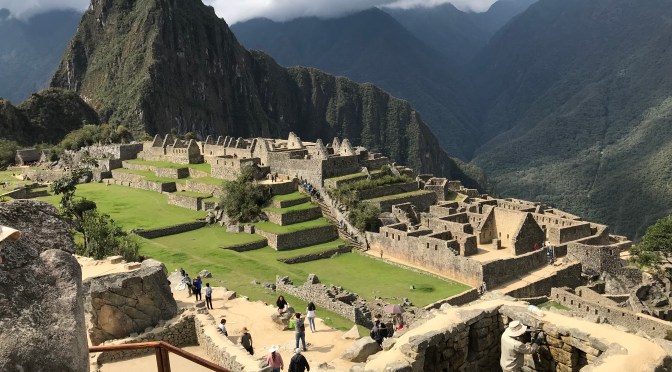
A word about the Macchu Picchu buildings from yesterday’s post. There were various ceremonial buildings for offerings to the sun god and others, but an area also served as the King’s residence. Grain was stored in one area, and the extensive terraces were used to grow food.

For more about Macchu Picchu, Hiram Bingham, the man who discovered it, and its origins, go here:
https://en.wikipedia.org/wiki/Machu_Picchu

The other important uses for terracing the mountains was to serve as a system to prevent soil erosion and to collect water from the top to the bottom of the mountain. It’s tempting to compare these to the terraces used in China to grow food, but I’m not sure which came first. In any event, the Peruvian terraces are spectacular just in sheer height and they demonstrate the ingenuity of the Incas and their predecessors.

As I leave Peru after such a short sojourn here, I realize that I may be naive and easily impressed. Nevertheless, the hardships of living in mountainous zones like this make the people sturdy. They live close to and respect nature.

Just a few random snippits about Peru:

Although Spanish is the national language, the second language spoken by people in Cusco is known as Quechua, an ancient and indigenous highland language.

The jungle covers 60 per cent of the country, and the balance is 30% highland and 10% is coastal.

The Inca based in Peru conquered and occupied parts of Argentina, Bolivia, and Ecuador, incl. Santiago, Chile.

Trees do not grow above the alpine level in the highlands, except for the imported eucalyptus from Australia, an invasive but fast growing species. The Macchu Picchu climate is at a lower elevation and has a microclimate more similar to the tropical forest (with orchids, bromeliads and coca plants.

Both Cusco and Macchu Picchu are UNESCO World Heritage Sites and highly recommended.

And for the bus and rail fans out there…here was the interior of the Vistadome Perurail car and a couple of the many spectacular views:

Day 5-6(a): Macchu Picchu, Peru


Error
This video doesn’t exist
Error
This video doesn’t exist

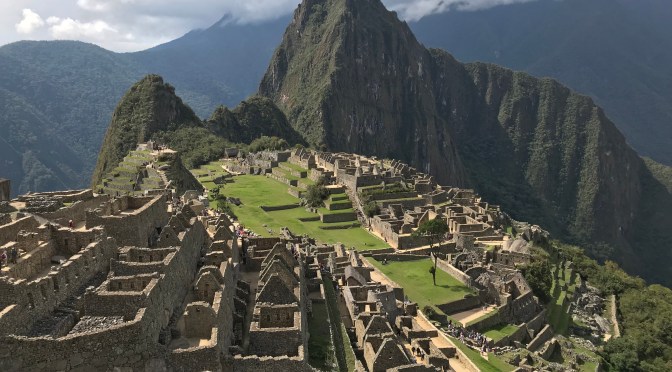
The enclosed photos speak for themselves….