Tag Archives: planning

Day 51: Schwäbisch Sonntag

In preparation for my departure at the end of the week, I took a stroll through the town on my own in the afternoon. I savored the time alone, with no rushing through museums and tours. There are so many interesting paths, side streets and alleys lined with historic architecture, from medieval to modern. The city’s double walls and independent status allowed it to be spared from many battles and sieges. Thus its buildings and city were preserved.

A festival with music in the market plaza served free food and beer. Here are a few more shots that I took today.

A return to the Hällisch-Fränkische Museum gave me an opportunity to study the geology, early history of the area, and other exhibits. The city gained its prosperity and fame from the salt deposits along the river. The area was occupied by Celts and later Romans. One of the area’s well-known sculptors was Leonhart Michael, who created the moving stone relief sculpture shown below of Christ’s Crucifixion.

On a Sunday afternoon and for 90% of the time, I was alone in this beautifully crafted and presented museum. The scale models of the city and buildings reinforce how much the towns appreciate their history, architecture and planning.

A wig gallery allowed me to inspect them closely. Having heard about all the hygiene problems until the recent past, I’m sure that the wigs were developed to hide all those lice and growies on one’s head. After trying one, I was left to my own devices and was forced to take selfies of myself in drag. Sorry, you’ll never get to see them publicly.

Day 44-46: Schwäbisch Hall

My 2015 80 Days Around the World are already over half-way completed. As I look back at the titles and featured photos of this blog, I can’t help but be amazed at all the incredible sights and sounds of each unique environment. It does restore my faith in humanity when I think about all the efforts and decisions that have taken place to advance mankind in the world. And it goes without saying that meeting friends and making new ones are the highlight of any city.

So why I am traveling so much and so far? For a few newcomers, I thought I should take a minute to explain the purpose of my travels. It’s the same rationale behind the trip I took around the world this time last year, only in the opposite direction.

The fundamental reason for my traveling each year is to get to and from Germany to study German. I studied German in high school, and like an instrument that hadn’t been touched for a long time, I decided to dust off the creaky machine and make use of it. Having taken a couple of non-contiguous courses in San Francisco at the Goethe Institute got me jump-started. And a growing new interest in German writers, opera, and music motivates me to read Thomas Mann, librettos for the Zauberflote by Mozart and books about musicians like Schumann and Beethoven.

The means of getting to and from Germany form my itinerary. Last year, I went to Dresden for a month. This time, I am spending two weeks in Schwäbisch Hall in a language and cultural program.

This year, I traveled on the Tran-Mongolian Express from Beijing to Moscow with my husband, Gee Kin, visited Russia (also with Gee Kin), and tapped into German-speaking countries for a couple of weeks on my own. At the end of my course, I’ll fly to New York, spend some time in New England with my college friend Karen, then take the train cross-country back home with her. We’ll stop in a few cities across the US along the way.

Last year, I rolled in my curiosity about the old Silk Road and Central Asian cities with carpets named after them, like Samarkand, Bokhara, and Kiva. I traveled in a one-way direction eastwards instead of a round-trip to and from Germany. You can read more about these in the summaries for 2014 and 2015.

Of course, having the pure and intrepid lust for travel doesn’t hurt. It makes travel planning fun and challenging. Along with a fully supportive and understanding husband and family, I am free to go as far as I can, wherever I want. I try really hard to keep things affordable, interesting, but varied to match my interests.

So, back to what I have been doing for the past few days.

On arrival at Schwãbisch Hall, I was happy to finally unload EVERYTHING from my bags for two weeks. Despite traveling light, I still accumulated more brochures, historical materials, and a few CD’s than I had planned on collecting. I’ll have to make some hard decisions at the end of this stay as to whether I will continue to tow these in my bags. I slogged my carry-on, nearing the 14.6 kilo limit for the German Wings flight we took from Moscow to Berlin, and my backpack off three trains and a remote bus link to the Goethe Institute guest house where I am staying.

As it was overcast, threatening to rain and nearing the end of the day, I beat it over to the main guest house to retrieve my keys and card. It was exhilarating to get in the door after nearly two hours of juggling all my paraphernalia. The room was perfectly adequate, with a half-size refrigerator, plenty of storage, and a private bath. There were other students milling around, but everyone seemed pretty mellow and ready to start class.

The first day of class is always exciting. Direktor Herr Schmidt of the GI gave us an introduction about the city, its history and economic activities. We were split into classes after a written exam to determine our level and ability. I was not disappointed to be placed in the middle of the pack, along with 11 other students.

Our teacher has been teaching at the GI for ten years. After introductions and playing some getting-to-know-you games, we all felt comfortable. The nationalities in my class included students from the UK, US, Denmark, and Japan. Each person had an interesting background, but we also had similar interests in art, music, and history.

The GI is located in a former hospital that has been renovated completely. A “kirche”, or church, was part of the original building and where we were greeted in the beautiful, large meeting hall. Other modern facilities included a media library, cafeteria, and classrooms.

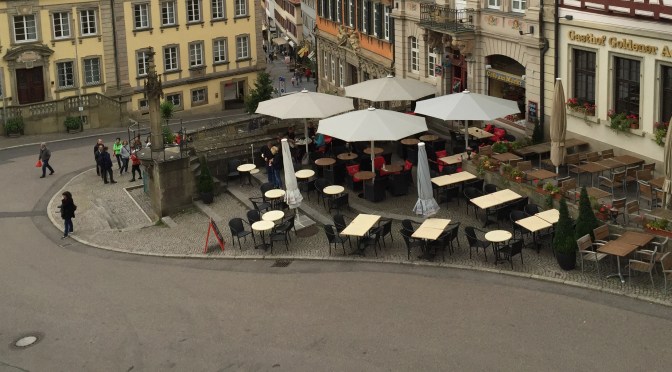
Schwabisch Hall is situated in South Central Germany between Frankfurt and Munich, near Stuttgart. It is a lovely, small city of about 40,000 people and a welcoming environment for its visitors. The Goethe Institute serves as an anchor for the city’s activities and Schwabisch Hall offers a wealth of celebrations, cultural events, and historical architecture. Within the Market Plaza are examples of medieval, Gothic, Renaissance, Baroque, Rococo and modern architecture! You can get an overview of history just by turning 360 degrees!

The town is peppered with a network of pedestrian passages, stairs, and cobbled streets that make this a delightful environment for visitors and residents alike. The town planners showed how modern architecture, open landscaping, and transportation can work together to form a compatible, balanced machine for living.

Days 24-26: Salzburger Knockouts

I’ve been trying to get my dose of Salzburger Nockerl, a famous local dish made from pure egg white meringue. Unfortunately, it has eluded me so far. I either wasn’t in the right cafe that serves it, or didn’t have the 20 minutes it takes to prepare it.

Despite this oversight, I finally struck gold in many other ways on my last couple of days here. I got it all and what I love about traveling: quality architecture, quality museums, quality music, quality food, and of course, quality people! The tag posts seem to tell it all.

I’m trying to reduce and concentrate the number of posts to only a few a week (Wednesdays and weekends) so I don’t flood your email boxes. Unfortunately, it makes the posts longer.

Here’s a spread of what this richly, well-endowed, and now much appreciated little city of Salzburg has to offer. To make it a little easier, I’m including a summary so you can skip to the parts that interest you:

1. Salzburg Fortress (Festung)
2. Mozart Houses (Birthplace and Living Quarters)
3. Performances (my raison d’etre for being here, but not necessarily the most exciting)
4. Food and People


1. The Salzburg Festung, or fortress, was very informative and an excellent excursion today. Gee Kin would be proud of me-I trooped up the hill and partook of the view from the top. Because Salzburg is so overrun with tourists, the city has managed to take tourists’ needs to heart. They provide excellent displays and explanations in English (for those of us brain-dead in German). They even had a electronic kiosk soliciting feedback at the end of the tour.

There were many architectural or design features I had not seen before. Those listed are not in any particular fashion. Follow the captions for specific items. You can hover over the photos now to see the captions.


1. Stone columns honed in a fashion the way wood is turned on a stile;
2. Matching metalwork
3. Torture elements–aha! can anyone venture a guess what this contraption is?? (see below)
4. A wooden threshold that was so old and worn that it exposed the “knuckles” of the knots from the tree, like aged knuckles on a centogenarian
5. A section of real arches that shows how they were constructed.
6. A display of how they created cranes to haul stonework up the mountain.
7. A latrine that was one of the first of its kind
8. Romanesque arch construction displayed

And a few morbid items from the torture storeroom to remind us of our mortality.

Since the fortress was built in the 11th century and over a period of hundreds of years, the museum was able to trace its construction history. It was an exciting architectural exhibition of walls, innovations and construction methodology. While most of the fortress was reinforced and expanded in the 15th century, it captures the various early periods from Romanesque beginnings to High Renaissance.
2. Mozart’s Birthplace and House:


3. Performances:

The star quality of these performances have been a bit mind-boggling. The interesting point is that my favorite opera star, Jonas Kaufmann, was not at the top of his game in Fidelio. The music was deep and entrancing, but his performance was weak. The opera performances shown here were much better. These performers can really deliver full-bodied voices and their skill and dedication really shows. Audiences were very responsive and clapped heartily.


4. Food and People: On my last day here, I decided to go for the two-hour lunch instead of the evening dinner option. My lunch was celebrated at the Heimer Specery. I took my time, had a small antipasti plate of eggplant, sun dried tomato and roasted red pepper with Prosecco, followed by the house specialty, a succulent full bodied pork chop that comes from the establishment’s own piggery. Along with a glass of rose, this was the chef’s recommendation so it had better be good. And it schmecked, or tasted delicious! I had just told Gee Kin that I thought pork was often disappointing as a dinner entree. I often found it dry and uninspiring. After your third bite you wish you had ordered the branzino. Well, I wasn’t disappointed this time. This little restaurant around the corner from the Festival Hall delivered to demanding regulars and I was a beneficiary.

The night before, I took my place at another restaurant (the one I went to for lunch today was fully booked 2 nights in a row, thus the lunch decision). As I was about to hog a table for four all by my lonesome, another gentleman was looking for a single at the same time. He asked if he could join me, the very exact same time another woman came along and did the same! I was very flattered, and didn’t mind the company at all. I was even more delighted when I learned that neither of them spoke English!

The three of us ended up with a very friendly conversation, and I had a chance to practice my elementary German. It was frustrating as I could ask basic questions but never “got” the answers. They drifted to fairly complex conversations about what the two dinner partners thought of the Greek Crisis, Angela Merkel, and the operas they were seeing. The gentleman’s nephew was performing in the opera we were about to see (Angela Georghiou in Werther). He was a baritone and did very well.

What I like about traveling is connecting the dots. I was flashing on how non-English speakers must feel when they are asked questions. After a few pleasantries, a zero-tolerance policy toward any non-English speakers seems to drift into the picture. Native English speakers tend to expect everyone to speak English, even in non-English speaking countries!

Well, the tables were definitely turned here. I felt stupid, unable to respond to simple political and economic questions. While it made me more determined to learn German, it made me reflect on how hard it is for many people in many countries to master English. I certainly came to that conclusion as I realized I could only sit and muse as the two native German speakers became very engaged and animated in their conversation. Sadly, I could only plaster a smile on my face and pretend that I understood everything.

German women seem to like short spiky hair, blow-dried behind the ears. Subtle platinum highlights, or jet red. Less Gothic these days. The woman who joined me was of the subtler version, and very svelt. She worked for a pharma company in Regensburg, and drove two hours each way to come to the performances this week. The gentleman from Innsbruck was a retired German teacher. It was, despite my misgivings, really fun trying out my German with no English back-talk.

Here are a few random street shots. The urban planning and insight for local Salzburgers and tourists alike are appreciated and well used in high density pedestrianized areas borne out of necessity. Delivery trucks and taxis drive right over the fountains and gutters, and everyone shares the paths in a symbiotic way.

Day 14: Moscow Drum Roll: Market and Modern Art

Dorogomilovsky Market early in the morning was Gee Kin’s pick today, followed by mine–the Tretyakovskaya Modern Art “Gallery”. We managed to take the subway three stops to our first destination without getting lost. The subway had a dizzying amount of subway names–all in Cyrillic–so you have to master the alphabet or you are “TOCT”. Gee Kin showed rapid improvement from his initial blundering, “What’s that alphabet called–Acrylic?”. I’m including the subway station menu, that requires good eyesight in addition to calisthenic tongue skills.

As a “wrailwray” kinda gal, I love cracking the system. We stepped into the huge escalator tubes of travelers, stretching endless miles deep down into the bowels of the Moscow River and beyond. These were the longest escalators we have seen anywhere–they felt like at least 3 to 5 times any of the deepest tube station in London. The Russian engineers liked doing things bigger and better, and this was another showcase opportunity. We sliced and diced the station names like a Benihana master chef would, and deconstructed each one letter by letter. We followed every sign religiously. We even avoided going down one-way streams and didn’t make elbow contact with anyone.

The cars were spotless, not a crumb or grungy morning coffee spill in sight. Like all good citizens, the Moscovites rushed swiftly, politely and silently. Gee Kin noticed that commuters zoned out with fewer hand-held devices and opted more for books and magazines than their Beijing or San Francisco counterparts.

As expected, the market was also a bustle of activity, with carts being swung and navigated every which way down aisles beyond safe speed limits. You can see our fascination with an array of some familiar but also new sights: furry rabbit’s feet good luck charms, Korean kimchee specialties (a note about that later), racks of lamb and carcasses, 8 piglets without blankets, bottled and pickled everything (including grass mushrooms Gee Kin loves), and on and on. It reminded me of the bigger but less varied market in Tashkent from last year.

Next, our day was traumatized by a trip to the Modern Art “Gallery”–along the Moscow River. That was the only bearing point for the humongous site. The monumental museum (and I mean MONUMENTAL…the size of an Olympic stadium…was so big and dwarfed human context so much that it became a nightmarish experience. We dragged and slogged our way though miles of artwork. Despite the noble effort to catalogue modern art in the Soviet Union from pre-Bolshevik days to today, the museum and its fascinating history was lost and unappreciated due to the vastness and lack of selectivity of the material. Its attempt to show “everything in the warehouse” (purportedly 170,000 pieces) made it mind-numbing and exhausting.

This frustration may have been caused by sensory overload from the earlier market visit. Just getting to the building from street to front door was a chore. The gallery literally looked like a stadium complex. We weren’t quite prepared for this mental and physical workout. If you go there, be sure to dedicate one entire day for a visit. Better yet, a week. Bring your camp stove and tent but don’t get caught.

Don’t misunderstand my message. I did love the artwork. I was inspired by the sculpture more than the paintings, though. They all cried for attention. Because there were fewer pieces of sculpture, you could focus on them more easily. I found the predominance of woman’s bodies depicted in real, human ways very moving. They weren’t idealized as Venuses. They were reflections of real women, of mothers, sisters, workers. I even found a few that looked like me! Their bodies “hung out”, but their faces spoke volumes.

I couldn’t help but think about the stunning ballet performance by the prima donna from the night before. She could perform so flawlessly, and so dramatically. Her face and body spelled all the agony and torture of the dying Violetta. The sculpture of woman and child spoke to me in the same way, as did the other pieces that were chiseled and sparked to life from stone.

Aside from a few Chagall pieces that I could detect, it was difficult to find any recognizable names. We were on the lookout for a cache of Matisses, but these were all Russian artists (Chagall was a Belorus-born French artist). The French Impressionists are elsewhere in Moscow, not here, in this national repository.

And of course, near and dear to my heart, design. See my favorite pieces of artwork in the entire stadium: calligraphy on beautifully crafted plates.

Note regarding Korean community in Moscow: some came here before WWII. They were later purged to Uzbekistan, and a small population still lives there.

Giddy at the Getty

J. Paul Getty was an oil magnate who traveled and learned to appreciate the antiquities of Greece and Rome. He was an avid collector and showed pieces he acquired in his Malibu mission-style ranch house. Although he lived in London most of his later life, he commissioned the Getty Villa to be built in Los Angeles to house his artwork but never saw the villa.

The Getty Villa simulates a Roman villa from Herculaneum, a town that was buried from the eruption of Mt. Vesuvius in 79 AD. While Pompeii is better known for the entire city that was excavated, the site at Herculaneum was closer to Vesuvius and was preserved intact under 65 feet of ash and lava.

The villa that Getty copied was owned by a Roman senator whose daughter was married to Julius Caesar. The senator was quite wealthy and influential, and the house was 60,000 sf. The Getty Villa is a small replica of the Roman one and contains an amphitheater for Greek plays, a peristyle or colonnade surrounding an atrium for dining and social meetings, and rooms above to house slaves.

Getty clearly got addicted to acquiring Greek and Roman artifacts. Once he accumulated all of these possessions, he had to build a museum to house them. Stephen Garrett, an architect, was hired to research, design and build the villa. Machado and Silvetti were also involved in the design of the site.


Photos, from top, left to right:
1. Entrance Plaque to the Getty
2. Detail of Greek Terra Cotta Dish, ca. 450 BC
3. Detail of Roman Sculpture, ca. 150 AD
4. Exterior Garden and Pool

The Getty Center, also built with Getty Foundation funds after Getty’s death, took more than 20 years to complete from inception to opening. It was designed expressly for the preservation of Western Art at the cost of $1 Billion and as part of a lawsuit. Family members were engaged in a bitter battle over the inheritance, and the only resolution was to build the museum. Twenty years ago, I was disappointed that funds were not devoted to building a higher education institution. The UCSF Mission Bay Campus would have cost about $1 Billion.

However, with all the museums I have visited this past year, I have revised my opinion. The Getty Center has become a vibrant and relevant educational institution on its own merits. I certainly witnessed many diverse visitors enjoying the buildings, exhibitions, and gardens. The Turner exhibition and the WWI Images special exhibition at the Research Center were both excellent and well curated. With a variety of visual aids, visitors were engaged in learning about the artists and the subject matter. For some reason I was more aware of the level of activity and engagement at both locations than what I normally notice at other museums. Both museums are free.


Photos, from top, left to right:

1. I-405 Freeway Access to Getty Center; a Monorail takes visitors from Parking Lot to Center at top of hill
2. Approach to Main Plaza
3. Main Plaza
4. Research Center. Buildings are designed by Richard Meier, a prominent New York architect. He moved to the site to determine placement of buildings. Flooring, panels and windows are designed to the architect’s signature 30″ grid. The Center opened in 2006.

Being located at the northern end of Los Angeles, the Getty Villa in Malibu and the Getty Center off I-405 are worth grouping for a day-long tour of both. Unfortunately getting to both requires a car.

Addenda:

1. Exhibit from WWI Images.Map by Walter Trier, an artist who illustrated books for Eric Kastner. Each European country is a sinister character.
2. Henry Moore Sculpture, 1983
3. Chart showing personalities of each European Country, divided by “Futurists” and traditionalists or those against progress.


1. Burl texture (see Sacto Dreamin’ video from November)
2. Super gigantic fig tree in garden of Fairmont Miramar Hotel, Santa Monica.
3. Acanthus leaves in garden at Getty Villa, similar to those represented on Corinthian columns

Day 64: HK MTR and Vertical Cities Symposium

Hong Kong was one of my old stomping grounds, so I was particularly excited about seeing old friends. After graduating from architecture school, I arrived here with $100 left in my pocket and a determination to work here for a year. I ended up staying for seven. Gee Kin and I met in HK, and, well, the rest is history.

I’ll tell you more about the my day traveling on HK’s mass transit system and today’s seminar on Vertical Cities that I attended through the annotated photos:

1. This was the interior of the car in the MTR system. After nearly 40 years since I first worked on it while it was under construction in 1976-78, the system has held up well. I remember trying to introduce some of the BART system concepts to the British who controlled development of the system at the time. They were not interested in the BART fledgling system, which was barely 10 years old at the time. Being true colonials, the engineers preferred to utilize the London tube or British Railway system as their precedents.

Nevertheless, it’s an efficient, well-maintained system. It hardly showed any wear and tear despite its mature age. I was told that there are some delays and breakdowns that are only just beginning to appear, but the system has run well until recently. This photo is a general overview of the train interior.

2. Cell phone mania is not particular to China. 5 out of 8 were actively using their cell phones in this cluster of people. If I had taken photos in other cities I visited, they would have been similar, and maybe only nominally lower in numbers.

3. A shop, inside the MTR selling pastries. The two unusual items that caught my eye were green tea and fig rolls (that I tried) and squid ink, tomato, olive and pickle pizza (that I did not try)

4. A upshot of high rises near Garden Road.

5. Speakers at the Asian Vertical Cities Symposium sponsored by the HK American Institute of Architects at the Asia Society

6. Asia Society Walkway design by Tod Williams and Billie Tsien to protect the local bat colony near HK gardens.

7. Flower arrangement in the Asia Society Building

The symposium consisted of an afternoon of presentations by local luminaries, followed by dinner and conversation. My good friend Peter Basmajian, a local HK architect who has lived in HK over 30 years, invited me to join him at this event. I also reconnected with George Kunihiro, a fellow architectural classmate from UC Berkeley. We had not seen each other for nearly 40 years! He happened to be visiting Hong Kong from Japan, where he now works.

A few salient comments from the symposium focusing on transit-oriented, high-density vertical cities included the following:

Ken Yang from Malaysia introduced his idea of green buildings and creating continuous linear parks as developed in the Solaris Building in Singapore for an ecological solution

In designing a building as part of a competition, you have to start with something interesting for a competition and end up with something different or unexpected, as shown in the winning design for the Crown Plaza project in Sydney, Australia.

Dinner topics included table discussions on sustainability, livability, affordability, and mobility. Many of the cities discussed include those in China, India, Indonesia, Thailand and Malaysia.

Day 62(a): Race to the Top

Rome wasn’t built in a day, but maybe it should have waited to take a lesson from the Chinese. It wasn’t exactly a day, but how about 5 days? 5 years? Complete with a working mass transportation system. I thought about how many buildings I could name in Manhattan versus those I could name in Guangzhou. Many vs. one–the hotel where I am staying. What’s going on here?!?

I spent today walking around Guangzhou’s new civic center area after I visited their Guangzhou Provincial Museum (Part b of today’s posting). Initially I was very impressed by the overwhelming volume and size of the buildings. This area included the equivalent of a state museum, an opera house, a park, and a huge library. In the end, I have more questions than answers.

I wanted to go to the Guangzhou Opera House, thinking that it was, well, for Guangzhou Opera. Wrong. Upcoming performances include Angela Georgiou (I wouldn’t have minded) and the St. Petersburg Philharmonic. I decided to pass on tonight’s production the Globe’s Midsummer’s Night’s Dream for $40, cheapest seats available. So much for my fantasy to revel in those days when I went to Chinese Opera with my mother in Chinatown nearly 60 years ago.

Zaha Hadid Baby got her commission after battling against Rem Koolhaas. I guess her pebbles made a big splash. You can read more about it in http://en.m.wikipedia.org/wiki/Guangzhou_Opera_House.

After a visit to the museum, I wandered back to the hotel and many buildings caught my eye. First, in general, by the sheer size and scale. I’m posting some for your enjoyment. It feels like an arms race to the top. Who are they competing against? Other designers? Other companies? The region? Other cities in China? New York? I would love to know.

Second, I got fixated on the rooftop finishing. Having just completed the Neurosciences Building at UCSF, I know it was about mechanical screening. OK, saw a few buildings that did that. Some clearly wanted to reach to the clouds and show their mighty height with spires. Ok, get that one too. And then there are the loop de loops.

Well, you might draw your own conclusions. I get the decorative elements to provide some relief from high rise ennui. But I think I am missing something. These architects have left something out of the obvious reasons for me. Any guesses?!?

It did make me think of the little pitched roofs in Germany and the curious blinking eyes I posted back in August. They were unintentionally playful perhaps, but I am not sure I could call these responses to the transitions to sky exactly “playful”. (By the way, my fixation on cranes is also amply displayed here. They aren’t part of the decorative elements of the rooftops.)

Day 39: Sustainability and Transportation

imageimageimage

 Sustainability in Germany

Photos above, from top:

1. Older buildings utilized exterior louvers to provide sun shading for buildings to reduce heat gain. (Refer to lower bottom right of photo).

2. Customers return bottles at supermarkets and receive instant cash receipts. These can be used at the counter when paying for groceries.

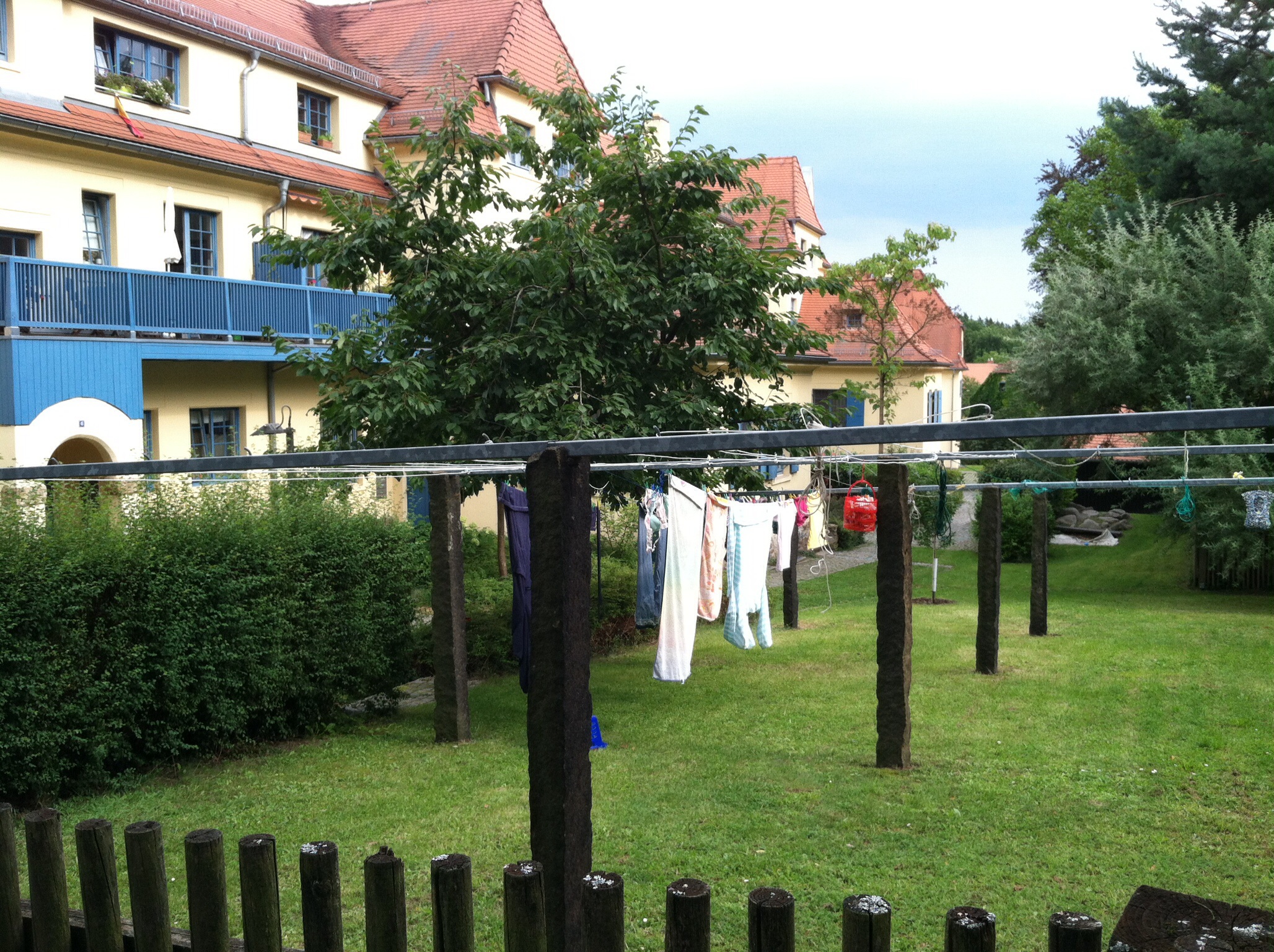
3. Photo from an earlier post (at Hellerau) showing how drying clothes outdoors has never really gone out of style in Germany, even in up-scale neighborhoods.

The only thing I didn’t see to any degree were solar panels, at least not as visible as in the Bay Area. Given the direction Germany has taken historically to provide steep roof lines for snow load control, it may be facing an uphill battle. The widespread use of penetrations for gabled roofs and attic windows don’t help matters. And there seems to be a lot of cloudy days here. 

Considering how Germany attempts to lead the world in sustainability and zero carbon footprint, this might hamper their reputation in solar energy development. Perhaps China has already pulled the carpet out from under Germany’s lead on industrial production of solar energy by now.

There has been a lot written about Germany’s endeavors to be sustainable, but it seems to come more from the traditional conservation methods than by innovative technology. Perhaps it’s not yet that evident, and it occurs in newer buildings. But for now, at least in Dresden, it hasn’t quite taken taken hold. Its historical use of reducing waste is a far better bet for the future than what the US is able to do for the time being.

Transportation

The Dresden transportation system is one of the delights in coming here. I have managed to get around the city and all the sights I have posted, with few exceptions. It’s safe, clean, and efficient. There’s respect and even affection for public transportation. Why can’t we get it together? 

Buses, cars and bikes are all in symbiotic relationship with each other here. You don’t do stupid things, wait for the lights to change, and minimize the impact on the environment. With taxes being out to good use, the Germans reap the benefits of their efforts.

Photos below, from top:

1. A bus shelter, that posts the full schedule for weekdays and weekends. It’s reliable, practical and clearly identified. Bikers often use the system and bike in between.

2. Interior of the tram system is kept clean and tidy to make it a pleasure to use and appreciate.

3. Window graphics indicate that areas near doorways are for wheelchairs and strollers.

4. The train system has been developed throughout Europe and thrives. Stations like this one up the street from where I live make it easy to get to virtually any point in Europe, or to regional spots. Safe, clean, and efficient.

image

>image

imageimage

Day 34 (a): Hellerau Garden City

image imageHellerau has always been a romantic notion to me, but I finally was able to see it with a small group of students sponsored by the GI. It was based on an English town planning concept developed around 1910 in this idyllic “Dorf” a mere 15 minute ride along my tram line 8 north of Dresden.

It felt a little bit like Marin or wooded Montclair, but of course, in the German tradition, extremely tidy. Everyone was entitled to a well designed unit, with plenty of open space, gardens for every unit, and community space. The buildings were well built and conceived, as evidenced by its condition today. There is the line connection to the city, but it looked like most people had cars to get back and forth.

The Werkstatt was intended to provide a community for Live-Work, obviously not a new concept. A furniture shop served as one of the mainstays for income. Today, it has been repurposed for artists and designers. Local temporary dance companies work in the community center and musical performances connected with the Dresden Music Festival are held here annually.

image image image

Photos, from top, down:

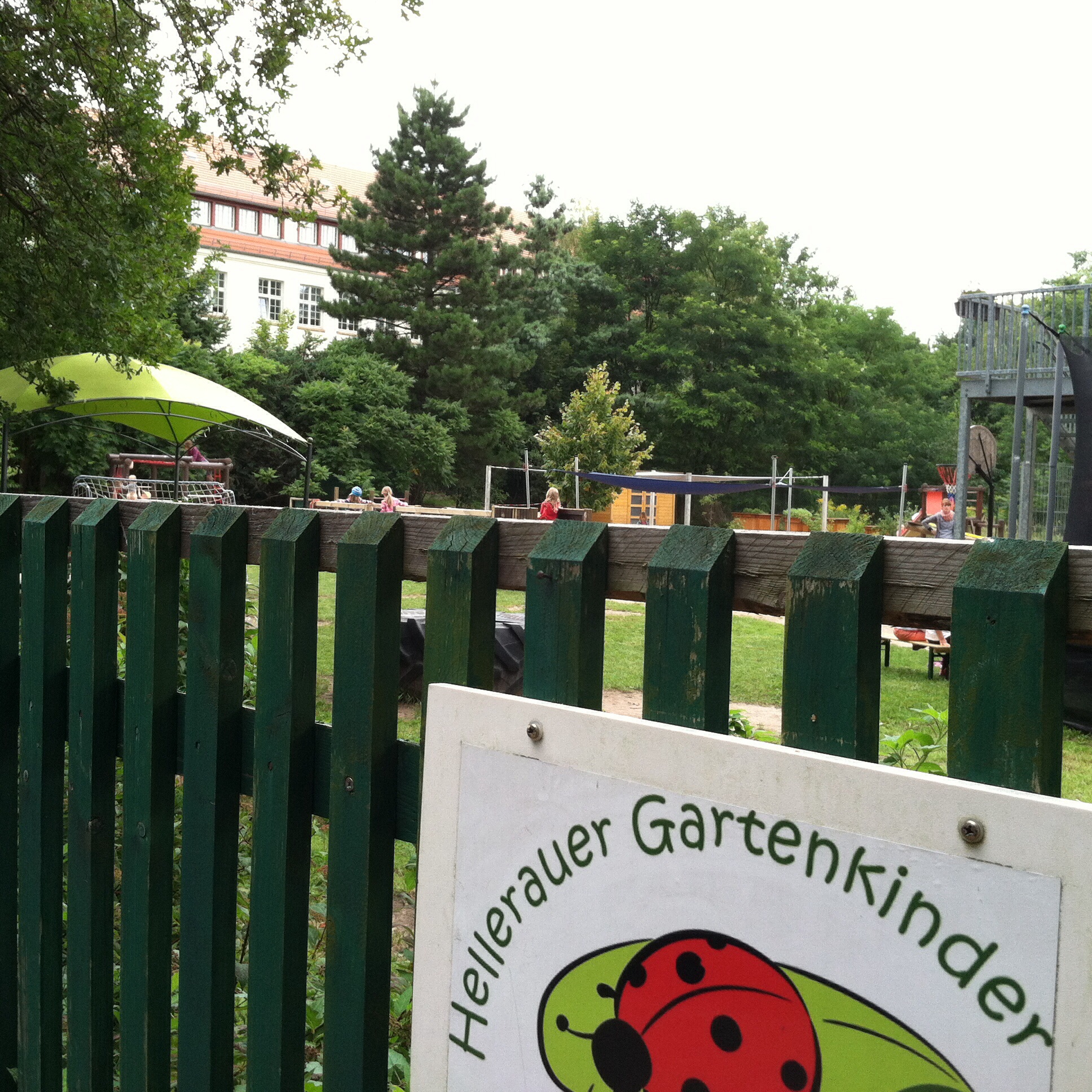
1. The new spin on what Germans coined for Kindergartens. They are, needless to say, well planned stages of life, with a lot of attention and loving care. These are still excellent models to emulate across the world.
2. Sustainability in action. This hasn’t changed from when the development was first built. Time for us to rethink our priorities.
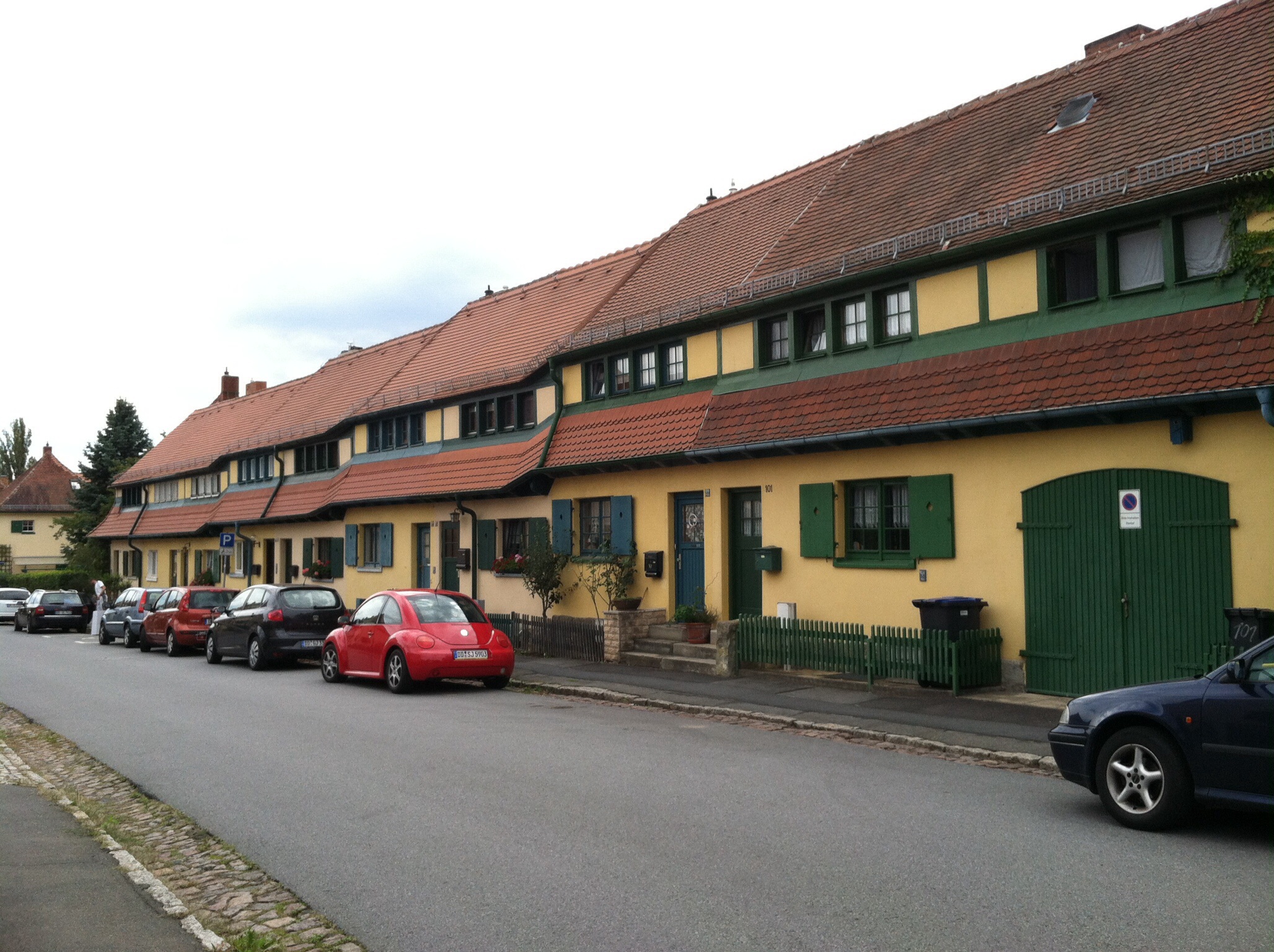
3. The first row housing development on a small scale, taken from the British, with more color
4. The Art Nouveau influence at that time is evident from the graphic lettering used on the Workshop for Furniture.
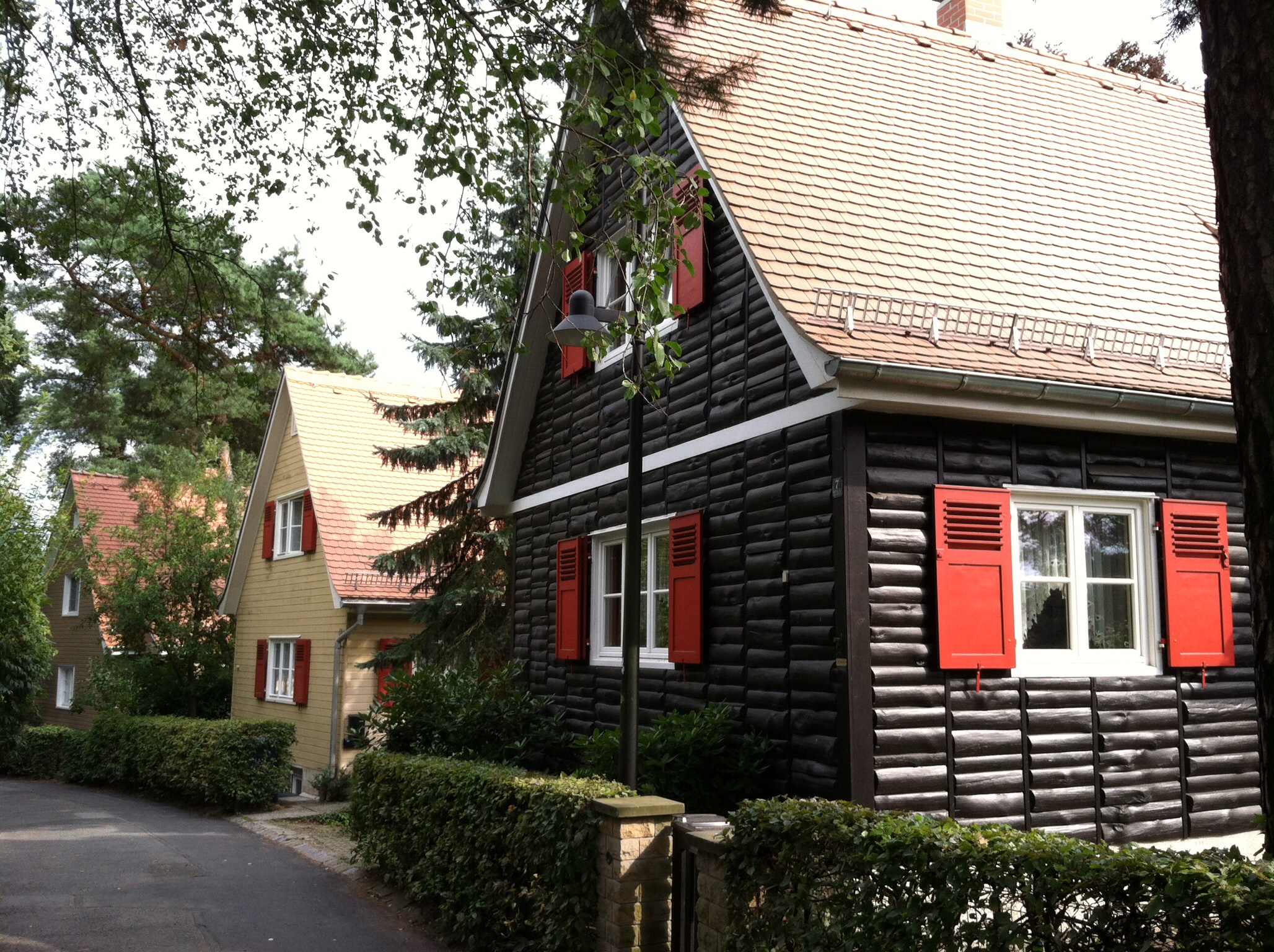
5. Individuality was allowed on buildings. While most were stucco plaster, this one utilized a log cabin concept with tapered logs, but stacked in smaller lengths in metal channels. This could have been a very efficient way to construct the exterior, and it still looks durable and easy to maintain.

For more information on Hellerau, check out http://www.hellerau.org/english/hellerau/history/the-garden-city/