Tag Archives: Interiors

Days 20-22: Planes and Boats and Trains

Such has been our busy week of flying from Moscow to Berlin, taking a hydrofoil to Peterhof from Moscow, and the train from St Petersburg to Moscow. We enjoyed the Sapsan train the best, which turns out to be the same as the ICE train I am taking from Berlin to Salzburg. We assumed the Russian premier long distance train was its opportunity to showcase Russian engineering, but it looked suspiciously similar to the German trains.
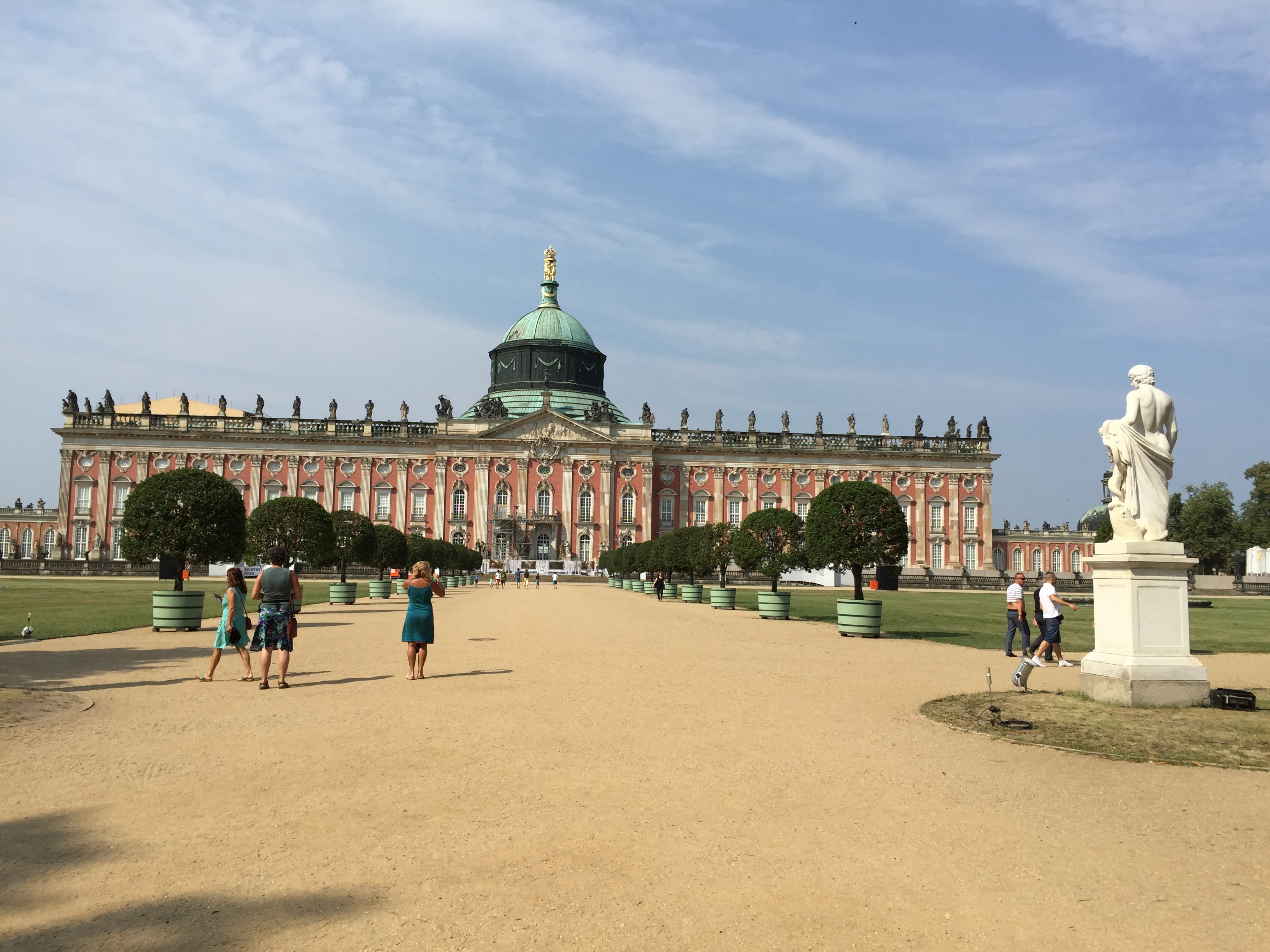
IMG_7686Yesterday, on Gee Kin’s last full day in Berlin, we took a day excursion by local train to Sans Souci Palace in Potsdam. We didn’t visit the palace as most visitors do, but took a three-mile walk between Sans Souci and Charlottenborg Palaces in the scant shade of 99 degree weather. A UNESCO world heritage site, Potsdam was the chosen site for the summer palace of King Friedrich. Here’s a Wiki link: https://en.wikipedia.org/wiki/Sanssouci

The event planners were preparing for the Sommernacht at the palaces the following day. It sounded like a wonderful celebration of German classical music in a beautiful venue, but unfortunately we were leaving. It would be worth coming back one day for the festivities and fireworks in this elegant location.

In our 36 hours in Berlin, we had launched our stay with a leisurely walk in the neighborhood of Potsdamer Platz, through the zoological garden in the middle of the city. It was calming and provided time for us to reflect on all the Siberian landscapes we had just traversed.

Those of you who know us are aware that we like long urban walks, 5-10 miles a stretch. This was yet another “walk in the park”. (For the curious, I have a website, http://www.crazyladywalks.com, that provides detailed information on Bay Area walks). It may seem pricey to go halfway around the world for a walk, but these are the most memorable and enjoyable ones to us.

We managed to balance the rest of our three days with local tours and attractions. We found a good Turkish restaurant in the more local area around the Zoo. Gee Kin slugged out on the museum track so we did a Young European concert with the Kiev Orchestra last night.

Sandwiched in between our morning walk and the evening concert, we visited the Reichstag dome. Being one of the hottest days ever in Berlin, we wondered how we got ourselves into this predicament. Masses of local tourists had come from all over the world to the Reichstag for their German civics lesson, on this one day. We not only fried at every pit stop, but then we were sous-vide under the dome, which resembled the George Forman griller.


Nevertheless, it was still fun to see and experience Norman Foster’s masterpiece. Luckily for you, the photos can never effectively convey temperature. But I guarantee you, the open vents in the building were insufficient ventilation for the once-in-a-hundred years heat wave. My dead straight hair went curly and the wood on our paper fans are permanently warped from this day at the Bundestag.

Three activities in one day’s 99-degree weather may be asking for trouble. Gee Kin’s alternative was to go to some delightfully soothing, air-conditioned art museum and he picked this?? Granted, the tour to Reichstag was pre-booked. We had failed to do this a few years back on our first trip to Berlin around 2012. And I was a day off on the booked date. Being our last day, we were not going to forego these paid-in-advance commitments so we had no choice but to go. So our last day was a bit of a marathon but it was penance for our lethargy the first 48 hours.

As mentioned, we went to a concert at the Konzerthaus Berlin, in a renovated building in a lively area in the middle of the city. But that’s not saying much, as everything seems to be in the middle of the city. Rome and San Francisco feel intimate like this, but not Moscow or Paris. Those are honking huge BIG cities, that dwarf your existence. That may be due to the six-plus-lane wide ribbons of thoroughfares used for pomp and circumstance.


I am at this very moment passing through Bamberg, where Gee Kin and I first discovered Cameron Carpenter. He is an amazing Curtis-trained contemporary organist who can do both classical and popular music. Some of you saw his performance at the SF Symphony Hall last year. He is one of our favorite new artists.

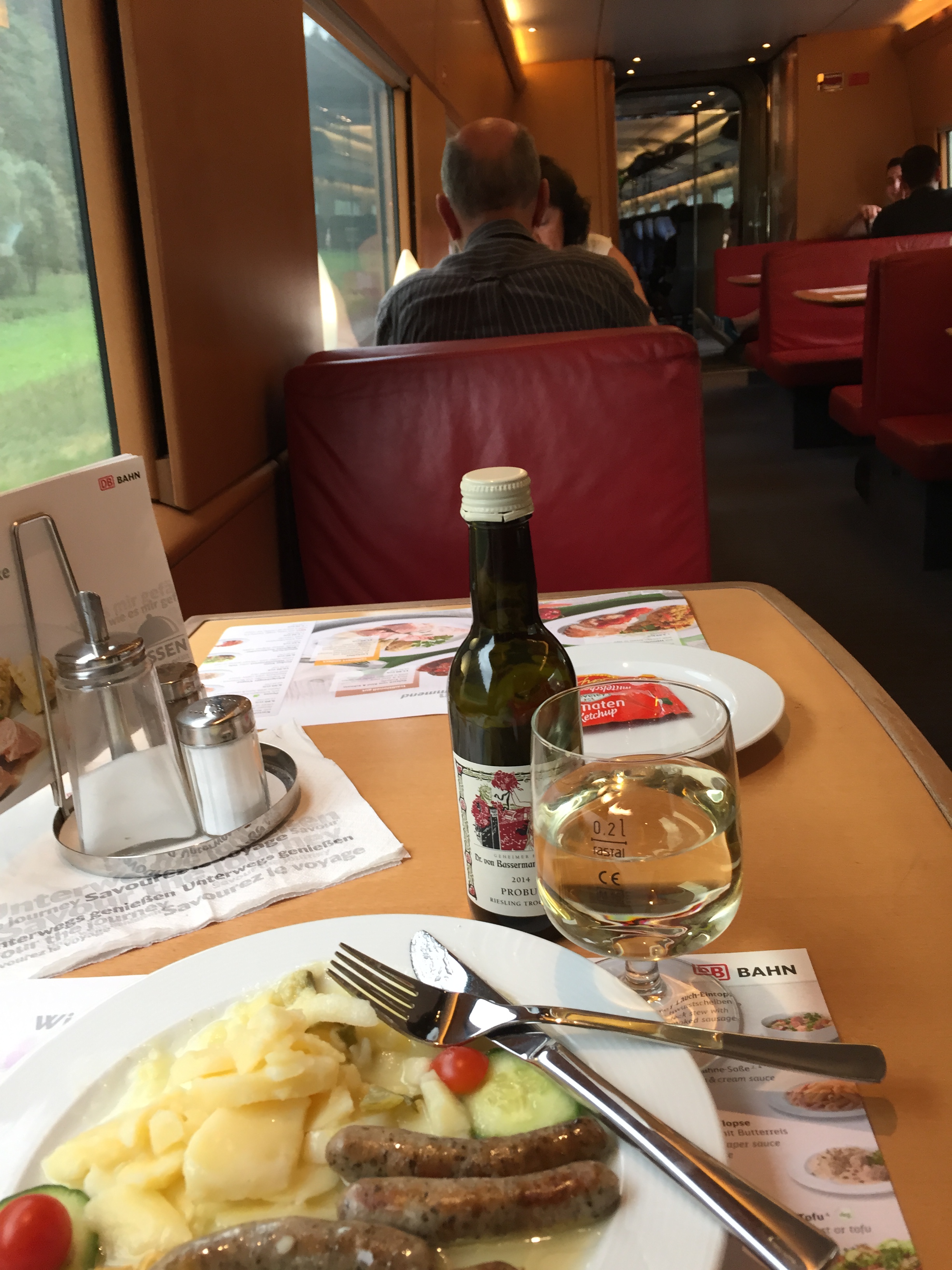
I am sitting in the dining car for lunch, noshing on bratwurst and cold potato salad. (See photo). IMG_7743The quality of food is less important to me thanthe total experience–environment, ambience, and PEACE. This was it, enough for me to write all of this discreetly in a maple-veneer and leather-lined carriage. Prices were reasonable by American standards. I had my .2ml wine (a bit more from the split bottle but you can measure if you want from the mark on the glass), entree and dessert with coffee, with a priceless view and free opera music via my IPhone to boot! To me, this beats a table at French Laundry.
Am heading to the Salzburger Festival and will post from there in a few days. Til then, stay wet (not dry
for SFers) and cool (for Deutschers). Clouds on the horizon.

Day 16: St. Petersburg Architecture

Let’s take a look at St. Petersburg’s finest offerings. You can click on photos to view full-size images, and hover over each to read captions.

Above photos: St. Petersburg’s first and foremost flagship department store, similar to Harrods in London, with Art Nouveau Interiors

Photos, below: Original Singer Store (from US Singer Sewing Machine fame), now a book store, with Art Nouveau traces*

Photo, below: DLT Department Store, St. Petersburg’s newest and flashiest shopping center, ca. 2014
IMG_7442
And a potpourri of street scenes, below. For Julianne and Melissa from Dostoyevsky’s 19th C. apartment building, “Here’s lookin’ at you kids”.

*excerpt from Wikipedia
The famous Singer House, designed by architect Pavel Suzor, was built in 1902–1904 at Nevsky Prospekt in Saint Petersburg for headquarters of the Russian branch of the company. This modern style building (situated just opposite to the Kazan Cathedral) is officially recognized as an object of Russian historical-cultural heritage.

Day 8a: Success and Failure in One Felt Swoop

My first glimpse waking up this morning through the window was a view of a mountain-wrapped, dead flat valley with waterways feeding Lake Baikal. Villages sprinkle the edges with single story, detached houses and proper 5’-high wooden fences succinctly staking out each owner’s territory. Its clean air and water is disrupted by a parade of toilet paper shreds populating the railway line. The pieces were all dried out, caught in the brambles, and sadly waving from neglect.

You could say it’s the Siberian town you would expect to see, somewhat bleak and tragic. Unfortunately, we are only passing through and have no impression of the liveliness or livelihoods of the people who live here. It could be completely different from surface impressions.

Yesterday produced a winner and a loser. Some of you may have already noticed my one-hour escape to Wi-Fi Heaven at the Ulan Bator Railway Station. I sang my Hallelujahs as I sent my three latest posts and added images to those that wouldn’t behave in Beijing. It was exhilarating to walk into a dead railway coffee shop and ask for Wi-fi Access, and “You can alway get what you want”, contrary to Mick Jagger. Just ask.

Immediately after our return to the train, the car attendant informed us that all the first class 2-berth compartments were fully booked out by a Chinese tour group that just embarked. So no upgrade. Wah!! That took the wind out of my buoyancy from a few minutes beforehand. What an emotional roller coaster!

Without any option, Gee Kin and his optimism kicked in. He loves to dig into the “toughing it out” adventure he had always imagined. I was grumpy. No toilet to ourselves, only the single grungy one for the car.  OK, so we were the only ones in the entire car except a late-bake single woman who mysteriously appeared in Ulan Bator. She had the nerve to occupy “our” car.

As I continued to pout, the car attendants (2 for each) tried to convince us how fun it would be to have access to the entire car (except for the invader). What’s the difference between sharing a toilet in the first class, polished wood compartments with Chinese carpet runners along the corridor and ours, anyway? 

We had carpet runners too, and even the first class ones had stretchy lumps that you tripped over predictably on the way to the dining car. And we had our “shared” toilet, full access to the shaver outlets in the wash room for recharging our devices, and hot hot hot water for tea on demand from an urn. Bedding was fine, and not much difference in quality to the embroidered upholstery. But I was sure I liked the goopy gold filigree on red version than the flat blue-on-blue plain jane in ours.

In the end, like the crazy horse that grows mature and gets tamed, I resigned myself to the fact that we are stuck in the second class compartment. Although it was not our choice by design, it is growing (more) hair fondness on my chest. Live like the locals (except no local in their right mind is doing this). Get to like taking a half-bath in the railway station mop sink (which I did). Eating doses of Instant Oatmeal packets and Chinese Noodles is perfectly tolerable for 5 days. Packaging is fun when you can rip the tops off with your teeth. 

Waiting for the customs and immigration officials to embark and do their thing certainly wasn’t any different. Between first and second class you get treated equally. After being forewarned at the border between China and Mongolia (remember the dry-docking of the cars?) between 10pm and 1am, this one should be a piece of cake. A two hour stopover from 8-10pm according to one schedule should be plenty of time for the crack team to do its thing.

Instead, we didn’t have to re-wheel. Mongolia and Russia had their act together, but China must have missed this detail on track standardization. We skimmed right through any workshop in the station straight to the barbed-wire lined border station (Naushki). Hefty drug-sniffing Russian Shepherds glazed past us, then the Brunhilde-like inspector came in. 

She did a good job investigating each and every compartment in our car. She adeptly and impressively mounted every ledge or protrusion to scale and anchor her Doc Martins to reach the ceiling of each room. She found every architectural piece of hardware used to close or hinge metal ceiling or wall panels and either opened them herself or had the compartment attendants do it. We heard her for half an hour commanding, “KAI!” for “OPEN!”. And yes, each and every one was opened and the empty space behind was thoroughly inspected.

Meanwhile, her cohort looked down below. Empty compartments were already prepared for this customs search, so lower bunks were tipped up in order for space underneath to be visible. We got to see the show for our compartment, since we had been sleeping until the border patrol arrived. The agents were courteous, but made us get up out of bed so they could “look at us”, full-height (clothing not essential) against our visa photos.

After this “interesting” experience, we were grateful that border patrol was completed. Gee Kin got his adventure, and me my experience to share.

For the foodies out there, our food improved with the Mongolian dining car. It was attached during the dry-docking, and the bad Chinese food left for the next gig. We had beef and onions, rice, and pickled carrots. Perfectly decent. Looks like a Russian dining experience is next.  The only thing we can’t figure out is when lunch is. There is six hours’ time difference between Moscow and Ulan Bator. We are traveling west. Every time we check the time, it seems to be an hour away to lunchtime. Can anyone figure this out???

Day 3: A Chinese Style Boutique Hotel

As mentioned earlier, we are staying at a Courtyard-style residence. This small boutique hotel is over 300 years old and is well preserved and showcases the best of Chinese Architecture. The rooms are decorated with traditional Chinese fretwork and furniture. The public spaces also reflect traditional Chinese art and design.

panorama

Private rooms surround the courtyard. It is well used and shared by guests, who can recover there from the stifling heat and frenzied activity in the surrounding neighborhood. Dongcheng, or East Wall, has become the hot new area after a portion of the courtyard style residences has been saved. Despite much controversy in the recent past, this area was renovated and repurposed to retain its history and old-city atmosphere.

It’s been a fun place to explore and peek into existing courtyard homes. Shopkeepers have been very creative (see yesterday’s post). They sell one-of-a-kind handmade and locally produced clothing, accessories, and of course, food. (This is China, after all!!) Services such as spa treatments can also be found in this area. Both foreign and local tourists alike are fascinated by the clash of modern and ancient Chinese culture.

Updated 8/6/15

Liszt-less in Weimar?

One of the true pleasures of coming to Germany is to hear great classical music, not only by inspired young musicians, but to hear performances in the composers homes where they lived. We had such an opportunity yesterday, when we attended a performance by the Hoch Schule for Musik Franz Lizst (Franz Lizst Music High School). Seven advanced piano students performed pieces by Chopin and Lizst.

Their performances were passionate and stirring. The very room where Lizst trained his students was where these students played these masters’ compositions. (See drawing room photo above, left, and dining room adjacent to drawing room, right)

Liszt Hochschule for Musik

Earlier yesterday and this evening, we attended performances at the Hoch Schule around the corner across the back alley to our hotel. We could slip into free performances by a guest harpsichordist from Prague and other Hoch Schule cello students. What a treat it was to hear high quality music so conveniently located–virtually in the back yard–and for free! Photo above shows Festival Hall where performances are held)

This morning before our activities in town, we took a brisk walk 4 km. to the Belvedere Castle outside of town and back. The bus easily could have taken us there, but we decided to get some exercise and see the countryside. We walked through the Park Ilm, another historic UNESCO world heritage site. There are about a dozen sites in Weimar that form a collection of UNESCO-recognized cultural treasures.

Later in the day, we visited the Schiller House. Although Schiller wrote the stories about Don Carlo and William Tell, we are more familiar with the music set for them by Verdi and Rossini. Beethoven also wrote his Ode to Joy based on the poem by Schiller. An exhibition at the Schiller House showed how instrumental the Artist Lucas Cranach and his son were in promoting the teachings of Martin Luther through their woodcuts, graphic arts, and paintings.

Our evening was topped off by a performance at the Weimar Hall with a solo pianist performance. (see header and photo below). It was a full day that filled our brains with deep thoughts, our ears with beautiful music, and our eyes with inspiring visions. We were definitely not bored or looking for amusement today.

Lizst Hochschule Festival Room

Großartige (Magnificent) Weimar

Photo above: View of Plaza outside Goethe’s House

Goethe and Schiller are often mentioned in the same breath when taking about Germany’s literary past and pride. It is no accident that both were friends and lived in Weimar as contemporaries. We came to this elite small town to learn more about each of them.

The Goethe Institute’s namesake was already mentioned last year when I attended a month long language class in Dresden (see Day 22 post in August 2014 Archives). I was fascinated by his life story. It began with his love interest, Charlotte, who was seven years’ his senior. He was swept away by her, despite her already being betrothed to another man. He was compelled to write one of the first romantic novels that spilled the beans (or poured his heart if you will), very openly and honestly. He eventually had to go away to Italy for two years to get over her.

The Sorrows of Young Werther recounts his passionate love for Charlotte as a young man. It went viral. Unfortunately, this success later plagued him in life to the extent he regretted writing it. The fleeting romance story didn’t exactly match up to the stature of his deeper thoughts. For me, it added dimension to his life and a reason for learning more about this great philosopher.

It even compelled Thomas Mann to write a story about Goethe’s famous love for Charlotte. In Lotte in Weimar, the modern writer of the 1930’s imagines Goethe meeting Charlotte in Weimar after they are in their sixties. She comes to visit with her sister and daughter, and she meets with Goethe. A faint reminder of Pride and Prejudice, both Goethe and Mann stories have deep psychological meaning despite being early soap operas. They are fascinating stories that examine and delve into German character and emotions.

Although we had been to Weimar before, I wanted to revisit this historically significant town. As a philosopher, politician, writer, artist and humanist, Goethe was a Renaissance man. After seeing his home, we have greater awareness and appreciation for his life and work. Of course, it didn’t hurt that he was patrician and hung out with royalty!


Photos above:
1. and 2. Interior of Goethe’s house
3. View of garden from inside house


Photos Above:

1. View of scenic Elbe River and Bad Schandau, from train en route from Prague to Dresden (approximately 2 hours by train)
2. View of Prague train station Art Nouveau interior, spotless and spit-shined (also very safe)

More on Schiller and the Bauhaus to come…

Thank You Very Mucha

image

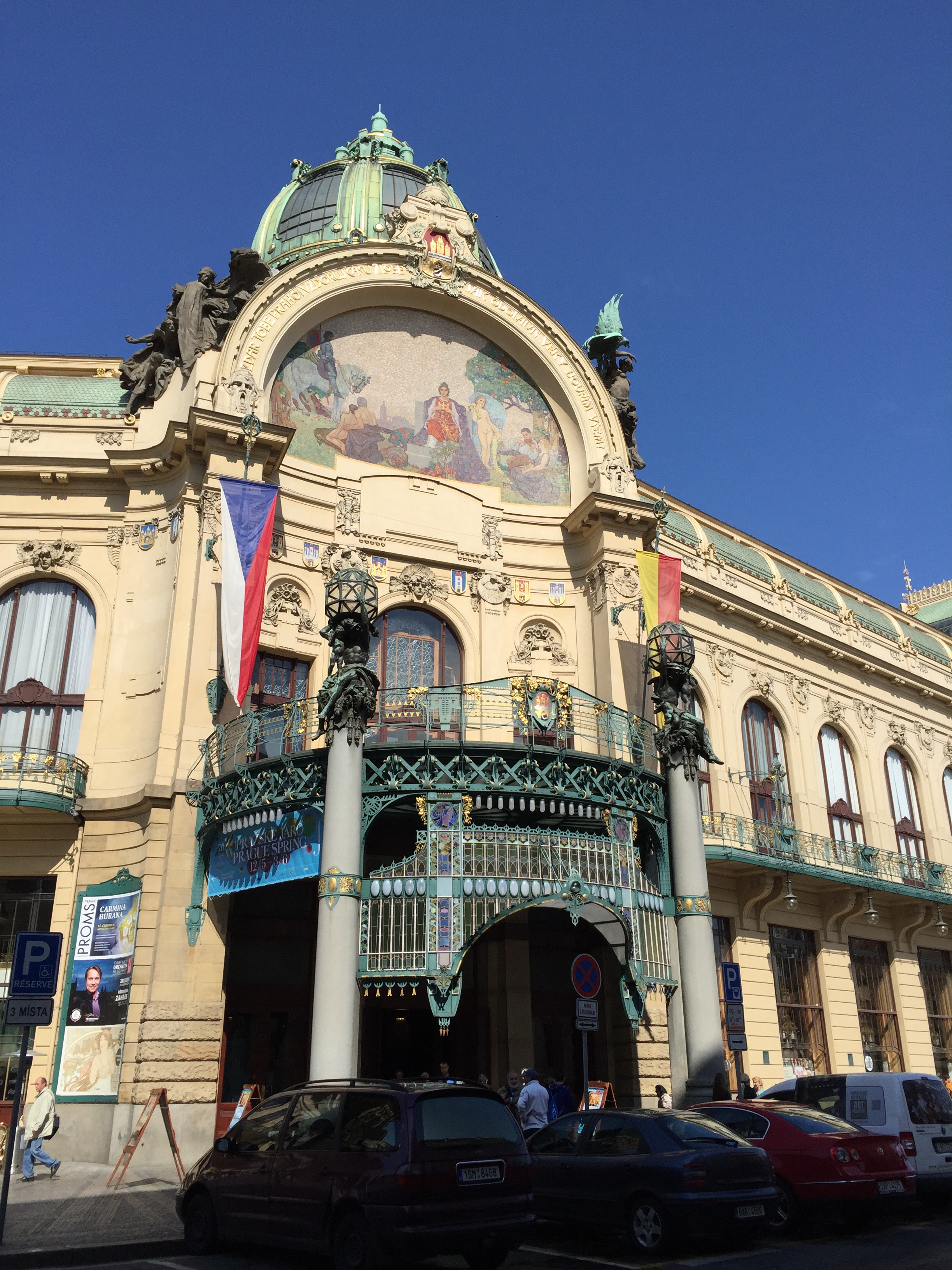
Exterior of Municipal Hall with murals by Mucha

Alfonse Mucha was a Czech graphic designer who was known for his advertising posters of Sarah Bernhardt, and for his signature designs that were instrumental in the Art Nouveau movement. After a successful career in Prague and New York, he decided to return to his Czech roots. He dreamt of helping to record the saga of the Slavic nation after WWII. Through his benefactor, he was able to depict the Slav Epic in 20 murals, now housed in the National Museum.
image

The museum was closed, but we were able to see three of his works in the National Gallery. The poster framed in gold was one of the pieces. The Mucha Museum showed most of his work and an informative video produced by the Mucha Foundation presented the life of this artist. He was prolific as one of the first advertising artists of his day, and became famous in Paris. He hob-knobbed with famous artists and patrons, and eventually made his way to New York.

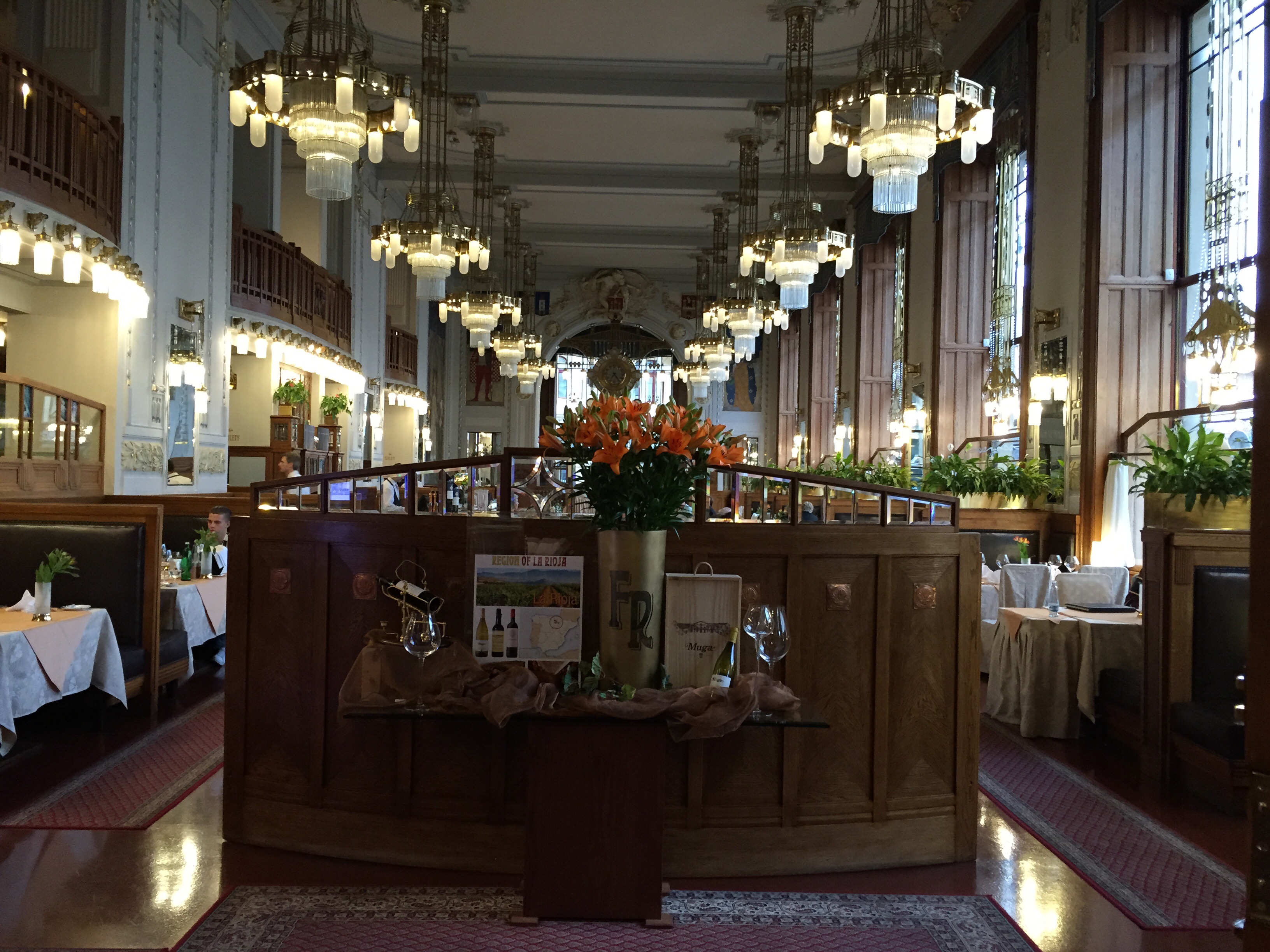
Upon his return to Prague, he was commissioned to decorate the Municipal Hall where the concert we attended last night was held. The interior was ornately decorated with etched glass, brass trim, and murals by Mucha. The view of the stage with the organ, the dome, and the interior photos you see are taken inside the hall.

More impressive was the musical performance. Despite my initial trepidation about hard sellers barking on the street to us, we were glad that we succumbed to their pleas. The music itself was delightful and the quality was very high. We heard a Mozart Concerto in C Major with a violin soloist, and Beethoven’s triple Concerto in G Major for Violin, Cello and Piano. The highlight was Dvorak’s New World Symphony, a stirring reminder of the Czech Republic’s early beginnings.

With 60 musicians performing for a small audience of less than 200 people (mostly tourists), I wondered how they were able to break even. It was great value, and I even felt a bit guilty paying so little for such a fine, ovation-warranted performance. To top it off, we continue to enjoy visiting and attending performances in beautiful and historic buildings. This particular building reminded me of the Palacio des Belles Artes in Mexico City. (See posts and video in December 2014 on Mexico City Art and Architecture).

It was particularly thrilling to reflect on the day’s exposure to Mucha and his commitment to the Czech People, followed by stirring music by Dvorak and the conductor of the North Czech Philharmonic Orchestra, in a venue decorated by Mucha himself! The visual and sound effects conveyed the passionate feelings of the artists and made the experience very moving and emotional.

As for the competition between Dresden and Prague, two musically inclined cities, I can only be politically correct and say that they are similar and different. Dresden has the Semper Opera House, the Schiller Theater, Frauenkirche and many other smaller venues that provide seasonal programs including the annual Music Festival.

Prague has its counterparts in State-supported venues such as the National Opera House, National Theater, Municipal House, Rudolfinum and many churches. With a larger population, Prague seems to rely on a pattern of daily, year-round performances for tourists who expect to hear music on demand. I’m sure there are performances catered to local music lovers, but I wasn’t able ascertain whether the tourist-oriented events were also for local residents.

I’ll continue this debate and decide after the musical events in Dresden this week as to which city I prefer (I have a hunch already–what’s your guess?). It will be strictly subjective, determined by many factors such as weather, what I ate that day just before the performance, how easily I got to the venue, and who’s in the audience! Assume all the music in both cities is the best quality and value that can be found anywhere in the world.

image
Entrance to historic restaurant in Art Nouveau splendor
image Detail of hall interior

Prague Architecture & Promos


Like Dresden, Prague has a Disneyland-ish quality to it. We think of the SoCal American counterpart as fantastical, whimsical, and totally pedestrianized, and this city seems to match those descriptions. Like Disneyland, it also has hoards of tourists. For this city’s economy, tourists are no plague for Prague.

The buildings are impeccably maintained as are the streets (at least in the old town–I haven’t seen the real world by daylight anywhere yet!). It’s best to succumb to the lovely lures of the inner city and not overly scrutinize what may be beyond just yet.

Photos, from top left, counter-clockwise:
1. Tattooed Building
2. Baroque Beauty
3. Another Baroque Beauty outside hotel
4. Town Hall and Astronomical Clock in city center
5. Stone Relief on side of building
6. Effigy decorates confluence of crooked streets; impressions of Prague in 3GS: gruesome, gnarly, and Gothic.

image
Jewish Synagogue (above)

As for Prague being a musical city, it definitely is well endowed, with a twist. Tourists must run the gauntlet of mass advertising for concerts and performances held at virtually every available venue. Catholic and Protestant churches competed in the past for parishioners and compete today for music patronage. Like canned tours, it is impossible to avoid the bombardment of flyers and hawkers (not for sex, but…music???). I felt a bit sorry for those disinterested in music, like the feeling you get when you’re not a sports fan and everyone around you is a fanatic. What’s all the fuss about?!? It’s a different world.

Fortunately for us, I was a bit unprepared and the readily at-hand research saved my ogling-going on Google. Instead, we physically stumbled into an ideal performance at the Municipal Hall. Dvorak’s New World Symphony will be performed with 60 local musicians of the Czech orchestra for around 40 euros each. (Quantity, not quality matters here) It’s also easy to compare choices when ads are at every street corner.

We are about to go to a Prague State Opera performance of “Nabucco” tonight. Keep your fingers crossed. Although I bought tickets online, I wonder how many tourists got coerced into going to something at the last minute that they really didn’t want to see. As for performances in Dresden and Leipzig, they haven’t capitalized on music or pandered to tourists to the extent done here (unless I missed something before). Maybe by choice, or less desperation. Stay tuned….

Update: the Prague Opera did not disappoint…in fact, it fully redeemed my faith in coming here. The performers were stellar, the staging straightforward, and the kudos were appropriate to the performance (not overinflated as they are in the U.S. with standing ovations the norm rather than the exception).

*I couldn’t help but add a panoramic of the interior of the beautiful opera house here. The acoustics were the best of any house I have visited. It’s small, intimate, and perfectly balanced. Maybe it was sitting in dead center of the parterre that did it, but for $55 for best seats in the house it beats the Met hands down on acoustical quality and value.

imagePrague State Operahouse interior

Unplugged in Prague

imageAfter our initial determination to attend a performance at Prague Castle, we discovered the Lebkowicz Palace where the afternoon concert was held. Rather than hitting the more popular Castle grounds, we learned that the Lebkowicz Family had a fascinating history, tracing from the Spanish King Philip of the Spanish Armada and New World fame to a modern day American family. They lost their inheritance twice, first to the Nazis in WWII and then to the Communists.

It wasn’t until the Velvet Revolution in 1989 that the Lebkowicz family fully recovered its properties in Prague. The Palace boasts the largest private collection of artwork in Central Europe that includes paintings by Bruegel, Velasquez, Cranach, and Canaletto. We followed the history in a fascinating audio guide narrated by Martin Lebkowicz himself, the American heir to the Lebkowicz family. The history transcends many historic events in European history, particularly the Thirty Years’ War.

A Chinese wedding booked part of the Palace, and this entry was decorated for the affair. The musical performance in the main room included classical hits featuring flute, piano and viola solo and trio performances. The room was recently renovated as part of the Lebkowicz Palace.
Sights and sounds around the city included views of Prague Castle, St. Vitus Cathedral exterior and interior Stained Glass Window detail, and fine examples of local Baroque architecture. The panoramic view in the header above shows the Vlatava River, Dresden’s equivalent to the Elbe River (both painted by Canaletto).
Street musicians played classical, Blue Grass and Bolivian tunes. Music in Prague is eclectic and non-judgmental. Whatever you want to hear will be here, from Pop to Classical, high-brow to low. It demonstrates the vibrancy of the city and the arts that permeate society from the past to the present.

Some initial comparisons between Dresden and Prague:
1. Both are located along a winding scenic River with many bridges.
2. Both have a historic and active musical tradition.
3. Both have a strong respect and patronage for the arts.

These are only first day impressions, more to come.

The news of the day is focused on Cameron and the Conservative Party winning the most seats in the British election!