Tag Archives: Architecture

Day 59(b): Olde World Charm on Jinli Pedestrian Street

This is Chinatown reinvented by Chinese for the Chinese. Despite being Disneylandish and very crowded, this recreation of an old street in Chengdu maintained some of its old buildings, walls and facades. It looked like a winner to the Chinese tourists, who were curious about all the vendors displaying their crafts and willing to try different food. There were plenty of demonstrations of brush painting, shadow puppets, Chinese instruments, and food preparation. I found quite a few new presentations of snacks that I had never seen before, so for me it was a worthwhile visit. And of course I was momentarily distracted by reproductions of original Chinese architectural features in the fretted windows of the shops and dining establishments.

1. Oysters and pearls
2. Jellied pudding with spicy dressing
3. Rolled rice noodles with spicy dressing
4. Bamboo with sweet rice stuffed in stalk
5. windows along restaurant
6. Hand painting
7. entrance to Jinli Street
8. vendor selling meat on skewers, dim sum and sweet rice dessert
9. Traditional windows

Day 54: Dunhuang City Museum


The Dunhuang Museum was an exciting experience, because the museum provided the history and the context for what we were seeing in the ruins the previous couple of days. Most of the development of Dunhuang occurred during the Han Dynasty, when the emperor sent troops and their generals to protect the frontier of China. At that time, Dunhuang and the area around it was the outer edge of the country. The Han general finally defeated the Hsiung Nu raiders from the North.

Following this major victory, trade needed to be controlled and taxes charged. So it stood to reason that Dunhuang occupied a very strategic position in the future success of China. As a matter of fact, the heavy control over the trade and passage through the Silk Road allowed the Han Dynasty relative peace and prosperity. The country advanced in many areas during that time.

After a period of turmoil and disorganization, the Tang Dynasty continued to maintain strong control over the passages. We visited the Mogao Grottoes in the afternoon, and while there are no photos to share the experience, the Buddha sculpture, paintings, and architecture were a clear expression of the flourishing of encounters with the outside world. Trade, language, art, and religion were being introduced, explored, challenged, and absorbed between many cultures during this time (600AD-900AD).

I am posting a few pieces from the museum that I particularly liked and found quite unusual. They seemed to be very robust and expressive, similar to the style of the better known horses of the Tang period. The Photos of Han and Tang (200BC-900AD) Museum pieces, from top, left to right:

1. Celadon plate
2. Pair of Cocks
3. Arabic lettering
4. Bronze Turtle
5. Pair of men pulling a strap
6. Expressive Figure

The new museum itself was surprisingly beautiful and excellent in its presentation of material. It was very thoughtfully and clearly laid out, and spanned everything from early neolithic implements to planning for the future generations. It will be interesting to compare pieces as well as the building with the Arab Museum of the World that I visited in Paris in July. I am inserting a couple of photos to show you how the new building interior courtyard looks. I would highly recommend this museum to anyone intending to visit this area.

Photos:

1. Slanted Door detail to match building geometry
2. Atrium Roof
3. Interior Courtyard, applying small gridded windows similar to those used in the beacon towers in Gaochang and Jiaohe

Day 45 (a): Bokhara II

As a UNESCO World Heritage site, Bokhara has an extensive collection of Islamic Architcture.

Photos above, from top, left to right:

1. Map of the Great Silk Road: this week I am traveling along it from Tashkent to Khiva (Uzbekistan) and next week from Turpan in Northwestern China to Dunhuang.
2. the Ark (it wasn’t just Noah’s): the ceremonial grounds to the Fortress required visiting dig arises to back out after having an audience with the Amir. When the guest reached the wall in front of the exit, he knew he could turn around and leave.
3 and 4: the Ark from the exterior: big voluptuous corner and side wall fortifications
5 and 6: Samonid Mausoleum, one of the earliest remaining buildings in Bokhara, built between 9th and 10th C. Purported to be a masterpiece of world architecture and a perfect geometric form built of brick. Beautiful texture, but looked a little bit like an Irish fisherman sweater.
7. Interior Corner of Samonid Mausoleum: corner elements cleverly reconcile weight of circular dome over walls by being slightly smaller in diameter than width of square.
8. Samonid Mausoleum Tomb: both father, son, and grandson are buried in the tomb. he father’s tomb was originally in the middle, and the grandson was the third tomb, but they were they were all moved into one tomb and thus the offset position.
9. Kalyan Mosque is the largest mosque in Bokhara and second largest in Uzbekistan. The old wood columns are typical of the period and were periodically replaced.
10. Kalyan Mosque: Praying is conducted outside due to the mosque’s popularity. On Fridays, the mosque can hold up to 12,000 people. A electronic board indicates the times of prayer.
11,12, and 13: Courtyard and surrounding galleries of the Kalyan Mosque. (Header also shows overview of Courtyard, where worshippers pray)
14. Medressee Miri-Arab Madrasah: Opposite the Kalyan Mosque, this highly regarded spiritual Islamic University was built in the 16th C.

Day 44: Bokhara I


Fast facts: The population of Bokhara today is 280,000. Bokhara is the oldest city and predates the others at 2750 years old. Just for comparison, Samarkand’s population is 500,000 and Tashkent’s is 3 million.
The land is flat, considered steppe and not desert (a desert designation is devoid of vegetation, and steppe has some visible vegetation if sparse–you know, kinda like the Bay Area).

Photos, from top, left to right:

1.  Nodir Devon Begi Madrassah 1623. This is one of the later buildings dedicated not to the king but a lower ranking official. By the time the buildings were dedicated to others the central govt was already in decline. The phoenix birds show Indian or Chinese influence. The face at the top was not banned at the time in artwork and different interpretations are made as to whether images are acceptable or not. The use of multicolored tile and yellow is also a late development, compared with the earlier cobalt and turquoise monochromatic schemes.
2. trading market designed and as covered market at crossroads to two streets. There were 5 built-in the city but they didn’t work so well. The earlier strip markets developed organically around neighborhoods. These did not take into account where people lived and needed the services. These trading markets are now mainly tourist attractions after they were designated for specialized trades such as metalwork or arts and crafts. Open cross ventilation makes this a very cool and sustainable place in the summer though!
3.wood door detail inside trading center
4. the water system was crucial to survival of the cities. Bokhara was considered an oasis along the trade routes and served as the seat of many governments who conquered and ruled this strategic location. Water came from the river that separates Afghanistan and Uzbekistan, but is now piped from the mountains in Tajikestan.
5. the minaret, made of bricks, shows how creative their brick craftsmen were in designing and pushing the height of these lighthouses.
6. contemporary building using wood columns and doors decoratively.
7. The earliest building in Bokhara was built below grade and preceded the Mongol invasion around the 12th c. Most buildings, particularly Islamic structures were built on top of the sites of former sacred sites, so it is likely that an earlier building preceded this one. This building is devoid of tile decoration but shows how use of brick for both structural purposes and textured walls was used very successfully, prior to the introduction of tile.
8.Detail of brick work.

Day 43(d): More Islamic Architecture

Photos, from top, left to right:

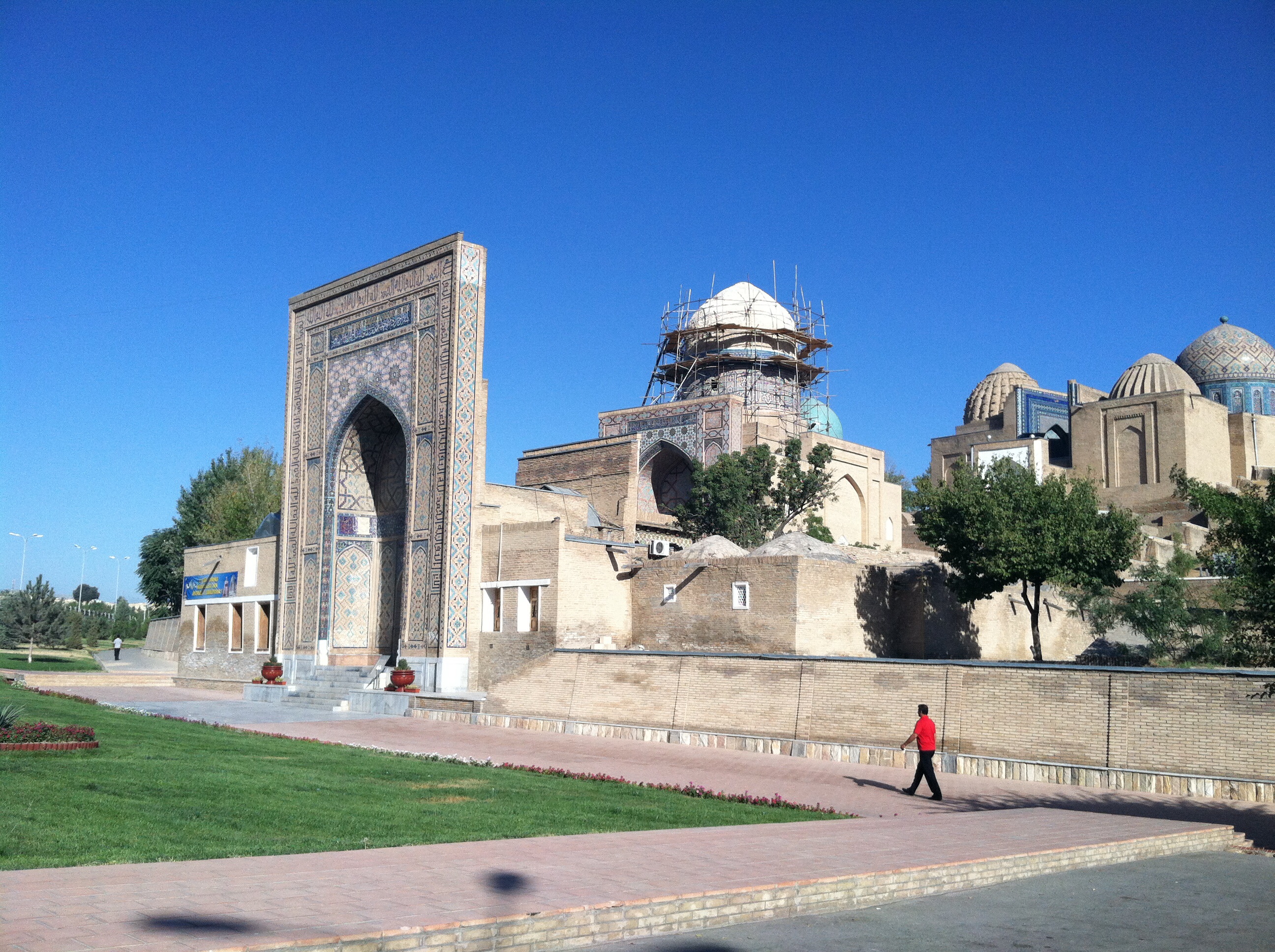
1. Exterior of Afrosiab Complex, built on a hill that was then ransacked by the Mongols. Tamar worked out that it was easier and more fortuitous to get water from the lowland rather than to transport it up the hill to the fortress, at the expense of having fortifications.

2. Steps leading to mausoleum complex. One is supposed to count the number up. If you count the same number coming down, you are a good and faithful person. If not, try next time. I went down the back-end so will never know my worth

3. “The City that Defies Death” consists of mausoleums dedicated to dignitaries with a street connecting all of them to each other.

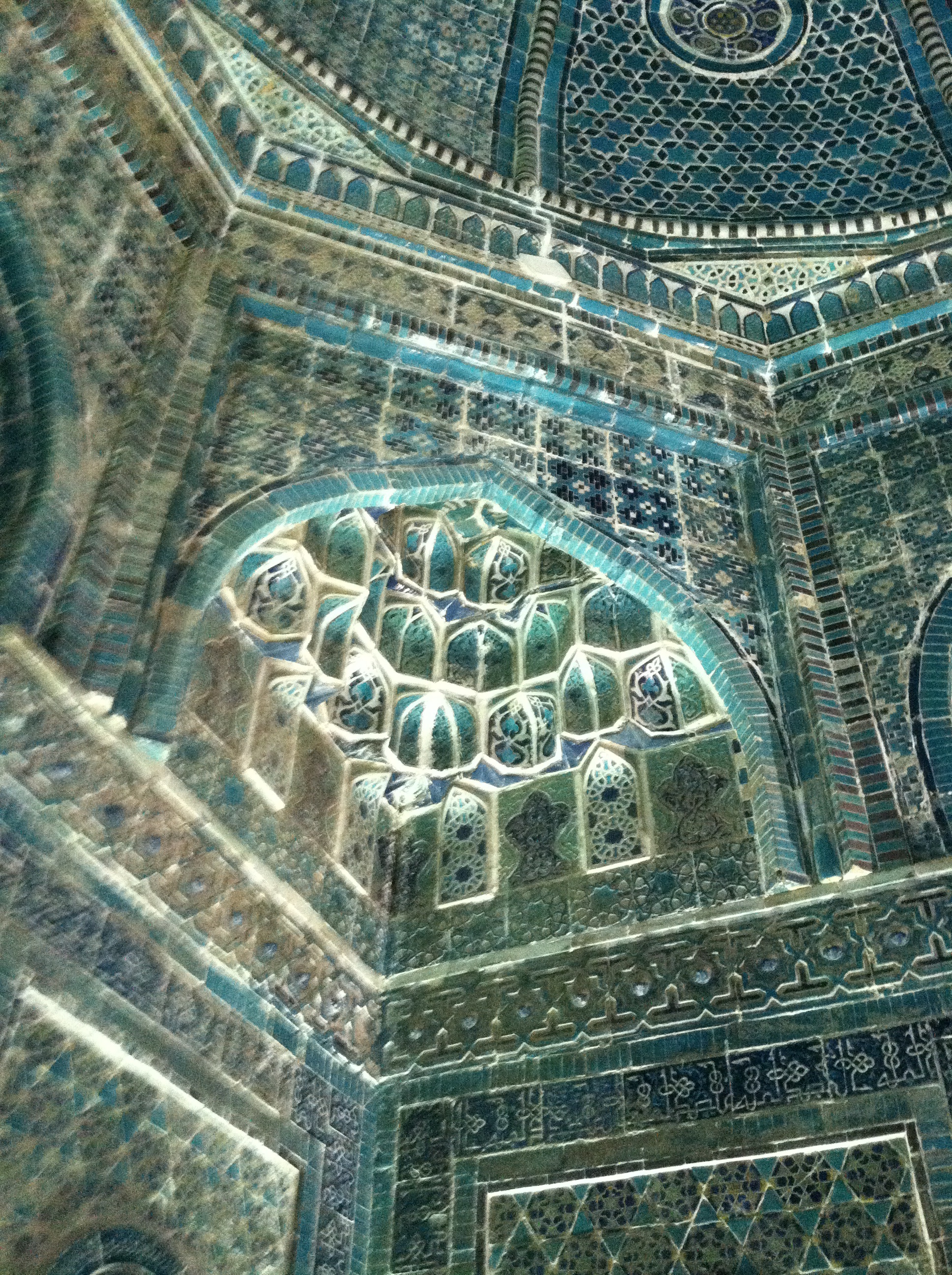
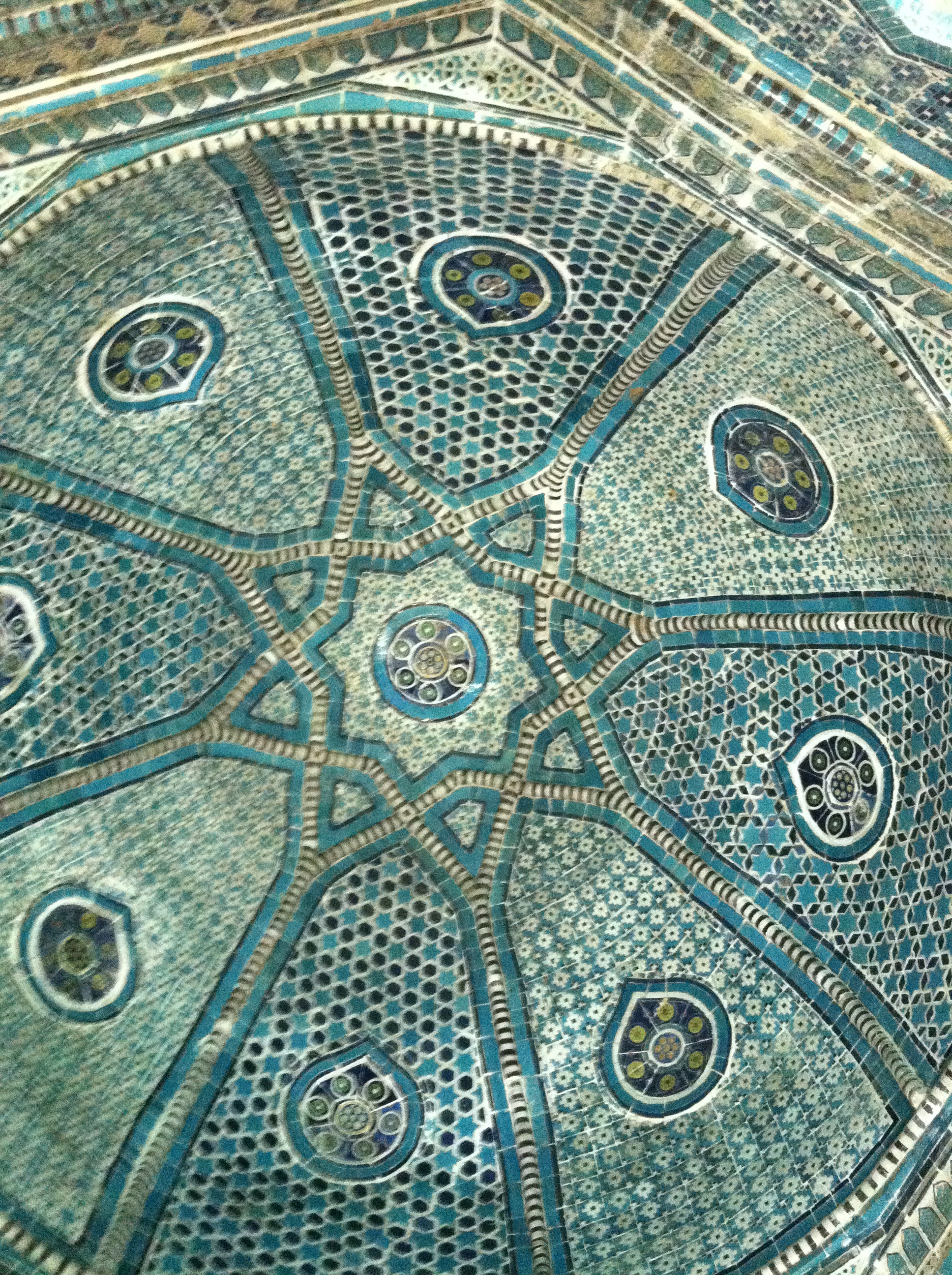
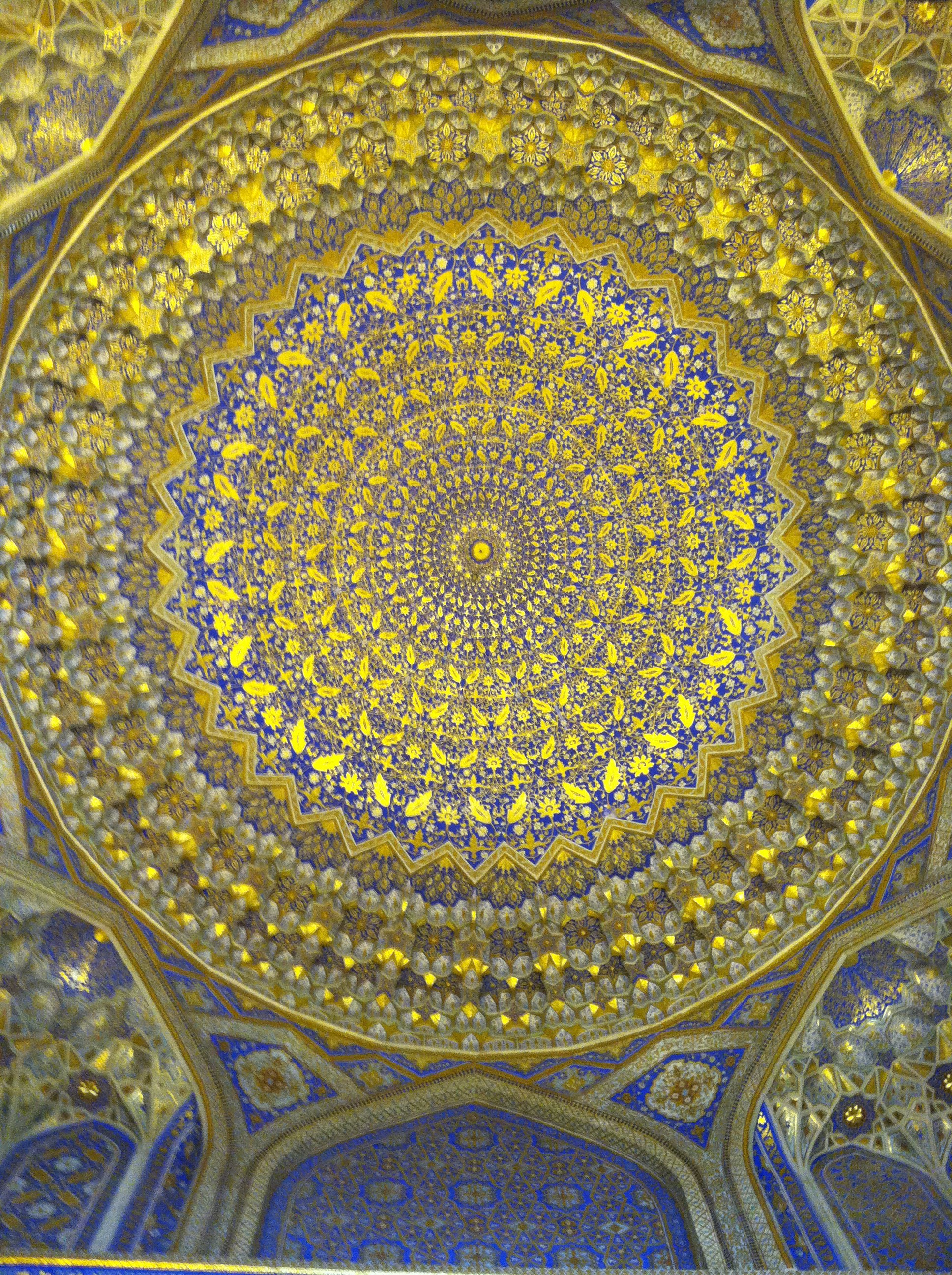
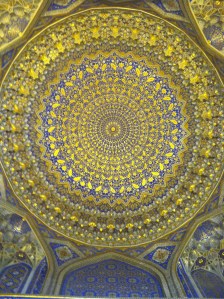
4. A decorative ceiling inside one of the domes.

5. The stalactites in the corners between the dome and the wall reinforce the dome support and provide clever decorative element to the room.

6. another dome interior, with more cobalt blue coloring.

7. Beginning of Chinese influence with fritted wood panels over windows and wall paintings

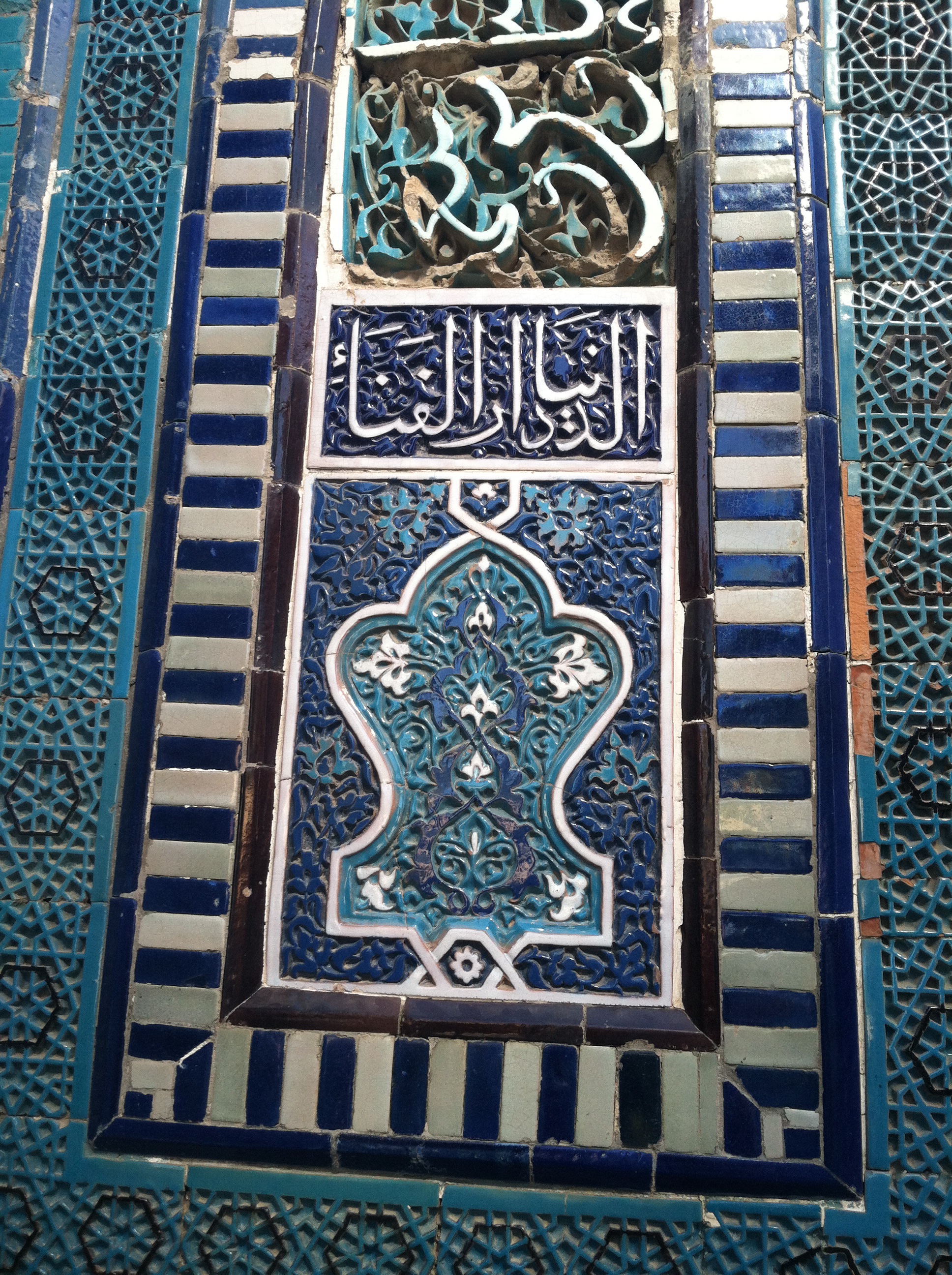
8.  Detail of stone Arabic lettering before tiles replaced in between

9. Another wall detail showing intricate floral, written and geometric patterns

Day 43(a): Islamic Architecture

imageimageimage
image
image

Memories of Days Gone By

The Afrasiab Hill consists of a series of mausoleums developed between the 12-15th Centuries to dignitaries who lived in Samarkand. They were designed by architects and ornately decorated in a variety of stone carvings, mosaic patterns, and exposed brick.I felt like I was seeing all the European Gothic cathedrals all in one city. It’s no wonder so many pilgrims made their way through to Samarkand just to see so many beautiful buildings in one place.

There are many beautiful and moving stories about captured princesses and war campaigns plotted and lost. Some of the passion and beauty of the period are depicted in the intricate tracery patterns that are all different. The inscriptions appear to be wise, cautionary, and quite mild mannered and respectful of the multiplicity of religious beliefs at the time of Timur (ca. 1400), who was working on promoting Islamic religion.

Photos, from top:

1. Decorative tiles on interior
2. Detail of Dome
3. Entrance to complex on the Afrisaib Hill
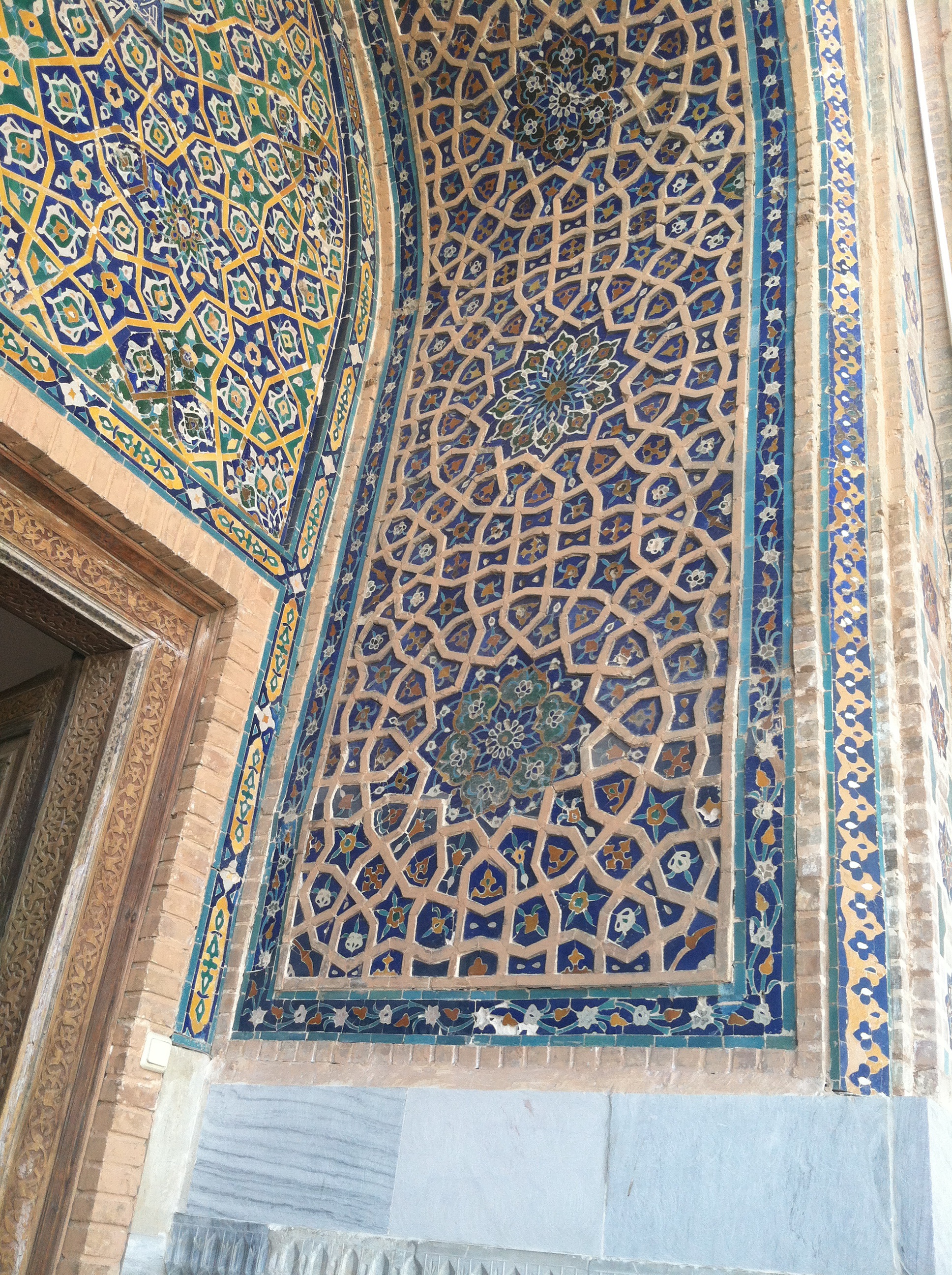
4. Detail of exterior cut stone and mosaic tiles
5. Exterior view from back of hill

Day 42 (a): Samarqand

imageimage

image

image

The first day of this segment has overwhelmed me with history, jogging my brain and challenging all of those connections between Alexander the Great, the Mongols, and Tamir. Some of you may know this better, but for me, it’s learning on the job.

Lets start with Tamir and work back. Many of the madrasah photos shown here date from around the beginning of the 15th century. A madrasah was the focus of education, and included a library, classrooms and a place of worship. Tamir was from Samarqand and made a campaign to conquer India. His grandson was the scientist and developed an observatory and promoted a lot of concepts developed by the Arabs and and the Chinese.

2. When the Mongols struck in the 13th Century, they basically burned every town and village they encountered to the ground. Many of the relics predates this period, but the buildings are no longer standing. Alexander the Great conquered this area, but there is still some debate where and how long he ruled. He was physically here in the area with his army.

3. The complex of 3 madrassahs were built in two different periods: the one on the left was first developed in the early 1400s and the latter two that form a courtyard were from the 1500s. The later buildings were designed to form a symmetrical triad of buildings, but the domes are not symmetrically placed. There is a balance between symmetry and asymmetrical elements.

4. There were multiple religions operating at the same time, including Christian, Hindu, Muslim and Judaism. Sayings in Arabic on the entries to the building welcome all religions but only believers. These were sacred places of education held in high regard, and the eight major faculties each had their own rooms. Women were encouraged to learn in these institutions.

Extensive reconstruction of the tile work and buildings were made in the last few years. A bazaar used to be in the courtyard but the vendors have been relocated to preserve the structures.

Photos, from top:

1. Overview of Madrassah Complex, Samarqand

2. Map of Uzbekistan. My route is Tashkent-Samarqand-Bokhara-Khiva-Tashkent

3. Golden dome from inside, designed flat to reflect sound of prayer inside

4. Detail of stone tracery integrated with mosaic tiles to create textured pattern

Note: Internet access getting sporadic and unpredictable, particularly as I go further inland into the country. Keep your fingers crossed. I have an excellent guide but it is difficult to catch everything as she is covering a lot of ground. I’ll try to fill you in as I go.

Day 40: Farewell to Dresden

image

imageimage

imageAs I wind down this segment of my travels, I feel very sad to leave Dresden. Particularly having bonded with my German class, it is hard to say goodbye. Everyone has their lives to live beyond this momentary blip in the universe. I’m so grateful for having had the support and encouragement from family and friends to do this, at this time of my life, because it IS the time of my life.

I felt wistful about leaving out some shots that didn’t ever seem to fit into the theme for the day. This is a potpourri of architectural photos, a one-off sign, and some cultural relics. I’ll be leaving Dresden, overnighting in Frankfurt, then starting Segment 3 of the Silk Road this weekend.

Photos above, from top:

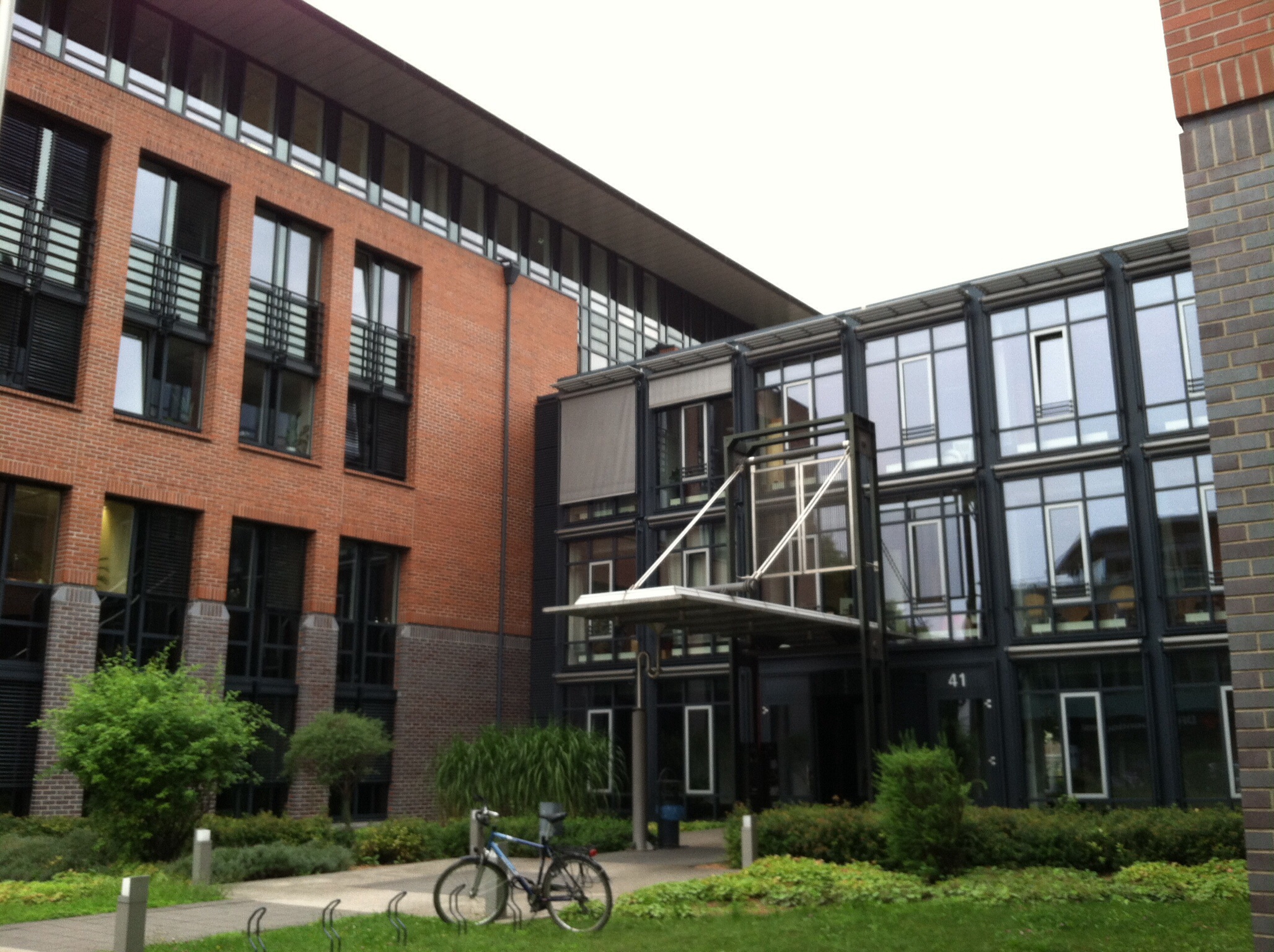
1. The Blood Center

2. Clinical buildings in the medical center area of Dresden.

3. Another clinical building.

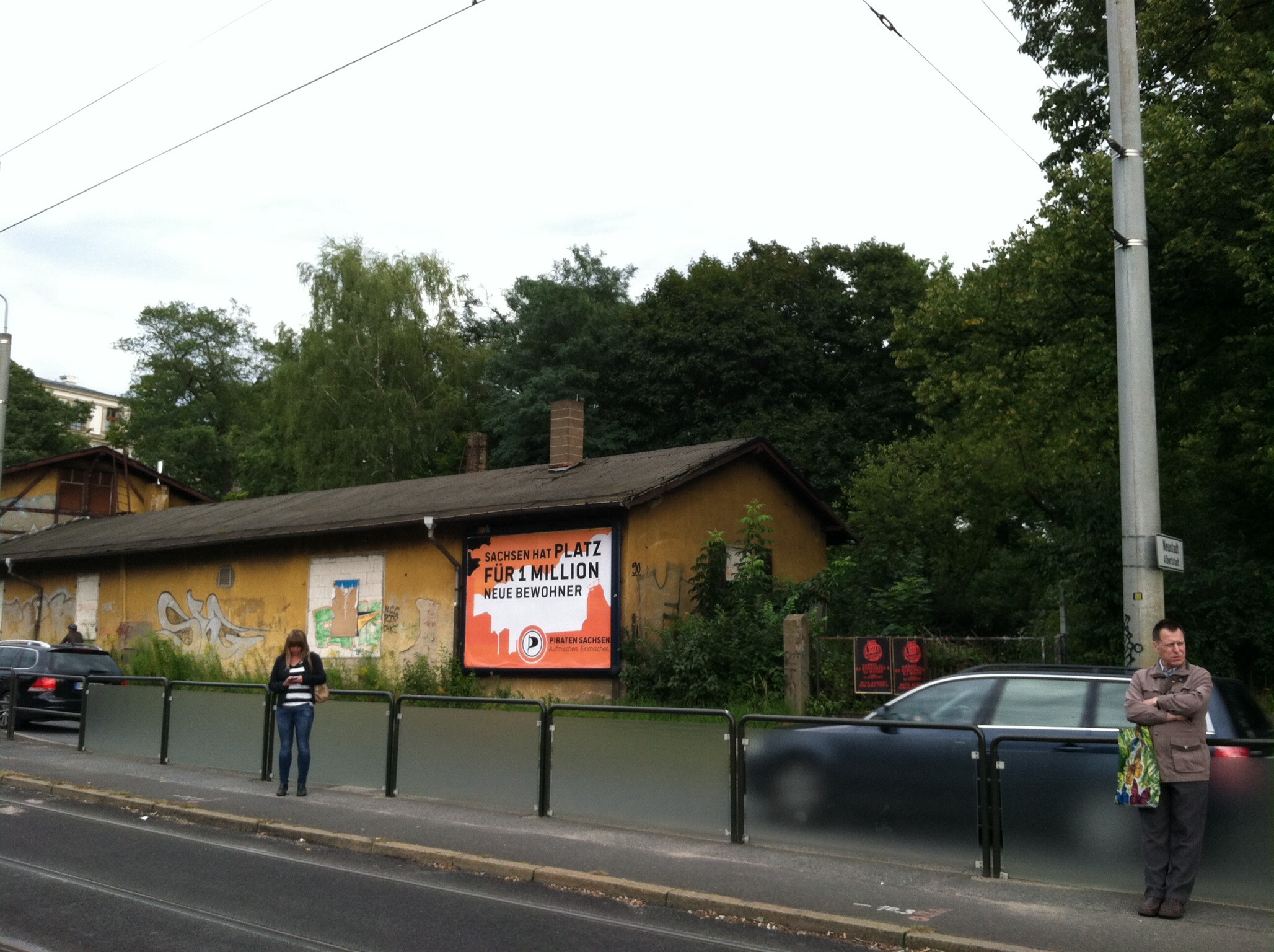
4. Sign indicating from the Pirate Party that there is room for another million residents in Sachsen, the state where Dresden resides. It also implies that mixing and matching population is good for Saxony. (tap up the scale to read text).

Party elections are coming up and Angela Merkel is scheduled to come to Dresden on Saturday. Unfortunately, I will be off before then, but I would have definitively gone to see her.

Photos below, from top:

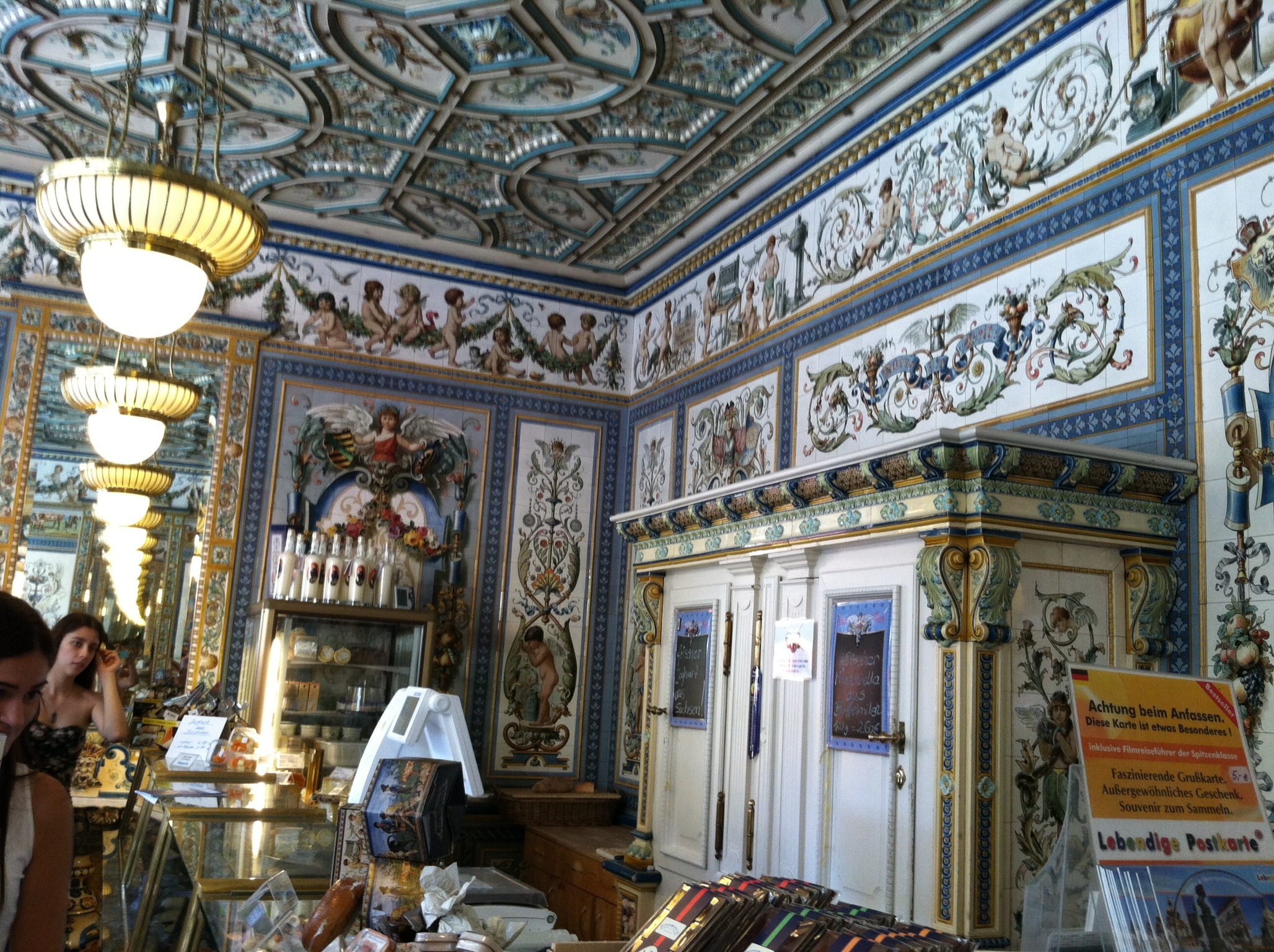
1. The Molkerei, a dairy and classic cheese shop that has been around for generations. The ornate decoration makes this a popular tourist stop.

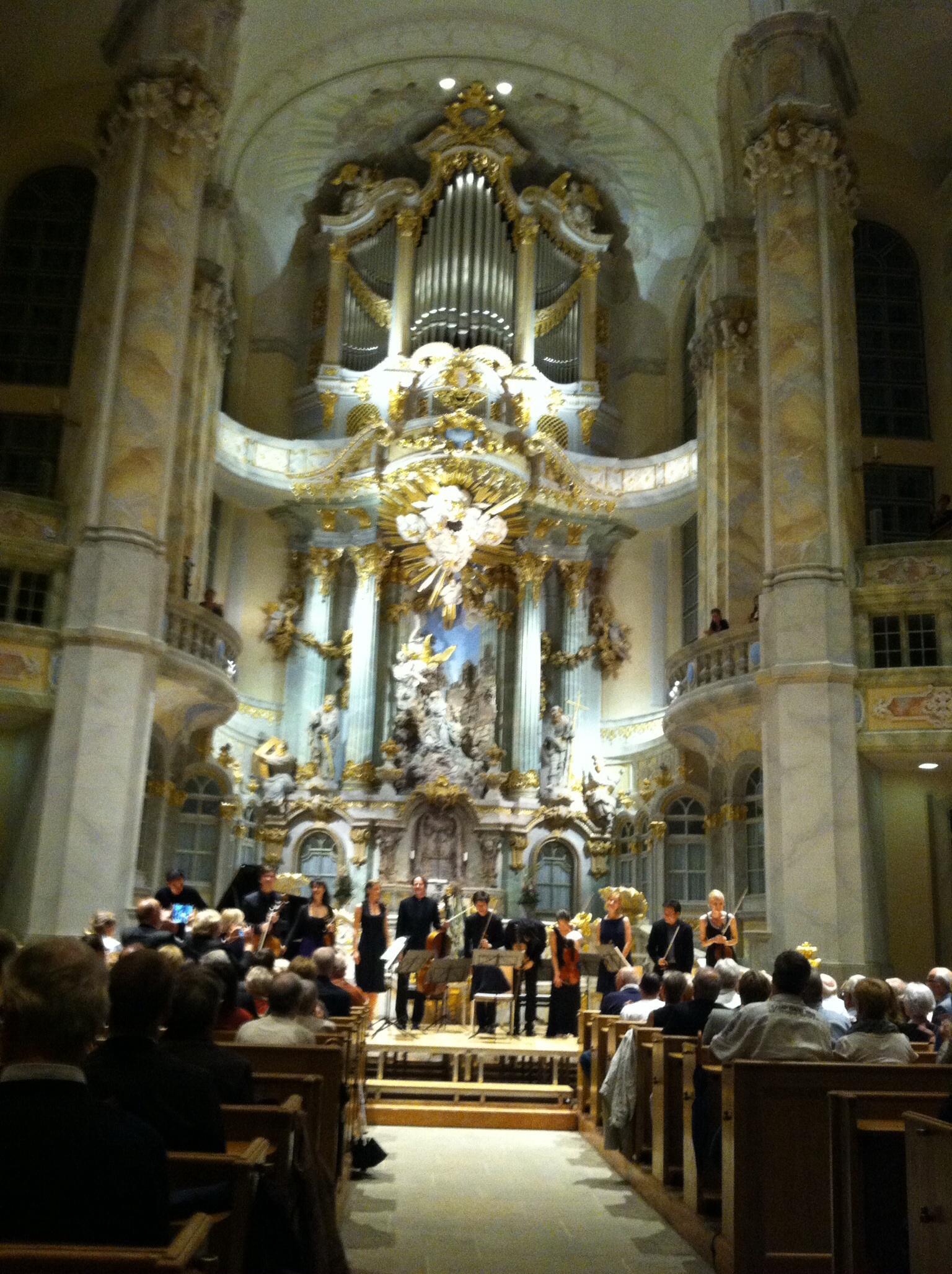
2. The interior of the Frauenkirche, where Helena and I attended a concert. Maria Baumer played the part of Bach’s wife in several readings between Bach pieces. The concert was sponsored by the Moritzburg Festival.

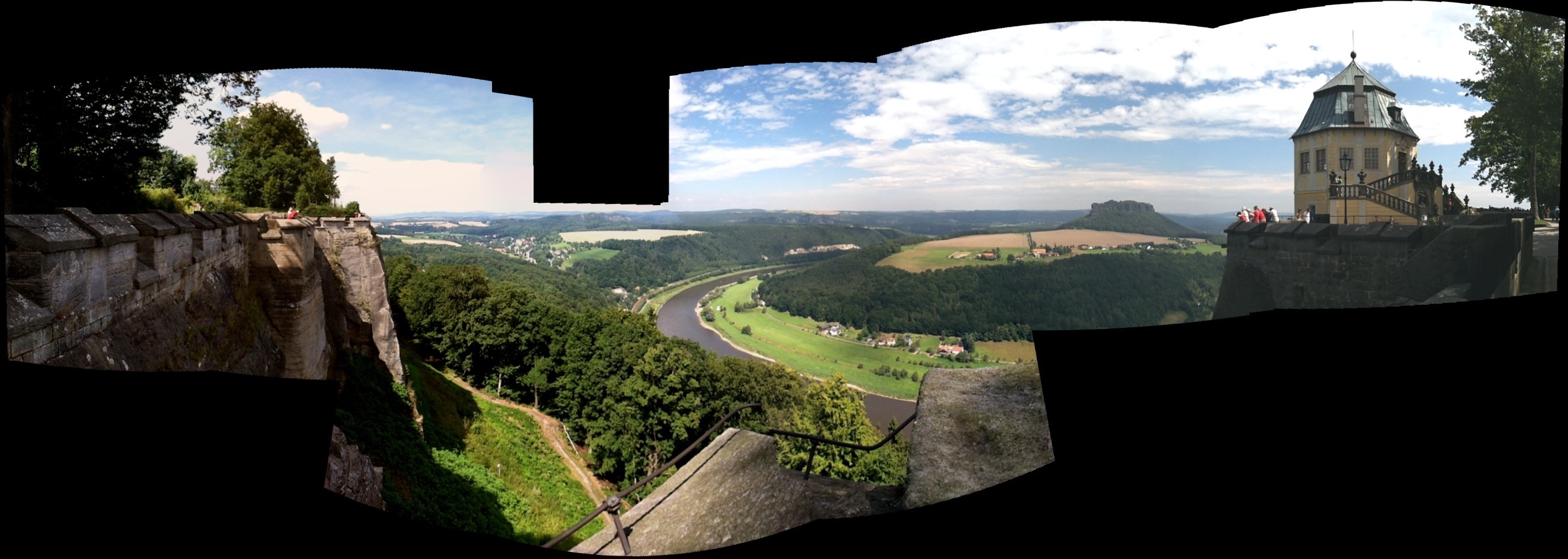
3. Another panorama shot of Dresden and surrounding area from the Konigstein fortress. Zoom up to appreciate the beauty of this area.

imageimageimage

Day 37: Military History Museum

image image image image image

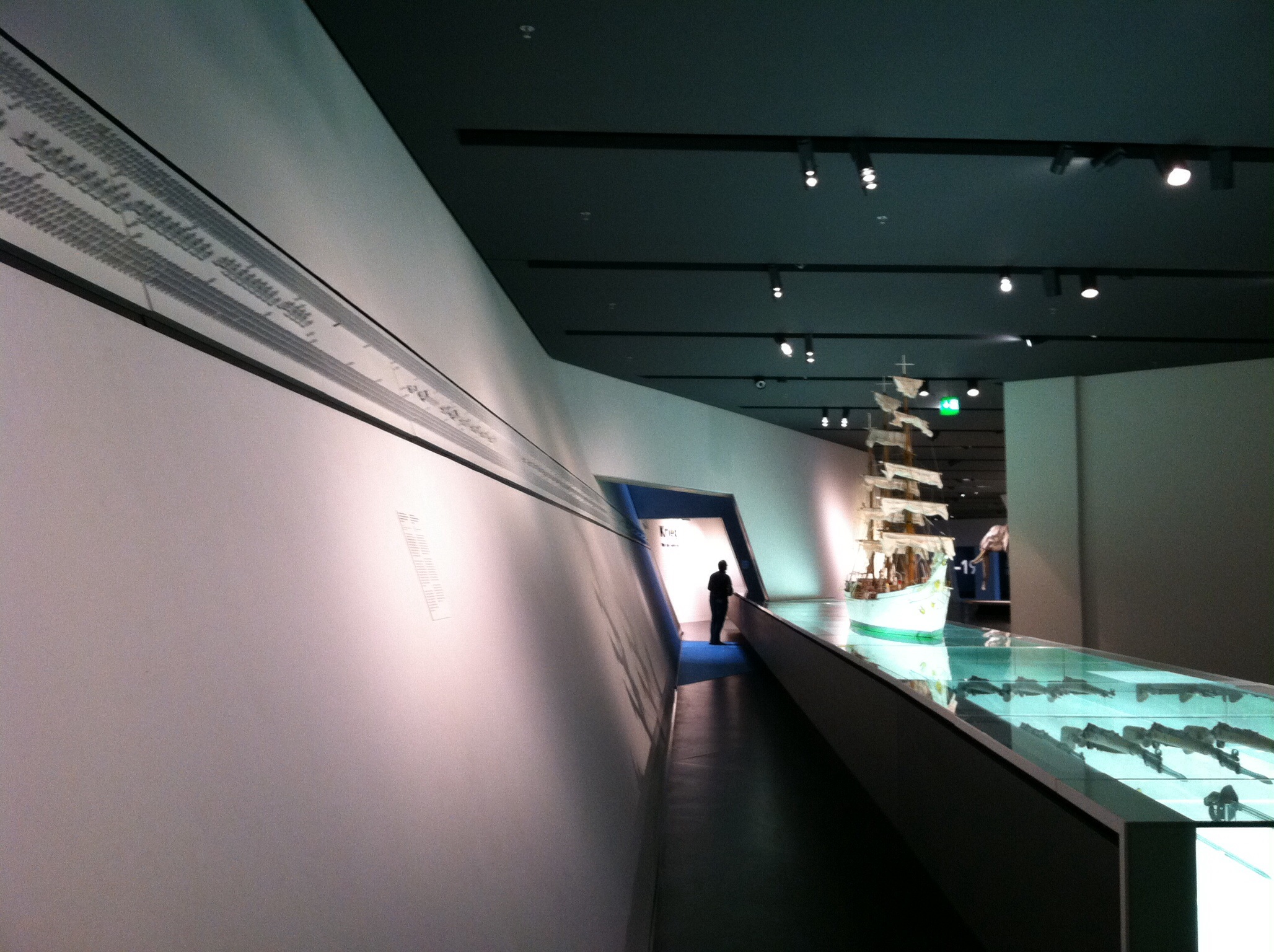
The Military History Museum is one of the most interesting museums in the world, not only for its collection and the building design, but for the message it brings. It tries to tackle the prickly issue of war and its consequences and uses displays to teach how everyone loses in wars.

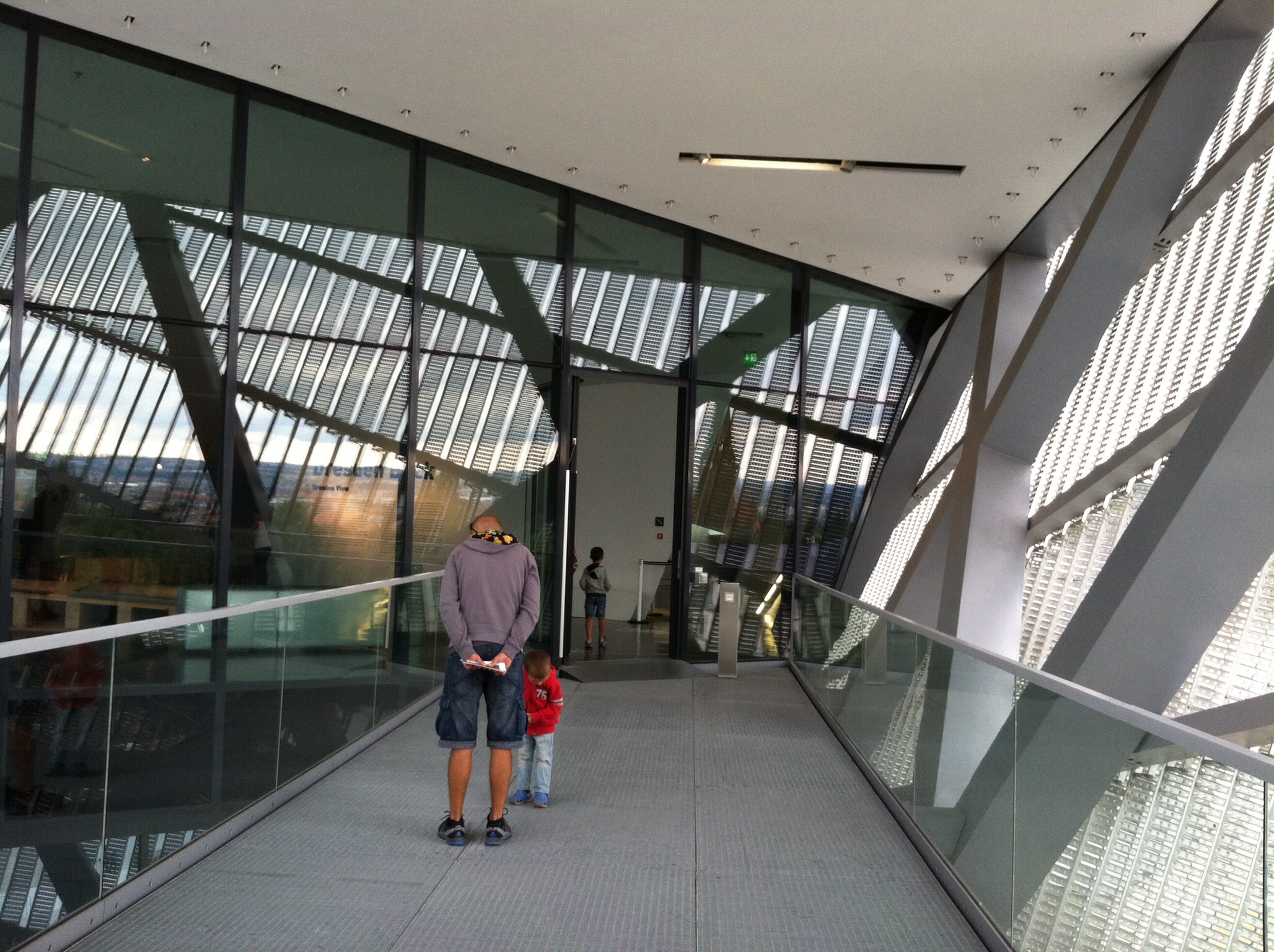
Daniel Liebeskind designed and finished this building in 2011. The exterior of the neo-classical building is truncated by a metal shard that points to the spot where Dresden was targeted. While both sides of the building are devoted to traditional armaments, the new building tries to confronts visitors with the human impacts of war.

Photos above, from top to bottom:

1. Exterior of the building, located in a former military area.
2. Overview of Building interior on the top floor.
3. Exterior terrace inside the metal point. From here you can see a view of Dresden Old City. The open metal walkway can be a harrowing experience but is appropriate with the entire building and what it conveys.
4. Beautiful stairs and custom designed lighting built into the handrails.
5. Custom designed horizontal panel for the elevator controls.

Photos below, from top to bottom:

1. Wall to the left shows a regiment of 10,000 troops in formation heading to war at a miniature scale.
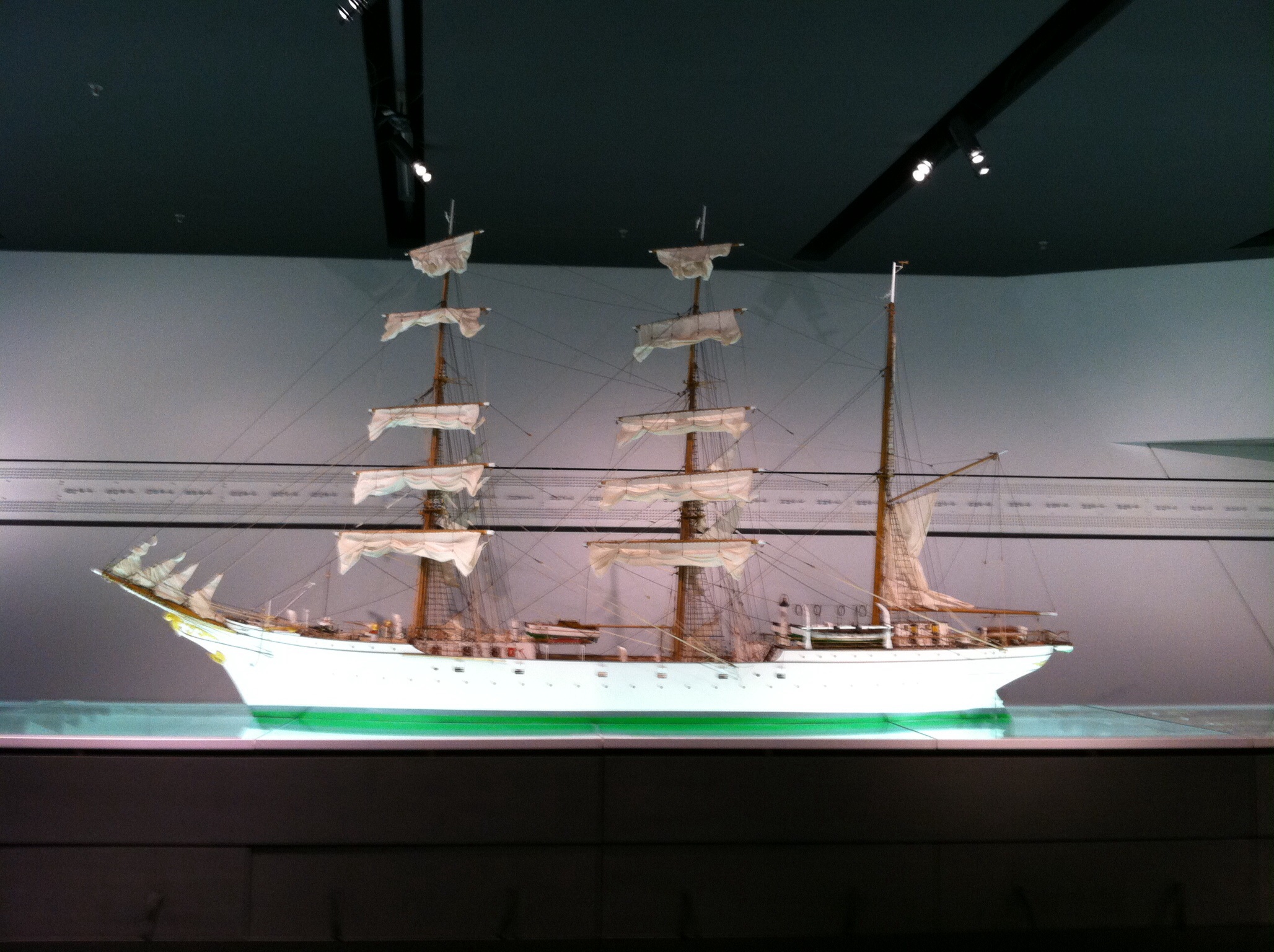
2. A scale model warship, with a view of the formation in the background
3. A full scale display of animals
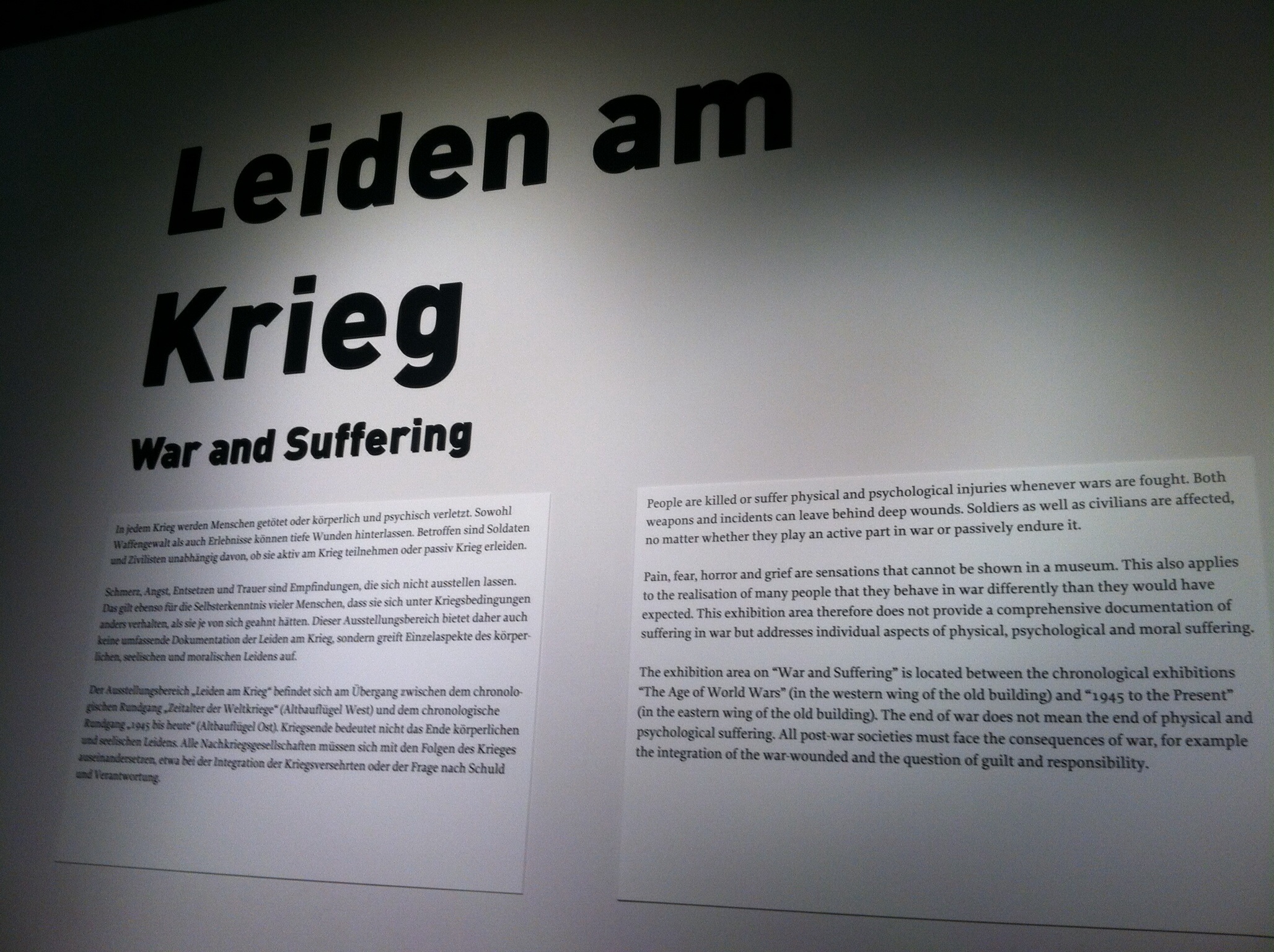
4. Typical text explaining the consequences of war. (Tap to scale up)
5. Another text display.(Tap to scale up)

imageimage
imageimageimage

For more information, see http://en.m.wikipedia.org/wiki/Bundeswehr_Military_History_Museum.