


1. Exterior of Guangzhou Opera House by Zaha Hadid
2. Space between “Pebbles”
3. Opera House lobby
4. Exterior of Guangzhou Library
5. Library Lobby
6. entrance to Library
7. Exterior of Guangzhou Provincial Museum
8. Museum Interior

1. Exterior of Guangzhou Opera House by Zaha Hadid
2. Space between “Pebbles”
3. Opera House lobby
4. Exterior of Guangzhou Library
5. Library Lobby
6. entrance to Library
7. Exterior of Guangzhou Provincial Museum
8. Museum Interior


Rome wasn’t built in a day, but maybe it should have waited to take a lesson from the Chinese. It wasn’t exactly a day, but how about 5 days? 5 years? Complete with a working mass transportation system. I thought about how many buildings I could name in Manhattan versus those I could name in Guangzhou. Many vs. one–the hotel where I am staying. What’s going on here?!?
I spent today walking around Guangzhou’s new civic center area after I visited their Guangzhou Provincial Museum (Part b of today’s posting). Initially I was very impressed by the overwhelming volume and size of the buildings. This area included the equivalent of a state museum, an opera house, a park, and a huge library. In the end, I have more questions than answers.
I wanted to go to the Guangzhou Opera House, thinking that it was, well, for Guangzhou Opera. Wrong. Upcoming performances include Angela Georgiou (I wouldn’t have minded) and the St. Petersburg Philharmonic. I decided to pass on tonight’s production the Globe’s Midsummer’s Night’s Dream for $40, cheapest seats available. So much for my fantasy to revel in those days when I went to Chinese Opera with my mother in Chinatown nearly 60 years ago.
Zaha Hadid Baby got her commission after battling against Rem Koolhaas. I guess her pebbles made a big splash. You can read more about it in http://en.m.wikipedia.org/wiki/Guangzhou_Opera_House.
After a visit to the museum, I wandered back to the hotel and many buildings caught my eye. First, in general, by the sheer size and scale. I’m posting some for your enjoyment. It feels like an arms race to the top. Who are they competing against? Other designers? Other companies? The region? Other cities in China? New York? I would love to know.
Second, I got fixated on the rooftop finishing. Having just completed the Neurosciences Building at UCSF, I know it was about mechanical screening. OK, saw a few buildings that did that. Some clearly wanted to reach to the clouds and show their mighty height with spires. Ok, get that one too. And then there are the loop de loops.
Well, you might draw your own conclusions. I get the decorative elements to provide some relief from high rise ennui. But I think I am missing something. These architects have left something out of the obvious reasons for me. Any guesses?!?
It did make me think of the little pitched roofs in Germany and the curious blinking eyes I posted back in August. They were unintentionally playful perhaps, but I am not sure I could call these responses to the transitions to sky exactly “playful”. (By the way, my fixation on cranes is also amply displayed here. They aren’t part of the decorative elements of the rooftops.)


Everything has improved remarkably…the food, the familiar faces, the language. Even the stifling heat and humidity are reminiscent of living in Hong Kong. Of course, the visual scene has changed significantly, and I can say it is virtually unrecognizable. The sleepy colonial version of the city is hidden or missing, and I have no bearings to the city. I headed over to a pedestrian street that was another recommended “must see”, known as Beijing Jie.
The first exciting discovery came from archaeological findings dating back to the Song, Ming, and Yuan Dynasties. In renovating the street in 2006, various layers of the street gates were unearthed. The pavings were preserved and covered in glass so you could see the different generations of paving for this ancient street. Now that was a thrill!
The second came from the wide, but short shopping street for locals. It was Friday night, and everyone was happily shopping or appeared to be. All the usual knockoffs but no top of the line. In the mix were a variety of clever crafts shops made modern and food vendors that differed from the one in Chengdu. These were less touristy and more for the local resident population.
Try Peking Duck sold by a duck skinner paired with an assistant who spread the plum sauce on a crepe and assembling just the right amount of duck. Four pre-rolled snacks for 10 Kwai, or $1.66. I bought some moon cakes and dried pork for my relatives in the Chinese version of Fouchon, all nicely packaged but primarily again for locals only. Lots of original designs and clever spins on old crafts.
And third, a great subway system is in place. I could easily figure it how to get back to the hotel without a hitch. All for the price of 3 Kwai or 50 cents. The high rises are staggering and similar to those in Chengdu, but with less night lighting.
Everyone on the subway missed my taking photos of them because they were intent on their smartphones and thought I was intent on mine. They never bothered to look up or be bothered.
Photos, from top, left to right:
1. There’s a Hi-rise city coming your way…
2. Beijing Street
3. Unearthing of Song, Ming and Yuan Dynasty Street paving and gates below glass at street level
4. Peking Duck to go for a song
5. Electronic big screen ads rival Picadilly or Times Square
6. Man still shops for daily greens al fresco despite modernization
7. Inside Guangzhou Metro station
8. Cell phone mania inside train–a world-wide phenomenon
9. Metro floor graphics for crowd control


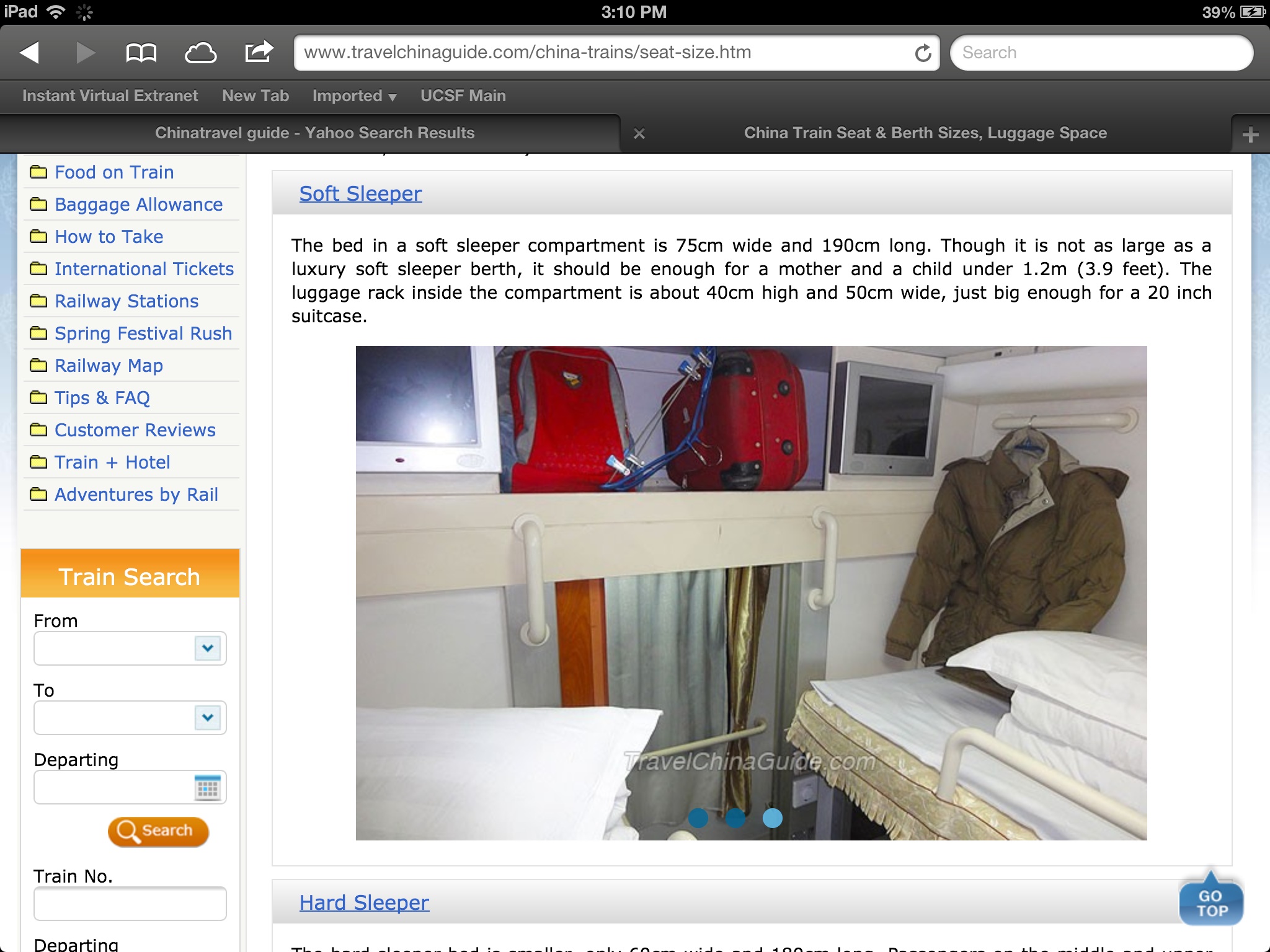


I’ve been traveling with Gee Kin by train for over a week throughout China and haven’t made much mention of the trains themselves except for the nice photos of the attendants on the night train from Turpan to Shulehe. Needless to say, it has been an experience. Since I was able to collect my thoughts on this next to final leg from Chengdu to Guangzhou, a 28-hour ride on my own, here are a few of them to share with you:
1. The Chinese trains have a few sweet touches, like flowers in the compartment, a thermos for hot water (for the instant noodles that everyone brings), table cloths, and drapes that the assistants come in and close for you at night. They also have a waste basket and a stainless steel tray for all the peanut shells and melon seeds that everyone eats on the trains to pass the time.
2. The toilets, well, are there. Modern ones with a commode. Use at your own risk. There’s a shared counter with three sinks. They close the facilities when the trains are inside stations, so you have to plan your strategy. These haven’t changed much since we did our Beijing-HK train ride for 36 hours back in 2000 with the girls.
3. You can buy tickets off the Internet through travelchinaguide.com.
They all worked, and communication was clear. A few blips, but overall very efficient. I am attaching some photos of the K and T trains we took.
The last one was a four compartment soft berth overnighter (K), and the one Gee Kin and I took to Shulehe was a 6 compartment hard berth version (T).
4. The food service is still decent. Chinese will always manage to feed you, with recognizable elements. The dining room and the takeout food brought to your compartment were reasonable. My breakfast consisted of a hard boiled egg, chopped green beans with spices, pickled turnip, green veggie with minced meat, and congee with scrambled egg.
5. The itinerary I took from Chengdu to Guangzhou consisted of massive cities with high rises everywhere. If you were wondering where the cranes were, they are all in China. Each city is in a massive building boom. There must be more cranes in all of China than everywhere else in the world combined, or at least it feels that way. The point is that no city was recognizable by name, with the exception of Chongqing. And they were all sizeable. Where have I been??? I feel like Rip Van Winkle, who overslept…maybe 5 years?
6. Despite Chongqing whisking right past me, I did see the Chang Jiang (Yangtze River) and portions of Guizhou that were Guilinesque near Guangdong in the morning. There were still pristine rice paddies, but with high rises off in the horizon. A nuclear power plant slipped by, and many many high rises that boggle the mind. Cities the size of Hong Kong seemed to float past, one after another.
Photos, from top, left to right:
1. Breakfast in the dining car
2. aisle to sleeping compartments
3. Dining car
4. view of Guizhou Mountains
5. High rises in distance to paddies
6. List of stops–most are major cities (recognize any?)
7. Screen shots of train soft berth compartment for 4
8. Screen shot of train hard berth compartment for 6 (shown earlier)
9. Screen shot of train exterior


This is Chinatown reinvented by Chinese for the Chinese. Despite being Disneylandish and very crowded, this recreation of an old street in Chengdu maintained some of its old buildings, walls and facades. It looked like a winner to the Chinese tourists, who were curious about all the vendors displaying their crafts and willing to try different food. There were plenty of demonstrations of brush painting, shadow puppets, Chinese instruments, and food preparation. I found quite a few new presentations of snacks that I had never seen before, so for me it was a worthwhile visit. And of course I was momentarily distracted by reproductions of original Chinese architectural features in the fretted windows of the shops and dining establishments.
1. Oysters and pearls
2. Jellied pudding with spicy dressing
3. Rolled rice noodles with spicy dressing
4. Bamboo with sweet rice stuffed in stalk
5. windows along restaurant
6. Hand painting
7. entrance to Jinli Street
8. vendor selling meat on skewers, dim sum and sweet rice dessert
9. Traditional windows


Who isn’t bamboozled by the cuteness factor of pandas?!? High on the irresistibility index, these pandas romped, slept and chewed bamboo on Chengdu time–slow and easy. Only other competitors in this world are koalas and otters.
Back in my old Campus Planning days in the 90’s, I received a dubious distinction for “Most Diverse Clothing”, and no, I wasn’t cross dressing. I could easily transform myself from slob to slick. At that time it meant wearing tee shirts before casual was in and business suits for women that weren’t dark blue imitations of what men wore except for floppy dark blue bow ties.
For this post I decided to show you the range of hotel accommodations, from Emei Shan to the following day in Fraser Suites in Chengdu. (OK, for Emei Shan camping could be more extreme but this was in a structure–or at least purported to be one. And yes, it was in a rural, remote part of the world, with NO standards. It makes the Marriott attention to detail something you would kill for after this encounter. And there’s no comparison as far as price was concerned because we are talking two ends of the spectrum.


I never claimed to be big on luxury, but I am admittedly a bit eclectic. You can compare the living, dining, and sleeping accommodations at your own leisure. At Fraser Suites, we were able to get a free upgrade to a 1-BR suite, free buffet breakfast, and full kitchen with washer/dryer for the price of a typical chain hotel. I think you will catch the drift. The bathroom in Emei was edited so you wouldn’t see the details of the floor toilet conveniently integrated directly below the shower, but the room did have, as the Brits say “an ensuite bedroom”. We came back to Fraser Suites in Chengdu and I finally got my shower. The difference in 24 hours is what bears consideration, and what a shock it is to my system. I think I deserve a “Diversity in Accommodation Award” at least for yesterday and today.


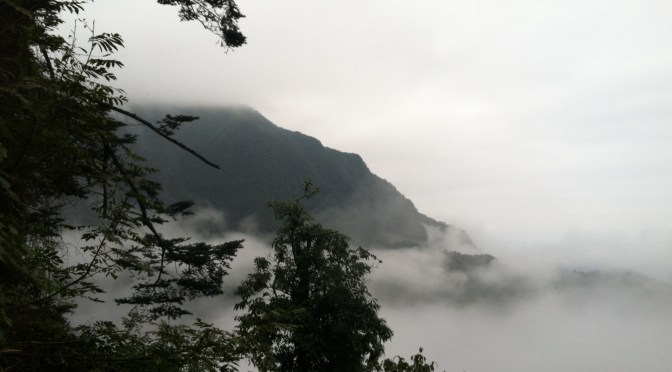
At 3,000m, Emei Shan in Szechuan Province is one of the four sacred Buddhist mountains of China. We made a point to come to this area when Julianne recommended it after her trip there. Photos show some of the environment and the landscapes that “look just like a Chinese painting”…except that they are real.
Gee Kin and I climbed two of the major mountains in China in the past–Mt. Huangshan in 2000 and Tai Shan last year with Melissa, so this was our third.
Photos, from top, left to right:
1. Two wild monkeys chatting on the steps. They are prevalent in the hills around Emei Shan.
2. We stayed in accommodation halfway up the mountain in the middle of the photo. Don’t ask how we got there.
3. Xinxiang Temple
4. Along river gorge
5. Background for “a Chinese Painting”
6. Gee Kin with typical steps in the background
The museums we visited are incredibly rich and excellently curated. They brought to life a renewed respect and deep appreciation for the continuity of the Chinese culture. This particular museum focused a great deal of attention on Szechuan’s formative period between the Chou and the Han periods, which were much earlier than those of other cities. The museum was laid out in sections of calligraphy, painting, pottery and bronzes.


Photos, from top to bottom, left to right:
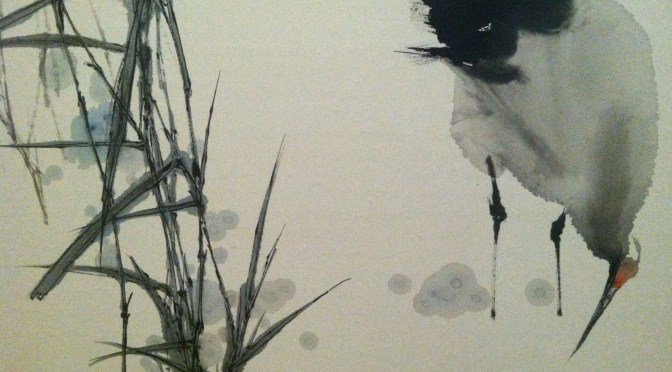
1. Contemporary painting, Red Crane
2. Contemporary Calligraphy
3. Bronze sculpture, Chou Dynasty
4. bronze bells, Chou Dynasty
5. Pottery making process
6. Han Dynasty Figurine
7. Han Dynasty Figurine
8. Han Dynasty Horse and Horseman
9. Celadon bowls
10. Museum Exterior


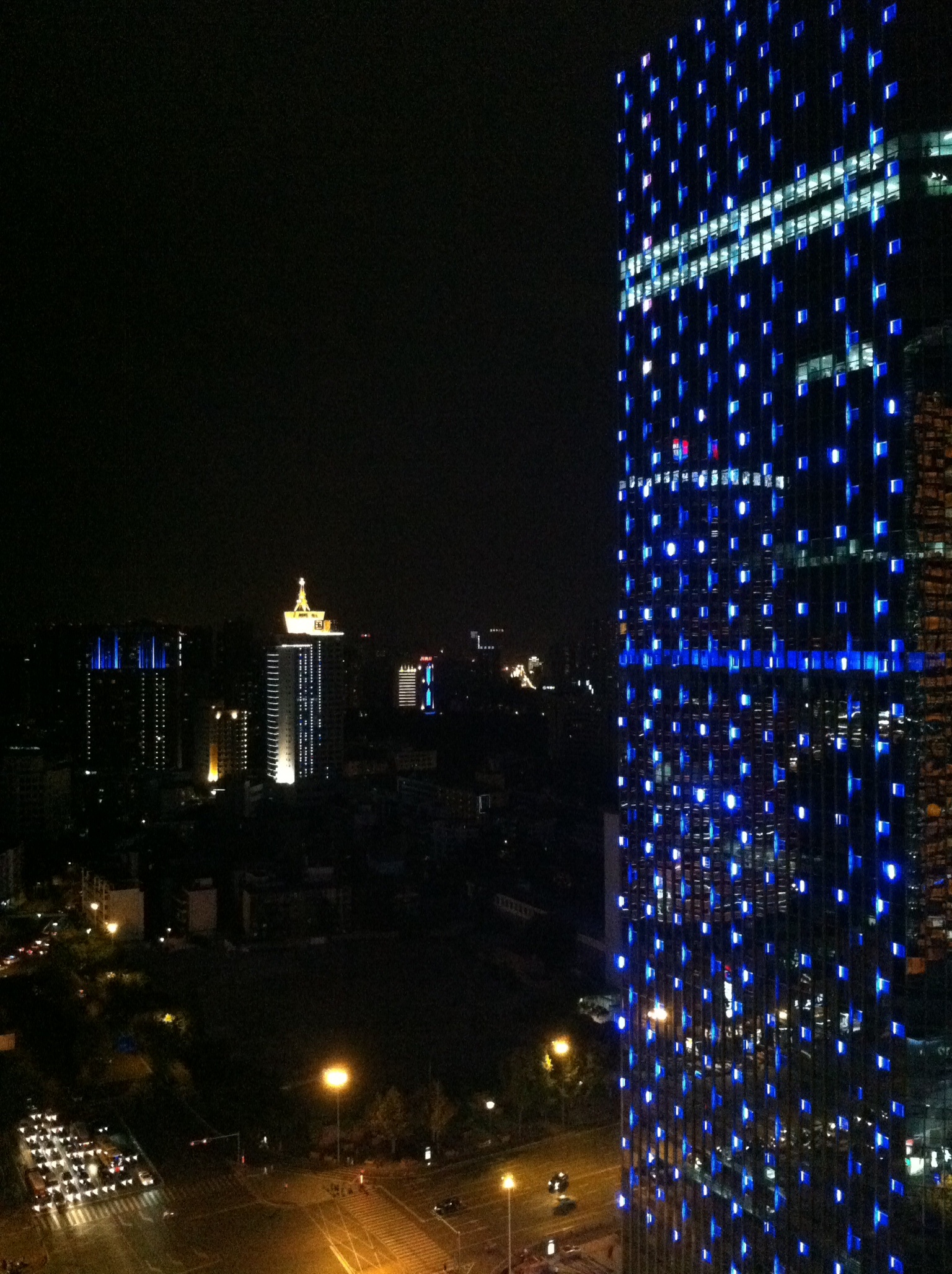

This city of 7.6 million people strikes me as being one of China’s prides–everything seems to be the latest and well done. The architecture and the people are more like Chicago than New York–better planning and friendlier. The buildings are exciting and refreshingly soft on the eye. Lots of lighting at night that’s fun to look at. The people are stylish but not over the top.
I have uploaded the missing photos from the previous posts to Instagram. Look for them at vifongit.
Attached is the fascinating history and interesting facts supporting my impression of Chengdu on Wiki: http://en.m.wikipedia.org/wiki/Chengdu
 travelswithmyselfandothers.com