Tag Archives: street scenes

Day 39-43: Dwarfed in Düsseldorf

IMG_7673
Frank Gehry’s Media Hafen along the Rhine

After learning about all the fairy tales in class to conjugate the past tense in German, I was wondering if I hadn’t shrunk myself. At the place where I am staying, the owner trains horses and is about 6′ tall. She fitted out the apartment to suit her height. The kitchen table is at my chest height. Standing up (because there are no chairs this high, not even bar stools), I can slurp soup directly from the bowl on the table top without having to lift it.

I also need a stool to get to the bottom shelf of the overhead kitchen cabinets. I wonder if I’m not going to face an avalanche of dishes stored over my head every time I reach for one. It’s a pretty funny scene after the third or fourth time around when I try to cut corners. I really feel like a dwarf.

Speaking of dwarves, we learned all about Grimm’s Fairy Tales, Snow White, Sleeping Beauty, and Little Red Riding Hood in my German class. Don’t forget that these stories all come from Germany. The Schwarzwald, or Black Forest, isn’t far from here either. I always thought that the stories had a dark and ominous tone to them. I never understood why little kids were always getting lost in the forest. But not to worry. Walt Disney borrowed them, sanitized them, and made them safe harbors for the Disney Empire.

S-L-O-W Living

We talk a lot about slow food but not slow living. I have spent a lot of time meandering through parks here, partly because you run into one in any direction before you know it. The city parks are incredibly accessible, well-maintained, and beautiful here. Because Dusseldorf is along the banks of the Rhine River, it is relatively flat. A lot of bikes travel at a reasonable pace and share the footpath with pedestrians. It reminds everyone to slow down. Maybe it’s time to think about slow living.

Here are some views of one of the beautiful parks in the heart of the city.

I’m blasting a series of shots of buildings, sights, and details here:

Below: Daniel Liebskind’s masterpiece of the Ko and Shadow-Arkaden, a mixed use office and retail complex. The exterior on the Nordliche Dussel (a small lake) side is mesmerizing. The rear wavy-gravy houses Apple and Tesla, and has a great plaza for people-watching. I even managed to break out pen and paper to do some sketching.

Now I know and agree why Düsseldorf is deemed one of the ten most livable cities in the world.

PS. For those of you in San Francisco, you can see “Young Goethe in Love”, a great movie classic, at the Goethe Institute Thursday, May 25! It’s not too late! Check it out!
Day 26-31: Do So in Düsseldorf

I’m finally getting around town and am starting to like this place. There’s a reason for it being in the top ten livable cities in the world: a vibrant economy, clean streets, energetic people, and lots of historic and cultural sites to visit. What’s not to like?!?

Sunday Strolling along the Rhine is a Dusseldorf must-do, and a beautiful one at that. Its promenade is one of the longest and prettiest that I have seen anywhere. Here’s a snippet of the casual ambience, combined with a Sunday afternoon book fair. Of course everyone reads books here!

Many of my friends are astounded by my staying power for German culture. It could be regarded as passionless rather than passionate, dry as opposed to juicy, tired instead of energetic. To me, they are all the positive words I used.

My deep respect for the technical foundation of Germany was obvious to our family friend in Bath.  He knew exactly why I come here, and cited the Bauhaus before I could claim the catch phrase. Even though he can’t claim to be as obsessed as I am, he’s close to being an architect in mind and practice. Judging from his beautiful home in Bath, he already manifests an architectural way of thinking and living.

I’ve written about this in great detail in the past, but for newcomers, I’ll summarize three reasons, well actually, four, why I come to Germany every year:

1. To learn the second language I started in high school, fell in love with (after 5 years of loving French), but never had enough time to pursue;

2. To develop my love for art and science in architecture, and to savor Germany’s application of art history and technical ability together;

3. To learn and follow opera in German.

4. An extremely understanding husband, who lives with a crazy woman and gets a month off every year to recover from the other 11 months of being with her.

That’s my reason for being in and doing Germany. As for Dusseldorf, it’s in the top ten of liveable cities in the world, so why not? It’s the fourth in a series where I have chosen to study in Germany, after Dresden, Schwabisch Hall, and Berlin, in that order. Some of you may have missed earlier posts.

Yesterday, our German teacher explained that up until the Soccer World Cup win in Germany in 2014, Germany had never openly displayed the German flag. We were just learning the word for flag, and it was her teachable moment.

Miscellany:

Here’s a quick shot of the curtain call from our class evening at the opera, “Tosca”. The stage presentation wasn’t as impressive as those in larger cities, but the performance was still very good.  A group of students were invited to go free of charge, so we were delighted to attend and enjoy an evening getting to know each other.

A quick overview of our German class postings is below. Our teacher is great. She keeps us on our toes during the entire four hours of class each day!

Köln Cathedral: The last posting showed the interior of the cathedral as I breezed through it on the way to the opera performance. It’s situated directly opposite the train station, and therefore hard to muss.

A UNESCO World site, the cathedral is probably one of the top 50 buildings in the world, and yes, one of our classic architectural history gems.

I’m attaching the Wikipedia link to those who might want to learn more about this impressive Gothic Cathedral. It is one of the tallest during its time, with two rows of columns on the exterior to support the vaulted ceiling. Gerhard Richter was tapped to design the stained glass windows!!

https://en.wikipedia.org/wiki/Cologne_Cathedral

Be sure to click on photos if you want to see enlargements or captions.

No Carbon Footprint Series: Belmont-San Francisco (Days 4-5)

Header image above: Bay Meadows Development

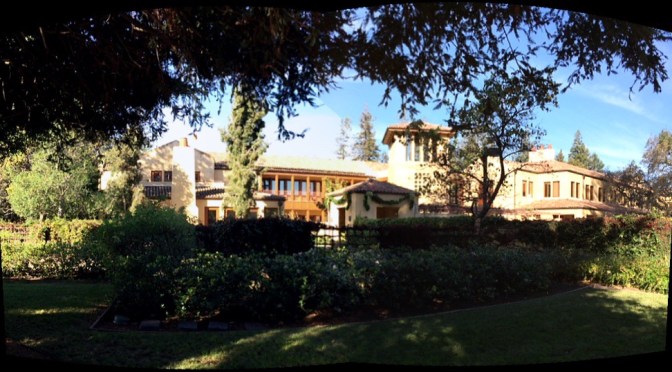
Featured Photo above: a very exclusive corporate center in Palo Alto where I made a pit stop!

Photos of Millbrae sights, above:

1. Milk Mural

2. Historical marker for Milk Mural

3. Vintage cars, in abundance in San Mateo. Mild weather, no bugs, and lots of old people with lots of money make them plentiful

4. Iron Horse chained to a pole at a gas station!

5. Yep, we made it here.

6. Street monument on El Camino. Not as romantic as the ones in Berlin, but still fun to find at your feet

Above, our lunch at Hong Kong Flower Lounge in Millbrae. A highlight of our jaunt included Tofu, ginkgo nuts, and pea tendrils in soup, pigs’ feet and red egg in vineagar, congee with thousand year old egg, and sesame balls!!

The fish tank displayed 2 giant lobster, Alaskan King crab, and prawns.

We have reached our destination safely and in one piece (two pieces, to be exact)! It was a great way  to make use of a fabulous week of perfect winter weather, have fun with great company, and get in some serious calorie reduction techniques. You can reduce the carbon footprint instead of flying, avoid traffic, and see your world around you. For those interested, here was the route:

San Jose-Sunnyvale (Sunday) 8.4 mi.

Sunnyvale-Palo Alto (Monday) 9.7 mi.

Palo Alto-Belmont (Tuesday) 7.7 mi.

Belmont-Millbrae (Wednesday) 10 mi.

San Francisco-Millbrae (Thursday) 12 mi.

You can also find my earlier trips to Napa and San Jose at http://www.crazyladywalks.com.

Finally, on a sad note, we send our condolences to the families of the Berlin attack. A photo of the location from our visit to the Breitscheidplatz Christmas Market in Berlin in January of this year is here:

A safe and precious holiday to all.

VickieVictoria

No Carbon Footprint Series: Sunnyvale to Belmont (Days 2-3)

Our journey from San Jose to San Francisco progresses at a rate of approximately 10 miles per day. Since it follows a dead flat route with virtually no elevation change, it is a healthy, simple challenge for beginners. It’s not exactly the Santiago de Compostela, but certainly more easily accessible being in California!

After a 3-4 hour beeline with a couple of pit stops for clothing changes, nut breaks, and bathroom visits, we arrived at one of the hotels I prebooked a couple of days ago. We enjoyed a late lunch nearby, took a nap, and caught up with lively conversations that would not otherwise occur. It’s a great way to reconnect again, and to appreciate the precious time you have with your partner.

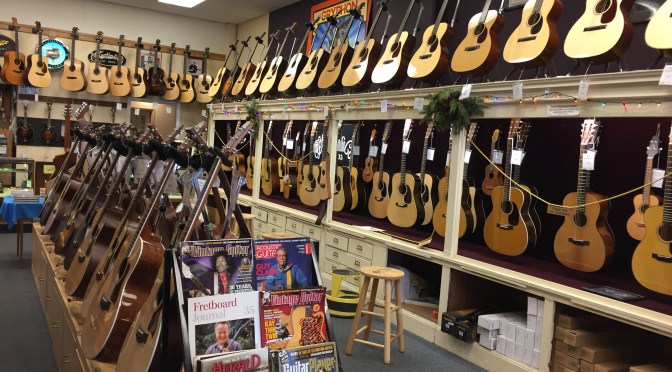
I haven’t documented prior trips so this time I’m devoting additional time to doing so. Yesterday we discovered a gem of a music shop in Palo Alto, that sells guitars, mandolins and other hand plucked string instruments (see photo above).

The old Mountain View neighborhood hosted a string of modest, pre-war bungalow-type houses that were as inviting as those in Sunnyvale the day before. They proudly displayed orange and grapefruit trees in their front yards. Interestingly, there were fewer decorations as we approached upper-crust Palo Alto.

The houses are close to the streets, with only a 5-15′ setback. A sad reminder of a time when the world was trusting and safer.

I looked out for Eichler homes that are scattered throughout the neighborhood. They were a new phenomenon at the time–a departure from the 3-BR 2-bath ranch house. Same size, but instead they boasted inner courtyards with plenty of light for each room. They didn’t appear to be as prominent on the streets we passed along.

Although we follow the general route of El Camino Real, a long strip highway/road originally linking the missions, we manage to take parallel off-streets whenever possible. The small residential streets are definitely more pleasant, but they sometimes end up inside subdivisions with curvy dead ends or no outlet. To avoid that I check the street end-to-end before using it, so we know where to turn. Google maps allows us to plan out our strategy and assures us that we have backup support whenever needed for navigation.

El Camino as a concept reminds me of both the Nakasendo Highway near Matsumoto in Japan and the Pilgrim Route (Santiago de Compostela) in Spain. There are many other similar long-distance foot trails (also the Pacific Trail) that provide a variety of challenges. My go-local determination allowed me to refrain from going to Spain or France for a destination walking trip. Since we were already in Japan last year, we took a side trip inland.

Despite the Christmas holiday frenzy, we grabbed the good weather forecast to make time for this trip. We discovered that the down time for business travel has slashed the price of hotel rooms–up to half off!!

There are plenty of delights and surprises, just around the corner from where you live! Take a look at two woody walking paths not far from El Camino along the way, and a sweet little surprise to literary friends.

No Carbon Footprint Series: Do You Know the Way from San Jose? (Day 1)

Most of you know the way along 101 or 280. But most likely not the way we are coming. This week we are walking from San Jose to San Francisco–a mere 48 miles over a few days’ time.

For the past few years we have gone out the door (literally) and walked to Napa, California and two ways to San Jose–south along the east side of the Bay and along the Peninsula. This time we are going in reverse order from San Jose Downtown to San Francisco north along El Camino Real.

Many of you know us as urban walkers, and who enjoy the “slow” version of transportation. We see the small businesses stringing El Camino strip malls. Their parking lots serve nail salons, ethnic fast food take-outs, specialty music shops, and mid-range companies (vs. start-ups), that all pay their rent, bills, and struggle to stay in the economy.

The first time I started this wacky way of walking, I was on a weekend trip from Hong Kong to Honolulu about to take my first professional architectural licensing exam. Perched in Manoa Heights at a friend’s home, I had made plans to meet my friend Downtown for lunch. When I missed the bus, I discovered that the next one would not be for another hour! I glanced down the hill and determined that it wouldn’t be too difficult to walk instead. A three-mile walk is a breeze today, but in those days NO ONE walked outside their houses. Especially in Honolulu.

I was used to being without a car in Hong Kong for seven years, so it seemed rather natural. The look on my friend’s face must have been priceless when I told her that I would be a little late and why. She thought I was…well, wacko. So that’s how I coined myself the crazy lady ever since.

Nevertheless, we are keeping up the crazy lady walks. We came to San Jose for a performance, and despite the holidays being around the corner, we had the time to walk back to San Francisco, so why not?

For a few starters, we passed the Old Frank Lloyd Wright Building and the Rosecrucian Museum on the way towards Santa Clara University.

The weather is clear and crisp (above frost level today). The lovely neighborhoods we walked through included tidy pre-war bungalows and 60’s ranch subdivisions, all proudly displaying their Christmas decorations and embarrassingly beautiful citrus trees reminiscent of the region’s agricultural legacy.

San Jose, Santa Clara, and Sunnyvale are in the heart of Silicon Valley and dead flat with paved sidewalks along the entire stretch to San Francisco. Walking 10 miles a day is a no brainer, with plenty of food and lodging establishments along the way.

Can you guess what we saw? Here’s the curtain call:

img_6115

Days 77-80: San Francisco Summer

Many of you have heard Mark Twain’s quote about San Francisco: “The coldest winter I ever spent was a summer in San Francisco”. It’s truer than ever this past week since I have returned. Visitors from the East Bay showed up in shorts, only to find the brutal inversion layer of fog cloaking the city with a 50 degree blanket. The temperature difference within 50 miles can be 50 degrees. The pattern occurs consistently in the summer months, until the sun breaks through in early Autumn.

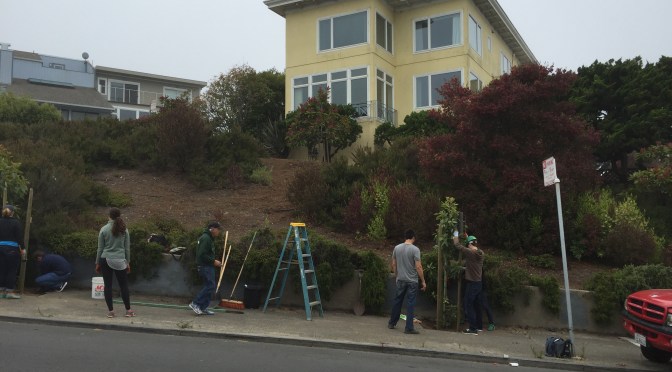
We ordered four street trees that were planted by the Friends of the Urban Forest (FUF), a local non-profit in the City. Gee Kin volunteered to help on Saturday, and the team covered a collection of houses in the Inner Sunset. After the trees are planted, the FUF maintains the trees for three years. While the trees are the responsibility of the property owner, there is talk about switching the maintenance back to the City. That would allow for more regular maintenance and protection for the tree plantings.

Growing trees obviously helps enhance and preserve the environment, but we heard that there are still many skeptical neighbors. They find the trees a nuisance with droppings, obscuring visibility, and cracking sidewalks. It seems like a simple goal, yet complicated by differences of opinion.

On the cultural end, I decided to extend my travel mode by visiting local museums and attending performances. The Asian Art Museum’s “Treasures from the Emperor’s Collection at the National Palace Museum, Taiwan”, featured a portrait of none other than Kubilai Khan.

imgres

After having just been in Mongolia, I was keenly interested in his place in Chinese History. He formed the Yuan Dynasty and moved the capital from Khorkorin to Beijing. From traveling, I have been able to connect the dots and have a better appreciation of the interactions between East and West. The exhibition covered four dynasties, the Song, Yuan, Ming and Qing.

Earlier this week, we hosted a family from New Zealand who are “kissing cousins”. They originated from Palmerston North and come from a mixture of Chinese, Maori, Irish, Croatian and Lebanese backgounds. Now there’s a conversation to be had! We were delighted by their stories about traveling around the world, living in the Guangdong father’s village for three months with all five teenage children in tow, and visiting Vancouver, Cuba, New Orleans and San Francisco during this last venture. How’s that for independent travel?!!

Since my birthday last month and all the greetings, I am hoping to collect birthdays from friends so I can reciprocate. Looking ahead for August, a Happy birthday wish to Pam in Chicago, niece Pam in Albany, New York, and old friend Karen in Oakland. Send me your date if you haven’t already, and I’ll keep you on my list!

This day completes the third 72+8 days around the world. Thanks to all for your input and comments on the survey. You can see the results after each question. It’s a valuable tool to help me improve my blogging skills! I’ll be posting once a month to keep the news up to date, during which time I will develop and share my plans for travelswithmyselfandothers. Enjoy your summer everyone! Stay cool, as we always are in San Francisco!!

Days 74-76: Heady Headers

Photo, above: Mongolian Herder Family, with awards from Dad’s wins in local horse  racing contests. You can see them all in Mongolian Herder Family video at https://youtu.be/QBCz8EjsMoc

As a finale I decided to summarize my trip by sharing the headers below that were used for my postings with you. I remembered (nearly) every location by heart, with a couple of technical exceptions. I am fond of each and every experience! They are now like my children, and hard to give any of them away. I hope you have enjoyed seeing these again, this time with captions.

A note about the number of days on each annual trip: There have been 68, 80, and 72 in 2014, 2015, and 2016, respectively. Anchored on one end for a German Language Course and Asia on the other end for contrast, the stuff in between has been the most interesting and lesser traveled. I was always fixated on the Silk Road, and this time, the Genghis Khan saga across the great Eurasian Continent. The timing was right for me, the weather and climate suitable, and a very achievable itinerary in my (crazy) view of the world. If you have questions or details on accomplishing it, let me know and I’d be happy to give you more information.

A big hug and thanks to each of my travel partners and visitors: Gee Kin, above all; Tom, Helena, Patrizia, Hanne, Jens, Vladimir, Iyoko, Paul, Kanji; and new Goethe friends Mukda, Anu, Jess, Ilaria; and Mongolian guides Aggie and Nassa. I now have collected many friends from all over the world to join me in my future travels. And of course, to you, the readers.

There’s a very short, 3-second survey at the end of this post that I would really appreciate your taking the time to respond to for my benefit and future trips. Thanks again to all for following my blog and keeping me focused on getting both of us new and exciting experiences, both in the raw and virtually!! Love to all.

cropped-image107.jpeg
View of Tennozu Isle, Tokyo, Japan
cropped-image941.jpeg
View of Mt. Magome, Japan
cropped-image85.jpeg
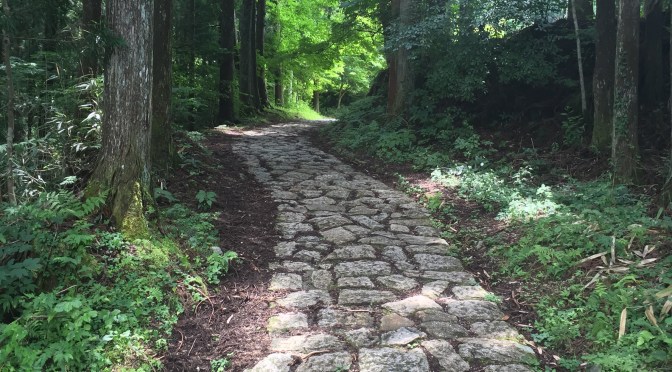
Nakasendo Highway, Japan
cropped-image60.jpeg
Rear End of S7 flight-Valdivostok to Tokyo
cropped-img_4625.jpg
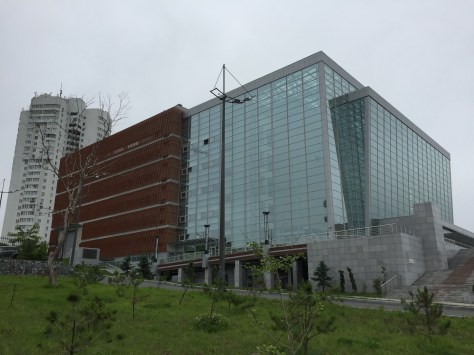
Vladivostok, Russia
cropped-img_4560.jpg
Vladivostok Harbor, Russia
cropped-img_4336.jpg
In transit on Trans-Siberian Irkutsk to Vladivostok, Russia
cropped-img_4244.jpg
Village along Lake Baikal, Russia
cropped-img_40231.jpg
Khorkorin, Mongolia
IMG_3923
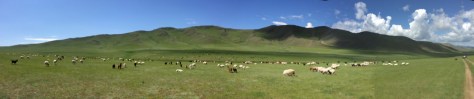
Free Range Sheep and Goats, Orkhon Valley, Mongolia
cropped-fullsizerender-73.jpg
Gorge of Orkhon River, Mongolia
cropped-image131.jpeg
Forbidden City, Beijing, China
cropped-img_3193.jpg
Bauhaus, Dessau, Germany
cropped-img_3104.jpg
View from Kunst Akademie, Berlin, Germany
cropped-img_2845.jpg
Spree River, Berlin, Germany
cropped-img_27201.jpg
Tiergarten, Berlin, Germany
cropped-img_2561-5.jpg
Museum of Terrorism, Berlin, Germany
cropped-img_2441.jpg
Egyptian Panel, Neue Gallerie, Berlin, Germany
cropped-img_2412.jpg
Street Art, Berlin, Germany
cropped-img_2329.jpg
Bernauer Strasse, Berlin Wall Park, Germany
cropped-image17.jpeg
Weimar, Germany
cropped-panorama.jpg
Jazz Orchestra, Dresden Musikfestspiele, Germany
image
Dresden, Germany
cropped-img_1357.jpg
San Francisco City Hall, California, USA

Survey


Day 64-66: Nakasendo Highway and Matsumoto Castle

After traveling for over two months in Europe and Asia, the culminating event was walking along the Nakasendo Highway in Japan. An ancient highway for over 400 years to provide communication between Kyoto and Edo (present-day Tokyo), this route was used by messengers, tradesmen, and government officials.

Between postal stations and forest paths, much of the route is annotated with historical features. Literary references to famous Japanese writers and haiku poems about the physical environment were identified along the path, as well as religious shrines, military battles and scenic spots.

After scant Japanese and English translations at railway stations, the information transfer magically yielded maps and schedules. We were handsomely rewarded with instructions for a 500-meter change in elevation, three-hour walk through Magome Pass from Tsumago to Magome. We traverse gorgeous lush pine, maple and bamboo forests, deep glades and gushing river streams, and gently seductive waterfalls for an exhilarating experience.

We fell in love with this area surrounding Matsumoto. Although we had never heard about it before, it is famous for trekking, skiing, soba and sake. They all seem to fit well together.

I have been in such awe of the natural beauty of this area that it tempers my entire voyage to date. While my travels have been unabashedly Euro-centric to date, I am being severely challenged by this newly rediscovered Asian culture.

The Japanese have a deep, rich history and its status as an advanced industrialized country is impressive. Together, Japan has a lot going for it.

See the gallery below for a random assortment of shots in Magome and Tsumago, both prosperous villages at the time of their development and renovated, and the delightful walk between.

At the end of a day of hiking, we stayed at a ryokan in the lovely hilltop village of Magome.

Matsumoto

Our day was packed with three hours of  travel and three trains between Kusatsu Hot Springs to Matsumoto Castle.

Not being a Japanese speaker, I find that traveling in Japan is challenging. However, with a wealth of information available on line and at tourist information counters at stations, one can manage. Good travel skills like speaking slowly, waiting for stilted English to emerge, and a lot of body language and gestures definitely help.

The castle was built over 400 years ago in the Bunraku Period (1593-1594) and is Japan’s oldest existing castle tower. It is designated as a national Treasure. Take a look at the impressive stone foundations.

There were three moats surrounding the castle to slow down invaders. Shelves were constructed to release stones against soldiers attacking the castle. Guns eventually replaced bows and arrows used as weapons from the towers.

You can climb up steep steps to the top of the sixth level for a view of the Japanese Alps.  The castle and grounds  are impeccably preserved.

image

The sleek and elegant Bullet trains have transported us seamlessly between points, making it a pleasure to travel in Japan. Little English is (admittedly) spoken outside of Tokyo, but there are enough minimal signs to direct you to the right trains. Patience and fortitude pay off in one of the safest, most courteous countries in the world.

Day 59: Vladivostok, Russia

Here are some first views of Vladivostok coming from the north by train on arrival at sunset the night before:

Dinner at Three Brothers across from the hotel, complete with live American jazz music for $30 for both of us with wine

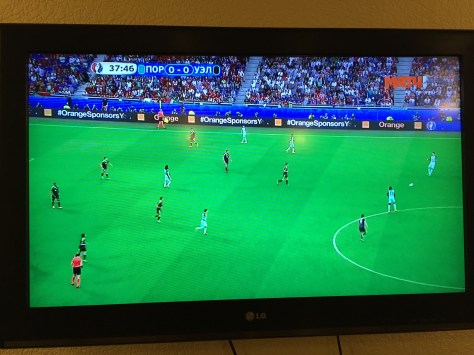
Evening Entertainment: Portugal vs. Wales with Rinaldo scoring 1 of 2 goals

IMG_4475

If you were visiting Vladivostok for the first time like we were, you could start an early morning walk at the Friday morning Central food market:

You can take a minibus to the new Mariinskiy Opera and Ballet Theatre. It is hosting the first International Piano Competition at the end of this month. I predict that it will be a great draw for concerts, ballet and opera in the future. You might consider taking a trip to attend this magnificent new venue and the emerging new productions and stars that will perform here!

After that, you can catch a bus back to the city and stop at the Lookout Point over the new Golden Bridge completed in 2012. Does the design look familiar to you?

IMG_4541

Later in the day, get your cultural brains in gear and visit the Primorie Art Gallery. When we attended, it was showing an exhibition of Russian Art from 1700-1900. We were intrigued with the very personal touches of each painting, that may have reflected or imitated more famous Western paintings of the same era. Sargent, Picasso, and Matisse came to mind.

There were also a number of startling paintings that represented new subjects seldom seen in paintings of the same era. Chinese or Muslim figures were represented in historical settings that required more context and explanation. Unfortunately, all paintings were titled in Russian or limited English.

At the end of the day, kick back and have dinner at the Three Brothers for evening meal. This was our return visit from the night before. The outdoor dining was perfect for the cool balmy weather of Vladivostok. The city is very similar to San Francisco, with hills, coastal fog, city views everywhere, and a lively ambience. We’re in love with this city of 2 Million!! This city is destined to be a big tourist destination in the next 10 years, so come soon.

Day 55: Sadly, Irkutsk, Russia

Here’s a gallery of unpreserved historical and old buildings in Irkutsk. Both the Trubetsky and the Irkutsk Historical Museums that we visited today did not allow photos inside, so these are exterior shots only.

You can really get a sense of how bleak and gruesome it was living through a winter in Siberia. Around 1830 in St. Petersburg,  nobles tried to revolt and lead a coup against the Russian empire. They failed, were put into hard labor camps, then exiled to Siberia. Their wives and children were left to follow and look after them, at their own expense.

Known as the Decembrists for the month of the revolt, the anti-imperialists are now finally given due respect for their travails. Trubetsky was one of the survivors who was allowed to live out his life in Irkutsk. His wife had died and was buried here,  so he chose to remain where her grave was. The museum is located in the home where he lived out the remainder of his life.

Irkutsk has a short history of only 355 years. I find it surprising that American history predates the one here. We are so easily surpassed by any country in Europe. It’s not surprising that few humans would contemplate ever living here.

The state of disrepair and condition of the city were depressing. At a site we passed, old Russian artillery and tanks were on display in a neglected area overrun with weeds. Once a building was built, it never seemed to be maintained or repaired to extend its life.

The harsh weather of Siberia shows how difficult and impractical it was to make sufficient repairs in the few good months of the year. It seems that everyone needed to spend the time recovering from the previous winter and enjoy the few days of sunshine, rather than toil to gain a simple pride of place.

Relevant to this conversation, the construction of the Trans Siberian Railroad was another example of how difficult it was to build anything. Stretching nearly twice the length of the US, the railroad took 25 years to build. The area around Lake Baikal was particularly difficult. Here’s more information about the construction around Irkutsk:http://www.irkutsk.org/fed/transsib.html.

Sadly, Irkutsk didn’t have the vibrancy and can-do  energy of Mongolia. It seems to be bogged down by its climate, corruption and inertia. It may be harsh judgment, and I can not speak from an impression of the city. Gee Kin travels for understanding, while I travel for enjoyment. It’s hard to do either here.

Going off the grid for three days or more. Will try to report from Vladivostok next. Apologies in advance if you are having trouble accessing the website. It’s been erratic and unpredictable. Hopefully this will be fixed by time I reach Japan. Thanks for your patience!