Tag Archives: Performances

Day 20-25: Duffelbag in Düsseldorf, Multi-Tasking, and Multi-Culturalism

The eagle has crash landed. After an eventful day traveling from London via Brussels and Köln to Düsseldorf, I settled down to my “home” for the entire month of May, 2017. Reporting on Pretty Yende was irresistible. I apologize to those non-opera fans for obsessing on someone you might not know. But if you have heard of Pavarotti, you will soon hear Pretty Yende as a household name too.

So, Düsseldorf. My first introduction to the concept was quickly corrected by my AirBnB hostess. When she watched me unsuccessfully enter the internet access password she had given me, she reminded me that Düsseldorf needs to spelled “DuEsseldorf” to be correct. No E, no Entry to the Magic Kingdom of the Internet.. OK, right, as they say in the U.K.

The drizzly week didn’t help to motivate me to see much if the city, except to hang around the train station and the Goethe Institut, where I am taking a one month German course. This is my fourth course in four years (refer to the travel itineraries under the header for each year).

Some of my former German class buddies may be curious to hear how my class is shaping up. Students are diverse in age and nationality. One or two Koreans, Chinese, Japanese and Indonesians; Ukrainians, South Americans, Saudis, British and Americans.  It’s best to avoid groups of three or more students from the same country as clumps and gangs form! I’m pretty satisfied with the collection for now, but we’ll see.

Multi-Tasking

Our first German class topic was about the brain and learning. It was a great introduction to the up-to-date, state of the art German education. It quoted the most current research, citing numerous examples of ways to retain new information. I reflected on the brain research studies Gee Kin (husband) and I will be participating in after I return to San Francisco: part of superstar Adam Gazzaley’s research on distraction and brain landscapes.

We have devoted our lives to multi-tasking to the point of distraction. While hipsters can manage and focus, it’s a bigger challenge for those of us who have built multiple careers on prior knowledge. It gives us little time to clear out the attic and the clutter is evident.

As part of learning new German vocabulary, our class was taught all the various learning styles: seeing, hearing, speaking, and a combination of speaking and movement. We should vary exercises and not be fixated on only one method. For instance, walk around and recite seven new words, but no more, for very short periods. They didn’t say it, but these suggestions are based on brain studies and the most effective ways to retain information.

We also learned in class that men learn quickly but also shut down information quicker than women. This started a lively conversation stereotyping men’s and women’s learning styles. It was too tempting to resist judgment between the sexes: one student claimed that men were smarter while women paid more attention to detail.

This naturally caused a call to arms between my new kindred English woman architect classmate and me. We exchanged some rapid eye movement and eye rolling and began to dispute the claim.

Initiated by a couple of male students from “not-so-liberated” countries, we stepped up and did what would have done Gloria Steinem proud. But in the midst of it, I felt a sad mood descending on our spirited encounter.

A few months back, I had seen a program about the Flüchtlingen (refugee) experience in Germany on Deutsche Welle, Germany’s version of Voice of America. A recent immigrant interviewed expressed his gratitude for free and public education, housing, and health care, but he noted how he was not accustomed to going to training classes with female students. I couldn’t help but flash on this observation.

I wondered what experience one of these male students had in classes with women students. While I don’t consider myself a super-feminist, I saw the huge canyon between my perspective and this classmate.
Should nations of Western Europe and the US strive to convince the world to go our way? Or are we imposing our might on others? I felt as if there was a mountain of work convincing this student that women were as good as men. Maybe women in his country just don’t ever get a chance to take men to task. Where does that put Angela Merkel, a chemical engineer, running a major country? Or maybe we should just back off?

I was grateful that I lived in the US, where you are at least free to enter the ring.

We assume that Diversity means other races and cultures but in some cases we have to remember to include women on the list.

Multi-Culturalism

Later that day in Frankfurt, I met a nice African-American woman, Carol Lynn. She had been working and living in Germany for over 35 years. She came from DC, so I couldn’t help but rave to her about the NMAAHC. She listened politely, then told me briefly about her life. Her family was already 5 or 6 generations traceable, back to the original slave owner. Her family of 9 siblings promoted many offspring, numbering over 100 members in the family and with 50 nieces!
She had many jobs working both as military and civilian personnel supporting our American presence in Germany.

I began to realize how many Americans are in Germany. Until now, most of my travel had been concentrated on Eastern Germany or in the countryside, so it was less evident. This conversation gave me perpective. Particularly for African Americans, I wondered if it wasn’t a more positive experience abroad than at home.

It’s important for all cities to embrace its members in a multicultural society. It isn’t enough for struggling minorities to merely “parallel play” and be marginalized.  All cultures must be engaged in a common goal and feel that they are contributing collectively to the vibrancy of the city to which they belong.

Apropos to all of these observations and experiences, I had asked husband Gee Kin to reflect on our recent travels. Here are his thoughts, and please send us yours.

Diversity in the World’s Great Cities by Gee Kin Chou
San Francisco is considered one of the great cities of the world. However, it’s a mere village compared to two other great cities on the list: New York and London.

I’m not talking about size; I’m talking about diversity.

Within the 64 square miles of San Francisco proper, White and Asian faces dominate. Yes, Latinos and African Americans become a larger part of the picture when you expand the geography to the greater San Francisco Bay Area, but many are marginalized; African Americans in particular live in increasingly segregated communities. Africans from Africa, and Islamic headscarves are rare.

In New York, and even more so in London, a random day is likely to include contacts with several ethnicities. The shop assistant may have emigrated from Egypt, the bank teller from Nigeria, the hotel clerk from Bulgaria, the waitress in the upscale restaurant from Colombia and the electrician from Barbados. Every day encounters with ordinary people doing ordinary things. It may seem trivial but this is not the daily Bay Area experience.

I had always thought the “diversity” of the Bay Area was the future and the role model for the rest of the world. But visiting New York and London after a long hiatus has reminded me not to get too smug: San Francisco is not where it’s at. New York and London are truly GREAT cities.

Miscellany

Finally, a few shots of the Frankfurt Opera interior (the new one, not the old opera house and the evening performance “Three Operas”:

It’s worth seeing something at the opera house as the intimacy, sight lines, and acoustics were fantastic.

Header Image Above: Can you guess where and what this is?  It was too significant to pass up as one of the largest Gothic cathedrals in Europe. You’ll have to wait for more Dusseldorf sights next week, when friend Helena and I will do the town and attend concert events here and in Essen!

Plus: Happy Happy Birthday today to Isa!!
Day 19: Pretty Awesome Pretty Yende (Köln)

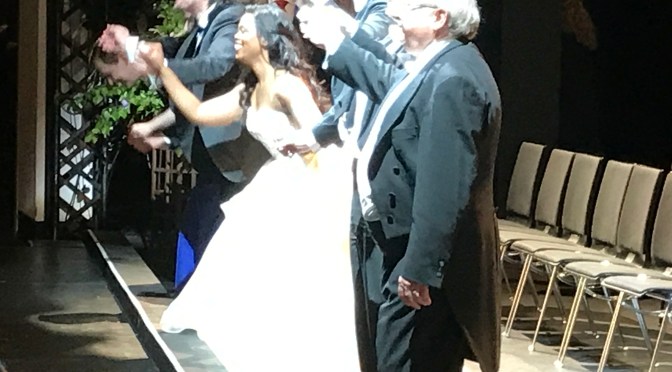
Last night I attended a concert with Pretty Yende at the StaatenHaus am Rheinpark at 6pm in Koln. She is the hot new South African opera star adored by the Metopera whom I wrote about earlier. I found an under-the-radar, one-shot performance in Koln and I managed to get myself a ticket several months beforehand. Pretty (that’s really her name, she owns it) was partnered with Eric Cutler, a tenor, and Igor Golovatenko, a baritone, singing arias from Romeo and Juliet and Lucia de Lammermoor. She had performed these recently at the MetOpera in New York.
Naturally, as I do at each performance, I study the audience. Asians are not yet a significant part of the classical music crowd in Europe. There are normally a sprinkling of Asian attendees, but few and far between.

Let’s face it, I look Asian. I AM Asian. And I also look to see if there is any other representation. There are even fewer of any other ethnicity. Sad but true. I have adjusted myself to being the only one in the audience as I was tonight, and didn’t really mind, considering who I was about to see.
Occasionally I feign myself as being a former crown princess of some ancient city. I strut about royally during the pauses, disdaining the cheap champagne and decayed mushroom puff pastries being served at the bars. I peruse the huge bouquets of lilies and roses, and imagine that they were being sent to my hotel room as an acknowledgement of my attendance. I update my fantasy to being a wealthy, thirty-something owner of an internet empire. I idylly drift in and out of world-class performances and bummel around elegant Baroque castles, wineries, and fineries of Europe.
I return to my Row 1, Seat 1 proudly. I could observe every twitch and turn of both conductor and star performers and detect what was really going on in their minds. You are so close to them you can see their temples pulsating as they reach their climaxes (musical).
But back to the performance. Stellar. Stellar. Stellar. Pretty Yende was poised and perfect. Every note was chiselled with the finest of singing tools and the wind going through her throat melted like honey.
I breathed every breath she took, as her trills and curls gave me tingles like lightning up my hairy arm. I imagined drawing her as a model in my figure drawing class, and saw the shapes and triangles on her face and body. Her costumes were an extension of her inner beauty and strength, and her name. I was captivated.
A couple of men in the back of the audience shouted “Bravo!! Bravo!!” Mesmerized by her delivery, I suddenly discovered myself yelling the same. I couldn’t believe it was me—that quiet Asian wonan, who can never raise her voice loud enough to be heard answering questions in German class, suddenly turning into Katy Perry and shouting as if “you can hear me R-O-A-R???” while both disregarding and commanding attention?!?
Hey, it’s easy when you are congratulating perfection. Timing my call was perfect too, like what a percussionist does to nail that single triangle stroke or clash of gongs. Could it have really been me? The polite German woman next to me looked taken aback and perplexed. (If you know German audiences like I do, they never give standing ovations.**)

I started to like this new-found powerful image of myself. Why stop?

At the end of the next piece, I suddenly heard a different shout.

“Brava!! Brava!”

Oh God, THE WORD IN ITALIAN HAS GENDER!

Did I really shout what I heard the first time, or did I follow like a lamb what I heard??

I lambishly shouted and mimicked again, but quickly disregarded my first faux pas and claimed this time, “BRAVA! BRAVA!”

After all, why kill a good thing coming?

Sorry, Pretty Yende, if you are reading this, you really were Pretty Awesome. And I was thrilled to meet you.

IMG_7473
Pretty Yende signing CDs

*I noticed that the title of this post was used by the NY MET in their press releases but I tagged mine before seeing it. So hopefully I wont be accused if plagiarism! You can also find the smashing cover of Opera Magazine UK with Pretty Yende on it here: ‪http://www.opera.co.uk/, along with many others to come!

And here’s an interesting discussion I found on the web about the use of Brava, Bravo, Bravi, Brave, Bravatissimo, etcetera…etcetera…
https://italian.stackexchange.com/questions/1880/can-i-say-bravo-to-a-female-performer

A quiet moment in Koln just before the performance, just so I can remind myself that I was really there:

**There were no standing ovations at any opera performances that I attended in Germany, except once for Nina Stemme in Tristan und Isolde in Berlin’s Deutsche Oper. Normally, as they did for Pretty Yende, Germans stamp their feet sitting down in lieu of standing up and clapping. As an architect, that makes me cringe–not so much because of concern for the weight or stress on the structure, but for the abuse on the floor!! OMG!

Days 9-11: (Upper) West Side Story

Following our side trip to Washington DC, we are back in New York staying at The Beacon Hotel on the Upper West Side. It provides convenient and walking access to the next three days’ events at Lincoln Center’s Metropolitan Opera: Aida, Der Rosenkavalier, and Eugene Onegin. You might find that worse than doses of cod liver oil, but for me, it’s like dying and going to heaven. You’ll hear more of the gory details later.

Breakfast

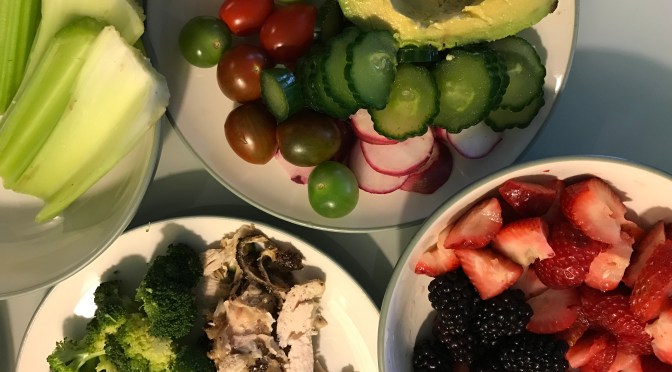
We started off the day with the Fairway Supermarket across the street from the hotel. We loaded up with fresh Mediterranean fare (see photo above)–fresh fruits with yoghurt and granola, cucumbers and tomatoes, and veggies with protein. We are taking a break from restaurant food everyday by booking a hotel with kitchens in the rooms to cook and eat healthier.

A quick walk within a half-mile radius of the Beacon Hotel yielded a wealth of new finds. Many shops are individually owned, mixed in with community gardens. Sandwiched in between Central Park on the east and Riverside Park, the Upper West Side is stocked with plenty of greenery and O2 to replenish the body and soul. A couple of retirees in Riverside were racing their model sports car through our feet as we gingerly tiptoed through the racetrack and the tulips.

Lunch

What more can you say? Food is everything in New York. You can find just about any type of cuisine or ethnic cooking, including crossovers like my favorite example of Uzbeki-Korean food. Not to beat that over a dead horse, but that level of complexity ain’t in foodie-snobbie San Francisco.

After-Dinner Snacks

The evening performances at Lincoln Center are dazzled by sparkling chandeliers inside the operahouse that modestly excuse themselves from blocking anyone’s view as the concertmaster plays A on the violin, the lights dim, and they retire to the very top of the ceiling.

All seats are good. The ones I selected for the series of three this time were side-saddles with box seating at the dress circle level. The $25 tickets I purchased at the very top row of the balcony in the past aren’t a slouch either. You have the option of ditching the performance if you don’t like it or incentive to get creative with a wild one.

What follows is our raisin d’etre for coming to NYC this time. The string of operas with curtain calls, synopses and my subjective opinion of the performance (all in: singers, staging, music, etc) for those interested:

Aida

IMG_7126

http://www.metopera.org/__Redesign/Views/Pages/Discover/Synopses/Synopsis.aspx?id=46544&epslanguage=en

My Rating this performance: ***

Der Rosenkavalier (Renee Fleming’s swan song/final performance and curtain call as an opera diva, along with Elina Garanca)

Error
This video doesn’t exist

http://www.metopera.org/__Redesign/Views/Pages/Discover/Synopses/Synopsis.aspx?id=46548&epslanguage=en

My Rating this performance: **

Eugene Onegin (with Anna Netrebko in Tchaikovsky’s masterpiece)

IMG_7155

http://www.metopera.org/__Redesign/Views/Pages/Discover/Synopses/Synopsis.aspx?id=46533&epslanguage=en

My Rating this performance: *****

Let me know if you have ever lived on the Upper West Side or on the Lower East! What was your experience? We had been pretty stuck on Midtown or Upper East Side in the past but found that trying out these new neighborhoods gives us a very different dimension to New York City. We’re encouraged to try a different neighborhood each time we come to this magnificent, multi-cultural city. I hope you will consider doing the same!

As a final tribute to our being in New York, we toasted our anniversary and a birthday with a dear friend whom we met in Hong Kong and who is a New York City native. At a rehearsal of the American Ballet Theater’s upcoming Don Quixote, we caught a glimpse of Misty Copeland! What more could you ask for in a sendoff from New York City??

We’re on to London, so be prepared for a British accent to the next post! (Fewer operas, Queen’s Gate, then on to Bath and Blenheim)….

Days 3-4: A Beeline for the Highline and a New York State of Mind

A couple of years ago, I was introduced to the over-the-top experience on the Highline in the Meatpacking District of New York City. It didn’t take much convincing for me to want to retrace my steps again on this visit. The clever landscaping over a derelict elevated railway track, sumptious architecture and brilliant urban planning make the short two-mile long path an essential destination for both tourists and locavores alike. New outdoor art installations have been added since the first visit, and Zaha Hadid, a world-famous architect, has a signature building under construction on the north end. (She recently passed away.)

We made another beeline in the afternoon for Brooklyn. In a posting last month, our Brooklyn buddy researched the Uzbeki-Korean Cafe Lily for us. The hour-long ride to and from Brooklyn was no sweat compared to flying back and forth to Uzbekistan for kimchee and kebabs in one fell swoop.

Thanks to the favorable review from the NY Times in February and an eyewitness account (see the special correspondent report from the February 2017 post), we were not disappointed. Okay, it was after 2pm when we descended on an empty restaurant, but hey–it was open for business.

After a deliciously simple cucumber and tomato salad, perfectly flavored and crisply fresh (exactly as I  remembered the food in Uzbekistan), we slurped beef soup, prepared at the table with condiments, and tickled our palettes with a teeny lamb kebab. The highlight was an entire fried branzino for $15! The whole meal barely topped $50. This was the antidote to gourmet dining.

In Uzbeki food, simple cooking allows the inherent freshness of each ingredient to be sensed and savored with each bite. The Mediterranean emphasis is evident, but subtle. I noticed the care taken in preparing each slice or morsel of food when I visited Tashkent. Samarkand, and Bokhara (Oriental carpet namesakes) on my first world trip. Even though it is Eurasia’s version of California’s Central Valley, Uzbekistan does not seem to take food production lightly. Maybe it’s the depletion of nearby Lake Aral where the water was used inefficiently for cotton growing, or just historical frugality. Uzbekis seem to cherish each and every fruit and vegetable they grow with love and kindness.

Our day was topped off by a third and final beeline to a Billy Joel concert at the mighty Madison Square Garden. Going there was already an experience itself. Watching the living songwriter/master pianist/singer/quintessential entertainer deliver a straight two hour performance without an break was a phenomenon in itself!  It doesn’t take the Metopera to be the pinnacle of civilization. Only the best of the best–like Billy Joel.

Here’s a short clip of the stunning performance with a birdseye view from the rafters:

The next day we visited the Han Dynasty exhibit at the Metropolitan. Here are a few of the many excellent pieces on display.

We’re off to Washington D.C. today, so more museums to come….

Pretty Philharmonie, Pretty Cities and Pretty Yende

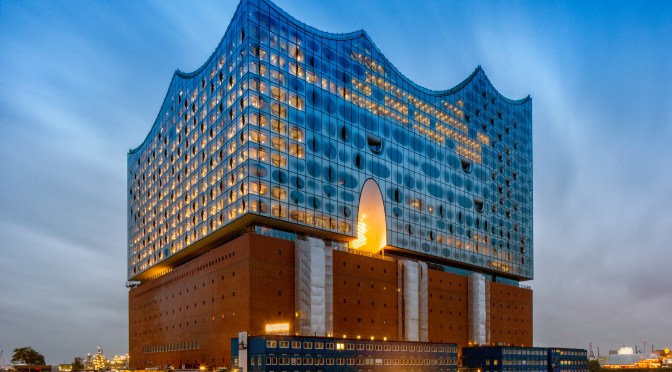
The fantastic Hamburg Elbphilharmonie is a newly minted symphony hall by Herzog and DeMeuron, one of our favorite starchitects. Costing nearly a Billion dollars (nur ein Milliarde auf Deutsch, to make it sound like less in classic German humble pie) and three times the original cost, it better klingt gut! It may seem unconscionable at that price, but…at least I wasn’t the project manager for that one!?! Whew!!

Nevertheless, I’m sure that it will take your breath away if you see it live. Perched high on a six-level parking podium, this building guards the Hamburg harbor.  Looking like a gigantic, dry-docked cruise ship, the interior is equally impressive.  Notice the scale of the building next to adjacent existing low rise buildings along the harbor. This building will change the face and pace of future symphony halls. More and younger crowds will attend to be seen and heard in these exciting venues that must include creative new productions and innovative performers in order to survive.

You can read all about it here: https://en.m.wikipedia.org/wiki/Elbphilharmonie#

Five German Speaking Cities Ranked Top in Quality of Living Survey

A recent survey tracked the most liveable cities in the world. Of eleven top cities, five are German speaking (Munich, Frankfurt and Dusseldorf are in Germany; Zurich is in Switzerland; and Vienna is in Austria). San Francisco was the only American city ranked in the top ten aside from NYC. Berlin was #11.

The cities — 230 in total — were evaluated on 39 factors including political, economic, environmental, personal safety, health, education, transportation and other public service factors. Cities were compared to New York City which was given a base score of 100. Mercer, who conducted the survey, is one of the largest human resources companies in the world based out of New York City.

Here’s the (updated) link: https://www.mercer.com/newsroom/2017-quality-of-living-survey.html

This survey may explain why I devote so much time and effort in learning German and spending a good proportion of my travels in Germany. The clues are based on the key factors cited above. They are the same reasons why I live and breathe in San Francisco. Now you know where I’d be if I hadn’t left my heart here.

Pretty Yende Pretty Amazing

April 30 will be a big day for me, when I see Pretty Yende in Dusseldorf. She has a pretty strange and curious name, but once you see her perform, you will completely understand why she us called that.

Out of (South) Africa, Pretty started learning and doing opera from Age 13. Apparently enough time on the clock to soar to one of the Met Opera’s youngest divas–performing in the Barber of Seville, Romeo and Juliette, and pinch hitting a few years earlier in Comte Ory. She’s gorgeous, powerful, energetic, and a heavenly sensation.

She’s planning to learn Wagner next, so get ready for some more fireworks. Don’t walk but run* to the nearest operahouse where she is performing. She’s slated to sing Lucia de Lamermoor and Elixir of Love next season, and I am already getting in line for tickets at the Met!

Watch the trailer for her new album here:

Incidentally, if you are a new opera lover like me, check out http://www.operabase.org for a database of all performances, opera companies, and performers throughout the world. For instance, if you search for Pretty Yende under Artists, you will see all her past, current,  and future performances. It’s an awesome site that I use regularly for trip and personal event planning.

A friend spotted Rufus Wainwright at the Zuni Cafe at lunchtime yesterday! There’s still time to catch his performance at the Uptown in Napa tonight.

My next post will be the start of Year 4 for Travels with Myself and Others ….so fasten your seat belts…

*Strange visual as some people attending the opera require canes to get around, but that’s changing!

Wishing a happy birthday this month to sister Muriel!

Marina Mirage

PAs I’ve been pumping through the San Francisco Marina twice a week to attend my figure drawing class at Fort Mason, I was suddenly struck by the austere beauty of the Bay before me.  The crystal clear weather, drowsy early morning awakening of humanity and activity, and occasional glances among shore pedestrians compelled me to stop my normal routine. As I got out of the car to take a few pictures, I saw a flock of birds heading westward toward the bridge.

I used the rhythmic pace of faint honks and flaps of wings to follow them, but soon the birds were gone. Then, as I panned the Bay to capture its thirsty lapping, I encountered another flock. One of the landmark islands in the Bay is named after them. The birds gather frequently at this time of year and head south for the winter. Apparently these birds and their flight pattern are common knowledge, and something that all San Franciscans (except me, who’s an East Bayer) know about. Can you detect what kind of birds these are? And the Spanish name of the island named after the birds?

You can check the birds of the bay here:

I think it’s time to follow them.

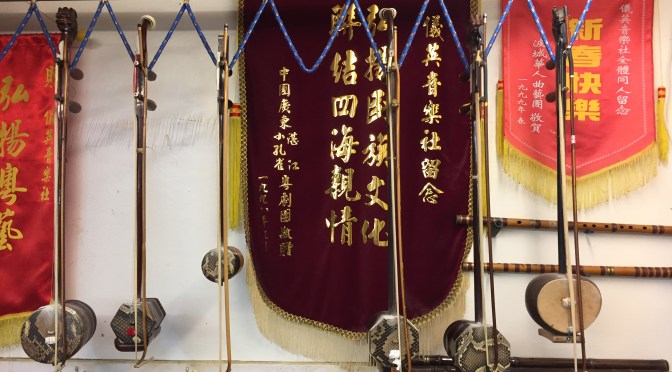
In Chinatown last week, I visited a Chinese Musician’s club rehearsal. The club is located just down the street from Mister Jiu’s on Spofford Alley between Clay and Washington Streets. The er-hu, two stringed instruments shown in the featured image above are hung in the room, just like roasted ducks waiting to be picked. I offered to film the six-piece band for a chance to hear some authentic, percussion-focused Chinese music and singing.

Turkey Day has just finished, and the Christmas holidays are around the corner. Hope all is well with everyone as we close out 2016.

Dream of the Real Opera

After being re-introduced to Chinese opera through Dream of the Red Chamber, I got curious about the Real McCoy. I researched the web and was surprised to find a local production the following weekend. In addition to the full classic opera “Princess Cheung Ping” (带 女 花)on Saturday, there were greatest hits the following day that included an excerpt of Dream of the Red Chamber. As additional incentive, the performances were a fund raiser for the Self-Help for the Elderly, a local non-profit organization providing senior services for the Chinese Community.

Both performances did not disappoint. I had forgotten how stunningly beautiful the costumes were, and I was warming up to the voices and makeup. Many of the gestures and movement are symbolic, such as horse hair wands used to indicate riding in the open; flags perched on the backs of men’s costumes to indicate high ranking military; and swirling troupes of female dancers to indicate time travel. They all reminded me how unique the Chinese opera form and style are.

I’m ready to delve back into my roots and appreciate the treasures of Chinese culture! While not a simple venture, I feel mature enough to tackle this task: 1. A familiarity with and love of Western opera;
2. Fond Memories of going to the Chinese Opera with my mother;
3. The recent production by Bright Sheng and Henry David Hwang for the SF Opera makes me question how authentically and successfully they were able to convert and interpret a Chinese classic for Western eyes and ears.

More and more Western and Asian blends of culture are coming. With the rise of Chinese standard of living, an unquestioning acceptance of Western art forms, and a thirst for new, modern productions by both sides, this is only the tip of the iceberg. I look forward to this spawning of innovative work and talent.

Please enjoy the colorful array of scenes and Chinese opera performers from the two-day marathon below:

On Being a Full Time Student (Again, for no particular reason)

After traveling around the world three times in three years, I finally settled down and organized my schedule to take classes at San Francisco’s local city college (CCSF). It’s a fantastic institution and alternative for students transitioning from high school to the university, working and attending school at the same time, and for those looking to enhance their lives.

I fall into the last category, but as a full time student taking four courses (two film classes, one figure drawing, and my beloved German), I can definitely re-relate to the plight of students. I had forgotten about the big black cloud that descends upon your Life as a Student. After finally shedding it the first time a long time ago, I can’t say this was a pleasant reminder. It felt as if I had lost 50 lbs, only to become a blimp again.

I have more thoughts and comments about being a full time student, but first some visuals and good news: the instructor and my figure drawing class are fantastic–inspiring, supportive and a great group of students. Some visuals of my instructor, a working artist with his own studio, and our first pin up critiques and display of our work:

The bad news is that many of the facilities at the Ocean campus are in dire need of repair. CCSF has approximately 10 sites throughout the city and bonds to fund the improvements are on the ballot. The bond measure is likely to pass, despite the financial fiasco and mismanagement at CCSF that has jeopardized its accreditation. Reviewers were assessing the latest efforts to rectify the problems. And the master plan process is underway. It might help to rectify some egregious and offensive facilities that students should not have to endure.

This past weekend was one of four Open Studios throughout October. Artists’ studios and their work are on display in many San Francisco neighborhoods. It was my first foray into the local artist community. Like Berlin, this city is very encouraging and inviting for the artistic community to thrive and work in the city (despite the high rent!).

Finally, for opera friends here’s another clip from this month:

Curtain call for “The Makropolous Affair”, a SF opera production by Janecek about a woman who lived for 300 years to regret doing that. All her friends were gone and it really wasn’t worth the pain and agony of sustaining life. A good reminder for all of us about our mortality and to make use of it while you can!

img_5783

For those wondering, my 2017 travel plans are underway. You’ll be hearing more about them as they become finalized. Stay tuned…

Opening Night at the Opera and Museum Sickness

Last year when I attended the Salzburger Festival by myself, I wondered how the glitz and glamour compared with our backyard gala. I satisfied my curiosity when we attended the opening night of the 94th season of the San Francisco Opera last night. The glitz and glamour were definitely there, but in limited supply.

Here are a couple of pre-opera performance shots:

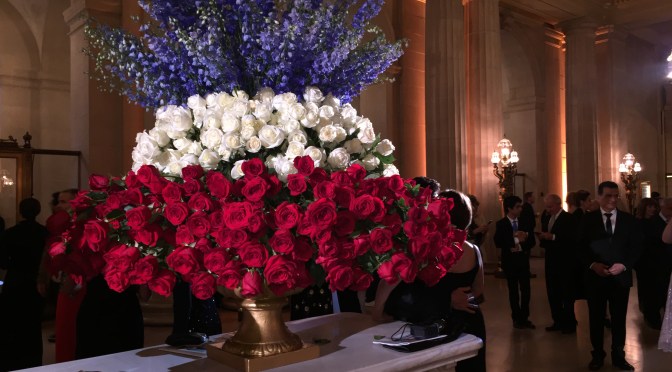
Nevertheless, the SF Opera House is always an exciting and beautiful venue to visit. Thanks to Dede Wilsey, the grand dame of arts in San Francisco, the lobby was decked out in a magnificent red, white and blue flower arrangement and the interior of the opera house was draped to reflect the French theme of “Andrea Chenier”.

While it holds over 3,000 seats, the opera house is on the order of NY Met’s capacity at 3800 seats. The Semperoper in Dresden is half that size, with only 1500 seats and Vienna is similar to Dresden’s with 1700 seats. The SF Opera still feels more intimate and reminiscent of the European opera houses because of its Beaux Arts design than the Met’s spartan Sixties Modern style.

The only difference between Opening Night and other performances, aside from excitement in the air and a bit of a Halloween-like “dress like someone else you always wanted to be” atmosphere, were two distinguishing marks. There were speeches beforehand by the President of the Board and an introduction to the new General Manager of the SF Opera. It felt a bit like going to a Chinese wedding, where you had to sit through two hours of speeches before getting food. Fortunately, it lasted only ten minutes or so.

Before the performance, we sang the Star-Spangled Banner. That was another first for me, at least at an opera performance. I couldn’t help but think about Colin Kapernick and the debate he has aroused from this simple tradition. I snuck a look around the room and behind me to see if anyone had the courage to protest. But no, everyone complied.

You probably can’t tell from the photos, but the photographer has taken painstakingly edited views of the evening. We have our own distinct American style of casualness and innovation that needs to be appreciated. Nevertheless, I’m making plans to return to Salzburg as soon as I can. The schedule of events is announced in March next year.

Andrea Chenier is an opera about the French Revolution sung in Italian. Younghoon Lee was the star of the evening. He replaced Jonas Kaufman as Don Jose in “Carmen” at the NY Met last year. While Lee’s voice is very powerful and technically impressive, I felt that he still lacked the performance quality and passion that I enjoyed in Kaufmann’s performances.

Many of you may be wondering where I have been since returning from our third world trip. I finally got organized and signed up as a full time City College of San Francisco student! It has been a bit of a jolt realizing that there are so many bureaucratic steps to getting recognized as an individual with unique needs. I had forgotten that UC Berkeley had taught me how to be a master of administration, and not necessarily a master of any academic pursuit.

Still, the old battle skills kicked in. I managed to get signed up for figure drawing, Intermediate German, and two cinema classes. It’s probably over the top and overcommitting myself, but that seems to be my style these days.

I decided to try the local city college approach to language training for a variety of reasons. Arriving at a class of over 40 students was a bit disarming, I’d have to admit. After sorting out various levels and stages of German language training, the instructor assured us that she could manage. She adeptly split us into 4 groups. Two for beginners, two for intermediate.

Each group is subdivided into “academic” and “practical” students. She whizzed her way through the system and found another classroom, where she toggles between two groups of students in each room. Like the star of “Bewitched”, she magically flies between rooms giving instructions to each and sprinkles “can do” grammar dust on us in between. It strangely works, at least for the time being. Admittedly, this is an extreme switch from the clockwork 12 students in Germany or the monastic tutorial. More on this method to madness later.

In one of the cinema classes, I am writing a “how to” film script. I decided to do mine on “museum sickness”. A certain close friend is afflicted with this strange phenomenon that strikes unfailingly each time we go to a museum. It miraculously subsides once we are about a mile away and well outside the possibility of ever returning to the premises. Some of you may wonder why I coin “travels with myself…”…and now you have a pretty good idea.

Doing a bit of online research has been fascinating and entertaining. My topic, “how to avoid Museum Sickness” is derived from information I collected from the museums I visited in the past year, such as:

1. The Dresden Hygiene Museum, where they offer portable stools for visitors.
2. The Rijksmuseum in Amsterdam, that displayed a curious chair known as the Stendhal Chair” for museum goers to decompress when being overwhelmed. A variation of a confessional, this chair has a flip door in front of the seat so you can sit down and avoid eye contact with others when you are seated inside! (You may have seen this earlier in January 2016 when Melissa and I were in Amsterdam)

The Stendhal syndrome is a defined condition related to becoming disoriented while in a museum. Apparently Mark Twain experienced this phenomenon when traveling by ocean liner across the Atlantic to Europe, then immediately going to one of the famous museums. He became dizzy and sick from the overstimulation.

Another version of museum sickness is called “synesthesia”, a condition of mixed sensations–where one modality affects another, such as audial effects transferring to visual, or from form to color. I wondered how prevalent this condition was or whether it was purely hypothetical in nature. Obviously, more research will bear this out. In the mean time, I am completing my assignment in script format. Get your fancy dress ready to attend the Oscars!

Since my posts are down to monthlies until I am traveling again, I’ll keep you posted on my educational progress. I hope all of you continue to live and learn, to keep the fire burning in the attic…

Days 74-76: Heady Headers

Photo, above: Mongolian Herder Family, with awards from Dad’s wins in local horse  racing contests. You can see them all in Mongolian Herder Family video at https://youtu.be/QBCz8EjsMoc

As a finale I decided to summarize my trip by sharing the headers below that were used for my postings with you. I remembered (nearly) every location by heart, with a couple of technical exceptions. I am fond of each and every experience! They are now like my children, and hard to give any of them away. I hope you have enjoyed seeing these again, this time with captions.

A note about the number of days on each annual trip: There have been 68, 80, and 72 in 2014, 2015, and 2016, respectively. Anchored on one end for a German Language Course and Asia on the other end for contrast, the stuff in between has been the most interesting and lesser traveled. I was always fixated on the Silk Road, and this time, the Genghis Khan saga across the great Eurasian Continent. The timing was right for me, the weather and climate suitable, and a very achievable itinerary in my (crazy) view of the world. If you have questions or details on accomplishing it, let me know and I’d be happy to give you more information.

A big hug and thanks to each of my travel partners and visitors: Gee Kin, above all; Tom, Helena, Patrizia, Hanne, Jens, Vladimir, Iyoko, Paul, Kanji; and new Goethe friends Mukda, Anu, Jess, Ilaria; and Mongolian guides Aggie and Nassa. I now have collected many friends from all over the world to join me in my future travels. And of course, to you, the readers.

There’s a very short, 3-second survey at the end of this post that I would really appreciate your taking the time to respond to for my benefit and future trips. Thanks again to all for following my blog and keeping me focused on getting both of us new and exciting experiences, both in the raw and virtually!! Love to all.

cropped-image107.jpeg
View of Tennozu Isle, Tokyo, Japan
cropped-image941.jpeg
View of Mt. Magome, Japan
cropped-image85.jpeg
Nakasendo Highway, Japan
cropped-image60.jpeg
Rear End of S7 flight-Valdivostok to Tokyo
cropped-img_4625.jpg
Vladivostok, Russia
cropped-img_4560.jpg
Vladivostok Harbor, Russia
cropped-img_4336.jpg
In transit on Trans-Siberian Irkutsk to Vladivostok, Russia
cropped-img_4244.jpg
Village along Lake Baikal, Russia
cropped-img_40231.jpg
Khorkorin, Mongolia
IMG_3923
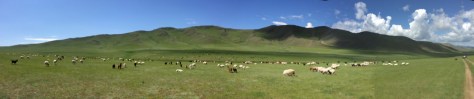
Free Range Sheep and Goats, Orkhon Valley, Mongolia
cropped-fullsizerender-73.jpg
Gorge of Orkhon River, Mongolia
cropped-image131.jpeg
Forbidden City, Beijing, China
cropped-img_3193.jpg
Bauhaus, Dessau, Germany
cropped-img_3104.jpg
View from Kunst Akademie, Berlin, Germany
cropped-img_2845.jpg
Spree River, Berlin, Germany
cropped-img_27201.jpg
Tiergarten, Berlin, Germany
cropped-img_2561-5.jpg
Museum of Terrorism, Berlin, Germany
cropped-img_2441.jpg
Egyptian Panel, Neue Gallerie, Berlin, Germany
cropped-img_2412.jpg
Street Art, Berlin, Germany
cropped-img_2329.jpg
Bernauer Strasse, Berlin Wall Park, Germany
cropped-image17.jpeg
Weimar, Germany
cropped-panorama.jpg
Jazz Orchestra, Dresden Musikfestspiele, Germany
image
Dresden, Germany
cropped-img_1357.jpg
San Francisco City Hall, California, USA

Survey


Days 40-41: Keeping Clean at the Hygiene Museum

After all the racy operas and design porn I’ve been posting, I’m not sure how to outdo myself and keep things clean. A trip to the Hygiene Museum in Dresden today, however, sent my senses to the cleaners. It seems that ditching the art world for science isn’t such a bad venture, at least for an afternoon.

I was enraptured with a series of well-presented exhibitions that included sex (well, sort of), the brain (neuroscience and scanning techniques), health, DNA, and lots of peripherals about the history of science education in the DDR and Germany. The Hygiene Museum was famous for the “first transparent man”, where you could see all the innerds reproduced through clear plastic. All of the above were a fascinating foray out of the world of art and architecture and into the other end of the spectrum.

While I consider myself decently informed on technology but low on science, this experiment in seeing how the other half of the world lives (into science and out of art) was pretty promising. I can truthfully thank the Dresden Hygiene Museum for this exposure. I have to confess that neither the Exploratorium nor the Lawrence Hall of Science in the Bay Area did it for me. My kids loved both, but my ADD never allowed me to concentrate on anything. I think that this visit has changed my perspective on science museums.

Other than a few NOVA episodes or a Long Form broadcast on how a tongue disease kept someone from from being able to speak (my daughter forced me to listen to the episode during our drive from Berlin to Amsterdam in January), I confess that I zone out on scientific explanations of the world.

Two seminal experiences on this trip have changed my attitude, thankfully. One was the Naturkundes Museum in Berlin (the Natural History Museum), where I finally learned how the earth’s crust functions, and today’s post, the Hygiene Museum. Maybe it’s the aura of being in Germany that has worked wonders on my appreciation of science. Whatever it is, it’s working!

The Hygiene Museum has a somewhat checkered history. I gathered that from the first introduction poster that tactfully explained how all subject matter was voluntary or approved to the extent possible.  No knowing pain or agony was inflicted on the part of subjects used in research experiments. I took this as a moment of truth and trusted the claim, at least for now.

That having been said, the history of the museum itself featured prominently in displays. The museum either presented research from or collaborated with other institutions (like the Max Planck Institute or Deutsches History Museum in Berlin) to develop displays. I found these very curious as the information was apt to talk about its past, frank, and very unique from the way Americans would present information.

Here are a few examples:

Photos Above, top to bottom, left to right:
1. Display on Food and input from visitors on what they think should be done to improve healthy eating habits
2. Effect of MacDonalds on humanity and the iconic image of Ronald MacDonald
3. Overall Display
4. World Map of Life Expectancies in Selected Countries: Germany, US, Canada are high, but not the highest. Can you guess the country with the highest life expectancy? The lowest? Some of the statistics are surprising.
5. An explanation of PET technology: you can slide the red bar horizontally in each image to see the slices in the brain scans (if you’re like me, you always wanted to manipulate these images but never could do it unless you found a museum like this one).

Displays below are about childbirth and delivery:

1. top left: birthing chair, that was popular in the 19th century. It was portable and used by midwives who carried the chair to their patients, who delivered at home; or families owned a chair that was handed down within generations in the family. It was not until the latter half of the 20th C. that the prone position in hospitals became a more accepted way of delivery. The stool was used by the woman delivering as a counterbalance. Now, the chair is coming back, using gravity as the assistant to natural delivery. (ed. note: why didn’t I know this??)

2. video of a baby going through the birth canal (ed note: why didn’t I see this before??)

3. The different stages of a baby going through the birth canal as the cervix dilates (ed. note: why didn’t I know or see this before??? Do you know how many women have gone through this without a visual image of what happens??)

The displays below will not format into a gallery for some reason. Perhaps it’s just as well. See explanations below or in captions.

IMG_3311IMG_3327IMG_3304IMG_3303IMG_3321IMG_3318

1. This first cartoon character that everyone knew in the DDR was used to keep all kids clean and healthy. The character made sure that all kids did not run around with snotty noses and carried out unclean or unhealthy practices. By time kids got reprimanded by this character, they got the picture pretty fast. It was a form of social control and clean living habits. The character was abandoned after reunification.

2. The windflower was used to help children who were dying of a terminal illness and their families. It was a form of hospice used at the Charity Hospital in Berlin. It helped children and their families understand the nature of dying and death, and to accept the inevitable. I thought this was a very thoughtful way of raising the issue and showing how hospice programs help. The four pictures are by a 10-year old boy who drew pictures about his younger sister dying from a disease.

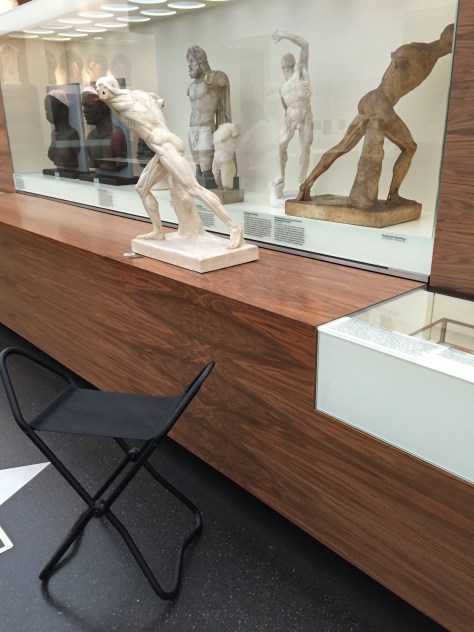
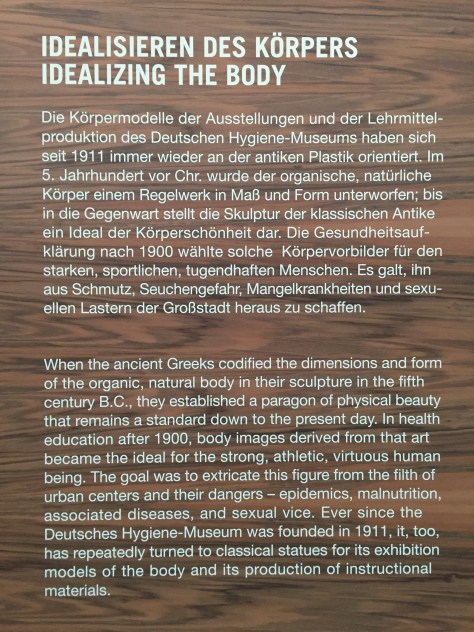
3. and 4: these two pictures show how the human body was idolized and idealized since classical times and the text that went with the display.

PS. The photo with the sculptural casts of the human body also show a chair. These stadium chairs were available in large supply for anyone going through the museum who wanted to listen to audio guides and needed to sit while doing so. What a great idea!! I loved it and took advantage of this free service. (ed. note: why don’t they have this in other museums all over the world??)

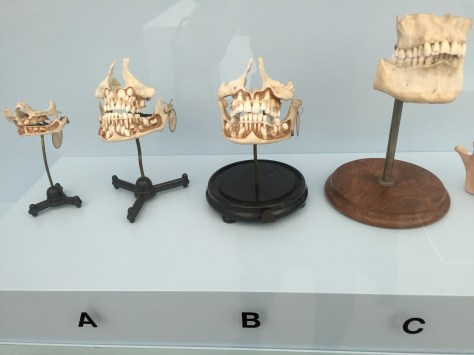
5. A display showing the development of teeth in human development, from childhood to old age. Children’s teeth are already poised for discharge, to be filled in by permanent teeth already formed or forming above their baby teeth (ed. note: Why didn’t I know or see this before??)

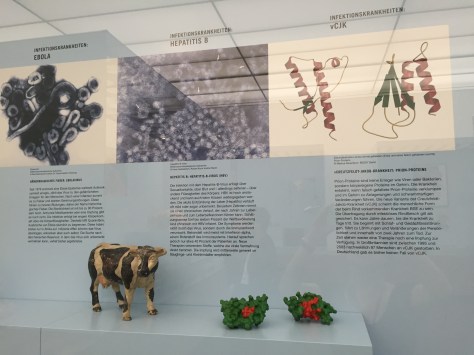
6. A typical poster display explaining the different common diseases, such as malaria, tuberculosis, and hepatitus (ed note: why didn’t I know this or see this before??)

There were many other interesting displays that I haven’t included, such as a transparent model of the human body, how the reproductive system works, and a really good explanation of death and dying. There were also excellent displays about health and healthy eating. These were too numerous to cover, but the bottom line is…get to a place where you can see these types of displays to educate yourself, and if you are lucky enough, come here to the Hygiene Museum in Dresden.

Not all displays are translated in English, but there are enough cues to inspire a neophyte like me and to make it a fascinating and inspirational experience. You can read more about this delightful museum here: http://www.dhmd.de/index.php?id=204

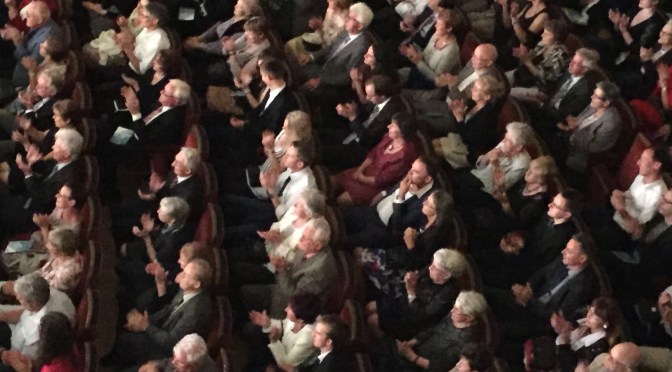
A final gasp in my Dresden pit stop before leaving Europe was a lovely opera at the Semperoper, “Liebestrank”. Little did I know that this translation was for the delightful Donizetti comedy, “Elixir of Love”! It was a stellar production, and in typical German fashion, the audience clapped politely. The performers deserved a lot more than they got (not even the raucous foot stomping). Maybe the nudity was missing, but the audience did stay awake (see the featured photo at the top for proof: they clapped).

Alas, to all: I am leaving Germany and all the wonderful experiences I have had in the past month behind. My next venture will be a big change from 24 degree warm weather with frisches Luft and no sunscreen in Dresden to 30 degree heat, humidity, and pollution in Beijing. I have no idea about the connectivity…so don’t be surprised if I go AWOL for awhile. Some of you may remember this from past trips through China. Until then…hang tight, and read my lips….