Tag Archives: Commentary

Hallo Halloween

It’s been over two weeks since I have returned. I am finally re-acclimated to being at home and am enjoying my daily walks around the neighborhood. They help me keep the glow of my travels alive as long as possible. On one of my 3-mile hikes through the Upper Haight-Ashbury in the City, there were plenty of gobble-de-gooks and other surprises to amuse me and remind me why walking is a better way to travel and see the world.

I began to ponder the color orange. In a recent ice-breaker exercise, participants were asked to state their favorite color. Obvious “safe” answers such as “green”, “blue” or “pink” were mentioned, but few people would say their favorite color is orange! It seems to be an odd color, not quite fitting in with anything or eliciting a pleasant response.

IMG_0370From this Matisse painting posted this morning from the Barnes Foundation in Philadelphia (see my post from Day 69-70), Matisse once said “The chief function of color should be to serve expression”. The BF suggested that autumn colors should inspire how we express ourselves.

DSCF2671 I am posting a delicious photo from a Schwäbisch Hall friend, who visited Cumbria in the Lake District. It’s a good reflection of what Karen and I may have missed in Vermont this year.

Other than being associated locally with the San Francisco Giants’ Baseball team and the shocking “Clockwork Orange” movie by Stanley Kubrick, the color orange either reminds people of Fall Foliage, Halloween, or Thanksgiving. Beyond that…well, not much.

For those who are not as familiar with Halloween in the US, it is a fun and scary night with goblins, ghosts, and creepy-crawlies for kids. Children (and some adults who never grew up) dress in costumes and ply through their local neighborhood to demand from each neighbor a “Trick or Treat”…meaning you should give each child in a costume a “treat” or they will “trick” you. Most kids don’t really have a plan to take revenge on their neighbors, though. And I’m not sure whether hosts can opt to “trick” those at their doorsteps.

If you don’t answer or are not at home, you can get eggs thrown at your house, toilet paper strewn throughout the bushes, or a pumpkin smashed on the street. Older kids who did those things were intent on doing it anyway. Kids are now closely supervised by their parents on these outings. As a kid, I only remember going alone and getting sweaty from running in my home-made costume. I raced through my Crocker Highlands neighborhood in Oakland door-to-door to grab as much candy from neighbors as possible in two hours. I could easily gather one or two grocery bags full of goodies and stash enough to rot my teeth for the rest of the year.

Unfortunately, it is no longer a simple matter. Much later, our kids’ orthodontist was a real wet blanket. He collected the candy from kids who brought them in after every Halloween and bribed them with some pathetically unmemorable incentive. Crime has risen and deterred children from being able to go into their neighborhoods safely alone. It seems that kids nowadays are joining families or school groups to have private parties as an alternative to the neighborhood haunt.

But from my walk and looking for things orange, I discovered a small piece de resistance and renewal of faith for Halloween. The Upper Haight has been known to be a classic neighborhood where kids from both inside and outside the ‘hood are also welcome to visit. Even in our middle class neighborhood there are manifestations of defiance and celebrations of the spooky holiday. Maybe it takes a small community with money, iron determination to counteract current fears, or both. I could be a Scrooge and complain about how much money is being wasted and spent for no good cause. In any event, I was happy to see these expressions of home-made fun, whimsy, and creativity. I hope you enjoy them too.

Note: I will be posting an index of my 80 days around the world for those who missed specific cities. Stay tuned.

I noticed that the photos I normally take of favorite pieces from the Barnes Foundation were absent. The museum did not allow photos to be taken of artwork.

For those who continue to be interested in my wanderings, I will be making occasional posts over the next few weeks. You can always opt out if you aren’t.

Day 76: Chicago to Santa Fe, NM and the Amtrak vs. TME Report


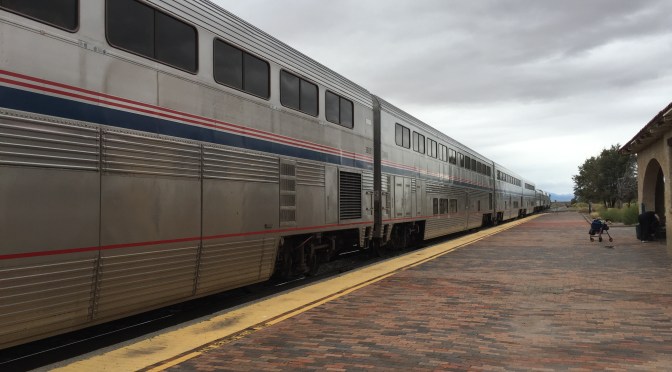
After setting off from Chicago late in the afternoon, we enjoyed an idylllic train ride plying the Midwest from Illinois through Missouri, Kansas, Colorado, and New Mexico. We passed the Mighty Mississippi and wheat fields to enjoy a peaceful sunset.

On arrival, we had a look around the city and enjoyed a sunset the following evening from our hotel roof deck. See view above.

Preliminary Evaluation of the Amtrak vs. Trans-Siberian Express (TSE)

As for the evaluation between Amtrak and the Trans-Siberian Express (TSE) a la Trans-Mongolian Express portion (TME), here’s my interim report below.

If you recall, on Day 71 I established a self-inflicted competition between the American Amtrak system and the Trans-Siberian Express (TSE). You may be confused when I refer to the Trans-Mongolian Express (TME). The TME is a significant portion of the TSE, and differs only in the start point. the TSE begins in Vladivostok on the eastern coast of Russia. The TME begins in Beijing and traverses through Mongolia to Moscow, where both the TSE and TME meet. See map below.

Transsiberianmap

If you are not particularly interested in either, skip this post as it will be a bit long-winded, self-admittedly, and only for those die-hard train afficinados.

Here are comments based on the original criteria I established:

1. On Time Record

So far, the two long haul trips we have taken on Amtrak (Philadelphia to Chicago, Chicago to Santa Fe (Lamy), NM) have been on time or early, and the shorter legs through New England have been on time or slightly delayed. Trains on the TME were either on time or early, but we were not able to verify the arrivals or departures due to fuzzy time zone changes (!!)

2. Comfort (Bed strength, ability to rock a baby to sleep and keep them there; access to lights, camera, action; no annoying overhead PA system used at free will for the comfort of the system and not the passenger; and good padding and ergonomics for blogging)

Beds on Amtrak are comfortable, non-formed foam pads over two seats pushed together in the roomettes, with an overhead bunk that does not allow you to sit up straight. One passenger complained about the pillows and beds being too flat, but seating ergonomics and padding seem fine in both systems. Beds on Amtrak are in the direction of travel, whereas the TME beds were perpendicular to the direction of travel. Not sure either makes much difference in terms of rockability, but the Amtrak trains definitely sway more at the top due to the double-height cars. Most of the sleepers were on the upper level so more passengers would experience the sway, so I’d give Amtrak a negative point for this.

There are more stops at night on Amtrak due to the higher population along the route, so it may appear to be slightly more disruptive at night. However, the train starts and stops are smoother on Amtrak compared with the Chinese bump-and-grind at each stop. The Chinese trains did not appear to have any or much cushioning between cars so they slammed into each other when the trains departed or arrived at each station.

Lighting and controls were sufficient on both systems so no particular comments. In contrast, the use of the PA system was notable on Amtrak. The dining car made repeated comments about availability, MIA’s, and hours of operation; there were none on the Chinese cars (perhaps because there were so few or no passengers! or the multiple languages spoken by passenger on the train would render the effort fruitless). We did take a Chinese train on a different trip last year that piped overly loud and annoying announcements and music on their PA system. At one point, the speakers were disconnected (i.e. ripped out) to our car by a passenger and it seemed to take care of the problem.

3. Service (attentive staff, no back talk or attitude–i.e. Courteous; visible but not obtrusive; professional but not hollow friendly delivery of information)

As you know, we found the service on the Chinese trains to be very good, but that’s because we spoke Chinese. I am not sure foreigners would find the staff as friendly. Surprisingly, the Amtrak staff have been generally friendly and attentive. They must have improved their customer service training since we took the trains a generation ago. There are still vestiges of the long-timer staff person here and there who crack canned jokes every now and then, or a raspy voice yelling out instructions by someone who cumulatively earned the distinctive voice quality. Overall, both appear to be genuine in intent and concern.

4. Cleanliness (no spit on counters; toilet paper unfailingly in supply; Windows you can see through; stainless upholstery and carpets)

Well, can’t say I went looking, so I didn’t find any gross evidence in either system. In general, the toilets in the Chinese trains were not well attended, but in defense of the system, we were only 2 of 3 passengers in our car. There were four toilets available in one Amtrak sleeper car for some 24 rooms; only one toilet and one washroom per car on the Chinese train. You can do the math.

Toilet supplies were plentiful on Amtrak, nada on the Chinese trains. Bring your own.

Windows were a little soiled on Amtrak. Hard to see through some windows on Chinese cars.

Upholstery on Chinese cars were old but clean; no carpeting in rooms.
I noticed a few stains on the blankets of the Amtrak, and maybe on the carpeting. The concierge announced that shoes are required on all Amtrak trains.

5. Food (real food; reasonable prices; no cheap shots using lots of salt and sugar; no bar codes on wrapping; cold beer; wine list; nuking; no plastic, polystyrene, or jewel boxes)

Food to date on Amtrak was decent, and better than I remembered. When you book a sleeper you get free meals. Dinner options included salmon fillet, steak, chicken, or pasta. The only disappointing aspect were the frozen vegetables.


Hard to compare the food from the Russian dining car. The food appeared to be freshly cut and prepared, and although small portions, the food was fresh, tasty and healthy. Gee Kin’s vote for the staff’s home-cooked pasta and meat buns unfortunately do not qualify for this evaluation of customer-consumed food. Interestingly, I asked Sean, our Amtrak attendant, what he did for food. He immediately remarked that the food on the train was unhealthy for service staff. Assuming that they ate it frequently, the food would take a toll on your weight and BMI. The food is included in their benefits, but he mentioned that he beats it over to Whole Foods whenever he gets in to Seattle. Staff stock up on their own food but are not allowed to bring anything requiring refrigeration. That poses some limitations, but he said they work around it (wink, wink). Occasionally the house chefs make family meals for the staff and they really appreciate it.

I am copying and pasting the earlier post comments for convenience and adding any additional notes or changes.

Pros of the Trans Mongolian Express:
1. Decent food in the Russian dining car at reasonable price
2. Service in the sleeping car was very good and attentive by the two attendants assigned to our car (even though we and one other woman were the only passengers in the car after Ulan Bator!)
3. The compartment was tidy and toilet at the end of the car was adequate.


Cons for the Trans Mongolian Express (TME)
1. The tracks are not universal in Mongolia thereby requiring wheels to be changed on every car going between China and Russia through Mongolia
2. The trains do not have Internet access
3. The schedule and arrival times at any station were a mystery due to fluctuating time zones

Pros for Amtrak trains
1. The trains are very comfortable
2. The trains have Internet access (10/7 correction: none on the long hauls!!)
3. The information for time, stops and scenic opportunities is helpful (10/7 update: excellent handouts available at every seat)


Cons for Amtrak
1. Service staff are surly (10/7 update: I would delete this comment that was based on historical experience)
2. Stations are antiquated (10.7 update: true, but they have installed First and Business Class lounges with internet access that overnight passengers can use)
3. Seating is not reserved (10/7 update: all seats are reserved on the long-hauls)

This report includes two long hauls:
1. Washington DC to Chicago on the Capitol Ltd.;
2. Chicago to Santa Fe, New Mexico on the Southwest Chief;

The last report will include the third and final leg:
Santa Fe to Los Angeles (continuation of the Southwest Chief), then the Coast Starlight train from LA to San Francisco.

Day 59: Ich Erinnere Mich…

In addition to afternoon walks to various museums and sights sponsored by the Goethe Institute, I put in my daily walk to and from the guest house to the Institute. I became very fond of my own personal “Schwabisch Weg” in either direction, as this tiny trek was only for a two-week duration but seemed different and fairy-talish every time I took it.

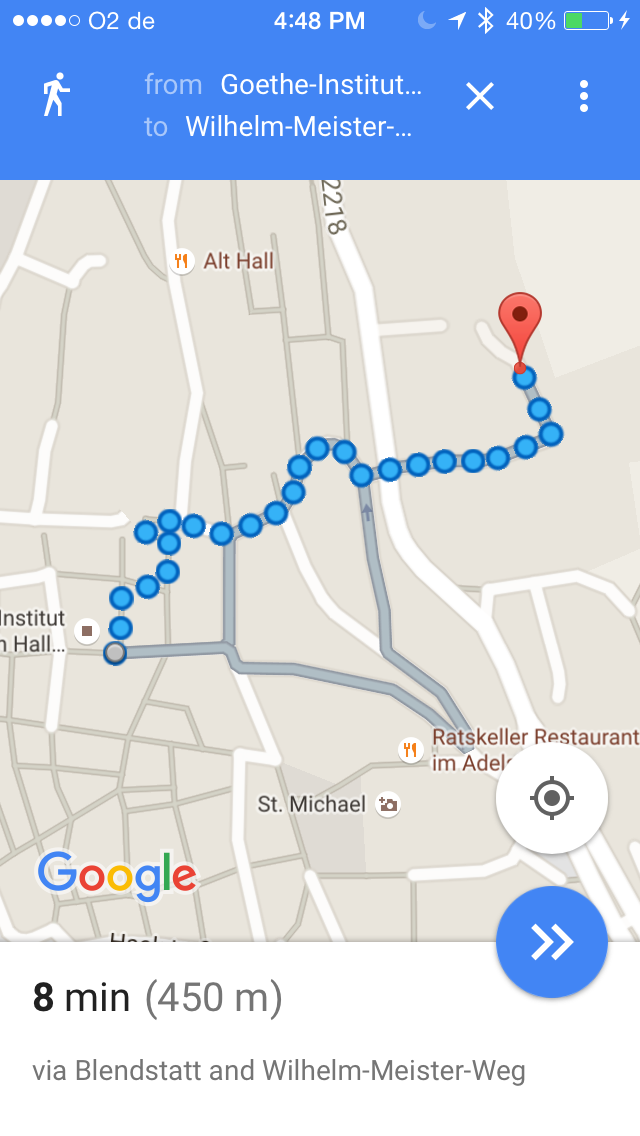
From the map attached, you can see that there are multiple ways to accomplish getting there. Initially, I got lost more than once, in my inimitable way of trying to find shortcuts. They usually led to dead-ends (any life lessons here?) but somehow I managed to dig my way out of innocuous tribulations for the benefit of a hearty trial.

IMG_9273

While only 8 minutes each direction according to Google Maps, it actually takes longer.

As you exit the building and the guest house, you must go in the opposite direction (ie, north or up in the map) from the destination, along a very narrow and heavily traveled route, to cross the road. The traffic is erratic and unpredictable, thus the need for a subterranean crossing. Some liked dashing across the road, but I decided that a little more exercise wasn’t going to hurt and others wiser than me thought it was safer. It occurred to me that I could make someone pretty miserable if they hit me by mistake, but whoever thinks of that?? I must be getting senile, or more considerate in my old age!

The Grundschule am Langen Graben, a grade school, adjacent to our living quarters, is paired with what looks like a private upper school for the older students. I first noticed it with the traffic signs decorated by school children reminding everyone of its precious cargo (as we used to refer to kids being transported in the U.S.) The signs were made by students, and the adorable naive drawings, life-size, were good reminders to adults and drivers to mind the crossing for children.

After navigating past the very official automatic barricade and the stainless steel man-gate, you can make your way past the private vehicular entrance to the public tunnel under the road. It’s a bit dark and uninviting, but it’s perfectly safe day or night. The cold concrete and functional features don’t ask anyone to dally, except for more student artwork of life-size kids lined up in a row to remind you of the little people in the area.

Once past this threshold is another set of steps. It threads through the Landrat Building, a pretty innocuous modern government admin building for Migrants. I imagined that one day soon that building would be overwhelmed, but as of yet had not seen any impact of the refugees coming in. I could only identify the access with an auto insurance company logo. That reminded me of one of our class lessons in “Versicherheit”, or insurance, that is so essential for survival in Germany.

Immediately after, you link into a quick swoop down a cobbled, winding street clad with modern housing over small scale retail. The shops offer natural wool-made products, a shoe maker, photography studio, and candy. A furniture store connected to the building with the auto insurance broker displays Scandinavian style Futon lounges and L-shaped sectional seating for $450.00. You wonder if they are still selling the original goods from the 60’s or whether they are a retro-snap–for that price it’s a bargain.

Steps are necessitated by a gradual downward grade toward the river. Remember the entry steps outside St. Michael’s Cathedral, facing the river. It’s a good stage for theater, dance, and musical events.

We carry on to the Big Steps. Modernized to fit a little town on the move, this wide, stone-surfaced series of three or more flights straight down the hill make you hesitate and think twice before tackling it. It is laden with broken glass from the previous weekend’s teenage brawl. Maybe better dealing with the clean-up than the guns or mindless violence we see in the States, I say to myself.

You can opt for the glitzy glass elevator if you don’t have the stamina to tackle the straight shot down the stairs. A bit hard to find, the vertical tower gleams in open space by itself. The only problem is how to get to it. Once you figure it out, the path to it has another challenge. The open steel grating to let water through is a bit unsettling. Don’t look down, or you might get vertigo. Innate trust in engineering calls on you. You have a momentary dilemma–should I go back and take the tumbling steps, or tiptoe over the grating to avoid any vibration and looking down?

Once down toward the river and near the Institute, you have one of three ways to the classroom. You can go either to the right up the alley then around the courtyard in the middle of a U-shaped building, or to the left up the alley and up a flight of stairs outside. The middle route, where I normally went under the arch into the complex, by-passed an immigrant beggar every day. I avoided this path as it made me feel guilty that I hadn’t supported this person in need.

The Goethe Institute was located in a renovated building that formerly was a hospital. In the middle of the hospital was a chapel. It was apparent that the chapel was an integral part of the hospital operations. When the hospital was no longer needed or moved, the chapel was repurposed into a gathering and meeting space for the Institute. The outdoor courtyard, or hof, surrounding the building, provided a social activity space. A few inexpensive tables and chairs were enough to become an inviting and lively atmosphere for students.

While the trips back and forth to the Institute were rushed many days, it was short and sweet enough to help me appreciate the history and quality of the environment. It’s a memory that I hope I have captured and can preserve for a long time.

Day 55-57: Schwishin’ Schwäbisch

After the end of the Language and Cultural Program, it is difficult to come off a “high” from having made several new friends in a short time span. While others were packing their bags and moving home or elsewhere today, I decided to stay behind another day to savor a town I have called “home” for the past two weeks.

A morning walk refreshed my first senses of this sweet little town. A river runs through it, where people can still fish from it. Walks are everywhere that meander along the river and trace the town’s history. A community that cares about its environment and each other. And specialty local produce and products are made with purpose and don’t cost an arm and a leg.

Here are a few recordings of my walk this morning:

The Saturday Market was just getting ready for a big weekend celebration.

IMG_9259
Our class mascot, “Goethle” with specialty products Bratwurst, Bio-Blutwurst, and Schaschlik Guwürzsalz.

Our last two days were a little sad as friends got together for dinner and said our good-byes. While we didn’t exactly master the German language, we made some good friends, shared and learned alot from each other, and thoroughly enjoyed a successful two-week stay in Schwabisch Hall.

Time Out: Thoughts on Austria’s Minority and Immigrant Population

Traveling on the road allows you to stay in touch or out of touch with the news. It wasn’t until my daughter informed me that there was a refugee crisis of monumental proportions happening right under my nose that I started checking the NY Times. While it has been in the German news on a daily basis, the effects of refugees haven’t been felt in the cities where I have been traveling…yet.

Ironically, I wrote the following piece below (on Day 31) when I first arrived in Vienna over two weeks ago. It got shelved because I thought there would be little interest in this topic. I decided to publish it now so I can share my thoughts about immigration in this part of the world with you. Please bear in mind that it was written prior to the events that have taken place and with little research.

It suddenly struck me when one of the students commented about his train from Vienna to Schwäbisch Hall being stopped for three hours at the border last week. He was allowed to continue travel but refugees were returned to the border of Hungary from where he had traveled. By then, I had already left Austria the week before and was in Switzerland when I first heard about the truck of refugees that were discovered.

Day 31: Thoughts on Austria’s Minority and Immigrant Population

Austrians speaking German. Turkish speaking German. Africans and Asians speaking German? I am finding a fascinating array of backgrounds and experiences among the resident population here and in Germany.

One of my first conversations with an immigrant living in Europe was back in China. Gee kin and I were on a train going from Shanghai to Huang Shan, a beautiful mountain with misty Chinese landscapes like the ones you see in paintings (except they really look like that).

We met a young college student who was going to Germany to learn German. It struck us as very odd. Coming here today clarifies for me this person’s intent from twenty years ago. The Chinese diaspora (which, let’s face it, must be by numbers relative to the population in China the biggest in the world) is an endless tale of the supply and demand chain. Chinese provide excellent skilled and unskilled labor to each country, and the Chinese immigrants can raise their children in relative peace and prosperity.

Once you arrive in Vienna, the capital of Austria, you can’t but notice the large minority population resident in this country. How did they come here? What is it like to live here as an immigrant? Do they see a future here?

The evidence of this is not by the tourists swarming these European cities, but by the stroller population. There are young African mothers, Middle Eastern mothers, Chinese and Asian mothers, with kids. They get on and off the underground and the buses that I am taking. They aren’t tourists; from their conversations they live here.

I am attaching a site that helps to put perspective on my questions: http://www.migrationpolicy.org/article/austria-country-immigration. I had also overlooked the Eastern European immigrants and their conflicts. Granted, this article is dated and didn’t seem to address the influx of Middle Eastern population that came subsequently, but it gives an overview of immigration in Austria at the time it was written.

I had a funny experience going to the Mozart concert the other night at the opera house. I purchased a ticket to an all-Mozart “variety show” so I could see a performance and the Vienna opera house. The musicians and attendants were all dressed up in Mozart-era costumes. Some employees touting tickets to tourists were Middle Easterners wearing white powdered wigs. It seemed silly, until you realized it was a job.

Austria has always had a fixation on wealth and the privileged class, just as the US has become (thanks to Austria’s namesake Arnold Schwarzneggar and others like him). And because of immigration in the past 50 years, Austria is now facing similar integration and assimilation issues that plagued the US since the Sixties.

In the mid-70’s, I came to Vienna on a tour with my mother and sister. Two young Indian sisters on the tour asked me to accompany them to visit their relatives in a refugee camp outside Vienna. Because I purportedly spoke German, they asked me to join them. While I wasn’t of much assistance, it was an eye opener for me. The camp consisted of people packed in tents and blanket plots, as densely placed as those at San Francisco’s Opera in the Park.

As Ugandan natives, their relatives were being purged from their own country during one of Idi Amin’s brutal campaigns. Although they were S. Asian by descent, they had never lived or been to India. Fifty years later, refugees like these are no longer refugees. Very few were ever repatriated to countries they claimed, such as the UK, US or other developed country. Although once “temporary” refugees, they are now second and third generation residents of Austria. They are no different from my history in America. Yet I wonder whether these new Austrians have the same benefits and respect in their country that I receive in the U.S.

For Middle Eastern immigrants, the recent influence is evident in Austrian hotels. Visitors who come here to visit relatives watch Aljizeera and a number other Middle East stations, which are represented on Cable TV. Their presence is noticeable in the hotel lobbies, where they visit with relatives. You realize how many more people are traveling back and forth between these parts of the world and Europe than in the US.

While these are all random impressions, they form a pattern. It raises questions about whether these once immigrants and now residents are integrated into society and being treated fairly. The US is no shining example, but perhaps it has had the advantage of dealing with immigration over a long time and many nationalities. Maybe there were a few good men to contribute to this cause.

As a small country of 8 million people, Austria’s proximity to the Middle East and Africa makes it a destination for immigrants. Germany, with 80 million residents, is in a similar situation. After I struck a conversation with a bus driver going to the monastery today in Linz where I was staying, I asked him whether he needed to speak English to many tourists. He remarked, “No. Turkish.” When I pursued why that answer, he said, “just a joke.”

Austria will have to tackle this problem now, as it unfolds.

Day 44-46: Schwäbisch Hall

My 2015 80 Days Around the World are already over half-way completed. As I look back at the titles and featured photos of this blog, I can’t help but be amazed at all the incredible sights and sounds of each unique environment. It does restore my faith in humanity when I think about all the efforts and decisions that have taken place to advance mankind in the world. And it goes without saying that meeting friends and making new ones are the highlight of any city.

So why I am traveling so much and so far? For a few newcomers, I thought I should take a minute to explain the purpose of my travels. It’s the same rationale behind the trip I took around the world this time last year, only in the opposite direction.

The fundamental reason for my traveling each year is to get to and from Germany to study German. I studied German in high school, and like an instrument that hadn’t been touched for a long time, I decided to dust off the creaky machine and make use of it. Having taken a couple of non-contiguous courses in San Francisco at the Goethe Institute got me jump-started. And a growing new interest in German writers, opera, and music motivates me to read Thomas Mann, librettos for the Zauberflote by Mozart and books about musicians like Schumann and Beethoven.

The means of getting to and from Germany form my itinerary. Last year, I went to Dresden for a month. This time, I am spending two weeks in Schwäbisch Hall in a language and cultural program.

This year, I traveled on the Tran-Mongolian Express from Beijing to Moscow with my husband, Gee Kin, visited Russia (also with Gee Kin), and tapped into German-speaking countries for a couple of weeks on my own. At the end of my course, I’ll fly to New York, spend some time in New England with my college friend Karen, then take the train cross-country back home with her. We’ll stop in a few cities across the US along the way.

Last year, I rolled in my curiosity about the old Silk Road and Central Asian cities with carpets named after them, like Samarkand, Bokhara, and Kiva. I traveled in a one-way direction eastwards instead of a round-trip to and from Germany. You can read more about these in the summaries for 2014 and 2015.

Of course, having the pure and intrepid lust for travel doesn’t hurt. It makes travel planning fun and challenging. Along with a fully supportive and understanding husband and family, I am free to go as far as I can, wherever I want. I try really hard to keep things affordable, interesting, but varied to match my interests.

So, back to what I have been doing for the past few days.

On arrival at Schwãbisch Hall, I was happy to finally unload EVERYTHING from my bags for two weeks. Despite traveling light, I still accumulated more brochures, historical materials, and a few CD’s than I had planned on collecting. I’ll have to make some hard decisions at the end of this stay as to whether I will continue to tow these in my bags. I slogged my carry-on, nearing the 14.6 kilo limit for the German Wings flight we took from Moscow to Berlin, and my backpack off three trains and a remote bus link to the Goethe Institute guest house where I am staying.

As it was overcast, threatening to rain and nearing the end of the day, I beat it over to the main guest house to retrieve my keys and card. It was exhilarating to get in the door after nearly two hours of juggling all my paraphernalia. The room was perfectly adequate, with a half-size refrigerator, plenty of storage, and a private bath. There were other students milling around, but everyone seemed pretty mellow and ready to start class.

The first day of class is always exciting. Direktor Herr Schmidt of the GI gave us an introduction about the city, its history and economic activities. We were split into classes after a written exam to determine our level and ability. I was not disappointed to be placed in the middle of the pack, along with 11 other students.

Our teacher has been teaching at the GI for ten years. After introductions and playing some getting-to-know-you games, we all felt comfortable. The nationalities in my class included students from the UK, US, Denmark, and Japan. Each person had an interesting background, but we also had similar interests in art, music, and history.

The GI is located in a former hospital that has been renovated completely. A “kirche”, or church, was part of the original building and where we were greeted in the beautiful, large meeting hall. Other modern facilities included a media library, cafeteria, and classrooms.

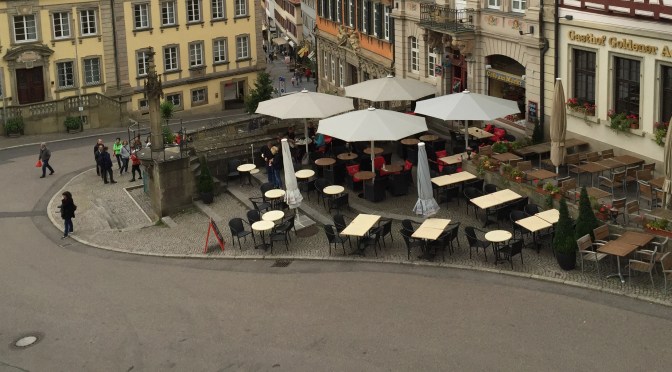
Schwabisch Hall is situated in South Central Germany between Frankfurt and Munich, near Stuttgart. It is a lovely, small city of about 40,000 people and a welcoming environment for its visitors. The Goethe Institute serves as an anchor for the city’s activities and Schwabisch Hall offers a wealth of celebrations, cultural events, and historical architecture. Within the Market Plaza are examples of medieval, Gothic, Renaissance, Baroque, Rococo and modern architecture! You can get an overview of history just by turning 360 degrees!

The town is peppered with a network of pedestrian passages, stairs, and cobbled streets that make this a delightful environment for visitors and residents alike. The town planners showed how modern architecture, open landscaping, and transportation can work together to form a compatible, balanced machine for living.

Day 34: St. Florian, A Closer Look

Time to reflect on St. Florian, the Augustinian monastery outside Linz, Austria, where I spent my last three days. At first it seemed very grim and austere, but by the time I left I felt the urge to return. It has its undeniable charm, and the offerings in the area were far beyond my expectations. The biggest draw, although I did not do it, was the Bruckner Weg, or Symphonie Weg. I described it earlier, but it’s hard to describe how excited I was by it. It combines my love of walking and music!

It’s a great way to learn about the music of a composer who was so dedicated to organ music, he wanted to be buried under the church of St. Florian. And indeed, here’s a picture of his crypt in the basement!image

I was able to discover this grand old monastery and its historical treasures that are now under appreciated and forgotten. The library holds over 140,000 volumes and about 4,000 are original books before the printing press was invented.

image

Other treasures were the performances in the cathedral itself. I took many videos of the two daily performances and the mass at six jsut to record the music. I guess it wasn’t really a mass because the monks all came out and chanted for about 20 minutes and there was very little audience participation. I got really curious about the Augustinians. Here’s a description if what I read in Wikipedia:

https://en.m.wikipedia.org/wiki/Augustinians

The interesting part was about their psyche. It indicated that monks were high on the masculine scale but also had a very high preponderance towards female qualities of neuroticism and detail. Wow. What a combination. I wondered if I was material for monkhood??

In any event, that minor piece of information got me to thinking what could have motivated these men to join the order. I was surprised to learn that Martin Luther was an Augustinian before he protested against the Catholic order and the papal Bulls. Eventually, he got married.☺️
Others like him must have suffered some hardship or divine inspiration. The Augustinians also have hermits too, so their monastery is a perfect place to try out the lifestyle. I wondered how Herman’s Hermits picked their name.

As the monks left the cathedral, I couldn’t help but study each face. Hmm, older, tall, and pretty handsome for their age. Is that where all the men have gone? I’m searching for my single lady friends.

It all starts to come together. All the glorious trimmings at the expense of the people. But it was interesting to see the development of the environment and understand the conflicts that were subsequently caused by it.

Here are some more views:

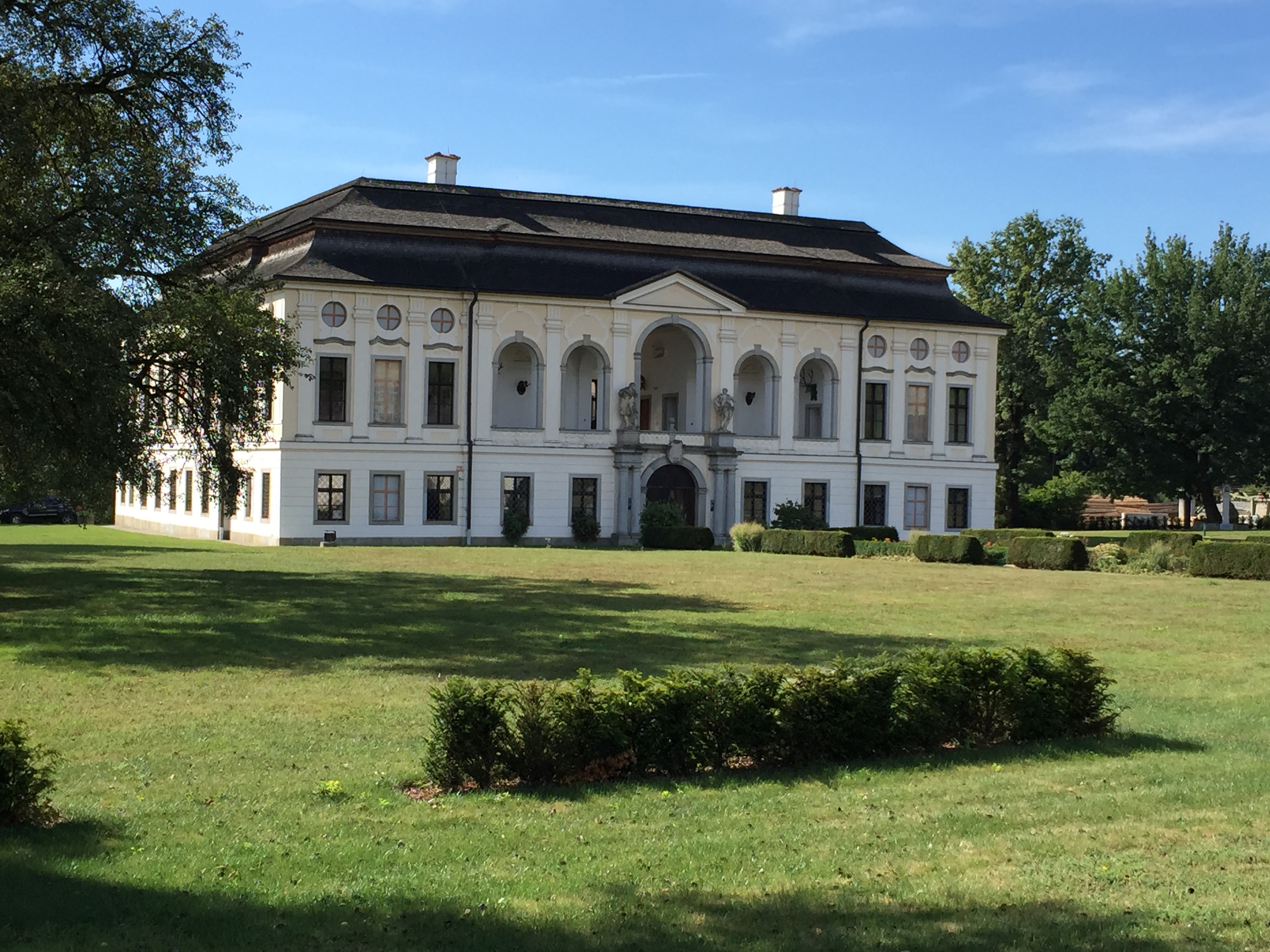
I mentioned some of the wonderful paths and “wanderings” available throughout Austria and Germany earlier. Switzerland probably has an awesome offering, but I haven’t heard about them yet. Although I was unable to do Jacob’s Way to Santiago de Compostela (my 19 days were already numbered), the Bruckner Way or the Symphonie Way (the museum at the far end was closed for the month of August), I took a short walk a mile away to the Hohenbrunn Schloss. It was blazing saddles, so I had to shade-spot along the path. Before arriving, I stopped to enjoy looking back at St. Florian in the distance beyond the road (pictured in the header).

Hohenbrunn, shown below, is some version of a hunting lodge built between 1722 and 1732. No one was there except me, and for a few quid I could see the entire place to myself, unaccompanied. At first it seemed a little creepy, as it felt like someone had just occupied it and left the water running somewhere. And all those guns. The one I took the picture of was one-of-a-kind. It actually is used for shooting ducks on a boat, so the boat supports the long barrel. I’ve captioned a few of the other photos that struck my fancy as I pranced through.

Front of House
Front of House

The up close and personal with the animals got a little weird. They all seemed to be having Gary Larson conversations with each other, wondering where all the human pets had disappeared to. I felt like Ben Stiller in “A Night at the Museum.”

Despite my digs at the culture in and around St. Florian, it was really pretty sweet. It took a bit of courage and good faith to come here on my own, but I stayed in contact with my support staff. I am nearly half way through my journey, and as many of you know it is not about the destinations but the process of getting there.

At times I wondered what I was doing. When I finally played my on-line music appreciation class that I brought along with me, I realized that this is real-time learning. I can hear and relate to music that is being performed. I ironically was at the point of learning about “Baroque” as in Bach vs. “Classical” music by Beethoven. That was awesome!

I hope I can convince any of you to come back with me to St. Florian. The surrounding area is luscious and vibrant, and you feel the freedom to explore at your own pace. It’s heavenly to hear the organ and Bruckner here. And yes, I am a little sad to leave.

Featured photo at top: Hoenbrunn Schloss, in St. Florian near Linz, Austria

Day 30a: St. Augustine

Greed and curiosity are a dangerous combination. After careful consideration and planning, I decided to attend an organ concert at St. Augustine Church in the heart of Vienna’s tourist center, near the Hapsburg Palace. The palace is a messy complex of buildings that have been extended over 300 years. Spaces between buildings have been filled in, and arcades and passageways were added for protection from inclement weather.

After locating the church yesterday and inquiring again today to make sure that there was a concert, I felt pretty confident I was at the right place at the right time. The priest at the door advised me that I should make a donation at the end as there is no charge for the concert, and I thought that was pretty fair. As I entered just a few minutes before 11am, I was surprised to find that the church was full. I quickly found a single spot in a section full of visitors.

The organ music started promptly and the priest and his entourage entered. Hmm, I thought. Pretty big regalia for a concert. Only then did it enter my mind that this might be a “Mass”, and not just an organ concert. It was, after all, Sunday, wasn’t it?? Shortly after the introductory music stopped abruptly, the priest began reciting a lot of words very slowly in German. Initially I revelled in the high German spoken so eloquently and the few words I could recognize, “Heiligen Geist” and “Jesus Christo”. It was a Mass!, and not just an organ performance! Uh Oh.

A few hymns and stand ups-and-downs later (I even hummed along), I realized that those around me weren’t the expected tour groups or even individual tourists that I had been accustomed to tolerating at performances. They weren’t even the smattering of Italian or Spanish couples and their families I had seen gesturing and heard rolling their R’s on the U-Bahn. I was in the midst of German-speaking devotees, who could recite the verses on cue and sing all the hymns unprompted.

As I started to sweat uncontrollably, I decided that I should just tough it out. Make myself obscure. The sermon wasn’t any different from listening in English, only better. The music was lovely. It was a complete Sensurround experience, with the best operatic voices I have ever heard in a church. The high ceilings and refined arches were a cross between a Lutheran Church and Cologne Cathedral. All the senses were covered. The incense swung at the beginning, creating a waft of mystic trance. The music, which was my purpose in attending, was truly heavenly to your ears. Everyone there touched the sacred ground the church was built upon. And, if you are baptized, you get a little wafer at the end.

Unfortunately, my only exposure to Catholic mass in the past has been very limited, so my apologies to those believers reading this. The last time and only time I went to a mass was at Mission Delores with Gee Kin’s niece from New Zealand maybe ten years ago. That was in English and it was still intimidating, so I don’t think it’s the language issue. It’s when everyone gets up, kneels, and goes for the wafer. So you stay seated, admitting guilt for your sins? Or do you go get one and fake your devotion? Obviously I opted for the former, feeling that I should get mileage points for honesty and bravery.

I had been to plenty of musical performances in churches in Leipzig, Paris and elsewhere. Boys’ choirs and concerts were normally held in the afternoons or evenings. I had failed to take notice the “messe” word in the German program. And despite Gee Kin’s niece prompting me at the mass I attended with her, it was a long time ago and I was a bit rusty on the protocols.

Maybe all the Germans there were only mimicking each other for the same reason I was there? It really wasn’t that bad. I wasn’t made to feel uncomfortable in any way. You just want to know what’s going on and what you are supposed to do. How did I manage myself into a situation like this? Was it greed, curiosity, ignorance, or all of the above? I muttered my regrets between my breath. This was an experience equivalent to a Vegan showing up at a Chinese wedding banquet and not knowing that meat is on the menu.

In the end, it was quite a respectable ceremony. The music was beautiful, and obviously why so much classical music was created for and from the Church. (Haydn, Mozart, and Bach were on the program). The size, shape and proportions of the cathedral were perfect acoustically and better than any symphony hall. The operatic singers could project their voices and make the music more godly and beautiful for everyone. Despite my mishap, I came out glad to have been there. But I have to remember what happens sometimes on a Sunday morning.

Special Guest Report: Reflections of the TME by GK Chou

As many of you know by now, I don’t let traveling alone stop my intrepid wanderings. But I love to travel with Gee Kin and others when the timing works out. On this year’s world tour, Gee Kin wanted to go on the Trans-Mongolian Express (TME). In particular, he was interested in getting a glimpse of Russia and understanding why it gets such bad press. I thought it might be interesting for you to read his own penned version of the three weeks we spent traveling through China, Mongolia, Russia and Berlin, Germany together. If any of it sounds like you heard it before–well, I plagiarized them earlier!—VV.

Since I love trains, I got what I wanted from riding the TME. I found the experience soothing and serene. It allowed me to think, to meditate and to reflect. Even if the scenery was mainly birch trees, it WAS constantly changing. I was never bored. It was good to be off-line. Sharing the experience with Vickie reminded both of us that we really don’t need a lot of stuff to be happy.

Understanding Russia was a different challenge. I only scratched the surface, but I am resolved to learn more. I regret not stopping for a few days in Siberia. I know Russia is going through difficult economic times and Moscow is not Russia. Perhaps on another trip. Speaking of stopping, going to a public toilet in Russia was a pleasant experience; “having to go” in China is still stressful.

Here are some of my quick, superficial impressions from Moscow and St Petersburg, and a couple of comparisons with Beijing with which I am more familiar. All 3 cities have humungous, clean and efficient mass transit systems (one of my “must-have” factors to be considered a “great” city). The Chinese (“my people”) seem to have pushing and shoving in their DNA; I found the Russians in crowds patient and polite. I did not see one person on the Beijing subway reading a book, newspaper or a magazine (but devices were everywhere); I noticed many Russian commuters reading hardcover books.

And OMG the women in Moscow! Nearly everyone that was on the street or that we encountered looked like a model. Even Vickie was looking ☺.

But I have come to realize what many of you probably already know. Although many Russians look “European”, Russia is not Europe — it is Eurasian.

While the feudal system was pretty much gone in most of Europe by 1500, the Russian serfs, who comprised the majority of the Russian population, were not legally emancipated until 1861, and then in a way that left most of them heavily indebted to their original masters until the October revolution in 1917. Since the reign of Peter the Great (1682-1721), Russia has wanted to be recognized and accepted as one of Europe’s major players. But because of historical, political and cultural differences, Europe (and the US for the past 100 years) has often been suspicious and demanding of its giant neighbor.

Sadly, this seems to be where things stand today. Everyone just wants peace, to be able to relax with friends and family, and a better life for their kids. I hope this current state of affairs does not turn into violence and tragedy.
Despite all the big questions that beg for more answers, my most profound memory from this trip is that of the staff of the TME. They prepared their meals from scratch every day. Nearly every time we passed their cabins, someone was chopping vegetables, mincing meat, mixing dough or making dumplings. And despite the constantly changing timezones, we knew when it was time to eat when the staff gathered together for their meals.

Yes, Chinese life revolves around preparing food and eating together. It takes up a tremendous amount of time and energy. But I don’t think this is a bad thing. Perhaps it would be a more peaceful world if all cultures did the same.
–Gee Kin Chou, August 19, 2015

Baozi made in pantry

(Ed. note: Photo is the one and only photo that inspired Gee Kin to take on his Iphone camera or any in the last 20 years that I can remember)–VV.

Day 19: Day of Reckoning

We’re leaving Moscow today, heading for Berlin and the Western World as we know it. Russia feels more Eurasian and part of the Asian Continent than Europe in many ways. It has been a fascinating foray into the Russian culture, environment, and history.


I am posting a few miscellaneous views of Moscow from the Kremlin Armoury and from on our last day here. Gee Kin has finally mastered his fourth word, uttering Hello! and Good bye! in one conversation. We are now aware of what it takes for foreigners to say “Ni Hao!” in Chinese, and the tables are turned. I am sure the Russians are wincing as we did when others spoke to us in elementary Chinese greetings.


Photos, above:
1. View of State Historical Museum, where some of the relics below are located.
2. GUM Department Store, a shining example of restored buildings in Moscow Center
3. View of Red Square from shopping street

Photos below, from inside the State Historical Museum:

We are sad to leave and feel woefully lacking in knowledge about any of Russia’s cultural treasures. Other than what we read in the local paper or magazine articles, we never pursued any information beyond the information we were fed. I suddenly discovered Wikipedia and Biography.com on this trip and have been using it regularly to search for all the Russian writers and composers that have been mentioned in guides.

I am passing a few on for those of you who are also curious: For Tsaichovsky:
http://www.biography.com/people/pyotr-ilyich-tchaikovsky-9503375#synopsis
It is interesting to note that Tsaichovsky was also a music critic. While he considered Beethoven a worthy composer, he was critical of Brahms, Schumann and Wagner. Anna Netrebko often sings in and promotes Tsaichovsky’s “Eugene Onegin” opera around the world.
For Pushkin: https://en.m.wikipedia.org/wiki/Alexander_Pushkin
For Borodin (remember “Stranger in Paradise” from Kismet?):
https://en.m.wikipedia.org/wiki/Alexander_Borodin
Dostoyevsky:https://en.m.wikipedia.org/wiki/Fyodor_Dostoyevsky
Prokofiev: https://en.m.wikipedia.org/wiki/Sergei_Prokofiev
I asked our guide about Baryshnikov. He made a face as if I mentioned a pariah. He is a persona non-gratis. Remember, he defected while on tour with the Bolshoi? Oops. No monuments to him, unfortunately.

The next chapter of my travels will focus on Germany, Austria and Switzerland until the end of the month. Now that the uncharted portion of my trip is over, I’ll be posting every few days instead of daily. If you are getting too many emails, you can adjust your settings to unsubscribe, and you can always check in after that by going directly to http://www.travelswithmyselfandothers.com. Please continue to send me your comments when something strikes you! I love hearing from you!