Day 9-10: Easter Island Moai

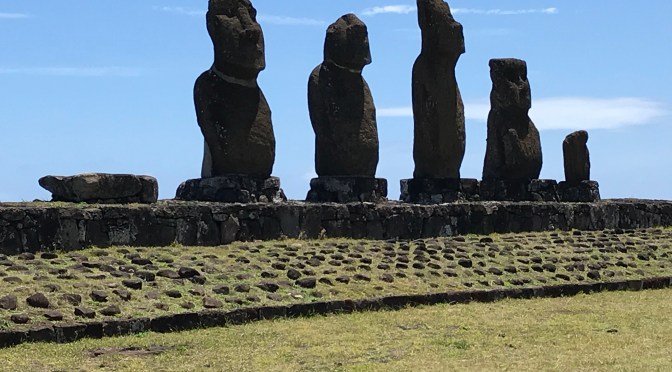
A full day of sightseeing led me to the various Moai on the Eastern side of the island. The Akahanga Quarry where the stone for the Moai were carved and extracted was a graveyard of sorts for the stones themselves. They were in various stages of completion: some were still in situ, some were being transported, and some were never to reach their intended sacred sites. The characteristic topknots for hair were gathered in one spot, as the red stone was normally placed separately from the body on top of the basalt.

I loved pondering how each sculptor decided on the eyes, nose, and mouth for each piece. Most of the bodies included full torsos, but no legs. Their hands were placed below their bellies, with long fingernails indicating royalty. The long ears of the royalty were evident, as there were no short-eared Moai (see previous post).

Behind the quarry are caves where people hid during wars and invasions. Next, we reached the highlight of the 15 Moai at Ahu Tongariki.  The guide explained in detail how the moai were carved out of bedrock, transported to a site where the dead were buried, and then erected with great teamwork and collaboration.

The Easter Islanders had a long term vision of creating these images to protect successive generations. It took incredible energy, creativity, and determination to plan, design and execute such monumental exercises. The photos above do not convey the extensive area where they were situated. See video below (apologies for the wind–you may need to turn your volume down to reduce the noise)

Error
This video doesn’t exist

A Japanese construction company helped to sponsor the UNESCO world heritage site, after it exhibited one of the Moai in Japan. Many of the Moai that were toppled were turnd upright and restored so they can be appreciated in their orignal splendor.

I returned to the Te Moana Restaurant in town for an another adventurous dining experience. This time I ordered whole fish, and was delighted with this pair on a bed of mashed tuber:

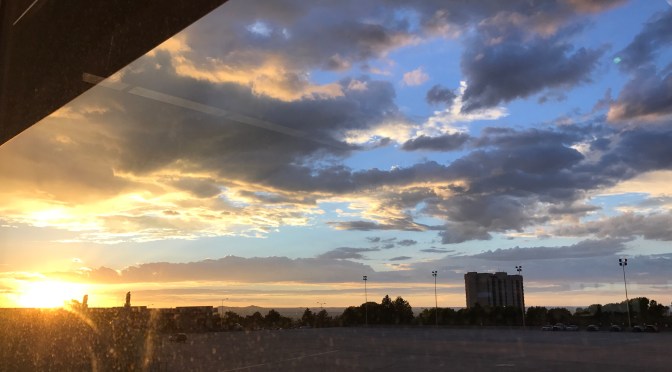
My sunset view at dinner gave me time to reflect on all the amazing human achievements from the past. Even better, I caught the last rays behind the Moai at the harbor just a block away from my hotel.  It symbolized another successful completion of travels with myself and others to two of the most magnificent places in the world. I hope you enjoyed traveling with me!

IMG_9513

Day 7-8: from the Mountain to the Sea…Macchu Picchu to Isla de Pascua

You may have heard of French Polynesia, but Spanish Polynesia?!? Combining Polynesia with Chilean culture is wild! Coming from the mountains of Macchu Picchu to the Moai at Easter Island is even more extreme and precious. These two UNESCO world sites are different but so spectacular in their own ways. The only two flights per day to Easter Island come from either Tahiti or Santiago, Chile.

Jared Diamond’s book, Collapse, inspired me to visit Easter Island. The Polynesians came here by following birds on catamaran-type boats. Initially, they found the land unoccupied and fish plentiful. Easy fishing along the shoreline didn’t last as the population burgeoned. As they needed longer boats to go further offshore to catch fish, they cut down more of the trees on the island to make the boats.  An entire tree was needed to make longboats.

Within a short time the wood was depleted, and they no longer had the resources to sustain fishing. It is a sad but true chain of events. It is also a reminder of our vulnerability as humans. Combined with tribal wars resulting from too little to go around, the Polynesian society on Easter Island thrived and then disintegrated in less than 500 years (between 800-1200AD).

The Moai are the main feature on the Isla de Pascua. The huge basalt and tufa sculptures look amazingly modern and timeless. After they were carved directly out of bedrock, they were transported to a sacred site and placed on platforms (ahu). They faced away from the ocean to protect their descendants from the ocean. Only ruling families were allowed to have moai (nearly 400 of them in existence today). They were not officially blessed until the obsidian and coral eyes were place on the heads.

Most of the “long-eared” early arrivals ran the show. They ruled the latecomers, who were short-eared. The Longears had status in society because they got to Easter Island first (sound familiar?). They made slaves of the Shortears. The Shortears weren’t allowed to build moai to protect their families but probably did all the work for the Longears to haul and erect the finished stone.

The Anthropology Museum on the island provided an excellent explanations on the history and construction of the Moai. There are wooden sculptures made of makoi wood that remind me of the Mayan figures that are highly individualized and animated.

Throughout the island, there are many artistic interpretations of moai by local contemporary artists. Some were more successful than others, but the spirit and pride in the culture lives on.

A sample of the island’s incredible flora are shown below.

And I have to post a full size photo of my dinner with myself and an outstanding plate of tuna ceviche, roasted tuber, and fried banana, assisted by a glass of famous Pisco Sour at Te Moana Restaurant:

Day 5-6(b) Sacred Valley, Cusco, Peru

Peru’s lack of distinguishable modern architecture is more than made up by its warm and friendly people, their genuine desire to help others, and a long history that does a country proud. Everything seems harder to accomplish here, yet the people are undaunted by physical hardships and challenges.

Cusco lies on a plateau in the highlands, so everything is downhill from there. After adapting to the 11k high altitude in Cusco, each 1K descent towards the 9K Sacred Valley and 8k level at Macchu Picchu feels noticeably easier. I can breathe normally. Not being a mountaineer, I have never focused so much on elevation before. I paid more attention to these stats than to rainfall or temperature in the area!!

We made stops along the way to visit an alpaca/llama (pronounced yama) farm, a weaving group, and a market in Pisac. (See photos above). Our foodies will note the wide array of fruits and vegetables as well as colors–a good sign of healthy eating.

Speaking of colors, Peruvians love bright colors. As demonstrated by the rainbow flag, it represents the people of the highlands. The familiar stripes and ribbons of color seem to aptly reflect the nature and personality of the Peruvian people.

The coca plant is used extensively as a tea to ward off high altitude sickness and one can survive on it alone for five days by chewing the leaf. You drink coca tea here to overcome altitude sickness.

There are over 2500 types of potato grown in Peru of the 3500 varieties known throughout the world. One type has alot of eyes, and as the story goes, if a young girl falls in love with someone, she will tell whether she will marry him by how well she peels one of these potatoes. If she peels it flawlessly, she’ll win her guy, but if she doesn’t….well the eyes will cry the tears for her!

Many of the ruins throughout the Sacred Valley, particularly the fortress at Ollantaytambo, are dress rehearsals for the big Kahuna, Macchu Picchu.The massive sandstones were hewn along the edges to perfection and carved to fit the next/last one as if the stone were extruded from some supersize tube of frosting, only to dry perfectly, without gaps or mortar in place. Hard to believe how these stones were cut, and the ability seem beyond human skills.

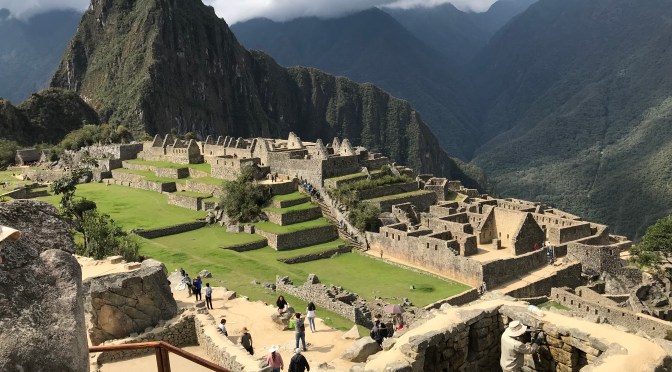
A word about the Macchu Picchu buildings from yesterday’s post. There were various ceremonial buildings for offerings to the sun god and others, but an area also served as the King’s residence. Grain was stored in one area, and the extensive terraces were used to grow food.

For more about Macchu Picchu, Hiram Bingham, the man who discovered it, and its origins, go here:
https://en.wikipedia.org/wiki/Machu_Picchu

The other important uses for terracing the mountains was to serve as a system to prevent soil erosion and to collect water from the top to the bottom of the mountain. It’s tempting to compare these to the terraces used in China to grow food, but I’m not sure which came first. In any event, the Peruvian terraces are spectacular just in sheer height and they demonstrate the ingenuity of the Incas and their predecessors.

As I leave Peru after such a short sojourn here, I realize that I may be naive and easily impressed. Nevertheless, the hardships of living in mountainous zones like this make the people sturdy. They live close to and respect nature.

Just a few random snippits about Peru:

Although Spanish is the national language, the second language spoken by people in Cusco is known as Quechua, an ancient and indigenous highland language.

The jungle covers 60 per cent of the country, and the balance is 30% highland and 10% is coastal.

The Inca based in Peru conquered and occupied parts of Argentina, Bolivia, and Ecuador, incl. Santiago, Chile.

Trees do not grow above the alpine level in the highlands, except for the imported eucalyptus from Australia, an invasive but fast growing species. The Macchu Picchu climate is at a lower elevation and has a microclimate more similar to the tropical forest (with orchids, bromeliads and coca plants.

Both Cusco and Macchu Picchu are UNESCO World Heritage Sites and highly recommended.

And for the bus and rail fans out there…here was the interior of the Vistadome Perurail car and a couple of the many spectacular views:

Day 5-6(a): Macchu Picchu, Peru


Error
This video doesn’t exist
Error
This video doesn’t exist

The enclosed photos speak for themselves….

Day 3-4: Cusco, Peru

Cusco is over 11,000 feet (3,399m) so it literally takes your breath away. It takes a couple of days to get used to the high altitude, so I hope you will excuse my temporary silence. It still took a bit of huffing and puffing to walk just a few steps at a shallow incline. I finally got acclimated enough for a full day of visiting Saqsayhuaman and Tambomachay, two Incan ruins outside Cusco. The first showed the extensive construction of terraced walls of sandstone, and the latter showed how the Inca developed and conserved water through irrigation and waterways. The Inca were very concerned about the predominant dryness of the area, and they developed ingenious ways to combat the forces of nature.

The rest of the afternoon was spent visiting Qorikancha, or the Convent of Santa Domingo in town. The Incan priests that preceded the Spanish Catholics constructed thick limestone-surrounded storehouses to stockpile dried potato, quinoa, and other foodstuffs to combat the warm periods caused by El Nino at this site. The priests and nobles shared the food with the peasants when they were unable to produce food.

Before the rain hit in the afternoon, I took a walk around Cusco in the morning. It turned out to be a good idea. It didn’t rain on my parade! Apparently parades with a cast of thousands are held every Sunday to commemorate a school or celebration. Great for tourists like me, who stumbled into colorful event by accident.


Error
This video doesn’t exist

Braided Ladies in town were preparing to sell or selling their wares in the Plaza de Armas:

Glimpses of my delightful hotel in the early morning sun reminded me of similar intimate hotel stays in Cappodoccia, Turkey, and in Essaouira, Morocco:

Treated to a room with a view, I made time to sketch!

Last, but not least, the end to a satisfying day was topped by a delicious and adventurous meal of alpaca brochettes at Pachapapa Restaurant. It was lean, well-prepared, and tasted far less gamey than venison. Unfortunately, Jusannah (my new Brazilian friend in Lima) and I ordered the specialty dish of guinea pig the other night but it was cancelled. This restaurant had the dish on the menu, but it would have taken an hour, to prepare and not worth the wait.

The next couple of days will be heavy traveling to Macchu Picchu, so I probably won’t be posting until after I return to Cusco. Keep sending those comments!

Day 1-2: Lima, Peru

Arriving in Lima reminds me of the rush I get when entering a new country, and the excitement over the opportunity to learn about another culture. Not having been to S. America except for a brief cruise stop in Caracas for a day, I finally organized a trip to this part of the world on my own.

No sooner had I arrived at the hotel when a feeling of calm and confidence struck me. The people were friendly, moved at the pace of a lilt and rhythm I enjoyed, and I became calm. Despite not much visual stimulation in the city itself, I decided to save the thrills for the ascent to Macchu Picchu later on the trip.

My full day free in the city focused not surprisingly on two historic and archaeological museums. The Larco Museum was founded in 1926 by a 25-year old archaologist who was given an Incan artifact from his father. Fascinated by this mysterious object, he pursued a career discovering a wealth of not only the Inca civilization, but the several significant epochs before that. We only seem to know the history about the conquests of the Inca by the Spanish conquistadors, but in fact the reputation and foundation for the Inca were built by many earlier societies.

Peru is divided into roughly three geographic areas: the coast, the highlands, and the jungle. The jungle occupies over half of the country, and the Amazon’s source lies in the Andes Mountains. Most of us only think of the Amazon and the rain forest in Brazil, when in fact it is also in Peru.

The various stages of formative and established cultures relative to other parts of the world are shown on the attached chart.

img_9945-e1507374114896.jpg

Many of the objects or designs in the museum were based on the notion of the underworld, represented by the snake; the earth, or middle world, represented by the puma (jaguar); and the upper world, represented by the owl. These worlds collide, interact, and support each other, as shown in the geometric, three-step patterns.

Urns from high priests were used for drinking fluids from humans and animals. Buriel sites show human sacrifices and the dead placed in a fetal position upright, then covered with cloth and woven textiles as thick as carpets. Enjoy some of the many pieces that I particularly liked from the extensive collection from primarily the Larco Museum, and its lovely garden.

The hotel recommended the La Mar Restaurant that was open only from 11-5pm, so it fit my schedule perfectly. After an exhilharating visit to the two museums, I was ready to chow down some of the best food in the world! As soon as I was seated at the bar, I was greeted by a friendly young woman sitting next to me. She was visiting from Brazil on her own. We struck up a conversation that led to an agreement to meet for dinner two hours later at one of the sister restaurants, La Panchita.

Try to Remember…

When was the last time you were in San Francisco in September with the temperature over 100 degrees?  With the advent of Labor Day and subsequent heat waves, San Francisco experienced record temperatures (over 106 degrees reported downtown??). The freak weather sparked a lot of unusual behavior–like packed parks with… what!?! people in them (See featured sketch above, at noon on 9/5/17 at the 100 First Street roof terrace).

Girls flung their normally conservative city modesty to the winds and were wearing skin-tight and flimsy almost see-through dresses. And surfers surfing at Ocean Beach without wetsuits!?! It must be an indication of the positive effect that weather has on our foggy Bay Area brains–and that we’re actually and finally capable of adaptation!

The Fall Semester has also descended. I finally consolidated my myriad choices for classes. As always, I pick more things from the buffet line than I can eat. San Francisco’s City College is free for residents starting this year, so I can gluttonize myself even more. I decided to forego the German classes this term. Instead, I opted for a purely hedonistic art and music program. I am continuing my figure drawing classes with the fantastic Ms. Diane Olivier. You may remember her from my incredible Moroccan sketching adventure in June. She continues to teach at the Fort Mason site where all the lifelong art students congregate.

As part of our class assignment in Art, we are expected to sketch daily. One of the better ways I accomplish this is joining Meet-ups for Sketchers. We draw in various parts of the city (Nob Hill, office buildings, events in the Park, etc). There seems to be a spontaneous combustion of happenings thanks to the internet. I can join several in one week if I choose to.  There are similar meet-ups worldwide, so I am really excited about these prospects in the future. Sketching outdoors has been great art therapy for me and a memorable way to view and record the city other than with a camera. Click on images below for captions.

Places

I’m making my ginger foray into Music in two directions. First, I toyed with both introductory piano and violin. Yes, I took lessons many years ago and only enough to allow me to play in solitary confinement. The incentive for the piano class was a fleet of brand-new digital Yamaha pianos.

I decided to forego the equipment upgrade and a cast of 20+ students for a beginning violin class of only 15 students (20-15=5x more attention from the instructor). My old violin that had been left unattended for decades was finally in the money again. You can imagine the delight from the poor violin’s standpoint.  It was dripping with sound from its inner belly and oozing through the curly-que slits to the world.  I could barely remember how to tighten the bow and prep it with rosin. Forget tuning and blowing up the rest pad–I had to rely on the instructor’s help for both.

Second, my next musical class is about music awareness.  We will learn more about opera using Elektra, Turandot, and La Traviata from the San Francisco Opera season. We have access to orchestra seats for $35! This is almost as good as being a Goethe Institute student in Berlin. I thought this class would be a pushover until I had to write two papers. I discovered that I had no music theory, background, or ability to explain anything in proper musical terms. Hopefully this class will improve my musical awareness!!

People

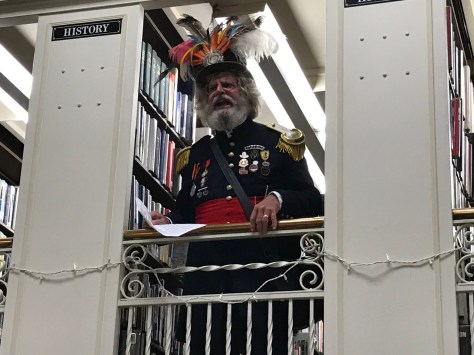
Last but not least…Emperor Norton found in the stacks of the Mechanics Library in Downtown San Francisco…during a treasure hunt. You can join the private library for a nominal fee with access to many up and coming books and their authors.

IMG_2527

In a couple of weeks, I plan to travel to Peru and Chile.  I’ll be visiting Macchu Picchu and Easter Island. Please join me for a bit of fun and adventure! As usual, my focus will be on art, architecture, anthropology, and food!  If you want to opt out of email notifications, you can change your settings in WordPress. Until then…

Sunset over the Southwest

I’ve heard that foreign visitors to the U.S. often yearn to see the wide open spaces that are unique to America, like Yosemite, the Grand Canyon, and Yellowstone. As Americans, we often overlook those magnificent expanses of space that we take for granted in our own back yard.

On a weekend visit to Santa Fe, New Mexico, we caught some of the excitement over such vistas that seem to go on forever. We spent the first day exploring the mesas and pueblos of the Southwest. Located about an hour northeast of Santa Fe, the Puye Cliffs and area inhabited by the Santa Clara Tribe thrived here between 800 AD until the 16th Century.

The mesas were formed by tuff, or volcanic ash that covered this area (and made fossils out of alot of plants and animals), then eroded over time to form dramatic cliffs. The pueblos are Native American villages dotted throughout numerous reservations in New Mexico. The Santa Clara originally lived in these cliff dwellings and then later, in pueblos. (Click on Photos to see captions).

The kivas, or ceremonial roundhouses in each village, were used for male rites of passage, important decisions, and festivals. When the Spaniards arrived, they burned the kivas and built Catholic cathedrals over the sites.

The cliff dwellers protected themselves from invaders in the caves. Later, they created pueblo dwellings that were two-story structures on open land. The dwellings had no doors, but they used ladders to lower levels of the dwellings from the rooftops. These entries protected residents from invaders.

At our neighbors’ recommendation, we made a special day trip the following day to Ghost Ranch. An hour’s drive north of Santa Fe just beyond the Puye cliff dwellings, Ghost Ranch is a retreat cum camp for writers and artists. The ranch offers weekly programs, seminars and workshops in the high desert.

Georgia O’Keefe’s home is near here, so there’s plenty of creative inspiration and history in this area. The landscape alone is breathtaking, with wide open views of mesas in the distance as far as the eye can see. The ranch is nestled in an oasis with a precious lake nearby.

There are archaeological excavations that date back to the Triassic Period on the ranch. You can even participate in digs. From having taken three Anthro classes in college, I became interested in Anthropology and even contemplated majoring in it.

cropped-img_9341.jpg

I immediately fantasized about joining a dig until I saw real-time photos of volunteers in the program, posing on their shovels during a break. The exposed skin on their faces and arms looked as parched as old shoes and as cracked as the pottery shards they were digging up! I decided to relinquish the idea as I was reminded not to forget my nightly skin regimen.

The main purpose of our excursion to Santa Fe, however, was to attend a premiere performance of the opera, the (R)evolution of Steve Jobs. It’s the complicated, contemporary, and tragic story of Steve Jobs. While the place names were immediately discernible to those of us living in the Bay Area (Stanford, Cupertino, Los Altos), the story of this one-of-a-kind genius gives everyone a perspective on where we have been, where we are, and where we are going.

The Santa Fe Opera was an ideal venue for this premiere, with its dramatic open-air stage, setting, and architecture. Everything was perfect, including the weather, production, and food!

Here’s the final curtain call, with Edward Parks (an international Operalia Competition winner), who played Steve Jobs, the librettist Mark Campbell, and composer Mason Bates. (apologies for the overlighting).

This production was sponsored by the San Francisco, Seattle, and Santa Fe Operas. When you get a chance, see it, or check it out here:

https://www.santafeopera.org/operas-and-ticketing/the-revolution-of-steve-jobs

Back in Santa Fe, art is ubiquitous and a reminder that beauty can, and should be everywhere. There are art galleries galore and tourist shops selling turquoise, carpets and pottery to numb the mind, but if you look beyond those, there are many treasures outdoors to be found. Here are a few examples of fanciful sculpture and mindful landscaping that you will encounter on a walk through town. (BTW, you can see more artwork from the Day 77-78 stop in Santa Fe from my October 2015 Amtrak trip).

Turquoise and terra cotta are the trademarks that define the American Southwest. They even use this palette to paint the overpasses along freeways so you always know where you are. As our weekend wound down, I managed to capture the mood, signature colors, and the remains of the day at the Albuquerque Airport.

Happy Celebrations to Pam C., Pam C., Karen M., and Jens U-B!!

Sunrise over the Sunset

This month gave me time to pause, gather thoughts, and enjoy reuniting with friends and family.

In the past few months since I had been away from San Francisco, two high rise towers rose from the ashes downtown. The long-awaited Transbay towers are the tallest in The city’s short skyline, but minuscule compared to other cities I recently visited. The header shows the view of the towers in the distance, just below the sun. The view is taken from our house in the Sunset District.

This month I started a Brain Research study as a participant. Sponsored by Dr. Adam Gazzaley’s Neuroscape Program, the study looks at older adults and their ability to focus. In addition to an MRI, hooking up to electrodes on a skull cap, saliva swab and a blood draw, we do videogames to test our level of concentration or distraction. The study hopes to develop exercises to increase the ability for older adults to focus better.

You can join the study if you are in the Bay Area:

Participate

The research clinic is located in the Neurosciences Building that I developed as Project Director at UCSF. Located smack in the middle of the Mission Bay campus, it was designed by Skidmore, Owings and Merrill, San Francisco. I love going there to see the building in its full glory and fulfilling its mission to find cures for neurodegenerative diseases.

After my Moroccan sketching trip and the inspiration from the culture and food there, I decided to try a few recipes from the cooking class I took in Marrakesh. It took a bit of research from Paula Woolfert’s cookbook and a few trials before organizing and gathering friends together to try out an entire meal.

I couldn’t stop thinking about the intriguing tomato base tagine, or casserole, tucked under a plate of fresh eggs for lunch after our drawing expedition to the market outside Marrakesh.

When it was presented to us at lunchtime, I stared at it for quite some time before I realized the trick to getting it into your stomach was with your right hand. The bread was scattered around the table, readily available to assist. After the awkward start, it became second nature. (You can see photos of the dish at the table in Day 54: Meet me in Mogadur)

IMG_8386

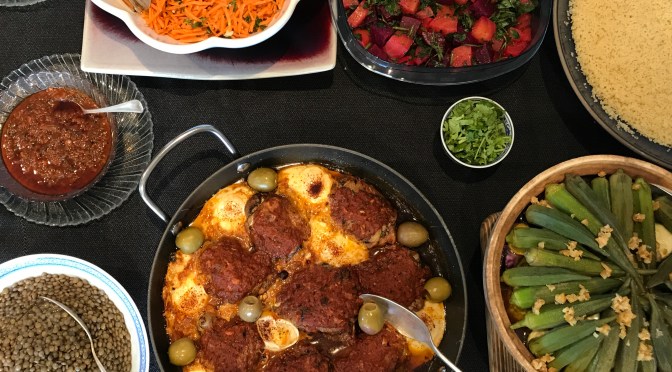
You can compare the homemade version in the featured photo above. It was a joint achievement, with friends helping to prepare side dishes. From the bottom center, counter-clockwise: chicken smothered in homemade tomato jam and topped with eggs and olives; seven-vegetable casserole (okra, cabbage, green beans, onions, potatos, and carrots) with home-made preserved lemon; thrice-steamed couscous; beet salad compliments of Carmen); carrot salad (compliments of Royee) hummus; home-made harissa; and lentils. not shown: zaalouk, an eggplant dish, compliments of Susanne); a dessert bastiya made with apricots and almonds; orange slices with orange blossom water; and fresh mint tea!!

Organizing friends to share in the production of a complex meal is a great way to engage and invest everyone in the process and the outcome. Especially for what might be less familiar, everyone is more interested in trying each other’s craft.

I could focus my attention on more challenging parts that I may not have tried on such an ambitious menu. And doing it this way serves as a great ice-breaker to boot! Try it with a menu you’ve never tried before! Think of it as a shared cultural adventure.

If you find cooking Moroccan food too challenging, you can try out the new Moroccan restaurant Khamsa at 15th and Mission in San Francisco. It just opened so we dashed down there last night to try it out. All the good dishes are represented, including a fish tagine, chicken bastiya, zalouk, Moroccan wine and even mint tea!

For other dining experiences in San Francisco, our family celebrated recently at the Progress (Workshop) Restaurant. It’s next door to its Michelin-star cousin State Bird and Provisions. We chose dishes from the prix-fixe menu consisting of chickpea and oregano dumplings, quail quarters and black cod.

Here’s a quick tip for our opera fans: you can follow performances at festivals this month (including the Salzburg International and Verbier Festivals) free for ten days on medici.tv.

Thanks to all for answering last month’s survey. You can view results posted in the previous “Day 72+3: Return to Sender” at the bottom of each question. A quick note on videos: I try to use them judiciously, to avoid frustration. According to WordPress (the blog platform), the ability to see videos is based on the device you are using and your service compatibility. The videos may not load properly if you are reading my posts directly from email notifications on a smartphone. In that case, you may need to use a computer to see the videos. My apologies for these technical glitches. While I’m getting a request to see more videos, I’m afraid that many of you are unable to access them. Let’s keep trying to pursue solutions to these problems in the future.

For those who have been asking: yes, I am planning my next trip. It will be shorter, and soon. Stay tuned.

Day 72+3: Return to Sender

Two packages were waiting for my return to San Francisco: one from Germany and one from Morocco. I cracked the system in two countries and successfully received goods that I sent from each. They were not that expensive and well worth the effort.  After organizing my personal effects, German books and class notes, I sent them via DHL from Dusseldorf. It turned out to be the same as paying the additional baggage charge or less without having to carry them through the rest of the trip.

The second package contained the coveted carpets I purchased in Marrakesh. Normally one would be hesitant to send large items in value and size. Having sent carpets once before from Cappodoccia, Turkey, I knew that I could save a lot of trouble. From both experiences, the mail systems in both countries, as expected, were very practical and reliable.

What’s it like to be back in San Francisco after two and a half months of travel? My first impression coming out of the BART station at Glen Park from the airport, was CLEAN AND SMOOTH. The air was fresh, the sky was an identifiable color, and everything worked. People spoke slower, and were friendlier. Perception is reality.

That doesn’t diminish the incredible learning experiences I encountered. I would not trade my memories of New York, DC, London, Germany, Hong Kong, or China for the ease of life. The differences in lives makes life interesting and worth living.

On the heels of my travels, two events led me back to San Francisco: a fun evening at La Boheme with two grand-nieces at the San Francisco Opera, and a tour of Angel Island.

Normally, I refrain from pictures of friends and family and the “social page”. Because we made a point to reconnect with so many this year, I couldn’t resist posting a gallery for those who might recognize each other. Hopefully I haven’t missed anyone we visited (I may have failed to take photos of you in our excitement over seeing each other!). I am still glowing from the many warm encounters, so check to see if you are among them!

London, Bath and Dusseldorf:

Morocco:

China, HK, and SF:

I’ll keep you posted about any upcoming travels, but until then will be reducing posts to a monthly basis. Don’t forget to stay in touch, even if I’m not traveling! You can always reach me on this website or by email.

Thanks again for all the comments and for following along! I have enjoyed my travels and sharing them with you.

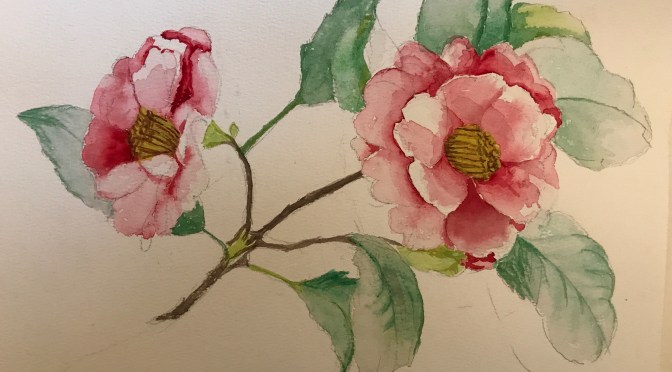
Featured Photo: my first watercolor imitation of a Chinese Camellia, HK Art Studio

As previously mentioned, the teeny weeny survey attached would greatly help me to improve future posts. If you have read Travels with Myself and Others, I would appreciate your feedback. Please let me know if you have any additional thoughts or suggestions!

A note about the poll: the format may appear differently if you are reading from a smart phone or from a computer. If you are having trouble responding on a phone, please use the survey on your computer. Thank you!

Real Time Creative and Independent World Travel