All posts by VickieVictoria

Intrepid traveler. Architect and appreciator of design, art, language, opera, history, and anthropology.

Day 58: Moroccan Magic

As our last night in Essaouira drew to a close, we didn’t have much time for nostalgia or glee. Between crazy over the top activities immersed with deep dives into the culture and grabbing tips and tools for sketching, each day was exhaustingly satisfying.

Diane, our instructor extraordinaire, exuded penultimate confidence in her craft. We agreed she was, indeed, a wonder woman. I would never admit that soneone knew more than me about traveling, but Diane is over the top savvy and knowledgeable.

She’s the only person I know who can smoke a cigar sitting on the ground in the middle of a major thoroughfare sketching locals who love it, AND manage a herd of cats who continually ask the same question after it’s just been answered.

Here’s the link to the video I made and shared with everyone on the last night of our sketching expedition in Essaouira, Morocco.

And, for Customer Service: a few final quickies before leaving to head back to Marrakesh:

(Note: I’m en route via Geneva, Zurich, Frankfurt, and Beijing to Hong Kong. The internet may be a bit spotty, so don’t be surprised if you don’t hear from me for a few days!)

Day 56-57 Dromedary Dates

I’m not sure whether dromedaries or dates came first, but we had both in the same day. The one-humped camels, by the way, are called dromedaries.  Our group  of a dozen or so artists and students launched the camel ride at the surf shop in Essaouira. After being well-clad in Berber style scarves, we braved the mini-sandstorm and headed south along the beach.

Our guide made sure that the camels stayed in one line. They were amazingly docile and sweet, and only pooped occasional olive-sized pellets that acrobatically cartwheeled in the sand.

After about an hour, we headed to a sheltered area of trees for a grilled sardine and watermelon lunch prepared by our camel guide.

In the evening, we feasted at the home of Diane’s friend and guide, Hassan. During Ramadan, this was a particularly festive and meaningful occasion. The table was laid out with fat juicy dried dates. Next, a huge dune of toasted almond paste flattered by bread, followed by pizza, then chicken tagine with olives and fries, custard dessert, and mint tea. My stomach hurts from the memory of how much delicious food I couldn’t consume.

The next day, we buckled down with a perspective, sighting, and measuring session first thing in the morning. Here are a few before and after sketches:

Days 54: Meat Me in Mogador

On Sunday morning, our art group headed out to the market by taxi. After a half hour ride, we were discharged into a completely local market with no tourists.  If it weren’t for a few precious plastic bags, you could feel as if you had time-traveled back a couple of centuries. We spent most of the time at the meat market in front of the abbatoir, where various sections of the animal were displayed (half-skinned heads, hoofs and rack ladders). Meat is eaten big-time in this part of the world, especially lamb and chicken.  Interestingly, the meat was so fresh there was no odor. For the chaotic scene it was for sketching, it seemed ironic that there were no pungent odors of innerds to discourage us.

Our instructor, Diane, was in full form. After sketching a chicken, the owner demanded that she draw him instead. She was up to the challenge, and crowds of men gathered around her to watch. There were few if no women in the market, and if there were, they were widows looking after themselves and their families.

This was the most rudimentary market I have ever visited. The men did not like having any closeup photographs taken, so we were careful not to offend. A few stuck their hands in front of the camera when I inadvertently pointed it in their direction.

We took the “Berber Mercedes” to a small village outside the market. The restaurants were closed during Ramadan, so our host in Essaouira arranged for a local to cook for us. The ride was exciting at times, as the donkeys knew they were heading home for lunch. We rode on the edge of a single metal wheel and got there after a Mr. Toad ride from Alice in Wonderland. Even though it was hair-raising, our drawing teacher was sketching!

Our lunch (see featured photo above) consisted of tagine with fresh eggs, and a huge platter of fruit. There are no utensils, just all-purpose bread you use to scoop up the sauce and as a napkin!

For those who want more background and history on Essaouira:

https://en.m.wikipedia.org/wiki/Essaouira

Day 50-53 Essaouira, Morocco

Essaouira, formerly known as Mogadur, is a fishing town on the northwestern coast of Morocco. As a historic fishing village, it is another UNESCO world heritage site. A group of artists and students, including myself and others, are here with teacher Diane Olivier to sketch for a week.

The network of narrow alleys formed by thick walls and tunnels keeps the areas incredibly cool. The courtyards in the houses and riads (small hotels with courtyards originally private houses) are also provide light and ventilation to deep dark, and cool rooms surrounded by thick  walls.

Above: Views of the local Medina, or walled village with shops inside. At one point there were more Jewish people living here than Moroccans, but now there is only one. Shops sell carpets, argan oil, wood products, and artwork to tourists. Every shot represents a drawing opportunity!

Speaking of Drawing, here are a few sketches below. We are encouraged to draw during free time and share our work at the end of the day. Diane, the instructor, has done this workshop for six years in Essaouira. She knows her way around the town and all the nooks and crannies. We officially started with gesture drawings (on the left) of people walking through the plaza. We also drew each other, and a twenty-minute “blind” gesture drawing of a classmate, without looking at our paper. The goal was to draw what your eye sees, not what your brain tells you to do.

Views from and of rooms were good material, as well as views from rooftop terraces.

Below: details to discover throughout walks inside the walls. The port and beach (apparently laden with camel poop) lie outside the walls.

My lovely room assigment: a suite with a sitting room:

There are plenty of restaurants in the local area, with fresh whole fish for $10.

Day 48-49: …They’re Taking Me to Marrakech…

When we were ferried out in a bus to the flight to Marrakesh at the Frankfurt Airport, I already sensed that the trip was not going to be a run-of-the-mill commuter. Instead, we ended up outside a hangar where planes were being repaired, and the lone plane outside looked as if it had been grounded for bad behavior.  The airport stretched for miles as far as the eye could see, between the Baltic and the Alps. I never realized that an airport could be THAT big, but Frankfurt was, like all German things, serious business.

We took off and landed three hours later to an another immense airport. The new Menara Airport, next to its old one, was so vast and empty that you wondered if they hadn’t put several square miles of the three largest airports in the world together and renamed it Menara. It was indeed a beautiful architectural masterpiece. Hopefully by a local architect. Regardless, it was impressive and ready to compete with Hong Kong, Paris or New York for tourists.

If you are in interesting places, it won’t be surprising to find that you are in a UNESCO world site without knowing it. That’s what happened here. Without trying, I discovered that the Medina of Marrakesh is indeed on the list. The history, the Islamic significant buildings (madrassas, mausoleums and mosques) and souks, or markets, all contribute to its status.

On an initial walk around the neighborhood of the hotel where we stayed, here were a few of the sights and sounds:

The Madrassah Ben Yousef was one of the earliest institutions of higher learning established in Marrakesh, where the doctors, lawyers and mullahs were trained.

The guilds within the market area preserve traditional crafts such as tanning, carpet weaving, metalwork, woodwork, and making argan oil and other pharmaceuticals for remedies.

The doorways are significant entry points through walls and into private spaces. Beautiful courtyards lie beyond reach for the public pedestrian. My guide explained, that after you arrive at someone’s home, you announce your presence. If they do not answer, you are never allowed to enter beyond the doorway, even if the place is accessible. That would be considered a breach of trust.

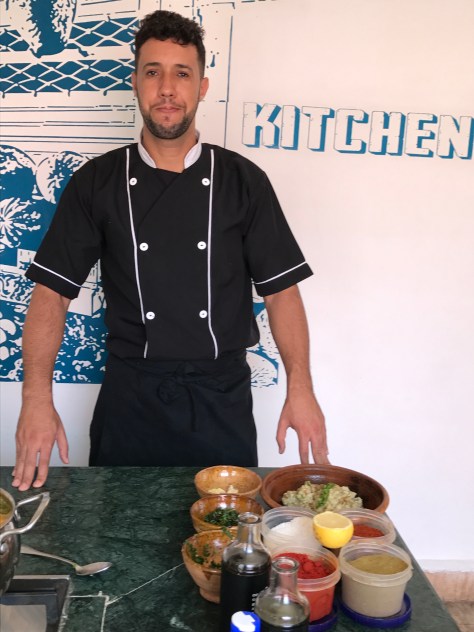
After a walk around the neighborhood on my own and a guided tour of the souk (market area later in the morning, I participated in a hands-on cooking class at the Clock Restaurant all afternoon. Its famous camel burger was on the menu, but we learned how to make tame versions of traditional dishes that included harisa soup, chicken tagine, eggplant caviar, and biscuits with dates.

And the Chef de Cuisine:

IMG_8204

At the end of a very busy day, I could escape to my suite in the historic Riad Dar Mouassine (also photo featured above)

Tomorrow: On to the Drawing Boards!!!

Day 46-47 Last Dance in Düsseldorf

IMG_7951
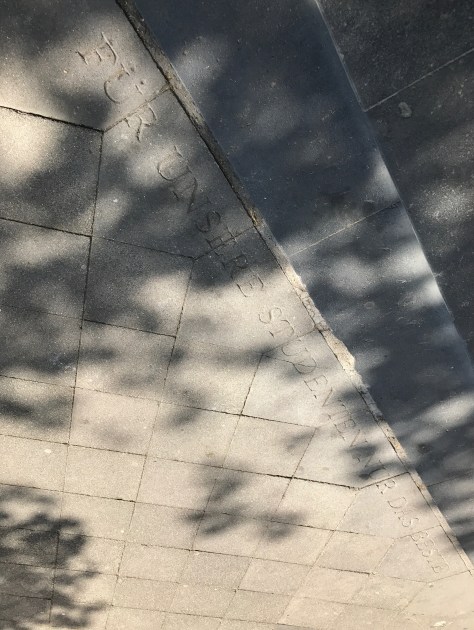
Inscription at Entrance to the Art Academy: ‘For our Students: Only the Best’

Art has been elusive in Düsseldorf, until I made a point to seek it out. Works by Luther promoter Cranach and German Expressionist Otto Dix were in town but hard to get to even though they were only a stone’s throw from where I lived. I discovered the Kunst (Art) Academy, where Gerhard Richter, one of my daughter’s favorite artists, studied and taught. The sobering words carved at the entrance seem daunting, for both student and teacher.

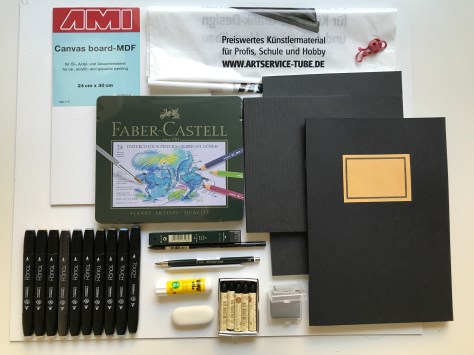
I originally came to the area seeking art supplies, and was delighted to find a tidy art store complete with what I needed for my sketching class in Morocco. It’s scheduled to begin at the end of the week, and I hadn’t stocked my bag yet. I sent all my German books  home so I could fit and replace the new materials in my carry-on.

IMG_7969

I enjoyed the experience so much that I decided to lay everything out for you. Just like ingredients for a soup, these are going to be the base and the flavor for my upcoming sketches. I loved all the quality German-made sketch paper, colored pencils, pastels, graphite pencils and holder, and even the UHU glue stick. After further inspection, however, I discovered that the gray pliable art eraser (in a plastic case) came from Malaysia and the markers from Korea. Oh well.

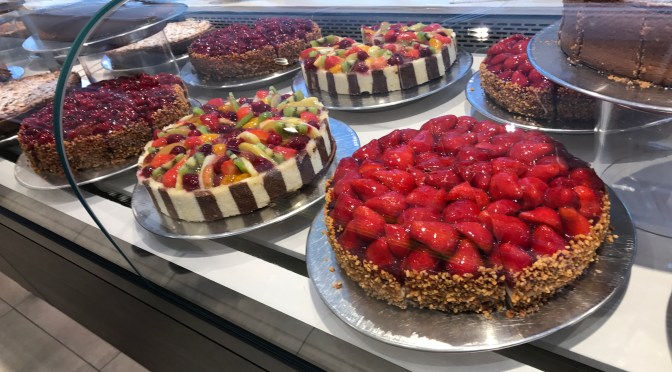
And just so you know I have my priorities straight, I stopped at the German bakery Heinemann’s for a kirsch cake over a Chocolate sponge and chocolate biscuit. They even packed the whipped cream with tender care “to go”.

Over the weekend, friend Vladimir was visiting and we made a stop at the Neanderthal Museum. Not one of my favorites, but here’s a tiny description of the 2,500,000 years of Migration, described as a “river”, with ebbs and flows”:

The burial discovery of a family of 14 showed how they were hacked by axes, where blows to the head were visible. The museum is the site for a discovery of Neanderthal man that was dated to 40,000 years ago, but earlier discoveries of Neanderthal man were made in Belgium before then. A number of artifacts and copies of archaeological finding were duplicates used to explain the evolution of man.

tmp_30199-DSC_06991044469968

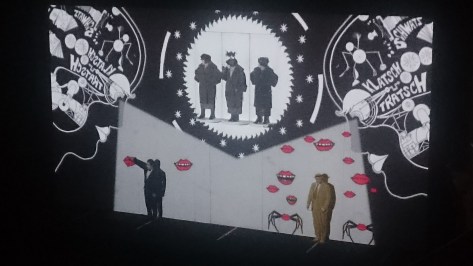
We made it back in time to see an innovative and clever version of the “Magic Flute”. The Germans are experimenting with new ways to present and appreciate the classic operas. In this one, they used the Buster Keaton silent film era graphics and period style as the backdrop for the beautifully enduring music. It worked well, the graphics and animated portions were original, creative, and thoroughly enjoyable. Don’t be surprised if you start seeing more of these interpretations as opera becomes more widespread and appealing to younger audiences.

tmp_27244-DSC_0742360256924For those interested, here’s a clip of the performance at the Opera on the Rhine in Dusseldorf:

http://www.operamrhein.de/de_DE/termin/die-zauberfloete.13972906

As I close this month’s visit to Dusseldorf, I am sorry to leave. The attention to art, music and culture is clearly evident, albeit subtle at times. In addition to promoting fashion, media, and trade fairs, the city has a bright and forward-thinking approach that will continue to make it a leader in these industries.

Addendum: a preliminary sketch of a static and well-behaved model that served as prep for my sketching class (photo was taken after the sketch!)

And the music legacy lives on as well…here’s the parting music and dance that took place on a casual 90 degree afternoon on Konigsallee around the corner from my apartment:

In Düsseldorf, you can hear year-end recitals by students at the Robert Schumann Musikhochschule free of charge. The piano recital I attended had a dozen or so students. Watch for these world-beaters in the upcoming years. The majority were Asian students. It will be interesting to see how they can influence Western music in their own countries.

I’m off to Morocco tomorrow, to meet with a sketch group organized by an art teacher at City College of San Francisco. Join me for some first-hand, and first-time experiences and adventures! I probably will post around the end of the week after getting acclimated, so stay tuned!

Day 44-45: Lost Schlosses of Barbarossa and Benrath

Kaiserwerth, just north of Dusseldorf on the Rhine, is the site of the legendary medieval Barbarossa castle. As Emperor, he built these fortifications to control the Rhine River. The town is just a small suburb of Dusseldorf. It’s easy enough for weekend party goers to get to (by public transportation, no less!) and an excuse for drunken brawls at the outdoor beer garden. It was already in full swing by Friday afternoon at 3pm.

The beach and feeder to the Rhine were fun and idyllic spots for local visitors and the historic town of Kaiserwerth made it a refreshing and worthwhile escape from the city.

Schloss Benrath (former residence of Elector Carl Theodor (1724-1799)

On my way out of the city headed south to Schloss Benrath, I continued to be impressed by the public transportation in Germany and how easy it is to get around. I am injecting photos of Schloss Benrath along with my commentary. They don’t have anything to do with each other, but maybe the pictures will help make my thoughts more interesting to read!

Having worked for the Hong Kong Mass Transit Railway System in my first job out of graduate school, I became an incorrigible train junkie. I got my “first training wheels” from former British Rail or London Tube engineers. They were making use of their ex-pat junkets in Hong Kong, living a colonial life of luxury at a time that was soon to eclipse. The looming year 1997 was just around the corner, signaling the end of the empire after more than 150 years of dominance.

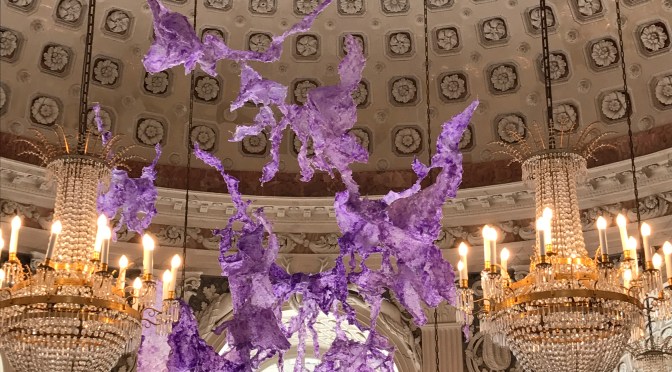
(note: The Palace was decorated with fabric sculptures as part of a special exhibition.)

Nevertheless, I used the skills the Brits taught me about station design, vent shafts, headways and trip generations. This led to a lifetime pursuit. I enjoy and marvel at all of the planning and logistics needed to run a public transportation system. Transit system design integrated with high density development worked wonders, particularly in Hong Kong, but the concept is no exception in major European cities.

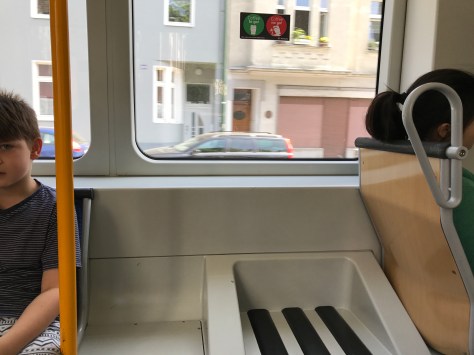
When I get on a local transit system in Germany, I get excited by its sheer beauty and efficiency. Its citizens appreciate and  respect the system so it stays clean. The users, the workers, the managers, the leadership all work for a common goal. There are places for luggage in lieu of seats (see photo) so the upholstery isn’t damaged.  Someone can still sit there if needed. Smart signage says it’s ok to have coffee but you need a cover for it.  (See sticker in the middle of the window).

IMG_7807
Yes, some design forethought can go a bit far. At the Schloss Benrath, I noticed all the “mother” hardware that could probably last 1000 years in place. Forged of hand wrought brass, the hinges are twice the size of the door handle.  It must have been decided that the weight of the door on the hinge produces greater stress than a door handle holding a door in place. Any ideas, engineers in the audience? In any event, it’s different from common practice today. We just replace hinges when they wear out.

On the German speaking tour. I heard a big gasp from the crowd about the size of a corset in the early 18th Century–a mere 46 cm! I’ll let you calculate the conversion.(:))

And at the Schloss outside:  a pretty picture who looked good enough to be a model to me…

IMG_7810

Day 39-43: Dwarfed in Düsseldorf

IMG_7673
Frank Gehry’s Media Hafen along the Rhine

After learning about all the fairy tales in class to conjugate the past tense in German, I was wondering if I hadn’t shrunk myself. At the place where I am staying, the owner trains horses and is about 6′ tall. She fitted out the apartment to suit her height. The kitchen table is at my chest height. Standing up (because there are no chairs this high, not even bar stools), I can slurp soup directly from the bowl on the table top without having to lift it.

I also need a stool to get to the bottom shelf of the overhead kitchen cabinets. I wonder if I’m not going to face an avalanche of dishes stored over my head every time I reach for one. It’s a pretty funny scene after the third or fourth time around when I try to cut corners. I really feel like a dwarf.

Speaking of dwarves, we learned all about Grimm’s Fairy Tales, Snow White, Sleeping Beauty, and Little Red Riding Hood in my German class. Don’t forget that these stories all come from Germany. The Schwarzwald, or Black Forest, isn’t far from here either. I always thought that the stories had a dark and ominous tone to them. I never understood why little kids were always getting lost in the forest. But not to worry. Walt Disney borrowed them, sanitized them, and made them safe harbors for the Disney Empire.

S-L-O-W Living

We talk a lot about slow food but not slow living. I have spent a lot of time meandering through parks here, partly because you run into one in any direction before you know it. The city parks are incredibly accessible, well-maintained, and beautiful here. Because Dusseldorf is along the banks of the Rhine River, it is relatively flat. A lot of bikes travel at a reasonable pace and share the footpath with pedestrians. It reminds everyone to slow down. Maybe it’s time to think about slow living.

Here are some views of one of the beautiful parks in the heart of the city.

I’m blasting a series of shots of buildings, sights, and details here:

Below: Daniel Liebskind’s masterpiece of the Ko and Shadow-Arkaden, a mixed use office and retail complex. The exterior on the Nordliche Dussel (a small lake) side is mesmerizing. The rear wavy-gravy houses Apple and Tesla, and has a great plaza for people-watching. I even managed to break out pen and paper to do some sketching.

Now I know and agree why Düsseldorf is deemed one of the ten most livable cities in the world.

PS. For those of you in San Francisco, you can see “Young Goethe in Love”, a great movie classic, at the Goethe Institute Thursday, May 25! It’s not too late! Check it out!

Day 32-38: Essen in Essen

Essen always had a curious name, since it sounds like the German word for “Food”, or “to eat”. There doesn’t appear to be any connection. I was tempted to feature the food we ate in town, but it wasn’t anything remarkable. A side trip from Dusseldorf to nearby Essen takes only a half hour by train, so friend Helena and I planned a full day excursion there.

At the recommendation of a fellow architect and German student, we spent the afternoon exploring the massive Zollverein, a coal mine converted to a museum for explaining the extraction, production and transport of black gold. As a UNESCO world site, this was the heart of the famous Ruhr Valley.

Like the African-Americans who migrated from the Deep South to the San Francisco Bay Area after World War II, many migrants came from Poland at the end of the 19th Century to this rapidly developing industrialized area. In the 1950’s and 1980’s, many new migrants from Italy, Spain, Portugal, Turkey, Russia and Romania arrived in this area and other parts of Germany to search for a better life.

The museum had a you-name it-we have it approach to anything and everything to do with coal and beyond. The plant area was so extensive, it could be a quarry for humanity. Integrated with the coal production factory itself, the collections included dinosaurs, Roman ruins, Greek urns, geological rock samples, and memorabilia. It felt a bit like the Tate Gallery and the High-Line concept in New York City thrown into one gigantic area, but it tries very hard to not be a theme park.

I amused myself by looking for the oldest fossil and located coral imprints that were 600 million years old!! My favorite though, was just a tender young fish print checking in at a measly 60 million years.

In addition to the actual production lines, scaled models were used to demonstrate the work flow. The tidiness and efficient Bauhaus-designed buildings didn’t reduce the cast of sadness and grueling work that must have taken place there. Work conditions were so poor that many workers did not live long. Below is a short clip of one of the videos presented (unfortunately in German only) that shows how the coal could be delivered from the shaft to the ground in 30 seconds:

In the evening, Helena and I saw Romeo and Juliet, the ballet by Prokofiev. The music was stirring and the performers expressive. We experienced a rare standing ovation by a primarily local crowd (i.e., no tourists), so it was definitely worth seeing. Recognition by the audience in such a warm way has been a rarity in my experience in Germany, but when it happens, you know you have seen something amazing.

The ballet was performed in the famous theater designed by Finland’s namesake architect, Alvar Alto. The flat panels of granite covering the building seemed strange on curved surfaces. He didn’t seem to think that poured-in-place concrete would be acceptable for such a noble building.

I couldn’t resist sharing this photogenic shot of Helena, my friend and traveling companion from Switzerland.  Every year, we attend music festivals in Germany or Switzerland. Some of you may remember seeing her in previous posts in Dresden. We keep threatening to tackle Salzburg together, or maybe a music festival near where she lives next. She prefers ballet over opera, but we compromise and go to both as well as concerts.

As a physician and therapist, she has traveled the world and lived in many places. She has an admirable life, from moving to Switzerland in high school from the States, to studying in China (where she and Gee Kin met), building a hospital in Mozambique, and working at a sleep clinic in Switzerland! She also has an amazing outlook on life that is energetic and contagious. She kept me on my toes (literally, trying to keep up with her pace), and fit enough for a queen.

IMG_7676

At the end of the weekend Helena and I went to another local event at Düsseldorf’s Oper am Rhein with a joint Russian and German concert. The program included arias from many popular operas, including Eugene Onegin, Don Giovanni, and Puccini. If that weren’t enough, we were in for another standing ovation.

The warm crowd (maybe a lot of passionate Russians?) clearly loved the performers and the music. We did too. But two in a row? If I don’t watch out, I will have to amend my comments on the rarity of standing ovations among German audiences. I could swear I didn’t detect any over-enthusiastic Americans or their accents prompting or provoking the crowd. In any event, it was a very satisfying weekend of walking, talking, listening, watching and enjoying life.

(Forgive me for cheating: the dish on the feature is from Düsseldorf, not Essen! We searched high and low for an American Breakfast on Mother’s Day, but only found a fancy hotel on the way serving yucky healthy food. Ironically, the scrambled egg on salad with sweet potato chips was delicious).

Day 26-31: Do So in Düsseldorf

I’m finally getting around town and am starting to like this place. There’s a reason for it being in the top ten livable cities in the world: a vibrant economy, clean streets, energetic people, and lots of historic and cultural sites to visit. What’s not to like?!?

Sunday Strolling along the Rhine is a Dusseldorf must-do, and a beautiful one at that. Its promenade is one of the longest and prettiest that I have seen anywhere. Here’s a snippet of the casual ambience, combined with a Sunday afternoon book fair. Of course everyone reads books here!

Many of my friends are astounded by my staying power for German culture. It could be regarded as passionless rather than passionate, dry as opposed to juicy, tired instead of energetic. To me, they are all the positive words I used.

My deep respect for the technical foundation of Germany was obvious to our family friend in Bath.  He knew exactly why I come here, and cited the Bauhaus before I could claim the catch phrase. Even though he can’t claim to be as obsessed as I am, he’s close to being an architect in mind and practice. Judging from his beautiful home in Bath, he already manifests an architectural way of thinking and living.

I’ve written about this in great detail in the past, but for newcomers, I’ll summarize three reasons, well actually, four, why I come to Germany every year:

1. To learn the second language I started in high school, fell in love with (after 5 years of loving French), but never had enough time to pursue;

2. To develop my love for art and science in architecture, and to savor Germany’s application of art history and technical ability together;

3. To learn and follow opera in German.

4. An extremely understanding husband, who lives with a crazy woman and gets a month off every year to recover from the other 11 months of being with her.

That’s my reason for being in and doing Germany. As for Dusseldorf, it’s in the top ten of liveable cities in the world, so why not? It’s the fourth in a series where I have chosen to study in Germany, after Dresden, Schwabisch Hall, and Berlin, in that order. Some of you may have missed earlier posts.

Yesterday, our German teacher explained that up until the Soccer World Cup win in Germany in 2014, Germany had never openly displayed the German flag. We were just learning the word for flag, and it was her teachable moment.

Miscellany:

Here’s a quick shot of the curtain call from our class evening at the opera, “Tosca”. The stage presentation wasn’t as impressive as those in larger cities, but the performance was still very good.  A group of students were invited to go free of charge, so we were delighted to attend and enjoy an evening getting to know each other.

A quick overview of our German class postings is below. Our teacher is great. She keeps us on our toes during the entire four hours of class each day!

Köln Cathedral: The last posting showed the interior of the cathedral as I breezed through it on the way to the opera performance. It’s situated directly opposite the train station, and therefore hard to muss.

A UNESCO World site, the cathedral is probably one of the top 50 buildings in the world, and yes, one of our classic architectural history gems.

I’m attaching the Wikipedia link to those who might want to learn more about this impressive Gothic Cathedral. It is one of the tallest during its time, with two rows of columns on the exterior to support the vaulted ceiling. Gerhard Richter was tapped to design the stained glass windows!!

https://en.wikipedia.org/wiki/Cologne_Cathedral

Be sure to click on photos if you want to see enlargements or captions.