All posts by VickieVictoria

Intrepid traveler. Architect and appreciator of design, art, language, opera, history, and anthropology.

Shimmering Shiraz and Perceptions of Persepolis

Tehran

After a few days of jet lag, weather changes, and internet hell, we resparked our curiosity and thirst for the unknown. We visited museums, mosques, and even a madrassah, but no mausoleums yet. The last three m’s were the order of the day for Islamic architecture during my visit to Uzbekistan, but there no indications of that being the same here.

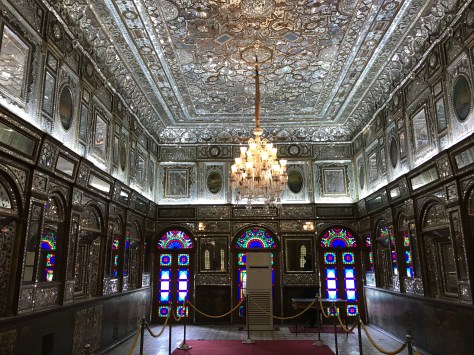
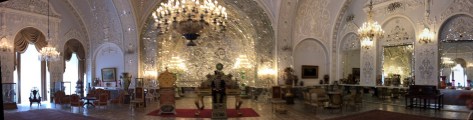
At the Golestan Palace in Tehran, a World Heritage Site, the pre-Pahlavi royalty (within the last 150 years) displayed their wealth and were over-the-top ornate. Most of the public rooms including the ceilings were covered with intricate mirror mosaics and made you feel like you were inside the Hope Diamond.
IMG_1800
Interior with Mirrored Ceilings

IMG_2640

The exteriors demonstrated the integration of gardens and fountains that are
famous in Iranian architecture and design, as well as the intricate mosaic work and marble carving on doors and walls.

The National Museum of Iran contained some of the most precious relics of the ancient world. The statue of Darius I (Xerxes I, from which an opera is based!)  and a panel from the Achaemenid Period in Persepolis are shown below. For those interested, you can scale up the text included in the adjacent photos.

The bazaars in both Tehran and Shiraz contained endless boutiques in a Walmart-sized atmosphere with limited and inexpensive goods from copperware to aromatic spices.

Shiraz

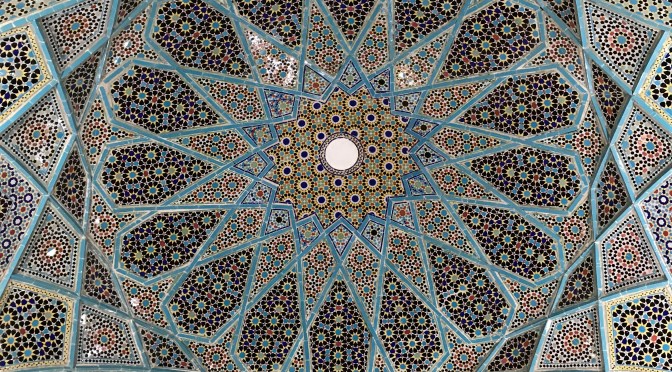
We bonded with our local guide from Shiraz after he passionately described Iran’s native son and poet, Hafez. His elegant poems are beloved by all Iranians and transcend cultures. F. Scott Fitzgerald and Goethe were known to quote his poetry. It was enough for me to determine to read some when I get home.

As we stood in the garden of the tomb of Hafez, Abdullah, our guide, explained that Shiraz is known for its wine, women, and roses. Many of us will recognize the famous wine namesake that comes from this region.

In the evening light, Abdullah pointed out the abundance of young couples strolling in the park, with flowers intoxicating the warm breezes. Knowing a little or a lot about the poetry of Hafez is enough to start amiable conversations and the start of a promising relationship, Abdullah surmises (maybe from experience?)

While Abdullah waxed poetic, we observed that families were out selfying just like any other society, enjoying a delicious evening, and lingering among crowds of friendly visitors.

There seems to be tremendous respect for fellow humans in Iran. So far, we have found the urban environment remarkably quiet. We stayed on busy streets in two cities and found the traffic unusually quiet. Being highly sensitive to noise, I am finding the calm, lack of noise shattering to my ears.

People glide about the streets, smiling at one another with eyes and lips, and salaam each other without exception. I’m not sure our guide has coopted us, but we sense the immense pride and confidence in the people.

Persepolis:

Just outside of Shiraz, on a wide open plain, lies the ceremonial center of Darius. Before him, Cyrus the Great created and led an impressive empire. The wooden ceilings of buildings and both palaces of Darius and his son built around 518 BC were later razed to the ground by Alexander the Great (around 330 BC), but the massive stone structures with priceless carvings remain.

After just having seen the great empires of Rome, Greece, Inca at Macchu Picchu and Aztec in Teotihuacan, it’s hard not to be impressed by the volume and quality of artwork in situ at Persepolis. We could not believe how much of its splendor is still present for the whole world to appreciate.

Were it not from my earliest art history lessons on ancient civilizations and curiosity on its context and meaning, I would not have made this trip.

Everything begins to fall into place, as the pieces of the puzzle assemble. My scant preparation for this trip, thanks to Francopan’s Silk Roads, a New History of the World, captures the whirlwind tour through the rise and fall of Eurasian civilizations. Iran, and more fondly, Persia by the same name, stands prominently at the helm of the Silk Road.

The artwork at Persepolis chronicles the peaceful arrival and acceptance of the local inhabitants to the new ruler. Darius followed shortly after Cyrus (within 40 years), and while not a direct descendant, they were related. Although the local Medians were conquered by Cyrus and the Archimineads, he managed a peaceful settlement and was respected for his accomplishments as a capable ruler. Darius culminated the dynastic rule with his grandiose and impressive complex at Persepolis.

Within the ceremonial entrance and grand reception areas are magnificent stone reliefs of warriors supporting the king on his throne. Rows of roundheaded conquerees alternating with the conquerors proceed to meet the king, hand in hand. Offerings from 23 nations include food, treasures and animals from surrounding areas and those as far as India.

Other friezes demonstrate the high quality of craftsmanship that preceded the Greek and Roman periods revered in history. In a splendid exemplary frieze, a bull and cow signify the end and beginning of the new year.

The symbolic meanings of birds, rings and flowers stem from the ancient monotheistic Zoroastrian and Mithras religions. They did not have a concept of God as a human, but that he lies within each of us.

Individually the symbolism of the characters presented are less significant than the collective splendor of the human mind that is left behind for all of us living creatures today to ponder.

(This post is now formatted as intended. It was created on April 17, 2018 and edited April 22, 2018).

Carry on in Tehran

With all my worldly possessions-and a precious visa to visit in tow, husband Gee Kin and I have just arrived in Tehran, the capital of Iran. We left behind the globalized world of Starbucks, KFC and Macdonalds, to one with brewed tea, fast food chicken legs roasting on an open fire, and lamb kebabs with bread made with pebbles for dimples. We passed tantalizing corner stores filled with pistachios and dry fruits that you buy to take to a friend’s house. Hospitality means alot here, and we can already feel it in the air.

Having just completed a marathon flight in 19 hours (San Francisco-Washington DC-Vienna-Tehran, I was glad to hit the end of the day with a hearty meal of lamb stew mascerated at the table and mixed into a tomato based soup, chicken and lab kebobs, saffron rice, yoghurt dressing, a vinegar-based eggplant sauce on the side, and bread.

Everything is not so different at first blush. Getting through immigration was a breeze and easier than stateside! Tehran has about 9 million people living here, with the active daily working population at around 14 million. Iran is a country of 80 million, about the population of Germany. The mountains just outside of Tehran are over 5,000 m, so skiing is a big attraction for tourists, who normally come from Germany, France, and Italy, but more recently even from China.

Stay tuned for more to come in art and architecture in Tehran and Shiraz, our next stop.

(This post is now formatted as intended and was created on April 15, 2018)

Drawing Marathon

Last week’s challenge to draw 100 people in five days was exhausting but satisfying! It took a bit of planning, but I managed to stalk strangers at the following locations:

1. City College of San Francisco students;
2. UCSF Osher Mini-Medical School evening class;
3. Hollow Cafe on Irving Street, San Francisco with fellow artists Karen and Lorna (in sketches), and Farley’s Cafe on Potrero Hill, San Francisco
4. Sunset Library, Adult and Juvenile Divisions
5. BART late-nite transit passengers and SFO International Airport

100 People 1 Week Drawing Challenge

Budding sketch artists will tell you that stationary models are the best for sketching purposes. Subjects who move around are at free will to ruin your intentions! The worst were those at the airport, who were already crazed and erratic in behavior. The ones in classes were probably the easiest to draw. If you haven’t ever tried it, give it a shot! It keeps you focused and out of trouble.

In order to learn more about developing sketching techniques, I joined the San Francisco Sketchers. There are normally two to three meet-ups a week. The last three included drawing during the preparations for the Chinese New Year Parade, the Annual History Day at the U.S. Mint in San Francisco, and a portrait party.

Last week’s portrait party hosted by author Julia Kay required us to draw each other in small groups of 4-6 sketchers. We started with a 30 second blind gesture using our non-dominant hand, then with the dominant hand. Portrait sketches, as the one you see in the header, were 10-minute sketches. Totally fun, especially getting to see other interpretations of you, as well as of others in the group.

I will continue to draw, especially during future trips. It gives you an entirely different memory experience and way of looking at things.

By the way, take a look at my newly posted world trip 2018 page (on the menu at the top) for details of my upcoming travels!

Islamic Art at the Metropolitan Museum, New York City, and the Grassi Museum, Leipzig

Having visited many fine museums throughout the world and being an avid student of art history, I enjoy venturing beyond the usual Eurocentric and Asian collections to investigate Islamic Art. I also like to pair my interest in art with world history and Silk Road civilizations. I am currently reading The Silk Roads, A New History of the World, by Peter Frankopan. It was recommended to us by Oxford scholar Craig Clunis. It turns traditional thinking about world history on its head and is a fascinating read.

My quest for understanding the Silk Road was initiated a few years ago during my first world journey in 2014 through Northwest China and the relatively untouristic path from Dunhuang through Turfan and Urumqi to Uzbekistan (See World Travels 2014 Page). My current personal research on Iran at the opposite end of my initial travels on the Silk Road  (originally named Seidene Strasse by a German academic) will hopefully culminate in a trip to Persia in the near future.

I couldn’t resist a stop at the Metropolitan Museum’s expanded and comprehensive collection of Near Eastern Artwork.  I two-timed the Michelangelo exhibit, the primary purpose of my visit,  that I saw with my sister in New York last month. The section includes an entire room with a soothing trickling water fountain and narrowly proportioned, elegant tracery windows made to simulate a traditional courtyard. Selected items in the collection are below, some with captions (but not all) .

As a design major in my undergraduate days at UC Berkeley, I learned Western calligraphy styles, such as Carolingian, Uncial, and Gothic. I couldn’t help but want to master the Islamic calligraphic style that now suddenly appeared so beautiful and balanced to me. Of course, learning how to read it would be part of the goal, a simple feat…

My earliest curiosity over the wide stretches between Asia and Europe came from specific designs of “Oriental” carpets, such as Bokhara, Tabriz, Caucasian, and Isfahan. I had no idea what they meant. Lo and behold, the places where they were made exist, or once did.  It was exciting for me to discover that Bokhara and Samarkand in Uzbekistan were also UNESCO world heritage sites.

Below are a representative collection of carpets in the Near East Gallery at the MET. The weavers of the Anhalt Medallion carpet (2nd from the left below) followed a paper cartoon in creating the design.  The carpet is derived from the Anhalt prince of Dessau, whose ancestors may have acquired it through military campaigns against the Ottoman Turks in the late 17th C.

Porcelain was a coveted item from China. In addition to silk, these goods pwere transported along what became the Silk Road. The Sogdian traders based in Samarkand were the kings of the highway, and were adept at managing, bargaining and anticipating desirable goods along the route. In turn, cobalt and copper were brought from the Near to the Far. The beautiful calligraphy and inscription to the bowl below reads “Planning before work protects you from regret; good luck and well being”.

There were only a few sculptural ceramics but I particularly liked the whimsical and creative “bird woman” shown below.

I’m including a few of the beautiful floral-themed beauties that I discovered at the Grassi Museum in Leipzig (descriptions are in German) below, to compare with those from the MET.

The featured map above also comes from the Grassi. I could stare at maps like these forever, to contemplate and realize how little we know about the vast array of significant dots between Europe and Asia. You can’t really study the Silk Road without knowing the key place names that put them in time and order!

Michelangelo Drawings at the Met

As an earnest and diligent student of figure drawing, I followed my art instructor’s recommendation to see the Michelangelo exhibit at the Metropolitan Museum in New York City. The drawings are culled from multiple collections, both public and private, throughout Europe and the U.S. I was enraptured by each contour, hatchline, and the shade and shadows that created three-dimensional images on a flat piece of paper. These magical acts come from a discipline unmatched by any other since Renaissance times, and I was able to view these hundred or more performances all at once.

I first joined an exclusive after-hours evening at the Met to digest and sip the information slowly. The next morning, with a courtesy admission, I was able to quickly document the exhibition so I could later savor this encounter with Michelangelo.

Here are a few visual highlights with associated text from the exhibition. They are annotated in the order that resonates the most for my interest in figure drawing:

Portraiture


The Human Figure


Early Precedents: These show how and from whom he learned. The white highlights on tone paper provide contrast and depth to the drawings.


Painting Preparation and Students


Architecture


Sculpture


City Planning


There’s still time to see this magnificent exhibition until February 12! If you are unable to attend, I invite you to please study and relish these reproduced copies carefully. In order to share these in a timely fashion, I have not captioned or annotated every image. I hope you will nevertheless catch the whiff of Michelangelo’s development, intentions, and success.  We should appreciate the wealth of information we now have at our disposal. The contributors to the exhibition are listed below. Congratulations and thanks to the Metropolitan Museum for this incredible effort.

P.S. I wanna be this guy!!

IMG_1390

Nippy in NewYork

Coming to New York in the middle of the winter sounds like a crazy thing to do, but we did. It started as a nippy 18 degrees in New York, but so far it didn’t deter any plans or ability to walk outdoors. In fact, the noticeably fewer tourists, being able to get into restaurants and museums easily, and bargain hotel rates were all incentives for risking unpredictable weather. I came with my sister to show her all my favorite sights that include the Highline, the Mighty Mets (Metopera and the Metropolitan Museum) and the Museum of Modern Art (MOMA).

We power-walked the first morning from Midtown Manhattan and bee-lined down Third Avenue to Balthazar (shown on previous posts) for a brisk three-mile stretch, then made a quick stop to see the 911 Memorial. The fountain, a bottomless pit, was a sobering reminder of that fateful day that changed America and the world forever.

The new highrise developments in the area are stunningly beautiful, including Calatrava’s Transportation Center (also in header above). We headed over to the Highline afterwards for another short walk from 23rd to 34th Streets. Being able to walk everywhere is heaven, and staying in Midtown Manhattan makes everything all the more accessible. We clocked an average of 5-7 miles per day, so felt alert and energized.

My dear friends Lisa and Dick, who have been residents of NYC for over 35 years were ready to assist with event planning.  We started with dinner at Le Bateau Ivre downstairs from the Pod Hotel, tasted wine from the Chef & Sommelier glassware they brought to show us, then met the next evening for opera. Lisa was a bit skeptical of long, drawn-out operas that last well into the night, but the two short, hour-long verismo operas Cavallera Rusticana and Pagliacci were perfect to convince her that opera is a worthy investment.  The music is among some of the most beautiful in opera, so there wasn’t much convincing to do.

Starring Roberto Alagna in both operas, they were emotionally satisfying and the music was glorious. His performance was bright and powerful.  The story about a vaudeville troupe is a play within a play. Canio, the clown, whose wife is in love with another man, must perform his comedy act for the audience even though he is heartbroken inside. In an interview with Roberto Alagna, he commented on how relevant the story is to opera performers, but how unique it was to be sharing the lead roles with his real-life wife, Aleksandra Kurdak. (She played Nedda, Canio’s wife).

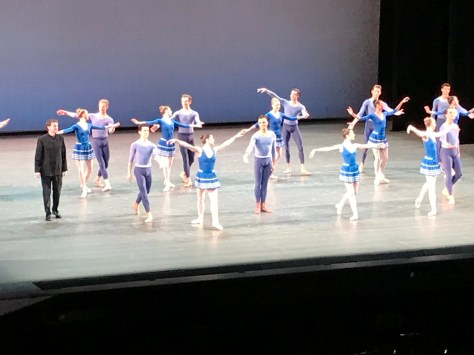
Later in the short week, we were also treated to a performance by the New York City Ballet. This time it was my turn to experience and appreciate dance through the joy of physicality combined with artistic talent.IMG_1537

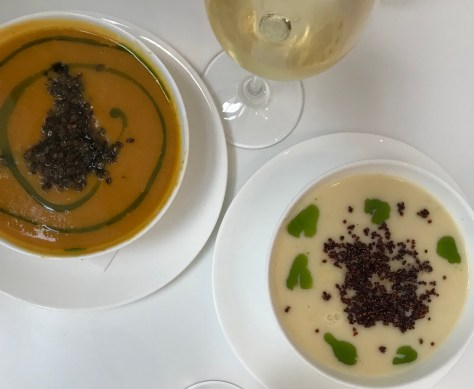
In addition to Balthazar and Ess-a-Bagel, our dining events include Bar Boulud and the Smith (both conveniently next to Lincoln Center), and Pastrami Queen at 1125 Madison Avenue on the Upper East Side. Some creative soups at the MOMA cafe filled both our eyes and appetites.

IMG_8927

When you can park yourself at one of New York’s best kept secrets–the Pod Hotel (at 230 E. 51st Street, between 2nd and Third Avenues) for $75 a night for two in bunk beds with a shared bath down the hall, mingle with international visitors of all ages, and spare the rest for all the food and entertainment in the Big Apple–what’s not to like? I normally do not mention hotels in my posts, but for variety and voracious urban consumers like me, this is it. Originally called the Pickwick Arms, we’ve stayed in this location in NYC off and on for over 30 years. To top it off, the Pod serves Ess-a-Bagels and Balthazar almond croissants in their cafe!!

The extensive Metropolitan Museum’s exhibition of Michelangelo’s Drawings, culled from over 23 sources throughout the world, was my primary purpose in coming to New York City. The private tour I took will follow in a separate post.

…seems it sometimes rains in Southern California…

Coming from Northern California to Southern California and finding drippy rain is a real downer. We Northerners never dispute the better weather LA gets…but what happens when it rains an entire day, causing plans to change and the wet weather gear to be pulled out…when it’s supposed to be an endless summer kind of town!?!

San Francisco rises to the ratings meteorically as a result. Better public transit, food, art, museums. Hands down. We don’t even have to make apologies for the fog this way.

Nevertheless, I continued my independent sketching exercises at the LA County Museum today. A painting of sketchers in an art studio gave me inspiration:

4EB8A603-63EB-4D5B-9942-F3638AC17BC9

Despite a host of Chagalls, Monets and other famous artists, we focused this time instead on a fine collection of German Expressionists.

Each time I explore this period of modern German art, I learn new means and methods for this group. I am drawn to them, not only because I am learning the German language, but because the techniques and emotional content speak to me.

They may even  seem a bit primitive (as in the large wooden sculpture in the featured image above), but apparently this particular artist studied the people and art in Palau, an island in the S. Pacific. Many of the artists have been displayed in museums I have visited in Germany, Chicago, and New York. Particularly those derived from the Bauhaus movement in Weimar and Dessau are represented(Feinnger), but also artists from Die Brücke movement or the Dresden artists were included.

Our antidote to wet days in LA was dining in two restaurants: a new one in the Arts District called Manuela, and an old favorite, Carlitos Gardel.

Manuela displays original artwork, including this mural by Raymond Pettibon.


Gettin’ it at the Getty

During this January’s post-holiday doldrums, we switched plans from an icy drive to Utah in favor of an old-fashioned schlep from San Francisco to Los Angeles. To clue in my international friends, SF-LA is about 400 miles away and it takes about six hours direct by Interstate 5 through the Central Valley.

I had forgotten how easy it is to travel by car. Instead of minimizing and condensing all my baggage and items to be packed like I normally do for international travel  (I usually pack months in advance of a world trip to test out everything), I could really slob out, be disorganized, and rely on last-minute tosses of extra shoes, jackets, snacks, etc. into the car. I’m not sure I like traveling this way, but why not?

We chose to take the more leisurely Hwy. 101 route. After two-hour drives between restful overnight stops in Aptos and San Luis Obispo (SLO stands for Slow Traveling), we beelined for the Getty Museum in LA. My primary goal for coming to Southern California this time was a drawing session at the Getty Museum on a late and lazy Sunday afternoon.

Once introductions were made, the art guide supplied us with pads, paper and written drawing tips for mark-making. The mixed crowd of all ages, both men and women, quickly learned how to hold a pencil six different ways, the benefit of hatching, and how to express emotions.

I was very impressed with the results of other participants. (See group review, above). A first timer but professional photographer clearly had his lighting nailed. If you are looking for a way to spend a satisfying, fun and active afternoon at a world-class museum, this is highly recommended.

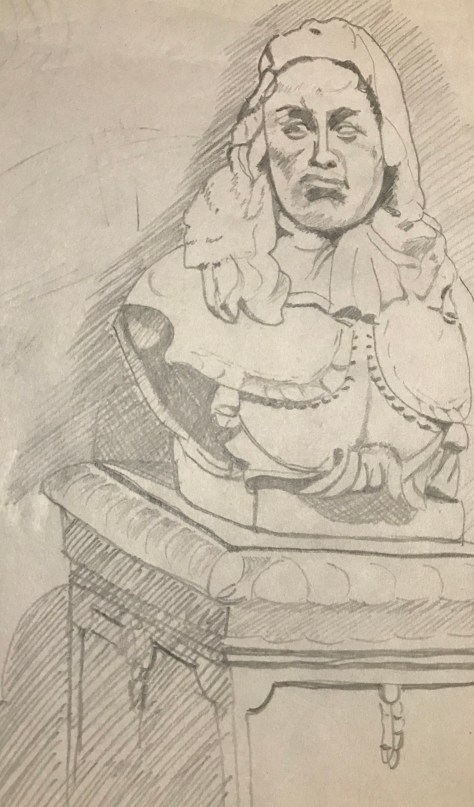
Drawing in a gallery with all the masters is a bit daunting, but it’s much easier in the company of others. After observing sketchers in a few other museums that I visited (the latest at the Art Institute of Chicago), I was ready to try some drawing myself. Below is the result of a bust I attempted.

CC50C058-9F20-4C7B-99CC-5F2937CDF664

Pick Your Poison

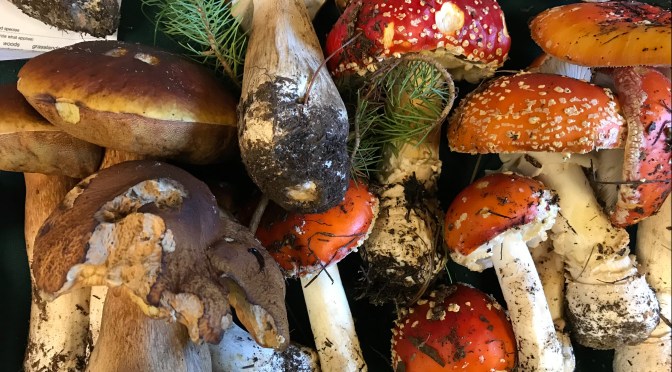
The Mushroom Madness event last week at the San Francisco Arboretum showcased not only the infinite variety of fungi, lichen, and spores that surround us, but it also surfaced many mycological fanatics. Not mythological, but close. In case you ever wondered whether the ones growing in your backyard were edible, this was the place to rub noses with those in the know.

The society reminded me of a similar group of astronomical buffs. When we stayed overnight at Fremont Peak years ago to stargaze, the featured delicacy of the evening, aside from Saturn and Jupiter,  was blue jello hidden below a frothy cloud of white meringue.

We couldn’t resist the Mushroom Soup this time either. Nothing too exotic, but we slurped and savored the mushy mess despite a few lingering trails of what looked like earthy seaweed in the broth.

December is wrap-up time for the academic fall semester. The student art show at City College of San Francisco’s Fort Mason campus brought together many new and old faces. Paper versions were displayed, while friends and family proudly gathered to admire the visual works. Below is a quick scan of a part of the Figure Drawing class exhibition’s earnest efforts.

And last night’s presentation of the SF Opera’s new and upcoming young singers from the Adler Program:

IMG_7894

Birthday wishes this month go to Eric, Melissa, Ruth, Jeff and Sherry!
Continue reading Pick Your Poison