Day 66: a Walk on the East Side: HK’s Mid-Line and Lo-Line

Bowen Path in Hong Kong Island’s Mid-Levels is a recreational path that preceded New York’s Hi-line Park. It provides respite and solemnity for Hong Kong residents, retirees, fitness fanatics, ex-pats, and amahs. Today I made a point to revisit an old favorite.

Much of the character is still there, with views of the world just beyond–Happy Valley Race Course, the Central higher-than-thou buildings of latter-day development, the newbies trying desperately to jam themselves in the tiniest of vest-pocket infills. They compete with the up-front views of 100-year old banyan trees, magnolia, daphne, and faint (real or imagined) scents and memories of yesteryear’s flora. A few of the vestiges of the past survive: the makeshift Buddhist shrine where paper money and incense was burned in honor of the departed; the badminton court; the lover’s hill.

But a disturbing impingement on this idle and fragile environment was undeniable: a score of new building sites and developments with green tarp were shrouding the railing ominously, trying their best to appear benign, and hogging the footpath like obese animals trying to tiptoe quietly.

I could barely decipher the building where I used to live. It was dwarfed by other developments, institutional and commercial alike. The Hopewell Centre, a round monstrosity from the late seventies, struggled to maintain its prowess from forty years ago. It clung by its fingernails and still managed to just top other newer developments in the area.

At first I tried to let go and allow all the messy and complex engineering calisthenics have their day. The construction blight seemed to be very simple: who are we to stand in the way of progress? Everyone needs a better place to live and work. But after seeing a desperate protest against construction of a road connecting to Bowen Path, I renewed my resistance to change.

This might be the last gasp for Hong Kong. Hong Kong may not have control over its fate, but this is, like a waterfront, something that is needed for its community. Its identity, well-being, and sense of place needs to be preserved. It is one of the few accessible and free walks in Hong Kong that can be appreciated by many future generations to come.

Photos, top to bottom, left to right:
1. Map of Path
2. Pastoral view of Path at daytime. About 20 people encountered along a 1 hour walk
3. View of Happy Valley in Distance
4. Complex Drainage System. Bowen Path manifested serious slope stabilization challenges and water from Victoria Peak can be torrential. Only 15% of Hong Kong’s land is build able due to very steep slopes into Victoria Harbour.
5. Reminder that trickles of nature can still survive despite human intervention.
6. The beginning of the end. Initial peace interrupted by massive construction sites along path and in Wanchai Gap
7.a wreath around Happy Valley
8. The steep pedestrian path to Kennedy Road
9. Hopewell Centre, a monstrosity at the time that is now barely a landmark
10.PR campaign explaining slope stabilization Projects
11. Practical sign indicating toilets ahead, but also how far away in time and distance! Now that’s something useful!
12. Grand View Tower, post ex-pat living, with a view to Bowen Path


LATE FLASH: here’s the Saving Grace! See my photos of North Point’s waterfront walk that equates to NYC Hi-Line in quality and functionality!

Day 65: Shop til You Drop

The purpose of my stop in HK was to visit with old friends. But it’s still irresistible–there are so many shops that you feel guilty avoiding them and not taking up the free AC at the front of the shop.

1. The equivalent of old Maxim’s Fast Food in the MTR at still not to be beaten prices–rice box with duck for less than $5US.

2. Apple Store flooded inside, even without a fancy staircase

3. Apple Store outside selling IPhone new release

4. Causeway Bay: the classic corner that takes 20 minutes to cross at peak–this was a sleepy weekday at lunch hour
5. more IPhone bargains
6. Boutique Deli items–Freeze-Dried Truffles, Chocolates, and other gourmet goodies
7. In case you are looking for snakeskin Remote-Control covers, hand over your $$$

Day 64: HK MTR and Vertical Cities Symposium

Hong Kong was one of my old stomping grounds, so I was particularly excited about seeing old friends. After graduating from architecture school, I arrived here with $100 left in my pocket and a determination to work here for a year. I ended up staying for seven. Gee Kin and I met in HK, and, well, the rest is history.

I’ll tell you more about the my day traveling on HK’s mass transit system and today’s seminar on Vertical Cities that I attended through the annotated photos:

1. This was the interior of the car in the MTR system. After nearly 40 years since I first worked on it while it was under construction in 1976-78, the system has held up well. I remember trying to introduce some of the BART system concepts to the British who controlled development of the system at the time. They were not interested in the BART fledgling system, which was barely 10 years old at the time. Being true colonials, the engineers preferred to utilize the London tube or British Railway system as their precedents.

Nevertheless, it’s an efficient, well-maintained system. It hardly showed any wear and tear despite its mature age. I was told that there are some delays and breakdowns that are only just beginning to appear, but the system has run well until recently. This photo is a general overview of the train interior.

2. Cell phone mania is not particular to China. 5 out of 8 were actively using their cell phones in this cluster of people. If I had taken photos in other cities I visited, they would have been similar, and maybe only nominally lower in numbers.

3. A shop, inside the MTR selling pastries. The two unusual items that caught my eye were green tea and fig rolls (that I tried) and squid ink, tomato, olive and pickle pizza (that I did not try)

4. A upshot of high rises near Garden Road.

5. Speakers at the Asian Vertical Cities Symposium sponsored by the HK American Institute of Architects at the Asia Society

6. Asia Society Walkway design by Tod Williams and Billie Tsien to protect the local bat colony near HK gardens.

7. Flower arrangement in the Asia Society Building

The symposium consisted of an afternoon of presentations by local luminaries, followed by dinner and conversation. My good friend Peter Basmajian, a local HK architect who has lived in HK over 30 years, invited me to join him at this event. I also reconnected with George Kunihiro, a fellow architectural classmate from UC Berkeley. We had not seen each other for nearly 40 years! He happened to be visiting Hong Kong from Japan, where he now works.

A few salient comments from the symposium focusing on transit-oriented, high-density vertical cities included the following:

Ken Yang from Malaysia introduced his idea of green buildings and creating continuous linear parks as developed in the Solaris Building in Singapore for an ecological solution

In designing a building as part of a competition, you have to start with something interesting for a competition and end up with something different or unexpected, as shown in the winning design for the Crown Plaza project in Sydney, Australia.

Dinner topics included table discussions on sustainability, livability, affordability, and mobility. Many of the cities discussed include those in China, India, Indonesia, Thailand and Malaysia.

Day 63: With Gratitude to My Role Models

In an earlier post, I mentioned that wanted to be a role model for my family. I just realized that they have been role models for me. Gee Kin is kind, patient and curious. What more can I expect in a partner? He teaches me to be better in those ways by his own actions. On his departure back to the U.S. and my getting ready to head for Guangzhou from Chengdu, Gee Kin still made sure that I had the address of the hotel in Guangzhou where I am staying by myself in Chinese, that I had a little raggie for my dirty little face first thing in the morning, and that I had enough toilet paper to get me through the all-nighter. You would understand these necessities if you have traveled by train in China. I’m still too rebellious and Western-propagandized to accept that dealing with these inconveniences are a personal responsibility.

Despite my denial of these essentials, I reluctantly agreed to take them at the last minute. Yep, he was right. Being on the train alone helped me to 1. Understand 2. Accept 3. Use all of the above. This public confession is a way for me to thank and acknowledge Gee Kin for his caring, patience, and kindness.

Melissa, for all her dedication and focused perseverance of her craft, has taught me the value of finding a passion and working hard at it. She has shown me that fame and fortune lie in one’s own abilities, and no one else’s. I give her a lot of credit for her achievements and a ton for independent thinking. She has reminded me to think more for myself.

And Julianne for asking why. She’s a milder version of Louis CK’s daughter and the skit Louis did on her asking why about everything. Julianne’s training in philosophy got me curious about what it was all about. The book she tossed to me on Schumann led me to Dresden. Her desire to engage people and ideas makes me want to do more of the same.

Chinese are not about bragging (except for material wealth, cars, how much they earn, degrees, etc., but please! never overtly!) For me, I just want to tell my family and whoever reads this that I love them and appreciate them. They inspire me, move me, and are MY role models. What more could you want in life?

Photos: from top, left to right
1. Gee Kin, on Emei Shan
2. Melissa and me, in Paris
3. Julianne, in a cafe in Berkeley

Day 62(a): Race to the Top

Rome wasn’t built in a day, but maybe it should have waited to take a lesson from the Chinese. It wasn’t exactly a day, but how about 5 days? 5 years? Complete with a working mass transportation system. I thought about how many buildings I could name in Manhattan versus those I could name in Guangzhou. Many vs. one–the hotel where I am staying. What’s going on here?!?

I spent today walking around Guangzhou’s new civic center area after I visited their Guangzhou Provincial Museum (Part b of today’s posting). Initially I was very impressed by the overwhelming volume and size of the buildings. This area included the equivalent of a state museum, an opera house, a park, and a huge library. In the end, I have more questions than answers.

I wanted to go to the Guangzhou Opera House, thinking that it was, well, for Guangzhou Opera. Wrong. Upcoming performances include Angela Georgiou (I wouldn’t have minded) and the St. Petersburg Philharmonic. I decided to pass on tonight’s production the Globe’s Midsummer’s Night’s Dream for $40, cheapest seats available. So much for my fantasy to revel in those days when I went to Chinese Opera with my mother in Chinatown nearly 60 years ago.

Zaha Hadid Baby got her commission after battling against Rem Koolhaas. I guess her pebbles made a big splash. You can read more about it in http://en.m.wikipedia.org/wiki/Guangzhou_Opera_House.

After a visit to the museum, I wandered back to the hotel and many buildings caught my eye. First, in general, by the sheer size and scale. I’m posting some for your enjoyment. It feels like an arms race to the top. Who are they competing against? Other designers? Other companies? The region? Other cities in China? New York? I would love to know.

Second, I got fixated on the rooftop finishing. Having just completed the Neurosciences Building at UCSF, I know it was about mechanical screening. OK, saw a few buildings that did that. Some clearly wanted to reach to the clouds and show their mighty height with spires. Ok, get that one too. And then there are the loop de loops.

Well, you might draw your own conclusions. I get the decorative elements to provide some relief from high rise ennui. But I think I am missing something. These architects have left something out of the obvious reasons for me. Any guesses?!?

It did make me think of the little pitched roofs in Germany and the curious blinking eyes I posted back in August. They were unintentionally playful perhaps, but I am not sure I could call these responses to the transitions to sky exactly “playful”. (By the way, my fixation on cranes is also amply displayed here. They aren’t part of the decorative elements of the rooftops.)

Day 61: Beijing Pedestrian Street in Guangzhou

Everything has improved remarkably…the food, the familiar faces, the language. Even the stifling heat and humidity are reminiscent of living in Hong Kong. Of course, the visual scene has changed significantly, and I can say it is virtually unrecognizable. The sleepy colonial version of the city is hidden or missing, and I have no bearings to the city. I headed over to a pedestrian street that was another recommended “must see”, known as Beijing Jie.

The first exciting discovery came from archaeological findings dating back to the Song, Ming, and Yuan Dynasties. In renovating the street in 2006, various layers of the street gates were unearthed. The pavings were preserved and covered in glass so you could see the different generations of paving for this ancient street. Now that was a thrill!

The second came from the wide, but short shopping street for locals. It was Friday night, and everyone was happily shopping or appeared to be. All the usual knockoffs but no top of the line. In the mix were a variety of clever crafts shops made modern and food vendors that differed from the one in Chengdu. These were less touristy and more for the local resident population.

Try Peking Duck sold by a duck skinner paired with an assistant who spread the plum sauce on a crepe and assembling just the right amount of duck. Four pre-rolled snacks for 10 Kwai, or $1.66. I bought some moon cakes and dried pork for my relatives in the Chinese version of Fouchon, all nicely packaged but primarily again for locals only. Lots of original designs and clever spins on old crafts.

And third, a great subway system is in place. I could easily figure it how to get back to the hotel without a hitch. All for the price of 3 Kwai or 50 cents. The high rises are staggering and similar to those in Chengdu, but with less night lighting.
Everyone on the subway missed my taking photos of them because they were intent on their smartphones and thought I was intent on mine. They never bothered to look up or be bothered.

Photos, from top, left to right:

1. There’s a Hi-rise city coming your way…
2. Beijing Street
3. Unearthing of Song, Ming and Yuan Dynasty Street paving and gates below glass at street level
4. Peking Duck to go for a song
5. Electronic big screen ads rival Picadilly or Times Square
6. Man still shops for daily greens al fresco despite modernization
7. Inside Guangzhou Metro station
8. Cell phone mania inside train–a world-wide phenomenon
9. Metro floor graphics for crowd control

Day 60: the Great Railway Bizarre

image image image image

I’ve been traveling with Gee Kin by train for over a week throughout China and haven’t made much mention of the trains themselves except for the nice photos of the attendants on the night train from Turpan to Shulehe. Needless to say, it has been an experience. Since I was able to collect my thoughts on this next to final leg from Chengdu to Guangzhou, a 28-hour ride on my own, here are a few of them to share with you:

1. The Chinese trains have a few sweet touches, like flowers in the compartment, a thermos for hot water (for the instant noodles that everyone brings), table cloths, and drapes that the assistants come in and close for you at night. They also have a waste basket and a stainless steel tray for all the peanut shells and melon seeds that everyone eats on the trains to pass the time.

2. The toilets, well, are there. Modern ones with a commode. Use at your own risk. There’s a shared counter with three sinks. They close the facilities when the trains are inside stations, so you have to plan your strategy. These haven’t changed much since we did our Beijing-HK train ride for 36 hours back in 2000 with the girls.

3. You can buy tickets off the Internet through travelchinaguide.com.
They all worked, and communication was clear. A few blips, but overall very efficient. I am attaching some photos of the K and T trains we took.
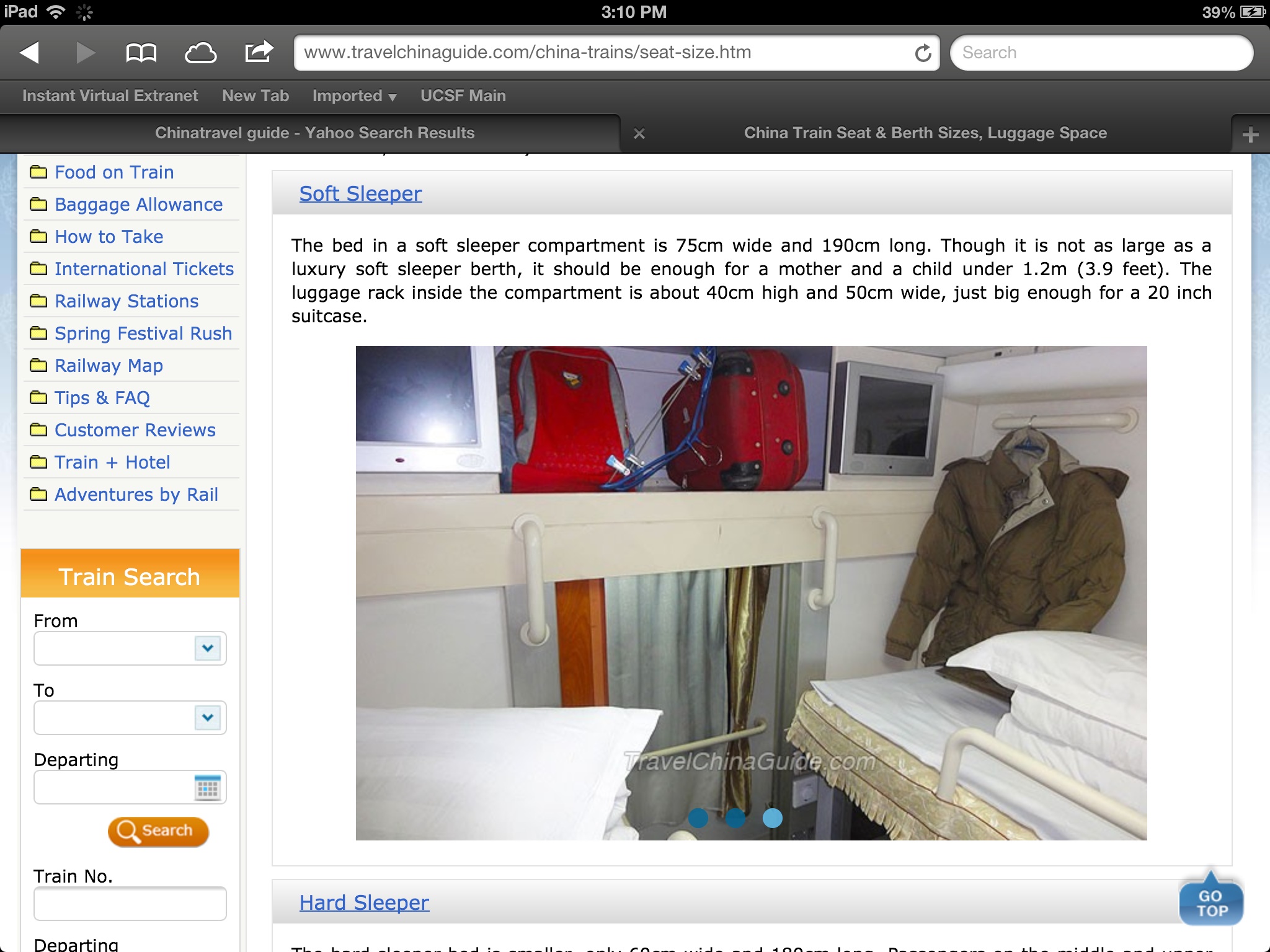
The last one was a four compartment soft berth overnighter (K), and the one Gee Kin and I took to Shulehe was a 6 compartment hard berth version (T).

4. The food service is still decent. Chinese will always manage to feed you, with recognizable elements. The dining room and the takeout food brought to your compartment were reasonable. My breakfast consisted of a hard boiled egg, chopped green beans with spices, pickled turnip, green veggie with minced meat, and congee with scrambled egg.

5. The itinerary I took from Chengdu to Guangzhou consisted of massive cities with high rises everywhere. If you were wondering where the cranes were, they are all in China. Each city is in a massive building boom. There must be more cranes in all of China than everywhere else in the world combined, or at least it feels that way. The point is that no city was recognizable by name, with the exception of Chongqing. And they were all sizeable. Where have I been??? I feel like Rip Van Winkle, who overslept…maybe 5 years?

6. Despite Chongqing whisking right past me, I did see the Chang Jiang (Yangtze River) and portions of Guizhou that were Guilinesque near Guangdong in the morning. There were still pristine rice paddies, but with high rises off in the horizon. A nuclear power plant slipped by, and many many high rises that boggle the mind. Cities the size of Hong Kong seemed to float past, one after another.

Photos, from top, left to right:

1. Breakfast in the dining car
2. aisle to sleeping compartments
3. Dining car
4. view of Guizhou Mountains
5. High rises in distance to paddies
6. List of stops–most are major cities (recognize any?)
7. Screen shots of train soft berth compartment for 4
8. Screen shot of train hard berth compartment for 6 (shown earlier)
9. Screen shot of train exterior

Day 59(b): Olde World Charm on Jinli Pedestrian Street

This is Chinatown reinvented by Chinese for the Chinese. Despite being Disneylandish and very crowded, this recreation of an old street in Chengdu maintained some of its old buildings, walls and facades. It looked like a winner to the Chinese tourists, who were curious about all the vendors displaying their crafts and willing to try different food. There were plenty of demonstrations of brush painting, shadow puppets, Chinese instruments, and food preparation. I found quite a few new presentations of snacks that I had never seen before, so for me it was a worthwhile visit. And of course I was momentarily distracted by reproductions of original Chinese architectural features in the fretted windows of the shops and dining establishments.

1. Oysters and pearls
2. Jellied pudding with spicy dressing
3. Rolled rice noodles with spicy dressing
4. Bamboo with sweet rice stuffed in stalk
5. windows along restaurant
6. Hand painting
7. entrance to Jinli Street
8. vendor selling meat on skewers, dim sum and sweet rice dessert
9. Traditional windows