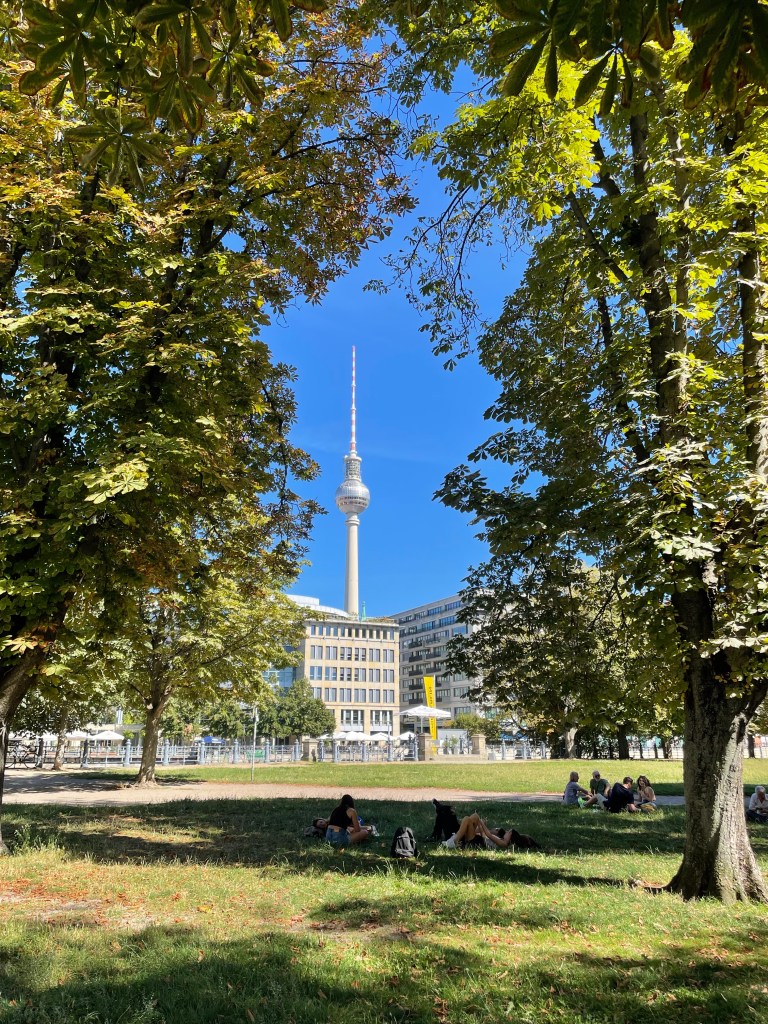
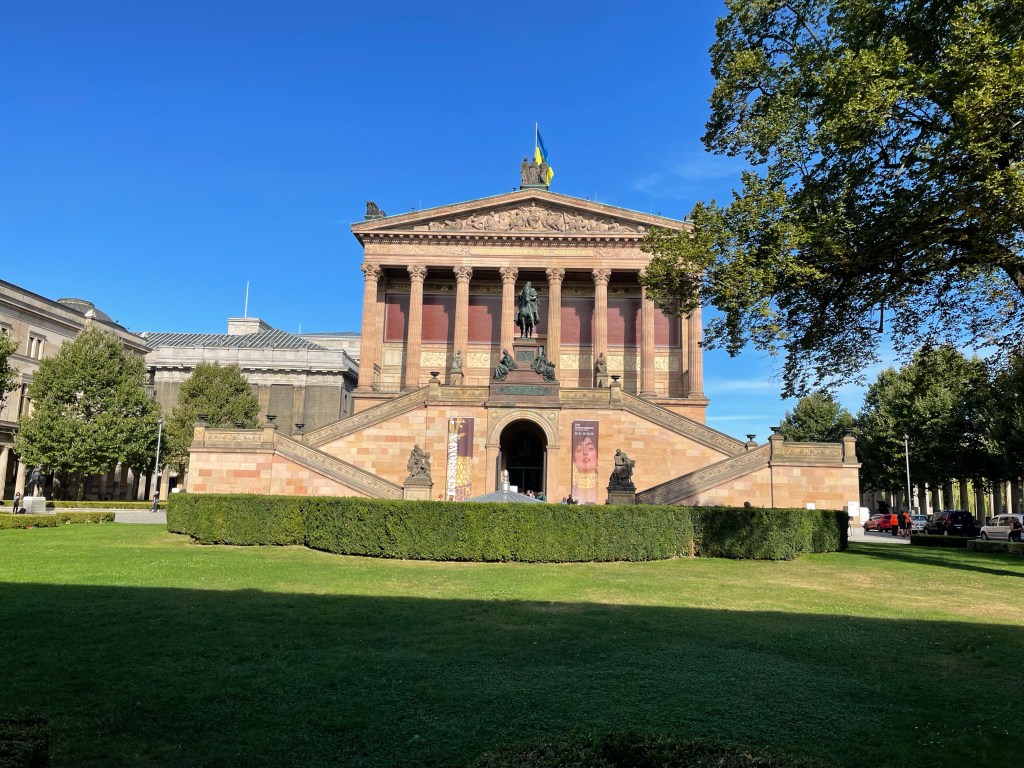
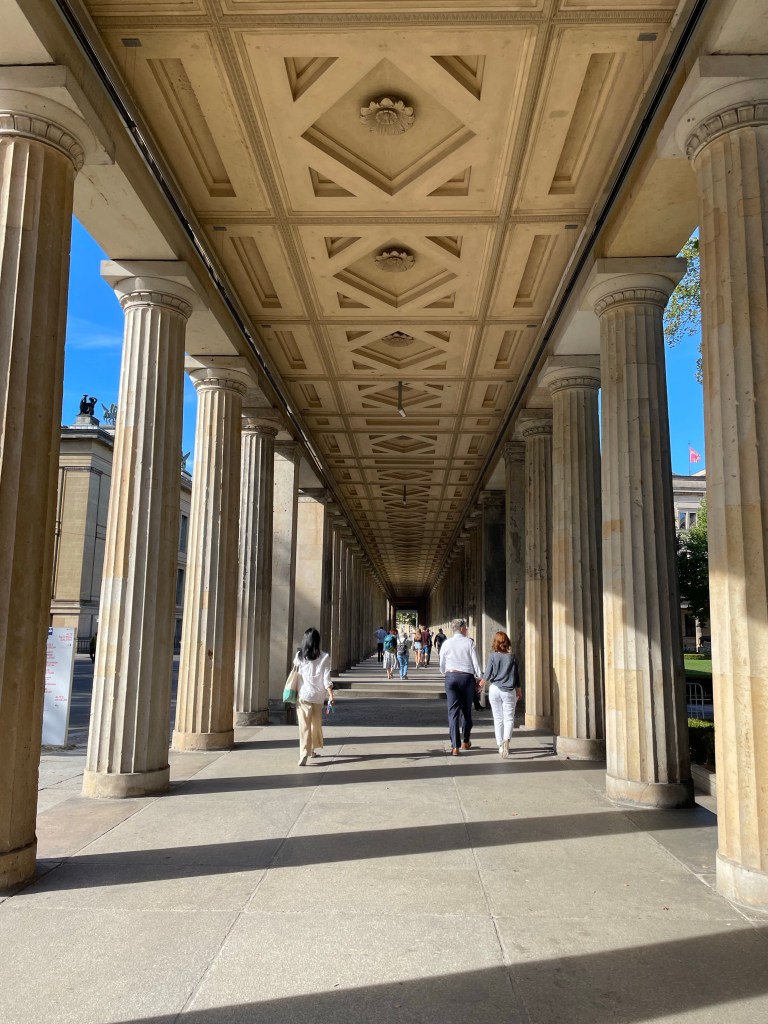
OK, this city has put me on total overload. I headed from Alexander Platz through Haecksher Markt to The Neues Museum. Along a leisurely walk surrounded by waterways and leafy green trees, I was reminded how beautiful the complex series of historic museums had become. Every building was renovated and preserved with the greatest detail and care.
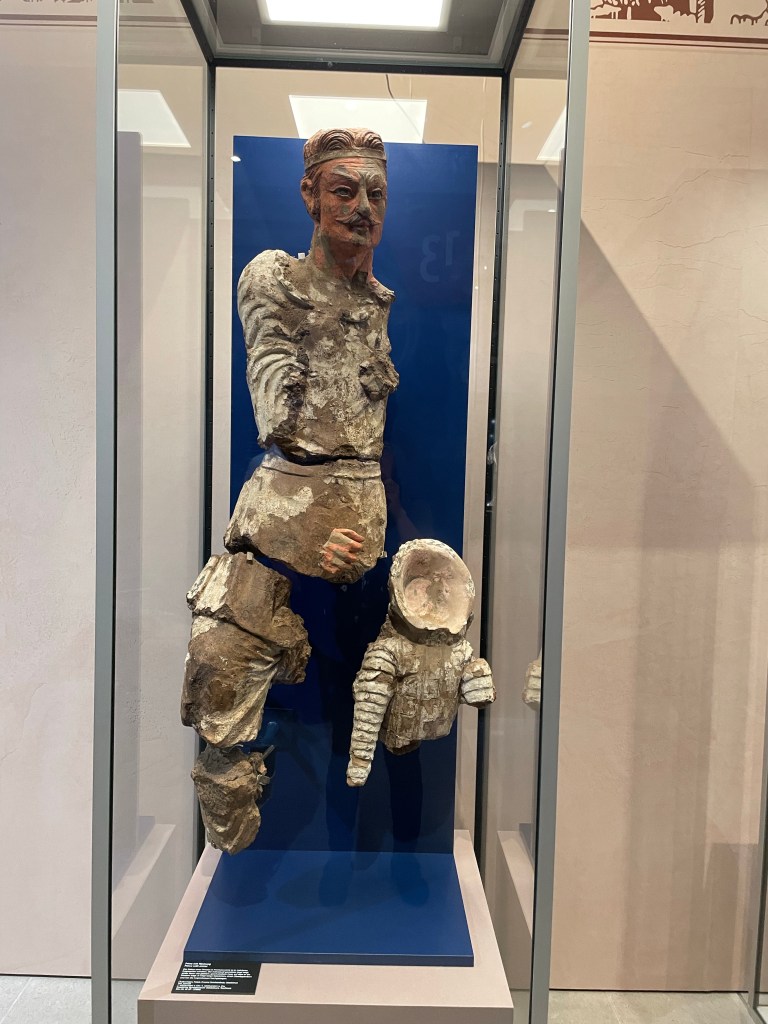
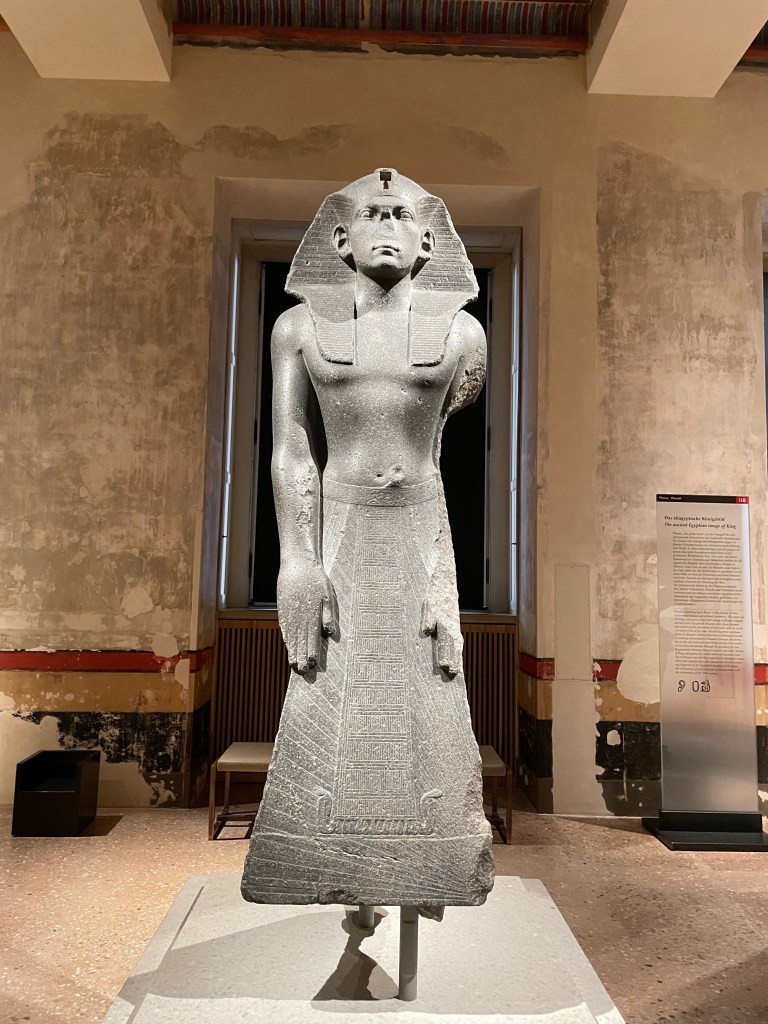
Buddhist Influence in UzbekistanEgyptian Sculptures in the Altes Museum
I found David Chipperfield’s integration of the Egyptian collection with the new wing very confusing. But the inspiring Archaeological Treasures of Uzbekistan exhibit compensated for the building’s shortcomings. The German museums distinguish themselves with superior curating and skill in educating the public with interesting, thorough, and thoughtful research. Most major exhibits are translated into English.
The exhibit introduced visitors to the early influences of buddhism in Central Asia before Alexander invaded and spread Greek culture throughout the area. Later, Arab invaders imposed Islamic culture after Persians brought Zoroastrianism, yet another religion, to this region.
Original Sogdians, a Turkic people, began and traded along the Silk Road. Journeys were not long transcontinental slogs imagined by Marco Polo’s travels. Initially, the Sogdians and others traded in short segments between two posts. Instead of traveling between a long string of pearls from one end to the other, they merely traded pearl to pearl.
Bokhara, Samarkand, and Kiva became wealthy cities from the silk brought by the Sogdian traders. The Silk Road stretched throughout the width of Uzbekistan, from the western Han Dynasty gateway that controlled trade in and out of China, through the trade cities, and on to Tehran and beyond.
Within the exhibit, a quiet sanctuary offered a place for reflection and solace. Visitors could post notes, questions and thoughts about the exhibit. It was the perfect moment to pause and refresh. I contributed a few of my own comments! I felt that I had flown on a magical carpet to Uzbekistan!
Berlin Philharmonie
Although I was able to sketch the Berlin Philharmonie (see previous post) from the outside, the chance to attend a concert inside seemed to elude me. I finally bought a ticket on the third visit to Berlin. The acoustics in the auditorium with more than 2000 seats provided a high quality, enjoyable performance.
An evening with the Israeli Philharmonic Orchestra at the Berlin Philharmic
The Art Supply Dream World
Here’s a tip for my urban sketching buddies:
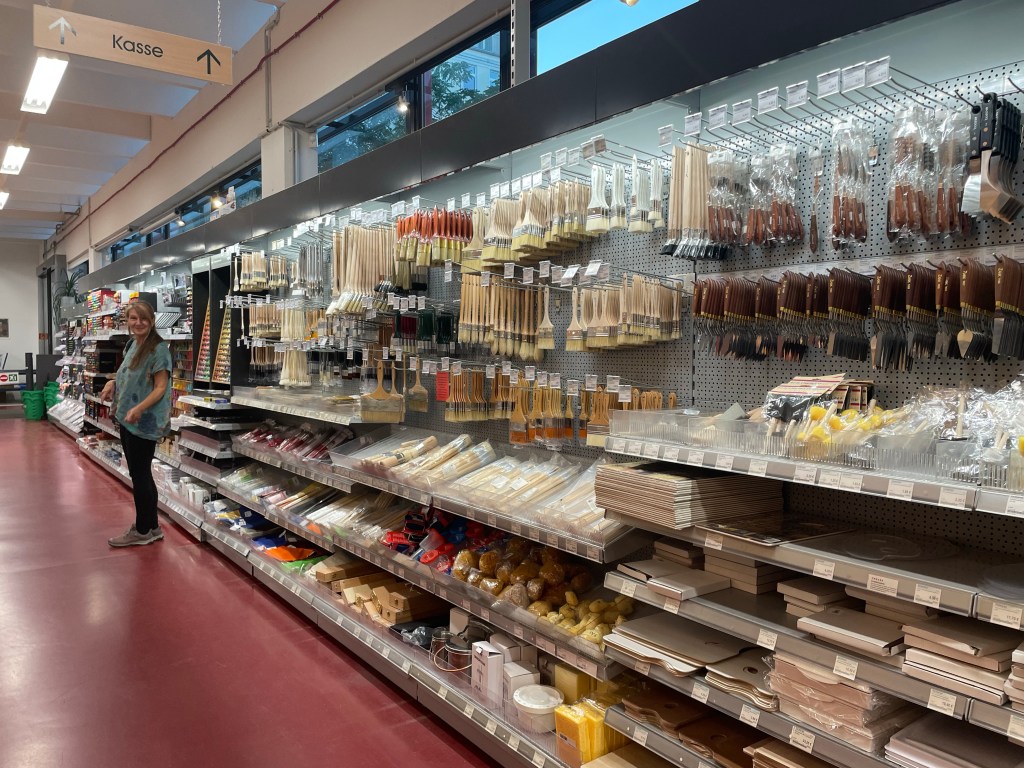
My vote for the best art supplier in the world is Boesner, a German store in Prenzlauer Berg (with branches in other German cities). It satisfies any and all aesthetic and technical needs for artists, including papers, paint, canvasses, brushes and everything else in between. Rooms full of sketch pads, imported papers of endless thicknesses and weights, and sets of watercolors, pastels or pencils increased the dilemma over what to choose. This was a top-flight, migraine-inducing experience!
The next stop is Leipzig, where many famous classical musicians such as Bach, Schumann, Mendelssohn and even Wagner, hung out and made music.
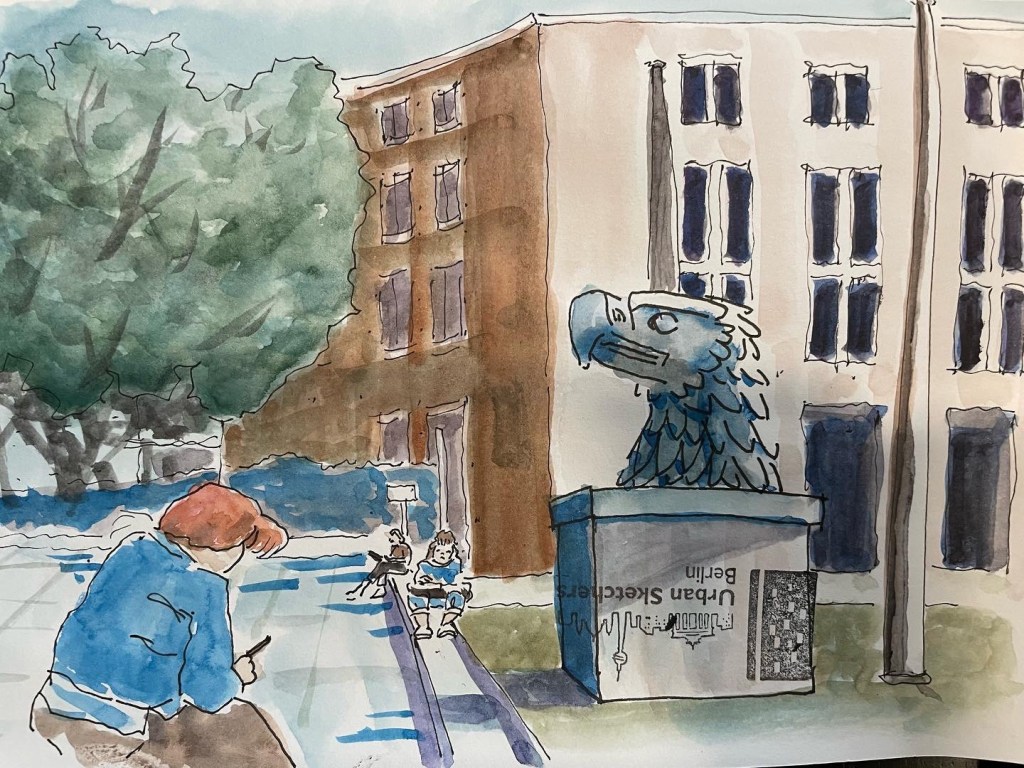
Oh My God. If this is any indication of German Planning, it wins the Nobel Prize! Over 950 participants descended on Berlin this weekend to sketch in over 60 venues planned throughout the city. Everything is free and the organizers simply wanted to avoid extensive sponsorships and risk exposure.
So they simply posted an email offering sketchers to sign up within a specified period of time in July. The response was overwhelming, but they delivered what they promised. Three meeting venues at the Kulture forum, Humboldt Forum and another location near the Brandenburg Gate gave everyone a place to connect informally. Organized sketch walks with tour guides were assigned to each participant.
My first assignment was site of the Templehof Airport, a Nazi creation. Nearby neighborhood housed a delightful Karl Muehlenhaupt Museum. His work, resembling that of March Chagall were child-like figures of gnomes and faces filled with “Liebe, Leid and Lebensfreude”, (Love, Passion and Lust for Life) that immediately grabs your attention and emotions.
A lot of what’s good about Germany hasn’t made it into translated material. This was one of them. Managing my own interpretation is a struggle, but even more rewarding when I discover the depth and earnestness of the German culture.
Today’s venture to the second site was more challenging. The Kurpark near the Golden Reindeer Monument in the park next to the at Rathaus Schoeneberg was outside of the center of the city. Several routes to get to it confused me with indecision, so a late arrival cost me the tour and a chance to meet others.
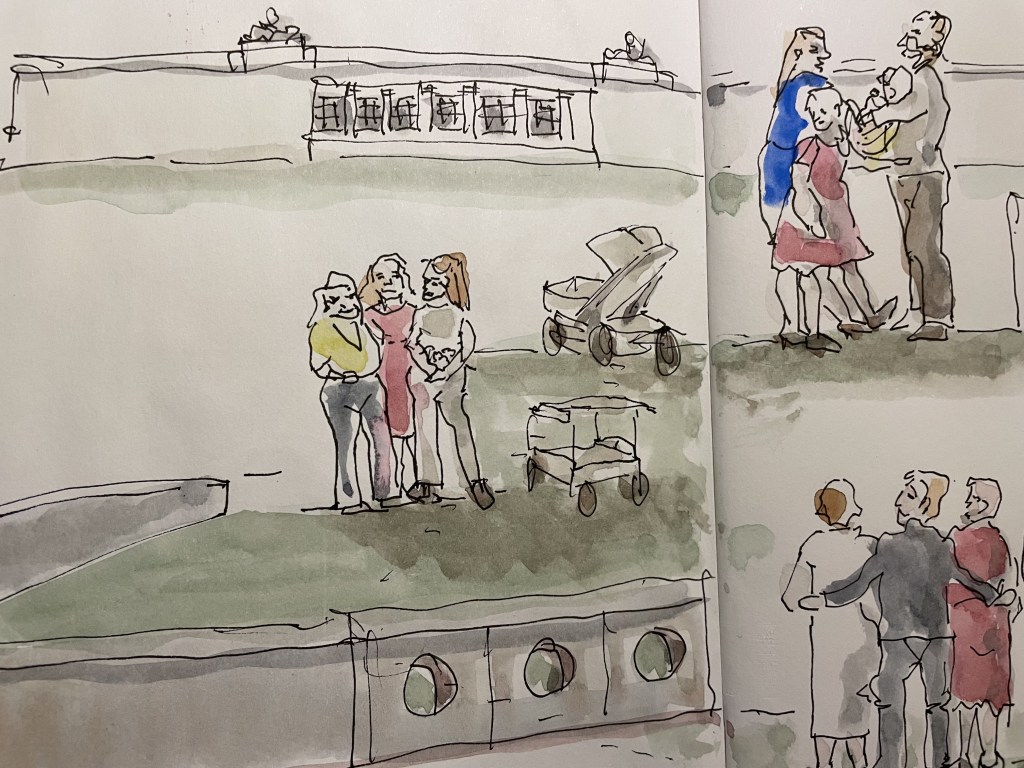
Nevertheless, I forged on to sketch as intended. Suddenly floods of wedding parties arrived as if staged for my benefit. They celebrated their free pop-up event with champagne and formal photo shoots. The park setting was merely a backdrop for me to focus on gestures of dressed-up guests and their animated conversations.
Champagne al frescoPosing for a group picture from the back
The Sketchers met for a photo shoot at the Kulture Forum the previous afternoon. It was a bit daunting to see so many dedicated and talented sketchers. Every sketch seemed more polished and intriguing! The German devotion to doing things well overwhelmed me, from the high-tech weightless sketching stool I spotted, to the super-organized backpacks everyone carried with all their supplies pared down to a minimum.
Bustling Berlin
I’d be disingenuous to claim that I was as dedicated as the German attendees to sketching in Berlin. I was distracted, and exhausted by the myriad events and historic sites beckoning to me.
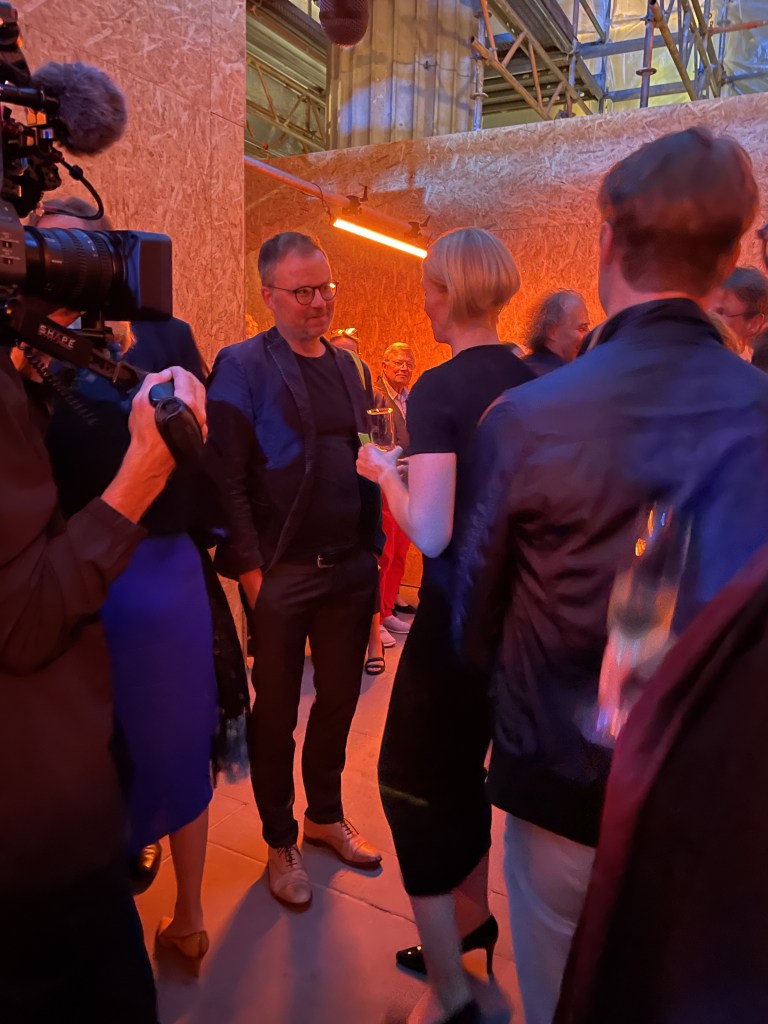
A special concert introducing rising star conductor Joana Mallwitz was held at the Berlin Konzerthaus was held with overwhelming support from the audience. Joana took her time to thank each and every soloist who performed, and took many bows herself. I was lucky enough to meet her and her partner Simon Bode at a reception after the performance.
Debut of Joana Mallwitz as conductor of the Berlin Konzerthaus OrchestraReception and Media coverage after performanceOutside Konzerthaus
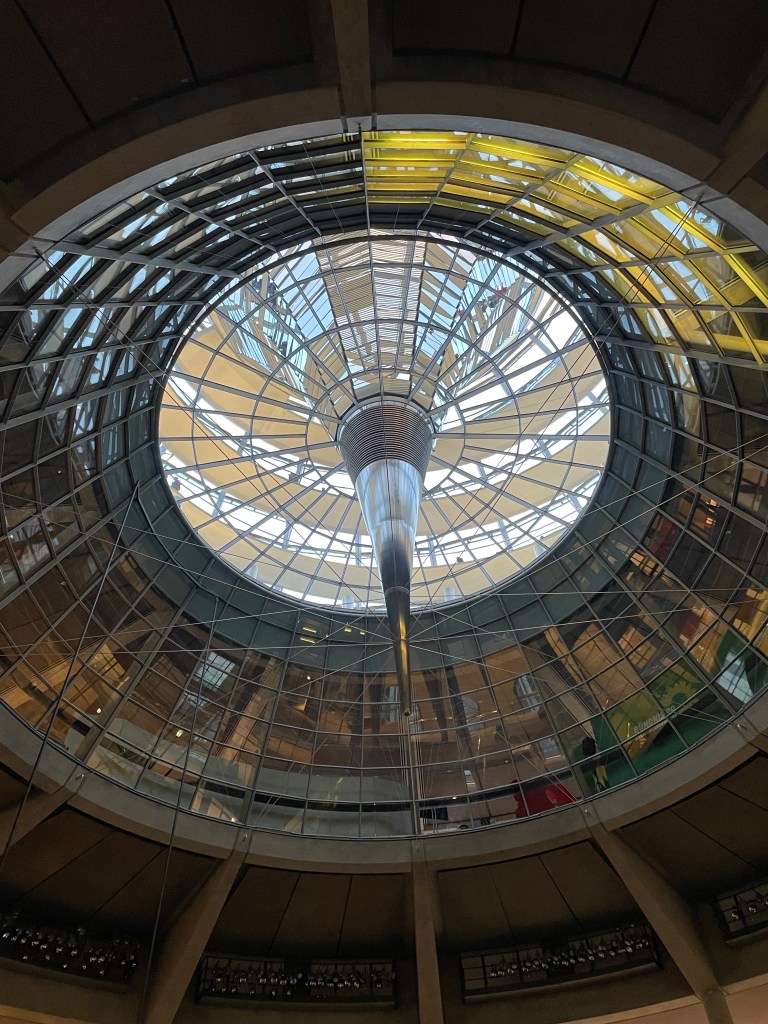
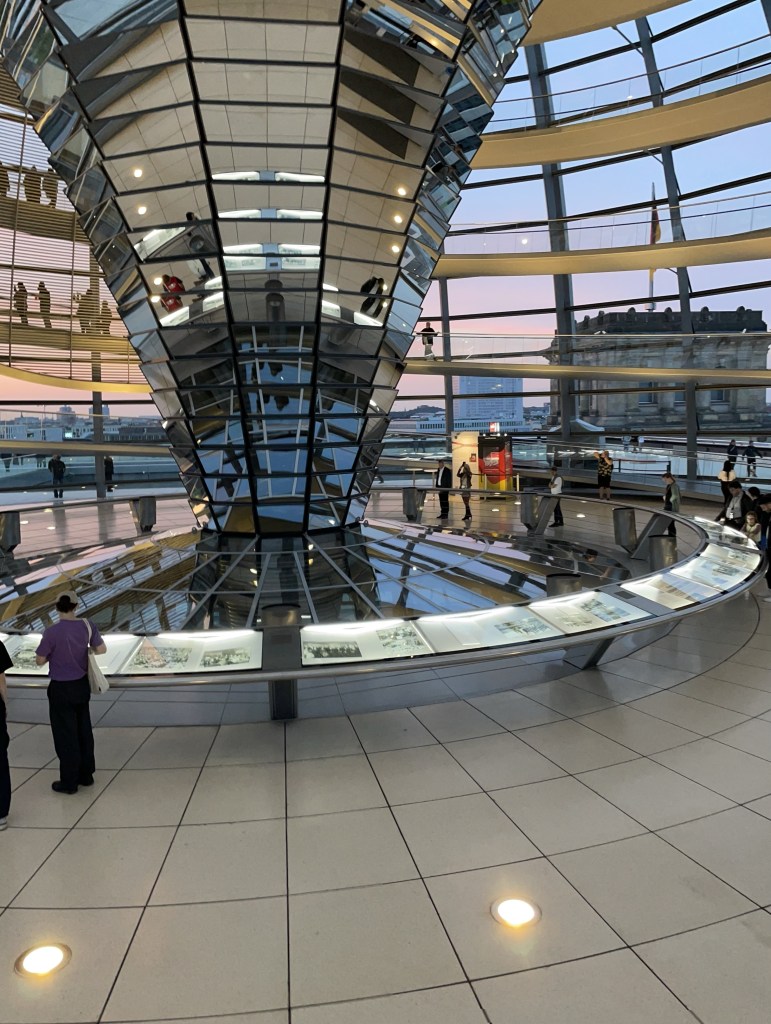
After the sketching photo shot, I raced over to an appointment to tour the Bundestag Building. The tour was tiring and boring at the end of the day, but I realized that I actually retained some of the information. Germany has 15 states that are represented in the Parliament, just like we have 50 states represented in Congress.
Before Perestroika in 1989, the Soviet Union also had 15 states. The Soviet Union was the third largest country after China and India, and larger in population than the US at the time (The Soviet Union had 300 million, and the USA had 250 million).
Today, Russia is just under 150 million, compared with that in the US at over 330 million. With Germany at slightly over 80 million, Russia is twice the size of Germany but half of its original mite. Ukraine is half the size of Germany or at about 40 milion people. It’s no wonder Russia is struggling to keep its former glory and trying to recapture some of the Ukraine.
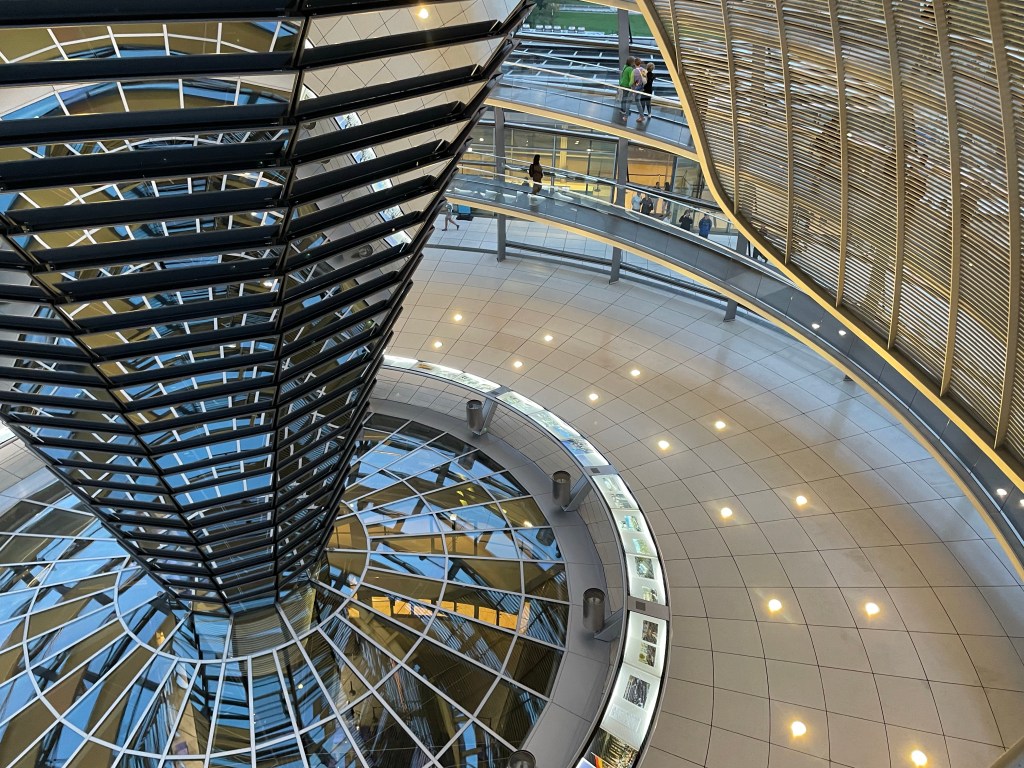
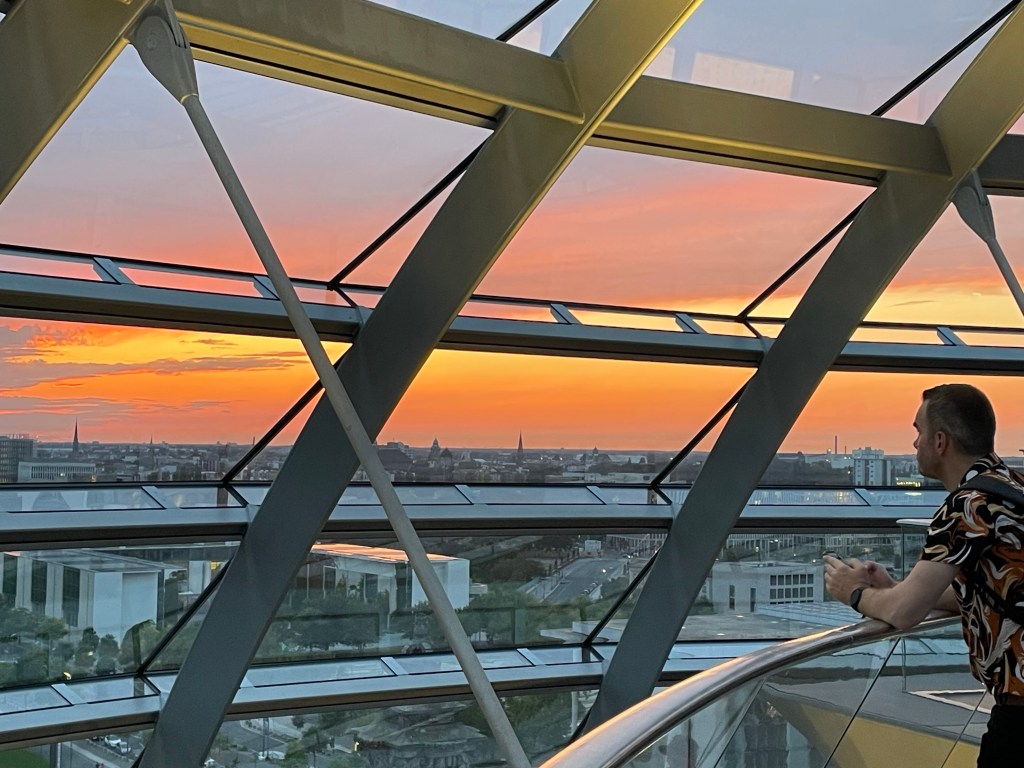
The current history of Germany is inevitably tied to Russia because of the division of Germany after WWII. The Bundestag building still displays relics of the Russians who took over Berlin in 1945. Graffiti was exposed by Bundestag architect Norman Foster who wanted to capture the historic takeover by the Russians. And the design of the building attempts to remind politicians that they work for the people, so the public at the top of the dome can watch over their leaders. Hmm….
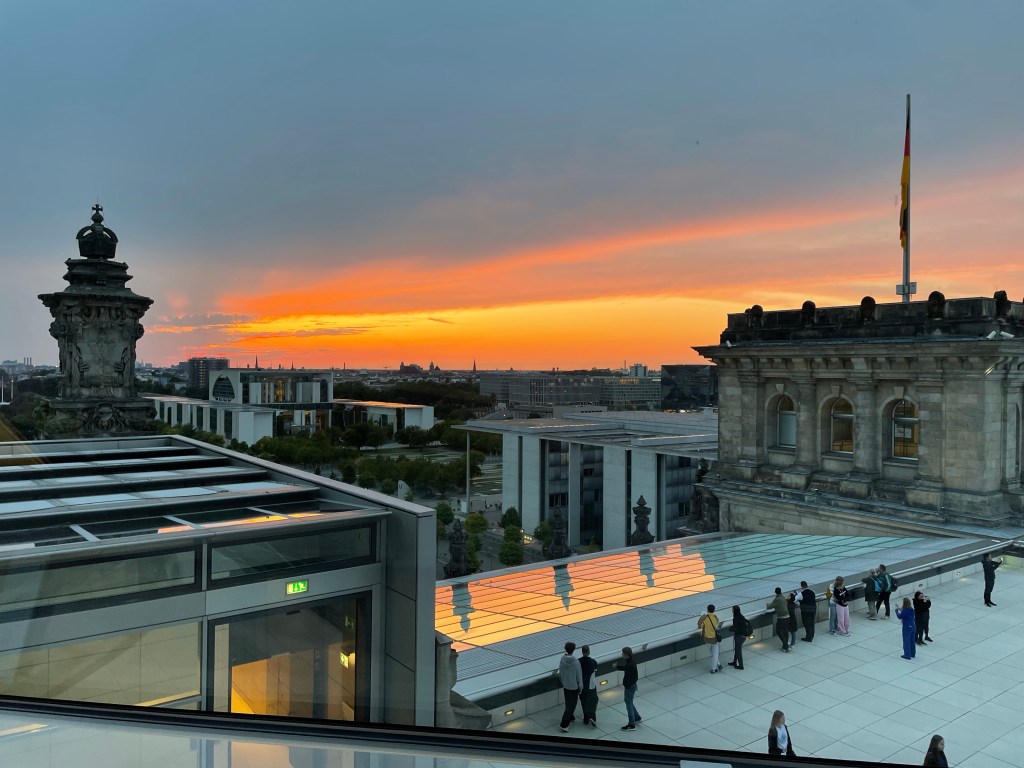
Being at the end of the day, the tour was tedious. Catching the sunset over Berlin made the trip worthwhile. Maybe the tour guide was a little too fixated on two young women who were together–one Russian and one Ukrainian. That did seem to inspire the rest of us to believe that the war will end one day soon.
A walk up the ramp at sunset
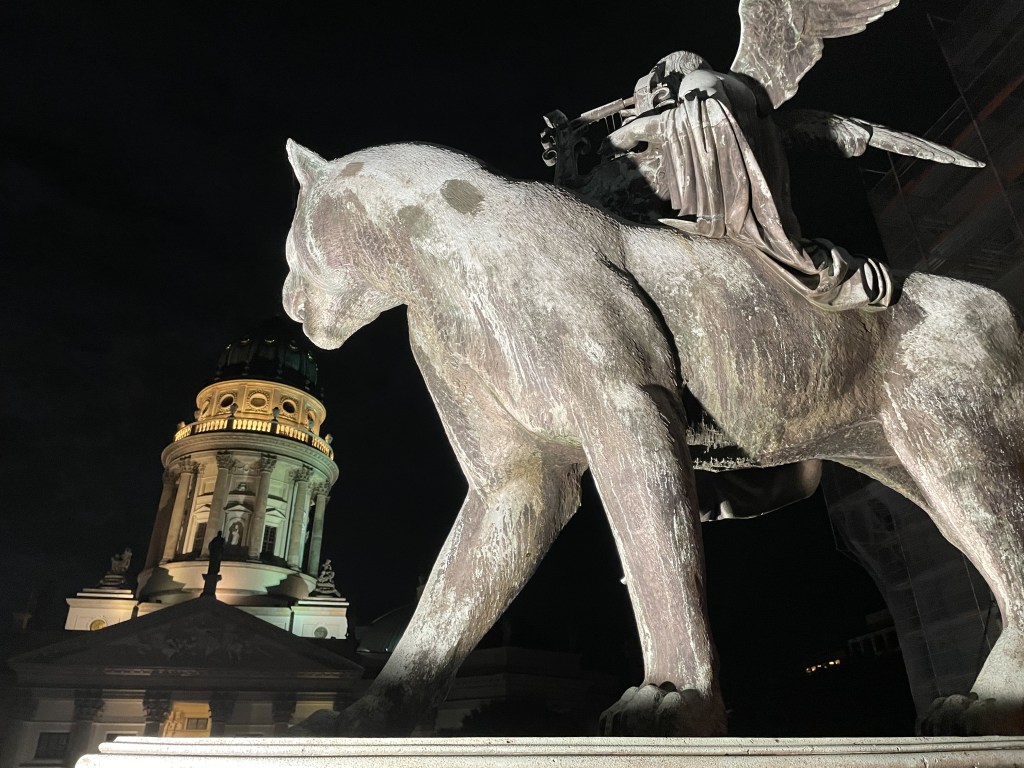
And of course I had to make a quick stop between U-Bahn changes to catch Brandenburg Tor.
Those who know me will wonder how I passed up two world-class opera performances at the Deutsche Oper. But I did. Maybe I’ll catch up at the free annual family event today in between the sketch exhibition, an open house at the Bundestag, or the Berlin Music Festival.
Wagner pompously stated “there’s Bayreuth…and everywhere else. Its hard to escape this dominant patron in the tiny city of 75,000.
This may sound incredibly arrogant, but the attitude is understandable when you are here. It’s an out of body experience to infuse the soul of one of the most enigmatic characters in modern history.
Germans adore their musicians, and support their favorite sons actively with state funding, reduced rate performances, and frequent indoctrination by researchers who uncover new tidbits of information about their musical gods and heroes. If only Americans would be so kind to their own artists and creative community!
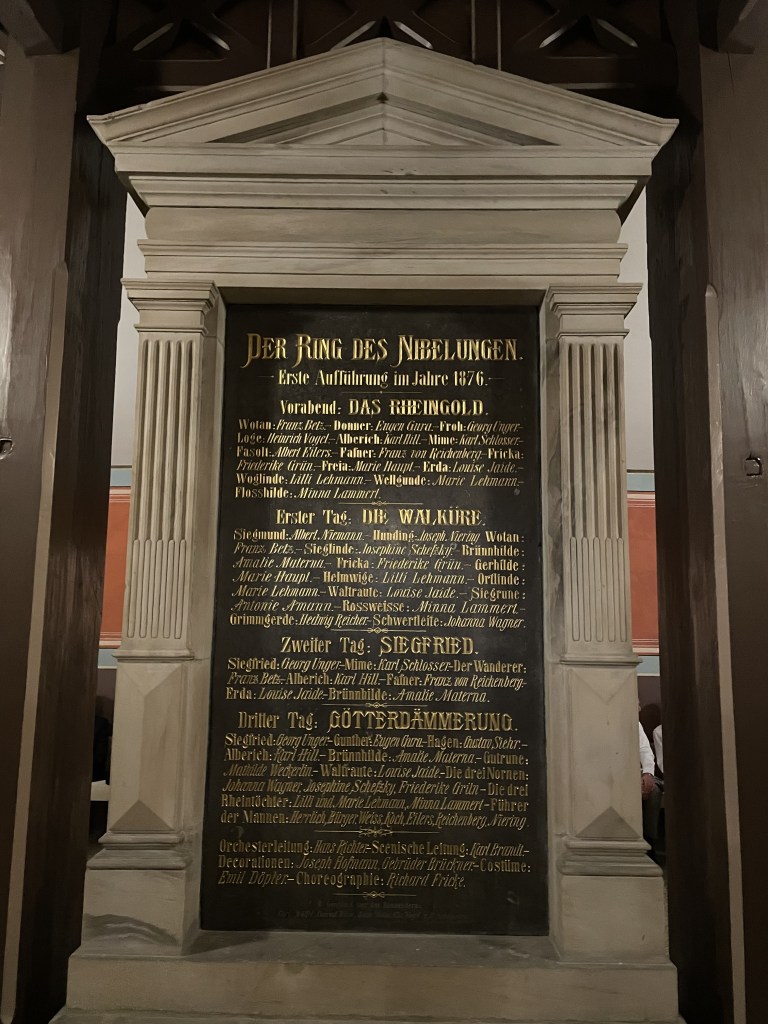
But back to the Wagner drum roll. His family were prominent residents of the town and managed to nab a slot in an idyllic park in the middle of the city. Then he built the festival opera house on a hill overlooking the city to present his work. His Ring cycle, four operas over six days and 17 hours of entertainment, opened the opera house in 1876.
For those unfamiliar with Wagner, you might wonder what the whole fuss is about. It would not be a stretch to say, at least among his disciples, that he represents not only the pinnacle of German opera, but of Western opera.
In the Ring cycle, Wagner not only wrote his own libretti or poems (in this series to tell the saga of a dysfunctional extended family), but he also scored some of the best classical music ever. He was an intellectual snob but succeeded transformed music with emotional skill and content.
Fast approaching its 150th anniversary in 2026, the Bayreuth Festival has been tooting its horn for quite some time. No other musician has attempted to build a monument in which his own works could be performed. Doing so seems pure folly. Wagner went ahead and did it anyway.
There’s no doubt Wagner was anti-Semitic. The Wagner House museum displayed some of his writings, but claimed that it was his family who embraced his writings and promoted them during the Nazi regime.
“There’s Bayreuth…and the rest of the world…”
I don’t know if you know anyone who’s been to the Festival, but I can claim only one other person from the States I know crazy enough to have come here. My friend warned me that Wagnerians take their religion seriously. Members of the Wagnerian society meet regularly, then proselytize after being trained in intricate Wagnerian minutia.
I’m only a neophyte, but I confess to ordering three books on Wagner. I felt compelled to weaponize myself in case my knowledge was put to the test. Aside from a narrative version of the Ring, a German-English paired translation of it, and a scholarly analysis of its music and history, I felt I had earned proof of my devotion to Wagnerian principles and thereby gained access to Valhalla.
The Festival Hall
Nothing too remarkable, except that it perches on a heath overlooking the town of Bayreuth. My accommodation was a fast half-mile walk and perfect for the occasion. The opera house accommodates 1500 eager opera lovers, a cozy size for the acoustics of unamplified voices and the way opera should be heard. That’s nearly half of the 3800 seats in the cavernous Metropolitan Opera in New York City.
The orchestra sits under the stage and is hidden so the audience is not distracted by the musicians. They huddle like Nibelungen in the cave, chipping away and churning out musical notes. Wagner exercised musical chairs to reposition players according to the sound they projected to the audience.
Every seat is a good view. The wide cone of nearly 70% makes everyone feel equal to the best. The down side is that, with nearly 50 seats per row without aisles, you have to skip the cocktail champagne to get into your seat in the middle or incur the side seaters’ wrath. Everyone grits their teeth until the center sitters arrive, then are finally able in domino fashion to seat themselves. By the last half of performances, late arrivals lost their pole positions and got relegated to the edges as others were instructed by ushers to move into vacant seats. That suddenly upped our real estate 10%.
I made the mistake of forgetting that cushions are available from the garderobe. During my first performance of Das Rheingold, I squirmed between drifts of head bobbing. I had not prepared myself properly with an obligatory nap beforehand. Rushing to Bayreuth with three changes on the day of the performance and buzzing from the glamour of being there was a fatal combination.
Catering is well planned for a variety of tastes and affordability. I tried most of every type of station—from sushi to ice cream, bratwurst to cold steak platters. I did pass on the 70€ buffet only because I didn’t think I could gorge on all that was offered within an hour!
The controversy over Wagner’s anti-Semitism lingers. Displays of prominent Jewish composers and musicians who contributed to Wagner’s success were posted. You couldn’t help but wonder if was only a token effort.
The Performances
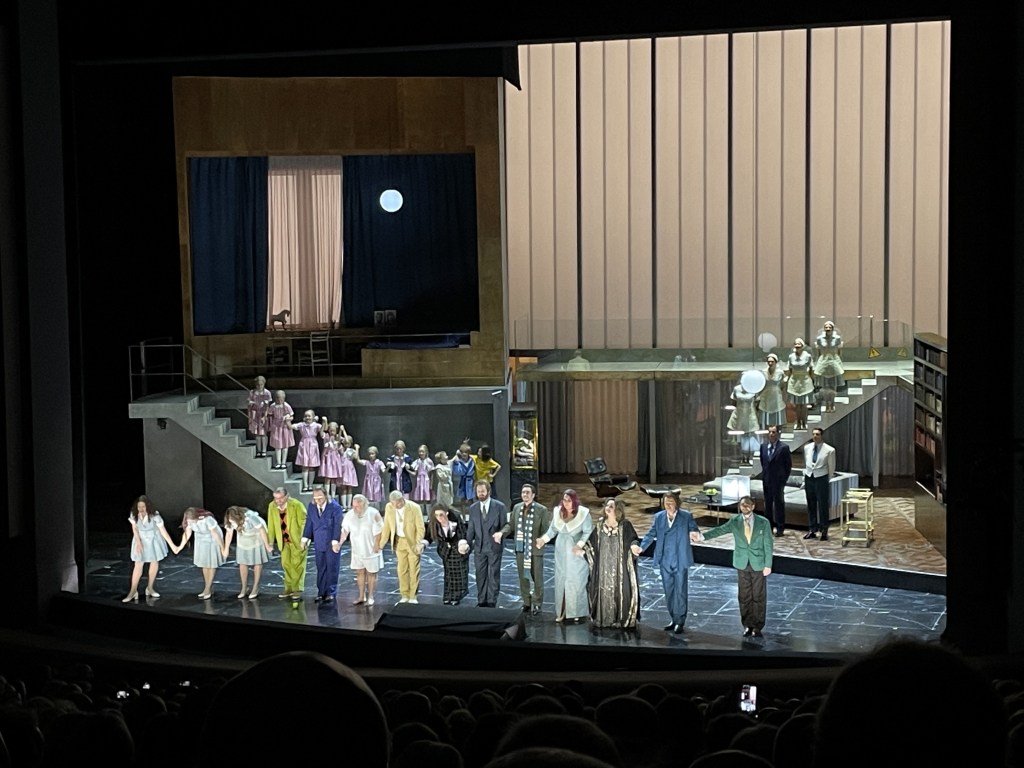
Having now seen all four operas of the Ring Cycle, I was intrigued by the visual changes to the traditional story. Performers wore contemporary fashion and gestured in current body language. Think Kardashians. Think Trump. Think downfall of society.
It took awhile to get whetted to the visual style. The director transformed iconic fairy tale characters into trash behavior. They strutting in stilettos, grabbed guns for attention, and constantly glued themselves to cell-phones. Did we really want to see a fantasy playing out the way we witness life every day?!? Where are my hero and heroic heroine figures that I came to wish upon a star with?
I tried my best to keep an open mind, but I struggled in the end to accept the director’s imagery. For me, an original story with timely relevance today expressed by Wagner in word and song over 150 years ago did not have to be a literal translation. This ironically backfired and left a very bad taste in my mouth not just for this stage direction, but also caused me to question Wagner.
Audience Reaction
Take my one interpretation and multiply it in a room by 1500. One of the most startling and entertaining parts of the evening was witnessing the audience reaction to each performance. The noise level steadily escalated to a crescendo in the fourth and final act of Gotterdammerung.
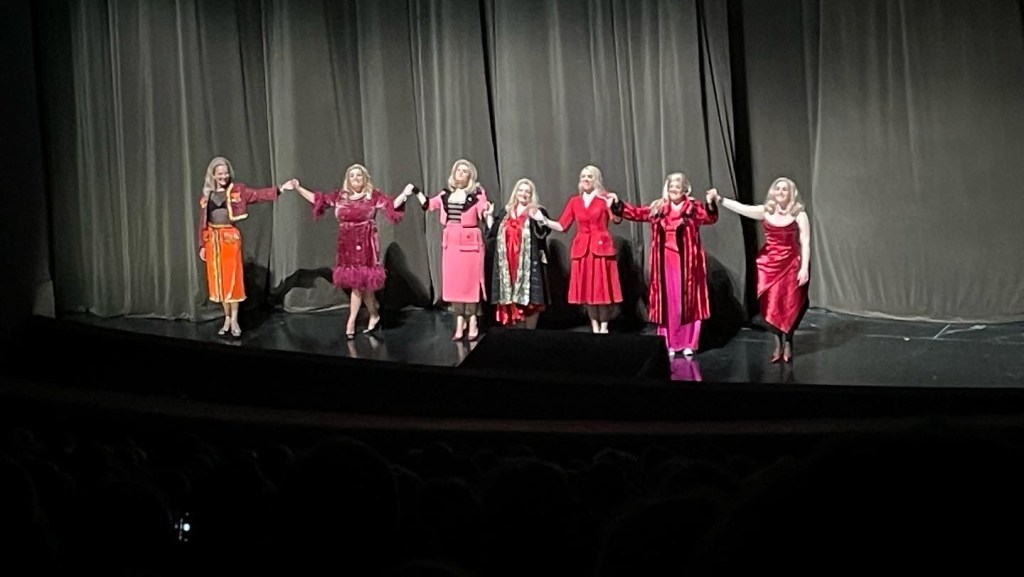
There were two competing aspects: superb singing and horrible visual effects. This is not the ho-hum nervous applause you expect from any American curtain call, embellished with an obligatory standing ovation.
German audiences are much more reserved and discriminating. They give standing ovations for performances that are genuinely exceptional. No grade inflation. But there was no standing here. The Germans were too busy in their seats stomping their feet while clapping furiously for minutes on end!
Simultaneously, wild jeers and boos were spat out while foot stomping. No one rushed off to catch taxis or buses, but remained in the theater far too entertained by the raucous scene to think about lost time. It was just too precious a moment to miss. This is one of the rare times I saw so many genuinely smiling faces in Germany, as if it were the community spirit suddenly unleashing itself. My, what a refreshing group therapy session that was!!
The Rest of the World
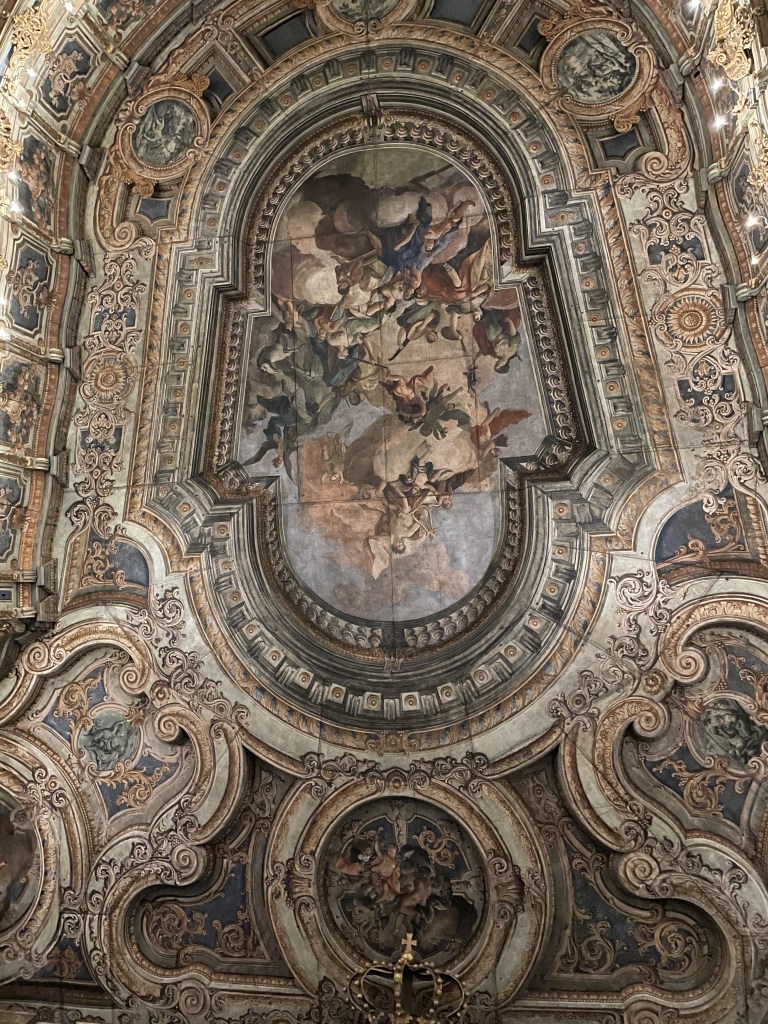
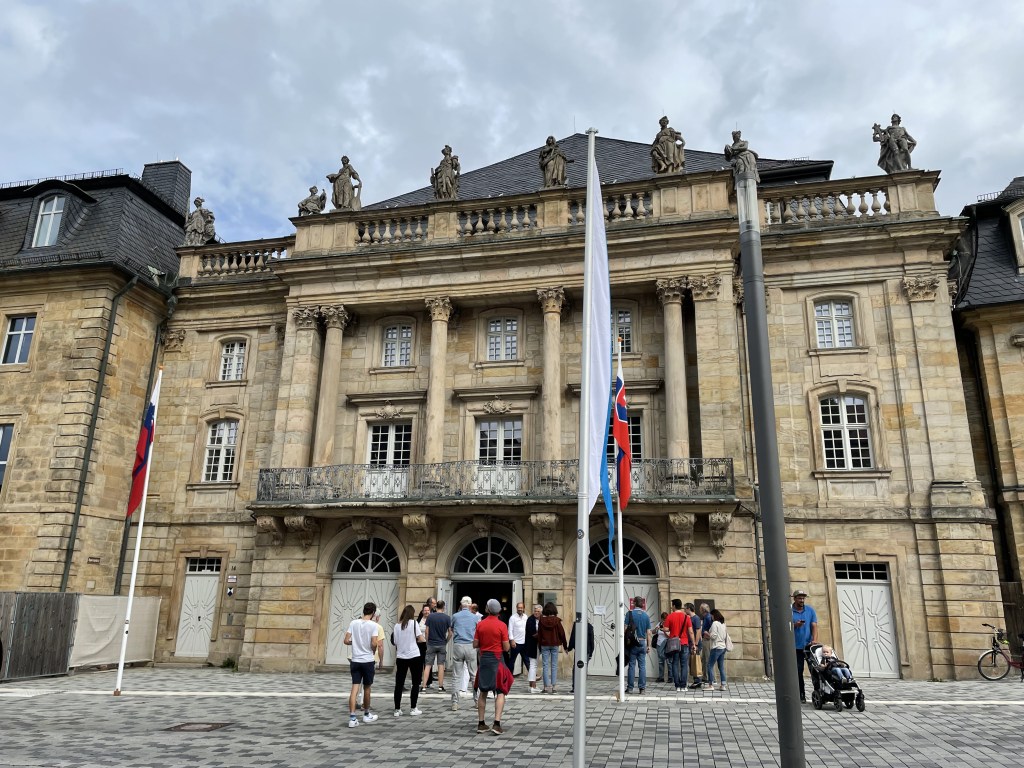
There’s still plenty to see in Bayreuth if you aren’t an opera fan. You can indulge in 1. another opera house recently made a world UNESCO site. Margravine Wilhelmine of Brandenburg-Bayreuth (1709-1758) was the Prussian king’s daughter and favourite sister of Frederick the Great.The baroque opera house was dedicated to the wedding of Wilhelmine’s daughter. An opera buff and some time theatre director, Willy chose high drama to showcase her daughter’s betrothal.
Opera House Margravian, a UNESCO World Heritage site
2. Wagner’s house. OK now we get it. He was of the gentry and came from a prominent family. Nice grounds to prove that Wahnfried deserved its name—to be free and satisfied.
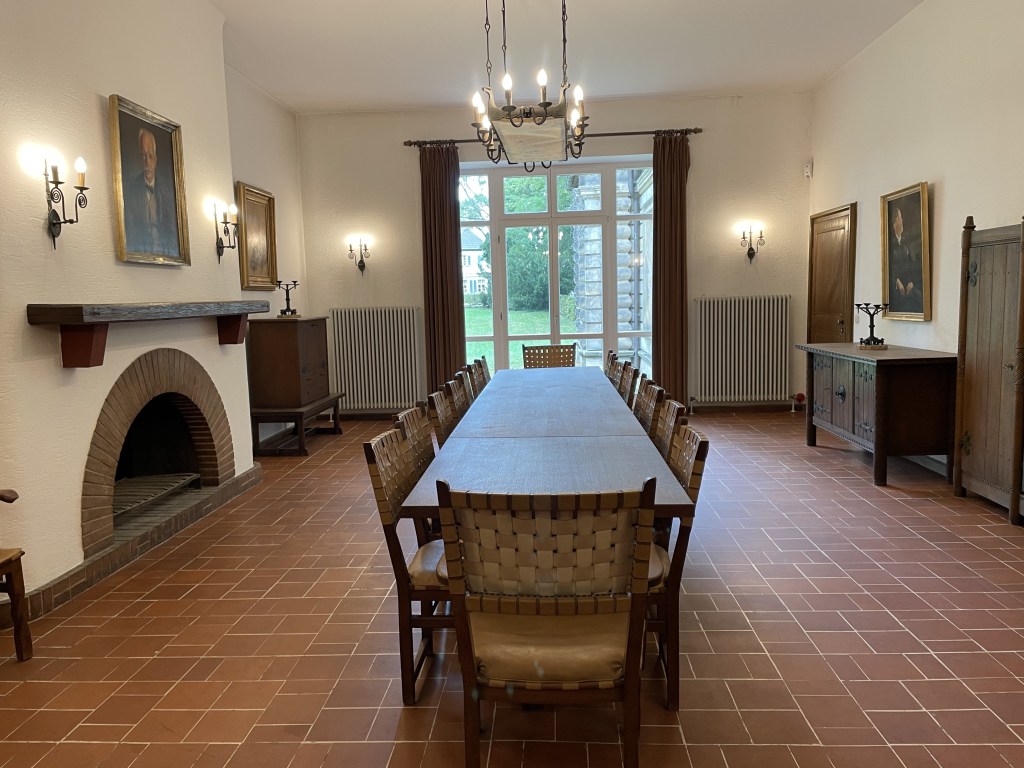
The performance roomUpstairs GalleryThe Dining Room
No, I wasn’t traveling to Bayreuth in the winter. This is a model of the opera house in Wagner’s house. Designed by Semper, it has strong resemblance to the shape and character of the Dresden Opera House that I love. Despite the uncomfortable seating in the Bayreuth operahouse, the acoustics are worth experiencing.
3. The Royal Palace (see header above): the royal court of Markgraf Friedrich von Brandenburg- Bayreuth landed here, and used the mid 1700 rococo facilities to impress and entertain the militia. No doubt a fun place to have a blowout. They even recreated an Italian grotto in a room where you went in full regalia to gawk at an imitation of the real world. Fortunately it was before Wagner’s time or he surely would have left an impression on Wilhelmina.
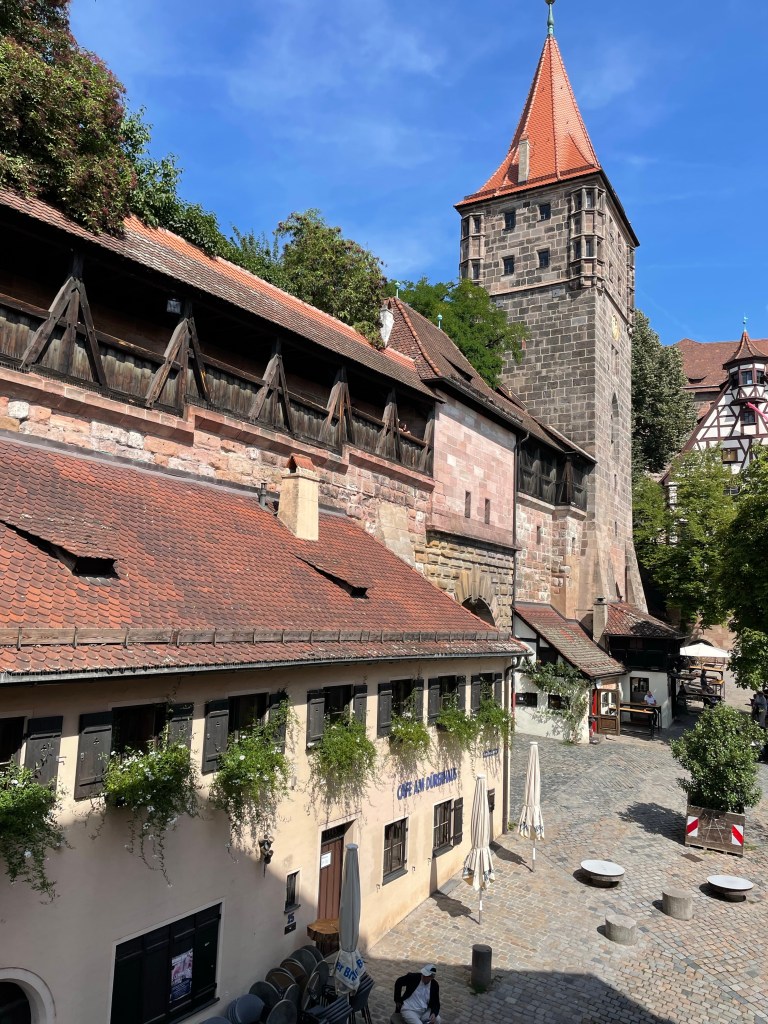
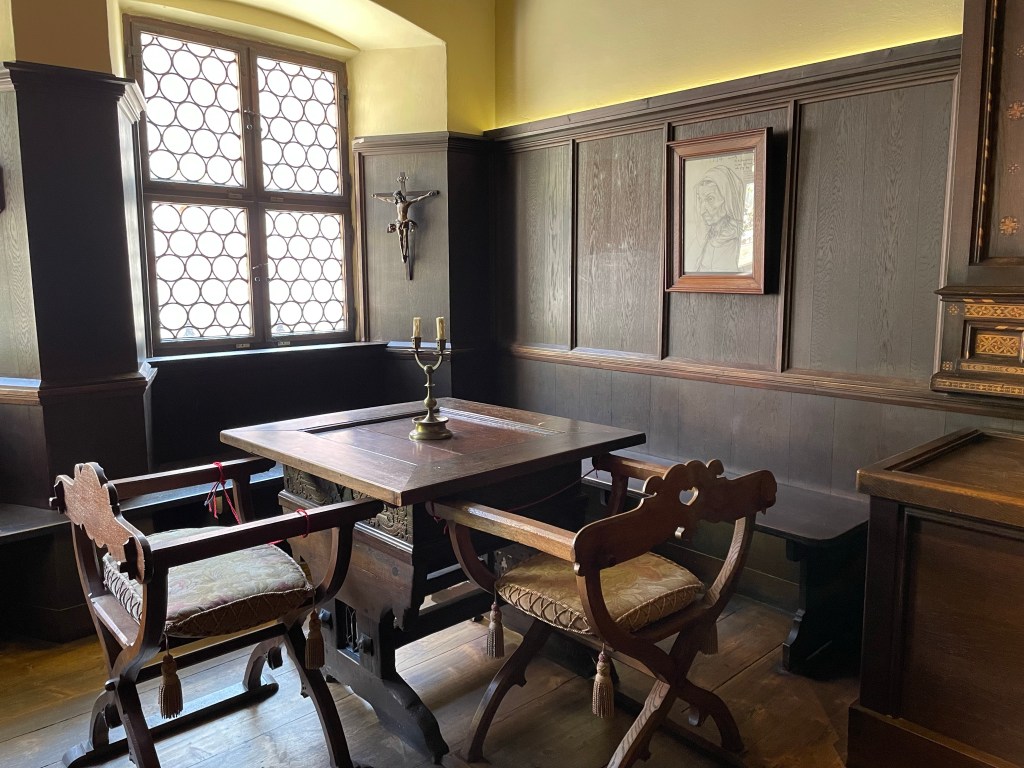
A sojourn in Nurnberg, about an hour and a half by slow train and bus to visit the medieval section of the walled city, where the Albrecht Durer House was located. I also visited the National Rally Grounds of the Nazi Party. It was a vast field of multiple football fields to promote the training and display of military might for the German people.
Apologies in advance for any errors or inconsistent information. I’m a bit rusty! Also trying to post this from my Iphone at the airport before takeoff!!
After two years of self-imposed travel black-out to Europe, I finally decide to take the plunge for an opera trip to the Bayreuth Festival in Germany. After applying for two years in 2017 and 2018 unsuccessfully, I was offered a slot to purchase tickets for Wagner’s Ring cycle for 2022.
Normally all performances are sold out years in advance. You qualify after four years of application. I’m sure the COVID pandemic was a big detractor for many, so my chances of getting tickets were improved. I deliberated back and forth until I was advised by others to “live my life as I would have normally before the pandemic”.
I am taking a break from the past year’s construction project. If you have been following the story of the ADU (accessory dwelling unit) under the direction of Foreman Felix, we will resume after this two week diversion!
Munich–the Gateway to Bayreuth
After a direct flight from San Francisco to Munich, it felt odd to suddenly be plopped out of nowhere to a country that I had studied and admired so much. Being in Germany reminded me of all the reasons I became a Germanophile: Citizens take the environment and sustainability seriously; clean, predictable, comfortable public transportation; appreciation for and attention to architectural detail; and safe streets (except for bicyclists running over pedestrians).
Refreshing my German language studies before coming helped to prepare me, despite a huge reliance on fully capable English-speaking Germans. The immediate sensual experiences were the lush green countryside, church bells ringing, and the distinct lack of smell or taste.
This summer, scores of public transport agencies have joined together to offer a special incentive to use their services. For a flat price of 9 Euros, passengers can ride any of the local agencies throughout Germany for an entire month (June, July and August). You can get just about anywhere in Germany, as often as you want, for the price of a round-trip subway ticket!
Many residents were concerned that trains and buses would be overcrowded. Rush hours and popular tourist sites need to be avoided, but the summer months are normally the lowest ridership. I wondered if statistics were due to the high volume of Germans traveling outside the country during summer months pre-Pandemic. In any event, it appeared that my three changes to reach Bayreuth were completely manageable.
Dachau Memorial Site
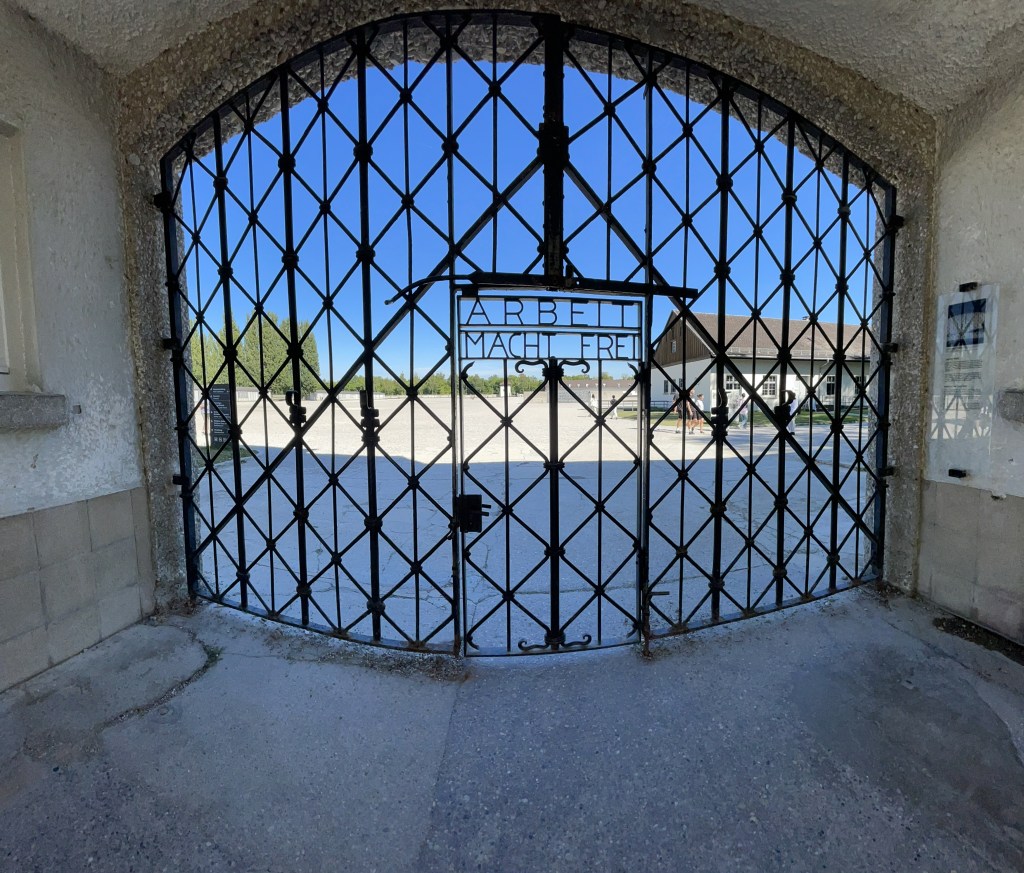
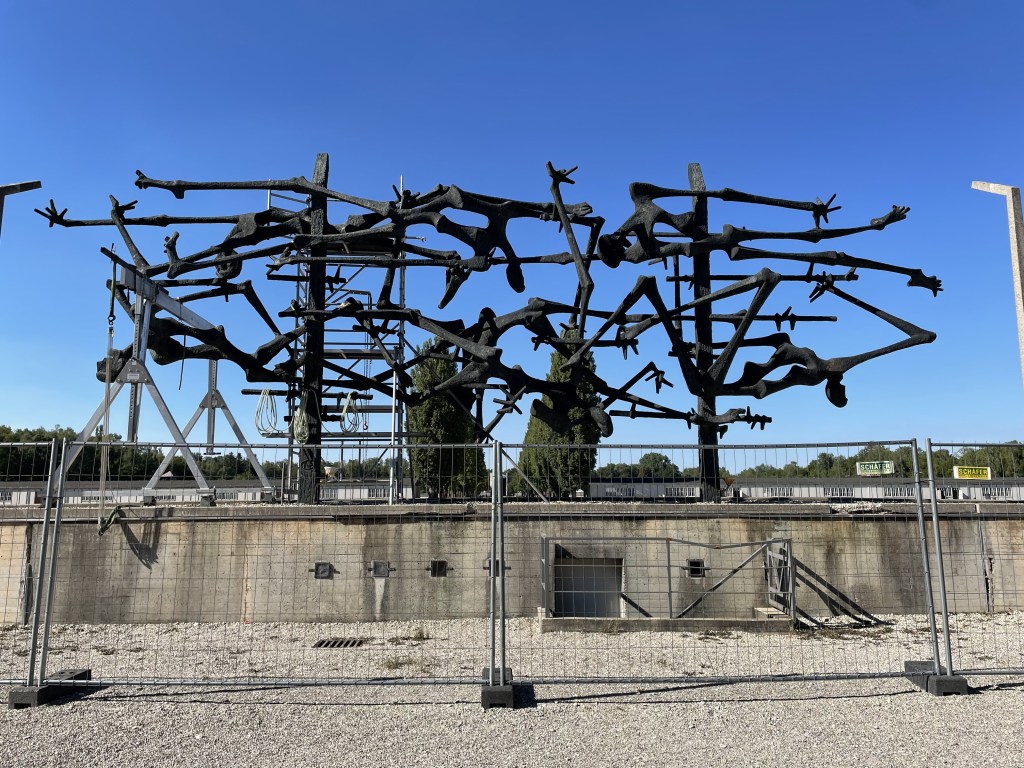
Worry-free travel encouraged me to venture to Dachau to visit the grim Concentration Camp outside of Munich. Now known as a Memorial Site, it was a second visit for me. It was not as jarring as the first, when memories were raw and more startling.
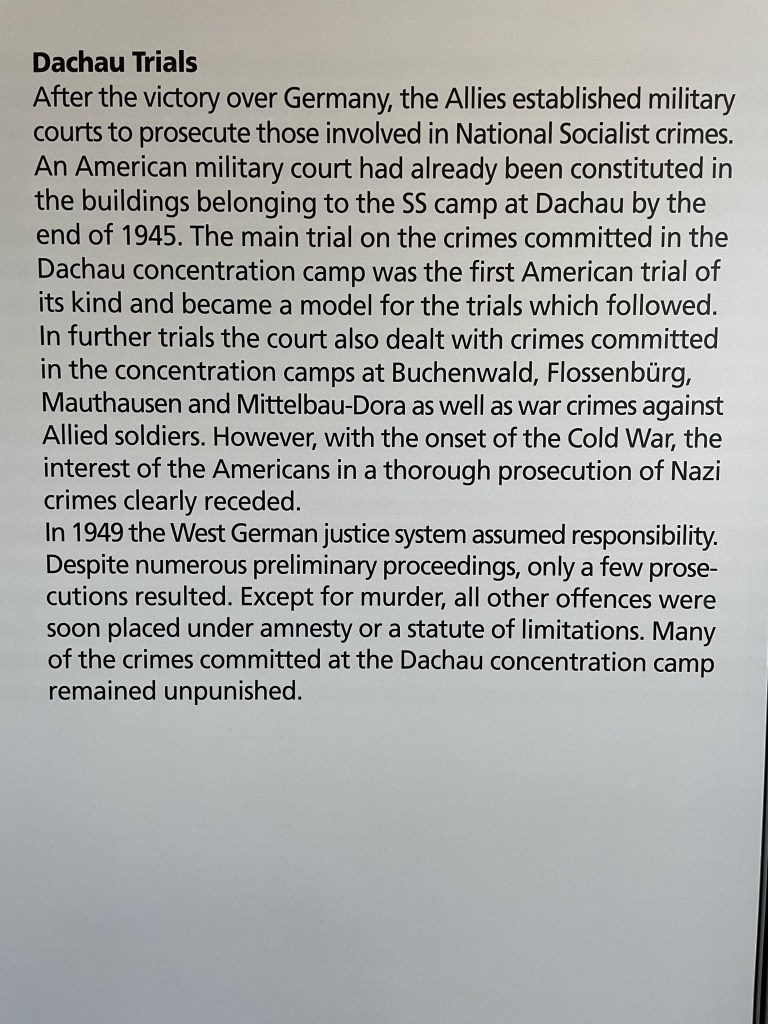
Mature beech trees and religious institutions are now located on the site to reduce the impact to visitors. Audio-visual materials translated into English helped to describe what happened. Efforts to explain economic hardships after World War I and during the Thirties gave perspective on the past. When the Americans arrived in 1945, prisoners were freed. Unfortunately, the advent of the Cold War distracted the war trials. Few were held accountable for causing the Holocaust.
Alte and Neue Pinokoteks and the Modern Pinokotek
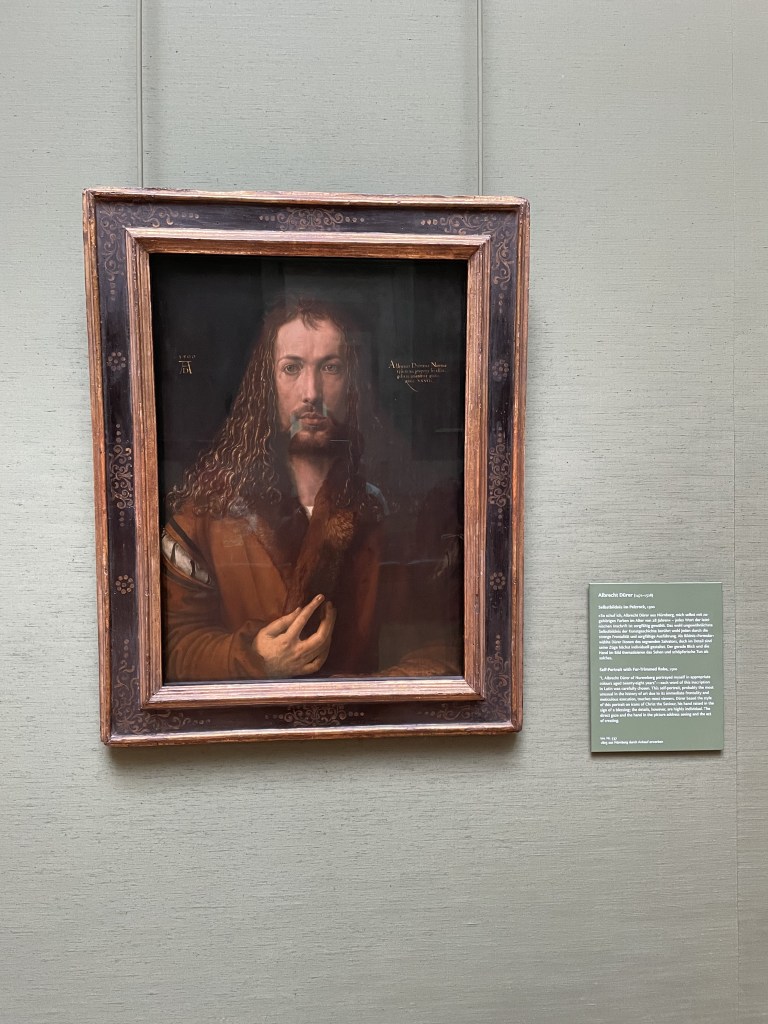
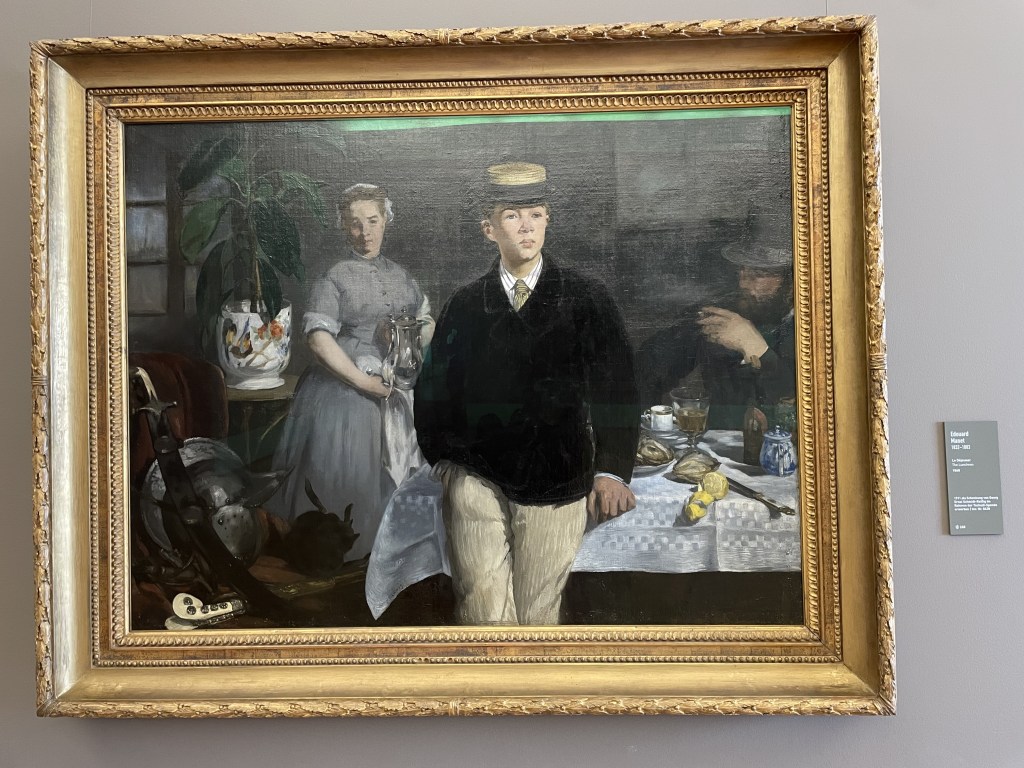
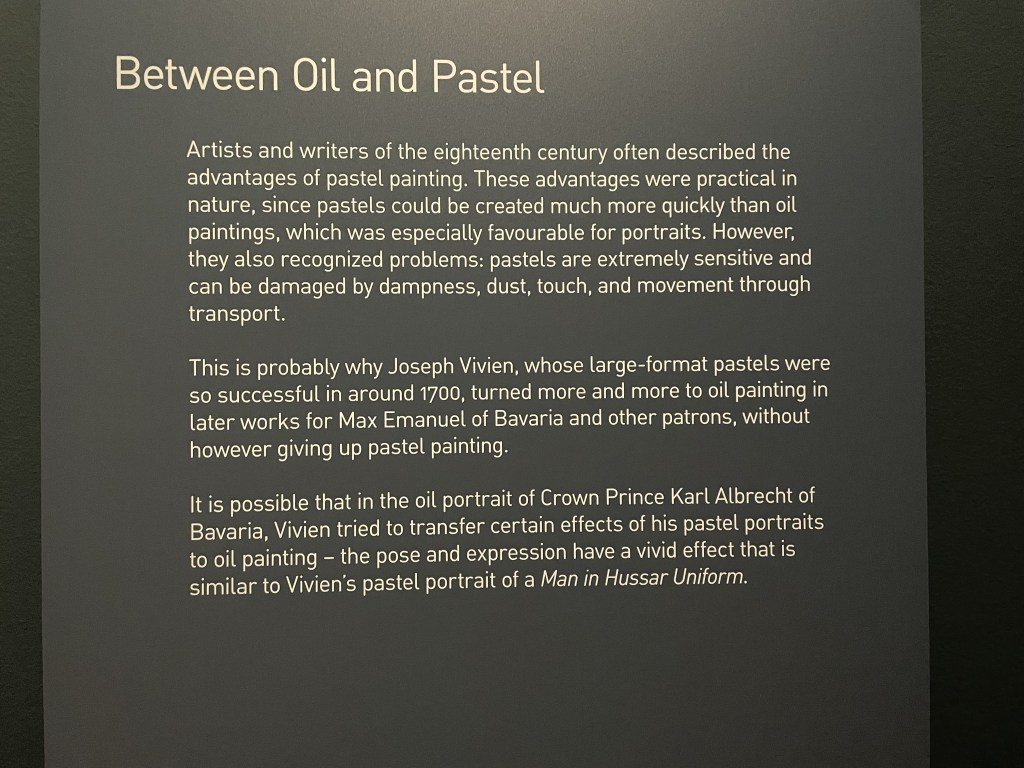
This extensive array of Western Art from the Greeks to Impressionists propelled me into full museum battlement. I covered many miles by foot and found the masters including DaVinci, Raphael, Durer, Van Gogh and Manet. I was delighted to find an Egon Schiele, one of my favorite artists. And the pastel collection was a great value lesson on how the medium achieves more luminosity over oil paintings. Pastel artists struggled with the chalky powder, so I felt vindicated by my shared frustration.
Raphael’s Madonna della TendaAlbrecht Durer Self-PortraitManet’s DejeunerKlimt’s WittgensteinVan Gogh’s WeberA Lady by CranachDa Vinci’s Madonna with a CarnationOil vs. Pastel
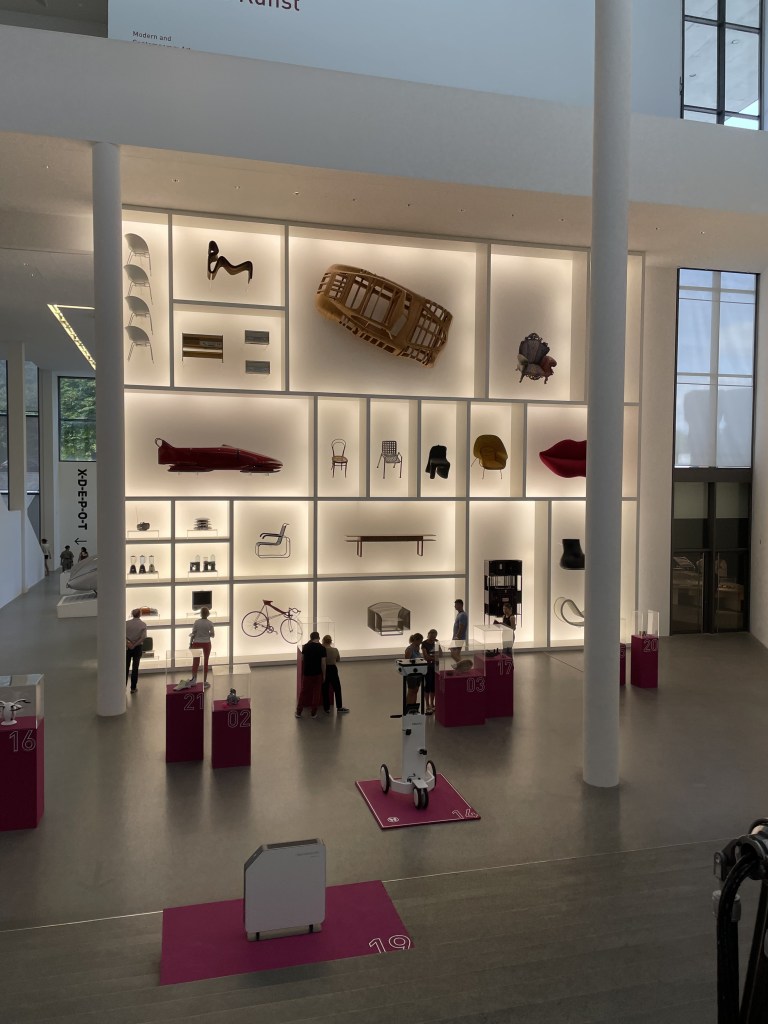
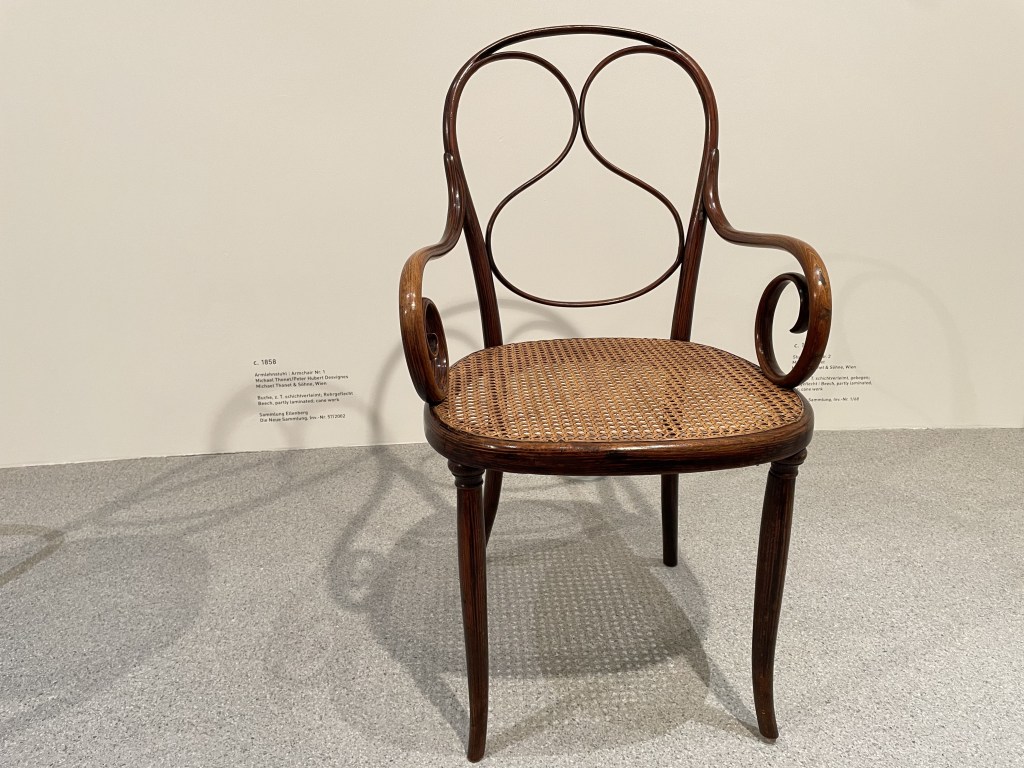
From the Alte Pinothek to the Modern, I searched specifically for any display of Thonet bentwood chairs. My early education as a design major gave me an appreciation for the best industrial design and chair production. The Modern Pinothek did not disappoint–in fact it showcased a chorus line of beautiful period Thonet chairs in chronological order!
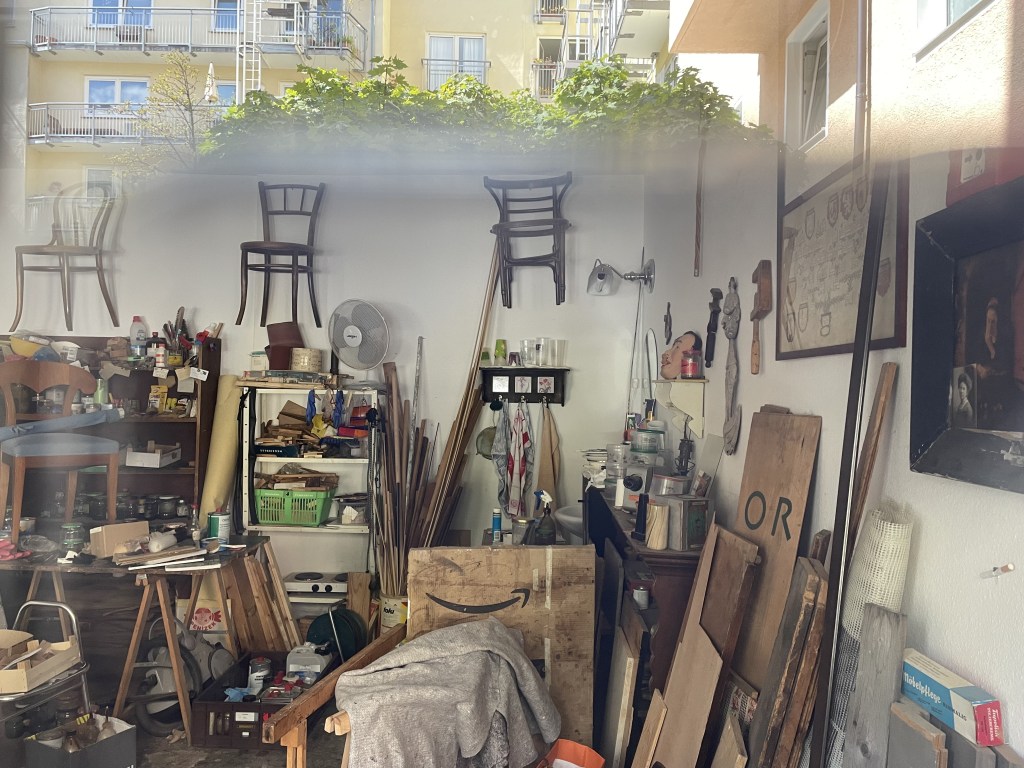
In the trendy Schwabing neighborhood where I was staying, I stumbled into a woodworker’s shop specializing in Bentwood refurbishing. Like many Germans in August, the proprietor was on “urlaub”, or vacation. A peek through his shop window motivated me to follow up with him after my return to the U.S. I also learned from conversations with a retail supplier that, while “Thonet” is produced in Germany, “Brueders Thonet” is a separate company out of Vienna, Austria. Important to know the date and source of production when searching for vintage pieces.
Schwabing
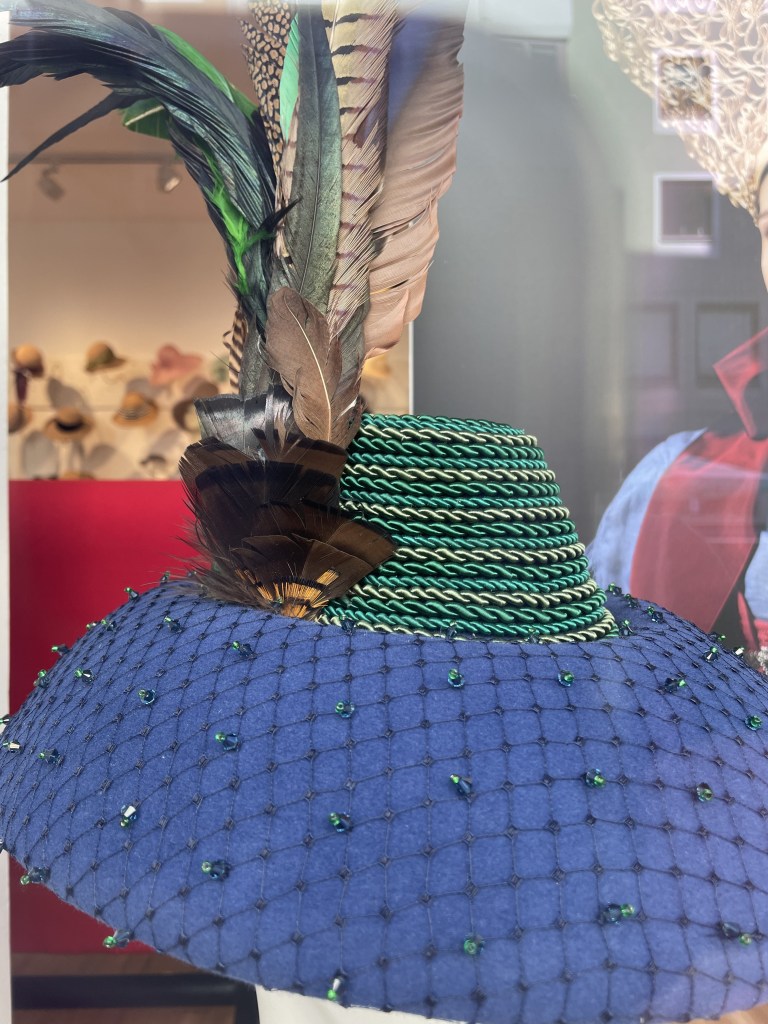
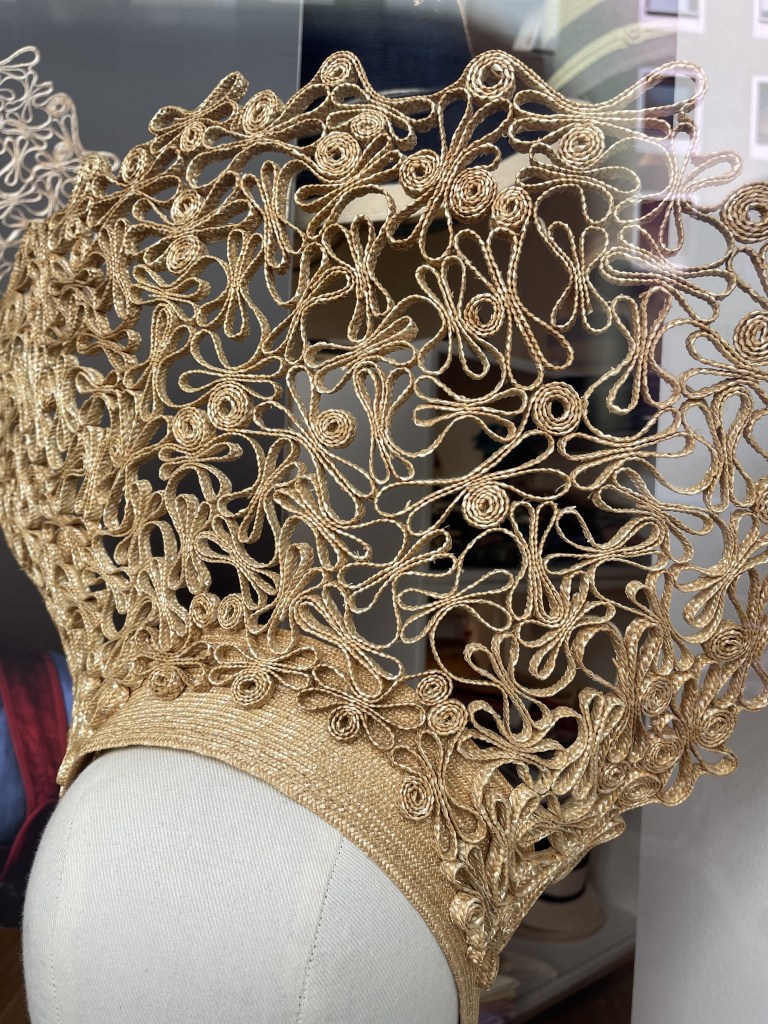
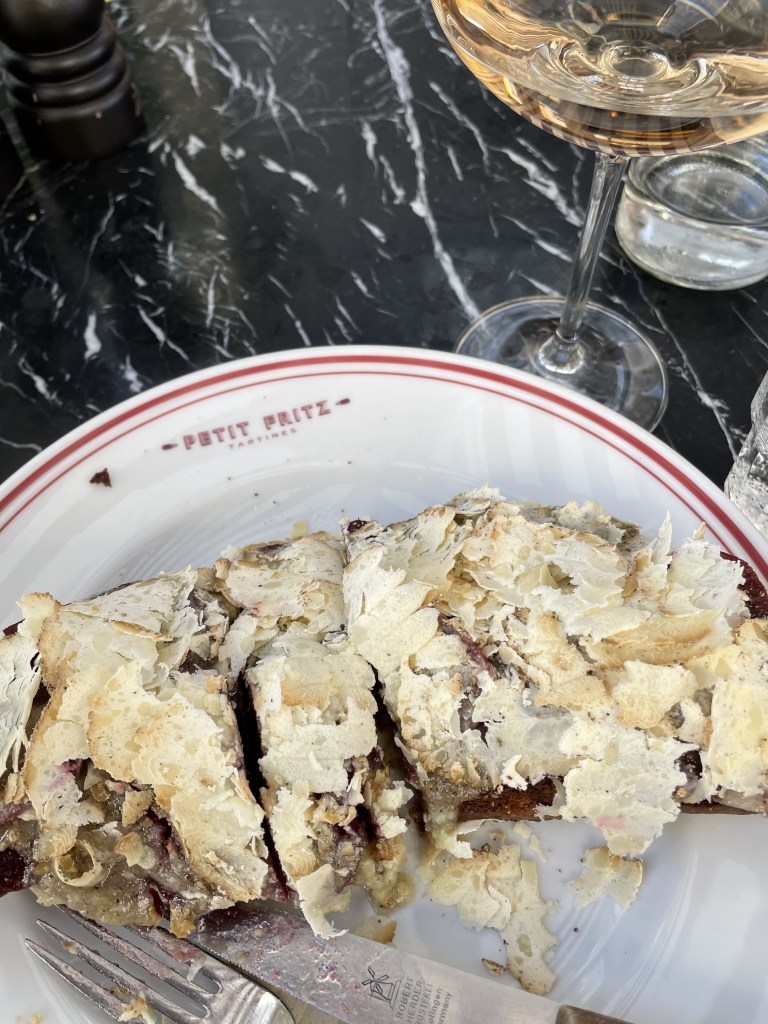
Several spins around Schwabing, the equivalent to St. Germain de Pres and near the Ludwig Maximilian University, yielded a boutique selling exquisite hats and headpieces, an academy for ancient Greek Sculpture where you can sketch to your heart’s delight, cute babies, and a yummy French bistro next to the hotel where I stayed.
(Note: the copper pipe in the featured photo above would never survive in San Francisco! Ah…such trust…)
A Collection of Schwabing’s Window Shopping and Sightings
I’m off to Bayreuth, about three hours by train-bus-train to see Wagner’s Ring Cycle! Sixteen hours of sitting in a theatre seat could just about get me around the world! Yes, the gods must be crazy and I am about to find out.
Don’t forget to write from wherever you are! When was the last time you were in Germany?!?
We mobilized our brains and prepped areas of the existing house to make room for the major home addition, which will consist of a kitchen/living dining area, two bedrooms, two bathrooms, and a small office in the rear yard of the property. All of the existing kitchen casework and appliances were removed for a new kitchen reconfiguration.
Week 2: Breaking Up Isn’t So Hard to Do!
First, two sets of old and deteriorated exterior stairs were taken apart to make way for the new addition. Then, the cantilevered portion of the kitchen that projected into the future new master bedroom area was demolished. Finally, the gaping hole in the middle of the house was covered with a temporary wall. We no longer felt as if we were living in a dollhouse!
Portion of Popout RemovedRubble from Kitchen DemoPopout from the inside Temporary Wall to Kitchen
Concrete patio to be removed for pier foundations
Our foundation contractors arrived to set up their work. Their first task was to remove two old juniper trees and branches that hindered access to the site. A medium-sized excavator with a jackhammer attachment arrived to cut up the concrete pad, making way for seventeen piers to support the new structure. Ten 25+ ft deep foundation piers will be cast into bedrock and seven shallower, 8 ft piers will be drilled for the deck.
With the slab broken into chunks, the excavator and bulldozer worked in tandem to remove the concrete rubble, loose rocks, tree roots, dirt and debris in a confident, orchestrated tango. Dancers, efficiency experts, and strategists could learn a lot from observing these moves, as we did.
Excavator clawing its way to happiness
With a box seat in the corner of the dining room overlooking the patio, Felix was fascinated by the unusual activity right outside the window. He watched ten minutes at a time and could have easily lasted longer. He did learn how to cover his ears, however, and practiced using his hands as sound buffers. You’ll hear more from him later.
Week 3: Holey Moley!
The foundation contractors began drilling four 18″- diameter holes up to 31 feet deep along the existing house to support concrete piers for the new addition. Six-foot long steel casings, soldered end-to-end, were immersed into the ground to prevent the soil from collapsing along the entire length of the hole.
Pier drilling along the edge of the existing house and clearing drill bit
Being only two miles from the Pacific Ocean and on a hill, our soil conditions are what you expect from a windswept, coastal environment. The original sand dunes with deep rock underneath produces fine, dry, soil with no compressive strength; it’s so loose that the drill appears to wallow in water. The excavator drilled the four piers with a rotating auger bit that avoided vibration and noise of other methods.
Only the soft whirr of the excavator could be heard during normal weekday work hours. Undeterred by noise, Felix was fascinated by the cacophony of new sights and sounds.
Felix watching generator startup for welding of casings
Coming next: Concrete solutions to constructive traveling
After returning to the Bay Area a couple of weeks ago, I have reflected on the past five months in New Zealand. I was able to join my daughter Julianne and her partner Jeff, who brought a newcomer into the family. Felix, born in New Zealand in July of 2020, is the joy of my life and the flower that bloomed despite the pandemic.
Already nine months old, Felix is a thriving infant learning all the motor skills for life from crawling, scaling stairs, picking up tidbits of food from the floor, and eating drumsticks with two fists. He has manifestations of a toddler and exercises his emotions and desires. As a new mother, daughter Julianne is now an exclusive member of the club that is celebrated today on Mother’s Day.
In the two weeks I have been home, the first week was a reverse-order process to traveling to New Zealand. I self-isolated as recommended by the CDC for a week to make sure that I didn’t catch anything on the flight home from Christchurch to San Francisco. I got a COVID-19 PCR test three days before the flight and three days after the flight. And I was able to get the first dose vaccine within a few days of arrival.
Despite all the worries, the transition was very smooth. Yes, I was very nervous and anxious about coming home. The daily news feeds from both sides of the ocean kept me informed. Yet everything appeared to be calm, improving, and with reason to be cautiously optimistic.
American friends still living abroad may be curious about my experience returning to the U.S. At this moment in time and in the Bay Area, it is about as good as it gets. The Bay Area has one of the highest compliance stats in the country. However, there is no guarantee that the present is indicative of the future.
The newly formed Australia-New Zealand bubble allows travel between the two countries. My layover in Sydney occurred the first weekend the “green zone” was created. Domestic flights were busy. Most travelers were reuniting with their families. Airport lounges in both airports were operating, but the international flight from Sydney to San Francisco was nearly empty.
American Customs and Immigration was smooth for returning U.S. citizens. After a taxi ride home, I picked up my car to drive to Daughter Melissa’s apartment in Oakland to self-isolate. It was a therapeutic week in the sunny East Bay. I took daily walks through the Crocker Highlands neighborhood where I grew up and was intoxicated by frequent stands of jasmine and perfume from other Spring blooms.
Spring Gardens in Crocker Highlands
Fong & Daughter Julianne reunited the second week. I was able to clutch Felix again after a brief hiatus in transit between countries. We all sighed a sign of relief once we were able to dodge yet another pandemic bullet.
We celebrated Mother’s Day by walking a mile to our Golden Gate Park, enjoying the newly minted Ferris Wheel ride, and having lunch outdoors at the DeYoung Museum. It was a day to relish among other families. They maintained clear bubble distance, both designated and unspoken, from other groups. Everyone seemed to know how precious the moments with friends and family were, and to not violate it for others.
(Photo above: Chestnuts foraged from hundred-year-old trees at Hagley Golf Course and Park)
In last week’s post I expected that I would be writing from home in San Francisco. Yet I want to share a few last lingering and loving thoughts about New Zealand.
I haven’t changed my mind about leaving New Zealand to return to the U.S, but I feel melancholy and wistful. Yes, it feels like I am swimming upstream and inconceivably towards more harm than away from it. For me, it is time to return to the real world, while having escaped from it for a while. I have been to the far side of paradise but I should leave it, now that I have been here.
After five months here, I relished the many positive points about this tiny island nation. Tourists rave about its pristine beauty. For those fortunate to live here beyond a dream vacation, they will find a life worth living.
Along the Avon River in Christchurch on a lazy Sunday afternoon
Pandemic Management
Today, as New Zealand joins the bubble with its big cousin, Australia, there are new protocols. Health providers must suit up fully to administer COVID tests. The requirements change frequently as the level of safety varies. Only half of the population approve of the new bubble and another quarter are ambivalent about the changes.
In my observation and experience, New Zealanders are courteous, cautious and conservative. Those have been the trademarks of managing the pandemic successfully. They wait for the science to prove itself, so there is no rush to vaccinate. Patience is a virtue. There will be enough doses for everyone, whether you hold residency or not.
Strong family values fostered by the Maori community are often mentioned in the media. Bilingual messages delivered through public media spread the latest information about COVID-10, the importance of getting vaccinated, and personal hygiene measures to avoid COVID.
Farewell to a Cute Country
Above: Magnificent hundred-year old trees along the Avon River in Christchurch are an example of the city’s hidden treasures. Labelled the “garden city”, Christchurch should be more accurately labelled “Park City”, for all the miles of grassed areas that are used for walking, sports, recreation, and family gatherings.
New Zealand is a country I would describe as “cute”. Its people, land formations, and customs give me a warm and endearing feeling. While it’s also “rugged” or “raw”, I am drawn to its mild-mannered people, their mindfulness, and their ability to be kind.
A Dedicated Street Performer
I don’t intend to compare the pros and cons of New Zealand characteristics with ours in the US. The world can learn alot from this tiny country that could. Over the past months, I have grown fond of New Zealanders, their tenacity, and can-do mentality. I will really miss New Zealand.
Historic working trams
Yes, back to masks. And I will perhaps be deterred from many freedoms already offered here: get my hair cut, go to a movie or attend a concert, or ride the bus mask-free. Hug friends and family readily. But maybe one day. Soon.
Four Strings, A Soprano and Four Suits: a live performance in Christchurch yesterday afternoon
The decision has been made. I am returning to the States after nearly a half year in New Zealand. Following the news on both sides of the Pacific has been fraught with uncertainty. My reasons for returning only slightly outweigh remaining in this picture-perfect island paradise on earth.
First of all, there may not be an active vaccination program in New Zealand until July. Word has it that it can be as early as May, but there is no assurance of that. Extending a stay here to complete both vaccinations would require complicated housing, flight arrangements, and family decisions.
Returning to the States involves where, when and how to be vaccinated. With anyone over 16 being eligible, the appointments will be much more competitive. The race against variants is worrying. Flights and the quarantine process on arrival require reverse-engineering the outbound San Francisco to New Zealand process.
On return, I do not look forward to the restrictions and mask-wearing, After savoring so many natural and human facial gestures throughout New Zealand, it will take some time to readjust. I’m not sure where the real world is anymore.
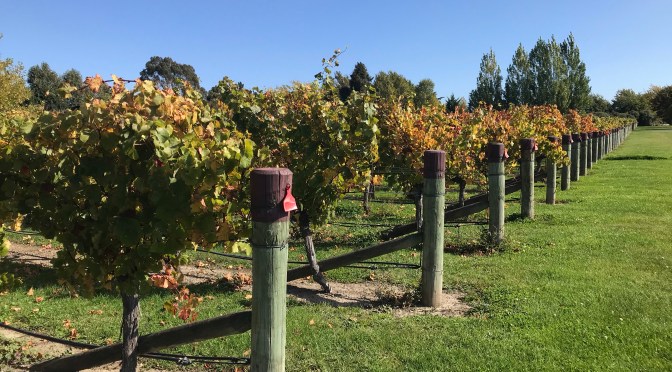
As part of my farewell, I made a special purpose visit to Marlborough Country. It’s famous throughout the world for its Sauvignon Blanc wines. Similar to the Sonoma Coast, the climate is milder for producing the whites that are delicate and flavorful. The vineyards are pristine and unlike other wine regions I have seen.
It’s not the Destination, but the Journey….
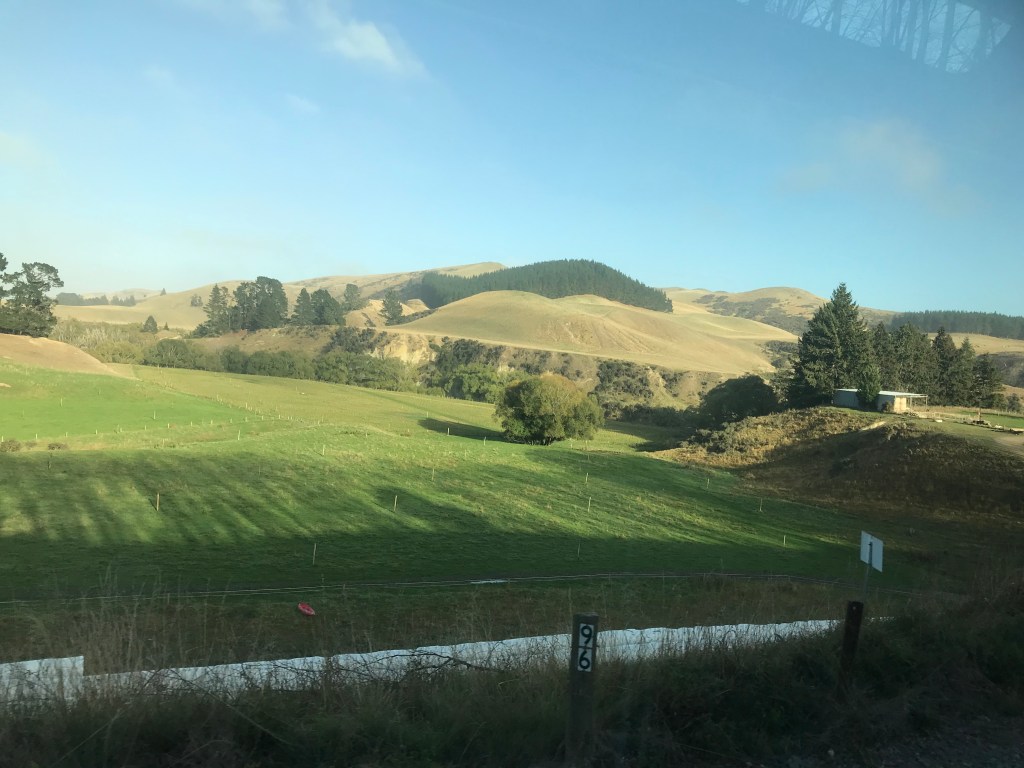
One of the two great rail journeys based from Christchurch plies the northeastern coast of New Zealand to Blenheim. (The other journey is through Arthur’s Pass to Greymouth on the West Coast). This coastal journey takes about five hours, where you can opt for a four-course dining experience during the trip or enjoy coach seating with access to a cafe and outdoor car. And yes, for now people travel maskless but are very conscientious in recording their whereabouts on a contact tracing app installed on smartphones.
The pastoral landscapes with rolling hills carved by many of the rivers and 27 earthquake faults, vast farmlands along the Canterbury Plain, and direct views of the Pacific Ocean (on the east coast here) were spectacular and helped me to momentarily forget my future travel woes.
By the way, everything in New Zealand is backwards to what Americans are used to! Driving on the left side of the road, water running down the drain counterclockwise, the strongest sun in the north, and Christmas in the summer are just a few phenomena to keep you wondering and on your toes.
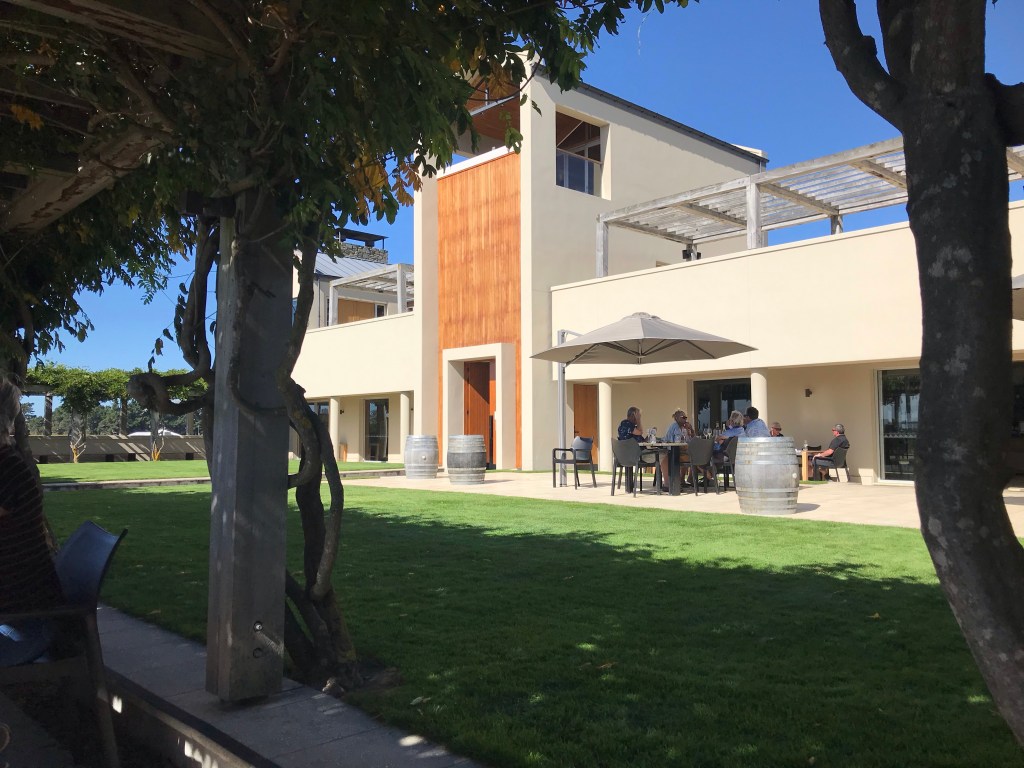
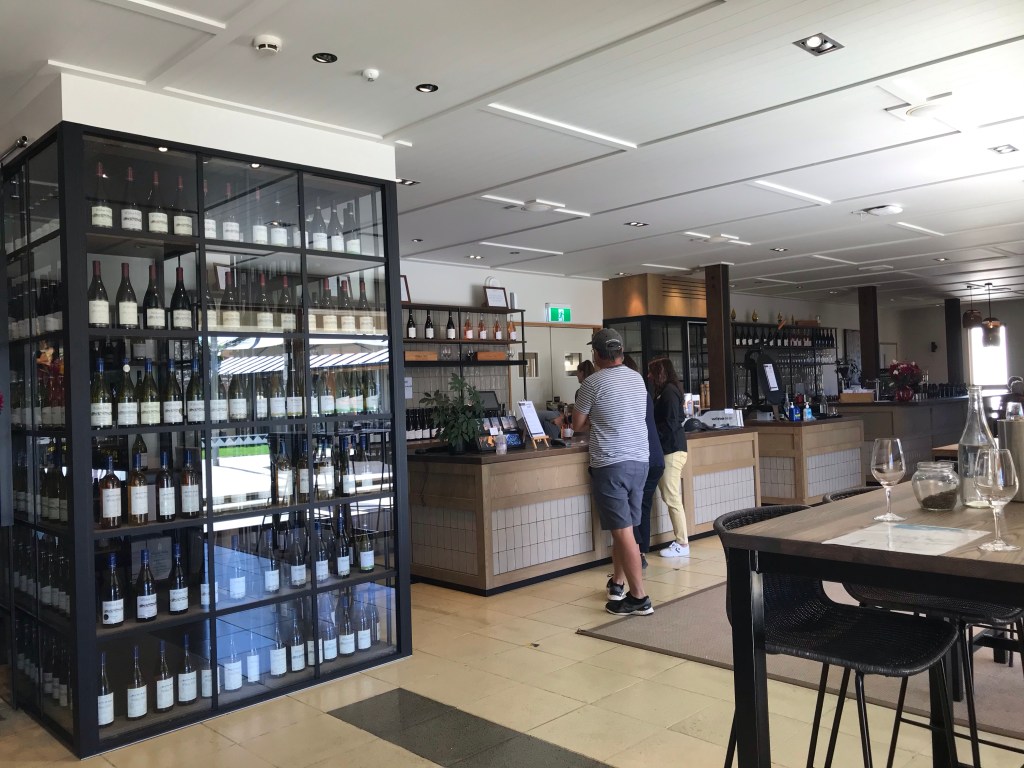
Cloudy Bay and Wither Hills Wineries and Vineyards
Cloudy Bay Winery, the cleanest, healthiest vines I have seen anywhere in the world
Wither Hills Winery, another winery with healthy vines
Winery Entrance
Wine Tasting
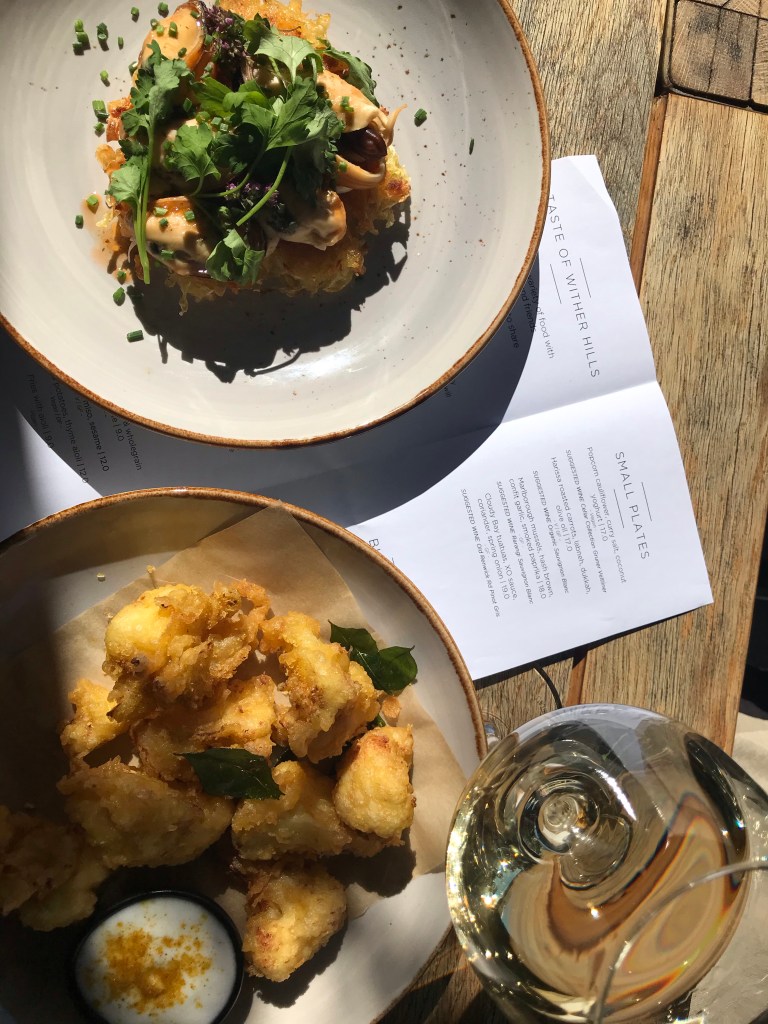
Outdoor Dining
Caluiflower Popcorn and Fried Mussels
Tofu and Passion Fruit Salsd on Popped Rice
As mentioned earlier, coming to paradise with freedom to move about can be a lonely experience. Friends and family in the States are unlikely to understand or relate to my time here. Maybe astronauts who have traveled to outer space feel the same isolation. Nevertheless, I am grateful that I came and will find ways to cope.
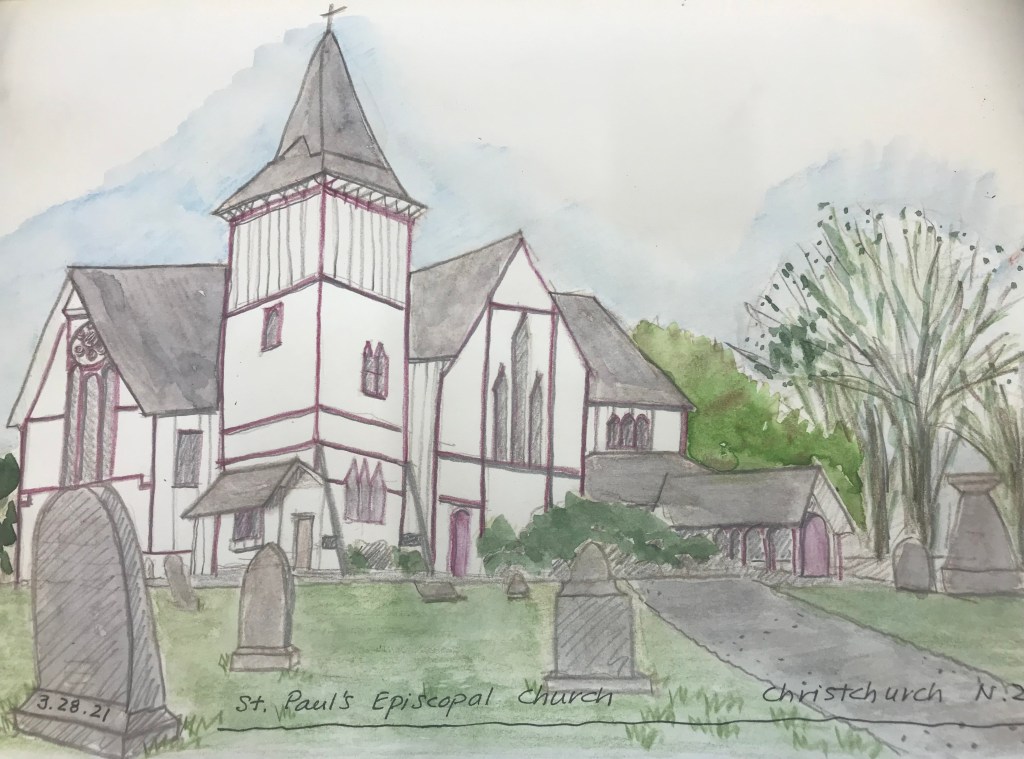
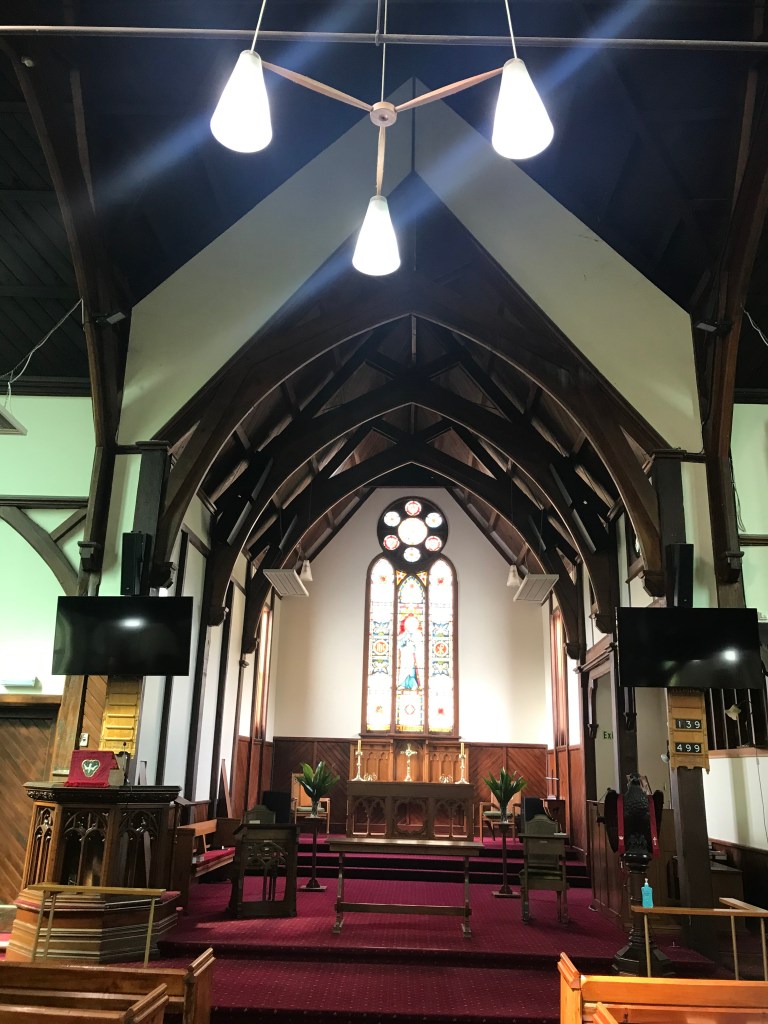
Sketching and Exploring at St. Paul’s Episcopal Church
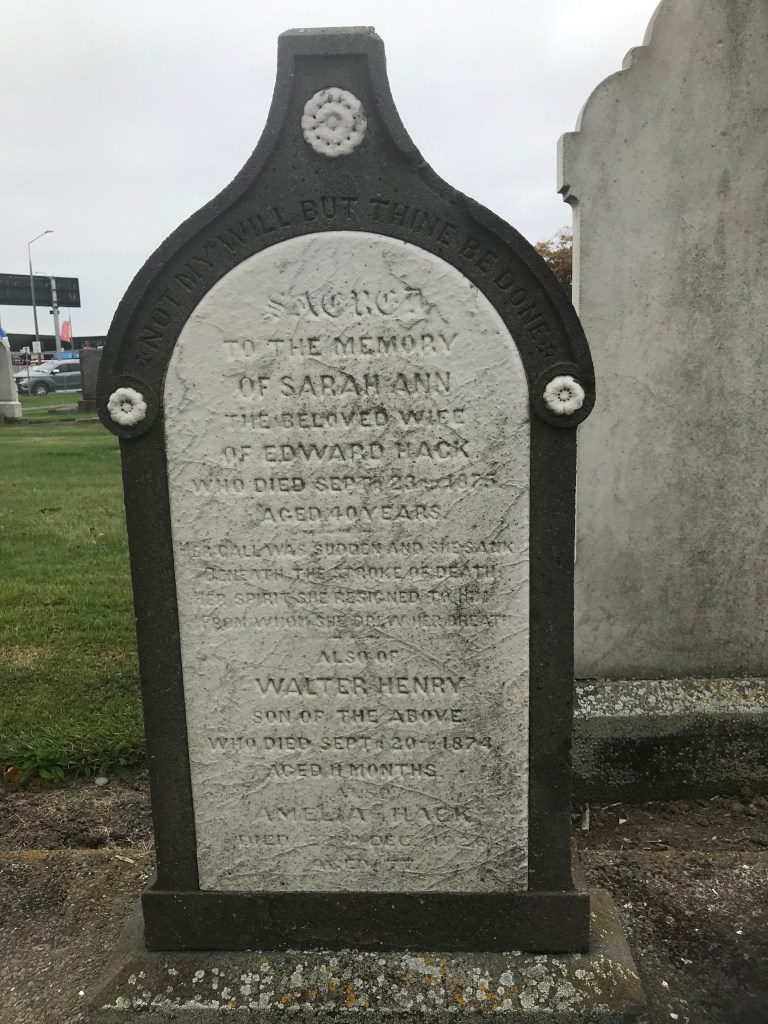
In a recent sketching event at St. Paul’s Church in Northcote, I couldn’t help but notice the tombstones included in my sketch. It took a second visit to the church to read the epitaphs to long lost and forgotten individuals. How fleeting is a mortal life! We are specks of dust that appear and disappear in a flash of light. The stone monuments in the graveyard attempted to extend the memories of an individual, until they also eventually disappear and are forgotten.
A few of the moving epitaphs of children who died over 100 years ago are captured in the attached slide show. It may be a bit difficult to decipher, but worth zooming . A few quotes on the stones gave me a glimpse of each individual. I could sense the deep love devoted to them by their families.
More Sketching
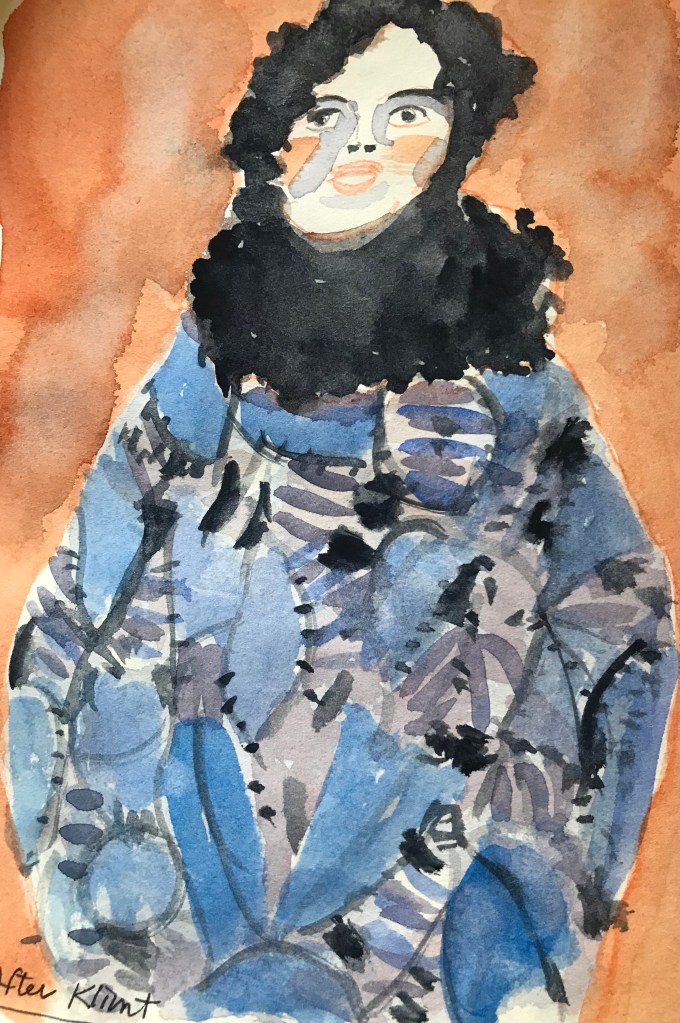
Continuing on a roll from the 100 People One Week Challenge, I found more subjects to sketch at the Mediterranean Cafe and at the Willowbank Cafe. And continuing the Zoom Portrait Parties from the Bay Area hosted by Jen and Govind has been a godsend. I painted my interpretation of a painting by Klimt below.
Before long, I will be back in the U-S-S-A. I am somewhat sad and ambivalent about the return home, as New Zealand has provided a semblance of normality in an abnormal world. As this is probably my last post from Christchurch, New Zealand. I hope you have enjoyed them! Please let me know, and look for my report next from San Francisco!
Last week was consumed with an international event for sketchers. Every year, the challenge is to draw 100 people in one week. Having done the same task last year, I was better prepared to develop a strategy to complete the exercise. First, you stake out your victims, then use the same venue each day to become familiarized with the types of poses and people you sketch.
Due to the pandemic, many people this year could only draw from photographs, magazines or online images. I was fortunate to be in a country where I could still go down the street to sketch real people in their natural environments.
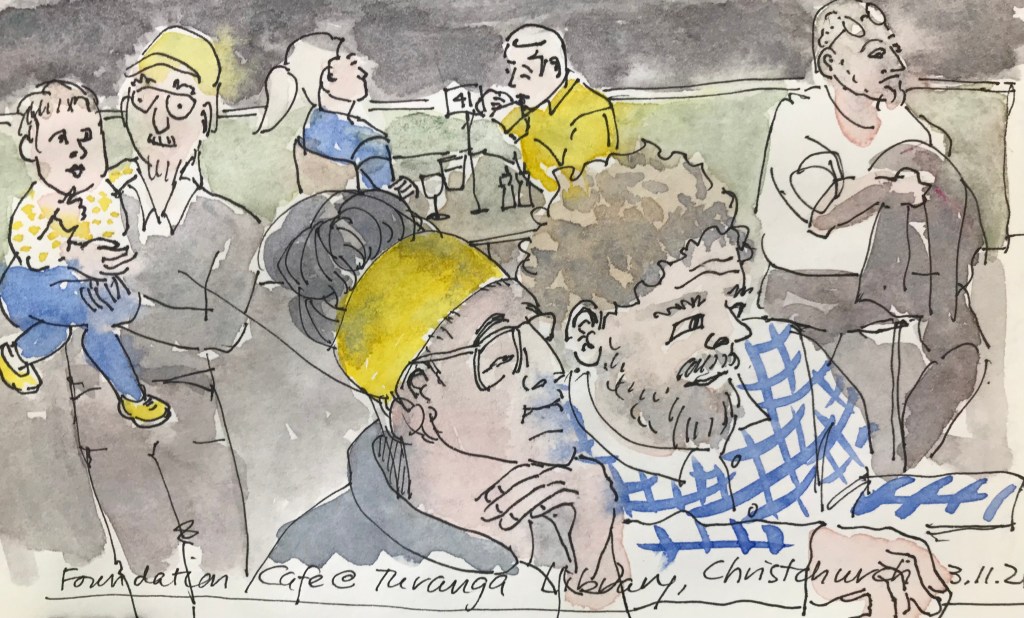
I chose the Christchurch Turanga Library. It is remarkable in many ways, as a “third space” for living. It is neither home nor work, but it fills in the voids in between. It was perfect for capturing teeming humanity, primarily in the Foundation Cafe, but also at computer stations, playing chess, and at the children’s center, where tired and exhausted mothers could catch a few minutes of sleep with their infants.
The sketches provide an example of the types of characters at the library–many engaged at activities yet to be appreciated in the States–surrounded by others without distancing, staff working close together, and active conversations with friends and families while eating. Let’s hope this is a mere taste of what’s soon to come in San Francisco and elsewhere in the U.S.
The Vaccination Dilemma
Speaking of the U.S., we hear that vaccinations in California will be available to anyone over 16 by the end of April. That’s good news for my daughters. One plans to return shortly with a baby. The other daughter is comforted to know that she and her colleagues in the food business will be protected.
We are waiting to decide whether to get vaccinated in New Zealand or in the States. It’s a tricky decision that depends on where we can get inoculated first, and for both doses. There are advantages and disadvantages for either location. We are weighing them as news changes daily and impact our decision. Add a minor stress of booking tickets and accommodations timed for the yet-to-be-determined exit and you have the picture.
Willowbank Nature Reserve
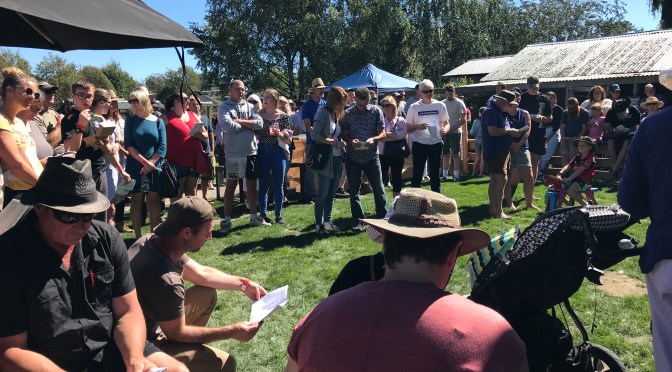
In the meantime, I continued sketching with Christchurch City Sketchers, who visited Willowbank Nature Reserve outside the city last weekend. Native kiwis are featured in their natural habitat there. Unfortunately the area was pitch black so none of the four kiwis were visible!
An unusual auction of rare breeds of birds and animals was held the same day. Unfortunately, I did not take full advantage of the llamas, cows, and a Clydesdale horse on display. I focused on drawing human animals in the cafe instead. After drawing so many people the previous week, I was fixated on capturing more tantalizing eyes, noses, ears, and saggy profiles. After leaving the park, I kicked myself for missing the golden opportunity to sketch all those voluptuous animals!!
A local auction of rare birds and beasts
Being in Christchurch has filled our time with interesting activities and new adventures. I took my daughter for her first round of golf! We only did six holes, but that was plenty enough to entertain and challenge us for a solid morning at Hagley Park. A momentary hiatus in the sandpit was not enough to discourage me from future outings.
News Update: As of Sunday, March 7 at 6am (New Zealand Time), Auckland will drop to Level 2 and the rest of the country to Level 1
Global news can change quickly, especially with the pandemic roulette swinging wildly. This up-to-now, COVID worry-free country has stepped up its vigilance. A couple of troubling community cases in Auckland near the airport last week has moved the city into an Alert Level 3 and the rest of the country to Level 2. That affects those of us living in Christchurch on the South Island.
Here’s a snippit from a recent news article on the recent changes:
While there are renewed restrictions such as the wearing of masks on public transportation, social distancing and contact tracing, the general population was initially slow in responding to any changes. Now, there are visible differences. The news reports progress openly and transparently, and reminds everyone to follow instructions.
Public service messages also remind everyone to be kind and not to excoriate those who may have extenuating circumstances for not following the rules. Except for uniformed kids hitting town after school, fewer people populate the streets of Christchurch. Local travelers encouraged to see New Zealand are putting intercity travel on hold.
Shops, cafes, museums and cinemas are once again threatened with a downturn in the struggling economy just as it has in other parts of the world. With a chain of events that include the Mosque bombing, the earthquake, and recurrent COVID fears , the people of Christchurch have demonstrated incredible resilience and acceptance of circumstances beyond their control
As the tide was turning, we were in the midst of a weekend outing to Mt. Cook in the Southern Alps. Mt. Cook is high on the list of quintessential outdoor destinations in New Zealand.
Tasman Glacier
The east side of the Southern Alps on the South Island are accessible from Christchurch within three hours. We drove through classic rolling hill countryside, passing an occasional car headed in the opposite direction. After pit stops in Fairlie and Geraldine, the snow-capped mountains appeared.
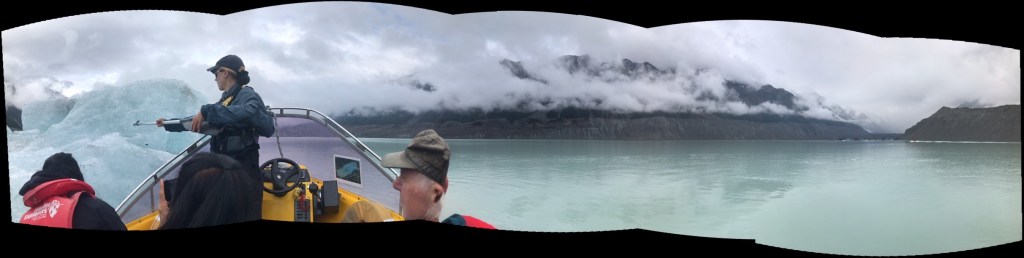
You can take a boat tour to see the Tasman Glacier on the back side of Mt. Aoraki (known as Mt. Cook). After a short one-mile hike to the lake, we arrived at the shoreline for our excursion. I had expected a big ferry with big picture windows, but the light, open-air raft awaiting at the dock was a surprise!
The German-born guide quickly sorted us into small groups to balance the boat and off we went. She described the history and formation of the lake from the ice melt. In just the past few months and years, the lake capacity has been increasing in volume.
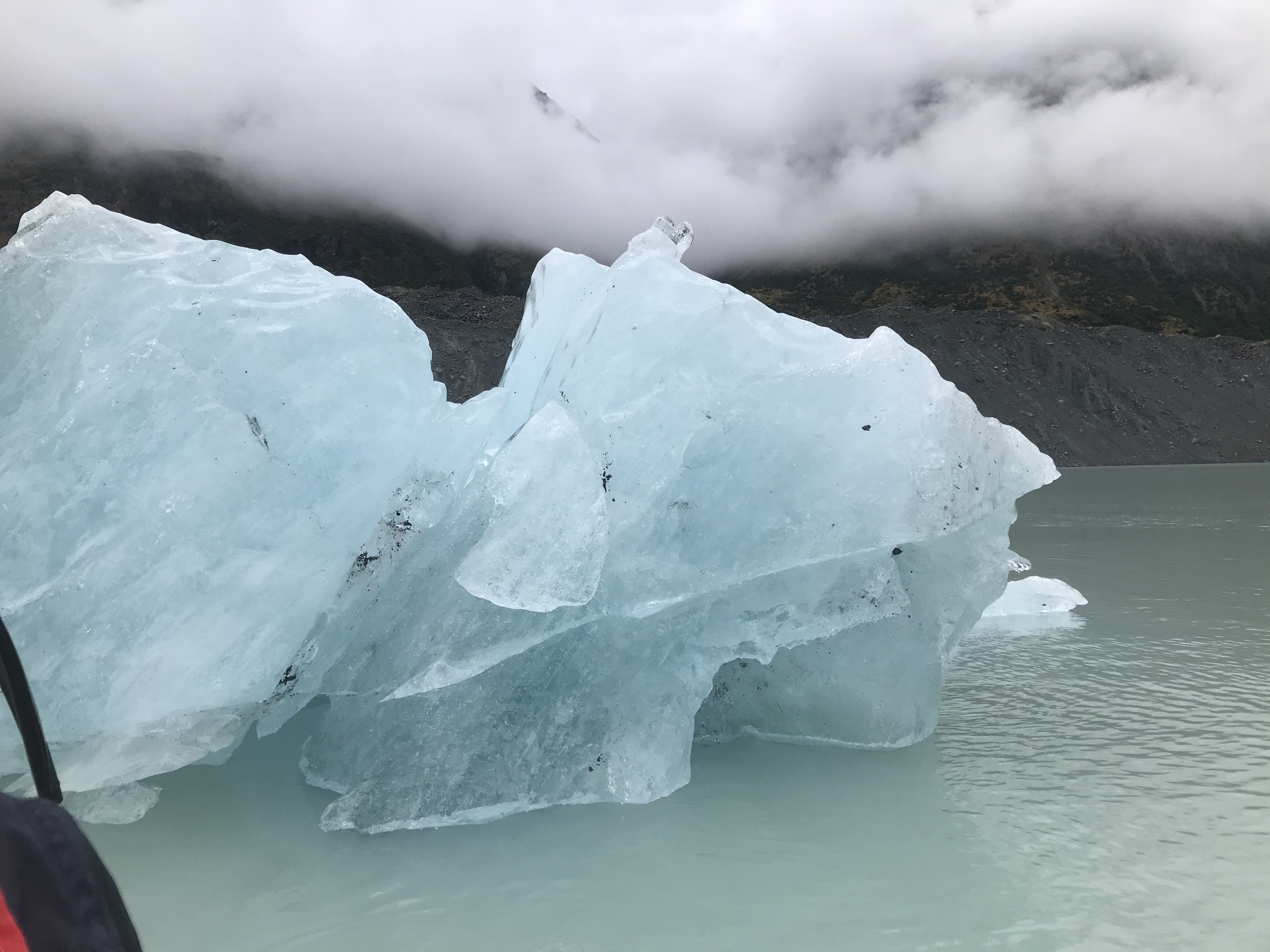
The ice floes show only 10% of its body mass. The rest lies below the surface. On larger floes and along the glacier, you can see the water line where the waves meet the ice form. The floes have lives of their own. They play like otters when they roll over and as the mass underneath changes.
The Tasman Glacier, like those in Alaska, relies on ground cover to insulate the ice from further deterioration. The visible river of ice was only a small rendition in scale with those we saw in Alaska, but nevertheless impressive for its peaceful and serene environment. We could only get partial peeks at Mt. Cook, but we were satisfied at having seen its peak the day before.
Zoom Sketching Live Musicians
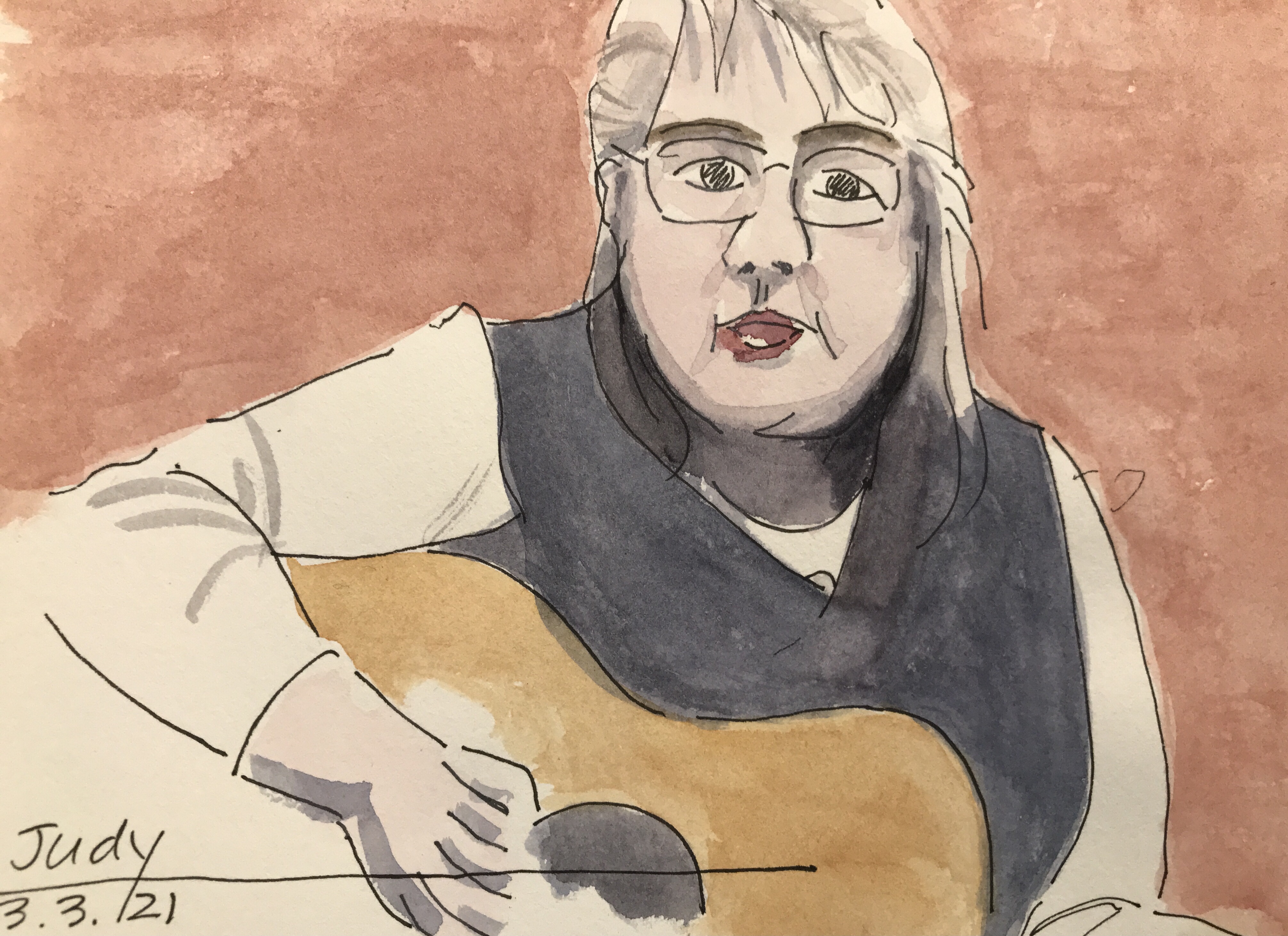
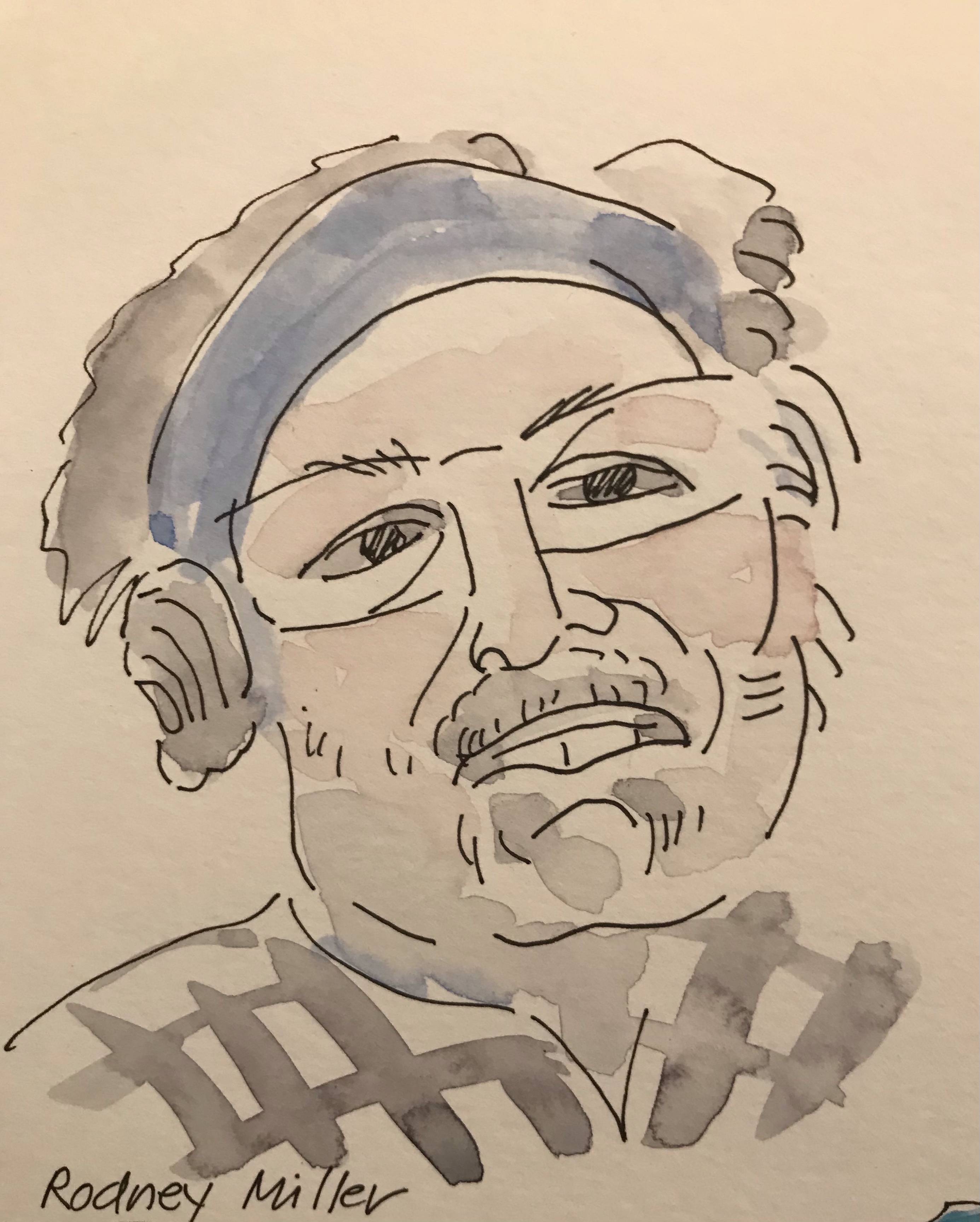
The Tuesday night jam sessions with live musicians originating from Andronico’s continues.
And a quick sketch in the Christchurch Gallery of a favorite sculpture–you can compare it to the real thing in the following slide!





















































 travelswithmyselfandothers.com