Tag Archives: People

Day 58: Moroccan Magic

As our last night in Essaouira drew to a close, we didn’t have much time for nostalgia or glee. Between crazy over the top activities immersed with deep dives into the culture and grabbing tips and tools for sketching, each day was exhaustingly satisfying.

Diane, our instructor extraordinaire, exuded penultimate confidence in her craft. We agreed she was, indeed, a wonder woman. I would never admit that soneone knew more than me about traveling, but Diane is over the top savvy and knowledgeable.

She’s the only person I know who can smoke a cigar sitting on the ground in the middle of a major thoroughfare sketching locals who love it, AND manage a herd of cats who continually ask the same question after it’s just been answered.

Here’s the link to the video I made and shared with everyone on the last night of our sketching expedition in Essaouira, Morocco.

And, for Customer Service: a few final quickies before leaving to head back to Marrakesh:

(Note: I’m en route via Geneva, Zurich, Frankfurt, and Beijing to Hong Kong. The internet may be a bit spotty, so don’t be surprised if you don’t hear from me for a few days!)

Days 12-16: A-Mews Yourself with Bathing in Bath

Arrival in London reminded us that the British are much more formal than Americans, but also friendly and engaging. Their use of the language is brilliant and a reminder of why so many of us use it throughout the world.

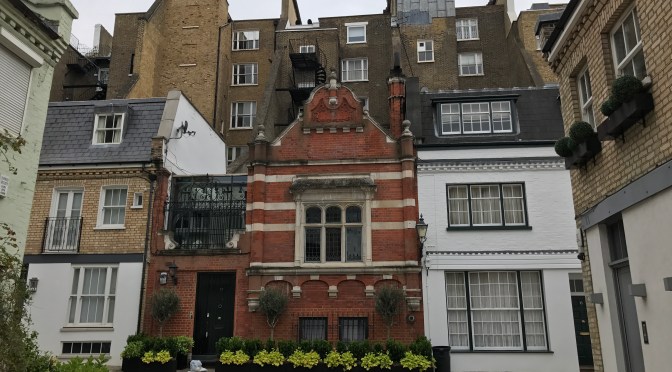
Our early morning walk around S. Kensington where we are staying surprised us with the V&A Museum, Imperial College, and the Natural History Museum within a half-mile radius. More intriguing were the quaint mews or back streets that used to house the horses and carriages of the gentry living in Kensington. They are homes to die for. A few little shops were tucked in for a-mews-ment. Back on the main road, we enjoyed the gigantic London Plane trees that lined Cromwell Road so majestically. They reminded me of the street trees where I grew up on Grosvenor Place in Oakland’s Lakeshore District.

At mid-day, we met an old friend for lunch at the Comptoir for Lebanese food to share our missed lives together. She was, at the time we first met, a community activist working in the Fitzrovia area helping Chinese settle in London. I was doing a study of the London Chinese as part of the Branner Traveling Fellowship from UC Berkeley’s Architecture Department. She helped me to connect to Chinese living and working in Soho, or London’s Chinatown.

I only discovered in our conversation today, that, in addition to training at the London School of Economics, she studied at Cambridge University and visited China with a group of students from Cambridge for two months. She also lived in the Hong Kong New Territories teaching English during the time that I worked in Hong Kong as an architect.

We shared many stories about our early careers and how we chanced to meet each other. It was a great rediscovery of each other’s past, ones that we had barely known or understood at the time. It was so much more meaningful, now that each of us have lived (and loved) in life. A few bruises along the way gave us greater depth and understanding of the world and each other’s lives.

I encourage everyone to go and find an old acquaintance and to rediscover the time absent between yourselves. You will gain perspective and learn more about each other. Like seeing old friends, this meeting made the entire trip across the universe from San Francisco to London worth the trip alone. Life is short.

Our first full evening was devoted to opera. I was looking forward to seeing Thomas Ades’ new work, “The Exterminating Angel”, based on the movie by Luis Bunuel. Modern opera has a way to go in appealing to devoted opera goers. The music, story, singing, and staging has to pair like a fine wine with the passion and drama of opera. I admit that I am a bit of a drama queen, but that’s why I appreciate good opera. It has all the elements of the classic life stories, whether they occur today or the day they were written. This one didn’t quite make it for me, but I’ll give it a *** for effort and execution. Here’s the story: http://www.metopera.org/Discover/Synopses/Eugene-Onegin/

Bathing in Bath

Within one and a half hours’ train ride, you can get yourself to Bath. I never connected the roman orgy of bathing to Pride and Prejudice, but it’s definitely alive and well in Jane Austen country.

All exteriors of buildings must be of local limestone, so the buildings are consistent and match each other beautifully.

Our first official tourist act was indeed to go to the Bath Thermae Spa around the corner from the hotel. The words all seem redundant, but we did enjoy the minerva spa, outdoor roof pool with a view of the city, and the steam bath indeed peeled away any stress from traveling and overeating.  I indulged in a facial. I convinced myself that I deserved it after passing up all the Baden in Baden-Baden.

The real purpose in coming to Bath was to visit friends here.  They had abandoned the frantic London life for a kinder, gentler world. Bath was perfect, being only a stone’s throw away but real enough to feel the quality of life run between your fingers. We luxuriated in a beautiful country home, complete with an English garden and view of the city’s skyline of limestone structures tucked like sets of stellae in the rolling hills. The canals rippled just below the back of the house and offer lovely strolls to town and beyond.

Our host-catered lunch included spinach ricotta cheese in puff pastry, tibouli salad, and baked ratatouille in the shell, with hummus and homemade yoghurt on the side. Another perfect day with finest of friends, food and the fine.

More Royal Crescent

Days 1-2: If I can’t make it here, I’ll make it… in SF!?!

On a cold, crisp, early, snowless morning, we landed in EWaRk–oops Newark. Land of the plenty, as hubby Gee Kin tells me. Joisey’s not only the second wealthiest state (per capita) in the US of A and higher than that of California, but the most densely populated (@470 sq. m/pp). In fact, almost as dense as the Netherlands (@409 sq. m/pp)! That’s a two-upper to lowly San Francisco Priders, who can claim neither for California.

Despite our early arrival from the red-eye, we managed to entertain ourselves with a brisk, let’s-avoid-chills-in-our-flimsy-made-for-California-jackets-walk in NYC to the Soho area where Balthazar, a great Frenchy breakfast institution, is located. I indulged in a rare Bloody Mary (no, I didn’t have a Vodka preference) with a salmon tartine and a first-time ever decaf coffee at 10am in the morning.

Our intriguing waitress was Korean-Irish and grew up in Japan. She validated my question about her origins after she told me that many people ask her if she was from one of the Stans. I guessed she might have been Uzbeki. For centuries the Central Asians have mixed their European and Asian roots into beautiful minds and bodies. It’s always exciting to find them in far-flung America.

On the way back to our Lower East Side hotel, we passed the New Museum. I couldn’t resist a quick peek. I learned from my personal guide, an Italian Art History major, about the museum’s genesis. As a spinoff from the Whitney, this museum collects work of living artists but has no permanent collection. That poses some challenges where there is a perpetual installation on half of the building’s several floors. Nevertheless, the portion that was open for Raymond Pettibon proved to be a worthwhile stop. While most of his work is focused on American iconic figures and political messages, his foray out of his graphic work into the SoCal surfing world was refreshing. See a few curly waves below.

After a break in the hotel to de-jetlag, we made it to the Pig and Khao around the corner for an early dinner. The diverse gathering of patrons and staff made the environment feel very friendly and comfortable. It reminded me about a comment from my German teacher. After she had visited New York for a week, she returned to San Francisco and was struck by how lacking in diversity San Francisco was. We were just starting to catch a whiff of the contrast between cities already.

The hotel is a new-age, suite hotel in the middle of the Lower East Side neighborhood. The narrow streets give this area an immediate neighborhoody feel. Despite the questionable gentrification, the owners made an attempt to link the hotel to the community by offering yoga classes and volunteering in the neighborhood. We actually went to the pop-up free food service to the neighborhood to help serve meals in the morning. It’s a great way to discover another part of NYC and a departure from our usual Midtown Manhattan Pod Hotel.

Pretty Philharmonie, Pretty Cities and Pretty Yende

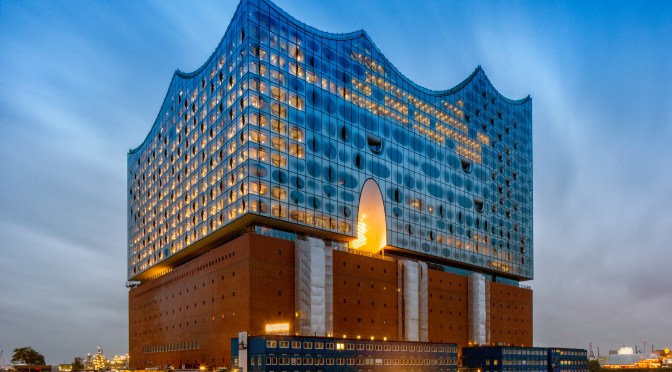
The fantastic Hamburg Elbphilharmonie is a newly minted symphony hall by Herzog and DeMeuron, one of our favorite starchitects. Costing nearly a Billion dollars (nur ein Milliarde auf Deutsch, to make it sound like less in classic German humble pie) and three times the original cost, it better klingt gut! It may seem unconscionable at that price, but…at least I wasn’t the project manager for that one!?! Whew!!

Nevertheless, I’m sure that it will take your breath away if you see it live. Perched high on a six-level parking podium, this building guards the Hamburg harbor.  Looking like a gigantic, dry-docked cruise ship, the interior is equally impressive.  Notice the scale of the building next to adjacent existing low rise buildings along the harbor. This building will change the face and pace of future symphony halls. More and younger crowds will attend to be seen and heard in these exciting venues that must include creative new productions and innovative performers in order to survive.

You can read all about it here: https://en.m.wikipedia.org/wiki/Elbphilharmonie#

Five German Speaking Cities Ranked Top in Quality of Living Survey

A recent survey tracked the most liveable cities in the world. Of eleven top cities, five are German speaking (Munich, Frankfurt and Dusseldorf are in Germany; Zurich is in Switzerland; and Vienna is in Austria). San Francisco was the only American city ranked in the top ten aside from NYC. Berlin was #11.

The cities — 230 in total — were evaluated on 39 factors including political, economic, environmental, personal safety, health, education, transportation and other public service factors. Cities were compared to New York City which was given a base score of 100. Mercer, who conducted the survey, is one of the largest human resources companies in the world based out of New York City.

Here’s the (updated) link: https://www.mercer.com/newsroom/2017-quality-of-living-survey.html

This survey may explain why I devote so much time and effort in learning German and spending a good proportion of my travels in Germany. The clues are based on the key factors cited above. They are the same reasons why I live and breathe in San Francisco. Now you know where I’d be if I hadn’t left my heart here.

Pretty Yende Pretty Amazing

April 30 will be a big day for me, when I see Pretty Yende in Dusseldorf. She has a pretty strange and curious name, but once you see her perform, you will completely understand why she us called that.

Out of (South) Africa, Pretty started learning and doing opera from Age 13. Apparently enough time on the clock to soar to one of the Met Opera’s youngest divas–performing in the Barber of Seville, Romeo and Juliette, and pinch hitting a few years earlier in Comte Ory. She’s gorgeous, powerful, energetic, and a heavenly sensation.

She’s planning to learn Wagner next, so get ready for some more fireworks. Don’t walk but run* to the nearest operahouse where she is performing. She’s slated to sing Lucia de Lamermoor and Elixir of Love next season, and I am already getting in line for tickets at the Met!

Watch the trailer for her new album here:

Incidentally, if you are a new opera lover like me, check out http://www.operabase.org for a database of all performances, opera companies, and performers throughout the world. For instance, if you search for Pretty Yende under Artists, you will see all her past, current,  and future performances. It’s an awesome site that I use regularly for trip and personal event planning.

A friend spotted Rufus Wainwright at the Zuni Cafe at lunchtime yesterday! There’s still time to catch his performance at the Uptown in Napa tonight.

My next post will be the start of Year 4 for Travels with Myself and Others ….so fasten your seat belts…

*Strange visual as some people attending the opera require canes to get around, but that’s changing!

Wishing a happy birthday this month to sister Muriel!

Days 77-80: San Francisco Summer

Many of you have heard Mark Twain’s quote about San Francisco: “The coldest winter I ever spent was a summer in San Francisco”. It’s truer than ever this past week since I have returned. Visitors from the East Bay showed up in shorts, only to find the brutal inversion layer of fog cloaking the city with a 50 degree blanket. The temperature difference within 50 miles can be 50 degrees. The pattern occurs consistently in the summer months, until the sun breaks through in early Autumn.

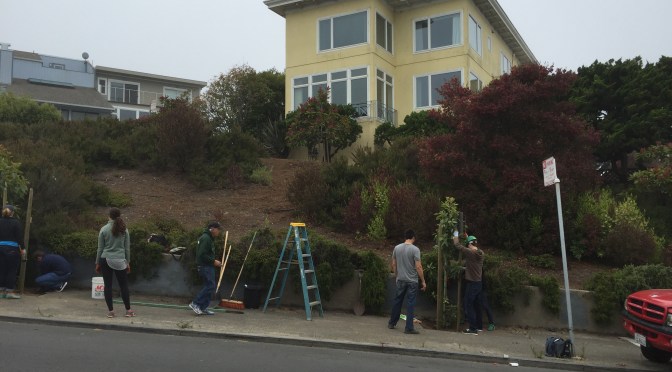
We ordered four street trees that were planted by the Friends of the Urban Forest (FUF), a local non-profit in the City. Gee Kin volunteered to help on Saturday, and the team covered a collection of houses in the Inner Sunset. After the trees are planted, the FUF maintains the trees for three years. While the trees are the responsibility of the property owner, there is talk about switching the maintenance back to the City. That would allow for more regular maintenance and protection for the tree plantings.

Growing trees obviously helps enhance and preserve the environment, but we heard that there are still many skeptical neighbors. They find the trees a nuisance with droppings, obscuring visibility, and cracking sidewalks. It seems like a simple goal, yet complicated by differences of opinion.

On the cultural end, I decided to extend my travel mode by visiting local museums and attending performances. The Asian Art Museum’s “Treasures from the Emperor’s Collection at the National Palace Museum, Taiwan”, featured a portrait of none other than Kubilai Khan.

imgres

After having just been in Mongolia, I was keenly interested in his place in Chinese History. He formed the Yuan Dynasty and moved the capital from Khorkorin to Beijing. From traveling, I have been able to connect the dots and have a better appreciation of the interactions between East and West. The exhibition covered four dynasties, the Song, Yuan, Ming and Qing.

Earlier this week, we hosted a family from New Zealand who are “kissing cousins”. They originated from Palmerston North and come from a mixture of Chinese, Maori, Irish, Croatian and Lebanese backgounds. Now there’s a conversation to be had! We were delighted by their stories about traveling around the world, living in the Guangdong father’s village for three months with all five teenage children in tow, and visiting Vancouver, Cuba, New Orleans and San Francisco during this last venture. How’s that for independent travel?!!

Since my birthday last month and all the greetings, I am hoping to collect birthdays from friends so I can reciprocate. Looking ahead for August, a Happy birthday wish to Pam in Chicago, niece Pam in Albany, New York, and old friend Karen in Oakland. Send me your date if you haven’t already, and I’ll keep you on my list!

This day completes the third 72+8 days around the world. Thanks to all for your input and comments on the survey. You can see the results after each question. It’s a valuable tool to help me improve my blogging skills! I’ll be posting once a month to keep the news up to date, during which time I will develop and share my plans for travelswithmyselfandothers. Enjoy your summer everyone! Stay cool, as we always are in San Francisco!!

Day 56-58: TSE in Transit

Good Morning Everyone

We boarded the eastern section of the Trans Siberian Express (TSE) the night before, so today is the second of three days on the train from Irkutsk to Vladivostok.

Irkutsk is positioned on the west side of Lake Baikal. As mentioned earlier, Lake Baikal is the deepest and oldest lake in the world. These may be little known or insignificant details to most people, except that it was one of the engineering obstacles in building the TSE. Although much of the construction required laying track along the 5880 miles or so, the section along Lake Baikal required blasting, going through narrow gorges, and swampy terrain. Now there is talk about a joint venture between China and Russia to build a high-speed version of the route.

Until then, I will enjoy what has been produced to date. The views of the eastern route have changed, from five of the six continuous days last year through Siberian birch forests and saggy wooden rooftops to brighter, open grassland sprinkled with wildflowers among pine and birch forests along the Amur River. There are twice as many stops on this eastern leg of the TSE (only about a quarter of the distance from Ulaan Baatar to Moscow). We were pleased to see a more vibrant side of the Russian landscape.

The people have been curious. We have had limited contact with Russians, and the language has definitely been a deterrent. We were finally able to connect with one of the guides at the Irkutsk City Museum by using broken French on both sides. So my five years of French in high school finally paid off, after trying English, German and Chinese in futility.

Virtually no one on the train speaks English, with one exception. We met a gentleman who lived in the Grand Canary Islands in the dining car yesterday. He was Austrian, originally from Innsbruck, and owned and operated a small, up-scale restaurant in the Canaries. He was taking a four-month break (low season in the summer in the Canaries, as most tourists go there in the winter) with his wife and was traveling through Eurasia by train.

In the Eighties, he made twenty films on different cities and countries in the world for an Austrian television series at a clip of one a week. San Francisco was one of the cities, so his eyes sparkled when we told him we came from there.

His current route took him from Vienna to Minsk, then Moscow, then Ulaan Baatar. After spending a week in Mongolia, they were heading in the same direction we were, to Vladivostok. We are finding that the travelers we meet along the way have substantive histories and travel background.

Other than 2-3 staff, this couple has been running a small high quality restaurant for over 30 years. The gentleman and head chef had been trained in a cooking school from the age of 14 to 17. When he turned 18, he left his home to start a successful business and wound up in the Canaries.

Every year, he and his family (the couple has a 17-year-old son) traveled to Africa, South America, and Asia. They loved traveling with their son as he was growing up. Alas, their son has finally decided to do his own thing this year. Although we have yet to meet the wife, the chef indicated that she was very sad about this change. We could certainly commiserate with him over this shift in no longer sharing family travel.

We realized that the depth and breadth of these travelers are fascinating stories. It took an hour-long conversation to get the facts and stats straight. They unfold slowly, with each question leading to another. This couple was planning to continue after Vladivostok to North Korea, take the ferry from Vladivostok to S. Korea, train from Beijing to Hong Kong, then back home. They planned all of their own travel routes and visas. I didn’t feel so crazy about my traveling itinerary after all. I found that it was often topped by other creative travelers.

The older couple on the hour-long minibus to Lake Baikal were another pair of experienced travelers. They lived in Doha as boomerang teachers and were doing the TSE after Mongolia to Moscow. They had lived and taught in Bonn, Germany for three years and loved Germany. They recommended going on safari through Kenya, Tanzania, or Botswana. After a week in Mongolia off-road, it sounded tantalizing and achievable.

The third group of savvy travelers we met during another dining car conversation going from Ulaan Baatar to Irkutsk. The young 30-ish fluent English speaker was originally from Mexico, living in Beijing, and owned an adventure travel company. He planned tours for ex-pats and locals living in the Beijing area, and could switch between Iran ski trips to scuba diving on Hainan Island. He was in Mongolia for the first time keeping an eye on a tour group led by a guide from his company.

One of his tour members was an older woman from North Carolina. She was teaching music in Beijing and was hopeful one of her emerging students could become world-famous. Like the rest, this woman was friendly, energetic, and ready to tackle any adventure along the path of travel.

The similarity between all three groups were the fact that they were ex-pats living abroad and eaking out a pretty good life. Whether young or old, these individuals were searching for ways to experience the world in as many ways as possible. I felt strangely at home with them. Being more visual, I find that seeing the world helps me to learn about it much quicker than through books.

Unfortunately, our encounters with the Russians have not been as promising as we hoped. The language barrier is obviously the main obstacle, but we found their demeanor a bit clipped and uninviting. I’m sure that under different circumstances it would be better.

We landed in a four-berth compartment on a wager that last year’s similar booking would get a private compartment without having to pay for it. Wrong. We are sharing the accommodation with a Russian mother and her 12-year-old son, who were a bit beside themselves when we invaded the space at 9pm in the evening.

We are still waiting for them to warm up to us, and to recognize that we are in this together for the next three days. The carriage is full, and despite cheery hellos in Russki and English we are still experiencing downward facing glances. We are now more appreciative of the friendly unassuming Americans, who have everything to share and are aware that they have everything to gain in doing so.

Due to the high density of the population, the Chinese in their inimitable way are also quick to engage despite their rude and crude behavior. They are not afraid to be embarrassed. Imagine Americans going to Mexico in the first generation of travel beyond our borders. Transfer that experience to Chinese traveling to Russia.

IMG_4449

Day 53-54: One Degree of Engagement (Lake Baikal, Russia)

Looking back at our week in Mongolia, it has been exhilarating and life-changing. I try to think of similar experiences, and although the trip we took to Montana came to mind, it seemed to be a far cry in comparison. Imagine Montana being the size of the US with the same density of population and that would give you an impression of what Mongolia is like.

I am attaching the Wikipedia reference for those who are curious: https://en.wikipedia.org/wiki/Mongolia. In this quick search, I learned that Mongolia is in fact the most sparsely populated country in the world. It’s no wonder that we felt the impact (or lack thereof) of human habitation on the planet here. We wondered if this wasn’t a good place to start if you wanted to live on the moon.

The low density means that people who live in Mongolia depend on each other. Gee Kin explained some of the details in the last post. For me, it was a reassuring vote for humanity. You learn to trust and rely on those around you. Just like the herder family in the video, you do everything for each other. We had a beautiful day and authentic experience with the herder family and our guides.

I am reposting the video from yesterday for those of you were unable to view it. I inserted the punchline in the back, so hope you will enjoy this revised version.

And…just to close out a few stray thoughts on Mongolia, here is a copy of the map of the Mongol Empire, showing Genghis Khan and Family’s Conquests in a few fell swoops:

FullSizeRender 71.jpg

Onward to Irkutsk, Russia

Our 18 month Russian visas from last year made it easy to take another trip into Russia this year. We hadn’t really planned on it, but coming to Mongolia made it irresistible to continue through Russia east to Vladivostok. We came north first by train from Ulaan Bataar (see spiffy Mongolian train above), then in a few days will be heading to the East Coast to on the last leg of the Trans-Siberian Express.

We heard that there were 19th Century wooden buildings in Irkutsk, so went towards an area for dinner that reminded me of Cannery Row in Monterey or Jack London Square in Oakland. It was an easy walk on a Saturday afternoon and many locals were heading in the same direction toward the mall.

We found a pretty decent restaurant with equal flair to any Bay Area restaurant:

Dinner with wine was only $40.00!

Listvaynka Village, Lake Baikal

Our main adventure the following day headed us in the direction of Lake Baikal, the oldest and deepest (about a mile deep) fresh water lake in the world. After gawking at the seaside crowd, we had pilaf and smoked fish for lunch in Listvaynka Village. It was refreshingly cool and a little bit of Sausalito in Eastern Russia.

The Sunday Weekend market in Lake Baikal featured smoked fish.

The bus back to Irkutsk put is in front of the city’s Sunday Market. It was very similar to the huge market that I saw two years ago in Tashkent, Uzbekistan. Uzbekistan produces much of the fresh vegetables and fruits for Russia, Mongolia, and other Central Asian and Asian countries.

On the way to Lake Baikal, about an hour outside Irkutsk, we met two Canadian travelers. They were a sturdy pair–active seniors who were working as educators in Doha and traveling throughout the world. In case you were wondering what’s happened to baby boomers, they are out of the woodwork and into the world again. Maybe not on the $5 a day like we did in the late 60’s, but resilient as ever.

They can do a mean Ritz Carlton on demand as easily as a backpacker’s hostel–for a few days, at least. I like to think of myself as being able to do both, but I tend to be more of a middle-of-the-roader. Our trip to Mongolia, on the other hand, was certainly a safari of sorts, but with fewer wild animals.

Our new-found friends told us a story about someone they met in Mongolia who was on a Guinness Book of Records pursuit for the most number of countries visited in the shortest amount of time. The 27-year old female traveler had already been to 130 of the 196 countries and is taking three years to complete the task. She spent most of her time obtaining visas and on the internet and had company endorsements.

I calculated that it would take about five days per country. At the minimum, all she had to do was to record the GPS point at the airport on her phone and get a visa stamp. I’m sure that she is doing more than that, but regardless, what a journey! It captured my imagination. I decided that I had met her through one degree of separation.

Day 52: Mongolia 5 (Herder Video, Guest Post, and Tips)

Mongolian Herder Video

Thoughts on Mongolia

Coming to Mongolia has been a philosophy class. What is “progress”? What is a “fulfilling life”? What should be the relationship of humans to the rest of the earth?

Thousands of years ago, much of the world was like present-day Mongolia: a few humans herding livestock from one location to another pursuing better pastures and decent weather. Then came the development of intensive agriculture; people stopped moving around and started living closer to each other. And we are now where we are.

Obviously, Mongolia is not thousands of years behind the rest of the world. But there ARE very few people, only 3 million living in an area the size of Western Europe. And as many as 30% of the population are still herders, living in “gers” that they move with the seasons. There are no fences. Their animals are allowed to roam and graze on lands naturally covered with native plants. Their livestock provide much of their food: meat and dairy. Their days are regulated by the hours of daylight, and their year is regulated by the seasons. The land and their animals provide life. This is their mantra.

All this is going to change. But Mongolia has a chance to do development right. It’s as if God is giving humans another chance – to not screw it all up this time round.

I don’t know what Mongolia is going to be like in 20 years. But as the population increases, there will be more constraints on the herding, nomadic way of life. Massive factory farms and open-pit mines already are fencing off areas from grazing.

A law that was passed a few years ago that entitled every adult Mongolian to 0.7 hectare of land will eventually have to end. Mongolians don’t write wills; the descendants decide among themselves how to divide up any inheritance. As Mongolians become wealthier and family members live further apart, lawyers are going to come into their own.

I like modern living. This past week in Mongolia has reinforced my appreciation of indoor plumbing, being able to eat foods other than meat and dairy, and security from wind, rain, bugs and wild animals. But there are other things I could do without.

If I had a chance to start human development all again, I would make choices. Mongolians have a chance to make theirs.

Gee Kin Chou, June 29, 2016

12 Tricks for Mongolian Ger Survival

I just realize that my posts have been pretty dry and humorless in the past few months. It’s hard to laugh with yourself unless you are reminded at times. Now that I have a traveling partner, we share the perspective on how we travel–the good, the bad, the fun, the pain. Laughter is the best medicine to get you through all situations.

Here are a few pointers for those contemplating a stay in a ger. There’s nothing like creating a list from real life experience.

  1. Duck your head when entering the low door opening. Oops, didn’t someone already warn me about that!?!
  2. Ask for extra blankets regardless of 90 degree weather in the daytime. Temperatures changes dramatically at night. ( hey, I thought I asked earlier?)
  3. Have the stove heated twice a day. Once before bedtime around 8 pm and once around 7 am before (thinking about it then is too late) you get up. The guide or staff will ask, but make sure it is customized to your waking and sleeping hours! It needs to be timed to when you are undressing and dressing. Notify staff or guide in advance if they don’t ask. This is your only option as there is no other thermostat in the room.(where ARE they?)
  4. Wear hiking boots , not just for hiking but for getting to the outdoor loos in knee high wet grass in the middle of the night and 6″ deep puddles during rain (Damn, I thought this was going to be a walk in the park?)
  5.  Use the futon or comforter as a sleeping bag and roll the edges around your body to eliminate air gaps (and bugs…or am I getting paranoid?)
  6. Use the long tongs for wood  from the stove for removing large black beetles from the sides of tent
  7. Do not be deterred by rain snow sleet or hail. Use garbage cans, trays, and water bottles during the time you are inside to catch any of the above that may inadvertently enter your ger.
  8. Fondle the felt when you first enter the ger. It will reassure you that you will be kept warm, away from most bugs except those that crawl under the gaps through the ground or fly in through the door or opening at the roof plastic. Don’t be disheartened by silly rodents that run over the tops of the ger roof or the moths that cluster outside the skylight plastic. They provide a sweet symphony to lull you to sleep. The felt also protects you from heat and inclement weather. (If you want to know what direction you are facing, the ger doors always face south.)
  9. Decide if you want light by leaving the door open or bugs flying around  the ger before bed. You get both if you leave the door open. Remember that if bugs have a hard time getting out if they manage to get in.
  10. Keep your voice down. If you hear others in the next ger, they can hear you.(Oops ! Have I been shouting? Remember whatever you say comes back to you in a round chamber)
  11. Avoid spending any brain power on the dung being used in the stove as the material contrary to common thought does not smell. If firewood is used, appreciate how far it has come to a neighborhood near you. The smell is only temporary as the stove will not be burning except when you are dressing. (unless you are crazy enough to come outside of the tourist season).
  12. Should you not find any hooks mounted in the walls, simply drape your clothing over any surface areas. Use the chair seats or backs, headboards or beds, and tables in the room. Avoid stuffing clothing between the cross slats in walls or structural ribs in the ceiling as they may cause the ger to collapse.

Above all, remember that Mongolians have been living in gers for centuries and the ger camps are providing you with this experience. They don’t need our advice on advancing civilization. They ruled it for over 200 years and have survival in their DNA.

(ed.note: please send us your comments! We appreciate any and all feedback on your impressions of our travels throughout Eurasia. Emails or comments here are appreciated and welcome!! Keep them coming so we can keep going! Thanks to all for those who have written during this journey.)

After today, our next venture will be in Eastern Russia, through Lake Irkutsk and Vladivostok by train, followed by Tokyo and the Nakasendo Highway. Stay tuned and travel with us.

A note to the newbies: This is my third, around-the-world, live (except for technical glitches), real time journey. As an architect, my interests are in Planning, Design, and Architecture professionally; archaeology, anthropology, art history, and travel generally; Silk Road history, opera, culture and food emotionally; and everything in between.

Day 48: Mongolia 2

This will be short. We spent the afternoon with a Mongolian herder family. It was alive with activity, including milking cows and horses (for mare’s milk), corralling animals, racing with boys, tasting fermented mare’s milk and curd dessert, and playing with the family’s newborn baby.

The family included an award-winning horse racer (30 years old), his wife (29 years old), his two boys (8 and 6), and the newborn (1 month old)

Our capable guide could milk the cows and horses and had many other talents, but we were thoroughly impressed when she could milk cows and horses without any difficulty! Our driver could wrestle and win races against 5 boys all at once!

Days 45-47: Mongolia 1

After the last posting on Beijing, I didn’t realize that leaving Ulaan Baatar was going to cap access to the internet for awhile. Therefore, you are receiving a rather long, delayed post. The itinerary through Central Mongolia was on and off-road, to ger camps without internet access. It was both a blessing and a curse.

But more importantly, a little background on the vast country of Mongolia. It is a flat, diamond shaped country the size of Western Europe. It is sandwiched between Russia and China and therefore must maintain good relations with these giants.

The growing season is only four months during the summer, and the entire country is shrouded in snow in the winter. Its harsh environment requires the mere 3 million people to rely heavily on family, community and each other. The limited good weather impacts all development, repairs and activity to a very short season.

Why come to Mongolia? Here are three reasons: to learn about the past, present, and future. The history of Genghis Khan, the first ruler who united the tribes, is a fascinating one. His descendants, including Kublai Khan continued to rule during the Mongolian Dynasty for two hundred years, from 1200-1400. Most of the expansionist period was during the first fifty years, when the grandsons who were posted to the outer reasons conquered as far west as Hungary and beyond. 1 in 200 men in the world have the DNA directly attributed to this prolific ruler Genghis and his descendants.

Following the Yuan or Mongol Dynasty that ruled most of Eurasia and China, the Ming defeated the Yuan at their capital in Beijing, and then the Manchurians (Ching Dynasty) ruled over China and Mongolia. With Russian help, Mongolia defeated the Ching Dynasty and became an independent country in 1921.

The second reason for coming to Mongolia is the environment. Mongolia, unlike China today, is still a pristine and pure environment. Nothing can be more contrasted than flying from Beijing to Ulaan Baatar (the correct spelling). The pollution and stifling heat of Beijing disappears and the crystal clear skies and bright sun of Mongolia appear. Ecotourism is being promoted here today and the Mongolians are very proud of their country. They know that the world is their oyster and they have every intention of protecting it.

The future is the third reason. Mongolia has huge mineral resources. Mining is one of its biggest industries, and tourism is growing despite its short season. With such a small population, Mongolia’s GDP has been growing at a rate of 10-15% over the past several years, twice the pace of China. While Mongolia is still considered a basically agricultural, nomadic land, it will experience phenomenal change.

Many people are still nomadic herdsmen, and they still live in the traditional ger, or round huts. They are constructed of wooden supports, felt padded walls, and can be easily assembled. A pot belly stove in the middle heats the room, and all the basics of living are contained within the ger: cooking, eating, sitting, sleeping, and storing. Oops, except for the toilet.

Everything has been hunky-dory in the ger camps where we have been staying for the past few days (we’re in No. 2 of 5). Toilets in the first ger were banked below the dining hall, not unlike those you would find at the UC Blue and Gold Camp in Pinecrest, CA. The second ger ratcheted up the ante to an outhouse, with a tastefully decorated Mongolian tent over the pair for easy identification. You could use the sawdust at free will. I was getting into the flow, with one minor detail. It rained this morning.

Imagine the scene for dressing (everything was set in place in advance the night before inside the ger), with even an umbrella. Contending with Mother Nature in order to let Mother Nature contend with you was a challenge. In the end, it wasn’t as bad as it sounded. You just felt all thumbs and big toes in the execution. When in Rome, do as the Romans, as they say.

But I digress. Back to Mongolia. The first afternoon of our private tour was devoted to the National History Museum in the middle of Ulaan Baatar. The museum traced the beginnings in the Fourth Century BC to the present day. Photographs are not allowed there or during the performance of traditional Mongolian singers and dancers. The main display I wanted to capture was the map of the conquests by Genghis Khan and his grandsons. They occurred over a very short time span of fifty years, and mostly in a ten year period between 1215-1225.

In the morning of Day 2, we visited the largest Buddhist monastery in Mongolia. Mongolia is 98% Buddhist, so the religion plays an important part in daily life as well as its history. Buddhism came to Mongolia via the Tibetan monks. Today’s monks come from all over the country to study and chant at this monastery.

Later in the morning, we left the capital city to visit a shaman. Shamanism, or contact with the spirits through a medium, is also practiced in Mongolia. If an individual wanted to send a message to the gods, he or she went to a shaman. The shaman did not give advice but only transferred the information back and forth.

IMG_3561 3

This shaman explained to us that she was “struck” by both a desire and calling only after being confronted a number of times. After her husband died and she was sick, she eventually consented. She very patiently and proudly explained her roots and the people she served.

Her room was laden with offerings to the gods and spirits, both good and bad. Offerings included cheese, curd, dried nuts, fruits and dishes of food. Unfortunately, I didn’t get the answer to a question I had in mind. Her next appointment was already waiting and time ran out.

In the afternoon the driver and our guide took us on and off road in search of the Przewalski horses. They run wild and are the ancestor to today’s domesticated horses. They are shorter, stockier and more muscular than the Arabian horses we are accustomed to seeing. They are named after the Russian who discovered them and helped to return them to their native land. They were an endangered species, but due to good management, they can now be allowed to proliferate in a protected environment. It felt a little bit like whale watching, but we were able to find a pack of six in the distance.

The vast green virgin landscape stretches literally for miles and as far as the eye can see. Occasionally there are pigs, and sheep dotted throughout the landscape. The herdsmen know where their herds are located and round them up at the end of the day. They are branded and the larger animals are used for milk and transportation.

The next day, the landscape suddenly rose in elevation, with mountains in the background to nearly 4,000 meters (12,000 ft!). Eventually a sandy desert mixed with small grass emerged. There are many small, Gobi-like deserts throughout Mongolia, and we headed for one of them. The camels that reside here are two-humped, and can carry up to 800 lbs. They can travel without water for a month and without food for up to two months. (See featured photo above)

The distances between sites are vast in this huge country, and few roads are sealed. It takes nearly three hours to travel 100 miles, due to hazardous pits in the road or sandy roads. We were surprised that the driver only had to refuel once in the three days we were driving. While we weren’t used to sitting in the car for such long hours, we were grateful that the Land Cruiser was very sturdy and capable of handling bumps, muddy pits, and stream crossings.

Today’s drive took three hours off-road to a beautiful valley known as the Orkhorn Valley. Rain and inclement weather has deterred our camel and horse back riding, but we have been able to see the beautiful lush green, unspoiled countryside in its natural state.

(Ed note: Apologies for delays and disjointed editing in post. Limited or unpredictable access to internet make posting a challenge! It was quite refreshing to be off the grid, were it not for my anxiety about posting. I finally decided to let it go, so hope you will understand and appreciate how some of the rest of the world lives. Gee Kin did catch one of the monks using his smart phone under his sleeves at the temple. He was playing chess. One of the daughters we met with the herder family confessed that she missed the internet in town. It’s a changing world….)