Tag Archives: Food

Amsterdam

As part of our Thelma and Louise descent on N. Europe in the dead of winter, Melissa and I drove through wind, sleet and snow (no hail) to reach Amsterdam. To an art history major like Melissa, this city is the museum capital of the world. The thought of tackling the Van Gogh, Rijksmuseum, Stedelijk, and Hermitage museums in one visit is daunting enough to send you to dreamland or the loo. (More about that later)

In any event, I had plenty on my mind. Our first major stop today was the Van Gogh Museum.

We were lucky enough to descend on a major exhibition between Edvard Munch and Van Gogh. The curators had a field day placing each major Van Gogh next to a relevant Munch and comparing them. The artists’ styles vary greatly but their humanism and emotionally charged social commentary were consistently similar.

Of course the most charged painting was the “Scream” by Munch. Sure enough, it was on display. This was the first of four versions of the subject matter, in pastel in 1893. You can read more about the exhibition here: http://mobile.nytimes.com/2015/10/01/arts/international/munch-and-van-gogh-together-at-last.html?referer=&_r=0

Borrowed from the Museum in Oslo, the Munch collection was vast. It saved a trip to Oslo in this exhibit alone, but the two artists’ work side by side was overwhelming.

The painting itself was described as a sudden turning of the sky to blood orange. The subject was reacting to the scream caused by the sky and by putting his hands to his face. He was not the creator of the scream, as most of us would think, but it also has that effect.

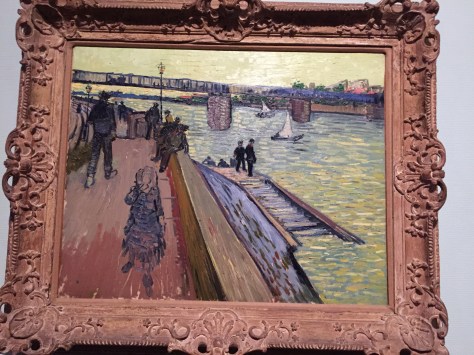
Van Gogh had a completely different version of a similar setting. (See below, an example of the comparisons and contrasts between these two famous painters’ work).
image
Van Gogh scene adjacent to Munch’s Scream

Aside from following intricate comparisons, I was having my own wonderings. Did Klimt borrow the Kiss from Munch? Munch’s piece, also entitled the Kiss, comes from 1902, followed by Klimt’s piece around 1908. What’s your guess?

The deep dark leaves depicted by Van Gogh reminded me of one of Melissa’s paintings. Similar in color and cool density, the leaves seemed to reflect the mood and style of Van Gogh’s masterpiece!

Another jog in my now cluttered memory bank was the recent Asian Art Museum exhibition of Western art influenced by Japanese artists. The Van Gogh Museum version contained a room with a Van Gogh painting juxtaposed next to Hiroshige’s bridge. Very similar to the recent Asian Art Museum exhibition. Hmm, not bad for making connections…one of my favorite pastimes.

The takeaway from this museum is the vastness of Van Gogh’s efforts to learn and do art. His strokes convey his internal struggle to communicate and reach the viewer. His subjects command awareness and commitment. His peasant families, landscapes and simplicity in living demonstrate his earnestness and conversion from living a bourgeois life (his father was a pastor and his brother a successful art dealer) to becoming an active conveyor of life and living. Here’s one guy who made his avocation his profession!

You can read more about the exhibition here:

And now about the loo. Grubby hubby Gee Kin gets museum sickness whenever we spend too much time browsing and pausing in museums. Initially, he made a dive into the men’s room after about twenty minutes of forking over his hefty share of the entrance fee. Slowly, he is overcoming his immun-deficiency and increasing his brain mass (not tolerance) for visual institutions and the intellectual challenges they offer. After a successful visit to the Hermitage in St. Petersburg last summer, he can proudly claim that he is in remission.

Sadly, I discovered a device at the Van Gogh today that might have saved Gee Kin his misery. It’s known as a Stendhal box.
Developed for museum goers in ecstasy, this chair with a shroud around it (there’s a wooden door to cover your view after you sit inside) can help you to decompress at the end of a raptured experience at the museum! While some may believe this to be comic relief, the confessional certainly could have treated Gee Kin with a refuge from torture and spared him another trip to the loo.

Our fruitful day ended with dinner at De Kas, located on a lake in town. The greenhouse and lab environment was an unusual setting to showcase its hydroponic food production that short-circuits farm to table in an entertaining and palatable way. The single menu included vegetable forward and crunchy appetizers, mushroom consommé, field fowl, and cheese plate or tarte tatin for dessert.

image

Ich bin eine Berlinerin

OK, this was an unplanned visit to my favorite adopted country. My daughter Melissa is between jobs and after contemplating Morocco or Mexico City, we agreed that Berlin was not a bad option for interesting food, art and culture.

Our first of two weeks revolved around a number of upcoming new restaurants, galleries that are open over the holiday break, and special performances.

After stalking many of Europe’s best venues, I learned that there are impresarios who descend on famous sites such as the Berlin Philharmonic. When the orchestra is off, they lease the facilities. Many of the promotions cater to local tourists from France, Italy and Eastern Europe.

The usual Swan Lake, Mozart masterpieces, and Strauss waltzes are offered, but are not part of the regular program. While we did partake in a Russian ballet company performance, it takes a bit of close navigation to understand who is producing what and when.

Nevertheless, we enjoyed seeing a bit of traditional ballet contrasted with a modern version by Duarto/Kylian, two contemporary choreographers. The latter audience was much younger and local, while the former was stocked with a mostly tourist audience.

There are museums and galleries galore here, probably too numerous to count. For that, Berlin beats Mexico City hands down. We tackled the Pergamon earlier over the weekend with friend Vladimir from Meissen with some difficulty, as the Museum Island is still being renovated and access to each museum is limited.

Yesterday we covered art galleries in the Prenzlauer and Kreuzberg areas that included the Institute for Contemporary Art and the Kunstraum Kreuzberg. Old schoolhouses have been repurposed for gallery use as well as after school music and arts programs. A decent cafe in each allows visitors to enjoy the environment while warming up to the cold chill (and now snow) outside.

The Kennedy clan are well known to Berliners, almost more than to Americans. Aside from JFK’s famous quote, he was known to protect West Berlin from succumbing to the Communists in East Berlin. A small but significant historical detail.

The Xmas Markets were fun to explore and finally experience. The “gluhwein” tastes better than it sounds, and is merely what we call mulled wine. And the stollen or Xmas cake leaves a bit to be desired, particularly when traveling with a pastry chef.

The hip new food fare here, however, has been delightfully innovative, inexpensive, and thoughtful. While not always successful (veggies a bit on the raw side), the intent on making food healthy, delicious and beautifully pleasing to the eye is very evident. While not a foodie myself, I am swept up by the company I am keeping. Traveling with one can cause you to get into the picture pretty fast. Take a look at some of the plates: my favorite was the avocado and red beets on toast. Easy enough to make me want to make it as soon as I return home..

For the wannaknows, we hit Lokal, Industry Standard, and Horvath.

Viewed at the top, Swan Lake x 2.

Day 60-61: New York City, New York

Attached are a few photos of the Picasso Sculpture Exhibit currently at the MOMA:

From a dozen gallery visits the following morning:

Lunch

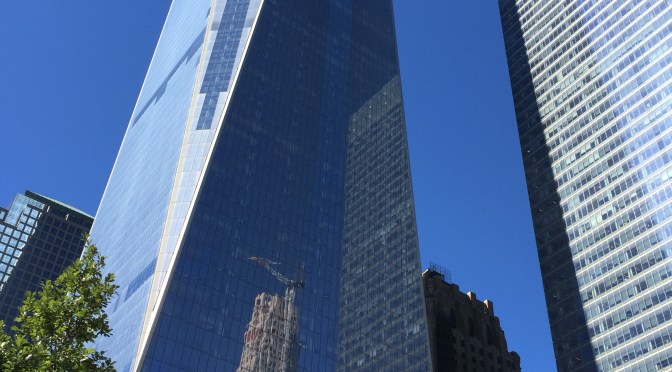
Tour of World Trade Center Area

Cruise on the Hudson in 130′ Yacht

Room with a View-New York City Skyline looking North

Day 55-57: Schwishin’ Schwäbisch

After the end of the Language and Cultural Program, it is difficult to come off a “high” from having made several new friends in a short time span. While others were packing their bags and moving home or elsewhere today, I decided to stay behind another day to savor a town I have called “home” for the past two weeks.

A morning walk refreshed my first senses of this sweet little town. A river runs through it, where people can still fish from it. Walks are everywhere that meander along the river and trace the town’s history. A community that cares about its environment and each other. And specialty local produce and products are made with purpose and don’t cost an arm and a leg.

Here are a few recordings of my walk this morning:

The Saturday Market was just getting ready for a big weekend celebration.

IMG_9259
Our class mascot, “Goethle” with specialty products Bratwurst, Bio-Blutwurst, and Schaschlik Guwürzsalz.

Our last two days were a little sad as friends got together for dinner and said our good-byes. While we didn’t exactly master the German language, we made some good friends, shared and learned alot from each other, and thoroughly enjoyed a successful two-week stay in Schwabisch Hall.

Day 47-48: Hohenlohe Lo and Behold

We were taken on an excursion this afternoon to Kirschberg, a medieval town in the outskirts of Schwabisch Hall. In typical fashion, the buildings were beautifully preserved, as Germany really appreciates the historical value and cultural significance of its past.

Our second stop was a visit to one of Germany’s model farms. It grows the maize and the hay to feed the cattle, and the cattle are grown for meat. It is cheaper to import beef from other countries to Germany, but the farmer can sell his meat at a higher price because of its flavor.

The farm used to produce alcohol but it became too expensive to produce. They have a new operation that processes methane for bio-fuel. Nearly every sloped roof I could see in the farming areas were packed with solar panels, and windmills are also located in the area to create electricity.

The second part of our excursion outside of town was at the Freilandmuseum of Schwäbisch Hall. Located in Hohenlohe, it is one of the seven open-air museums in the area. It is similar to Williamsburg, where period buildings are shown in their natural environment. Buildings were moved here from elsewhere to preserve them. We saw an early medieval farm house and a more recent one from the 19th century. We also visited a school house, where our instructor gave us a lesson on the present tense. He read us what the teachers would tell the students to discipline them. Corporal punishment was the name of the day–see “the White Ribbon”, a chilling film about a family in rural Germany by award-winning film director Michael Haneke.


The buildings showed the construction of the walls. Twigs were carefully cut and sorted to be consistently equal in size, and then they were placed between the posts and studs. The straw and mud plaster was used to fill in the gaps, and then plaster and paint was added over the walls. Early buildings were built of stone to avoid the eternal fear of fire, but eventually the materials were organized better to concentrate the use of stone in the basement for cooling and storage of food over the winter, and then placing the living quarters over the stone level to keep the house warm. Stone and iron were used in the cooking or hearth area to protect it from catching on fire.

If it wasn’t fire, the next greatest fear of any family was poor health. Of 15 children, half or more died in the 19th Century. Families had to live together for economies of scale and to look after the children. As mentioned in other historical tours, hygiene was very poor and people did not wash for a year. There was very poor sanitation and waste treatment. Like in the Rothenburg-ob-der-Tauber Midnite Watchman tour, Schwabisch Hall had its alleys full of waste that was thrown out the windows of the houses. Wealthier people lived at the top of the steep hill so all the waste washed or slid down the hill to the river. So the poor got the worst of the lot. This contributed to the disease and infestation that baffled and plagued generations of farmers and city dwellers alike. I woke up just in time to notice that tour attendees tend to get pretty lethargic, until the stories about gore and horror get mentioned. Everyone perks up and pays attention intently. It must be trick the tour guides use to give everyone a jolt and reminder to achtung. Unfortunately, I’d heard it before.

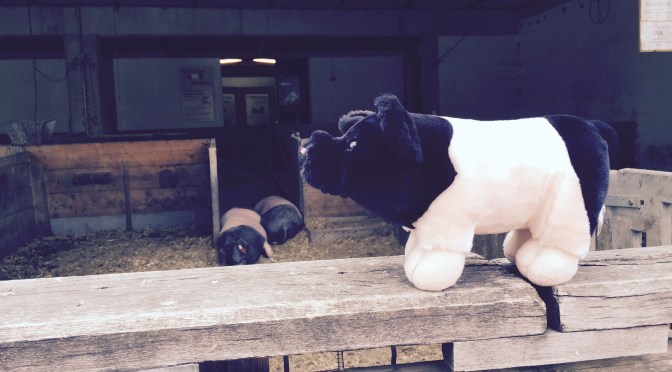
We were treated to a specialty of the area known as “Wibele”, tiny tiny waffle-like coated snacks that look like mini macaroons. I confess that they were more delicious than they look. Our teacher told us it was a highlight that he remembers as a child. The schwein shown in the picture below is also known to be a specialty of the area. Its black head indicates that it was bred from another pig and it yields a distinct and delicious pork flavor.

I’m trying really hard not to overeat, so I am buying food from the supermarket and even tried cooking in the guest house kitchen tonite. I buy the usual fruit, granola and yogurt for breakfast, and conjured up some twistee noodles with garlic, olive oil, and tomatoes for a tasty home-cooked meal. I have been making sandwiches for lunch with delicious aromatic schinken ham and Swiss cheese and arugula on a fresh brot. Sorry foodies, no pictures to brag about for awhile. You’ll probably have to wait until I get to New York.

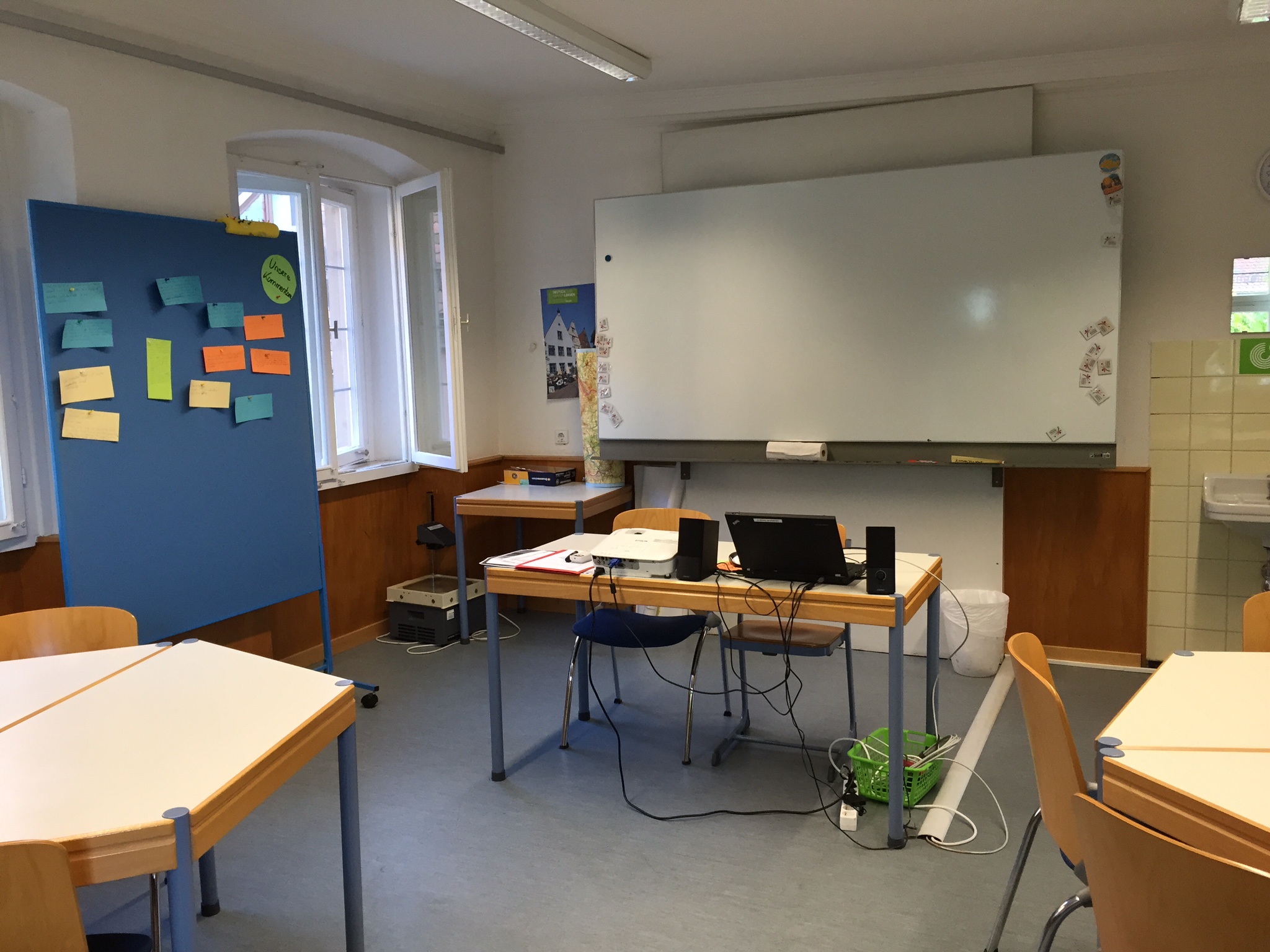
Finally, here’s a stray photo of our classroom, for those contemplating doing this program in the future:
IMG_8353

If you are the adventurous type, like meeting people, and living a spartan life, I highly recommend this program to you. You also get to learn a delightful language that is full of grace, elegance, and structure.

(Featured Photo, above: our class Mascot “Goethie”, from the Schwabisch pig shown in the background. They have black heads and bottoms, just like the stuffed one shown.)

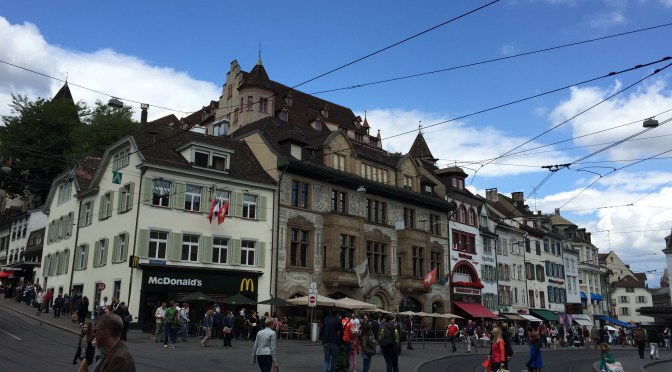
Day 43: Basel, Switzerland

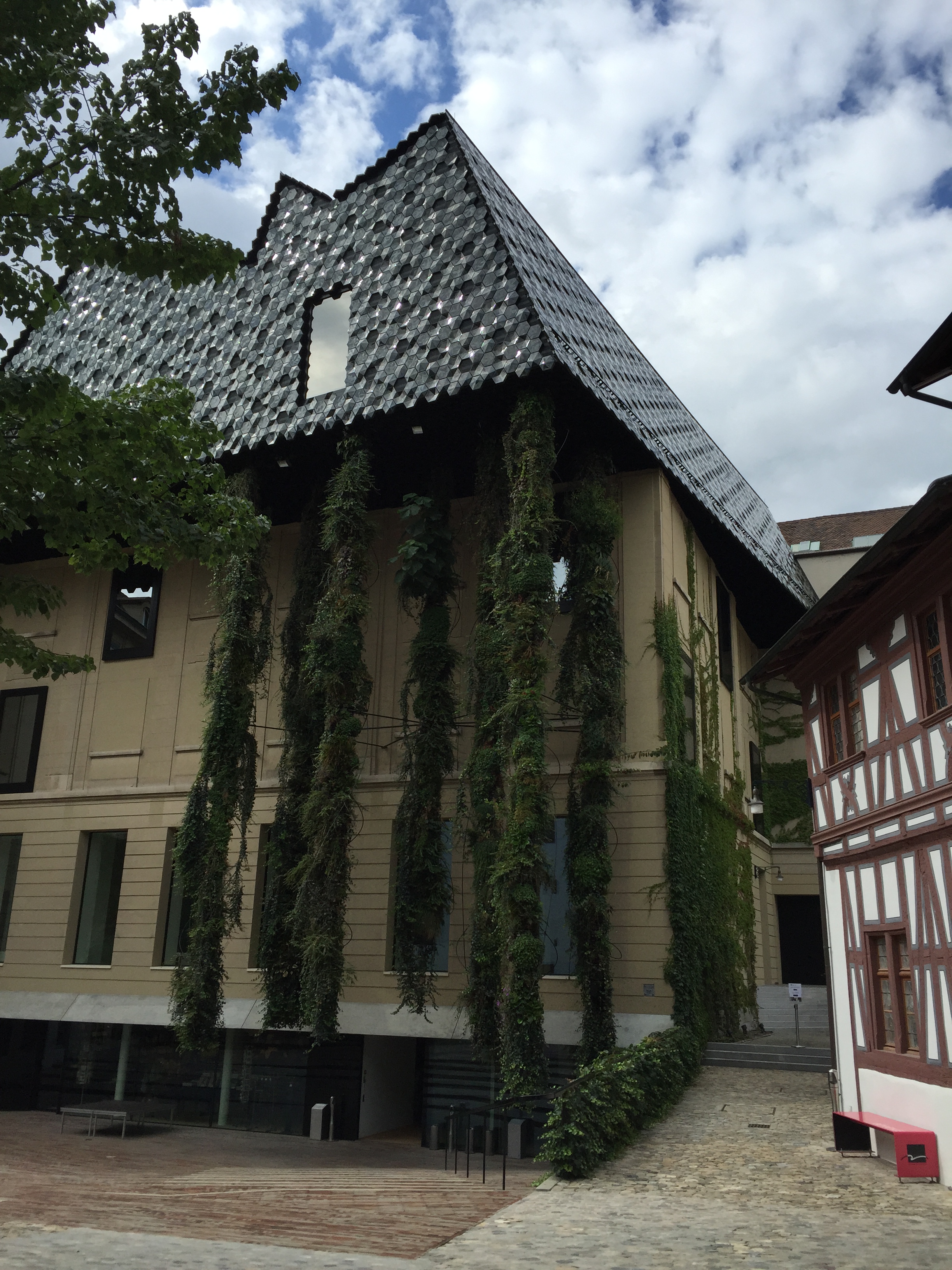
Three Walking Tours were available in the heart of the city and we decided to take the architectural tour. Many of the buildings in the city were designed by Herzog and Meuron. Basel has bragging rights to a number of world famous architects, including Zaha Hadid, Frank Gehry, Richard Meier, Tadao Ando and another of their own native sons, Mario Botta.

It’s interesting to note that both Botta and Herzog and De Meuron designed museums in San Francisco but are known in Switzerland for many other building types. The prevalence of American architects may be due to the development of the biotech industry in this area and its partnerships with American firms. Many of the buildings featured on the architectural guide were biotech companies such as Roche and Novartis.

IMG_8671


The vertical extension of Basel Museum of Culture was designed by Herzog and De Meuron. The textural pattern of hexagons reflected the irregular shape of the plaza facing the museum. They were in both convex and concave shapes. The giant hanging plants at the entrance reminded me of the seaweed forest at the Monterey Bay Aquarium, where they swayed gently in the breeze.

The De Young Museum in San Francisco, also designed by Herzog and De Meuron, is one of my favorite buildings. I love the mottling effect of the exterior copper panels on the inside of the building and how it imitates the light coming through trees in Golden Gate Park. The huge canopy at the entrance also reminds visitors of the deep shadows in the park.

The Basel museum featured an exhibit on opium that sparked a lively conversation with my hosts in Brunnen. My grandfather had died of an addiction to this deadly plant. The museum collection included all the history, plant production, implements and literary figures who were influenced by opium (including one of my relatives, Lin Biao). The saddest part of course was the Opium Wars and the treaty ports imposed on China as a result of the wars. The exhibition was very thought-provoking and a moving educational experience.

Swiss Cheese, Salad, and Potato for Raclette

Our final evening was topped by the famous Swiss specialty “Raclette”, a fondue-like dish of Swiss cheese toasted with onion and spices on a grill, then spread with a miniature wooden scraper onto the top of sliced potatoes.

After saying goodbye to my dear friends in Switzerland, I was looking forward to my next big adventure. I will be taking a German language and culture class for the next two weeks in Schwabisch Hall, Germany, and can’t wait to spread out my meager belongings during this time.

My friends Helena and Hans took good care of me and showed me a local’s view of Switzerland. I am very grateful to them for their generosity and appreciate their care and attention during my stay there.

Day 40-42: Swiss Whirlwind

This week I traveled across the beautiful country of Switzerland, from Brunnen on the shore of the Vierwaldstättersee near Lucerne to the French speaking area of Valais near Sion .
IMG_8583
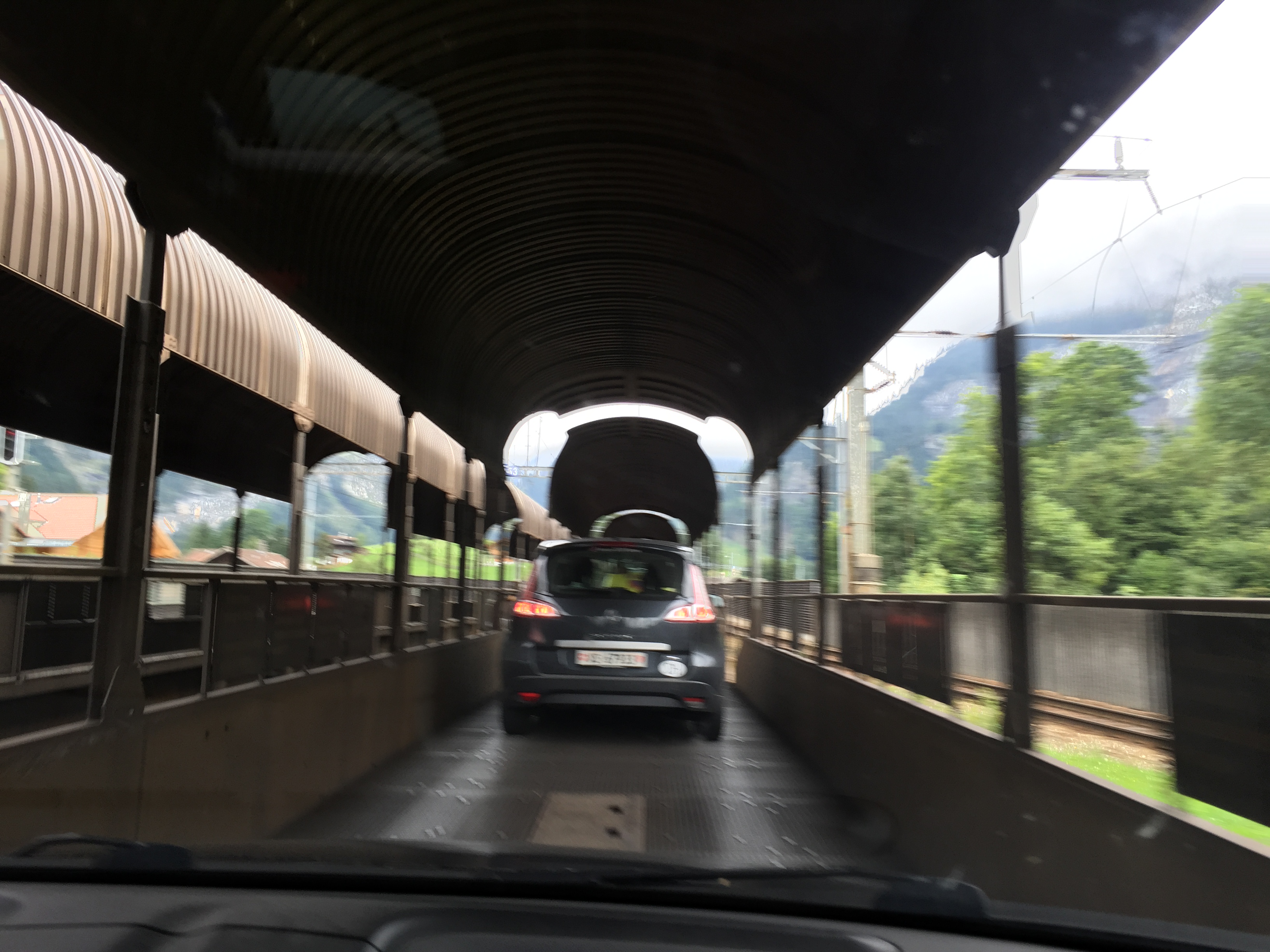
We took a car train through a deep tunnel in the mountains to the valley. Also known as Wallis in German, Valais is a serious wine growing region with a patchwork of vineyards etching the south-facing sides of the valley and flatter terraces of the north side. It was in the middle of the Autumn harvest, and the carpet of vineyards provided a lush green for the eyes and sheer pleasure for the palette.
IMG_8630After a much appreciated day “at home” at my friend’s home built with straw walls for insulation, I met another friend who was working in the French speaking area. Marie had a friend visiting from Der Wolf in Belgium, and together we went to the medieval castle on the hilltop in Sion. Afterwards, we had a delicious lunch al fresco at Restaurant L’Enclos de Valère. Upon returning to Sierre, I took the bus back to where I was staying halfway up the hill from Sierre and near the resort area of Montana.


IMG_8612

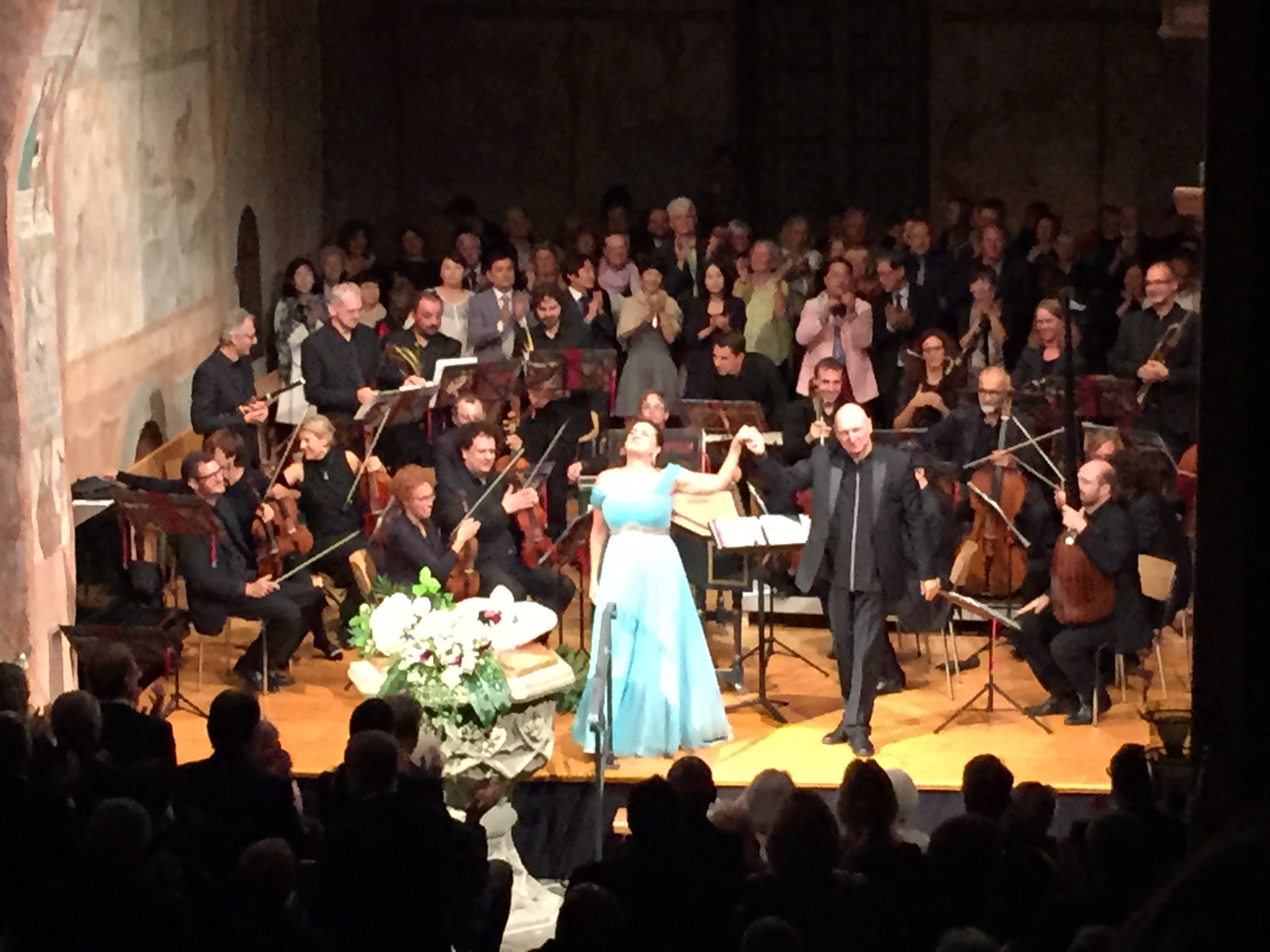
Later that evening, Hans, Helena and I attended a performance by world-famous opera diva Cecilia Bartoli in a small church in Gstaad. It was a two-hour ride by car to get there, but well worth the intimate venue and Cecilia’s delivery of beautiful baroque music by Vivaldi and others. It was performed by I Barocchisti, an orchestra specializing in this type of music, using original instruments from that period. Both Cecilia Bartoli and I Barocchisti performed in Iphigenie en Tauride, an opera I saw recently in Salzburg.
IMG_8650

Day 36: Zurich’s Riches

Every city on arrival has inspired me. Everything is so fresh, new, and exciting. I feel like I am abandoning the children I left behind: the cities that were so sweet, quaint, and lovely. Each one had their unique qualities, but I can’t help but look forward to the adventures in the near and present future.

Attached are some photos of a do-it-yourself city tour I took on Saturday morning. It was unbearably hot by time 2pm struck–it was well over 90 degrees. The street parade was taking place, and by time I got to the train station there were floods of celebrators, mostly young and in costumes and wigs, ready to tackle hundreds of music venues spread throughout the city. Many of the party-goers appeared to be from within Europe–Italians, Dutch, Eastern Europeans, and the like. They were ready to PAR-TEE!!

A curious contingent of Asians were in one of the small squares with yellow T-shirts promoting democracy. I thought that was a bit strange but learned afterwards that students and residents of Malaysia were protesting against their prime minister and were demanding for his resignation. He apparently was dictatorial and had mis-managed funds. Another group in yellow T-shirts were just getting out early ahead of the parade and entertaining tourists on the street.


Switzerland is frightfully expensive, so I am staying on the outskirts of town. The location feels South Peninsula-like, with many new internet and bio-tech firms concentrated in the area among spanking new housing. I noticed on my run this morning that new housing includes heavy metal louvers over each window as a standard. (even on my hotel window). It definitely helps provide shading and environmental advantages from the strong sun and temperatures here.

There was also a playroom in this new housing development. American architects have studied ideal housing in Europe consistently, yet I still do not see this level of integration for children in public or private housing in the U.S. At the same time, it would be perfect if housing can incorporate activities for seniors such as a support system for day care within the same development. Time to consider this approach and how we can get it to happen.

As a contrast, as there always are, I had to beat it to the supermarket before 9pm last night. They are closed on Sundays. I guess Americans just look like a bunch of workaholics who can’t get their lives together to avoid the food shopping on Sundays. Or else we just eat so much we run out of food every day, and need access to the Sabbath for that last beer. Maybe we should establish a one-day-a-week food-buying moratorium to curb the urge??

Day 35: Yummy Tummy Summary

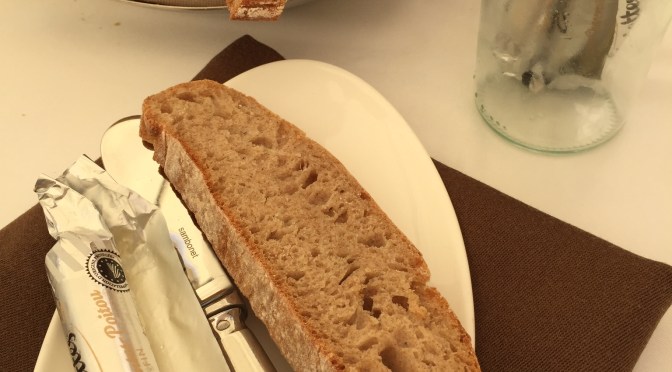
Here’s a special summary of what specialties and dishes I have encountered of late. Nothing from 5-star or destination restaurants, just high quality, places with proud owners who turn out good food at reasonable prices for its customers. The featured image above came as a simple bed of three bread choices as a starter, with chilled rolls of butter wrapped in foil. I thought it was an elegant presentation of Austria’s finest.

Some of these dishes along the way were left out of earlier posts for one reason or another. My focus in this post is about how I have drastically modified my food choices. Despite all the temptations and delicious food, restaurant food on an on-going basis is not sustainable. I’d be the last person to admit that, but even I have hit my limit…at least, for today.

The first few meals were hard to pass up:

1. A tasty salad of shaved mushrooms from the Vienna Kunsthistorishes Museum Cafe.

2. Another museum special in Salzburg, of roasted chicken on a bed of hominy and salad. It was delicately flavored and delicious. Museum cafes are convenient and seem to have good environments with great views and pretty reliable food, even if they are a bit slow or lack business. It’s also easy for a singleton like me to slide in and enjoy a nice glass of wine with my meal without feeling like I’m unpaired.

3. Wiener Schnitzel at the cafe across from the Freud Museum had a coating that was unbelievable. Better than any tempura or batter fried fish you ever had–crisp, hot, not oily and melted-in-your-mouth scrumptious. The problem was that the portion was enough for three big men, but I ate it anyway. (This was my predicament for the past few weeks, whether it was a salad, fish, or ANYTHING on a plate! What happened to those tiny meals in Russia??)

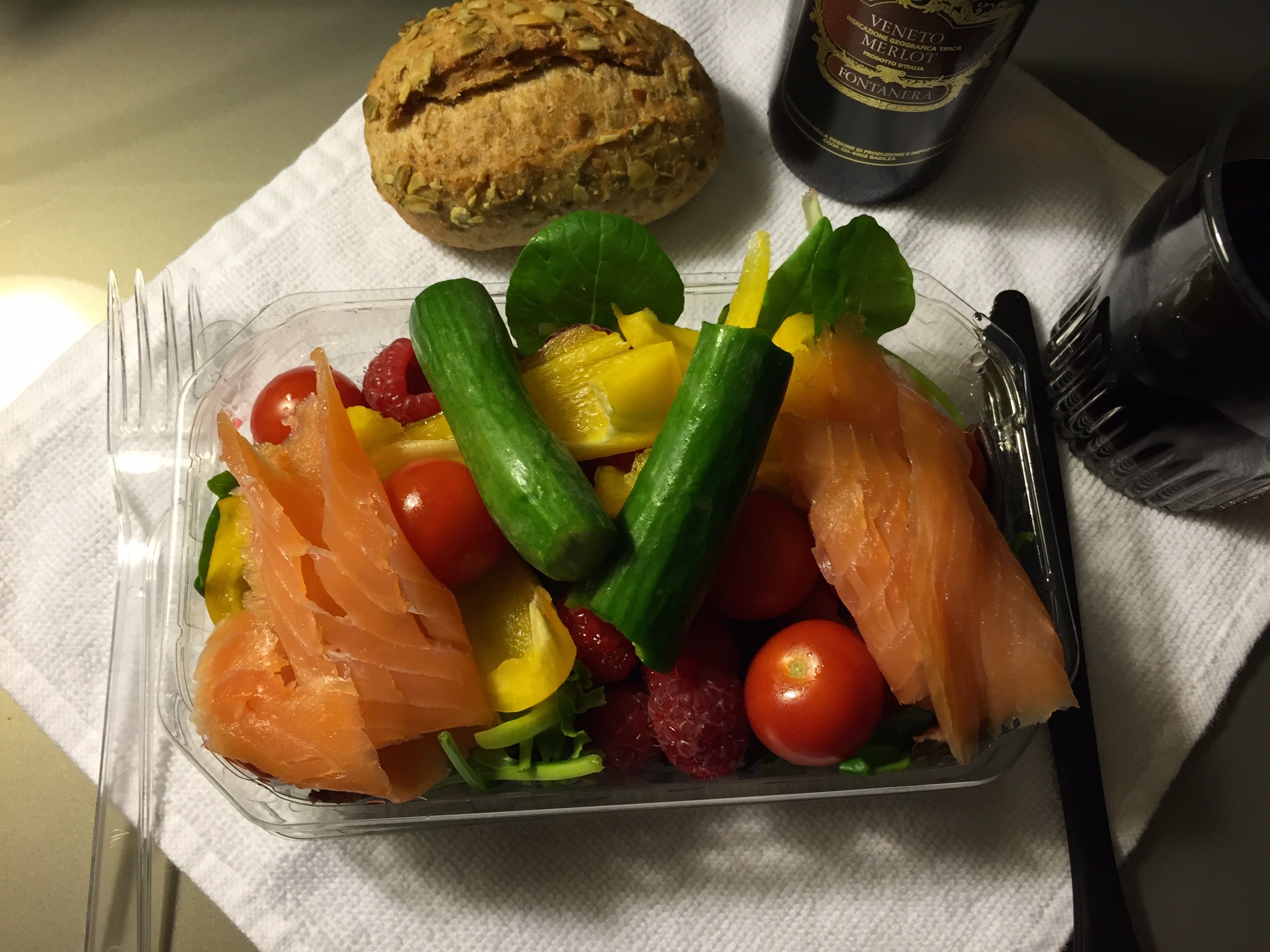
By the end of the week, however, I was yearning for the plain and simple. I arrived in Zurich making a dash for the nearby supermarket, conveniently across the street from the hotel. I was able to conjure up a delicious summer salad with Scottish lox, raspberries, tomatoes, yellow pepper, and finger cucumbers, with a seeded roll and split of Italian red on the side. I was proud of how I could prepare an entire meal with ad-hoc implements and bath towels from the hotel. I’ve been trending toward this healthier, less expensive approach to food on the road.

IMG_8090

Before leaving Linz and Austria, the famous Linzer Torte had to be tackled and deconstructed. I tasted it and wasn’t too impressed, but I am including several versions of recipes for those who are interested. Hopefully you can enlarge the print to read it. I tried holding my breath every time I take these photos with text so they don’t turn out fuzzy, but alas, I sometimes giggle uncontrollably.


The upshot of the torte is that, from what I saw, you make a sort of almond paste/marzipan type of glue that you fence onto the top of the cake smeared with jam. Pardon my description. It sounds gross but I am actually interested in trying to make a tasty version of it when I get home.
(from the Schloss Museum, Linz)
And of course everyone wants to have fame in the food world. The Linzer Torte can’t escape the temptation.
IMG_7960-1

Day 28: Schonbrunn to Apfel Strudels

Today’s adventure was to Schonbrunn Palace, the summer residence of the Hapsburgs. The featured image above is the SIDE of the palace, not the main elevation. That’s about 5 times the width of this view. As mentioned earlier, this tops Versailles in my mind. The Austrians, in the tour guide’s words: are “crazy”. The palace tour provided proof of the royalty’s propensity towards personality disorders. There were numerous amusing stories and morbid details. The guide repeated several times “don’t believe what you see in the palace—it’s all an illusion”, referring to the wooden chandeliers painted to look like solid gold, pictures of important dignitaries who were not present at an event, and elaborate settings that even the royalty couldn’t hack.


Among the many amusing stories were those about hygiene and infestation. Thanks to the Catholic Church, the priests promoted the idea that bad men smaller than the eye could see existed in the water. They could get into your pores through water and make you die. For thats reason alone and for 400 years no one wanted to wash. They only took baths once or twice a year. Slowly through a catholic edit they were able to wash once a month.

For that reason, so much death and dying occurred. Infant mortality was very high; the queen and women spent many years bearing children, many of whom died in infancy. Out of 15-20 children, only 2-4 would survive. During this time, someone you knew either died of smallpox, influenza, or the plague before 35. The fact that some people, let alone royalty, lived to 50 years old would be considered our present-day octogenarians or older.

The concept of the “flea Market” comes from one of the few activities that both rich and poor engaged in. During that time, monkeys were used to deflea and delouse inhabitants. All people were living and breathing biosystems infested with organisms that bred on the human body. The average person’s idea of a spa day was going to the market where they could get deloused or be rid of fleas in public. The monkeys ate the lice and fleas, and everyone was entertained in the process. The royalty didn’t do it in public venues, but had their own monkeys trained to do the same for them. It made me itching to watch someone I know partaking in this purging and richly satisfying event.

The pompadours and hair styles of the royalty often weighed more than several pounds, as they were from many years of growth from their own hair. In order to wash their hair, it took a lot of planning, help from others and a full day’s activity. Like washing, this was another once-to-twice a year event, because of the difficulty in organizing the cleaning (there were plenty of other distractions and more interesting things to do than this). They also had to wait an entire day for the hair to dry—sorry, no Vidal Sassoon dryers were on hand.

Obviously, I was inspired and paid more attention to this tour than others in the past. I guess this one of gore and filth really appealed to me and reminded me that I didn’t want to be one of the royalty anyway. I gave the tour guide 5 stars, though.


I’m attaching a few off-the beaten track photos I took while cruising the grounds.
image
I indulged in apple strudel at lunchtime and had that AHA moment. The dough is stretched like pizza to make it chewy, and they add breadcrumbs to the apples to soak up the liquid. I was reading the recipe from a cookbook I bought for that purpose and realized that I was eating what I was reading. So here it is to share with you. I am also attaching a recipe for Salzburger Nockerl for those of you who were wondering what I was talking about.


A few of VV’s Random, Spur-of-the-Moment World-Wise Travel Tips:

1. The supermarket is your friend. Find the nearest one as soon as you can, and buy fruits and vegetables for salads to maintain your diet. It can at least balance the rich foods you will be pigging out on in the restaurants. Eating out is often cheaper than eating healthy, so you have to swim upstream on this.
2. Do your own laundry. After not having any options in Russia, I finally started washing my own laundry. I managed to avoid this for a long time, even on all my travels. But now I am borrowing Gee Kin’s tips to use bath gel or shampoo to wash my underwear and even my designer jeans. I finally resolved that it takes less time to do this on Day 1 of a five-day hotel stay and have plenty of time for the items to dry out, than searching for and going to a laundry. You will find creative ways to hang garments on clothes hangers, such as any door knobs or projections in the hotel room—even on lamp shades!
3. Take public transit. Forget taxis, unless you are in a jam. I love cracking the entire bus and mass transit system if there is one.
4. Stay cool. Stay in the shade whenever you are at those palace grounds, walking 3 miles to the gazebo. Wear a wide brimmed hat and check your path before you move. Don’t follow tourists who are notoriously stupid about these types of things.
5. Save a screen shot of your arrival point to the hotel. Its often easy to forget. If you are taking public transit your phone is not often connected to wifi at the train station or airport. You can also show these at tourist information counters where you want to go, and point to it if you don’t speak the language.
6. Get a phrase guide for the country you are visiting off-line on your phone. Use it to practice while you are on the road.
7. Use wi-fi only in the hotels and turn off your cellular phone coverage. Check your provider in advance for options to cellular access but only if needed.
8. Bring bandaids for sore feet.
9. Find the biggest, flattest royal grounds to walk or run 3 miles every chance you can get.
10. Can’t make it to 10, so it’s the Top Nine.

Some are obvious, some are not. The ones at the top are from the fact that I have battled with these for years as a world traveler, tried to avoid them, and then finally resigned myself to facing the music. No magic bullets. Some learn faster than others.