Tag Archives: Commentary

Day 55: I’m a Travelin’ (Wo)man…

…made a lot of stops..all over the world. Having completed over 80% of my 68-day itinerary, almost 25,000 miles, nearly 20 stops, numerous hotels, flights and train trips, I feel a sense of exhilaration. Top three experiences: the tour of Uzbekistan, the Northern Silk Road in China, and the German Class in Dresden (not necessarily in that order). All exceeded my expectations. Obviously the people I met in each location made each experience unforgettable.

And now…it’s time to move to the fourth and final segment of the itinerary. I’ll be continuing through Chengdu, Guangzhou, and Hong Kong. I lived there for seven years from 1976-1981, and Gee Kin and I met there, so it is a very special place for us. I can’t wait to see old friends who are still there.

In pausing, I’d like to give a lot of credit for this trip to my family for supporting me and giving me the wings to fly. They are each very special people and unique in their own ways. So a big fat smooch each to Melissa, Julianne and Gee Kin. By putting my words into actions, I hope I can be a role model for them and others.

A few quick do’s and don’ts from lessons learned in traveling solo or with friends:

1. Organize your bag according to rooms in your house and how you use things in them: BR, bath, kitchen, etc. I use a lot of kitchen implements like a set of plastic fork, spoon, and knife to do most in-room dining for those unexpected, can’t be bothered moments to avoid eating out. Plus the knife comes in handy and passes security control.
2. Pack a box of tissue flat as a pad for your Ipad or computer.Use it as you go.
3. I use a nail clipper to cut and make my own band aids. They cost pennies if you buy them uncut and in sheets and you can make them any shape you need. The nail clipper also gets you around the scissor-weapon issue at airport security.
4. Be careful when taking trams and trains. Check to make sure that you know the end destination of the line, or you may end up in a completely different part of town!
5. Never be in a hurry when checking the next train or bus schedule.
6. Never, never, never take shortcuts near train tracks.
7. Don’t be without a cell phone.
8. Never have the batteries die or be close to dead before or after you take a train in the wrong direction.
9. Never be too sure you can meet someone even after you have just confirmed that you are meeting them in an hour.
11. Do not be in a remote location where there is no cell phone coverage.
12. Do not travel when it is getting dark.
13. Never trust your own judgment.

Minor point: in having executed 4-13 above in the span of 2 hours (between 7:30 and 9:30pm at an undisclosed location), I can vouch for the necessity to avoid these incidents at any cost, particularly when they are combined. Fortunately, one additional “do”: Do trust that your friend will be patient and wait for you, even if you are a complete flake and end up being over an hour late just because you were stupid enough to think that you knew what you were doing and didn’t.

About Posting Hell: I submit to defeat. Unless you are signed into WordPress.com as a subscriber to my posts, you will probably not see the posted photos. I am having a WordPress moment. If I haven’t exasperated you with these latter day posts, try going to Instagram and checking vifongit posts for the photos from
Day 54: Dunhuang City Museum. This is an experiment.

If it works, I will continue to post photos there. The photo captions, unfortunately, may not jive with the list of captions. This may be the only alternative that will get me to the end of the trip. Let me know if this alternative via Instagram is working for you in the comments. I will really appreciate getting feedback, as I am not able to see what you are seeing for the time being.
Profuse apologies to anyone who has been frustrated by the lack of visual elements. This was unanticipated!
Day 51: Thing for Thina

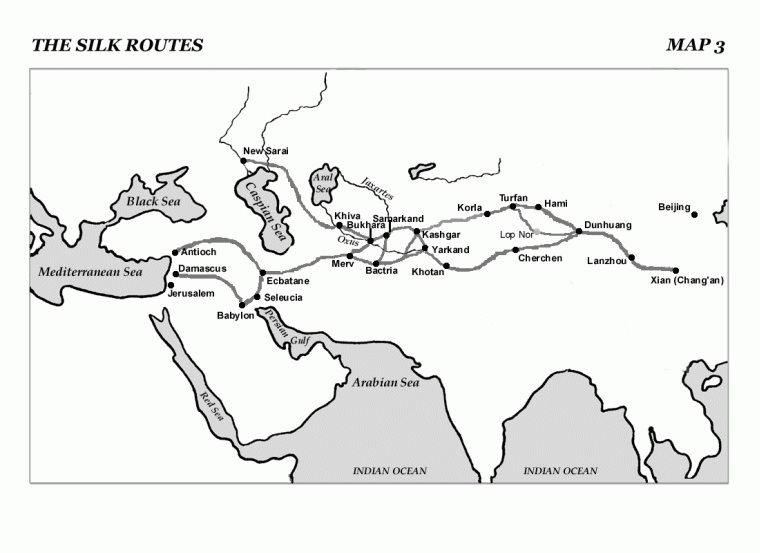
Today is a travel day, so I am getting ahead of the pack by sharing some information about the Silk Road. I read the book “the Silk Road, a New History” by Valerie Hansen and I want to cite some interesting points from it. The book covers three key chapters of my selected cities: the Turpan, Dunhuang, and Samarkand.
Dunhuang, while known for its Buddhist cave paintings, has a treasure trove of over 35,000 documents that recorded official edicts, announcements, and private letters. These were found in a garrison outside of Dunhuang. The dry desert air helped to preserve these documents from the 1st Century BCE to the 1st Century CE. Agreements were written on bamboo strips and wood before paper, originally used for wrapping, became the material for writing. Paper did not become widely used for writing until the 2nd Century. All envoys passed through this garrison at Xuanquan outside Dunhuang in either direction to control movement.
Turpan, a walled city further west from Dunhuang, was known for its foreign community dating back to the Tang Dynasty. It was only the halfway point between Samarkand and Chang An (current day Xian). One of the most significant groups living in Turfan, believe it or not, was the Sogdians, who originated from Samarkand! They settled in Turfan to farm, run rest stops, take care of animals, and trade.
A chapter of the book is devoted to Samarkand, one of our stops in Uzbekistan. The Sogdians who hailed from this area were originally migrants from Iran and practiced Zoroastrian beliefs such as leaving bones of their dead exposed before burial. Trade between Sogdiana and China peaked between 500 and 800 CE. Many Sogdians from Samarkand may have migrated to Turfan when Sogdiana was conquered by the Muslim genera in 712.
The difference in timeline between these cities can be substantial, so the context between them is important. The book focused on the period between 200 BCE and 1200 CE, with major Islamic developments in the latter half of the time span. This later period coincides with the Tang Dynasty at its peak in Dunhuang.image
In case you were ever wondering, the name “China” is derived from a reference to “Thina”, by a merchant in the 1st C. CE with a description of China as “a great inland city from which silk floss, yarn and cloth are shipped by land…” Since Ancient Greek did not have a letter for “ch”, the letter theta was used. In Sanskrit, where the English word for China is derived, China was pronounced Chee-na. This word came into use around 221-207 BCE during the Qin Dynasty.
As far as the Silk Road is concerned, it is a relatively recent concept from 19th C. explorers. The Silk Road consisted mainly of clusters of cultures that lived and traded among each other. The paths were unmarked and did not provide the big saga event romanticized by the Marco Polo story. Silk was only one among other goods traded that included chemicals, spices, horses, glass and paper.

Day 46: Following the Yellow Silk Road…the Wizard of Uz


So Where’s Uzbekistan? First of all, it shares a commonality with Lichtenstein. It’s doubly landlocked with no access to a seaworthy port (the Aral Sea doesn’t count, but more about that later). As mentioned in earlier posts, water was everything in the distant past as it is today.

The Soviets wanted Uz. to produce cotton so they did. They relied on a single crop to supply the former Soviet Union, so after Peristroika, Uz was in trouble, with no diversification. The government seemed to switched to mixed crops as quickly as it could, but it took a lot of water to grow cotton. That sapped the supply of water from the border river they share with Kyrgyzstan, so now they have to buy water for neighboring Tajikistan.

Traveling along the Great Silk Road today (7 hours by car from Bokhara to Kiva, another UNESCO world heritage site), I actually saw camels on the highway! That blew me away, until I saw an accident a few minutes later. There was a dead man in the crossing. His car was tipped over sideways and it looked like he was hauling some gas tanks. He looked scorched.

Otherwise, this could be a typical 90 degree summer day. Here’s the report ala Ruth Reichl Twitter style:

Cloudless sky. No smog. Gentle people. Girls walking home to lunch from school. Boys riding bikes. Huge birds with long tails. Stray oxen, cattle, donkeys, and goats. Dead flat. Power lines on horizon.

The driver has been very careful. After driving two hours with the windows closed, he rolls down window exactly one minute after I wonder why he hasn’t done so. He figured there’s no need to use the AC. (just because they say the car has AC doesn’t mean that it will be used, does it!?) But it suits me fine. There were uneven road surfaces everywhere. It took 8 hours to drive 500 km or 300 miles for what would take only 5 hours on I-5, but we’re not in California, right? On the last drive, he didn’t use the AC until the last half hour of a 4.5 hr ride. Made sense.

Driving along the Silk Road for eight hours can wax you poetic. There were prominent mounds every so often, that served as watering holes. The caravansaries were pitched nearby and served as stopover points along the Silk Road. Being dead flat seemed to make it a no-brainer for travel to progress along the way, in the way that it did. There were markers with strange clipped brushes pushed upside down to mark the way. (See photo above, markers are in mid-ground). We followed that path for half the time, then it disappeared. I pictured Gee Kin and me trekking along the path. Flat, marked path is a piece of cake so no desperate need for Google maps? Oops, no shade.

So back to Uz. There are about 30 million people here, mostly in agricultural communities. (Tashkent holds about 1/10 of the population or 3 million people, but most cities are small). It is run by Karimov, a “benevolent dictator” who has been in power for the last 23 years. Uz. Also has natural gas, uranium and is developing electricity.

Because cotton was grown here and the land absorbed so much water, the river also began to run dry and the Aral Sea that used to collect the water dried up. What used to be a port city is now sitting in the middle of a peninsula! San Francisco or Oakland suddenly becoming Stockton! It didn’t take very long so it’s definitely a word to the wise. Now they are trying to deal with all the salt in land where it used to be a lake. Less than 50% of the water is left; it used to be the fourth largest body of inland water in the world. (See photo above).

Just a few stray thoughts after yesterday’s post: I was told that Armenians were the best craftsmen and were recruited to come work on some of the buildings in Bokhara. Iranians were considered the best architects. It’s no wonder, with their attention to gardens and outdoor spaces, math and geometric skills, and beautiful interpretations of color and lighting.

As for insights on pilgrims visiting these sights: I noticed that a few visitors walked around site three times before entering the mosque or mausoleum. It was considered bad luck if you didn’t. They also rubbed sacred trees so some of the good luck would rub off, and they also practiced leaving money on the crypts. It was a way to wish for good things and have them come true.

In case you ever wondered where the fat French women were…they’re all in Uz. I can’t compare them to any Americans because there aren’t any here.

Day45(b): Bakin’ in Bokhara

So what am I thinking? It’s hard to squeeze it out when (traveling solo) you can keep your thoughts to yourself, private and without judgment. Since we are social animals, we have the need to share and communicate, so here are a few of my thoughts:

1. Looking back, I regret not taking the History of Architecture class on Islamic Architecture. There are so many things to learn–not just the types of buildings (madrasah, mosque, and mausoleums) and their functions, but many of the basic universal design principles come from this part of the world: presence and soothing effect of water, gardens for life, and patterns for texture and interest.
2. On top of that, you get the confluence of all religions here–it’s required an encyclopedic understanding of Islamic, Judaic, Christian, and Buddhist principles, not to mention the sub-religions such as Sufi (Gee Kin, you will remember the Whirling Dervishes), Zorastrian, Baha’i, Jehovah’s Witnesses, Sunni, Shi’ite, etc. The Sufis had a major center here and while they professed to not ever promote religion for material gain, they were highly intellectual and sought to purge themselves of all materialism. They strived to reach the point of connection with God analogous to becoming a drop of water sprayed into the ocean, as my guide informed me. At that point of annihilation, they become one with God.
3. All the battles, campaigns and failed attempts are enough to remind you how interconnected the world has been. The winners and losers needed to visit the Dresden Military History Museum to be reminded that everyone loses in war. Keeping track of the huge expanse of time is disorienting, so I am concentrating on three periods to keep myself straight: Alexander the Great, around 300 AD; the Mongol Invasions that swept through and destroyed everything in its path around the 12-13th Centuries, and the Timur Reign around 1400. That is helping me to put events and building design in perspective.
4. I am satisfying my curiosity, and if anything it has raised a huge list of further reading and to-do lists. If anyone is interested or knows something about any of the above, let’s talk!
5. On money changing: no need to count your Soums( the local currency, called that for a reason); the locals will automatically calculate it for you in USD. If you don’t trust them do the math: (1 Soum=0.00043USD). I had to bring a briefcase in the local currency to pay for lunch today.
6. Weather is manageable, but need all of the following before stepping out of the hotel:
A. Sunscreen 50 count, thanks to good German biotechnology. I hate the stuff as Gee Kin will attest on my behalf, but it’s needed for the scorching heat it hit over 100 deg. F. Midday).
B. Shawl for mosque but also needed for Early and late evening Mistral-like breezes)
C. Sunhat for low angle sun in early morning
D. Sunglasses
E. Umbrella for unshaded walks–despite my black umbrella not to be found elsewhere on the street, it was a lifesaver. Needed to contend with gusty winds.
F. Lots of band aids for blisters, again compliments to the German supply system.
G. Map
Once I was prepared, fumbling around with all of this paraphernalia was the next challenge. Had to think hard to avoid a Bridget Jones moment.
oh, and of course I had to take pictures on top of it all!
7. The people of Bokhara are known to be warm and friendly. Best of all, everyone has black hair! No bleached hair in sight. Girls like wearing their hair long, straight, and shiny or tied up in buns. The young women look very svelt and have beautiful dark eyes. Seeing swarms of students in uniform at their first day of school on Tuesday after the National Holiday reminded me what Russians brought to this country: education for all.
8. As for languages, if you speak a second language, it’s probably Russki. English was for the Colomials, remember?
9. Food service: when ordering a pizza, step back. They will roll it out, let the yeast rise, and fire up the oven. It’s fresh, you just gotta wait.
10. My apologies for editorial bloopers. Some of the posts are viewed with IPhone micro text or are experiencing breakdowns and disconnects. I decided it was better to post in a timely way than to hold up another day to make edits. Special apologies to editorial friends or those who may be offended by the deterioration of the English language.

Day 41: Dresden to Frankfurt

image
A full luxurious day on the train, on the beautiful Deusche Bahn system. These are to me the best trains in the world: fast, efficient and reliable. All the best in German engineering. As I sit on this five-hour ride, I can’t help but ponder what’s ahead for me in the future.

I am pretty happy. I decided that happiness is relative, and of course a process, not a place. It’s those endorphins you get planning something and thinking about where you WILL be, and not so much about when you are there. I have to say the German class exceeded my expectations. Little did I expect or know whom I would meet or learn from them. But that was just a bonus.

I used to watch the happiness programs on PBS and based on their advice, make the lists of what I was grateful for. Maybe it was needed when you are inundated with stressful days at work to maintain perspective. I definitely have had a full and satisfying life so far. But will that get me through the next third of my life? Who knows?

Part of this trip is about seeking inspiration. And my quest in Germany is fulfilling that. Learning about Goethe gave me a big shot in the arm and a reading list. At the top is going to be Thomas Mann’s Lotte in Weimar. The movie I saw about Goethe helped me to see inside the German culture. Then get an annotated guide for Magic Mountain. (The train just went through Weimar, and I wanted to get off!) Before, during or after that, maybe more on Weimar.

Currently the book given to me from the Krasnos has entertained and consumed me. “the Orientalist” is NY Times best seller and the author, Tom Reiss, won a Pulitzer Prize. It’s the story about a journalist Lev Nussibaum aka Essad Bey. It takes place in pre-war Germany, but traces Bey’s life from Lake Baku, where he was born, to a saga of escape from crumbling regimes through Turkey to France, and then to a private high school on an island in the North Sea. He ends up in Berlin writing books about Germany.

The author casts a lot of historical information as the backdrop for this audacious character, whose true identity was challenged multiple times. He was married to a socialite for a short time and operated in and was followed by high literary circles. I haven’t finished the book yet but am savoring and parceling out every last word as I am running out of something to read on my way to Tashkent.

Without getting into detail, this has been the best book for my trip. I’m really glad I have it and hope to use this as my springboard to learning more about German history, and its complicated relationship to Russia. The book in part tries to tackle the prickly question of how Hitler comes to power.

I decided that you could customize your own academic degree. When you have the time, you don’t need to find a program, apply for it, get credits, take exams and prove yourself with a degree–you just do it!

Targeting Tashkent…lets hope the Internet works there.

Day 36: Mme Mallory & der Duft von Curry

image

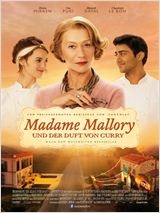
On Sunday afternoon I almost felt like a local going to the neighborhood movie theater (a famous one apparently, the Schauburg, in my neighborhood off Bischofsweg) to see a film that caught my eye: Mme Mallory & Der Duft von Curry. I’m sure you can figure out the gist of the movie as well as I can so I won’t elaborate. I thought it would make a good afternoon for improving my German, so I invited my friends Hanne and Jens to go along with me.

The story line starts with a family moving from India after their restaurant was burned down from civil strife. They manage to move from an initial try in London to France. As they are all packed into a car headed into the countryside, it breaks down in a small town. They decide to put their stakes down in a run down house that happens to be directly across from a Michelin-star quality restaurant.

The son of the restauranteur always had a talent for cooking, and he wanted to pursue his passion. It was natural when the father needed a means of livelihood that the son would lead his family in creating a quality Indian restaurant for the area.

Through a series of twists and turns, the family encounters battles with the puffy Mme. Mallory, who owns the restaurant across from them. This light comedy has great music that manages to pull at the emotions. It also succeeds at getting a few subtle messages across. One is how difficult it is for immigrants to arrive and survive in a new country. Combined with the stuffiness of French society, it can be overwhelming if not tragic.

Without conveying the outcome, this is a movie that is well worth seeing. It can certainly be included in the few and far between movies about food. It shows the ups and downs in the food business and the passion it takes to stay in it.

Overall, the dialog in German was easy enough to follow, thanks to gorgeous visual and audio support. It is unlikely to be a native German film, especially with credits to Spielberg and Winfrey. I guess globalization makes Hollywood inescapable, even for a Sunday afternoon walk in the cinema.

Access to the trailer here: https://m.youtube.com/watch?v=Wd2uDfDFia8

You may have trouble recognizing this famous actress on the poster, but you will want to see this when you realize who she is.

Foot forward: I am two days past the halfway mark for my trip and will be starting Segment III at the end of this week. I will be traveling to Tashkent, Samarkand and Bokhara. If you are interested in this segment, be sure to look out for my posts next week. Access to the internet is unpredictable, so there may be some delays.

Day 32: Close Encounters of the Third Kind

Ok, so my pieces have been pretty light and general, just to keep things flowing from both ends (my brains to those who are receptors of this material). But today I feel compelled to write about an encounter of the Third Kind.

Picture this: I’m standing at a tram station with one of my fellow students and starting up a conversation.

“Do you know how to get back to the Goethe Institute from the VW Factory?” I innocently ask.

“Oh yes, it’s the same way we came”.

Not being very good with directions, I squint my eyes at the sun breaking through the clouds and determine that we are facing west. Well, it seemed like we were going in the opposite direction. I scan the stop and see a few locals huddling nearby.

“Excuse me, but do you know how to get to Albertsplatz?” A few garbled answers, but generally confirming that we were headed in the right direction.

“Why didn’t you trust me?!?” retorted the student back to me, as soon as I returned.

“Oh, I’m sure you knew how to get back, I just wasn’t sure. Besides, I like trying to engage with Germans to practice speaking and listening.”

Silence.

In an earlier conversation, this young man had told me that he was a week late getting to the course. At his parents’ insistence, he tried transferring to the GI in Munich. The thought was that it would spare this young individual’s fertile mind from any possibility of Communist East German influence. Who know, maybe there are vestiges of the Russian military still lurking around these parts. Our guesthouse was only just converted and maybe I could inhale the fumes from the bed sheets that naughty Russians slept on and catch the fever.

Anyway, he came back to Dresden after he realized what a deal he was getting in the city that had the cheapest courses in Germany. And so what, the Reds in E. Germany may not be so bad after all even if they are swarming in his own country. And yeah, the risk he took to transfer to Munich cost him a week, but nothing ventured, nothing gained. Those Munchkiners take learning German too seriously and made hppim feel stupid. So back to the sidelines.

Meanwhile, he did the usual number on me.

“Where are you from?”

“Oh, do you speak Chinese?”

“Oh, ABC!!!” (“I knew it! I knew it! I could hear him cackling in the back of his mind. His glee was hard to hide”.)

He turns to our fellow GI companion on the tour. He compliments her when he learns that she is a Double E from IIT. “Oh, you are smart”, says he, definitively.

Day 22: Goetting Goethe

image

Okay, so what’s the fuss about Goethe anyway? Yeah, he wrote a book about dealing with the devil, and the Goethe Institute I attend is named after the dude. And of all things there’s a statue of him and his buddy Schiller of all things at Golden Gate Park. Being an architect and not a writer or a scholar, I have an excuse for not knowing about German writers and philosophers. So for you literary types out there, please give me a break, OK?

Tonite I went to a film night at the GI (not Gastro Intestinal, but Goethe Institute as I will henceforth refer to fondly as “GI”). The name of the film, Surprise! surprise! was “Goethe!”.  Despite getting there 15 minutes late (is this a pattern of mine?) I was quickly subsumed into the story line, despite the fact that the language AND the subtitles were in German. What is this anyway, a German class?

In the genre of the “Amadeus” movie by the Czech director Milos Forman or the other period piece “Beloved” about Beethoven, this story portrays Goethe as a frisky young guy who falls in love with a soon to be married young woman, Lotte. The twist to this story is that she sticks by her man and marries him (Kestner). Goethe is put in prison after a failed duel with Kestner. During the duel Goethe purportedly shot first, but missed. When it was the turn for Kestner, he shot into the air, saving Goethe.

But he got sent to prison anyway. Goethe did, for 6 months. During which time he used his time wisely and wrote the “Sorrows of Young Werther”.   Lotte pays a visit to Goethe in prison. Hurtfully, she tells him that she intends to marry Kestner after Goethe makes a last ditch pitch.  He writes feverishly as the wedding bells can be heard clanging outside his window. Heartbroken, he sends the finished manuscript to Lotte.

The final scene is Goethe’s release from prison and as he is going through the streets,  the throng of the crowds are heralding this fantastic new novel that has just been published. Guess what! It turns out to be the acclamation of his “Sorrows  of Young Werther”, that recounted is own story of Lotte, or the real life Charlotte.

I’m going to attach the Wikipedia (this is the first Wiki that has ever excited me) content at the bottom of this post so you can read accurate information for yourself and connect it with what you may already know about Goethe.

But three things for me:

1. He didn’t like “bugs, tobacco smoke, garlic, and the cross”.
2. He spearheaded the movement in Weimar, a city that I would love to visit more. Goethe foresaw the potential doom of the German people, that tragically played out in WWII. The Nazi shutdown of the Weimar Republic must have been related in part to Goethe’s writings. The Bauhaus movement began there too.
3. The opera “Werther” by Massenet is one of the most beautiful and passionate operas I have seen. (and the main singer Jonas Kaufmann, is an amazing new German opera singer–worth getting the DVD on the Met Opera movie). Tis was a takeoff on Goethe. No surprise that many writers such as Thomas Mann and composers pay homage to Goethe’s originality.
4. In 1774, Goethe was writing this novel  in the midst of the revolutions unfolding next door, in France, and in the US! Just imagine what a world that must have been. Of course no internet or Twitter, no Arab Spring, so news may not have even impacted Germany much at that time.
5. I am noticing a distinct similarity of the Goethanum mentioned in the Wiki article and the Goethe Institute here. Compare the photos.

That was more than 3. But I got inspired and couldn’t resist. Check this guy out. He’s worth it!

By the way, it looks like this movie is on YouTube. In English it is called Goethe in Love, produced in 2010 by a German director Philipp Stolzl.

http://en.m.wikipedia.org/wiki/Johann_Wolfgang_von_Goethe

Photos, below:

1. Hypothetical design for Goetheanum

2. Goethe Institute, Dresden

3. Statue of Goethe and his literary buddy Schiller resident in Golden Gate Park, San Francisco
imageimage

image

Day 18: Internet Access!!

This was somewhat a curse and a blessing. I had just acclimated myself to no Internet. I began to like the idea of writing letters, reading a book, taking walks and sleeping more. The funny thing is that we had this very discussion in our class and spoke (in German) about the pros and cons.

However, as soon as class was out, I made my way to the office that supplies the modems for our guesthouse. You pay a 100€ deposit to get the device, then install it in your room. The problem after having done that once a couple of days ago, is that you need a computer to hook it up in order to get Internet access. Without one, no deal, and I didn’t bring a computer.

Nicholas, a Ukrainian student, was in the office asking about the same problem I had. Apparently, with only an Ipad, a wireless device is also required. We learned this from Jose, a student from Mexico who had a bad headache on the day we called on him in the room next door to Nick’s. Jose had offered to help me connect my Ipad “with a cable” (he didn’t mention it was a MODEM that we needed to buy at Saturn, a store like Best Buy).

We finally straightened out the communication issue, and within the afternoon and schlepping to the mall downtown for the wireless port for another 25€, we were both connected in our rooms. That took a bit of teamwork, as I knew where the Galleria was and Nick knew how to connect the pieces together. Not that it was hard, just communication.

Whew! Now that I’m fully connected, I feel a little sad. It was fun being off the grid. But after being spanked I guess I have to go back to being good (or bad?) again.

A more interesting afterthought: Nicholas just arrived on the scene, with a scholarship to study in Germany. The language course was part of his offer to study Neurosciences here. He obviously was very bright and he was very resourceful from the get go. He worked out what needed to be done in a very short time for both of us.

On the train, we chatted and he told me about the situation in Kiev, where he lived. He said it was safe there, and everyone just goes about doing their daily activities without too much concern. Most of the disturbance is in the Eastern part of the country. He eventually expressed his disdain for the corrupted officials and explained how everyone had to be paid off for any favor or task.

No one pays taxes or wage earners pay a very token amount. There are very limited public services, so nothing works as a result. The average salary in the lab is $300 a month. It’s not enough to live on, so everyone is forced to leave if they want to get a decent salary. This sounded a lot like the story from the Bulgarian student in my class.

Day 16: First Day of Deutsch

imageimageimage
image
So off I go to the first day of Class. We met our teacher Herr Albert, a very orderly gentleman. We learned quickly the meaning of “duzen” and “Siesen” and which form of address is apropriate. He was fine with all students using the “du” or familiar version with him even if he was older than the students. We laughed about how he technically was supposed to refer to me in the “Sie” form, since I was a few years older than him but he technically pulls rank as the master teacher.

The 15 students in the class are an array of Deutsche Welle watchers: Korea, Japan, Thailand, Indonesia, India; Bulgaria, Czech Republic, Slovakia, France and Portugal; Mexico and U.S. I was pleased to be the only native from the U.S.  Most of the 20-30 something male students are studying German because it is job related and banking on their future in Germany; (most of the girls are studying for cultural or social reasons based on their statements); one or two are business related and are slightly older.

A few vignettes: a floor layer from Bulgaria who works in Meissen is taking the class to improve his grammar. He is largely self-taught, is reasonably fluent, and left his country due to lack of work. He installs carpet, wood, and other flooring materials in private residences. He says the retirees speak too fast for him to understand them.

A girl from Mexico is here for cultural purposes. She’s also fairly fluent, a very good contributor to the class, helps everyone, and is very outgoing. She even tutored students to pass into the next class!

My teacher is an old hand around the Goethe Institute and speaks multiple languages. He studied in England for a year. One of our assignments was for us to introduce each other and I was assigned to him. He has kept us from getting bored by varying each day, playing a lot of games and role-playing.

Photos, from top:

1. Exterior of the Goethe Institut, conveniently located at a tram stop that identifies the Institute in the Neustadt district where many students live and study music, art, engineering and language

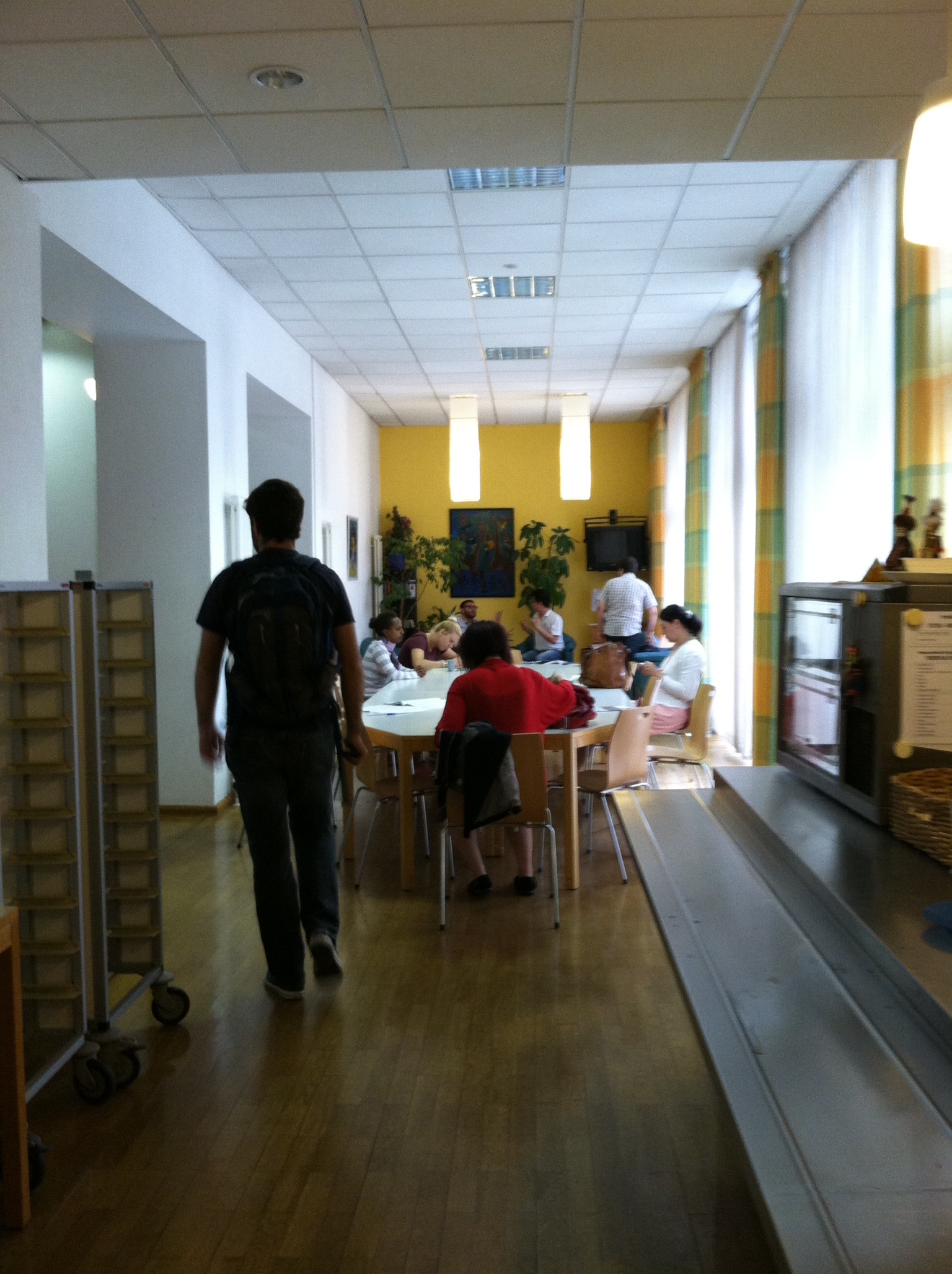
2. Inside dining area

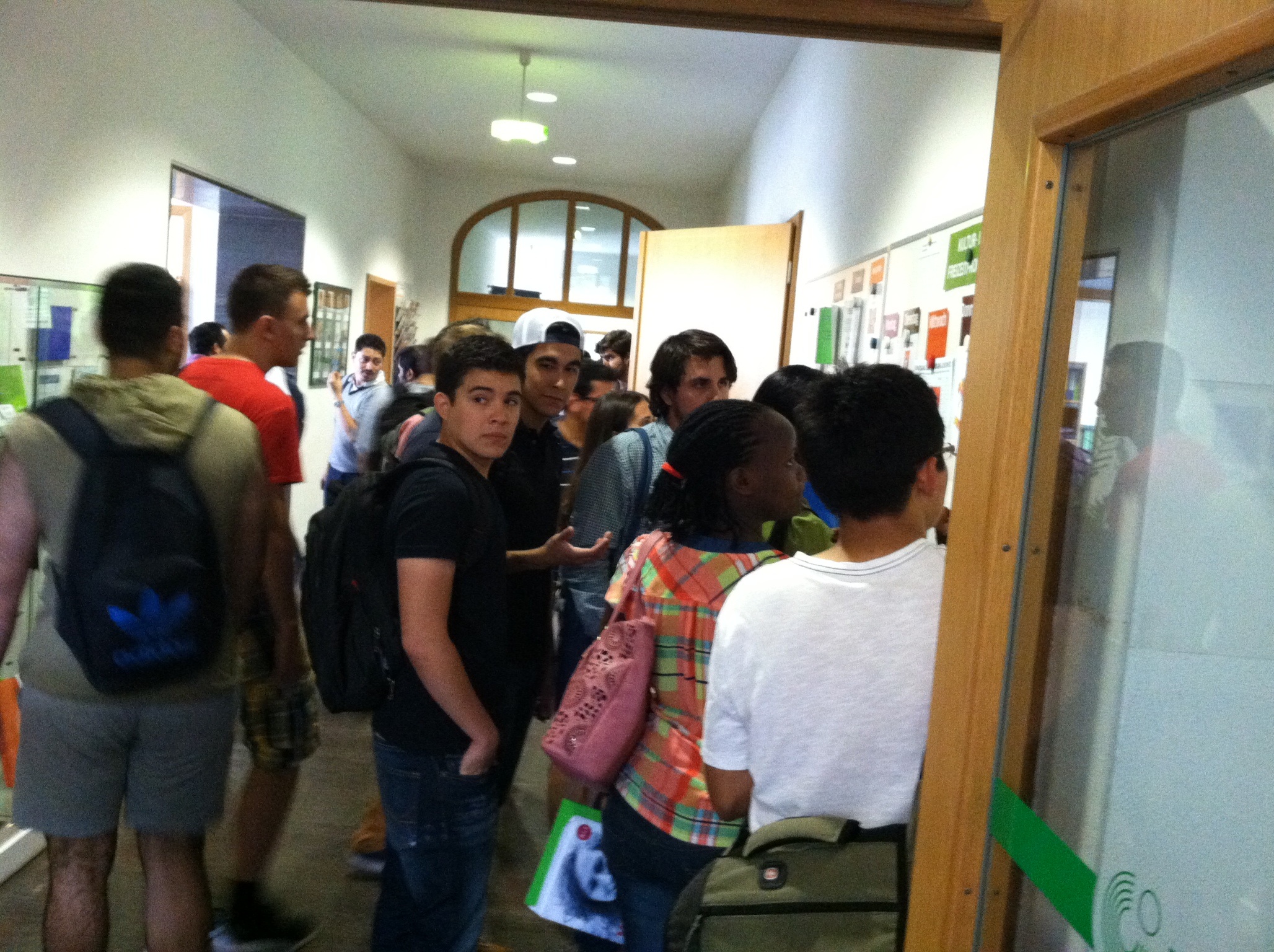
3. First day sign up for how to get work in Germany

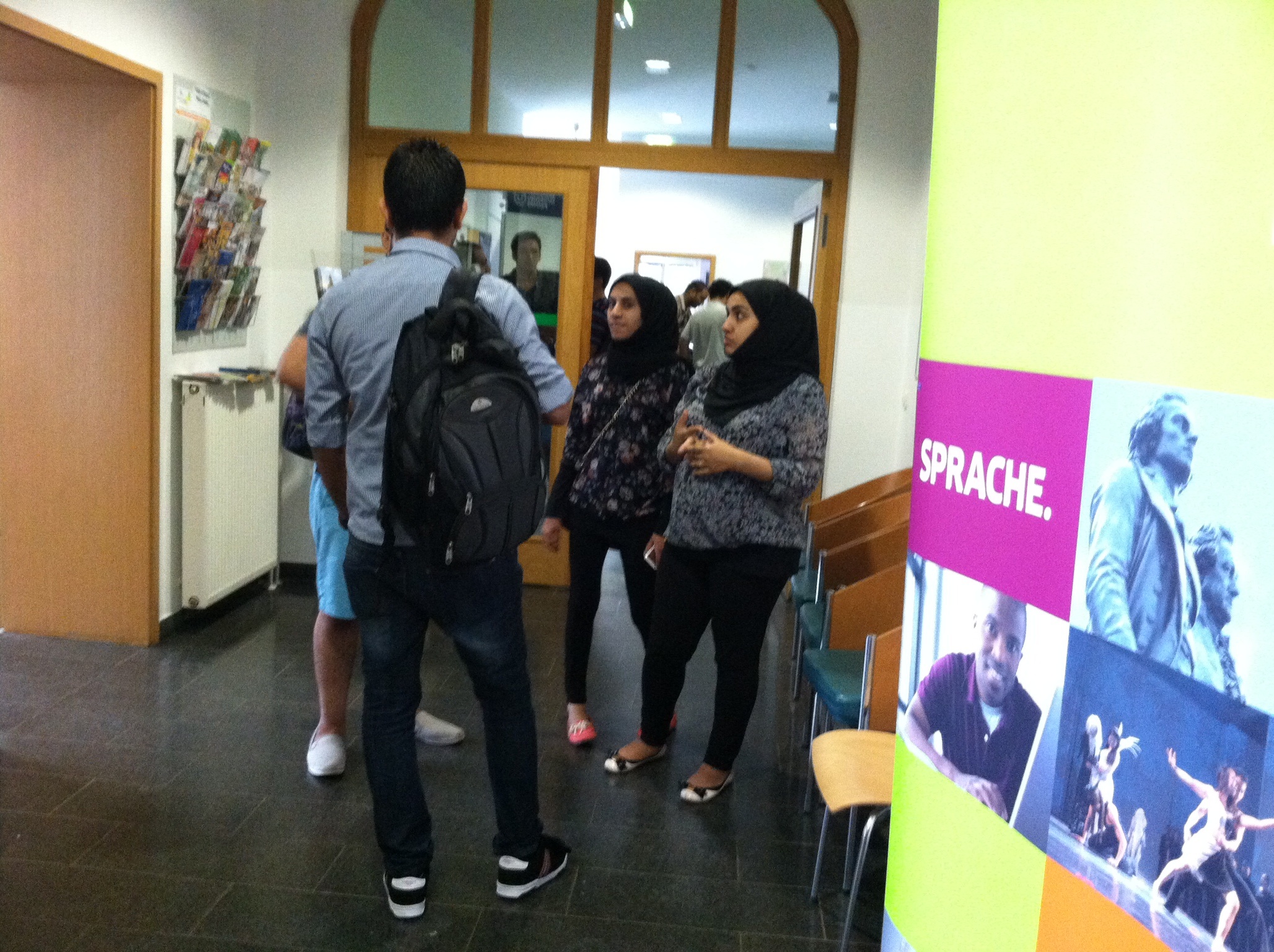
4. More student interaction in the lobby