BFF (Best Friends Forever)

Returning to Dresden is like my home away from home. I have been here five times in five years, to soak in the grossly unknown treasures of music, architecture, and art available in this restored city.
IMG_0550

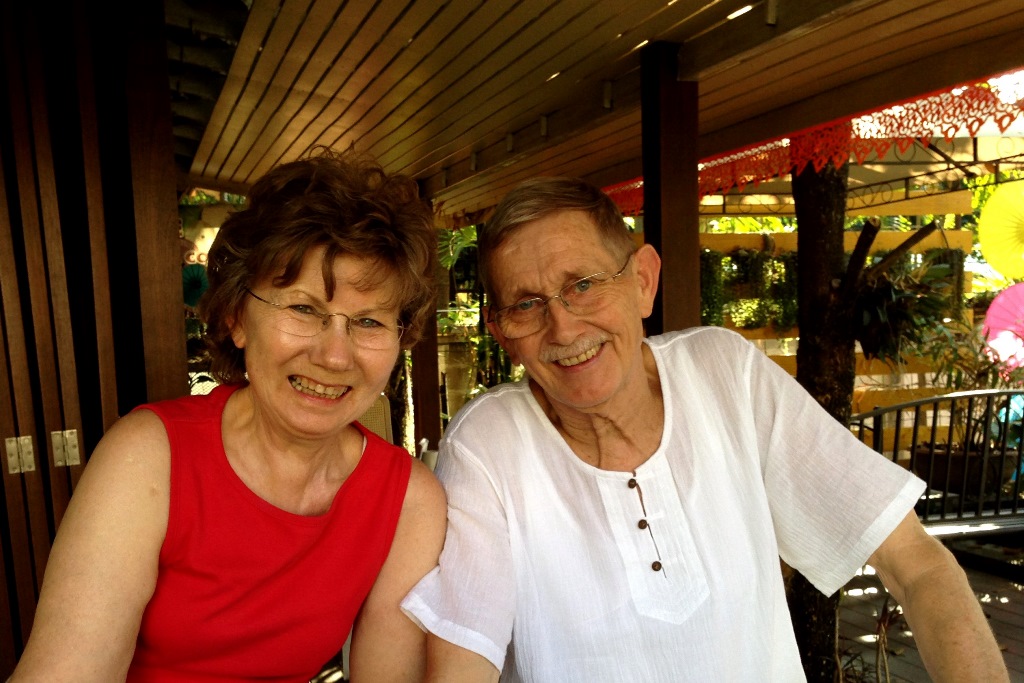
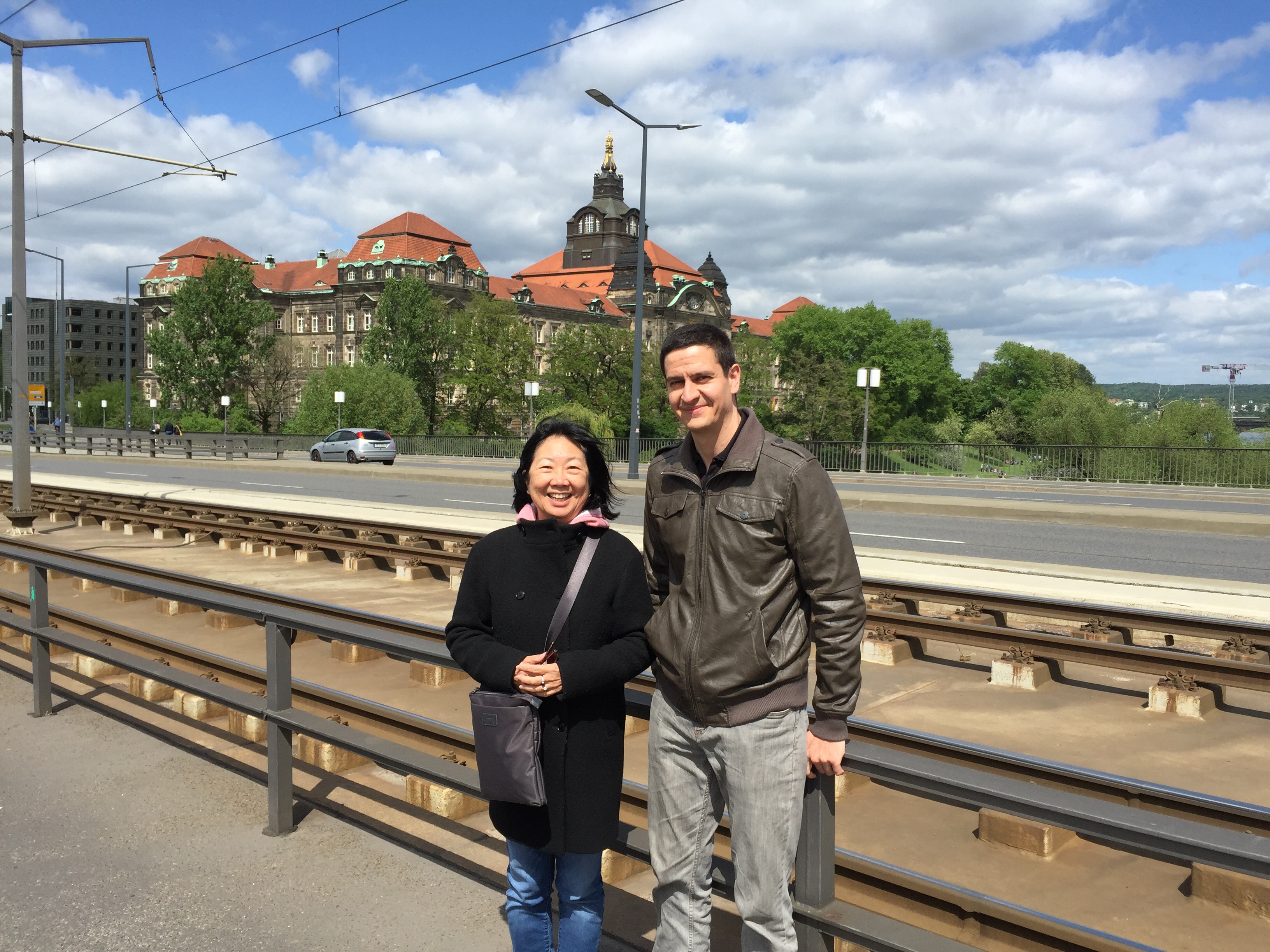
First we reconnected with our friends Hanne and Jens (shown above), who are residents of Germany. They just returned from world travels snorkeling in Thailand on a private junk and tours of Kweilin, Suzhou and Shanghai. We went to dinner at a Chinese restaurant to continue our research on the Chinese diaspora and to compare Chinese-German food with the real thing.
image
Our next highlight was meeting Vladimir (above, with me), one of my classmates from the Goethe Institut last year. We lamented our lack of progress learning German, discussed Bulgarian history and politics, and future plans. The time was too short but we made the most of the afternoon. We walked to the Blaue Wunder Bridge and back.

In the late afternoon our friends Helena and Hans arrived from Switzerland. (Gee Kin met Helena over 40 years ago from the Beijing Foreign Languages Institute). After Helena and I met in Dresden last August, we made plans to attend the Musikfestspiele together this year. It was really exciting to attend the Opening Gala together at the Dresden Messe.

image

Our short visit to Dresden was topped off by a meeting with Meilina (photo below, an der Frauenkirche), another dear friend from the Goethe Institut.

image

She is studying Forestry here in Dresden and is a foreign student from Indonesia. I admire her dedication to her studies as she is away from her husband and two boys at home. She told me a very moving story about how each of her family members supported her studies in Germany, and thought that it would be a good thing for Mommy to do to further her career.

I will miss all my new and old friends, and especially BFF Dresden. In case you were wondering, Dresden has beat the contest with Prague. This was of course a completely subjective approach to favoring the known and emotional attachment to the little city that could.

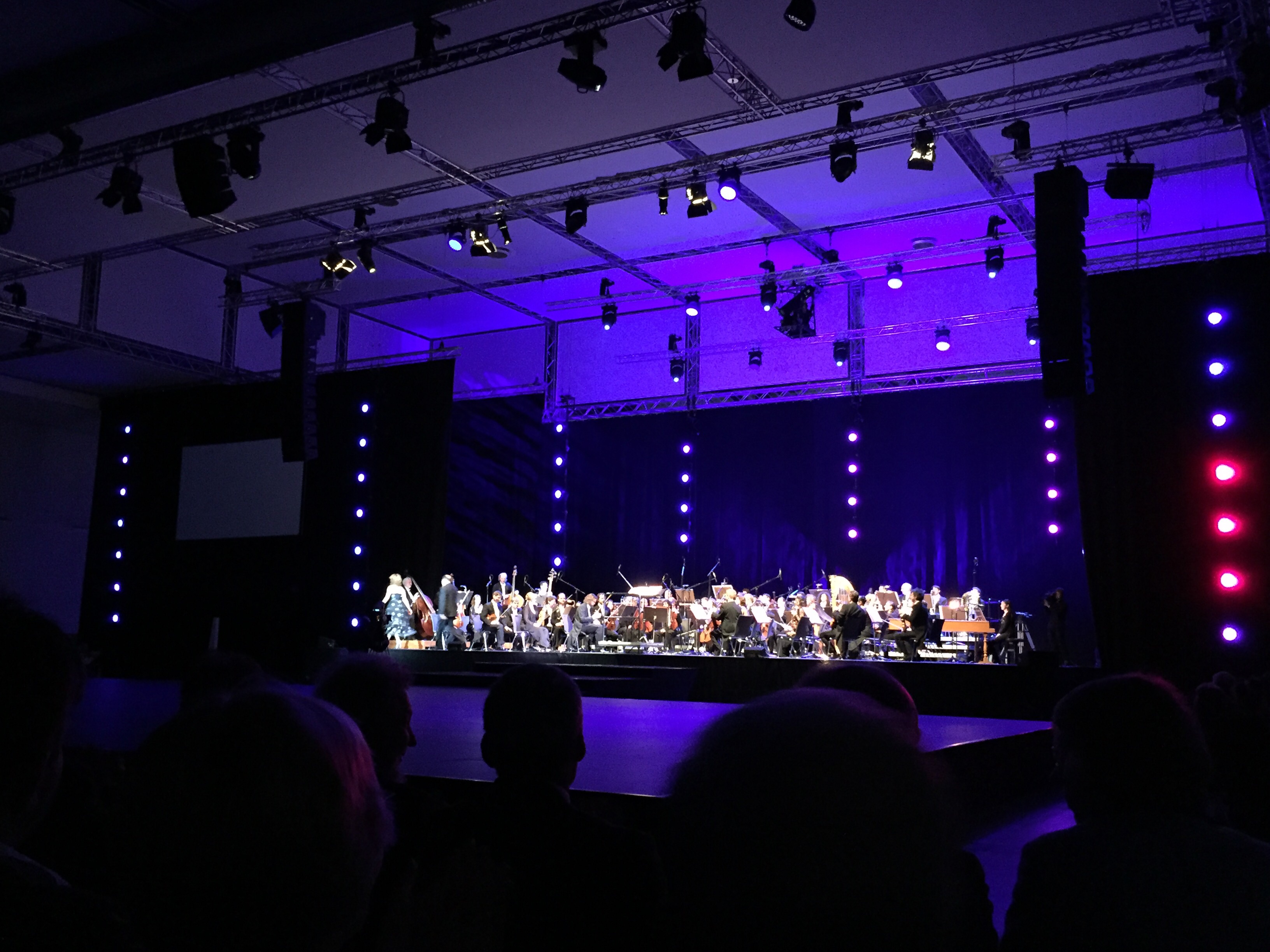
An example of this amazing city is the performance we attended last night at the Dresden Messe. Simone Kermes, an operatic solo, performed with the Dresden Festival Orchestra, followed by L’il Buck. Nothing could be culturally further apart. Jan Vogler, the cellist and festival director, played the Swan Lake solo while L’il Buck did his amazing interpretation of a Swan.
image
I admire both the director immensely for his visionary approach to blending classical and modern forms of music and performance, as well as L’il Buck for entering into a completely new audience. I challenge any other American or international city to provide this breadth of entertainment in one concentrated music festival period or single performance.

Prague is a major city capital and can offer many handsome historical and cultural activities to visitors. While being only a provincial city, Dresden offers a more intimate and simplified experience. Along with its great new airport, safe and spotless transportation system, access to a wealth of cultural activities, and a language that I feel comfortable in, Dresden wins hands down.

image
The Finale, and View of the Frauenkirche from our apartment window

Liszt-less in Weimar?

One of the true pleasures of coming to Germany is to hear great classical music, not only by inspired young musicians, but to hear performances in the composers homes where they lived. We had such an opportunity yesterday, when we attended a performance by the Hoch Schule for Musik Franz Lizst (Franz Lizst Music High School). Seven advanced piano students performed pieces by Chopin and Lizst.

Their performances were passionate and stirring. The very room where Lizst trained his students was where these students played these masters’ compositions. (See drawing room photo above, left, and dining room adjacent to drawing room, right)

Liszt Hochschule for Musik

Earlier yesterday and this evening, we attended performances at the Hoch Schule around the corner across the back alley to our hotel. We could slip into free performances by a guest harpsichordist from Prague and other Hoch Schule cello students. What a treat it was to hear high quality music so conveniently located–virtually in the back yard–and for free! Photo above shows Festival Hall where performances are held)

This morning before our activities in town, we took a brisk walk 4 km. to the Belvedere Castle outside of town and back. The bus easily could have taken us there, but we decided to get some exercise and see the countryside. We walked through the Park Ilm, another historic UNESCO world heritage site. There are about a dozen sites in Weimar that form a collection of UNESCO-recognized cultural treasures.

Later in the day, we visited the Schiller House. Although Schiller wrote the stories about Don Carlo and William Tell, we are more familiar with the music set for them by Verdi and Rossini. Beethoven also wrote his Ode to Joy based on the poem by Schiller. An exhibition at the Schiller House showed how instrumental the Artist Lucas Cranach and his son were in promoting the teachings of Martin Luther through their woodcuts, graphic arts, and paintings.

Our evening was topped off by a performance at the Weimar Hall with a solo pianist performance. (see header and photo below). It was a full day that filled our brains with deep thoughts, our ears with beautiful music, and our eyes with inspiring visions. We were definitely not bored or looking for amusement today.

Lizst Hochschule Festival Room

Theaterplatz

image
Classic Thuringer Bratwurst in Thuringia
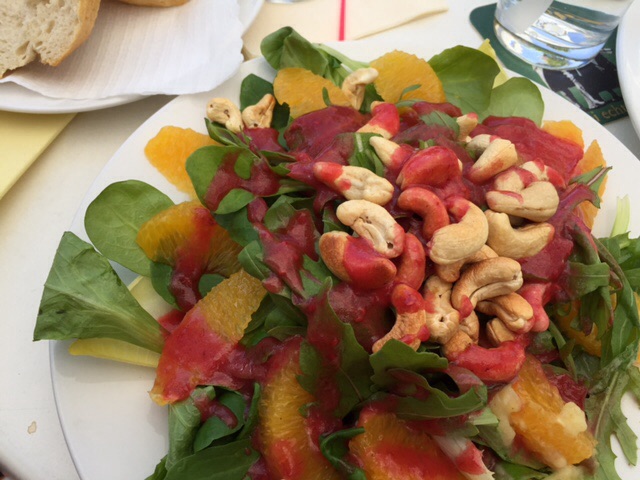
Inspired German Rucola Salad with Cashews, Oranges and Strawberry Vinaigrette, with glass of Franconian Riesling

While food has not been the focus on this trip, we nevertheless enjoy comparing and contrasting the regional specialties with contemporary dishes. German food today is similar to how people used to regard English food–with disdain. While German food is clearly meat and potatoes tradiationally, I have found that the quality of the produce very high and the preparation excellent.

Großartige (Magnificent) Weimar

Photo above: View of Plaza outside Goethe’s House

Goethe and Schiller are often mentioned in the same breath when taking about Germany’s literary past and pride. It is no accident that both were friends and lived in Weimar as contemporaries. We came to this elite small town to learn more about each of them.

The Goethe Institute’s namesake was already mentioned last year when I attended a month long language class in Dresden (see Day 22 post in August 2014 Archives). I was fascinated by his life story. It began with his love interest, Charlotte, who was seven years’ his senior. He was swept away by her, despite her already being betrothed to another man. He was compelled to write one of the first romantic novels that spilled the beans (or poured his heart if you will), very openly and honestly. He eventually had to go away to Italy for two years to get over her.

The Sorrows of Young Werther recounts his passionate love for Charlotte as a young man. It went viral. Unfortunately, this success later plagued him in life to the extent he regretted writing it. The fleeting romance story didn’t exactly match up to the stature of his deeper thoughts. For me, it added dimension to his life and a reason for learning more about this great philosopher.

It even compelled Thomas Mann to write a story about Goethe’s famous love for Charlotte. In Lotte in Weimar, the modern writer of the 1930’s imagines Goethe meeting Charlotte in Weimar after they are in their sixties. She comes to visit with her sister and daughter, and she meets with Goethe. A faint reminder of Pride and Prejudice, both Goethe and Mann stories have deep psychological meaning despite being early soap operas. They are fascinating stories that examine and delve into German character and emotions.

Although we had been to Weimar before, I wanted to revisit this historically significant town. As a philosopher, politician, writer, artist and humanist, Goethe was a Renaissance man. After seeing his home, we have greater awareness and appreciation for his life and work. Of course, it didn’t hurt that he was patrician and hung out with royalty!


Photos above:
1. and 2. Interior of Goethe’s house
3. View of garden from inside house


Photos Above:

1. View of scenic Elbe River and Bad Schandau, from train en route from Prague to Dresden (approximately 2 hours by train)
2. View of Prague train station Art Nouveau interior, spotless and spit-shined (also very safe)

More on Schiller and the Bauhaus to come…

Thank You Very Mucha

image

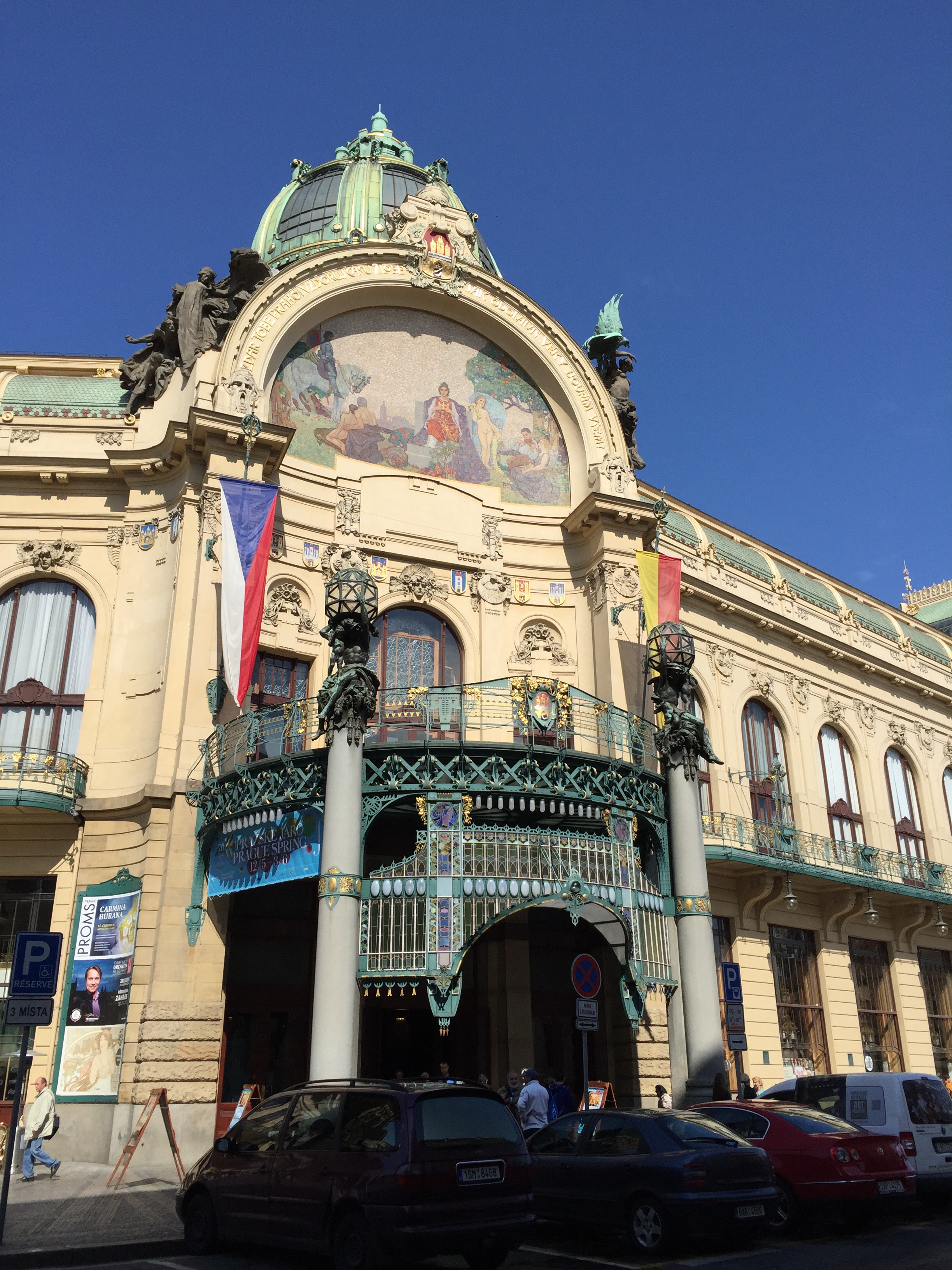
Exterior of Municipal Hall with murals by Mucha

Alfonse Mucha was a Czech graphic designer who was known for his advertising posters of Sarah Bernhardt, and for his signature designs that were instrumental in the Art Nouveau movement. After a successful career in Prague and New York, he decided to return to his Czech roots. He dreamt of helping to record the saga of the Slavic nation after WWII. Through his benefactor, he was able to depict the Slav Epic in 20 murals, now housed in the National Museum.
image

The museum was closed, but we were able to see three of his works in the National Gallery. The poster framed in gold was one of the pieces. The Mucha Museum showed most of his work and an informative video produced by the Mucha Foundation presented the life of this artist. He was prolific as one of the first advertising artists of his day, and became famous in Paris. He hob-knobbed with famous artists and patrons, and eventually made his way to New York.

Upon his return to Prague, he was commissioned to decorate the Municipal Hall where the concert we attended last night was held. The interior was ornately decorated with etched glass, brass trim, and murals by Mucha. The view of the stage with the organ, the dome, and the interior photos you see are taken inside the hall.

More impressive was the musical performance. Despite my initial trepidation about hard sellers barking on the street to us, we were glad that we succumbed to their pleas. The music itself was delightful and the quality was very high. We heard a Mozart Concerto in C Major with a violin soloist, and Beethoven’s triple Concerto in G Major for Violin, Cello and Piano. The highlight was Dvorak’s New World Symphony, a stirring reminder of the Czech Republic’s early beginnings.

With 60 musicians performing for a small audience of less than 200 people (mostly tourists), I wondered how they were able to break even. It was great value, and I even felt a bit guilty paying so little for such a fine, ovation-warranted performance. To top it off, we continue to enjoy visiting and attending performances in beautiful and historic buildings. This particular building reminded me of the Palacio des Belles Artes in Mexico City. (See posts and video in December 2014 on Mexico City Art and Architecture).

It was particularly thrilling to reflect on the day’s exposure to Mucha and his commitment to the Czech People, followed by stirring music by Dvorak and the conductor of the North Czech Philharmonic Orchestra, in a venue decorated by Mucha himself! The visual and sound effects conveyed the passionate feelings of the artists and made the experience very moving and emotional.

As for the competition between Dresden and Prague, two musically inclined cities, I can only be politically correct and say that they are similar and different. Dresden has the Semper Opera House, the Schiller Theater, Frauenkirche and many other smaller venues that provide seasonal programs including the annual Music Festival.

Prague has its counterparts in State-supported venues such as the National Opera House, National Theater, Municipal House, Rudolfinum and many churches. With a larger population, Prague seems to rely on a pattern of daily, year-round performances for tourists who expect to hear music on demand. I’m sure there are performances catered to local music lovers, but I wasn’t able ascertain whether the tourist-oriented events were also for local residents.

I’ll continue this debate and decide after the musical events in Dresden this week as to which city I prefer (I have a hunch already–what’s your guess?). It will be strictly subjective, determined by many factors such as weather, what I ate that day just before the performance, how easily I got to the venue, and who’s in the audience! Assume all the music in both cities is the best quality and value that can be found anywhere in the world.

image
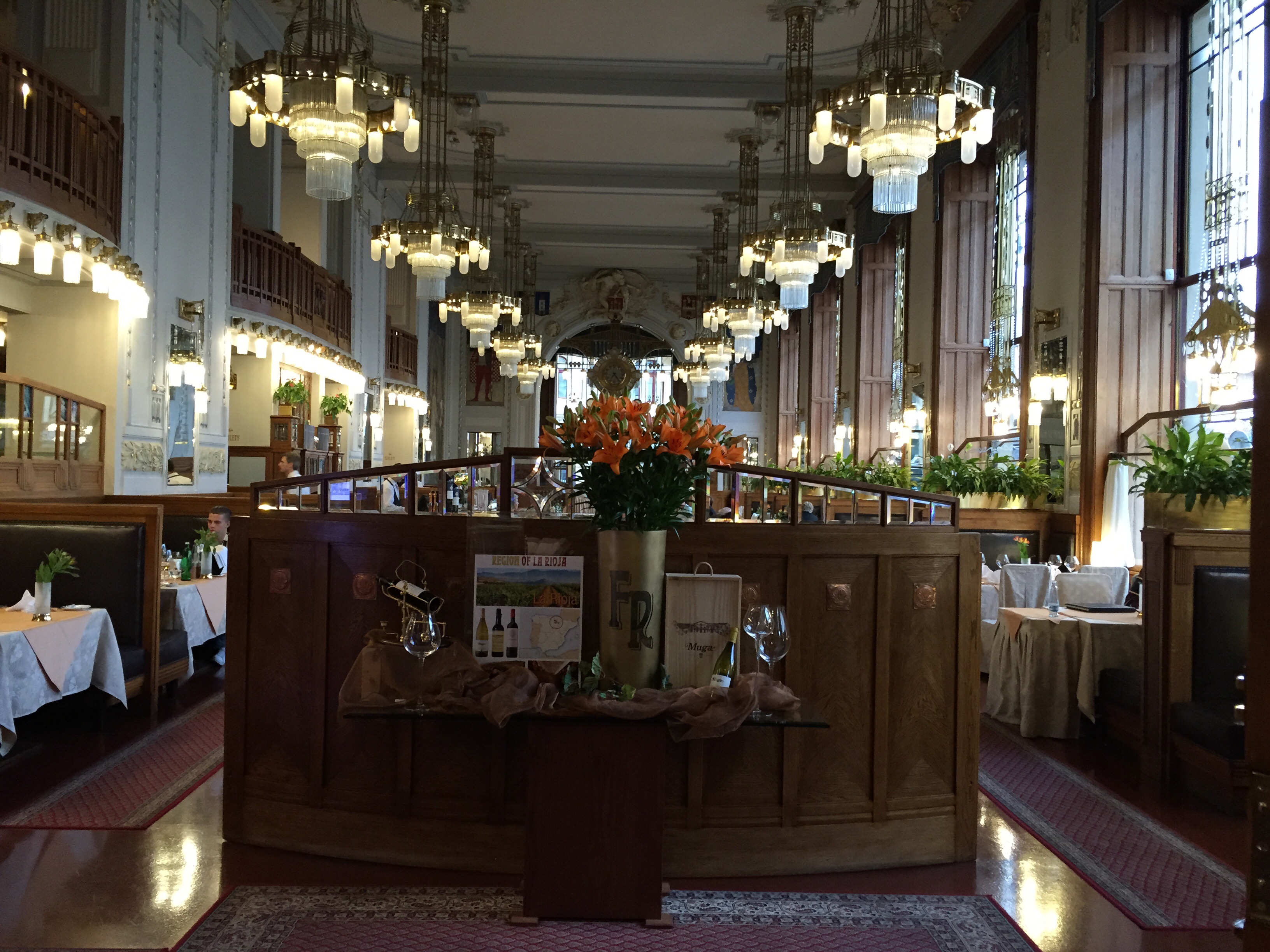
Entrance to historic restaurant in Art Nouveau splendor
image Detail of hall interior

Prague Perspectives

Here’s a potpourri of architecture, art, and street scenes from today’s walks to the National Gallery and along the Charles River:


1. The Fred Astaire and Ginger Rogers Dancing Building by Frank Gehry
2. Optional transportation across the Charles River
3. Elegant Witches’ Caps

Architectural Models by Loos and others (for the architects in the room)

Portraits by Rousseau, Matisse, and Picasso; Sculpture by Degas and Rodin

A moving tribute to a 22-year old artist


1. En Plein Air
2. Czech Donut Making


3. Witches and Goblins and Ghosts–Oh My! are everywhere in Prague (we just missed April 30, when everyone dresses up as a witch throughout the city)
4. Second Effigy in Two Days–a whimsical or warped obsession?

Note: Click on photos before for better viewing.

I’ll be on the road to Weimar tomorrow, so next post may be delayed. See you soon!

Prague Architecture & Promos


Like Dresden, Prague has a Disneyland-ish quality to it. We think of the SoCal American counterpart as fantastical, whimsical, and totally pedestrianized, and this city seems to match those descriptions. Like Disneyland, it also has hoards of tourists. For this city’s economy, tourists are no plague for Prague.

The buildings are impeccably maintained as are the streets (at least in the old town–I haven’t seen the real world by daylight anywhere yet!). It’s best to succumb to the lovely lures of the inner city and not overly scrutinize what may be beyond just yet.

Photos, from top left, counter-clockwise:
1. Tattooed Building
2. Baroque Beauty
3. Another Baroque Beauty outside hotel
4. Town Hall and Astronomical Clock in city center
5. Stone Relief on side of building
6. Effigy decorates confluence of crooked streets; impressions of Prague in 3GS: gruesome, gnarly, and Gothic.

image
Jewish Synagogue (above)

As for Prague being a musical city, it definitely is well endowed, with a twist. Tourists must run the gauntlet of mass advertising for concerts and performances held at virtually every available venue. Catholic and Protestant churches competed in the past for parishioners and compete today for music patronage. Like canned tours, it is impossible to avoid the bombardment of flyers and hawkers (not for sex, but…music???). I felt a bit sorry for those disinterested in music, like the feeling you get when you’re not a sports fan and everyone around you is a fanatic. What’s all the fuss about?!? It’s a different world.

Fortunately for us, I was a bit unprepared and the readily at-hand research saved my ogling-going on Google. Instead, we physically stumbled into an ideal performance at the Municipal Hall. Dvorak’s New World Symphony will be performed with 60 local musicians of the Czech orchestra for around 40 euros each. (Quantity, not quality matters here) It’s also easy to compare choices when ads are at every street corner.

We are about to go to a Prague State Opera performance of “Nabucco” tonight. Keep your fingers crossed. Although I bought tickets online, I wonder how many tourists got coerced into going to something at the last minute that they really didn’t want to see. As for performances in Dresden and Leipzig, they haven’t capitalized on music or pandered to tourists to the extent done here (unless I missed something before). Maybe by choice, or less desperation. Stay tuned….

Update: the Prague Opera did not disappoint…in fact, it fully redeemed my faith in coming here. The performers were stellar, the staging straightforward, and the kudos were appropriate to the performance (not overinflated as they are in the U.S. with standing ovations the norm rather than the exception).

*I couldn’t help but add a panoramic of the interior of the beautiful opera house here. The acoustics were the best of any house I have visited. It’s small, intimate, and perfectly balanced. Maybe it was sitting in dead center of the parterre that did it, but for $55 for best seats in the house it beats the Met hands down on acoustical quality and value.

imagePrague State Operahouse interior

Unplugged in Prague

imageAfter our initial determination to attend a performance at Prague Castle, we discovered the Lebkowicz Palace where the afternoon concert was held. Rather than hitting the more popular Castle grounds, we learned that the Lebkowicz Family had a fascinating history, tracing from the Spanish King Philip of the Spanish Armada and New World fame to a modern day American family. They lost their inheritance twice, first to the Nazis in WWII and then to the Communists.

It wasn’t until the Velvet Revolution in 1989 that the Lebkowicz family fully recovered its properties in Prague. The Palace boasts the largest private collection of artwork in Central Europe that includes paintings by Bruegel, Velasquez, Cranach, and Canaletto. We followed the history in a fascinating audio guide narrated by Martin Lebkowicz himself, the American heir to the Lebkowicz family. The history transcends many historic events in European history, particularly the Thirty Years’ War.

A Chinese wedding booked part of the Palace, and this entry was decorated for the affair. The musical performance in the main room included classical hits featuring flute, piano and viola solo and trio performances. The room was recently renovated as part of the Lebkowicz Palace.
Sights and sounds around the city included views of Prague Castle, St. Vitus Cathedral exterior and interior Stained Glass Window detail, and fine examples of local Baroque architecture. The panoramic view in the header above shows the Vlatava River, Dresden’s equivalent to the Elbe River (both painted by Canaletto).
Street musicians played classical, Blue Grass and Bolivian tunes. Music in Prague is eclectic and non-judgmental. Whatever you want to hear will be here, from Pop to Classical, high-brow to low. It demonstrates the vibrancy of the city and the arts that permeate society from the past to the present.

Some initial comparisons between Dresden and Prague:
1. Both are located along a winding scenic River with many bridges.
2. Both have a historic and active musical tradition.
3. Both have a strong respect and patronage for the arts.

These are only first day impressions, more to come.

The news of the day is focused on Cameron and the Conservative Party winning the most seats in the British election!

So Slow in Oslo


Welcome to the first posting on the Prague vs. Dresden Musical City Competition!

Our trip begins in Oslo. We had a day-long layover on our Norwegian Air flight (the airlines was voted the best in 2014) here, so I made reservations at Nodee Asian Cooking in advance. Fascinated by the Chinese diaspora, Gee Kin and I always like to visit Asian restaurants when we are in Europe. I decided that trying a reputable sushi establishment with emphasis on fresh fish in Scandinavia would be a good alternative to heavy meat-based Nordic food. Another couple we met on a similar escape from the airport were searching for good moose and reindeer.

We weren’t able to get reservations the last time we were in Copenhagen to Noma, deemed the world’s best restaurant. I researched comments on Eater.com, a website for foodies. I settled on Nodee based on fairly good evaluations and the fact that it was open for lunch. Although not intended to match the standard and quality of Noma, we weren’t disappointed. After a healthy 20 minute walk to whet our appetites, we found the restaurant adjacent to Frogner, a city park.

Painted in soothing mute colors with a Zen influence, the restaurant served attentively prepared and beautifully presented sushi. We chose a mixed plate of sashimi and nori sushi, and tempura-wrapped maki that you see in the photos. We easily whittled away our jet lag and time away from the din of the airport.

The restaurant staff was speaking both Cantonese in Mandarin in the background. Our waiter was a native Norwegian Chinese, whose parents immigrated to Oslo from Shanghai. It’s always intriguing to encounter Chinese in these far-flung places, and to find out what motivated them to live there. Despite their being amusing to us, we realize that we are novelties as well. Our accents and mannerisms are quickly detected as being different from native Chinese or the locals.

Going to Nodee was a great respite from the bustle of the city. We got a glimpse of the city and daily life in Oslo, and made good use of our down time while waiting for our connection to Prague. We were able to create a destination event to entertain ourselves and enjoy a decent meal without breaking the bank! You can see the menu and more at http://www.nodee.no.

Prepping for Prague

Just a quick note to let you know that I am heading for Prague and the Dresden Music Festival in the next couple of days, so look out for my postings! The trip will focus on exploring the similarities and differences between the two musically-oriented cities, and meeting old and new friends from the Goethe Institute, Germany, and Switzerland. Join the fun as I take you on a virtual tale of two cities soon….

Real Time Creative and Independent World Travel