All posts by VickieVictoria

Intrepid traveler. Architect and appreciator of design, art, language, opera, history, and anthropology.

Amsterdam

As part of our Thelma and Louise descent on N. Europe in the dead of winter, Melissa and I drove through wind, sleet and snow (no hail) to reach Amsterdam. To an art history major like Melissa, this city is the museum capital of the world. The thought of tackling the Van Gogh, Rijksmuseum, Stedelijk, and Hermitage museums in one visit is daunting enough to send you to dreamland or the loo. (More about that later)

In any event, I had plenty on my mind. Our first major stop today was the Van Gogh Museum.

We were lucky enough to descend on a major exhibition between Edvard Munch and Van Gogh. The curators had a field day placing each major Van Gogh next to a relevant Munch and comparing them. The artists’ styles vary greatly but their humanism and emotionally charged social commentary were consistently similar.

Of course the most charged painting was the “Scream” by Munch. Sure enough, it was on display. This was the first of four versions of the subject matter, in pastel in 1893. You can read more about the exhibition here: http://mobile.nytimes.com/2015/10/01/arts/international/munch-and-van-gogh-together-at-last.html?referer=&_r=0

Borrowed from the Museum in Oslo, the Munch collection was vast. It saved a trip to Oslo in this exhibit alone, but the two artists’ work side by side was overwhelming.

The painting itself was described as a sudden turning of the sky to blood orange. The subject was reacting to the scream caused by the sky and by putting his hands to his face. He was not the creator of the scream, as most of us would think, but it also has that effect.

Van Gogh had a completely different version of a similar setting. (See below, an example of the comparisons and contrasts between these two famous painters’ work).

image
Van Gogh scene adjacent to Munch’s Scream

Aside from following intricate comparisons, I was having my own wonderings. Did Klimt borrow the Kiss from Munch? Munch’s piece, also entitled the Kiss, comes from 1902, followed by Klimt’s piece around 1908. What’s your guess?

The deep dark leaves depicted by Van Gogh reminded me of one of Melissa’s paintings. Similar in color and cool density, the leaves seemed to reflect the mood and style of Van Gogh’s masterpiece!

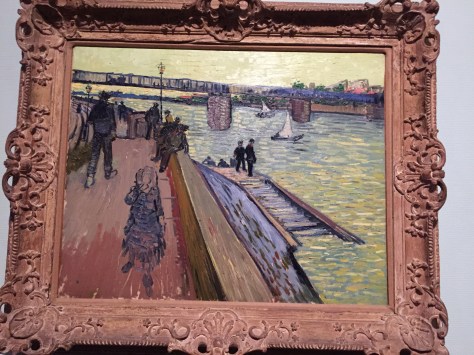
Another jog in my now cluttered memory bank was the recent Asian Art Museum exhibition of Western art influenced by Japanese artists. The Van Gogh Museum version contained a room with a Van Gogh painting juxtaposed next to Hiroshige’s bridge. Very similar to the recent Asian Art Museum exhibition. Hmm, not bad for making connections…one of my favorite pastimes.

The takeaway from this museum is the vastness of Van Gogh’s efforts to learn and do art. His strokes convey his internal struggle to communicate and reach the viewer. His subjects command awareness and commitment. His peasant families, landscapes and simplicity in living demonstrate his earnestness and conversion from living a bourgeois life (his father was a pastor and his brother a successful art dealer) to becoming an active conveyor of life and living. Here’s one guy who made his avocation his profession!

You can read more about the exhibition here:

And now about the loo. Grubby hubby Gee Kin gets museum sickness whenever we spend too much time browsing and pausing in museums. Initially, he made a dive into the men’s room after about twenty minutes of forking over his hefty share of the entrance fee. Slowly, he is overcoming his immun-deficiency and increasing his brain mass (not tolerance) for visual institutions and the intellectual challenges they offer. After a successful visit to the Hermitage in St. Petersburg last summer, he can proudly claim that he is in remission.

Sadly, I discovered a device at the Van Gogh today that might have saved Gee Kin his misery. It’s known as a Stendhal box.
Developed for museum goers in ecstasy, this chair with a shroud around it (there’s a wooden door to cover your view after you sit inside) can help you to decompress at the end of a raptured experience at the museum! While some may believe this to be comic relief, the confessional certainly could have treated Gee Kin with a refuge from torture and spared him another trip to the loo.

Our fruitful day ended with dinner at De Kas, located on a lake in town. The greenhouse and lab environment was an unusual setting to showcase its hydroponic food production that short-circuits farm to table in an entertaining and palatable way. The single menu included vegetable forward and crunchy appetizers, mushroom consommé, field fowl, and cheese plate or tarte tatin for dessert.

image

Ich bin eine Berlinerin

OK, this was an unplanned visit to my favorite adopted country. My daughter Melissa is between jobs and after contemplating Morocco or Mexico City, we agreed that Berlin was not a bad option for interesting food, art and culture.

Our first of two weeks revolved around a number of upcoming new restaurants, galleries that are open over the holiday break, and special performances.

After stalking many of Europe’s best venues, I learned that there are impresarios who descend on famous sites such as the Berlin Philharmonic. When the orchestra is off, they lease the facilities. Many of the promotions cater to local tourists from France, Italy and Eastern Europe.

The usual Swan Lake, Mozart masterpieces, and Strauss waltzes are offered, but are not part of the regular program. While we did partake in a Russian ballet company performance, it takes a bit of close navigation to understand who is producing what and when.

Nevertheless, we enjoyed seeing a bit of traditional ballet contrasted with a modern version by Duarto/Kylian, two contemporary choreographers. The latter audience was much younger and local, while the former was stocked with a mostly tourist audience.

There are museums and galleries galore here, probably too numerous to count. For that, Berlin beats Mexico City hands down. We tackled the Pergamon earlier over the weekend with friend Vladimir from Meissen with some difficulty, as the Museum Island is still being renovated and access to each museum is limited.

Yesterday we covered art galleries in the Prenzlauer and Kreuzberg areas that included the Institute for Contemporary Art and the Kunstraum Kreuzberg. Old schoolhouses have been repurposed for gallery use as well as after school music and arts programs. A decent cafe in each allows visitors to enjoy the environment while warming up to the cold chill (and now snow) outside.

The Kennedy clan are well known to Berliners, almost more than to Americans. Aside from JFK’s famous quote, he was known to protect West Berlin from succumbing to the Communists in East Berlin. A small but significant historical detail.

The Xmas Markets were fun to explore and finally experience. The “gluhwein” tastes better than it sounds, and is merely what we call mulled wine. And the stollen or Xmas cake leaves a bit to be desired, particularly when traveling with a pastry chef.

The hip new food fare here, however, has been delightfully innovative, inexpensive, and thoughtful. While not always successful (veggies a bit on the raw side), the intent on making food healthy, delicious and beautifully pleasing to the eye is very evident. While not a foodie myself, I am swept up by the company I am keeping. Traveling with one can cause you to get into the picture pretty fast. Take a look at some of the plates: my favorite was the avocado and red beets on toast. Easy enough to make me want to make it as soon as I return home..

For the wannaknows, we hit Lokal, Industry Standard, and Horvath.

Viewed at the top, Swan Lake x 2.

Happy Thanksgiving!

Wishing you all the happiest and safest of Thanksgiving Holidays!

The header image above is a mural being painted outside Laguna Honda Hospital in San Francisco, across from the Forest Hill station.

If you didn’t receive a separate email from me already, please check out my web page for the Children’s Council of San Francisco at https://giveto.childrenscouncil.org/fundraise?fcid=562263. You can cut and paste the link if it doesn’t connect directly.

And for the opera fans: curtain call for the Meistersinger after a thrilling 5 1/2 hours at the SF opera:

Last night I saw “Die Meistersinger”, a pop opera that was created by Wagner to help him get some income after a number of attempted operas left him impoverished. It was a slow start of a 5 1/2 hour saga, but turned out to be one of my favorite operas. It embodied all the German characteristics I love about the culture: appreciation of art, philosophy, politics, defiance, intelligence, and history.

This was indeed one of the hairiest marathon performances I had ever attended. In the back of my mind I was reminiscing about the Chinese opera double-headers (2×3 hours=6 hours!) I used to go to with my mother in San Francisco Chinatown as a child. We used to stake out a good string of empty seats where I could sprawl out comfortably. Although the SF Opera orchestra seating was 3/4 full, there were still a few rows at the edges that tempted me to drape myself across a pair of seats for the sake of claiming territory.

Aside from a few momentary drifts I indeed did myself proud. I perked up at the beginning of the second act, just in time for the grand drama that ramped up at Scene 1 of the Third. The dramatic build-up was so effective, you could hear a pin drop. I was glad that I had studied German to savor a word here and there. In the end, I rushed home to read the entire program head to toe. Being well past Midnite, it’s an indication that I must have enjoyed the performance.

It was a huge production, with a big chorus and a beautiful stage set. There were so many performers on stage at the end that the soloists’ voices were suddenly drowned out by the absorption of clothing and bodies whenever they turned on stage and away from the audience.

Here are just a few photos of the curtain call, from my seat at the edge of the orchestra floor 1/3 of the way back:

The featured image above shows a benefit performance on Sunday by Jazz prodigy Esperanza Spaulding at the SF Jazz Center for Links SF, compliments of friend and member Farris Page.

The Silk Road: in light of recent conflicts in Europe, read this article on Russia, China, and the new Silk Road. I just finished a fascinating book, “To the Edge of the World: the story of the Trans-Siberian Express, the World’s Greatest Railway” that puts perspective on our recent trip. This article provides another view on the future of collaboration between these two superpowers and the future of Central Asia, that isn’t even on the radar for the US:
http://www.huffingtonpost.com/pepe-escobar/the-eurasian-big-bang_b_7856614.html

Despite the recent world events and unthinkable attacks in Paris and elsewhere, life goes on. We become more understanding, yet we should allow our own good judgment and thinking to direct us to carry out our lives and living in the future.

Japanese Art, the Western World and Bonus Video

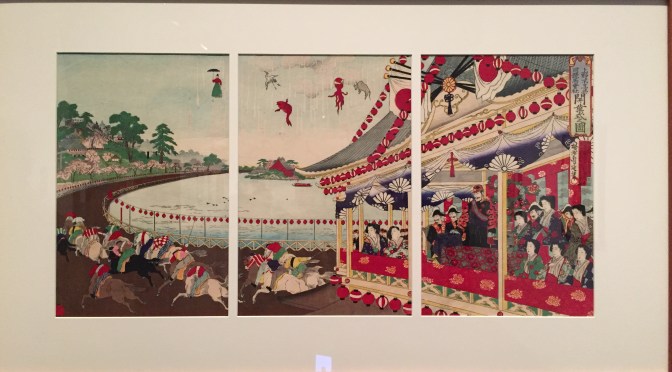
In a current exhibition at the Asian Art Museum, you can view some interesting comparative paintings between the Hiroshige woodblock prints and famous Impressionists like Van Gogh, Matisse, and Monet. Europeans were fascinated by Japanese artists and emulated these new discoveries. While the pieces by well-known Western painters are limited in number, the exhibition certainly provided a good case for the Japanese inspiration from which the Europeans drew.

Many of the wood blocks by Hiroshige, although small scale and delicate, had very intriguing themes. At the upper left photo, the woodblock depicts a lively scene with trees swaying in the wind and someone chasing after his hat. This scene is one of a series of woodblocks that recorded towns and villages between two major cities. Each one was unique so villagers could distinguish their town from others.

The close-ups close to the picture plane of portraits were also imitated by Westerners eager to draw from sources little known at the time. See the portrait of a Japanese Female Princess character in middle photo above. Japanese decorative arts were also widely copied and emulated, as seen in the photo, above right. While imitation is the greatest form of flattery, I wondered what the Japanese artists thought of Westerners’ borrowing of original ideas. There certainly weren’t copyright infringement laws in place at the time, so it was anyone’s game.

Regardless of the historical backdrop and lingering questions, the exhibition was very enlightening and presented much food for thought. Here are a few comparisons, that show the early precedents of Japanese art followed by paintings of Western artists:

Both the Jugenstijl movement (see my post on Mucha in Prague from May, 2015) and the Art Nouveau style in Europe (see St. Petersburg posts in September 2015), as well as the Arts and Crafts Movement in England, were heavily influenced by Japanese prints and decorative arts. Similarly, Frank Lloyd Wright was heavily affected by Japanese design (see FLW in Chicago post, October 2015).

See the inspiration for the graphic designs for Tiffany and other poster art here:

You can learn more about this exhibition and details of the exhibition, on display until Feb. 7, 2016 at: http://www.asianart.org/exhibitions_index/looking-east

Note: My apologies for not recording the titles or names of the Japanese pieces. While many of the woodblocks in the exhibition were attributed to Hiroshige, there may be other artists whose names I did not note.

For a video on the Goethe Institute at Schwäbisch Hall, where I took a German class for two weeks on language and culture, see here:

A One-Minute Survey and Index for 2015 Tour-80 days around the world

Your responses to the attached survey will help me to improve your reading experience! Please answer the following quick questions:


Thank you for your time and comments! This will greatly help me in future posts.

And, as promised, see the attached index for this year’s 80 Days Around the World. You can also use the “search” function on this website to find specific dates or countries.

2015 Index

Other summaries from this year that you may find of interest are:

Day 79: A recap of 80 Days Around the World
Day 71: An Unscientific Analysis of Two Land Voyages
Day 58: Pause to Refresh

For the 2014 version, please search for the September 27, 2014 Post Index.

Hallo Halloween

It’s been over two weeks since I have returned. I am finally re-acclimated to being at home and am enjoying my daily walks around the neighborhood. They help me keep the glow of my travels alive as long as possible. On one of my 3-mile hikes through the Upper Haight-Ashbury in the City, there were plenty of gobble-de-gooks and other surprises to amuse me and remind me why walking is a better way to travel and see the world.

I began to ponder the color orange. In a recent ice-breaker exercise, participants were asked to state their favorite color. Obvious “safe” answers such as “green”, “blue” or “pink” were mentioned, but few people would say their favorite color is orange! It seems to be an odd color, not quite fitting in with anything or eliciting a pleasant response.

IMG_0370From this Matisse painting posted this morning from the Barnes Foundation in Philadelphia (see my post from Day 69-70), Matisse once said “The chief function of color should be to serve expression”. The BF suggested that autumn colors should inspire how we express ourselves.

DSCF2671 I am posting a delicious photo from a Schwäbisch Hall friend, who visited Cumbria in the Lake District. It’s a good reflection of what Karen and I may have missed in Vermont this year.

Other than being associated locally with the San Francisco Giants’ Baseball team and the shocking “Clockwork Orange” movie by Stanley Kubrick, the color orange either reminds people of Fall Foliage, Halloween, or Thanksgiving. Beyond that…well, not much.

For those who are not as familiar with Halloween in the US, it is a fun and scary night with goblins, ghosts, and creepy-crawlies for kids. Children (and some adults who never grew up) dress in costumes and ply through their local neighborhood to demand from each neighbor a “Trick or Treat”…meaning you should give each child in a costume a “treat” or they will “trick” you. Most kids don’t really have a plan to take revenge on their neighbors, though. And I’m not sure whether hosts can opt to “trick” those at their doorsteps.

If you don’t answer or are not at home, you can get eggs thrown at your house, toilet paper strewn throughout the bushes, or a pumpkin smashed on the street. Older kids who did those things were intent on doing it anyway. Kids are now closely supervised by their parents on these outings. As a kid, I only remember going alone and getting sweaty from running in my home-made costume. I raced through my Crocker Highlands neighborhood in Oakland door-to-door to grab as much candy from neighbors as possible in two hours. I could easily gather one or two grocery bags full of goodies and stash enough to rot my teeth for the rest of the year.

Unfortunately, it is no longer a simple matter. Much later, our kids’ orthodontist was a real wet blanket. He collected the candy from kids who brought them in after every Halloween and bribed them with some pathetically unmemorable incentive. Crime has risen and deterred children from being able to go into their neighborhoods safely alone. It seems that kids nowadays are joining families or school groups to have private parties as an alternative to the neighborhood haunt.

But from my walk and looking for things orange, I discovered a small piece de resistance and renewal of faith for Halloween. The Upper Haight has been known to be a classic neighborhood where kids from both inside and outside the ‘hood are also welcome to visit. Even in our middle class neighborhood there are manifestations of defiance and celebrations of the spooky holiday. Maybe it takes a small community with money, iron determination to counteract current fears, or both. I could be a Scrooge and complain about how much money is being wasted and spent for no good cause. In any event, I was happy to see these expressions of home-made fun, whimsy, and creativity. I hope you enjoy them too.

Note: I will be posting an index of my 80 days around the world for those who missed specific cities. Stay tuned.

I noticed that the photos I normally take of favorite pieces from the Barnes Foundation were absent. The museum did not allow photos to be taken of artwork.

For those who continue to be interested in my wanderings, I will be making occasional posts over the next few weeks. You can always opt out if you aren’t.

Post-Mortem: Back in the U-S-S-A

It didn’t REALLY feel like being back in the US until after returning home to San Francisco. The last few stops in New York, Vermont, Chicago and Santa Fe were a continuation of the European adventure to me. Although I hastily posted the panoramas I took of each major stop in the 80 days around the world, I didn’t get a chance to highlight some memorable events from this year’s 2015 trip.

  1. Beijing: staying at the Courtyard 7 Hotel, in the midst of a lively commercial scene in Dongcheng;
  2. Trans-Siberian and Trans-Mogolian Express:  Exercising in a private car and nosing into staff attendants’ food prep;
  3. Moscow: seeing the mighty Kremlin, Red Square, and beautiful Russian women;
  4. St. Petersburg: exercising in the park adjacent to the hotel and overcoming hoards of tourists at the Hermitage;
  5. Berlin: a visit to the Reichstag in the seering heat and finding respite in the Zoological Gardens;
  6. Salzburg: seeing Jonas Kaufmann (a bit disappointing), but being in the company of extremely sveldt opera-goers;
  7. Vienna: the National Library collection and Schönbrunn grounds for running;
  8. St. Florian: handsome priests (!) and undulating hills
  9. Zurich, Brunnen and Wallins: Walking, seaside resort and crisp mountain air with scenery that makes your eyes ache from the beauty;
  10. Schwäbisch Hall: Goethle, new-found friends, and little Deutsch Verbesserungen;
  11. New York: art galleries, East River and more love for the best city in the world;
  12. Chicago: friends, Biennale, and more love for city that’s a sane New York;
  13. Santa Fe: good food, and integration of art and environment.

These are just snapshots of my fantastic trip this year. Who knows what 2016 will bring???

As for my reintegration into San Francisco and its own crazy world of high tech, housing crisis and public transit first, a few photos of my last few days:

IMG_0333 Curtain call for the San Francisco Opera Performance of Lucia de Lammamoor, with Nadine Sierra as Lucia;

IMG_0335

A rare shot of the Chou-Fong family: Gee Kin (an educational consultant); Melissa (a dessert chef at Mourad); Julianne (an architect at Mithune Architects), and VickieVictoria, celebrating the 40th Anniversary of the East Bay Asian Local Development Corporation in my home town, Oakland.

IMG_0340My two favorite architectural professors, Jim Ishimaru and Sara Ishikawa, at the East Bay Asian Local Development Corporation 40th Year Anniversary

And finally, on Friday Evenings at the De Young, a performance by Ben Ahn, an Asian ukelelist:

IMG_0344

As you can see, I am trying to keep the momentum going to stay active, see the world even if it is at home, and enjoy the best of life, art, architecture, and culture! Forward to the future….

Thanks to all for your comments and sharing in this adventure. I look forward to staying in touch with each of you.

Day 80: Santa Fe-LA-SF and The Final Analysis

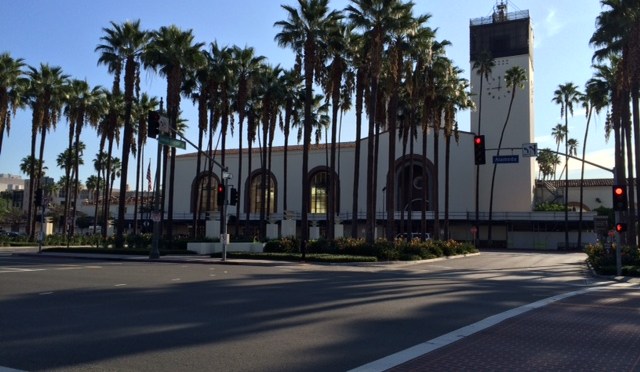
Before embarking on our third leg from Santa Fe to Los Angeles, a two hour layover allowed us to explore the Lamy Historical Train Museum. It was actually part of the hotel and dining hall from the old western days before automobile and air travel stole the thunder from the railroads. A knowledgeable local guide provided insight to what made Lamy a boom town with a Harvey Girl hotel and restaurant service.

The final train from Los Angeles Union Station to Oakland/San Francisco on the Coast Starlight chugged through Pacific Ocean beach views, verdant fields of the Salinas Valley, oil rigs and vineyards lacing voluptuous hills. This final leg was a day trip for us, but the Coast Starlight featured movies and wine tasting for the overnight passengers to Seattle.

I was thrilled to reach home after 80 days and see hubby Gee Kin after 58 days, and to soon see daughters Melissa and Julianne. I want to give each of them a big kiss and hug for allowing me to have this twice-in-a-lifetime journey to explore the world, learn and see, create, think and be.

I also want to thank Gee Kin especially for joining me on our hysterically fun and funny saga through Russia and Mongolia. I would do all the rest with you if time constraints were not upon you, but we have each day’s memories from visa applications to our own private carriage to treasure forever.

At this time, I would be remiss without mentioning the numerous friends with whom I have traveled, visited and met:

1. Professor Wang from Beijing’s Tsinghua University;
2. Helena and Hans from Brunnen and Wallins and Patrizia from Zurich in Switzerland;
3. Schwäbisch Hall Goethe Institute’s new friends Tom, Irene, Marie, Wayne, and Tony;
4. Josephine from Munich;
5. Beynisch Architects from Stuttgart;
6. Lisa and Dick from New York and June from Ross;
7. Niece Pam from Albany, NY;
8. Pam and Tom from Chicago;
9. Travel buddies Karen from Oakland, Doreen from Alameda, and Dennis from Santa Fe;
10. Friends from Dresden Hanne, Jens, Vladimir and Mellina

Thank you all for making this journey possible! You are the people that make traveling so delightful, worthwhile, exciting, and fun. I hope blog followers enjoyed the virtual traveling with me and others. I really appreciated your support and encouragement!

And thanks to all hotel, train, food and other travel services I have touched to make this adventure achievable, without incident or sickness, and safe.

THE AMTRAK VS. TME COMPETITION

Last but not least, here is the final report that includes the third and fourth legs of my Amtrak train travel across the United States. This report includes Santa Fe to Los Angeles (continuation of the Southwest Chief), and the Coast Starlight train from LA to Oakland/San Francisco. If you read the earlier one before, you can skim final edits that are shown in italics.. The final comparison of Amtrak vs. the Trans-Mongolian Express (TME) votes are in bold.

1. On Time Record (FINAL VOTE: A TIE)

The four long haul trips we have taken on Amtrak (Philadelphia to Chicago, Chicago to Lamy/Santa Fe NM, Lamy/Santa Fe NM to Los Angeles, and Los Angeles to Oaland) have been on time or slightly delayed. Trains on the TME were either on time or early, but we were not able to verify the arrivals or departures due to fuzzy time zone changes (!!)

2. Comfort (Bed strength, ability to rock a baby to sleep and keep them there; access to lights, camera, action; no annoying overhead PA system used at free will for the comfort of the system and not the passenger; and good padding and ergonomics for blogging) FINAL VOTE: TME WINS


Beds on Amtrak are comfortable, non-formed foam pads over two seats pushed together in the roomettes, with an overhead bunk that does not allow you to sit up straight. There are no views from upper bunk outside on Amtrak trains, but there are views on the TME from above. One passenger complained about the pillows and beds being too flat, but seating ergonomics and padding seem fine in both systems. Beds on Amtrak are in the direction of travel, whereas the TME beds were perpendicular to the direction of travel. Not sure either makes much difference in terms of rockability, but the Amtrak trains definitely sway more at the top due to the double-height cars. Most of the sleepers were on the upper level so more passengers would experience the sway, so I’d give Amtrak a negative point for this.

There are more stops at night on Amtrak due to the higher population along the route, so it may appear to be slightly more disruptive at night. However, the train starts and stops are smoother on Amtrak compared with the Chinese bump-and-grind at each stop. The Chinese trains did not appear to have any or much cushioning between cars so they slammed into each other when the trains departed or arrived at each station.

Lighting and controls were sufficient on both systems so no particular comments. In contrast, the use of the PA system was notable on Amtrak. The dining car made repeated comments about availability, MIA’s, and hours of operation; there were none on the Chinese cars (perhaps because there were so few or no passengers! or the multiple languages spoken by passenger on the train would render the effort fruitless). We did take a Chinese train on a different trip last year that piped overly loud and annoying announcements and music on their PA system. At one point, the speakers were disconnected (i.e. ripped out) to our car by a passenger and it seemed to take care of the problem.

3. Service (attentive staff, no back talk or attitude–i.e. Courteous; visible but not obtrusive; professional but not hollow friendly delivery of information) FINAL VOTE: TME WINS

As you know, we found the service on the Chinese trains to be very good, but that’s because we spoke Chinese. I am not sure foreigners would find the staff as friendly. Surprisingly, the Amtrak staff have been generally friendly and attentive. They must have improved their customer service training since we took the trains a generation ago. There are still vestiges of the long-timer staff person here and there who crack canned jokes every now and then, or a raspy voice yelling out instructions by someone who cumulatively earned the distinctive voice quality. Overall, both appear to be genuine in intent and concern.

When the service is good on Amtrak, you want to hug them and kiss them, but when it’s bad, you really want to write a letter to the head of Amtrak.

4. Cleanliness (no spit on counters; toilet paper unfailingly in supply; Windows you can see through; stainless upholstery and carpets) FINAL VOTE: AMTRAK WINS

Well, can’t say I went looking, so I didn’t find any gross evidence in either system. In general, the toilets in the Chinese trains were not well attended, but in defense of the system, we were only 2 of 3 passengers in our car. There were four toilets available in one Amtrak sleeper car for some 24 rooms; only one toilet and one washroom per car on the Chinese train. You can do the math.

Toilet supplies sometimes missing on Amtrak, nada on the Chinese trains. Bring your own.


Windows were cleaned on Amtrak, and we witnessed evidence of this. Hard to see through some windows on Chinese cars.

Upholstery on Chinese cars were old but clean; no carpeting in rooms.
I noticed a few stains on the blankets of the Amtrak, and maybe on the carpeting. However, the blankets were hermetically sealed and presented on each bunk. Doreen thought that was a pretty decent feature until she heard the stains were inside the sealed package. The concierge announced that shoes are required on all Amtrak trains.

5. Food (real food; reasonable prices; no cheap shots using lots of salt and sugar; no bar codes on wrapping; cold beer; wine list; nuking; no plastic, polystyrene, or jewel boxes) FINAL VOTE: TME WITH RUSSIAN DINING CAR

Food to date on Amtrak was decent, and better than I remembered. When you book a sleeper you get free meals. Dinner options included salmon fillet, steak, chicken, or pasta. The only disappointing aspect were the frozen vegetables. Red and White Wine selections available on all meals.

Hard to compare the food from the Russian dining car. The food appeared to be freshly cut and prepared, and although small portions, the food was fresh, tasty and healthy. Gee Kin’s vote for the staff’s home-cooked pasta and meat buns unfortunately do not qualify for this evaluation of customer-consumed food. Interestingly, I asked Sean, our Amtrak attendant, what he did for food. He immediately remarked that the food on the train was unhealthy for service staff.

Assuming that they ate it frequently, the food would take a toll on your weight and BMI. The food is included in their benefits, but he mentioned that he beats it over to Whole Foods whenever he gets in to Seattle. Staff stock up on their own food but are not allowed to bring anything requiring refrigeration. That poses some limitations, but he said they work around it (wink, wink). Occasionally the house chefs make family meals for the staff and they really appreciate it.
I am copying and pasting the earlier post comments for convenience and adding any additional notes or changes.

Pros of the Trans Mongolian Express:
1. Decent food in the Russian dining car at reasonable price
2. Service in the sleeping car was very good and attentive by the two attendants assigned to our car (even though we and one other woman were the only passengers in the car after Ulan Bator!)
3. The compartment was tidy and toilet at the end of the car was adequate.

Cons for the Trans Mongolian Express (TME)
1. The tracks are not universal in Mongolia thereby requiring wheels to be changed on every car going between China and Russia through Mongolia
2. The trains do not have Internet access
3. The schedule and arrival times at any station were a mystery due to fluctuating time zones

Pros for Amtrak trains
1. The trains are very comfortable
2. The trains have Internet access (10/7 correction: none on the long hauls!!)
3. The information for time, stops and scenic opportunities is helpful (10/7 update: excellent handouts available at every seat)

Cons for Amtrak
1. Service staff are surly (10/7 update: I would delete this comment that was based on historical experience) 10/12 update: No, I would not delete this comment.
2. Stations are antiquated (10.7 update: true, but they have installed First and Business Class lounges with internet access that overnight passengers can use)
3. Seating is not reserved (10/7 update: all seats are reserved on the long-hauls)

This report includes four long hauls:
1. Washington DC to Chicago on the Capitol Ltd.;
2. Chicago to Santa Fe, New Mexico on the Southwest Chief
Santa Fe, New Mexico to Los Angeles on the Southwest Chief
Los Angeles to Oakland/San Francisco on the Coast Starlight

For the curious, you can google Amtrak service on discuss.amtraktrains.com

FINAL FINAL ANALYSIS: IT WAS CLOSE, BUT TME WINS!!!

Note: there may be a couple of posts after the official 80 days, to help me wind down. I hope you have enjoyed the virtual travels with me and others.

All the best to all who live and breathe travel as I do.

–VickieVictoria

Day 79: A Recap of 80 Days Around the World

Here are a summary string of my favorite headers, from the panoramic shots posted:

Map of the Trans-Mongolian Express from Beijing to Moscow (see featured image above). Note the Purple line for portion of Trans-Mongolian Express that links to the Trans-Siberian Express (red line).

Beijing and Mongolia:

Moscow and St. Petersburg:

Berlin

Salzburg, Vienna, and St. Florian (Linz)

Switzerland

Schwäbisch Hall and Stuttgart

New York, Vermont

Philadelphia, Chicago

Santa Fe, New Mexico
cropped-img_0202.jpg
cropped-img_0211.jpg