All posts by VickieVictoria

Intrepid traveler. Architect and appreciator of design, art, language, opera, history, and anthropology.

The NMAAHC, The Dream of the Red Chamber, and Mister Jiu’s

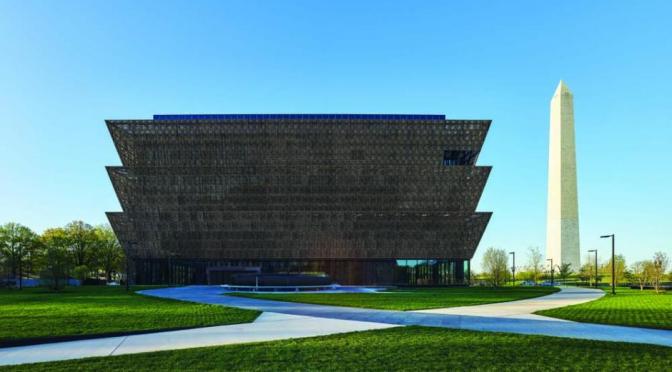
Photo above: National Museum of African-American History and Culture

Saturday, September 24 is the official opening of the National Museum of African American History and Culture. Located in Washington, DC, it holds a prominent position adjacent to the National Monument. Under the auspices of the Smithsonian Institute, this museum has been many years in the making and it will finally be unveiled today.

I first learned about the museum at the Chicago Architectural Biennale a year ago, when the now world-famous architect (WFA in pro-lingo) David Adjaye had an exhibition of his work at the Chicago Art Institute. He won the award to design the museum against fierce competition. You can read about him here: https://www.google.com/amp/mobile.nytimes.com/2016/09/22/arts/design/david-adjaye-museum-of-african-american-history-and-culture.amp.html

Oprah Winfrey was a big donor to the museum. Eight years ago she galvanized my thinking and decision to support Obama, a relatively new and upcoming star in politics. Just think how inspired we were compared to this year’s election.

Despite bouts of purported museum sickness, we have already made plans to visit the NMAAHC in DC next Spring. I hope you will soon have an opportunity to see this new national treasure.

Tonight was our opportunity to see a premier opera based on a famous Chinese novel. “The Dream of the Red Chamber” was commissioned by the San Francisco Opera. Written by David Henry Hwang with music by Bright Sheng, this opera offers the Western world a glimpse into a classical Chinese story. (Review of the opera? Needs work)

As a child, I had frequently gone to see live Cantonese opera and opera movies in San Francisco Chinatown with my mother. Until now, I never really appreciated the history and culture of this art form. But after seeing the latest incarnation, it reminded me of the fond memories I had with my mother.

We took the bus across the bay at least once a month to see Chinese movies on weekends. As a full-time garment worker, my mother often found solace in seeing the movies from China and her forgotten past. Although I often found the movies boring, incomprehensible and tedious, I was able to capture dedicated time with my mother. (Review of the opera movies now? Incredible, especially Chinese rap clips that preceded the American version)

After seeing four hours of a double feature in a musty theater, where kids ran up and down the aisles during the movies and everyone cracked melon seeds and spit them in the floor, we had dinner together at the Jackson Cafe next door to the Great Star Theater. We would order a rice plate with barbequed pork and veggies, or for a special treat, clams and garlic with black bean sauce. Sadly, both Chinese-run businesses are no longer there.

Ironically, we had dinner around the corner from the Chinese opera last night. Mister Jiu’s, a new restaurant with Chinese inspired dishes, is where daughter Melissa works. It is located in the former Four Seas Restaurant, a mainstay for all Chinese banquets for forty years until it ran out of juice. Here are a few shots of Mister Jiu’s, including the executive chef, Brandon Jiu; pastry chef, Melissa; and the restaurant. Among their specialties, the lobster custard, pea tendrils, hand cut noodles and sizzling ling cod were part of the four-course menu that our party enjoyed. (Sorry, Foodies, no photos, so you’ll just have to try them yourselves).

In keeping with my new tradition, I would like to wish a hearty happy birthday to Vladimir, a dear friend and classmate from the Goethe Institute in Dresden, Germany.
Opening Night at the Opera and Museum Sickness

Last year when I attended the Salzburger Festival by myself, I wondered how the glitz and glamour compared with our backyard gala. I satisfied my curiosity when we attended the opening night of the 94th season of the San Francisco Opera last night. The glitz and glamour were definitely there, but in limited supply.

Here are a couple of pre-opera performance shots:

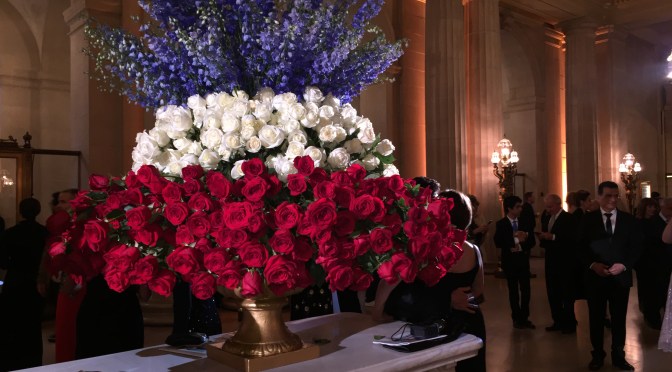
Nevertheless, the SF Opera House is always an exciting and beautiful venue to visit. Thanks to Dede Wilsey, the grand dame of arts in San Francisco, the lobby was decked out in a magnificent red, white and blue flower arrangement and the interior of the opera house was draped to reflect the French theme of “Andrea Chenier”.

While it holds over 3,000 seats, the opera house is on the order of NY Met’s capacity at 3800 seats. The Semperoper in Dresden is half that size, with only 1500 seats and Vienna is similar to Dresden’s with 1700 seats. The SF Opera still feels more intimate and reminiscent of the European opera houses because of its Beaux Arts design than the Met’s spartan Sixties Modern style.

The only difference between Opening Night and other performances, aside from excitement in the air and a bit of a Halloween-like “dress like someone else you always wanted to be” atmosphere, were two distinguishing marks. There were speeches beforehand by the President of the Board and an introduction to the new General Manager of the SF Opera. It felt a bit like going to a Chinese wedding, where you had to sit through two hours of speeches before getting food. Fortunately, it lasted only ten minutes or so.

Before the performance, we sang the Star-Spangled Banner. That was another first for me, at least at an opera performance. I couldn’t help but think about Colin Kapernick and the debate he has aroused from this simple tradition. I snuck a look around the room and behind me to see if anyone had the courage to protest. But no, everyone complied.

You probably can’t tell from the photos, but the photographer has taken painstakingly edited views of the evening. We have our own distinct American style of casualness and innovation that needs to be appreciated. Nevertheless, I’m making plans to return to Salzburg as soon as I can. The schedule of events is announced in March next year.

Andrea Chenier is an opera about the French Revolution sung in Italian. Younghoon Lee was the star of the evening. He replaced Jonas Kaufman as Don Jose in “Carmen” at the NY Met last year. While Lee’s voice is very powerful and technically impressive, I felt that he still lacked the performance quality and passion that I enjoyed in Kaufmann’s performances.

Many of you may be wondering where I have been since returning from our third world trip. I finally got organized and signed up as a full time City College of San Francisco student! It has been a bit of a jolt realizing that there are so many bureaucratic steps to getting recognized as an individual with unique needs. I had forgotten that UC Berkeley had taught me how to be a master of administration, and not necessarily a master of any academic pursuit.

Still, the old battle skills kicked in. I managed to get signed up for figure drawing, Intermediate German, and two cinema classes. It’s probably over the top and overcommitting myself, but that seems to be my style these days.

I decided to try the local city college approach to language training for a variety of reasons. Arriving at a class of over 40 students was a bit disarming, I’d have to admit. After sorting out various levels and stages of German language training, the instructor assured us that she could manage. She adeptly split us into 4 groups. Two for beginners, two for intermediate.

Each group is subdivided into “academic” and “practical” students. She whizzed her way through the system and found another classroom, where she toggles between two groups of students in each room. Like the star of “Bewitched”, she magically flies between rooms giving instructions to each and sprinkles “can do” grammar dust on us in between. It strangely works, at least for the time being. Admittedly, this is an extreme switch from the clockwork 12 students in Germany or the monastic tutorial. More on this method to madness later.

In one of the cinema classes, I am writing a “how to” film script. I decided to do mine on “museum sickness”. A certain close friend is afflicted with this strange phenomenon that strikes unfailingly each time we go to a museum. It miraculously subsides once we are about a mile away and well outside the possibility of ever returning to the premises. Some of you may wonder why I coin “travels with myself…”…and now you have a pretty good idea.

Doing a bit of online research has been fascinating and entertaining. My topic, “how to avoid Museum Sickness” is derived from information I collected from the museums I visited in the past year, such as:

1. The Dresden Hygiene Museum, where they offer portable stools for visitors.
2. The Rijksmuseum in Amsterdam, that displayed a curious chair known as the Stendhal Chair” for museum goers to decompress when being overwhelmed. A variation of a confessional, this chair has a flip door in front of the seat so you can sit down and avoid eye contact with others when you are seated inside! (You may have seen this earlier in January 2016 when Melissa and I were in Amsterdam)

The Stendhal syndrome is a defined condition related to becoming disoriented while in a museum. Apparently Mark Twain experienced this phenomenon when traveling by ocean liner across the Atlantic to Europe, then immediately going to one of the famous museums. He became dizzy and sick from the overstimulation.

Another version of museum sickness is called “synesthesia”, a condition of mixed sensations–where one modality affects another, such as audial effects transferring to visual, or from form to color. I wondered how prevalent this condition was or whether it was purely hypothetical in nature. Obviously, more research will bear this out. In the mean time, I am completing my assignment in script format. Get your fancy dress ready to attend the Oscars!

Since my posts are down to monthlies until I am traveling again, I’ll keep you posted on my educational progress. I hope all of you continue to live and learn, to keep the fire burning in the attic…

Farm to Table in About an Hour

The term, “Farm to Table” is touted and well-known in the restaurant business and throughout the world, but how long can it literally take?

On a chilly Saturday morning amidst the classic summer San Francisco coastal fog, we decided to take a trip into the edge of the Central Valley to find out. Brentwood, Ca. is a sleepy little town, more well-known for its retirement community and exurbs, due east of the San Francisco Bay Area. Approximately an hour’s drive away from the City, Brentwood lies in of one of the world’s greatest bountiful farm regions.

The area is laden with stone fruits such as cherries, peaches, plums, green gauge plums, pluots (a hybrid of plums and apricots), nectarines; corn as a major crop; all varieties of heirloom fancy and ordinary tomatoes; melons; peppers; and endless other vegetables and fruit. You can shop here and find just about every item on your list for healthy eating.

Brentwood jolted us from the usual morning 55 degrees to 95 degrees’ temperature (in Celsius, 10 degrees to 35 degrees). At times in the summer, there can be extreme temperature differentials as much as 50 degrees Fahrenheit (30 degrees Celsius) between cities. Between the summer inversion layer of fog in the City and the dry desert-like heat of the inland valley, you are never fully prepared for both on a day trip.

Imagine starting out the day with leather gloves, London Fog raincoats, knee-high boots and windshield wipers to clear the dripping dew from the windshield. OK, maybe that didn’t happen TODAY but I have recalled going to work in the middle of August experiencing such in the past. After arriving in the Valley, the miragy sunlight is so blinding you can get a migraine headache just from blinking.

We learned about Brentwood after visiting my mother there, where she lived a healthy life for the last two years of her life until she was 98. We managed to visit her and take advantage of Brentwood’s proximity to the variety of fresh fruits and vegetables that were grown in the area. We didn’t pay much attention to whether it was organically grown or not. We just knew it was fresh and reasonably priced, so we bought bagfuls to take home.

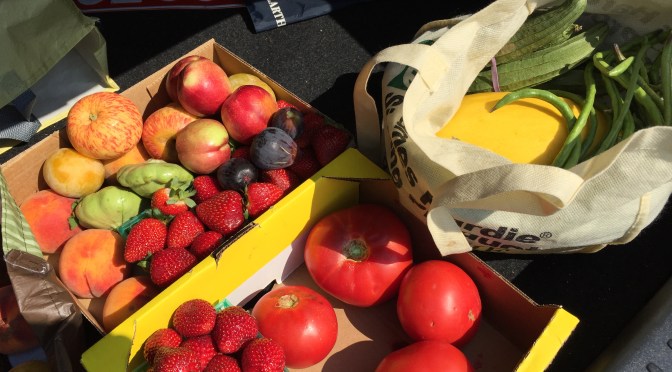
This time, we revisited three farms along the Farm Trail. Two were operated by small farmers of Asian descent. Chan Was NOT Missing (see photos, above) at one of our all-time favorites. The tiny stand sold fragrant, sweet strawberries still stoked by the sun. The pips were popping out like the magnified sesame seeds that MacDonald’s uses on their hamburger buns. At the next stop, we bought ripe, juicy peaches by the box. Both growers sold Chinese vegetables like long beans and silk melons (“see gua”) that we added to our bounty. Finally, we rounded up our Foray into Farmland by stopping at Smith’s Ranch for the rest–beans, nectarines, and apples.

We fondly recalled past visits to this area with friends and family to pick seasonal Mandarin oranges and cherries. Sadly, a number of U-pick farms that we loved visiting with the kids in other areas like Sebastopol have closed. Owners were unable to carry the liability insurance to cover people falling off ladders and making other careless mistakes. Fortunately, there are still a few in this area for “farm tourists”.

Being in this rich farmland reminded me of the huge markets in Uzbekistan. It supplies the massive linked continents of Asia and Europe (see my post from Day 50, September 2014). It was one of the largest markets in the world that I had ever seen.  Being so far north in far-flung Vladivostok and Moscow from Uzbekistan, we could understand how essential and significant Uzbekistan’s farms are to feeding Russians and Eurasians.

After having made a stop into town for cash, tomatoes at the local Farmer’s Market and lunch, we passed a local display of vintage cars at a nearby parking lot. It definitely conveyed an aspect of Americana and how locals like to spend their leisure time. Tents and tail-gate pantries surrounded the parking lot outside Safeway.

Technically, it took us more than an hour to get to the area, shop, and return our bounty home for dinner. In terms of distance, however, you can go one-way and get from Foggy Bottom San Francisco to Central Valley just to savor what the delicious California sun is really like “in about an hour”.

Days 77-80: San Francisco Summer

Many of you have heard Mark Twain’s quote about San Francisco: “The coldest winter I ever spent was a summer in San Francisco”. It’s truer than ever this past week since I have returned. Visitors from the East Bay showed up in shorts, only to find the brutal inversion layer of fog cloaking the city with a 50 degree blanket. The temperature difference within 50 miles can be 50 degrees. The pattern occurs consistently in the summer months, until the sun breaks through in early Autumn.

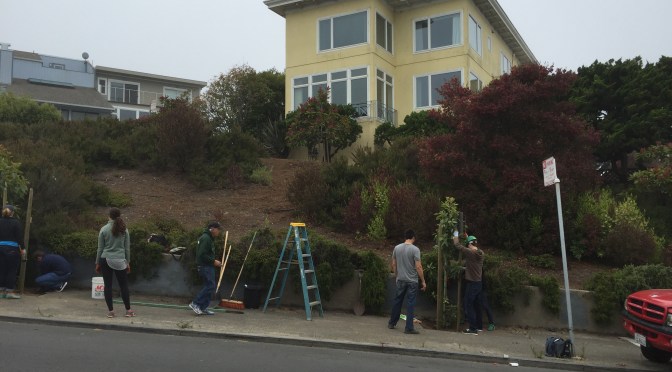
We ordered four street trees that were planted by the Friends of the Urban Forest (FUF), a local non-profit in the City. Gee Kin volunteered to help on Saturday, and the team covered a collection of houses in the Inner Sunset. After the trees are planted, the FUF maintains the trees for three years. While the trees are the responsibility of the property owner, there is talk about switching the maintenance back to the City. That would allow for more regular maintenance and protection for the tree plantings.

Growing trees obviously helps enhance and preserve the environment, but we heard that there are still many skeptical neighbors. They find the trees a nuisance with droppings, obscuring visibility, and cracking sidewalks. It seems like a simple goal, yet complicated by differences of opinion.

On the cultural end, I decided to extend my travel mode by visiting local museums and attending performances. The Asian Art Museum’s “Treasures from the Emperor’s Collection at the National Palace Museum, Taiwan”, featured a portrait of none other than Kubilai Khan.

imgres

After having just been in Mongolia, I was keenly interested in his place in Chinese History. He formed the Yuan Dynasty and moved the capital from Khorkorin to Beijing. From traveling, I have been able to connect the dots and have a better appreciation of the interactions between East and West. The exhibition covered four dynasties, the Song, Yuan, Ming and Qing.

Earlier this week, we hosted a family from New Zealand who are “kissing cousins”. They originated from Palmerston North and come from a mixture of Chinese, Maori, Irish, Croatian and Lebanese backgounds. Now there’s a conversation to be had! We were delighted by their stories about traveling around the world, living in the Guangdong father’s village for three months with all five teenage children in tow, and visiting Vancouver, Cuba, New Orleans and San Francisco during this last venture. How’s that for independent travel?!!

Since my birthday last month and all the greetings, I am hoping to collect birthdays from friends so I can reciprocate. Looking ahead for August, a Happy birthday wish to Pam in Chicago, niece Pam in Albany, New York, and old friend Karen in Oakland. Send me your date if you haven’t already, and I’ll keep you on my list!

This day completes the third 72+8 days around the world. Thanks to all for your input and comments on the survey. You can see the results after each question. It’s a valuable tool to help me improve my blogging skills! I’ll be posting once a month to keep the news up to date, during which time I will develop and share my plans for travelswithmyselfandothers. Enjoy your summer everyone! Stay cool, as we always are in San Francisco!!

Days 74-76: Heady Headers

Photo, above: Mongolian Herder Family, with awards from Dad’s wins in local horse  racing contests. You can see them all in Mongolian Herder Family video at https://youtu.be/QBCz8EjsMoc

As a finale I decided to summarize my trip by sharing the headers below that were used for my postings with you. I remembered (nearly) every location by heart, with a couple of technical exceptions. I am fond of each and every experience! They are now like my children, and hard to give any of them away. I hope you have enjoyed seeing these again, this time with captions.

A note about the number of days on each annual trip: There have been 68, 80, and 72 in 2014, 2015, and 2016, respectively. Anchored on one end for a German Language Course and Asia on the other end for contrast, the stuff in between has been the most interesting and lesser traveled. I was always fixated on the Silk Road, and this time, the Genghis Khan saga across the great Eurasian Continent. The timing was right for me, the weather and climate suitable, and a very achievable itinerary in my (crazy) view of the world. If you have questions or details on accomplishing it, let me know and I’d be happy to give you more information.

A big hug and thanks to each of my travel partners and visitors: Gee Kin, above all; Tom, Helena, Patrizia, Hanne, Jens, Vladimir, Iyoko, Paul, Kanji; and new Goethe friends Mukda, Anu, Jess, Ilaria; and Mongolian guides Aggie and Nassa. I now have collected many friends from all over the world to join me in my future travels. And of course, to you, the readers.

There’s a very short, 3-second survey at the end of this post that I would really appreciate your taking the time to respond to for my benefit and future trips. Thanks again to all for following my blog and keeping me focused on getting both of us new and exciting experiences, both in the raw and virtually!! Love to all.

cropped-image107.jpeg
View of Tennozu Isle, Tokyo, Japan
cropped-image941.jpeg
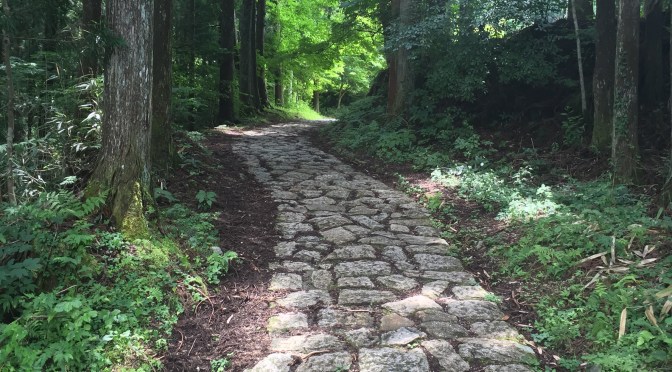
View of Mt. Magome, Japan
cropped-image85.jpeg
Nakasendo Highway, Japan
cropped-image60.jpeg
Rear End of S7 flight-Valdivostok to Tokyo
cropped-img_4625.jpg
Vladivostok, Russia
cropped-img_4560.jpg
Vladivostok Harbor, Russia
cropped-img_4336.jpg
In transit on Trans-Siberian Irkutsk to Vladivostok, Russia
cropped-img_4244.jpg
Village along Lake Baikal, Russia
cropped-img_40231.jpg
Khorkorin, Mongolia
IMG_3923
Free Range Sheep and Goats, Orkhon Valley, Mongolia
cropped-fullsizerender-73.jpg
Gorge of Orkhon River, Mongolia
cropped-image131.jpeg
Forbidden City, Beijing, China
cropped-img_3193.jpg
Bauhaus, Dessau, Germany
cropped-img_3104.jpg
View from Kunst Akademie, Berlin, Germany
cropped-img_2845.jpg
Spree River, Berlin, Germany
cropped-img_27201.jpg
Tiergarten, Berlin, Germany
cropped-img_2561-5.jpg
Museum of Terrorism, Berlin, Germany
cropped-img_2441.jpg
Egyptian Panel, Neue Gallerie, Berlin, Germany
cropped-img_2412.jpg
Street Art, Berlin, Germany
cropped-img_2329.jpg
Bernauer Strasse, Berlin Wall Park, Germany
cropped-image17.jpeg
Weimar, Germany
cropped-panorama.jpg
Jazz Orchestra, Dresden Musikfestspiele, Germany
image
Dresden, Germany
cropped-img_1357.jpg
San Francisco City Hall, California, USA

Survey


Day 73: Guest Post Summary and SaFe in SF

Reflections on the Far East

This past month has been a series of contrasts: first the energy (and pollution) of Beijing; then the pristine emptiness of Mongolia; the Russian Far East trying to establish a sustainable economy; and finally the efficiency and delicate beauty of Japan.

Each country is in a different stage of development. First Mongolia, with just 3 million people living in an area about a third the size of the continental US, where nomadic herders can still graze their livestock almost anywhere in the country. Then the Russian Far East, 3 times the size of Mongolia but only 7 million people; almost entirely birch forests or treeless tundra. The central government in Moscow 6 timezones away is trying to encourage emigration from western Russia. But even Vladivostok, with its attractive location and business potential is struggling to attract people and investment. Then there is China. There are 110 million Chinese living in the 3 provinces of China sandwiched between Mongolia and Vladivostok helping to drive an economy that has been booming. Finally Japan, having achieved the Asian “miracle” now grappling with how to sustain that miracle.

I have enjoyed traveling in every one of these countries. As a tourist with limited language skills, my understanding is shallow. But one over-riding conclusion comes through stronger and stronger the more I travel: people everywhere just want peace and a better life for their children.

And there are no right answers, no single road towards happiness. Neither China nor Japan holds the blueprint for sustainable development for Mongolia or the Russian Far East, no more so than the US holds all the answers for China’s future. History, culture and geography do matter. Countries are all dealt a different deck, and their people have to play their cards as well as they can. Hopefully, everyone can come out a winner.

Traveling humbles me. I know so little about the world. I want to keep coming back to these places to learn more.

by Gee Kin Chou 7/20/16

SaFely in SF

Ever since I left San Francisco to travel for the first time, I don’t think I was ever happy to retun “Home”. It’s hard to admit that if you come from one of the recognized world-class cities that happens to be thriving in a non-heavy industrial, high tech environment. But I was always a bit of a wanderer, so in that respect I always look to where the grass is greener, or at least growing.

Everyone wishes a safe return home, including me. We are back, and everything is fine. The weather here was breathtakingly beautiful: clean, crisp, with clouds from the Pacific Ocean swishing by.  It’s a typical day of 61 degrees Fahrenheit (16 degrees Celsius–the only two numbers that can be transposed), which is typical for most of the year. We are heading for a heat wave of 70 degrees Fahrenheit.

I know there is depressing news and horrific events that have transpired in the past two months, including one now in Munich apparently. My heart goes out to those who are affected. I only watched TV periodically or seldom while traveling. When you are out of the loop, it preserves your sanity in a way. While reality is sobering, I can’t help but believe our fears are heightened by the media that perpetuates these incidents.

And life must go on, as it has and will in all the peaceful cities we visited: Beijing, Ulaan Baatar, the Mongolian Countryside, Irkutsk, the towns and villages along the Trans-Siberian to Vladivostok, Vladivostok, Tokyo, Kusatsu, Matsumoto, Nagiso, Tsumago, and Magome. Before that, I was in Dresden, Weimar, Leipzig, Berlin, Dessau. I wish the continued safety and freedom from harm for these cities.

I had forgotten that there are bills to paid, junk mail, invitations (hypothetically), and maybe even calls to return (oops, no more voice messages left to be heard). But nothing that needs immediate attention, thanks to internet access and email dumps. A few flying papers strewn in the garden, dead plants, giant cobwebs, but nothing that can’t be amended.

My world travels for the past three years have been an ongoing experiment. With careful planning, traveling can happen with minimal disruption to one’s life. I hope you will all take advantage of life and what it has to offer, whether they are far-flung places or a trip to the grocery store.

Since Gee Kin has written the summary of our travels (ohne Deutschland), I am reposting the short films that some of you may have missed on Mongolia, Russia, and Japan that were made on the fly just after our visits to each country.

Mongolian Herder Family:

On Vladivostok:

The Art of Soba Making

It’s difficult to do a hard stop on this communication in travelswithmyselfandothers.com. You have been an important part of my travels. Thank you again for your comments. I’ll be reposting a few headers and footers in the next few days to make San Francisco a part of the journey for those interested.

Days 69-72: The Last Four Samurai Day

Auf Wiedersehen, Zai Jian, Dasvidaniya, and Sayonara

“Long Read” recently published an interview with Helen DeWitt, the author of the Last Samurai. Being in Japan, I thought it was very appropriate to have read the interview. While the story wasn’t really about Japan itself, I could see how the author chose the title. Unfortunately, the title is confused with the popular movie starring Tom Cruise, and I have no idea how the two relate or don’t. In any event, what I took from the interview is that DeWitt knows a staggering number of languages, including Japanese. And knowing them allows her to develop a different persona for each language she masters.

I thought that idea was apropos to my travels. I love languages and wish I were fluent in more than the handful I do poorly.  I love traveling throughout the world, and wish that I could have a different persona in each country. To live like the locals or being one among many is an inspiring thought to me. This trip enabled me to think about what it takes to be German, Chinese, Mongolian, Russia and Japanese. I have savored being in each country, drinking up and being drunk with cultural twists and turns. If I revisit these places, I can absorb more of each culture incrementally and a deepening appreciation. Each country’s history is tempered by those around it, and I love going between the borders.

So, we’ve come to the end of the third world adventure. I hope you have enjoyed the 72 long days’ journey into night through Germany, China (although briefly), Mongolia, Russia and Japan with me. Whether you followed religiously or randomly, I endeavored to share the best and brightest experiences of the day with you.

I appreciated the comments and emails from friends and family. For those who haven’t had a chance, please write to let me know what you liked or didn’t like. I’d love to hear from you, and get your ideas to improve the experience for both of us.

Greetings to all, and farewell!!

VickieVictoria

PS. You can read the Long Read about Helen DeWitt here:

http://www.vulture.com/2016/07/helen-dewitt-last-samurai-new-edition.html?mid=emailshare_vulture

Guest Post: Thoughts on Japan

I have often told Victoria that if cost is no consideration, my favorite travel destination is Japan. These past couple of weeks in Japan have reaffirmed my choice.

Yes, the July heat is oppressive, and Tokyo is crowded — but no more so than most cities in Asia. Yet somehow, the Japanese seem to care for the public good in a way that is still a distant dream for China and other countries in Asia. Victoria and I are constantly pointing out things to each other, all quite ordinary, that make us feel really good about being here. Let me give three examples.

First, the elderly seem happy and you see them everywhere (unlike most places I have been where the people on the streets, in shops and in the subway are overwhelming young). We know from Japanese friends that the economic circumstances for many elderly are pretty tight. Yet they seem to convey dignity and contentment that I am not used to seeing (especially compared with the elderly on the buses and trains in the San Francisco Bay Area).

Second, they take care of what things they have, both public and private. You can eat and drink on public transportation yet the buses and trains are pristine because everyone maintains the social contract not leave a mess! They look after their apartments by removing their shoes at the door.

Third: the story of my water bottle. I had forgotten to grab my water bottle as we hurried off the bus at Tsumago. Two days later, when we went back to the bus station at Nagiso where the bus starts its route, it was sitting on the ticket counter next to the clerk. Why was I so surprised? I think the sad thing is that I was surprised. I would like to believe this should be normal, anywhere in the world but sadly, it is not.

Japan has its flaws (e.g. too much packaging). Its economy is struggling to meet the aspirations of the young and obligations to the old

Avoiding the bustle of Tokyo is a wonderfully serene travel experience. By the way, cost does not have to be an issue. Prices are much the same as in the US.

By Gee Kin Chou

Tokyo Miscellany

The Tokyo Fish Market is renown for the sheer size and intensity of activity. While it was a bustling area for Japanese merchants, the tourist industry discovered  the novelty and impacted the neighborhood, creating a conflict between business and pleasure. The market is scheduled to move to new quarters in the Fall, so this location will no longer be operational. It feels like the SF Flower Mart, except scaled up a twenty times.

After standing in line for the freshest sashimi at a vest-pocket diner, I perused the retail vendors and decided to invest in a Japanese-style kitchen knife. The long, narrow blade that looks like a carving knife is designed for paring fruits and vegetables.

Photos, above:

1. This market scene will be a relic after September, 2016, when the Fish Market moves.

2. Edamame Beans on the stems

3. Fresh Wasabi root

4. One of several Teeny tiny diners serving only sushi and sashimi. I waited over an hour to get a coveted place.

While the advanced state of civilization is apparent everywhere you turn,  there were a couple of exceptions. I had to go to the Post Office in the Fish Market to use the ATM. After a lot of searching, I found the building very old and deteriorated. The other antiquated structure was the University of Tokyo library. Some aspects of culture that we regard with respect are not obvious here. Granted,our post offices have become obsolete,but investing in higher education shows an investment in the future.


imageNote: the above device is found in a fast food restaurant. When you are ready, you push the bell and the wait staff will come and take your order!

Days 67-68: Tokyo Weekend

Returning to Tokyo has allowed us to recover from the many trains and buses we have taken inland to the east. We perched ourselves in an Air BNB for a few days in an unusual area of Tokyo–a mere twenty minutes from the center of town, but in wide open swaths of fresh sea breezes to the south away from the high density high rises.

Known as Tennozu Isle, the new metro station is tucked between new high tech buildings, the  Tokyo University of Marine Science and the Samezu Sports Park. It feels like Mission Bay in San Francisco, and the UCSF campus where I worked. There is a core of ex-pats floating around the streets, and a Jonathan’s Fast Food Restaurant complete with American food AND Japanese dishes AND Chinese noodles AND Pizza AND Ice Cream AND Wine, etc., etc. If you died here, you’d have gone to Fast-Food Heaven, Japanese-Style.

It was strangely sensational and comforting to know that all these types of food could be found in one establishment. This place could solve any problems with getting the shakes over a fast-food deficiency.

Our foray to stock up on provisions led us to the Aoen Supermarket Basement of the Department Store in the area. It felt like a Ranch 99 gone big-time, hitting the mall in a high-rise scene and grown up with the big boys. The aisles were wide, the shelves well stocked with everything Japanese and Western, and it looked like Moscone Center or a convention center packed with Japanese food.

I felt a bit conflicted with food choices–sashimi with glassy flesh so fresh you could almost see through them; an entire case of seaweed options; and a whole dairy case of varying tofu densities. There were fresh octopus suckers, endless ginger and daikon variations, and rows upon rows of pickled cabbages. How can you decide what to buy when you’re too busy figuring out why you never set eyes on these items to this extent before?

After finally forcing ourselves to make a few decisions for dinner and buying ‘way too much to carry, we dragged our booty back to the apartment. It was only 15 minutes by foot but that’s only easy when you’re not lugging 30 pounds. We dragged our flimsy bags through the door. We savored a simple home-cooked meal of Teriyaki Salmon and salad with lemon dressing.

Speaking of food, we had lunch near Tokyo Station in the G-Zone, where we watched the local chef prepare hand made soba. These are the buckwheat noodles that are famous in Matsumoto. Here are two chef versions, one preparing the dough, and one cutting:

The handsome chef at the end was making and serving his own soba in Kusatsu, the hot springs village we visited earlier last week. When I showed him my video original, he graced my compliment with a shot of the finest iced sake I have ever sipped.

When we passed the Sports Park in Tennozu, we noticed the commotion ahead of us. A baseball game was in full tilt, complete with Little Leaguers in full regalia playing their hearts out. I would like to dedicate this clip to Kanji Hishinuma, my friend Iyoko’s son. He is a baseball fan and follows the American teams on Youtube.

I couldn’t complete the Japanese segment of my trip without mentioning the toilets. The designers of the equipment must be commended. No doubt anyone visiting Japan will remark on the cleanliness and impeccable care and detail of keeping public facilities spotless. Pardon my imprudence over raising this topic for those who might be sensitive or offended, but you cannot overlook the novelty if you come to Japan.

See photos below, left to right:

  1. A child’s booster seat mounted in the corner of the women’s rest room, so women can use the toilet with their babies and toddlers;
  2. An ordinary toilet, with palm-activated flush sensors. The more deluxe and typical versions have squirts for your bottom, warm seats, and, get this: amplified simulated waterfall sounds activated by the water flushing through the system. (Are we being confronted by a toilet fetish here?!?)
  3. Great design for toilets, with beautiful, cleanable surfaces, flush or recess-mounted baby changing stations, and perfectly operable hardware (they always close with a “click” so you know it’s closed!)
  4. Okay, this one’s not in the toilet but a device in a restaurant. Can you guess what it is? My answer will be in the next post!

Day 64-66: Nakasendo Highway and Matsumoto Castle

After traveling for over two months in Europe and Asia, the culminating event was walking along the Nakasendo Highway in Japan. An ancient highway for over 400 years to provide communication between Kyoto and Edo (present-day Tokyo), this route was used by messengers, tradesmen, and government officials.

Between postal stations and forest paths, much of the route is annotated with historical features. Literary references to famous Japanese writers and haiku poems about the physical environment were identified along the path, as well as religious shrines, military battles and scenic spots.

After scant Japanese and English translations at railway stations, the information transfer magically yielded maps and schedules. We were handsomely rewarded with instructions for a 500-meter change in elevation, three-hour walk through Magome Pass from Tsumago to Magome. We traverse gorgeous lush pine, maple and bamboo forests, deep glades and gushing river streams, and gently seductive waterfalls for an exhilarating experience.

We fell in love with this area surrounding Matsumoto. Although we had never heard about it before, it is famous for trekking, skiing, soba and sake. They all seem to fit well together.

I have been in such awe of the natural beauty of this area that it tempers my entire voyage to date. While my travels have been unabashedly Euro-centric to date, I am being severely challenged by this newly rediscovered Asian culture.

The Japanese have a deep, rich history and its status as an advanced industrialized country is impressive. Together, Japan has a lot going for it.

See the gallery below for a random assortment of shots in Magome and Tsumago, both prosperous villages at the time of their development and renovated, and the delightful walk between.

At the end of a day of hiking, we stayed at a ryokan in the lovely hilltop village of Magome.

Matsumoto

Our day was packed with three hours of  travel and three trains between Kusatsu Hot Springs to Matsumoto Castle.

Not being a Japanese speaker, I find that traveling in Japan is challenging. However, with a wealth of information available on line and at tourist information counters at stations, one can manage. Good travel skills like speaking slowly, waiting for stilted English to emerge, and a lot of body language and gestures definitely help.

The castle was built over 400 years ago in the Bunraku Period (1593-1594) and is Japan’s oldest existing castle tower. It is designated as a national Treasure. Take a look at the impressive stone foundations.

There were three moats surrounding the castle to slow down invaders. Shelves were constructed to release stones against soldiers attacking the castle. Guns eventually replaced bows and arrows used as weapons from the towers.

You can climb up steep steps to the top of the sixth level for a view of the Japanese Alps.  The castle and grounds  are impeccably preserved.

image

The sleek and elegant Bullet trains have transported us seamlessly between points, making it a pleasure to travel in Japan. Little English is (admittedly) spoken outside of Tokyo, but there are enough minimal signs to direct you to the right trains. Patience and fortitude pay off in one of the safest, most courteous countries in the world.

Days 61-63: Kusatsu Hot Springs, Japan

I’ve been following a few blogs every now and then. Not often, rather infrequently, just out of curiosity, and to see the style of postings. Mine tend to be pretty straightforward, while I find many blogs pontificate, pyschoanalyze, or philosophize about the meaning of life. I am not trained to do any of those, so I try to steer clear. However, today brought new meaning to life. Staying in a real ryokan, or Japanese style inn, has renewed my ability to appreciate and understand life. That’s a pretty tall order, considering the whirlwind of activities that I have thrust myself into over the past couple of months. But slowing down and being in an exquisitely beautiful area has given me cause to pause and reflect.

Good things come to those who wait. I guess it’s hard to see all the offerings life has before each of us. As we grow older, we are able to differentiate and discriminate. Many think that growing old is a sad process but I am finding it to be uplifting–not always, but the quality of what we see is so different. Once you have perspective on many experiences, you draw from them and can detect what is bitter and what is sweet.

We should have realized what an occasion coming to Kusatsu Hot Springs was going to be. Once we arrived at the bus terminus from the train station (3 hours travel west from Tokyo by 2 bullet trains), we asked the information counter how to reach our hotel. All I had was an address in Japanese. We asked if we could walk there. “Of course,” said the receptionist. “But I can call the hotel and they will come to pick you up. Just have a seat in the lounge and they will find you shortly”. Sure enough, within 5 minutes an older gentleman appeared to whisk us in a van to the hotel about 5 minutes away. Now that’s what I call service.

From the arrival at the entrance to the ryokan, we knew it was going to be special. Soft voices, infinite courtesies, and true hospitality catch our attention. Maybe after Russia and even Mongolia we are sensitive to the manner in which humans greet each other. Not so much the degree of warmth as the presence or absence of it.

The Japanese have the hospitality covered. In this case, it’s a business. But so are the Marriotts and the Goyo Travels (our guide company in Mongolia) and the Zemzuchinas (our hotel in Vladivostok). Everyone makes the effort, but no one knows respect for the customer like what we are getting here.

We were shown to our Japanese style room. Every detail in the room is exquisite–from the carved and lacquered wooden post that trace the inherent knots and wood grain, to the miniaturized proportions and tea service in the room. Every detail is taken into consideration. I don’t know where I heard this before but the thought of “economy, purpose and delight” come to mind.

After casing out every joint (literally, the choice of thickness for wood trim, the depth of niches, the size off doors, the thinness of wood recess handles, etc etc, we tore ourselves out of the room and to the house baths. The hot springs eternal here. As one of the many features, you go to separate quarters for men and women to wash down , then soak in tepid splendor.

Our dinner, with the complete set (see menu), was another version of perfection. I’m not sure how you can produce and consume every item on a menu but they produced and we consumed. They only thing we could do afterwards was roll over and flop into bed from overconsumption. Bad for the heart but great for the head. Anthony Bourdain was right to say the best food in the world is Japanese.

The early morning concert of birds reminded me of how Japan is or was, a tropical island. The wide leafed bamboo, lotus roots, and array of bird life are evidence. The Japanese not only have nature in their DNA, but in their history. It leaves me very envious that the Chinese were not as able to inhale the environment the way the Japanese have. Despite the disarming blight everywhere, the shibui or exquisite beauty seems to well compensate for the shortcomings.

Finally, a brief visit to the art gallery adjacent to the hotel reinforced Japanese compatibility with the sublime modern:

A Note on Travels with Myself and Others

I have been pondering my recent travels. They seem to gravitate on the 38th parallel north or somewhere between 35-40 degrees latitude. It’s not an accident that the San Francisco Bay Area (I was born in Oakland, across the bay), lies on this imaginary line. I probably mentioned that a year or two ago when I traveled along the Silk Road in Uzbekistan, and how everything felt so natural and comprehensible to me.

The beets, carrots, peas and potatoes were reminiscent of home. The Mediterranean climate is easy to get hitched to, but people do not associate it with further flung places like Beijing or Tokyo. The 38th parallel traces through of course Greece, Italy and Turkey, but also parts of China and Japan, Iraq, Iran, and Uzbekistan.

Granted, the culture and weather are different, but I still regard these environments as hospitable and liveable. You can read more about the countries along the 38th degree north here:
https://en.m.wikipedia.org/wiki/38th_parallel_north.

The Japanese have an infinite respect and appreciation of the environment. It is highly cultivated, but created for the enjoyment of all. They are natural at landscape design, architecture, and planning. Nothing less than awesome is what I’ve just witnessed on a brief morning walk behind the ryokan. This post is for you, Sara and Jim (my professors at Berkeley, to whom I am eternally grateful), and all my Japanese friends).

I have been contemplating what’s next. I’ve toyed with the idea of visiting countries along the ring of fire, but I haven’t convinced myself just yet. Alternatively, I considered tackling the countries along the 38th parallel south. To my dismay, it touches two countries where I have already been: Australia and New Zealand. That leaves Chile and Argentina on the list.

For a video on Vladivostok, click here:https://youtu.be/_i4E0wh-b9k