Day 71: An Unscientific Analysis of Two Land Voyages

Today I am launching my first official competition between the Trans-Siberian Express (We took the Chinese-run portion of the Trans-Mongolian Express using TSE tracks from Bejing to Moscow at the end of July and the beginning of August–see posts if you missed them) and the American Amtrak system.

I consulted with my hubby and travel partner on the TME what criteria I should use. His response was
1. Food
2. Food
3. Food.

In my attempt to be neutral (ala Swiss) and to avoid any international incidents between Russia/China and the USA, I decided to establish more traditional criteria for judging each system’s merits:

1. On Time Record (TME evaluation will be based on flickering Memory)
2. Comfort (Bed strength, ability to rock a baby to sleep and keep them there; access to lights, camera, action; no annoying overhead PA system used at free will for the comfort of the system and not the passenger; and good padding and ergonomics for blogging.
3. Service (attentive staff, no back talk or attitude–i.e. Courteous; visible but not obtrusive; professional but not hollow friendly delivery of information)
4. Cleanliness(no spit on counters; toilet paper unfailingly in supply; Windows you can see through; stainless upholstery and carpets)
5. Food (real food; reasonable prices; no cheap shots using lots of salt and sugar; no bar codes on wrapping; cold beer; wine list; nuking; no plastic, polystyrene, or jewel boxes)

Gee Kin reluctantly added the first criteria for time after he realized his credibility and reputation were at stake. By then, I had already prepared my testing lab for forensic evidence.

To date, the qualitative analysis will incorporate the following:

Pros of the Trans Mongolian Express:
1. Decent food in the Russian dining car at reasonable price
2. Service in the sleeping car was very good and attentive by the two attendants assigned to our car (even though we and one other woman were the only passengers in the car after Ulan Bator!)
3. The compartment was tidy and toilet at the end of the car was adequate.

Cons for the Trans Mongolian Express (TME)
1. The tracks are not universal in Mongolia thereby requiring wheels to be changed on every car going between China and Russia through Mongolia
2. The trains do not have Internet access
3. The schedule and arrival times at any station were a mystery due to fluctuating time zones

Pros for Amtrak trains
1. The trains are very comfortable
2. The trains have Internet access
3. The information for time, stops and scenic opportunities is helpful

Cons for Amtrak
1. Service staff are surly
2. Stations are antiquated
3. Seating is not reserved

Here are a couple of pictures comparing the station interiors for starters.

Stay tuned for interim reports after the three upcoming long haul, overnight trips across the USA:
1. Washington DC to Chicago on the Capitol Ltd.;
2. Chicago to Santa Fe, New Mexico on the Southwest Chief;
3. Santa Fe to Los Angeles (continuation of the Southwest Chief), then the Coast Starlight train from LA to San Francisco.

The results will be a cliffhanger and won’t be finalized til after the end of my 80 days around the world, so stay tuned!

Day 69-70: Philadelphia’s Grand Museums

Today we started at the Barnes Foundation Collection. Barnes was a wealthy patron of the arts and kept his artwork in very specific positions in his mansion. When he died in 1951, he intended the artwork kept in his home to be available to the public. However, after many legal battles, the Foundation succeeded at moving the collection. The new building, designed by Billie Tsien and Tod Williams, was opened in 2012. You can read about the history here:

https://en.wikipedia.org/wiki/Barnes_Foundation

While I was unable to take photographs of the paintings on display, my notes included the following features:

All the modern impressionists and classical painters were represented, with a wealth of Renoirs, Cezannes, and Matisses.

I made a point to learn about new painters whose names I did not previously recognize. I chose Jules Pascin, an American and Bulgarian painter. Another was Chaim Soutine, a Russian who was active in France between 1893-1943. One of my favorites was of a young pastry chef. Barnes bought over 50 of Soutine’s works. John Kane, whose work Barnes seemed to favor, was an American who painted lovely American scenes.

Barnes accumulated so many paintings that he was able to display work by painters influenced by earlier painters side by side. He intentionally placed these works adjacent to each other. It was very challenging to view the art as you were required to consider why the paintings were juxtaposed to each other.  A main piece was placed in the center of a wall flanked by other smaller similar pieces. Greater variety was created by placing portraits adjacent to landscapes to vary the scale and context, so your mind is actively bouncing back and forth between these paintings as well as painting styles.

In addition to variety in scale, content, and size, unrelated pieces such as an artist’s work from other parts of the world were interspersed throughout the collection. I found the small naive New Mexico panel paintings by Jose Aragon (1796-1862) an interesting contrast to those of much more sophisticated European artists. Chinese paintings from the Ching Dynasty were also injected over other Western paintings. The usual overload of styles from the same artist or period was broken by this approach. It was a clever way to provide relief and maintain interest.

Furnishings and decorative arts were also placed under or over paintings. Barnes claimed that a hinge was as worthy of being appreciated as a work of art as a major painting. Initially you are aghast at the display of so many items on one wall, but eventually you realize that the density and intensity has a purpose and meaning to it.

In the afternoon, we took a tour of the Surrealist collection at the Philadelphia Museum of Art that included pieces from Dali, Man Ray, and Picasso. The Surrealists moved from the Cubists’ physical description of space and added psychological interpretations. They attempted to depict dreams and drew from ideas posed by Freud and Jung.

At the tail end of the day, I made my way to see the Asian art collection that Gee Kin and I saw over 30 years ago on our first visit to the Philadelphia Museum of Art. I remembered the incredible Ming Scholars’ Room and the Japanese Teahouse, which are shown below. At that time, I had not appreciated the wonderful Tang musicians, horsemen, and camel figures in the collection. I first saw them along the Silk Road in Dunhuang last year (see 2014 posts in September, 2014). I enjoyed returning to this venerable institution a second time to discover these ancient treasures.

Text for French Courtyard in featured image above:
IMG_9733

After traveling from Philadelphia to Washinton DC, are about to embark on our first overnight journey. We won’t be stopping in DC except to transfer to the Capitol Ltd. to Chicago. Stay tuned for a big itinerary and lots of fun ahead!

Day 66-68: Very Vermonty

After a ride Upstate on the Ethan Allen Express from Penn Station to Albany, NY, my college roommate and I rented a car and drove east toward Middlebury, Vt to go “leaf-peeping”. The only ominous problem was that this year’s weather affected the Fall foliage. Much of the greenery along the Hudson River appeared to be damaged and dried from the unusual summer heat.

Apparently it rained in June, then very little over the summer. The leaves depend on cold weather to turn color. We started seeing just a tinge of color here and there, but were not too hopeful that we would see much in the next couple of days. Instead, we resolved to enjoy the casual air, windy roads, and 55mph highways.

We stopped in an apple farm along the way, had a long leisurely lunch at the “Lobby” with Otter Creek as our view, and then strolled over to visit the glamourous Middlebury College indoor track.

All along the way, I was reminded of the history of this area. “Last of the Mohicans”, buildings with ca. 1800 etched in stone, white clapboard houses, and picture-perfect Lutheran churches are abound.

I was struck by the resemblance in parts of Germany to New England. The early 19th and 20th C. signature church steeples in the small towns dotted throughout Germany were contemporary to those built in the US. It’s amazing to think that these areas were just getting their footing at the same time Goethe and Schiller were in full tilt in Weimar. It helps me to appreciate and relate to a book I am currently reading, “Two Boston Brahmins in Goethe’s Germany”.

Only a faint blur of red dusting the wooded hills were visible around the ski resort of Killington. Instead of a gondola ride up the 4162 elevation, I opted for a rickety chair lift in this ski town. It was half the price for half the height, and probably half the time, so it appeared to be a sound if not minimal investment to me.

image
image

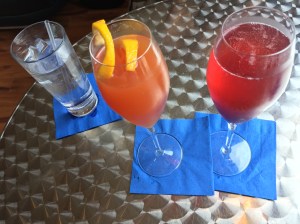
A late morning breakfast was jump-started by champagne cocktail, quiche, ravioli and finished with a delicious bacon and egg muffin sandwich cushioned with a sweet potato bed, in that order.

The next day, we left Killington to explore the Scenic Roads from Killington along Route 4 East to Woodstock, Vt. and South along Route 100 through the heart of Vermont to Wilmington. The leaves were most impressive along the Green Mountain National Forest.

We made a stop at the Shackleton Thomas Woodworking and Pottery Store, where they made hand crafted furniture and stoneware. Each item was lovingly produced in an atelier that carried on many traditional techniques.

Tomorrow we will be traveling from Albany, NY to Philadelphia, PA by Amtrak through NYC. We have ordered tickets the following day for the Barnes Foundation Collection and the Philadelphia Museum of Art, so art lovers, get ready!!