
Category Archives: SEGMENT III

Day 42 (a): Samarqand

imageimage

image

image

The first day of this segment has overwhelmed me with history, jogging my brain and challenging all of those connections between Alexander the Great, the Mongols, and Tamir. Some of you may know this better, but for me, it’s learning on the job.

Lets start with Tamir and work back. Many of the madrasah photos shown here date from around the beginning of the 15th century. A madrasah was the focus of education, and included a library, classrooms and a place of worship. Tamir was from Samarqand and made a campaign to conquer India. His grandson was the scientist and developed an observatory and promoted a lot of concepts developed by the Arabs and and the Chinese.

2. When the Mongols struck in the 13th Century, they basically burned every town and village they encountered to the ground. Many of the relics predates this period, but the buildings are no longer standing. Alexander the Great conquered this area, but there is still some debate where and how long he ruled. He was physically here in the area with his army.

3. The complex of 3 madrassahs were built in two different periods: the one on the left was first developed in the early 1400s and the latter two that form a courtyard were from the 1500s. The later buildings were designed to form a symmetrical triad of buildings, but the domes are not symmetrically placed. There is a balance between symmetry and asymmetrical elements.

4. There were multiple religions operating at the same time, including Christian, Hindu, Muslim and Judaism. Sayings in Arabic on the entries to the building welcome all religions but only believers. These were sacred places of education held in high regard, and the eight major faculties each had their own rooms. Women were encouraged to learn in these institutions.

Extensive reconstruction of the tile work and buildings were made in the last few years. A bazaar used to be in the courtyard but the vendors have been relocated to preserve the structures.

Photos, from top:

1. Overview of Madrassah Complex, Samarqand

2. Map of Uzbekistan. My route is Tashkent-Samarqand-Bokhara-Khiva-Tashkent

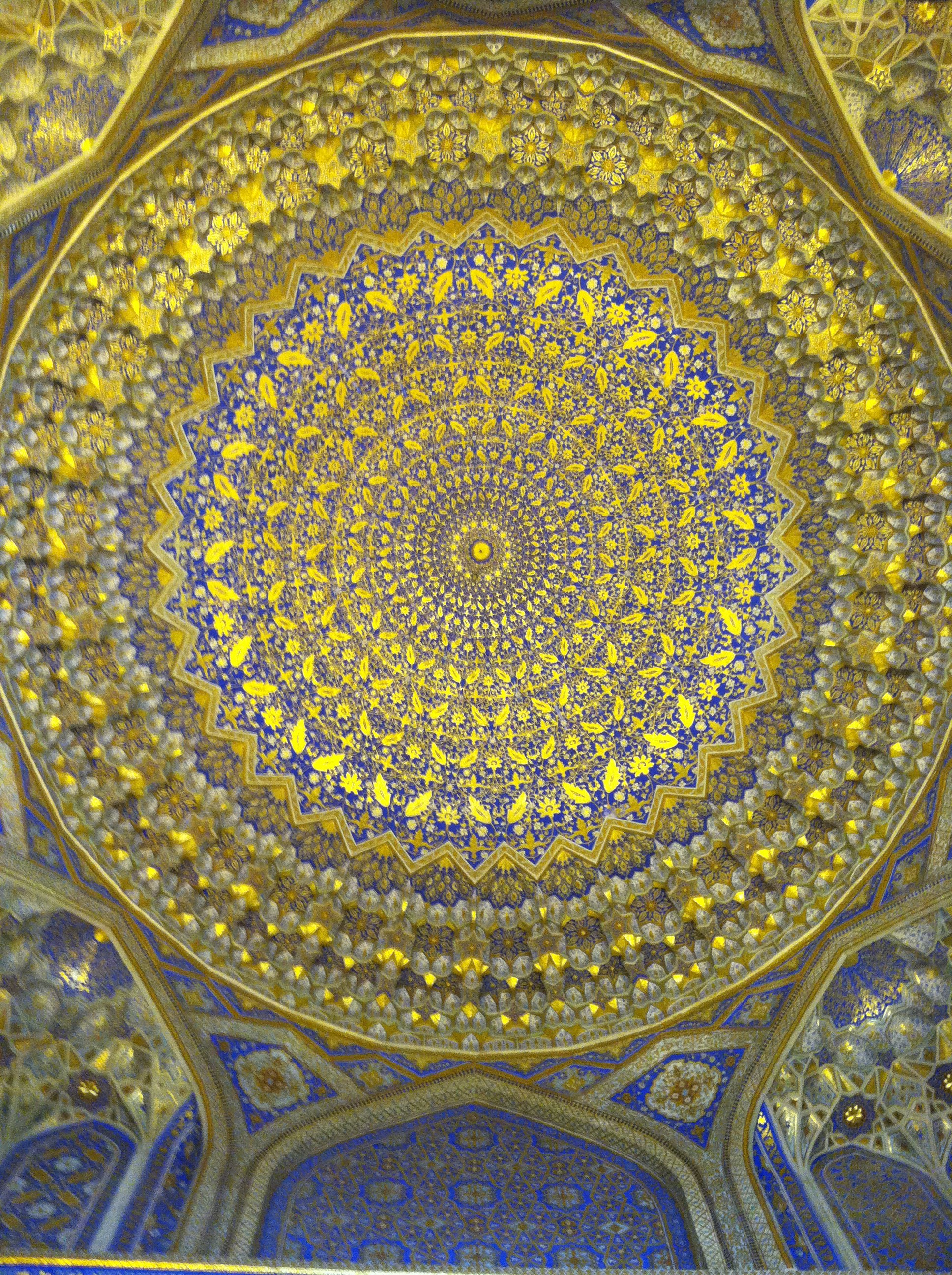
3. Golden dome from inside, designed flat to reflect sound of prayer inside

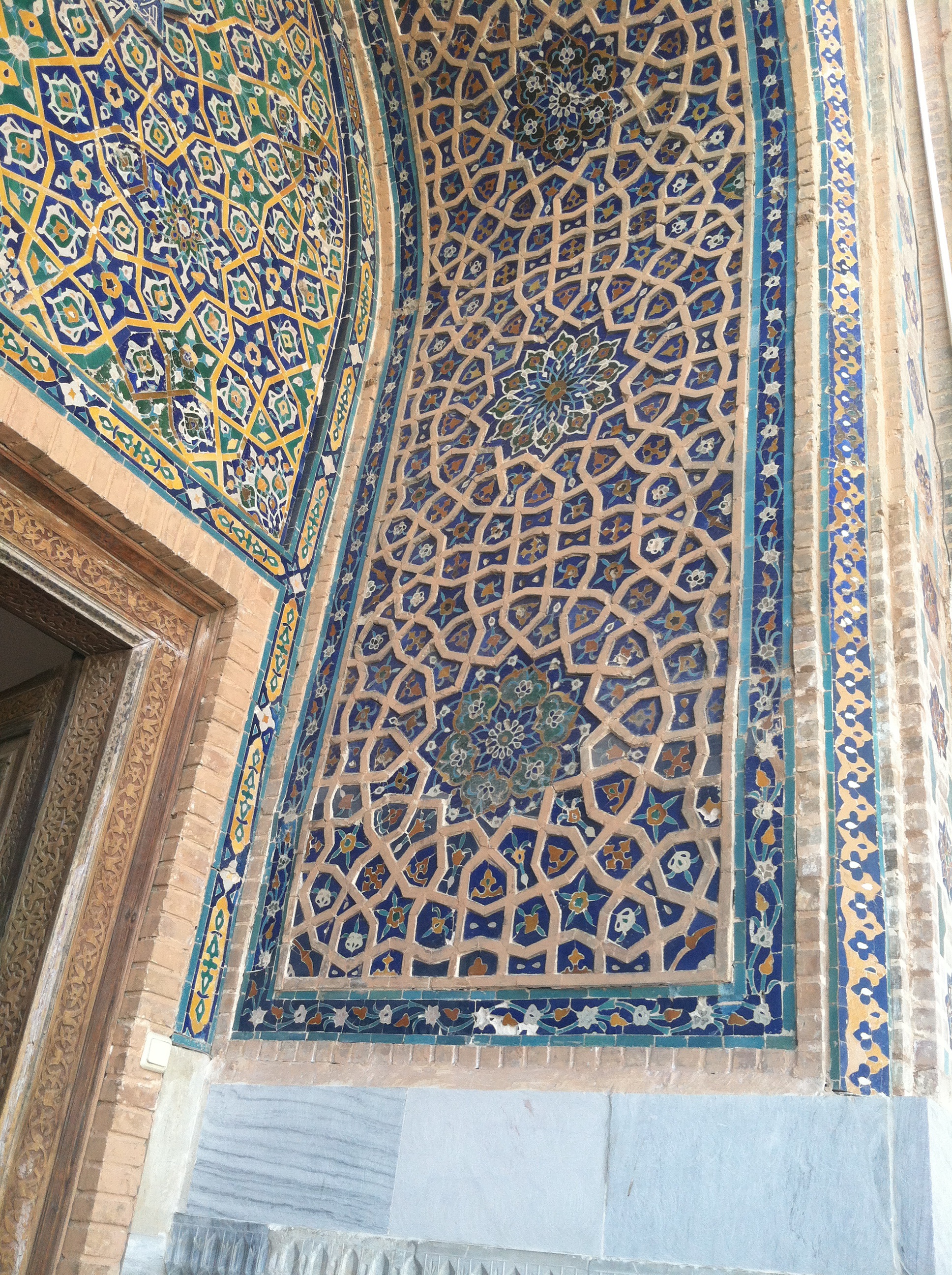
4. Detail of stone tracery integrated with mosaic tiles to create textured pattern

Note: Internet access getting sporadic and unpredictable, particularly as I go further inland into the country. Keep your fingers crossed. I have an excellent guide but it is difficult to catch everything as she is covering a lot of ground. I’ll try to fill you in as I go.

Day 41: Dresden to Frankfurt

image
A full luxurious day on the train, on the beautiful Deusche Bahn system. These are to me the best trains in the world: fast, efficient and reliable. All the best in German engineering. As I sit on this five-hour ride, I can’t help but ponder what’s ahead for me in the future.

I am pretty happy. I decided that happiness is relative, and of course a process, not a place. It’s those endorphins you get planning something and thinking about where you WILL be, and not so much about when you are there. I have to say the German class exceeded my expectations. Little did I expect or know whom I would meet or learn from them. But that was just a bonus.

I used to watch the happiness programs on PBS and based on their advice, make the lists of what I was grateful for. Maybe it was needed when you are inundated with stressful days at work to maintain perspective. I definitely have had a full and satisfying life so far. But will that get me through the next third of my life? Who knows?

Part of this trip is about seeking inspiration. And my quest in Germany is fulfilling that. Learning about Goethe gave me a big shot in the arm and a reading list. At the top is going to be Thomas Mann’s Lotte in Weimar. The movie I saw about Goethe helped me to see inside the German culture. Then get an annotated guide for Magic Mountain. (The train just went through Weimar, and I wanted to get off!) Before, during or after that, maybe more on Weimar.

Currently the book given to me from the Krasnos has entertained and consumed me. “the Orientalist” is NY Times best seller and the author, Tom Reiss, won a Pulitzer Prize. It’s the story about a journalist Lev Nussibaum aka Essad Bey. It takes place in pre-war Germany, but traces Bey’s life from Lake Baku, where he was born, to a saga of escape from crumbling regimes through Turkey to France, and then to a private high school on an island in the North Sea. He ends up in Berlin writing books about Germany.

The author casts a lot of historical information as the backdrop for this audacious character, whose true identity was challenged multiple times. He was married to a socialite for a short time and operated in and was followed by high literary circles. I haven’t finished the book yet but am savoring and parceling out every last word as I am running out of something to read on my way to Tashkent.

Without getting into detail, this has been the best book for my trip. I’m really glad I have it and hope to use this as my springboard to learning more about German history, and its complicated relationship to Russia. The book in part tries to tackle the prickly question of how Hitler comes to power.

I decided that you could customize your own academic degree. When you have the time, you don’t need to find a program, apply for it, get credits, take exams and prove yourself with a degree–you just do it!

Targeting Tashkent…lets hope the Internet works there.