Despite numerous trips over the past ten years, I continue to remain loyal to the arts and classical music scene in Germany. The familiarity with many event venues, the high quality of performers and performances, and reveling German efficiency over and over never tires. It’s still my go-to choice of travel.
This year, my German friend Annemarie joins me. We met last year at Hamburg’s Elbphilharmonie sitting next to each other in scalped seats and in awe over Anne Sophie-Mutter’s virtuoso violinists. I am now introducing Annemarie to some of Germany’s most popular events, venues and classical performers. These cultural activities are supported by the German government.
You will hear more about our seven-week journey as we plunder through Dresden, Lueneburg, Dortmund, Germany, and later through Sofia, Bulgaria, and Verona, Italy.
The Transatlantic Flight
The 10.5 hour trip getting to Europe is always a chore so I decided to take a business class flight direct to Frankfurt.
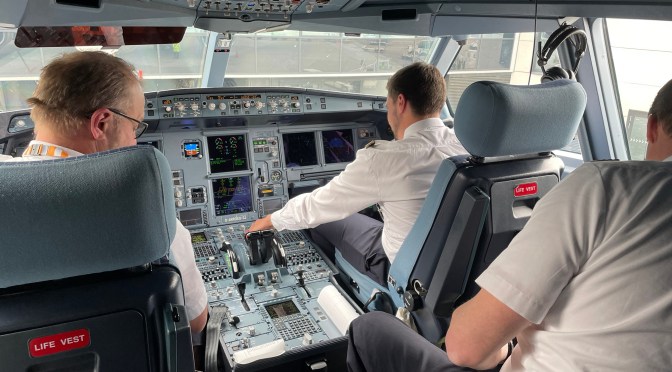
From the colorfully striped carrier to the comfy hang-out pod and delicious food, I was enticed by the extra effort being put into a memorable experience. The pilot crew even allowed me to take a photo of the flight deck on arrival in Germany!
How do bubbles rise from hell to heaven?
After meeting Annemarie at the Dresden airport, we had a big debate about the effervescence in the glass of Nicholas Feuillatte champagne. Were the bubbles instigated by something like a cube of sugar? After seeing the description “The juice is pale yellow with silver tinges, brilliant and crystal-clear, revealing a persistent ribbon of delicate bubbles,” (per Google), What do you think?
A long layover in Frankfurt gave me plenty of time to contemplate the automated baggage drop. I’m not sure Americans would be able to speed the process up with this robotic service.
Automated baggage drop at Frankfurt Airport
Goethe Haus, Frankfurt
Realizing that the glow from the business class flight was not going to sustain my nine-hour layover in Frankfurt, I resolved to find a city museum in between. The combined Goethe House and Romantic Museum seemed like an efficient way to kill two museums with one swipe
Goethe’s house displayed memorabilia by Germany’s beloved poet, philosopher and writer and with those who influenced him. There was an entire room connected to the Sorrows of Werther, the book that made Goethe wildly popular when he was only in his twenties.
Faust was yet another one of Goethe’s famous books (purportedly to have been written in Auerbach’s Keller in Leipzig) where a room in the museum was dedicated to the story and its inspirations.
Adjacent to the author’s house, the Romantic Museum connects many other artists, writers, and musicians that formed the romantic movement before, during and after Goethe’s lifetime.
A couple of architectural details caught my eye. The clever use of dots for lighting and steps in brass provided a coordinated balance to the subtle tile and wood finishes.
Die Walküre in Dresden
If you are not particularly tuned to being an opera junkie, just skip to the next section.
Our first performance at the KulturPalast was filled with cranky Wagnerians to hear a concert performance of die Walküre, the second opera of the Ring Cycle. Kent Nagano, a hometown Berkeley kind of guy, conducted brilliantly and led the four opera roles for Sigmund, Siegemunde, Wotan and Brünhilde.
Compared with a staged performance, the music rang exquisitely clear. The earlier lecture revealed that this performance was committed to the original wording and instruments from Wagner’s work. A jarring clash of wooden cymbals was noticeable, but other than that the rest seemed perfectly integrated for the modern ear.
Curtain call at the Kulturpalast of Die Walküre led by Kent Nagano
Bad Schandau
Known as “Saxon Switzerland”, Bad Schandau is a spa town in the forested area along the Elbe River near the Czech border. An easy hour from Dresden, the multiple means of transport used to get there was more exciting than seeing the tall cliffs in the distance. Altogether, it took the train, a ferry and a vintage light rail train to see a trickling waterfall being repaired after dead trees from global warming blocked its path.
More tomorrow as we explore the Military Museum and the Loschwitz neighborhood. Don’t forget to write home!
It’s still a little unbelievable to think that I made this trip to another part of the earth so quickly after COVID pandemic. From 2020-2023 the world stopped and travel overseas was limited if not non-existent. Now, it seems like everyone has forgotten, or wants to forget about it. Time to get on with loving life and traveling.
Sydney has surprised me in many ways. Let’s start with an admission that it is more spectacular than San Francisco. What Horror!!!! I have never admitted that to anyone, primarily because I truly believed San Francisco could not be outdone. Until now, no other European or Chinese city could beat San Francisco, I could never confess that any city fared better for combined climate, culture, diversity, transportation, and environment.
I’ve changed my mind. The vibrancy, sheer beauty, summer weather, buzz, and thoughtful planning of Sydney have all contributed to my change of heart. The buses, light rail, underground systems work seamlessly. A debit card or Opal card, the equivalent of a Clipper card, is all you need to tap on for any trip. You just need to remember to do the same when you leave, or you get charged to the end destination.
Modern buildings are tucked into sites adjacent to old 19th Century buildings. Both are clean and well maintained. There are plenty of public toilets everywhere, another safety and cleanliness indicator in my book.
There seems to be little blight, at least in the city center, and little or no homelessness. Moreover, it feels safe. A big bottom line: GUN CONTROL.
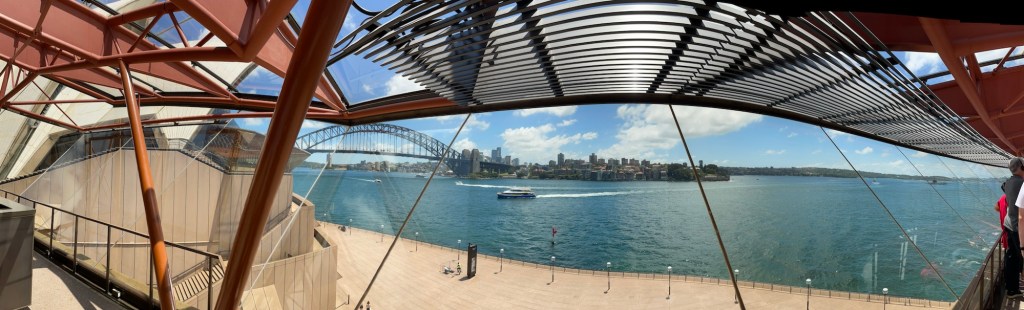
The harbor seems much more immediate in Sydney than in San Francisco. With active ferries scurrying back and forth, and the magnificent Sydney Opera House and Harbor Bridge looming on its edges, Sydney Harbor has so many drop-down gorgeous views that you’re exhausted by its sheer beauty.
People, particularly the women, are well dressed and attractive. That may be a bit of stretch in general, but my first impression is that they either look like Nicole Kidman or Survivor contestants. Bikinis or workout gear on public transport are the norm rather than the exception. I feel overdressed in my sleeveless, knee-length dress.
True, Sydney has a population of 5 million and San Francisco is a scrawny 750,000. But if I were to imaging San Francisco scaled up more than five times, I think the political system would collapse it before it crumbled under its own weight. Whatever the politicians and planners didn’t do to Sydney, we somehow haven’t figured it out, even on a minuscule scale.Let’s try BART for starters.
Sydney Opera House
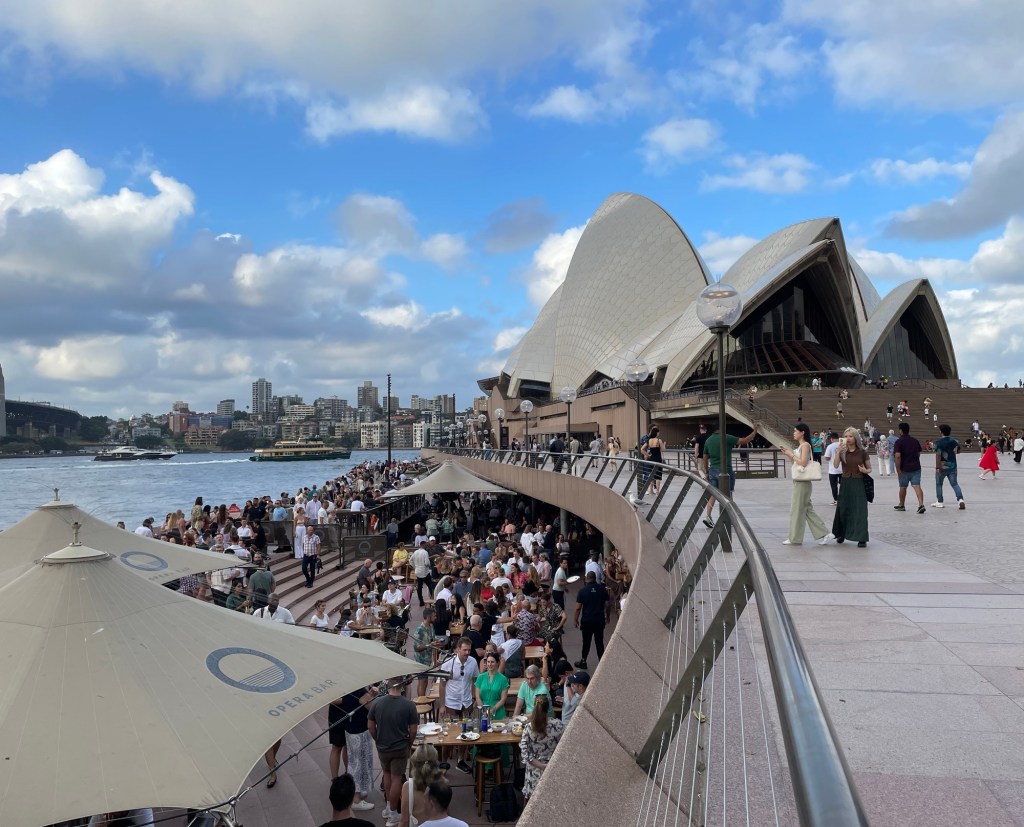
It’s hard for an architect to ignore the stunning presence of the Opera House. I have read in-depth articles on the formation, process, and disaster that created this international structure. Everyone recognizes this iconic form.
Despite having seen this on a previous visit, it was less imposing than it is now. Maybe activities outside enhance and support the building. Its sheer size, based on a full concert hall, an opera house, and series of performance theaters make it one of the largest entertainment venues in the world. The proportions of the building are monumental, but in this case, very warranted.
Sold-out performances of Ludovico Einauldi in addition to an opera gala were held at the same time. The ample outdoor terraces provided overflow space for crowds and the staircases were sized appropriately. You never felt claustrophobic from the expansive bay views visible from every corner of the building.
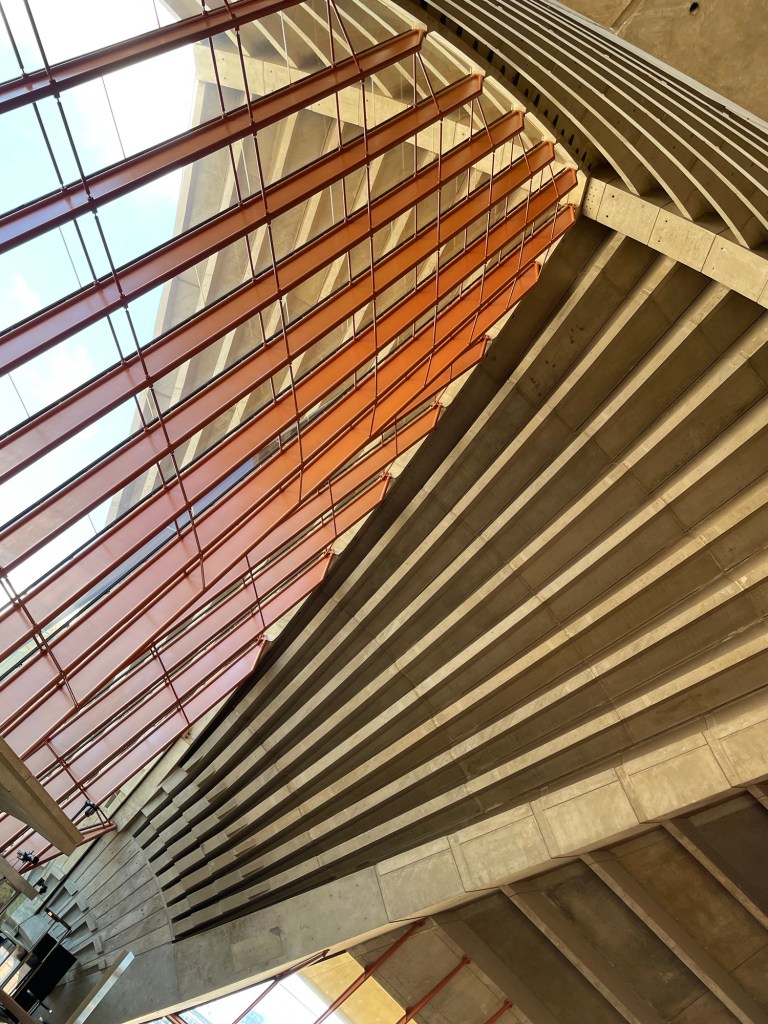
A one-hour tour was packed with information and details about the history of the building. The spherical shapes and combination of wood, concrete and steel were elegantly arranged, despite what seemed like random angles and inexplicable geometry.
Architect Jorn Utzon and the political will at the time were forces that delayed and promoted the project. In the end, it took 14 years of engineering ingenuity and construction to be completed. The project budget that was initially estimated at $7 million ended up costing $102 million, largely funded by a state lottery. Oh well. Sydney has probably been paid back for its world-class imagery. and reputation.
Ferndale Zoo
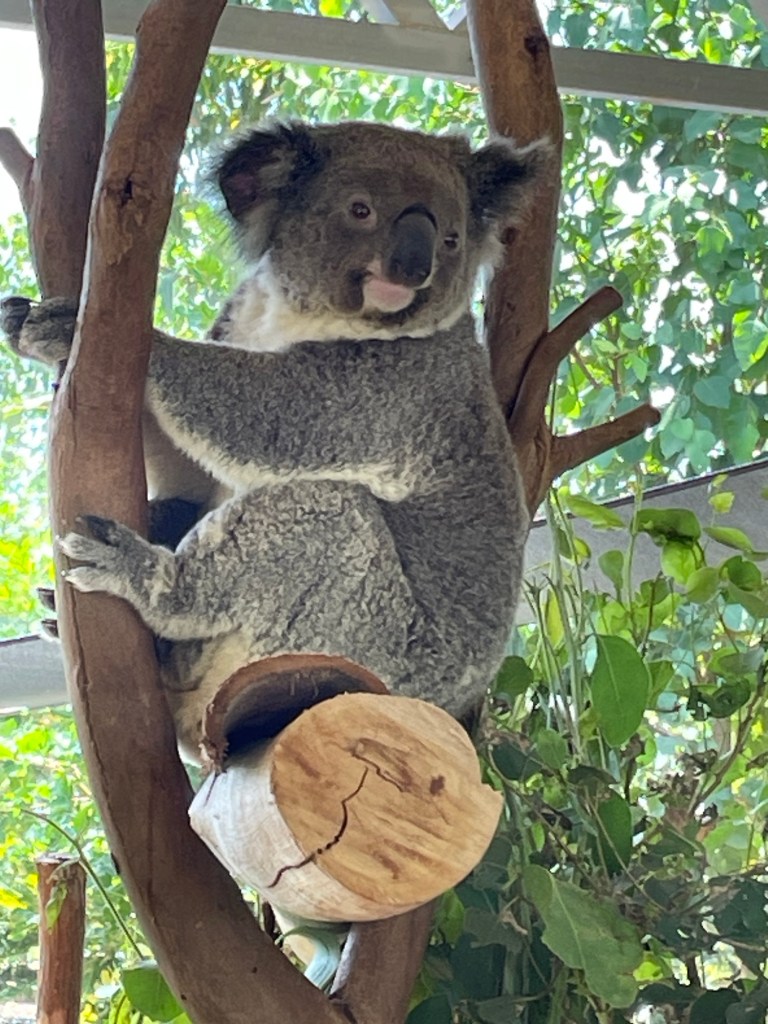
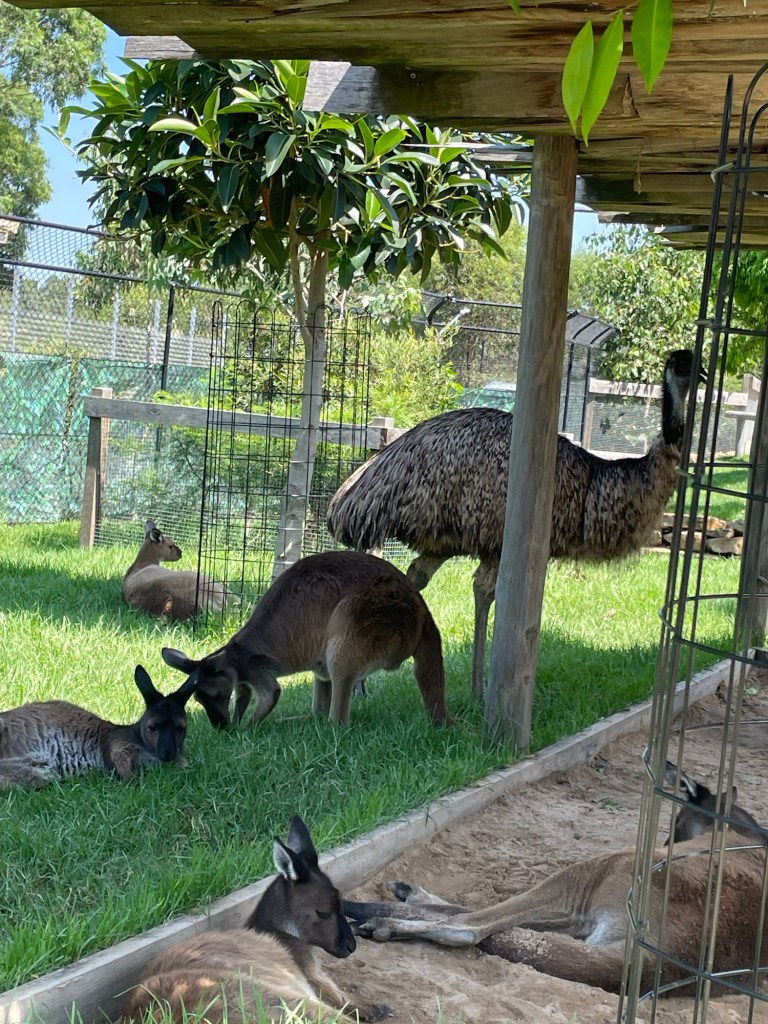
Just to put things in perspective, my first day trip was not to any museums or to attend a performance at the Sydney Opera House. Instead, my longing for seeing koala bears was fulfilled. It took two hours each way by public bus to the zoo in the outskirts of Sydney. The searing 40 degree weather did not daunt my determination to commute with the male, the females, and the joeys (babies), who were all segregated.
To be expected, most of them were sleeping, but I was happy to see a few munching on eucalyptus leaves or wandering along a branch. Like visiting a famous museum, I picked my battle by only focussing on the koalas and bypassed all the other zoo animals.
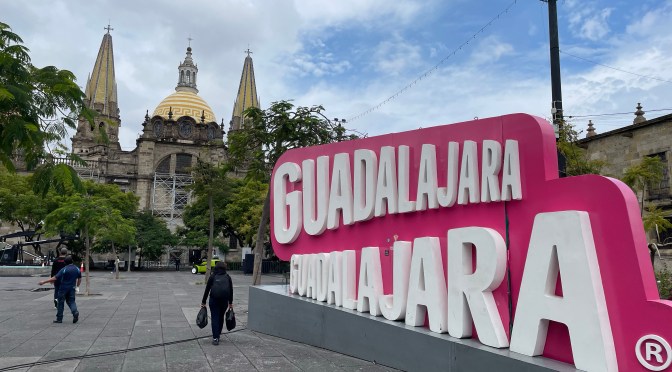
Despite my non-existent Spanish language training, I reveled in Guadalajara for a week earlier this month. Discovering works by Architect Luis Barragan and Muralist Jose Orozco were the highlights of this brief five-day trip.
Thanks to a personally curated set of guided tours, I was able to grasp the history and significance of Guadalajara. As the third largest metropolitan area of 5 million inhabitants in Mexico, Guadalajara has all the trappings of what city-seekers like me appreciate–a healthy dose of museums, historic buildings, music, and innovative food!
The York Times article I read a few weeks before my trip determined my destination. Unable to use a flight credit all year, I was down to the wire. My last gasp produced a Heimlich solution. I immediately choked out time, circumstance, and a course of action.
I first booked a central city walking tour to get oriented, combined with a visit to the artsy neighborhood of Tlaquepacque. I then planned a trip to the newly discovered pyramids outside the city near the tequila producing area. A final market and cooking class to learn how to make chicken mole added the finishing touch to my visit.
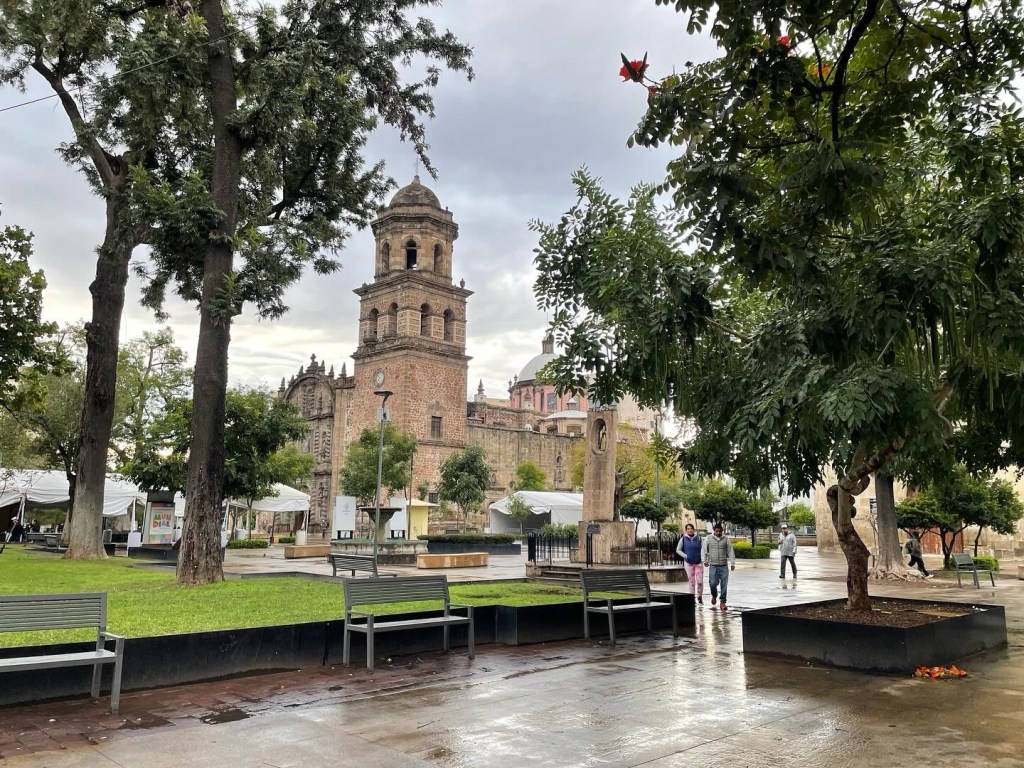
Large plazas linking different parts of the city helped me to get oriented. However, my total lack of Spanish language knowledge presented some challenges. Few people speak English in this interior city. This situation would be a blessing for those keen on speaking Spanish.
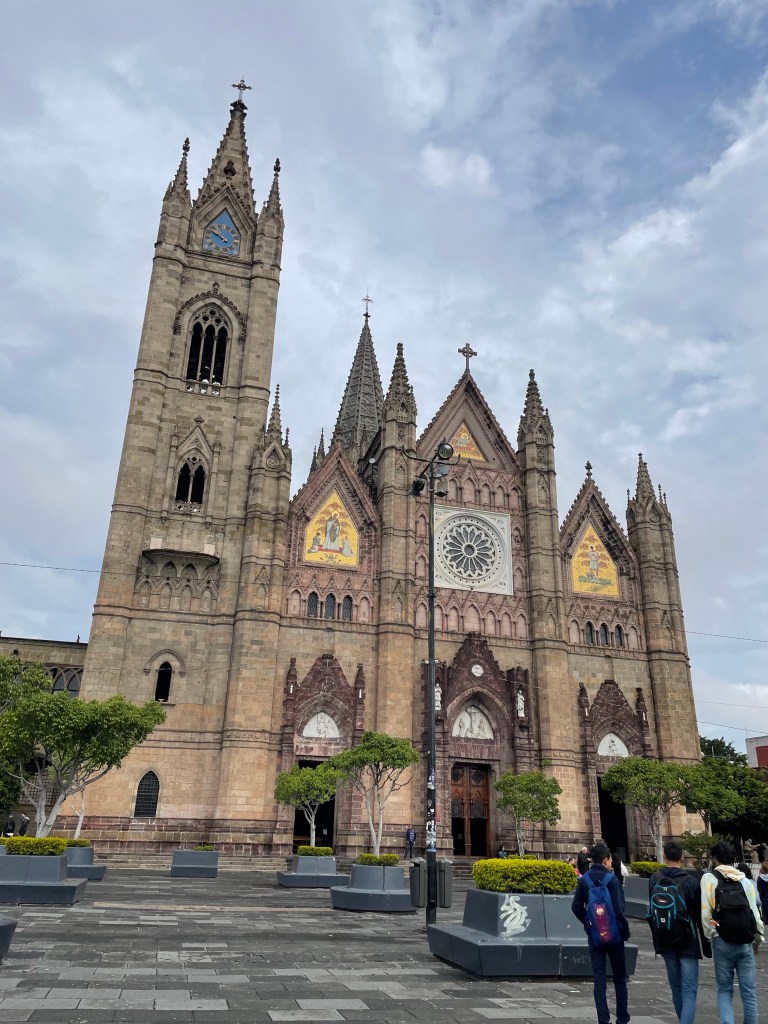
There were plenty of cathedrals and churches to visit in this Catholic dominated part of the world. I got into the flow and didn’t mind seeing the Church promoting itself with all its magnificent glories. The Mexican people continue to practice the Christian fait wholeheartedly.
Sculpture dedicated to a famous Woman Artist
I was surprised that Guadalajara, and not Mexico City, was the cultural capital of Mexico. Much of the style and practices of architecture and buildings were adopted from European culture, while integrating indigenous Native American culture together. Guides reminded me that most of the American Southwest was at one time owned by Mexico.
Barragan and Orozco
A world-renown architect, Barragan was a native son of Guadalajara. Prior to the 19th Century, traditional adobe houses were built with a central courtyard. European industrial expansionists converted their home to gardens facing the street to display their wealth.
Barragan, known for his modern houses in the early 20th Century returned to the original adobe house layout with rooms surrounding an open courtyard. Concrete masses formed sculptural elements around gardens. He added decorative patterns on the walls as they were being built and offset doorways from traditional or symmetrical axes.
I was delighted and surprised to find Barragan’s early work so evident and proudly identified in the middle of this bustling city. Bronze monuments are placed at the front of each house to indicate the work of Barragan.
Hospice Cabanas SculptureSculptures dedicated to Orozco and Barragan, native sons of JaliscoBronze monumentCasa Orozco, a Barragan house in the Central zone
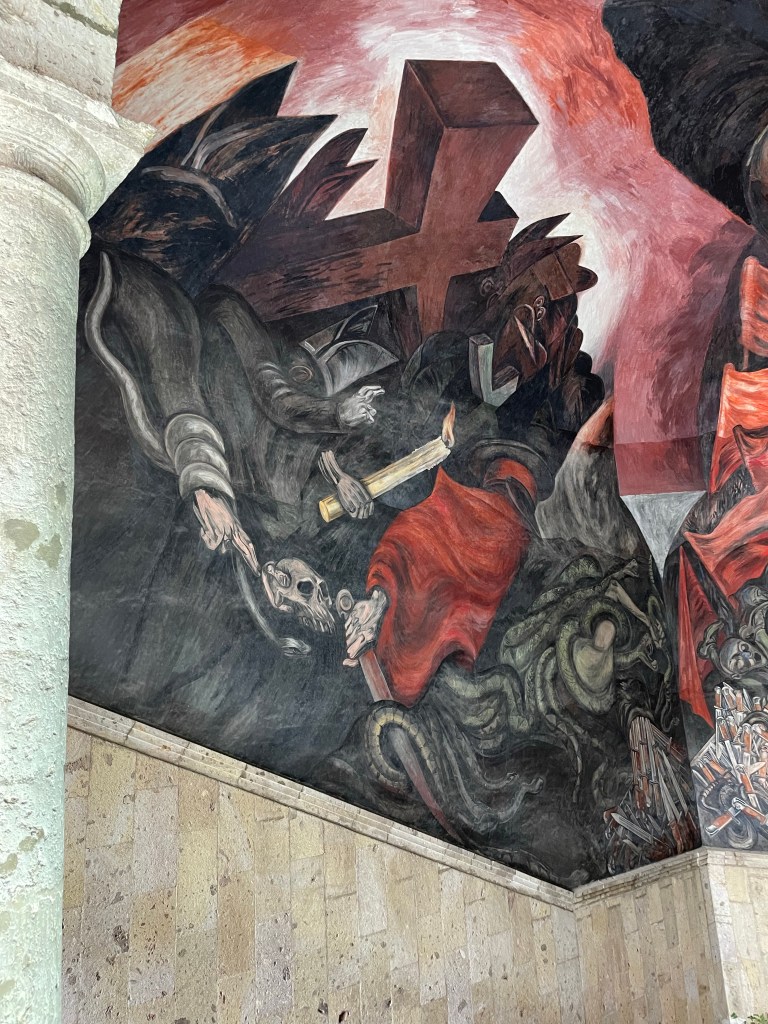
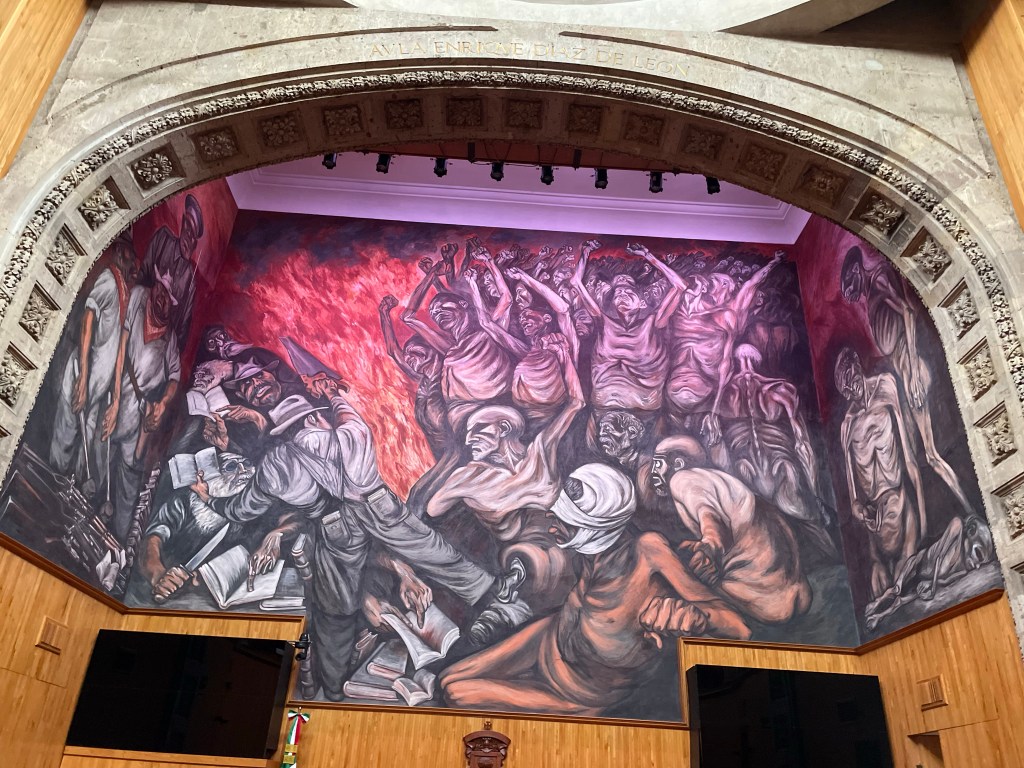
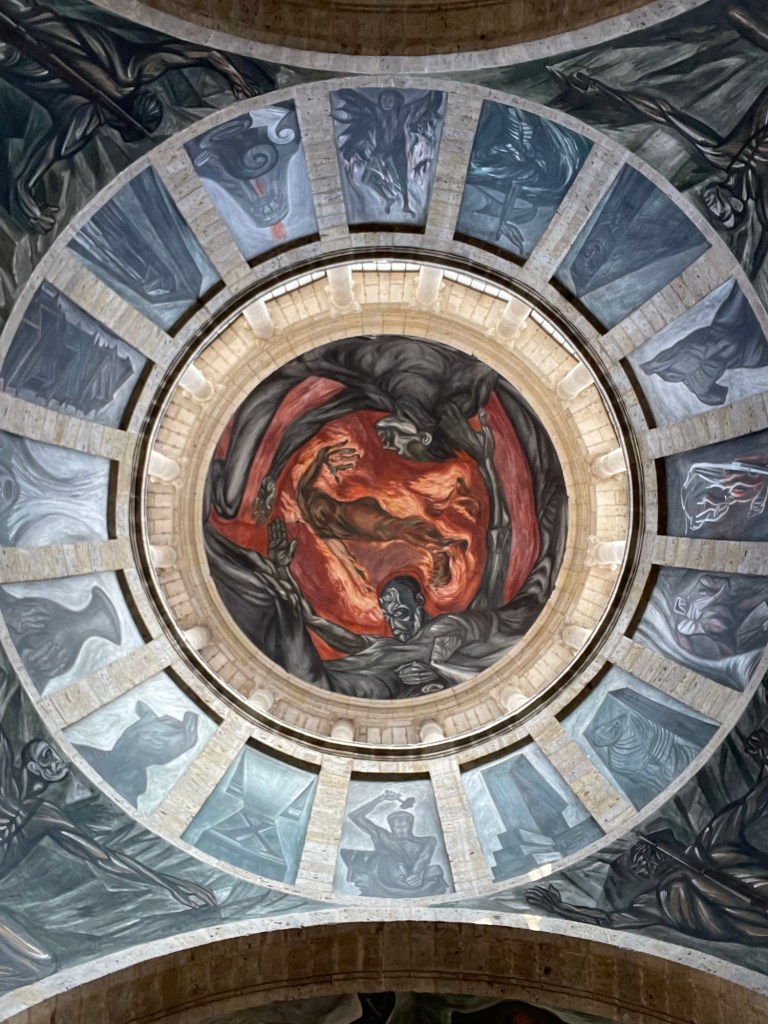
A visit to the Governor’s Palace was another startling surprise. I had only heard the name Orozco but was not familiar with his work. The technique for murals, placed on both walls and ceilings, were inspired by a trip he took to Italy to see Michelangelo’s Sistine Chapel. He mastered the art of fresco painting and used the best natural pigments available. Walls were painted quickly and skillfully before they dried. He painted in horizontal sections to control the amount of time he could apply the material.
The subject matter was philosophically arresting. Viewers of the murals are confronted with topics questioning the validity of politicians and religious leaders. He cautioned against capitalism, the possibility of industrial robotization , and deterioration of the human soul. He cautioned the role of the uneducated and the part they play in following orders unquestioningly.
Orozco wrote contracts that gave him complete artistic freedom from his clients. As a result, his messages to the public were uncompromised. The images are stirring and disturbing. Each viewer is confronted with the mess that competing forces have created.
He was critical of his contemporary, Diego Rivera. Orozco considered Rivera’s kowtowing to Rockefeller a disgrace, when he agreed to change the mural he painted in New York City.
Orozco was also a native son of Jalisco, the state in which Guadalajara is located.. You can read a brief summary of Orozco here:
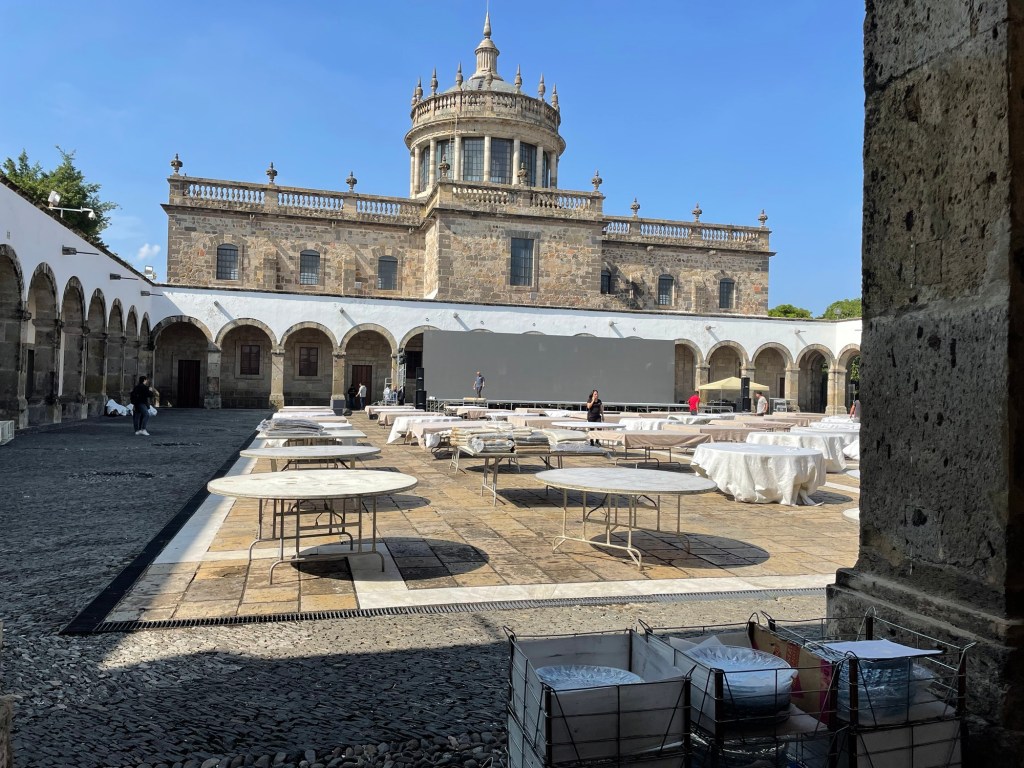
In a UNESCO world-heritage designated building displaying Orozco’s magnificent murals, the Cabanas Hospice was built in the early 19th Century by an ambitious Catholic priest as an orphanage. The Mexican Revolution wreaked havoc on the native population and resulted in many starving and homeless children.
At its time, the hospice building was the largest building second only in size to the Vatican. Modeled after the Vatican’s grand interior, the building represents the aspirations and influence of the Catholic Church in the New World. On completion, over 3,000 orphans filled the building’s rooms and corridors
When Orozco was commissioned to paint the interior of the building in 1930, it was in demise and accommodated only 200 orphans. The Neo-Classical building was converted to a museum with Orozco’s murals intended to be the highlight.
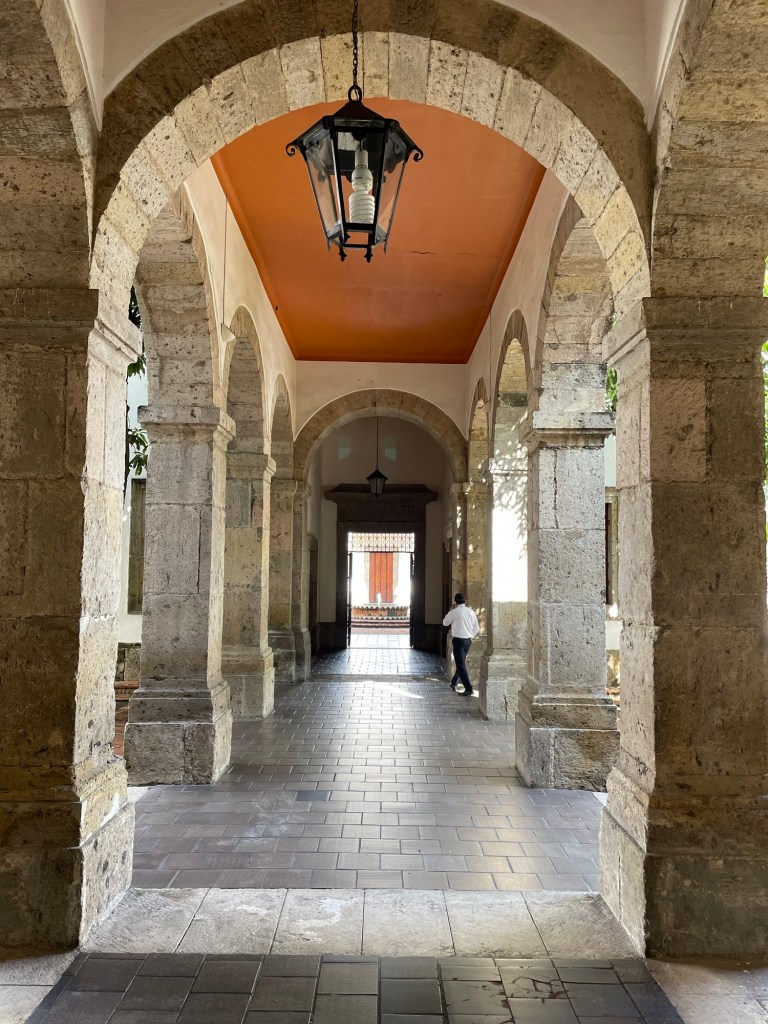
Courtyard of Hospice CabanasInterior with Orozco FrescosCorridor to AtriumInside Main Dome with Orozco FrescoesDome with Burning ManEntrance to Hospice Cabanas
Tlaquepaque
The artist colony and pedestrian area of Tlaquepaque showcased whimsical outdoor sculptures reflecting their creators’ love of life. The spark of joy (and girth) is evident in the art.
The Delgollado Theater
The Neoclassical Delgollado Theatre, located a mile from my centrally-located historic hotel, inspired me to attend an evening performance. The local symphony did a pretty decent job of Beethoven’s Eroica Symphony. I was interested in experiencing a crowd who enjoys these cultural events.
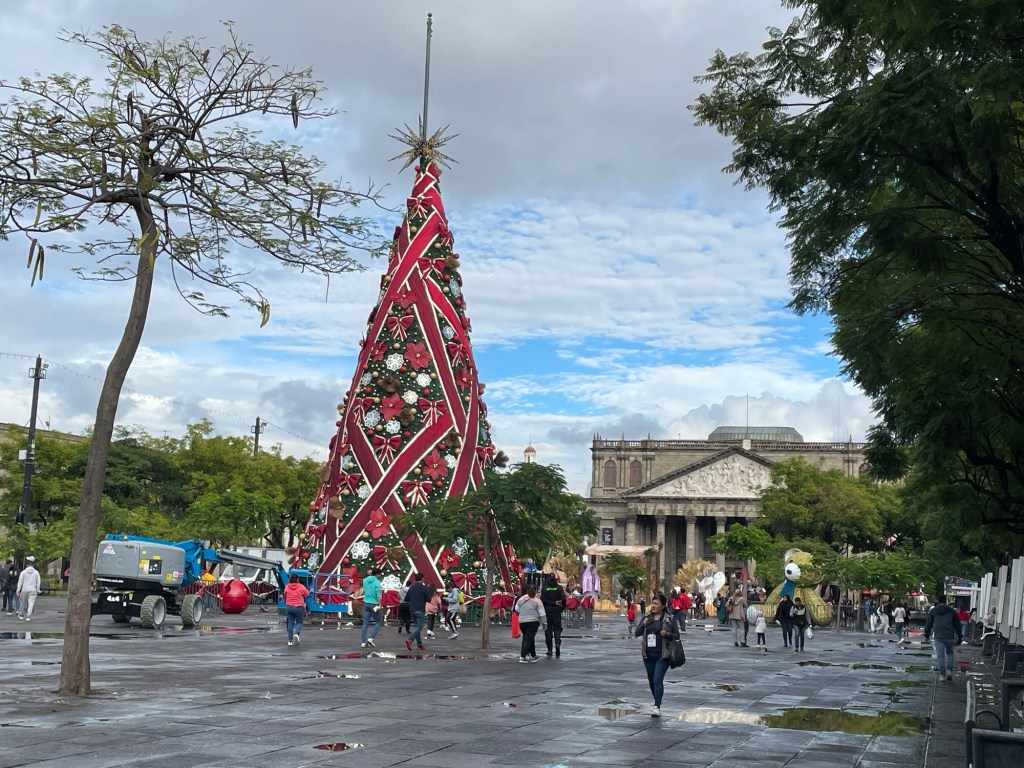
The throngs of friends and families shopping and strolling sent a festive mood throughout the plazas, ablaze with Christmas displays. Walking was easier than taking a taxi to get around–the streets are narrow and congested with what seems like more cars per capita than people. The one mile distance to the theatre took 20 minutes by foot and 30 minutes by car….go figure!!!
Lobby Lighting at Delgollado TheaterPlaza TapatiaDome of Delgollado Theatre
Interior of the Delgollado Theater
Circular Pyramids
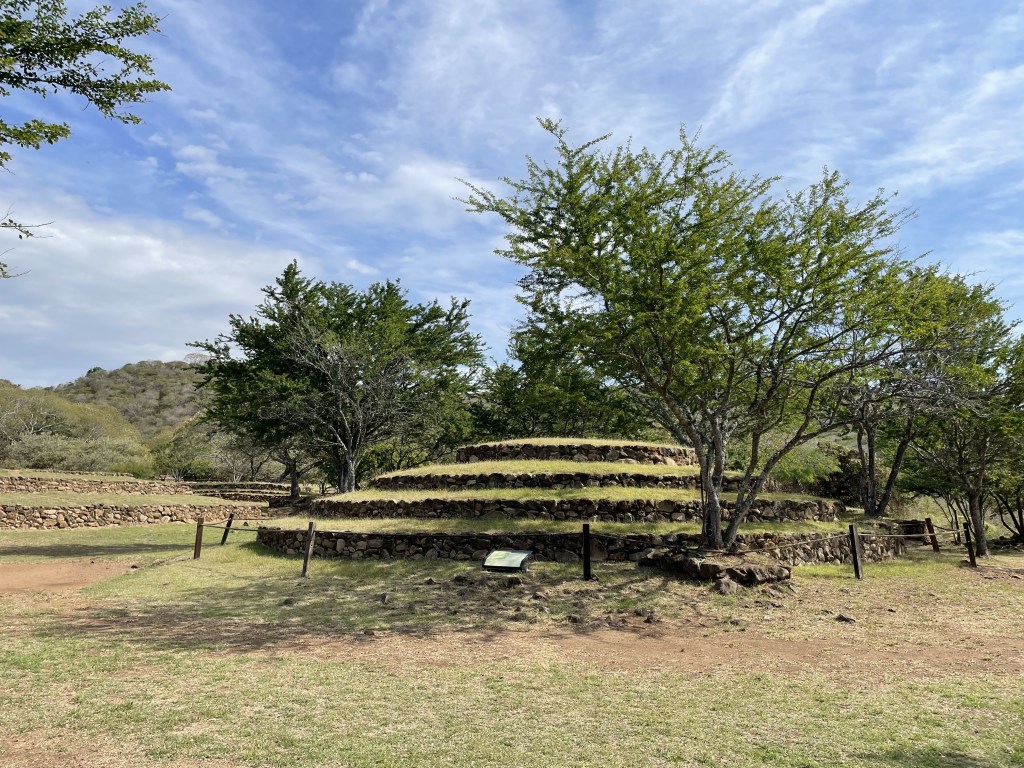
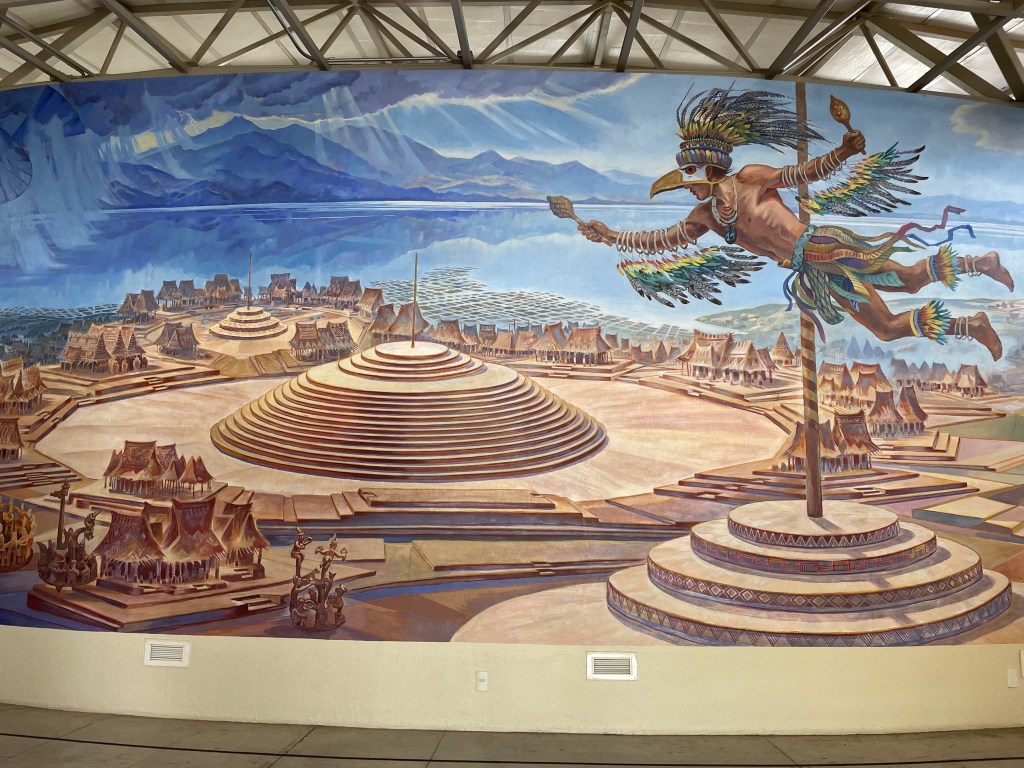
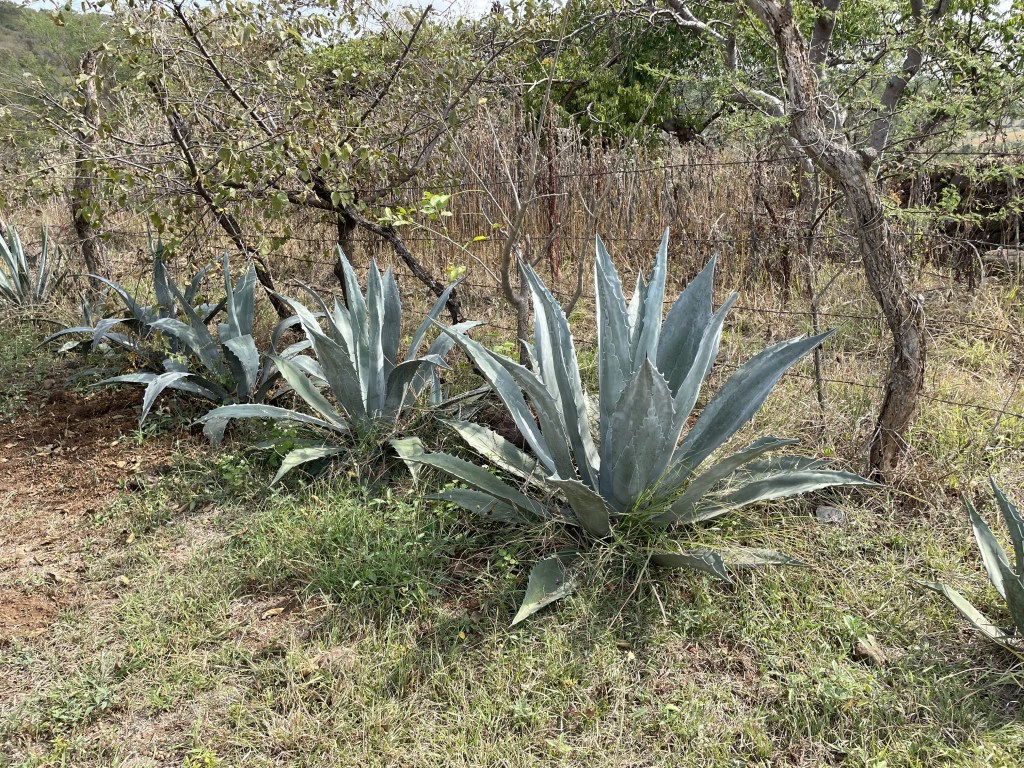
I took a side trip to Guachimonton, the circular pyramids about an hour and a half outside the city. It’s located on the other side of the mountain where Tequila is produced. Used as the main altar for burials, the mound is surrounded by a temple, patio, and a ball court. It is relatively unknown because it was only discovered in 1965 and excavations are still in process . The civilization thrived in the area from 300BC to 400AD.
Chicken Mole
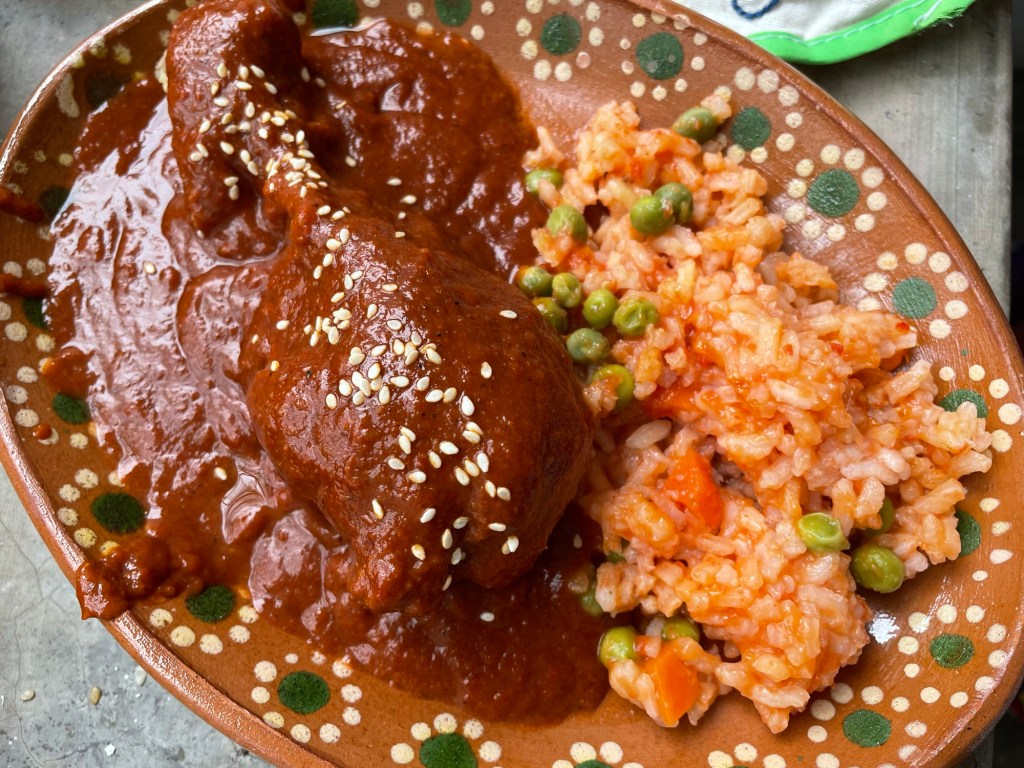
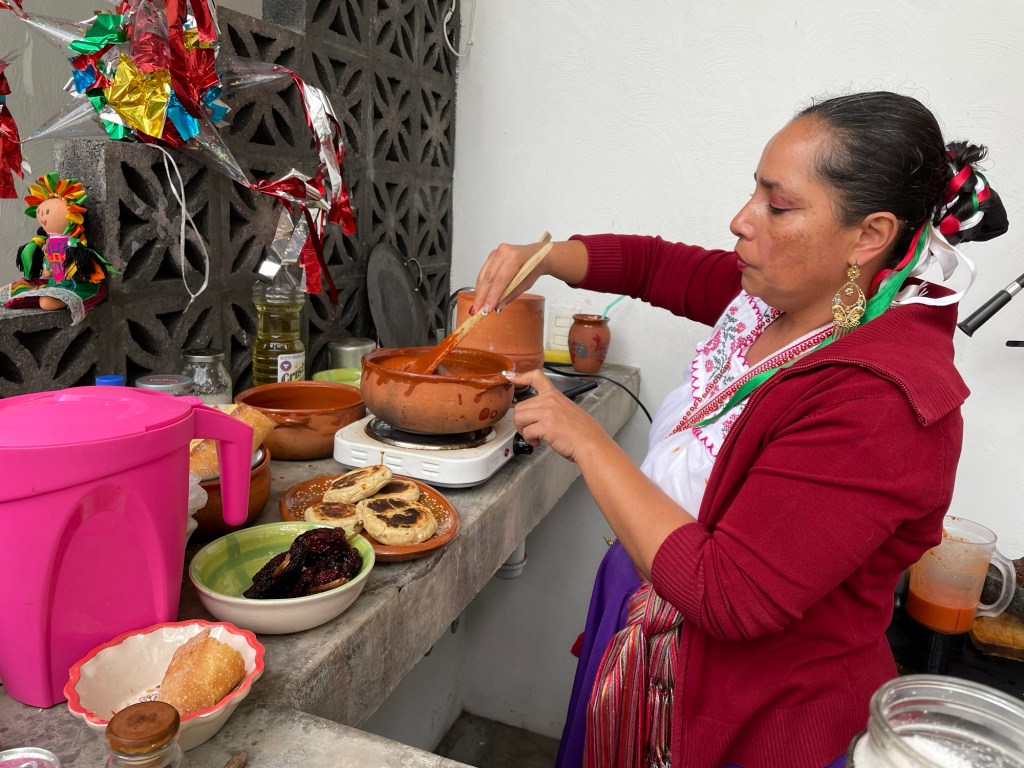
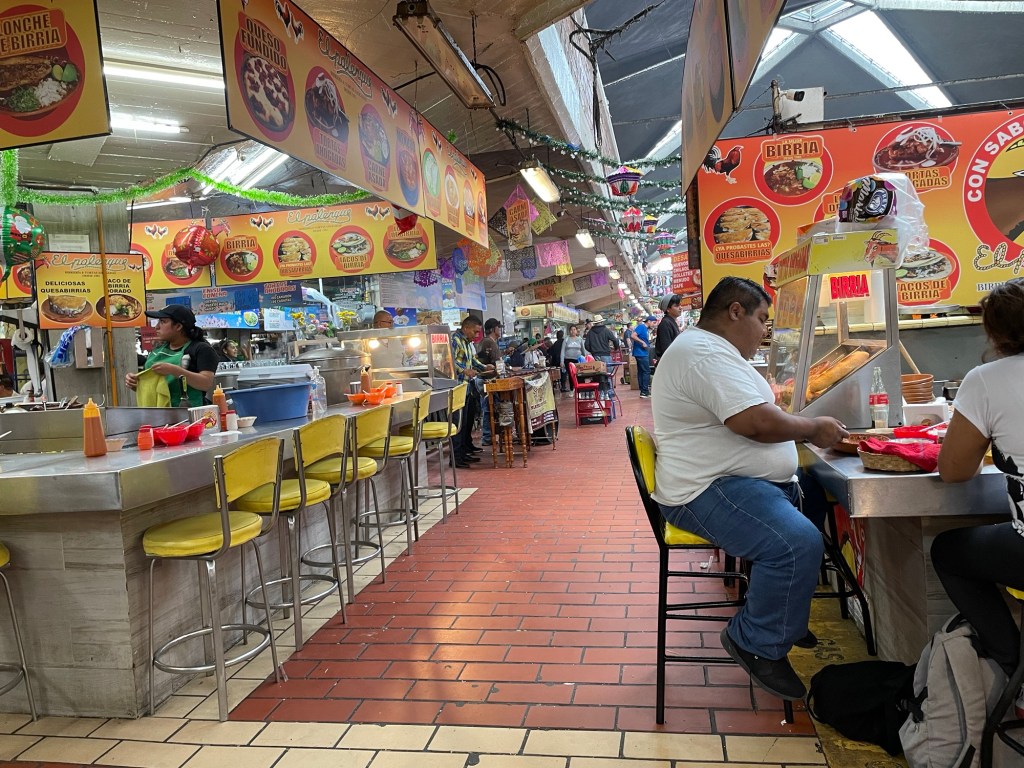
A rainy Friday gave me a good excuse to take a cooking class. With only one other student, the session became a semi-private lesson. We first went to the huge market to shop for ingredients and received a detailed lesson on the myriad types of chiles. We made an entire chicken mole meal from scratch, with rice supplemented by a delicious fruit drink.
Chicken Mole!Corn Husks at MarketMarket MainstayMaking the moleMarket Hall DiningTamale Maker
Al Fresco Tortilla Making
Despite a couple of days of dreary weather, I was very glad to have ventured to this unknown part of Mexico. It is developing slowly despite its cultural attractions. It’s a good place to come if you want to avoid noisy obnoxious tourists, and I could barely find one to complain about. I was particularly delighted to see and learn about the Barragan houses and the Orozco murals. Yes, I would highly recommend coming to Guadalajara just for those two reasons alone.
News Flash!
I will be traveling again in 2024, so stay tuned to this website! I plan to travel to New Zealand and Australia next month, and then back to Germany and Bulgaria for more operatic and classical music events in the summer. The travel fever in me hasn’t quite worn off so let’s see what the next year brings….and don’t forget to send your comments and encouragement!
Here are a few photos of a museum in Luneburg, crazy train travel on a 49Euro ticket throughout the country, and sights in Lubeck, famous for its marzipan (I bought 2 lbs!)
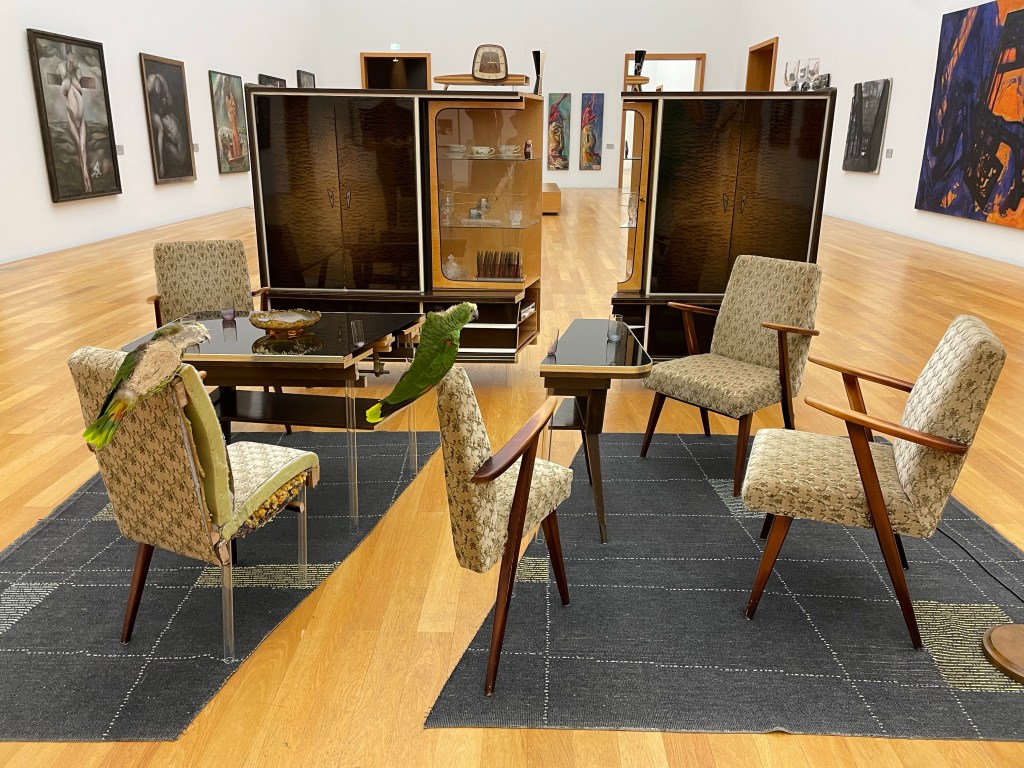
Sammlung Henning J. Claassen
This was a beautiful gallery on the outskirts of Luneburg with a modern art collection with some examples shown here.
Train Travel in Germany
I somehow managed to snatch an online ticket for the month of September for only 49 euros! Crowds were intense over the weekend, but much saner during the rest of the week.
Friend Annemarie with sendoff from Luneburg
Lubeck
Idyllic Boat Cruise
Climate Action Protest in downtown Lubeck
A Last Look at Hamburg
St. Pauli from the Elbphilharmonie Plaza
A Newly Found Friend
Lively. Vivacious. Warm and friendly. Crazy. These are words that describe my new best friend.
It all started with a lost wallet. That is another story to be told, but let’s take this moment to a better place.
The Elbphilharmonie in Hamburg is the blessing in disguise. I had just taken my place in 16S (as in 16thfloor), Row 4, Seat 18 in the rafters at the sold-out concert. Soon thereafter, Annemarie arrived and greeted me as she sat down in Seat 19. We exchanged pleasantries and discovered that we had purchased tickets the hour before from the same person selling tickets outside the concert hall.
A third and fourth person appeared to claim their seats, and we all happily shared stories about how clever we were in snatching our tickets. Anne Sophie Mutter, the soloist, was a world-class violinist about to perform with a dozen other virtuosi string musicians.
After the exhilarating performance, I learned that Annemarie had worked in Chicago for 14 years. She was a marketing pro in the shipping business and was immersed in her life and work. Her warmth and charm reminded me of the inimitable friendliness of those from the Midwest. Growing up on a small farming village outside of Munich with four brothers, Annemarie had learned how to stand up for herself. She attributes her self-reliance and independent nature to her family relationships.
After the performance, Annemarie convinced me to visit her the next day in Luneburg, where she lived. I used my 49-euro, contactless monthly ticket to take the train there, a short hour-long trip outside of Hamburg. She met me and escorted me to her apartment, a mere five-minute walk from the train station. Her beautiful apartment was impeccably decorated with white carpeting and walls, soft modern furnishings, a few carefully chosen hand-crafted antiques and splashes of red here and there.
Picture windows framed a soothing garden outside, with greenery as far as the eye could see trailing down to a river beyond. A window cracked open allowed the breeze from the recent shower to waft inside. I felt so lucky to be invited into this luxurious German home! After Annemarie explained her work in the States, she described her humble upbringing. Her family grew hops for the breweries in Munich.
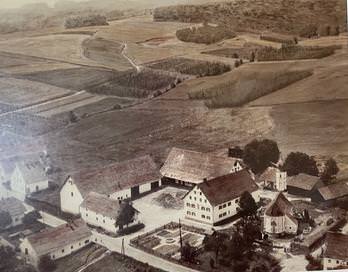
The two upper floors of her huge 20-room farmhouse were used to store and process grain. During harvest time, workers would load and hoist the hops that had been thrashed from the stalks to the top floor. The kernels would be poured into huge canvas sacks that were suspended by a hole on the bottom of the upper floor. They were then pressed into the sack while hanging down to the floor below. Using their feet, workers would then tamp and stamp the kernels inside the sacks to compress and leave them to dry.
Moarhofer, Putenhausen, Hallertau (outside of Munich, Germany)
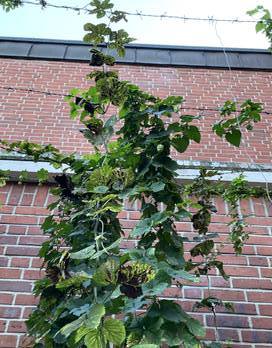
On our walk through the quaint town of Lueneburg, Annemarie stopped to show me one of the random wild hops’ vines. A plump kernel at the upper tips of the plant looks like a giant white raspberry. Annemarie broke it open to show me what it looks like inside. She then closed her eyes and took a deep whiff. Her face broke into a huge smile. It immediately brought her back to her childhood, and in a moment she took me there with her.
The hops vine
I too, had suddenly flown to this fairy-tale town to Southern Bavaria. I had often seen lush green fields and the tidy plots of German farmland. I instantly connected to the description of her humble beginnings. They reminded me of my mother’s childhood in rural China. I. too, closed my eyes and allowed the thought to take me there.There were many other stories that Annemarie told me about growing up in Germany and living in the States.
After sharing wine, glorious concerts, and even a special overnight at her lovely home, I treasured this story about her childhood. We connected in many ways. While names of the farm families change, Moarhofer continues. I would love to visit there one day. Annemarie’s vivid description brought the photo to life, and her friendship has given me the reason for investing in the German language.
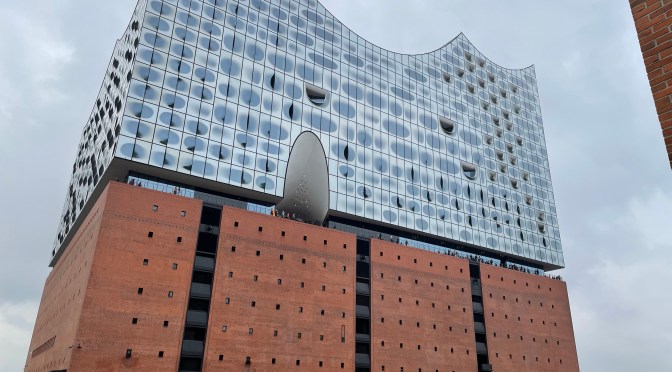
Approach to Elbpharmonie Concert Hall over parking garage and hotel levelsLife at the top
My primary interest in visiting Hamburg was the Elbphilharmonie, designed by Swiss architects Herzog and DeMeuron. In my book, it’s easily among the greatest modern buildings in the past hundred years.
It’s not flawless. But the experience is thrilling. As a destination, visitors marvel over its design and are overwhelmed by its prominence. Like a giant supercruise ship lifted out of the water, it sits on a promontory to the western edge of the city.
It’s now a destination point with tons of tourists from Luneburg to Buenos Aires. The size and massing establish its presence and its whimsical openings and surface treatment are intriguing,
There are few buildings I consider worthy from both interior and exterior perspectives. but this one exceeds my expectations. From the first encounter with the curve escalator to the 360 degree views of the harbor from the top, there is no comparable building in the world that combines an exciting amusement park with a inspirational view at the top of the world. Unless fans of bungee jumping argue that the sport is better. The results are the same.
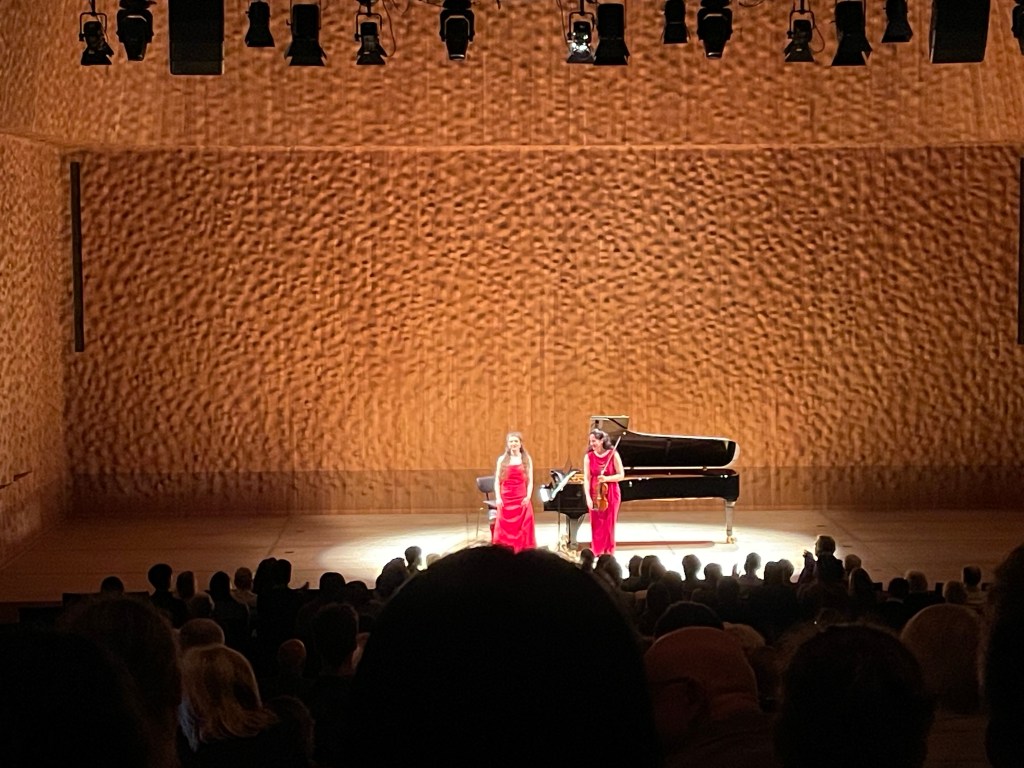
At the first performance there, I watched a rock star from the rafters. Anne Sophie Mutter and her Virtuosi concert took the sold-out audience over the top. Sightlines were so good you felt you were in a front seat and the sound quality, thanks to Japanese ingenuity, made you feel as if you had just cleaned the wax out of your ears.
Anne Sophie Mutter and Virtuosi Performance to Sell Out Crowd
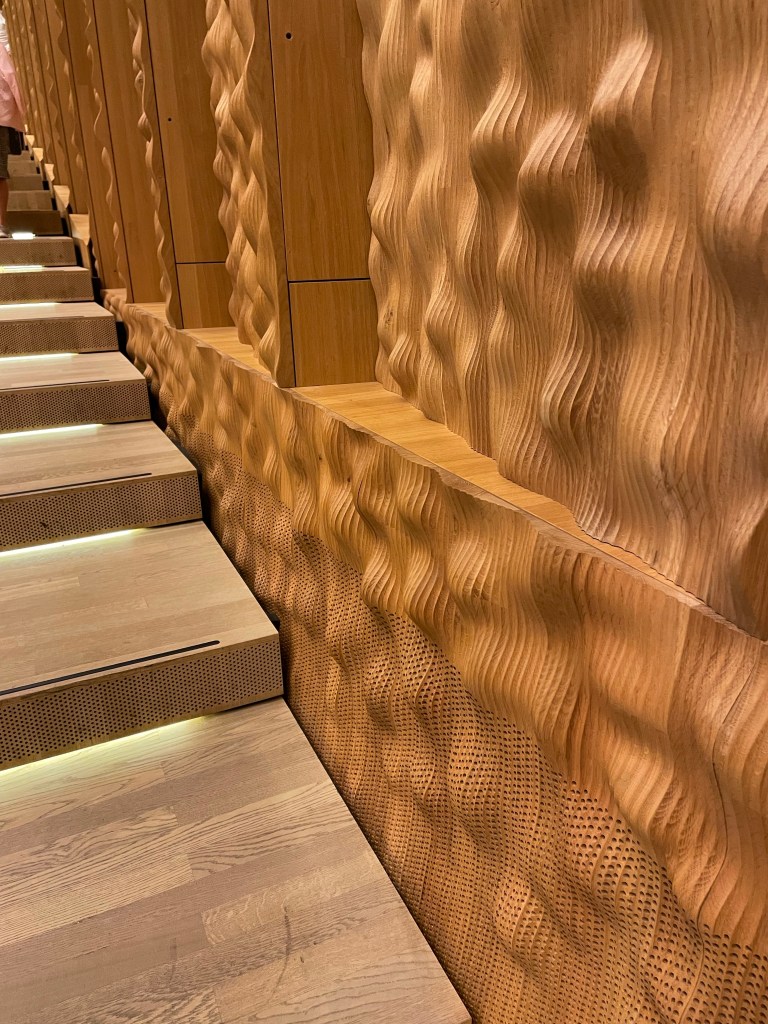
The second performance was in the Smaller Auditorium (Kleiner Saal). Quite a different but equally thrilling experience to that of the Larger Hall (Grosser Saal). The Mendelssohn Festival was being held simultaneously so the room and the chamber music fit perfectly.
Mendelssohn Festival in the Kleiner Saal (Small Room)Detail of sound wall in Kleiner SaalDizzying walls in an acoustically perfect sound auditorium
Like other European cities that have established star-architect branding to attract tourists to museums, Hamburg took a risk and turned its attention to a music venue. It cleverly lifted the concert hall to the pinnacle of a high rise building by putting 5 levels of parking at the base and sandwiching a hotel in the middriff.
Unfortunately it seemed like exiting the garage is a nightmare for attendees, both pedestrian and vehicular. And I questioned putting the high headcount at the top. I suppose its no different than occupants in a high rise building. There’s no doubt the building is spectacular and deserves its place among the top, if not the top, of ten best concert halls in the world. My opinion.
Fine and Applied Arts Museum, Hamburg
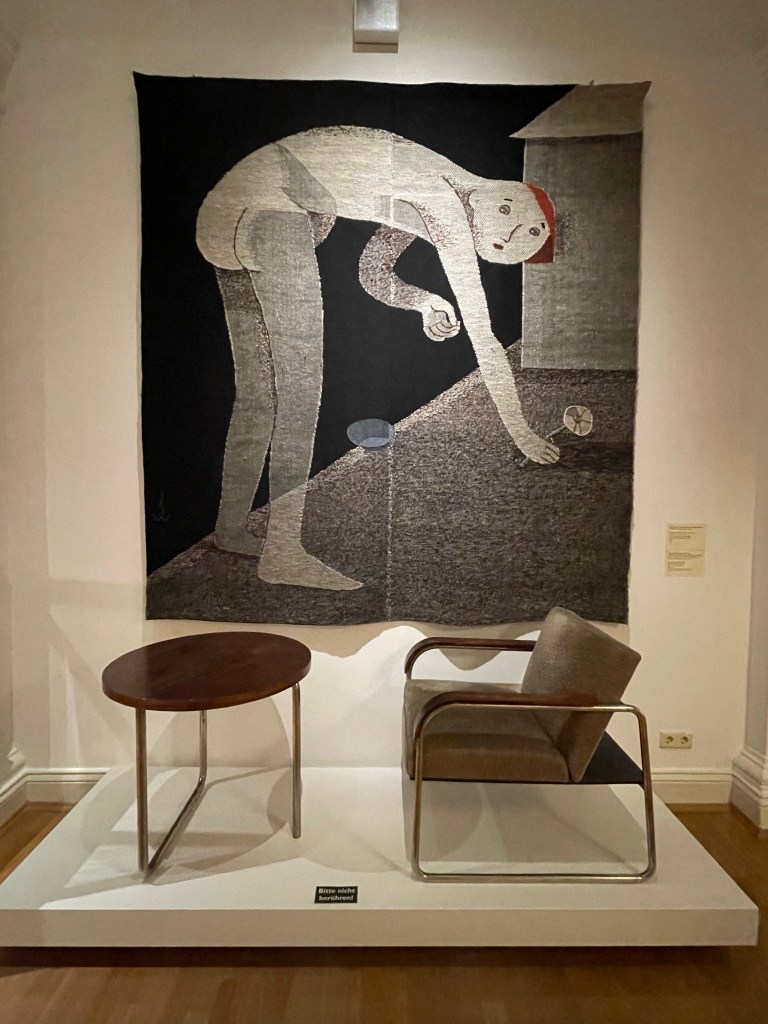
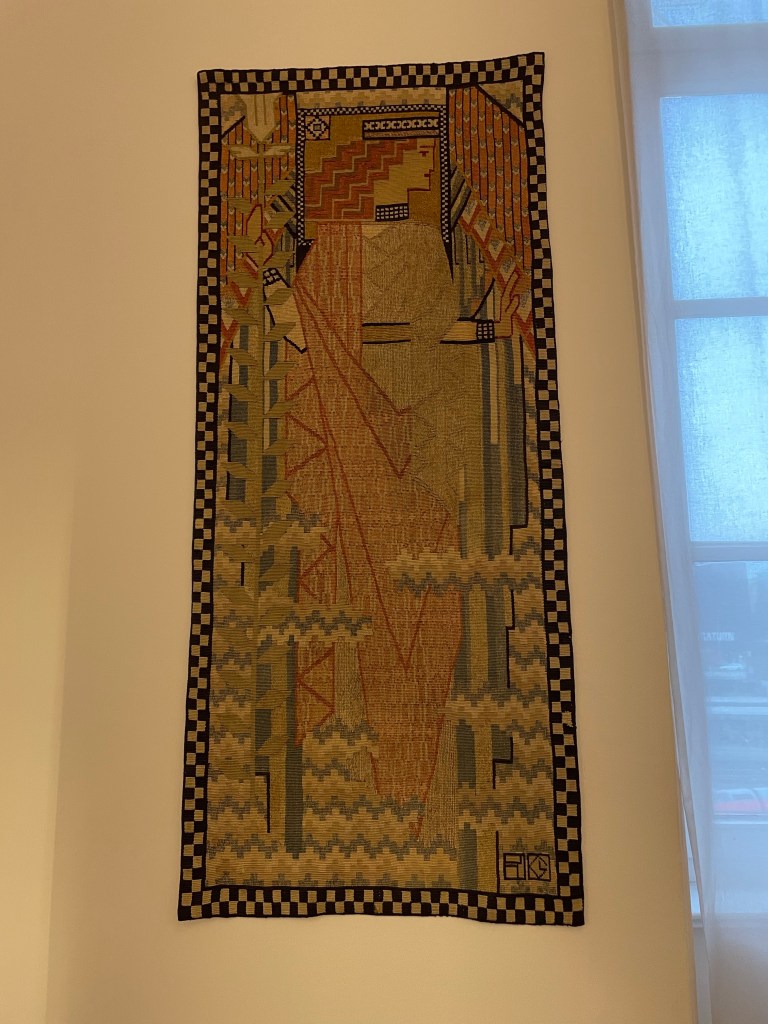
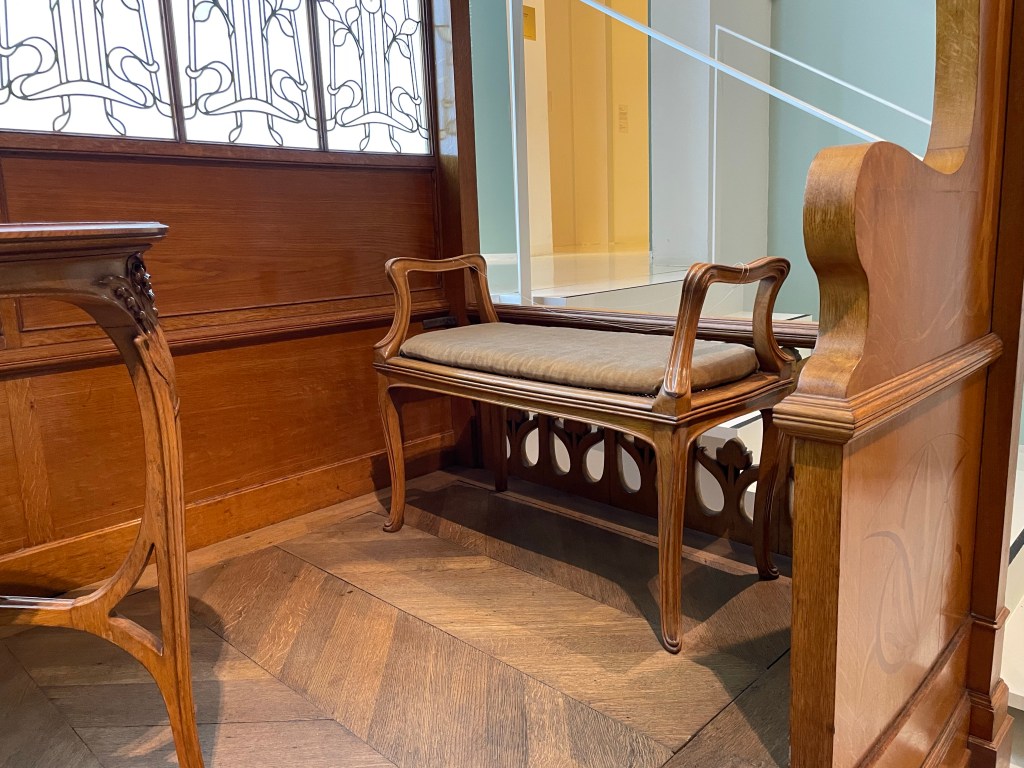
Wandering into the museum next to the train station was an oasis of German culture that I love. From the early beginnings of modern design and production of beautiful objects for the home, the roots of Ikea and Apple can ge found here. The tender, slender tendrils of Jugendstil (youthful style) represent the flowering of blending art and science, as it reflected the Art Nouveau movement and influenced the Moderne.
Fine and Applied Arts Museum, HamburgBeautiful ModerneHenry Van de Velde from the BauhausFurniture and Tapistry perfectly pairedTapistryUpholstered BenchMackintosh marketing menuFine and Applied Arts Museum furniture and objects from turn of the 19th to 20th century
The fine tapestries demonstrate the traditions of fine hand craftsmanship. Art extended into the home and blended architectural elements like walls, doors and windows as well as furniture. It’s no winder you see influences of Frank Lloyd Wright everywhere in these museums!
This special exhibition at the Fine Arts Museum captures the delight in educating and training children. The models, sketches, and planning required extreme care and dedication by talented professionals. Kids could draw their own creative versions!
PuppetsModelsKids’ versions of Sesame charactersPro Sketches for character shapes
Around the corner from the train station is where the other half of Hamburg lives. Real food is sold in markets here.
Luneburg
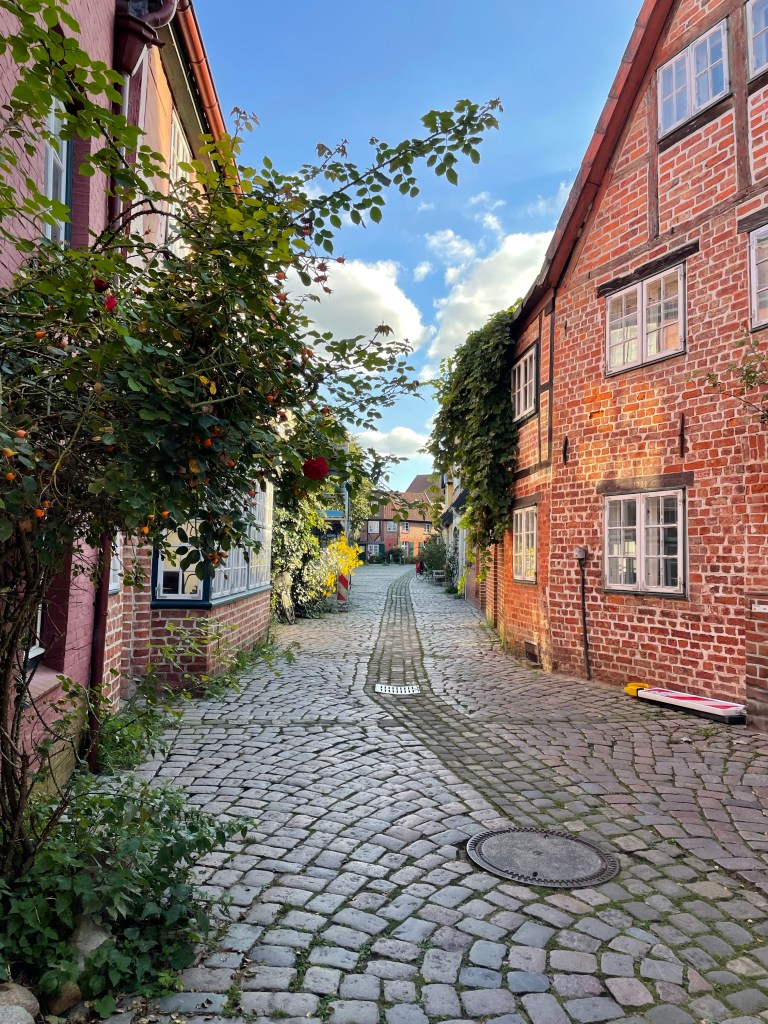
The Hanseatic city of Luneburg was a fine example of the wealth and commercial power of the Hanseatic league. Established to protect mutual trading interests of its members, the League was the most powerful from the 13th to the 15th centuries. Buildings in Luneburg have been preserved back to this period.
Locally controlled preservation of window detailsRoten rosen adorn the windows everywhereA typical windy space between buildingsHops vinesVillage view
Bremen controlled the North Sea and Hamburg controlled the Baltic. Athough Luneburg was not a coastal seaport, it derived its prominence from the salt in the area. I loved how roofscapes and windows made you “look up”, as Steve Jobs said in the opera (R)evolution about cell phones..
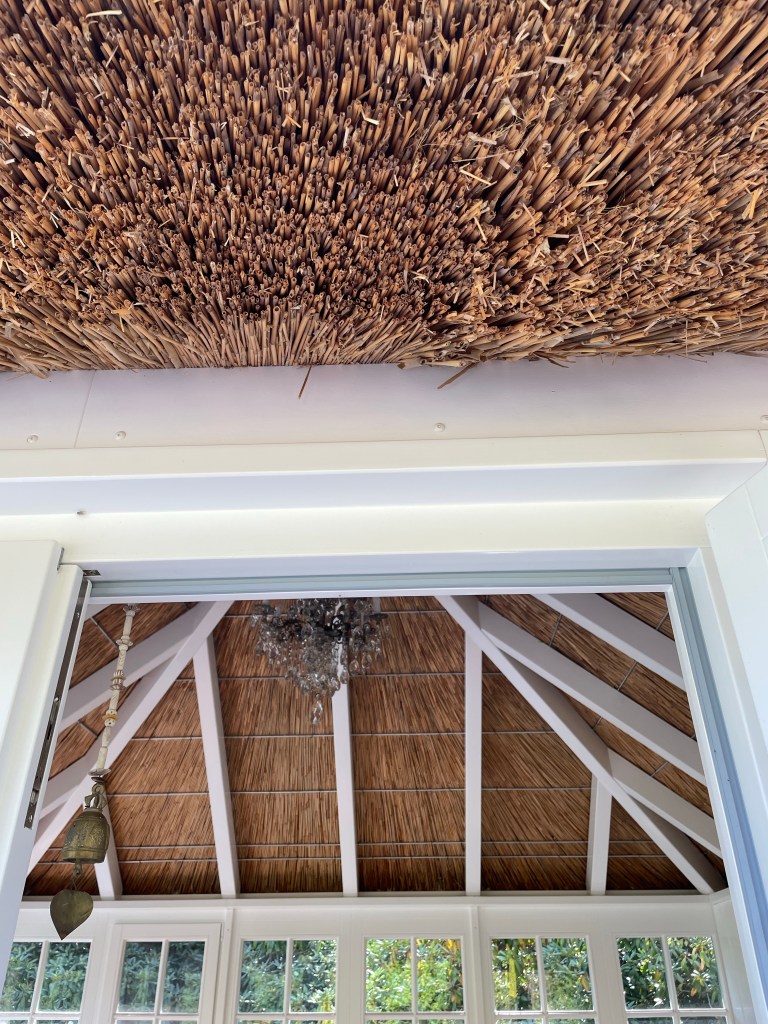
I was lucky enough to join my new German friend Annemarie to make a delivery to a client’s stately home on the outskirts of Luneburg. The thatched roof is a unique feature of homes in the area. Dedicated maintenance and care are required. The same roofing method was applied to the new pool house. The visit was a treat and a pleasure.
The underside of the new poolhouse roof, fabricated in the same way as the original house roofing material
There’s only a couple more days to see a final performance at the Philharmonie, then back to Berlin to catch my flight back to San Francisco!
Friends Hazel from Heidelberg and Vladimir from Meissen joined me in Leipzig for lively conversations. We also explored museums together. Each museum piece tells a story that connects to another. Collectively, they form a treasure hunt that makes museum-going so challenging and enjoyable.
This relatively new museum north of the town center was a vast repository for large-scale modern artwork. Current collections could barely fill the monumental four-story high volumes of space. The museum was clean and beautiful, but I did wonder how efficiently the building could be environmentally controlled.
For me, it is a struggle of conscience over desire. My recent training taught me that architects have a huge obligation to address climate change in every building, especially those like this one. Reducing the use of concrete and other processed materials for sustainability didn’t seem to be evident. Yet the building was purposeful and emotionally satisfying.
Mendelssohn House
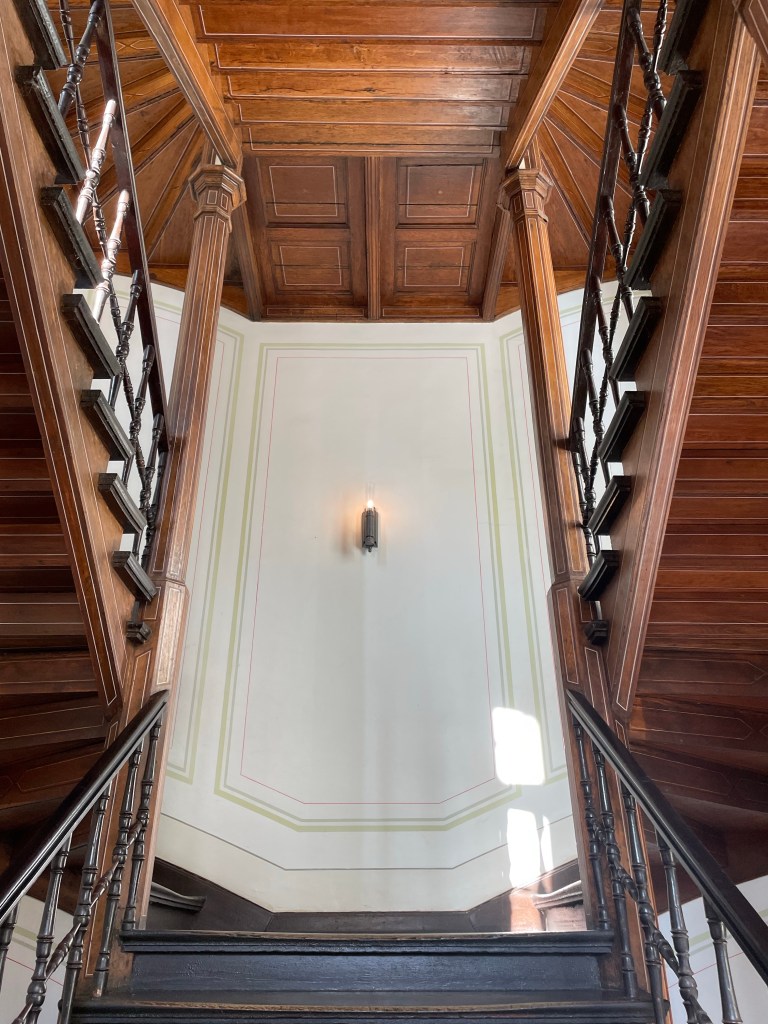
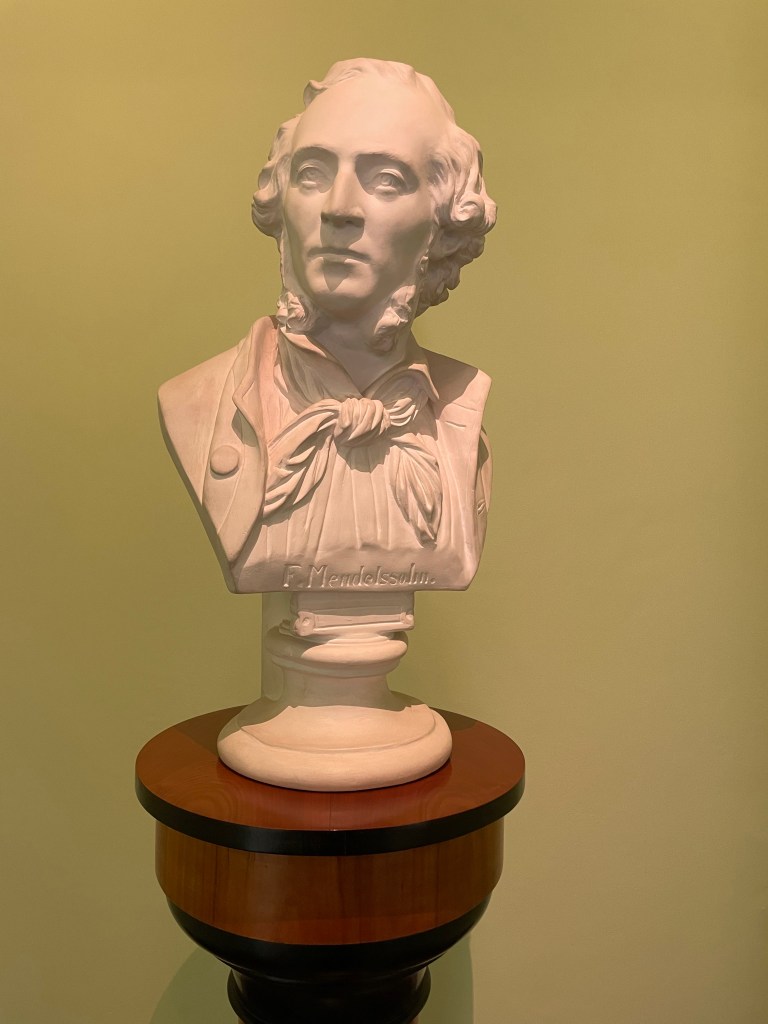
Entry stairMendelssohnEntry stairClothing from childhoodMendelssohn House
The Music Trail in Leipzig links the homes of Bach, Mendelssohn, Schumann and 20 other sites that have musical significance. The entire round-trip takes more than a two-hour sprint. Instead, it’s much more digestible in small spurts. The influence is palpable. It’s no wonder that music can be heard in and around the streets at all times.
Although I had been to Leipzig twice before, I looked forward to renewing my vows to each composer. Mendelssohn traveled throughout Europe with his sister Fanny and his parents. They first traveled from Berlin to Naples and then returned through Switzerland to London. The composers’ privileged lives allowed him to create beautiful music.
More research is being devoted to the lives of influential and famous women like Clara Schumann and Fanny Mendelssohn. Although Schumann loved his wife Clara dearly, they had a tense professional relationship.
You could say that Schumann was actually jealous of her talent! She was trained as a concert pianist by her father, Carl Wieck, who was also Robert’s piano teacher. He was skeptical that Schumann could rise to the level of a concert pianist and tried to keep Schumann from seeing his daughter.
He even had a restraining order against Robert’s seeing Clara, but it didn’t stop the two lovers from meeting secretly. Finally, when Clara turned 18, Wieck consented to their wedding plans. Some of the sweetest music was created during Schumann’s love for Clara and his triumph over adversity
Schumann had another challenge in learning the piano. HIs fingers cramped up. He tried many methods to treat them. He gave up performing and initially turned to critiquing music. He used his father’s publishing business to help him launch his writings, and eventually published the music he composed himself.
Schumann’s life had a tragic ending. He could be diagnosed today with bi-polar disorder, but he preceded Freud and the advent of psycholanalysis. He and Clara had seven children, but he died at the age of 45. He left a legacy of beautiful music from the romantic era that he helped to create.
Laps in Leipzig
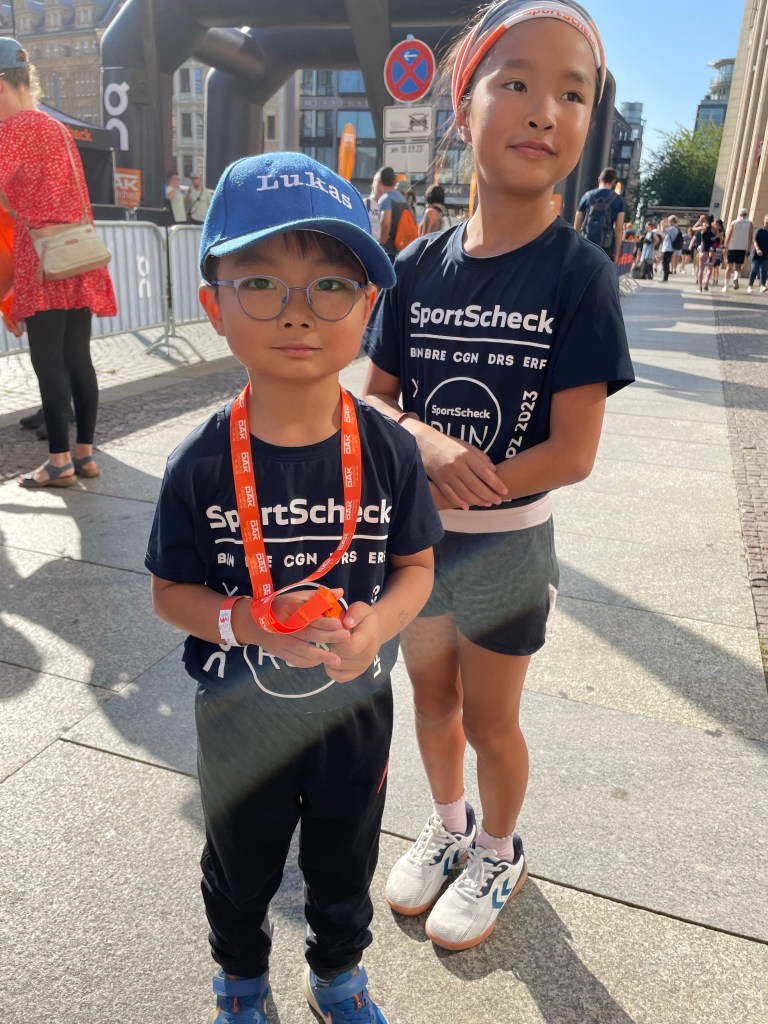
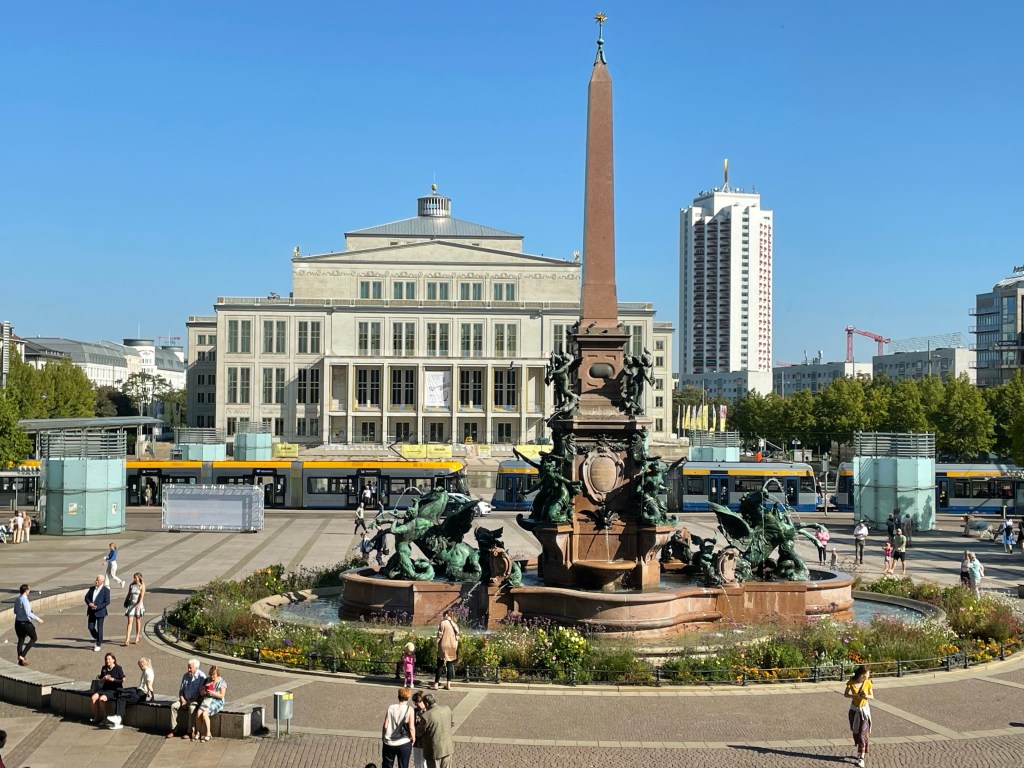
A great family event got kids out early Sunday morning to get fit and healthy. The race around the market plaza took determination, energy, and plenty of tears and smiles for extra flavor. Parents escorted the less brave, but in the end every child was a winner. I couldn’t resist taking a shot of a little German-Asian athlete proudly brandishing his medal.
Early Morning Race in Leipzig
Post Race
The Art Nouveau and Moderne buildings in the pedestrian zone are elegantly decorated with stone facing. The venue for annual book and trade fairs, Leipzig enjoys its status as a prominent city filled with commerce, art, music and culture.
Gewandhaus
Of course a concert was on the agenda during our visit to Leipzig. Like the Berlin Philharmonie, the Gewandhaus Concert Hall is a behemoth building better appreciated from within.
Conductor Herbert Blomstedt, now 96 years old, managed the concert with Berwald and Schubert pieces effortlessly. The elderly morning crowd greeted him with fondness and adoration. Blomstedt was conductor of the SF Symphony for ten years preceding Michael Tilson Thomas. He brought the orchestra to world prominence through his leadership.
Like Joana Mallwitz, Blomstedt acknowledged each soloist with intent and deliberation. It’s not something I had noticed before attending recent concerts in Germany.
Herbert Blomstedt commands the Gewandhaus Orchestra to a full house
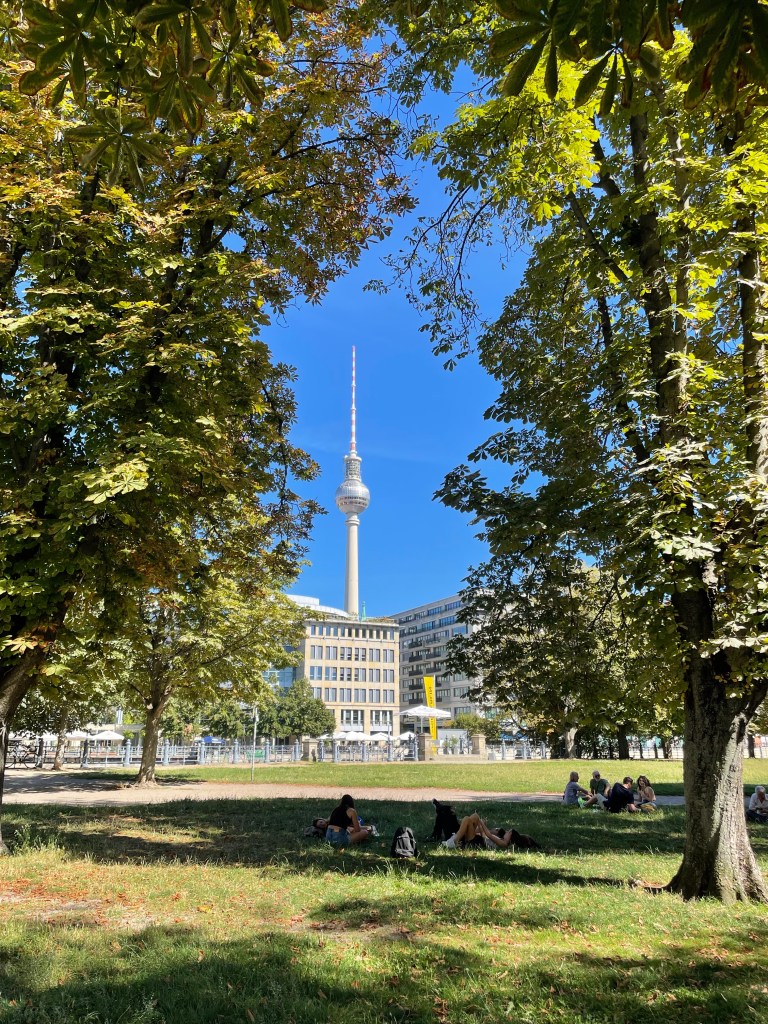
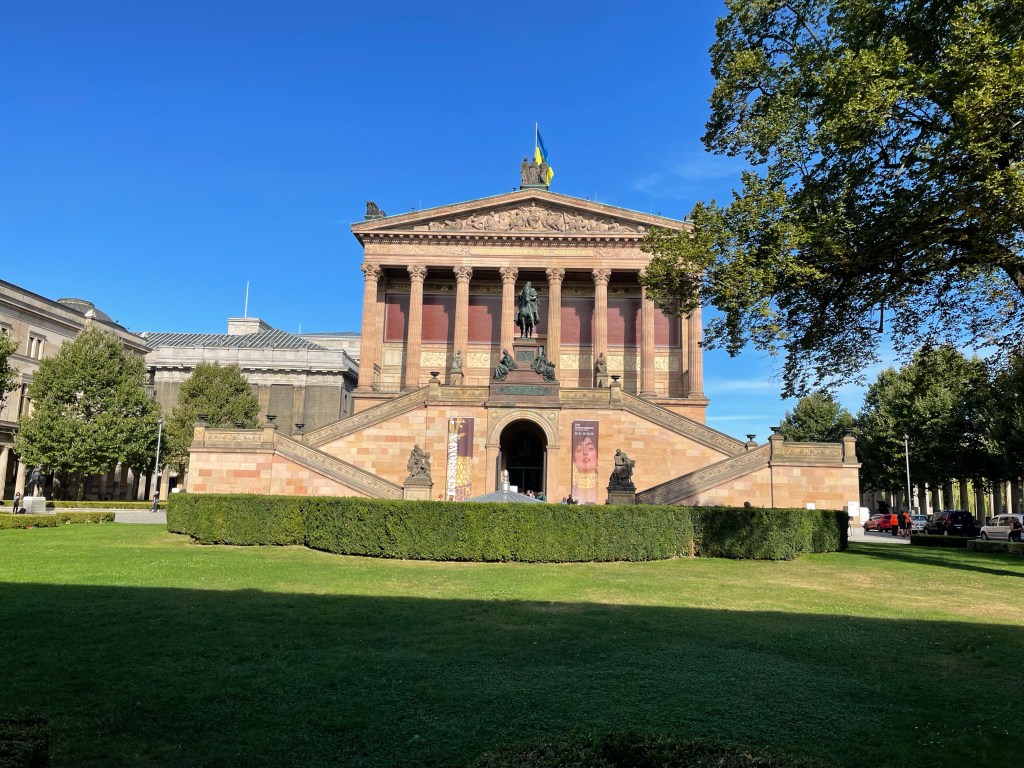
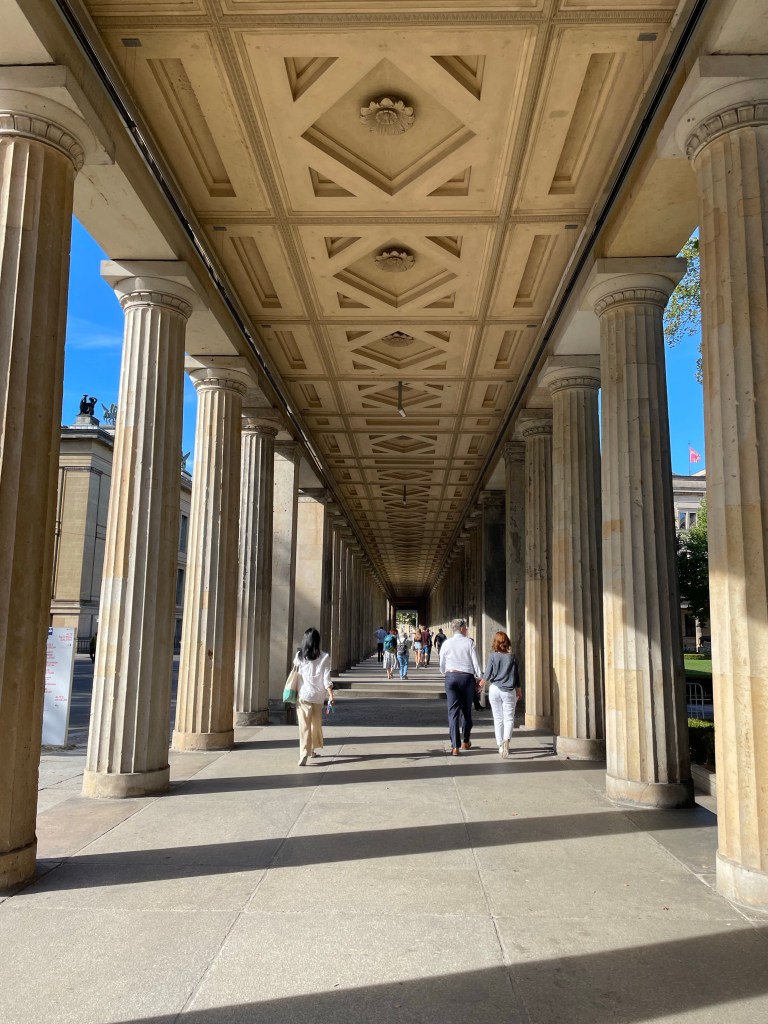
OK, this city has put me on total overload. I headed from Alexander Platz through Haecksher Markt to The Neues Museum. Along a leisurely walk surrounded by waterways and leafy green trees, I was reminded how beautiful the complex series of historic museums had become. Every building was renovated and preserved with the greatest detail and care.
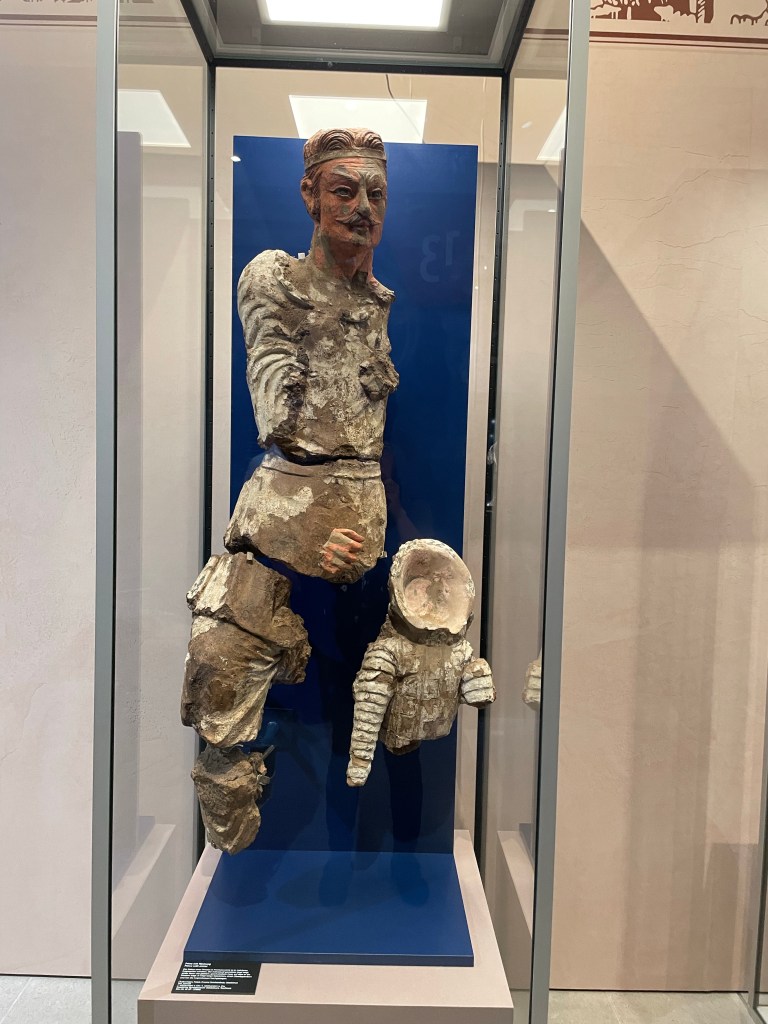
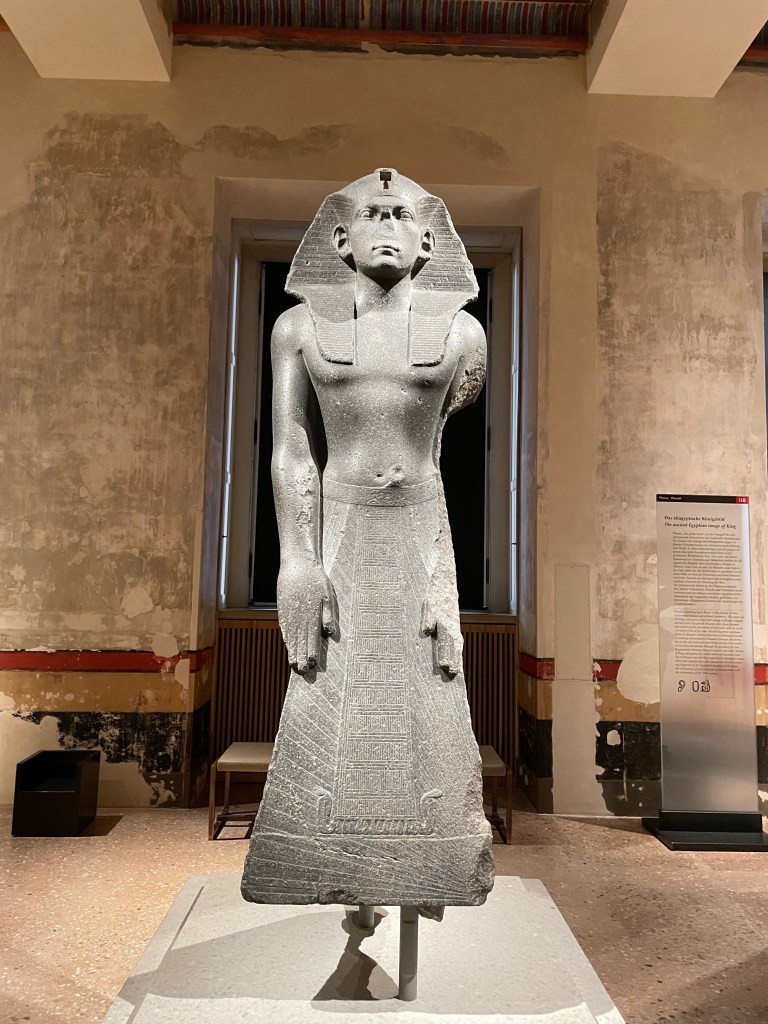
Buddhist Influence in UzbekistanEgyptian Sculptures in the Altes Museum
I found David Chipperfield’s integration of the Egyptian collection with the new wing very confusing. But the inspiring Archaeological Treasures of Uzbekistan exhibit compensated for the building’s shortcomings. The German museums distinguish themselves with superior curating and skill in educating the public with interesting, thorough, and thoughtful research. Most major exhibits are translated into English.
The exhibit introduced visitors to the early influences of buddhism in Central Asia before Alexander invaded and spread Greek culture throughout the area. Later, Arab invaders imposed Islamic culture after Persians brought Zoroastrianism, yet another religion, to this region.
Original Sogdians, a Turkic people, began and traded along the Silk Road. Journeys were not long transcontinental slogs imagined by Marco Polo’s travels. Initially, the Sogdians and others traded in short segments between two posts. Instead of traveling between a long string of pearls from one end to the other, they merely traded pearl to pearl.
Bokhara, Samarkand, and Kiva became wealthy cities from the silk brought by the Sogdian traders. The Silk Road stretched throughout the width of Uzbekistan, from the western Han Dynasty gateway that controlled trade in and out of China, through the trade cities, and on to Tehran and beyond.
Within the exhibit, a quiet sanctuary offered a place for reflection and solace. Visitors could post notes, questions and thoughts about the exhibit. It was the perfect moment to pause and refresh. I contributed a few of my own comments! I felt that I had flown on a magical carpet to Uzbekistan!
Berlin Philharmonie
Although I was able to sketch the Berlin Philharmonie (see previous post) from the outside, the chance to attend a concert inside seemed to elude me. I finally bought a ticket on the third visit to Berlin. The acoustics in the auditorium with more than 2000 seats provided a high quality, enjoyable performance.
An evening with the Israeli Philharmonic Orchestra at the Berlin Philharmic
The Art Supply Dream World
Here’s a tip for my urban sketching buddies:
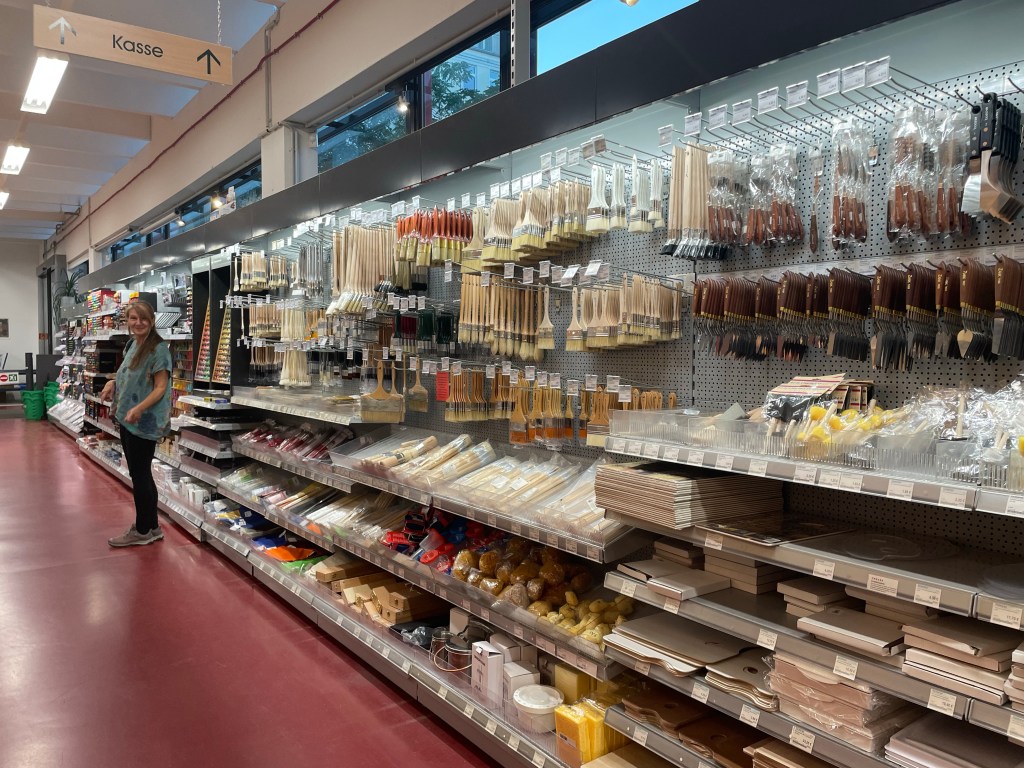
My vote for the best art supplier in the world is Boesner, a German store in Prenzlauer Berg (with branches in other German cities). It satisfies any and all aesthetic and technical needs for artists, including papers, paint, canvasses, brushes and everything else in between. Rooms full of sketch pads, imported papers of endless thicknesses and weights, and sets of watercolors, pastels or pencils increased the dilemma over what to choose. This was a top-flight, migraine-inducing experience!
The next stop is Leipzig, where many famous classical musicians such as Bach, Schumann, Mendelssohn and even Wagner, hung out and made music.
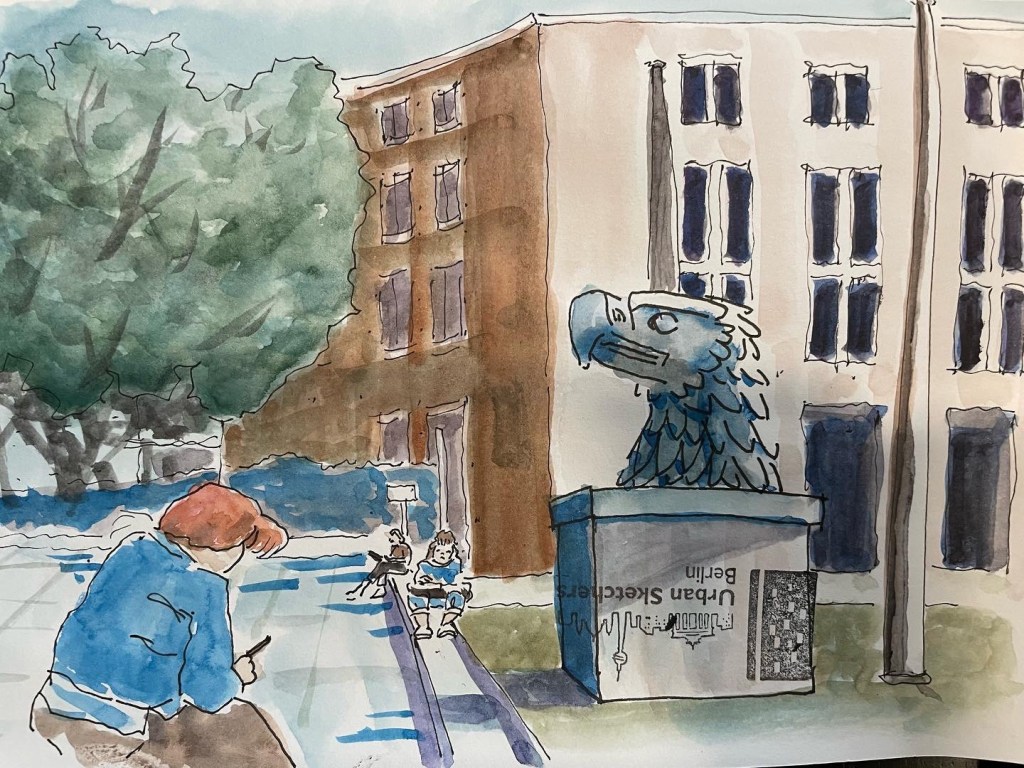
Oh My God. If this is any indication of German Planning, it wins the Nobel Prize! Over 950 participants descended on Berlin this weekend to sketch in over 60 venues planned throughout the city. Everything is free and the organizers simply wanted to avoid extensive sponsorships and risk exposure.
So they simply posted an email offering sketchers to sign up within a specified period of time in July. The response was overwhelming, but they delivered what they promised. Three meeting venues at the Kulture forum, Humboldt Forum and another location near the Brandenburg Gate gave everyone a place to connect informally. Organized sketch walks with tour guides were assigned to each participant.
My first assignment was site of the Templehof Airport, a Nazi creation. Nearby neighborhood housed a delightful Karl Muehlenhaupt Museum. His work, resembling that of March Chagall were child-like figures of gnomes and faces filled with “Liebe, Leid and Lebensfreude”, (Love, Passion and Lust for Life) that immediately grabs your attention and emotions.
A lot of what’s good about Germany hasn’t made it into translated material. This was one of them. Managing my own interpretation is a struggle, but even more rewarding when I discover the depth and earnestness of the German culture.
Today’s venture to the second site was more challenging. The Kurpark near the Golden Reindeer Monument in the park next to the at Rathaus Schoeneberg was outside of the center of the city. Several routes to get to it confused me with indecision, so a late arrival cost me the tour and a chance to meet others.
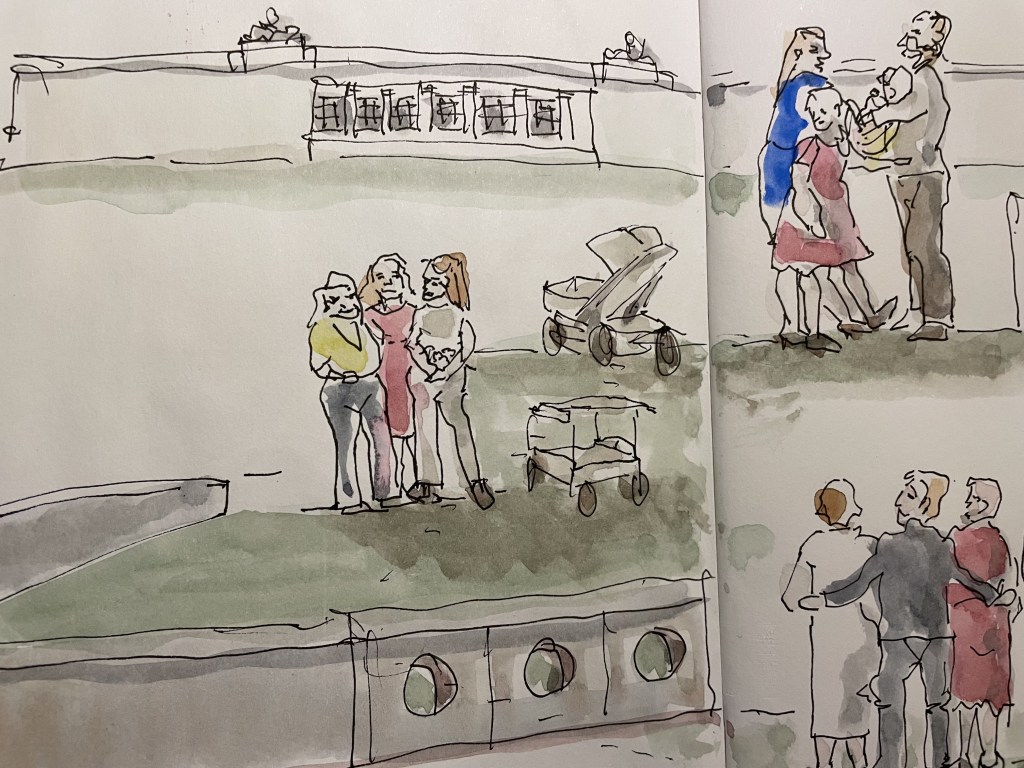
Nevertheless, I forged on to sketch as intended. Suddenly floods of wedding parties arrived as if staged for my benefit. They celebrated their free pop-up event with champagne and formal photo shoots. The park setting was merely a backdrop for me to focus on gestures of dressed-up guests and their animated conversations.
Champagne al frescoPosing for a group picture from the back
The Sketchers met for a photo shoot at the Kulture Forum the previous afternoon. It was a bit daunting to see so many dedicated and talented sketchers. Every sketch seemed more polished and intriguing! The German devotion to doing things well overwhelmed me, from the high-tech weightless sketching stool I spotted, to the super-organized backpacks everyone carried with all their supplies pared down to a minimum.
Bustling Berlin
I’d be disingenuous to claim that I was as dedicated as the German attendees to sketching in Berlin. I was distracted, and exhausted by the myriad events and historic sites beckoning to me.
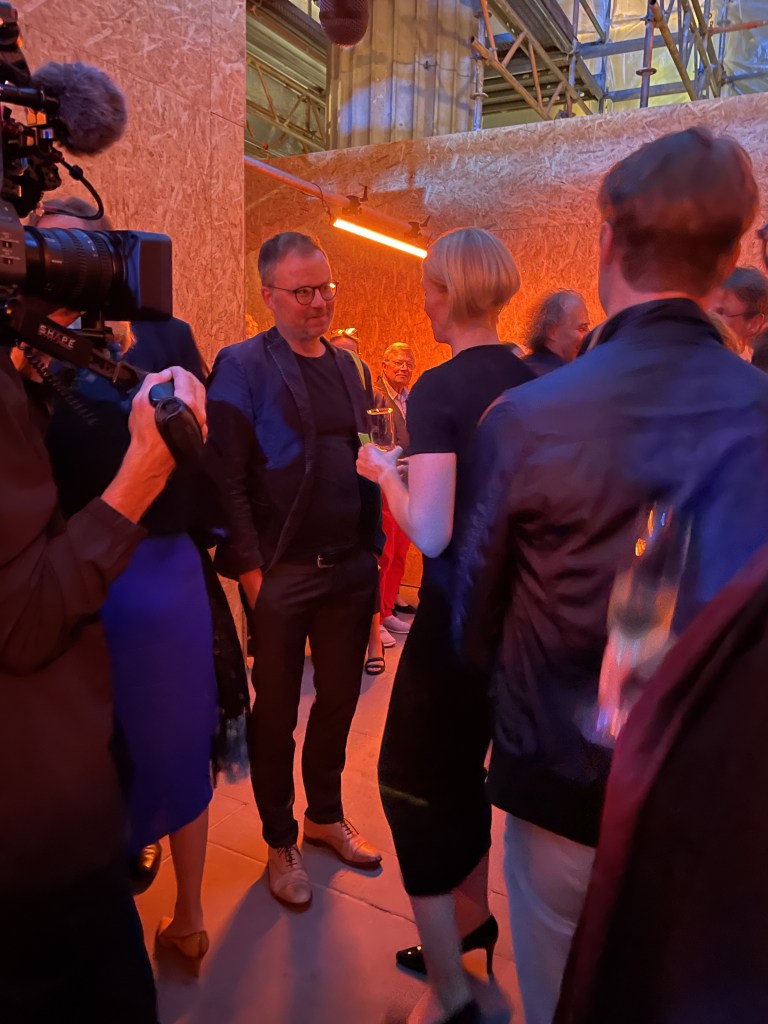
A special concert introducing rising star conductor Joana Mallwitz was held at the Berlin Konzerthaus was held with overwhelming support from the audience. Joana took her time to thank each and every soloist who performed, and took many bows herself. I was lucky enough to meet her and her partner Simon Bode at a reception after the performance.
Debut of Joana Mallwitz as conductor of the Berlin Konzerthaus OrchestraReception and Media coverage after performanceOutside Konzerthaus
After the sketching photo shot, I raced over to an appointment to tour the Bundestag Building. The tour was tiring and boring at the end of the day, but I realized that I actually retained some of the information. Germany has 15 states that are represented in the Parliament, just like we have 50 states represented in Congress.
Before Perestroika in 1989, the Soviet Union also had 15 states. The Soviet Union was the third largest country after China and India, and larger in population than the US at the time (The Soviet Union had 300 million, and the USA had 250 million).
Today, Russia is just under 150 million, compared with that in the US at over 330 million. With Germany at slightly over 80 million, Russia is twice the size of Germany but half of its original mite. Ukraine is half the size of Germany or at about 40 milion people. It’s no wonder Russia is struggling to keep its former glory and trying to recapture some of the Ukraine.
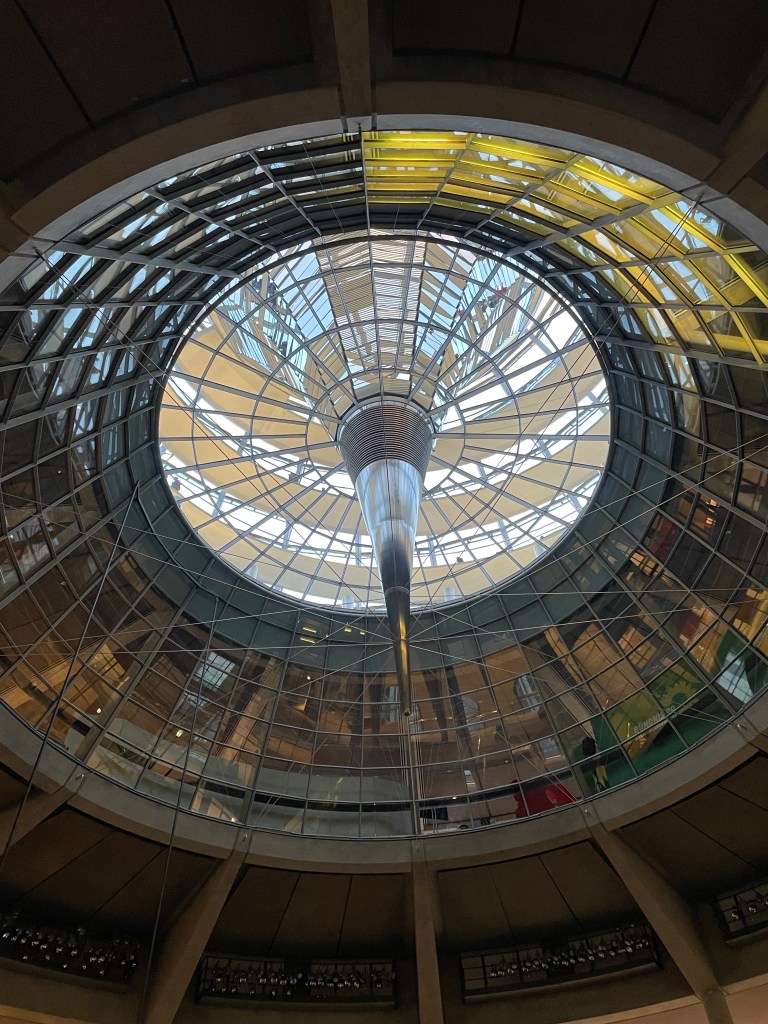
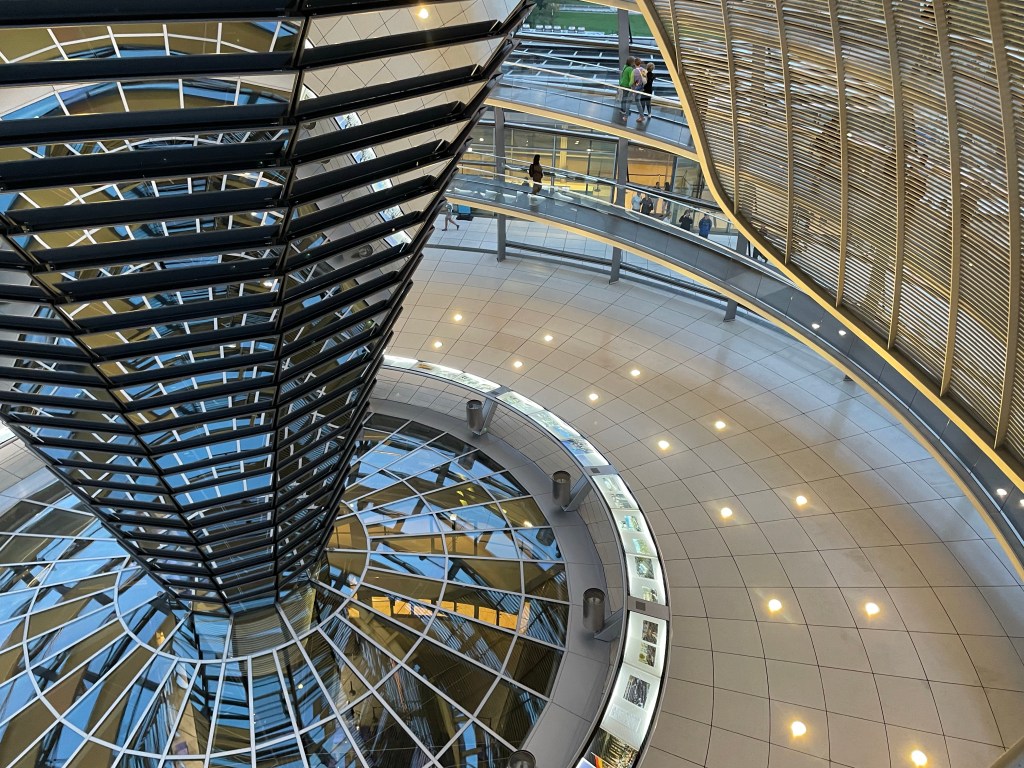
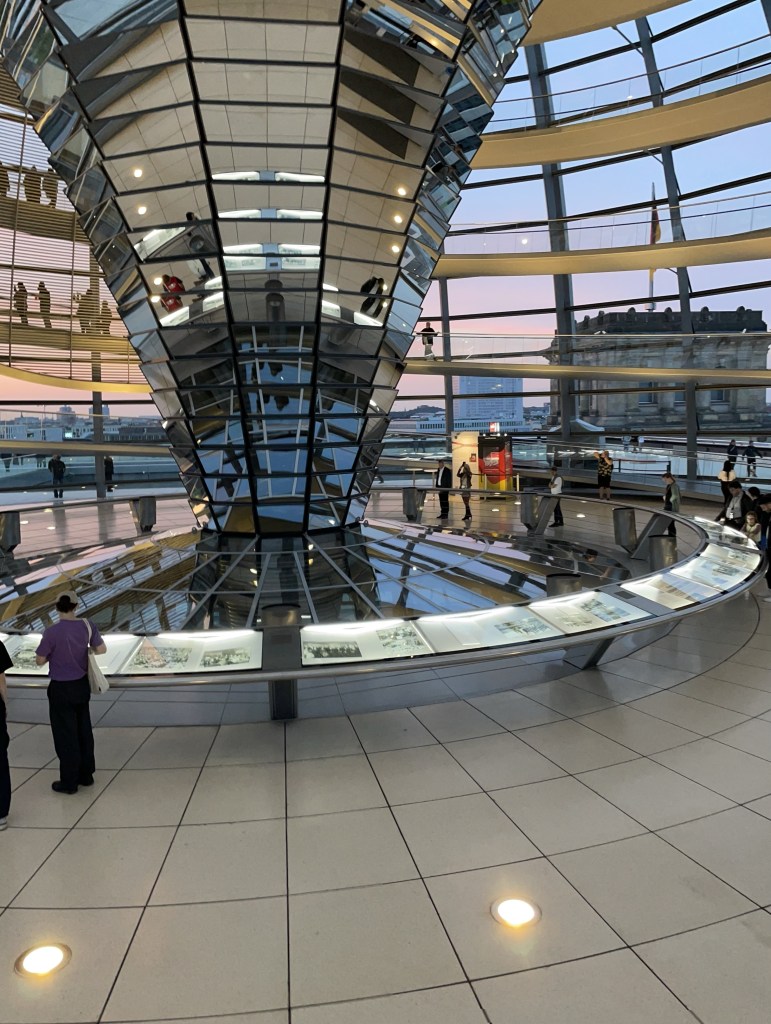
The current history of Germany is inevitably tied to Russia because of the division of Germany after WWII. The Bundestag building still displays relics of the Russians who took over Berlin in 1945. Graffiti was exposed by Bundestag architect Norman Foster who wanted to capture the historic takeover by the Russians. And the design of the building attempts to remind politicians that they work for the people, so the public at the top of the dome can watch over their leaders. Hmm….
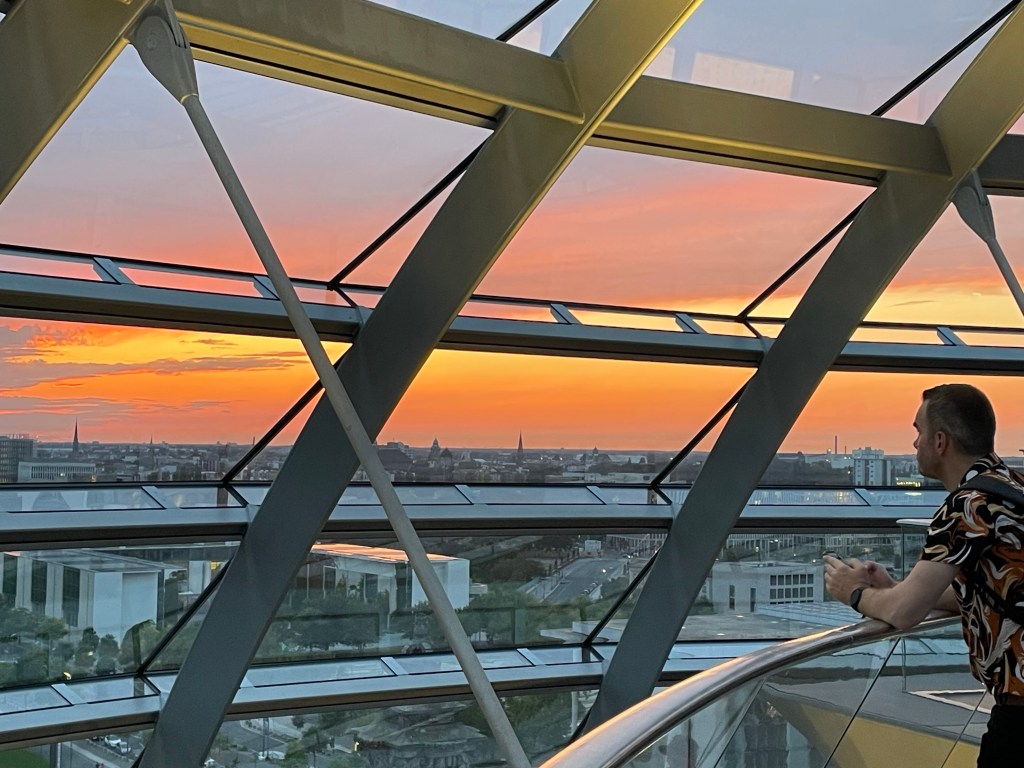
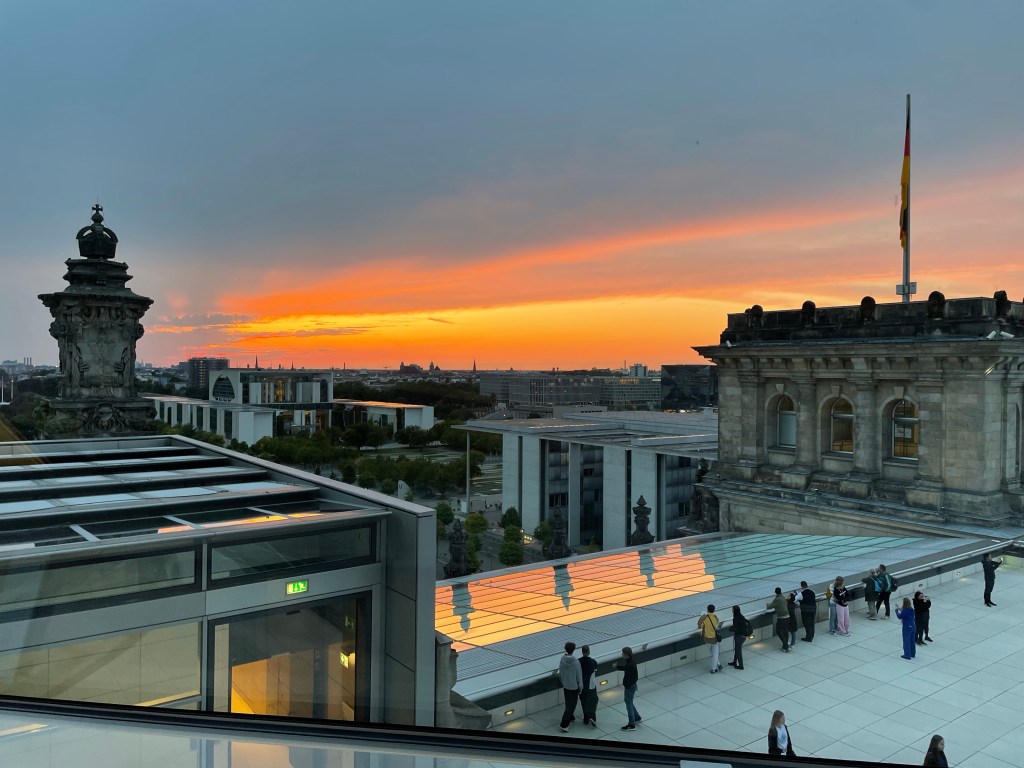
Being at the end of the day, the tour was tedious. Catching the sunset over Berlin made the trip worthwhile. Maybe the tour guide was a little too fixated on two young women who were together–one Russian and one Ukrainian. That did seem to inspire the rest of us to believe that the war will end one day soon.
A walk up the ramp at sunset
And of course I had to make a quick stop between U-Bahn changes to catch Brandenburg Tor.
Those who know me will wonder how I passed up two world-class opera performances at the Deutsche Oper. But I did. Maybe I’ll catch up at the free annual family event today in between the sketch exhibition, an open house at the Bundestag, or the Berlin Music Festival.
I’m taking my annual pilgrimage to Germany, this time without plans to take any German language classes. Instead, I’m joining a free weekend Sketchfest in Berlin, a side trip to Leipzig for opera and concerts, and more of the same in Hamburg.
Descent into DC
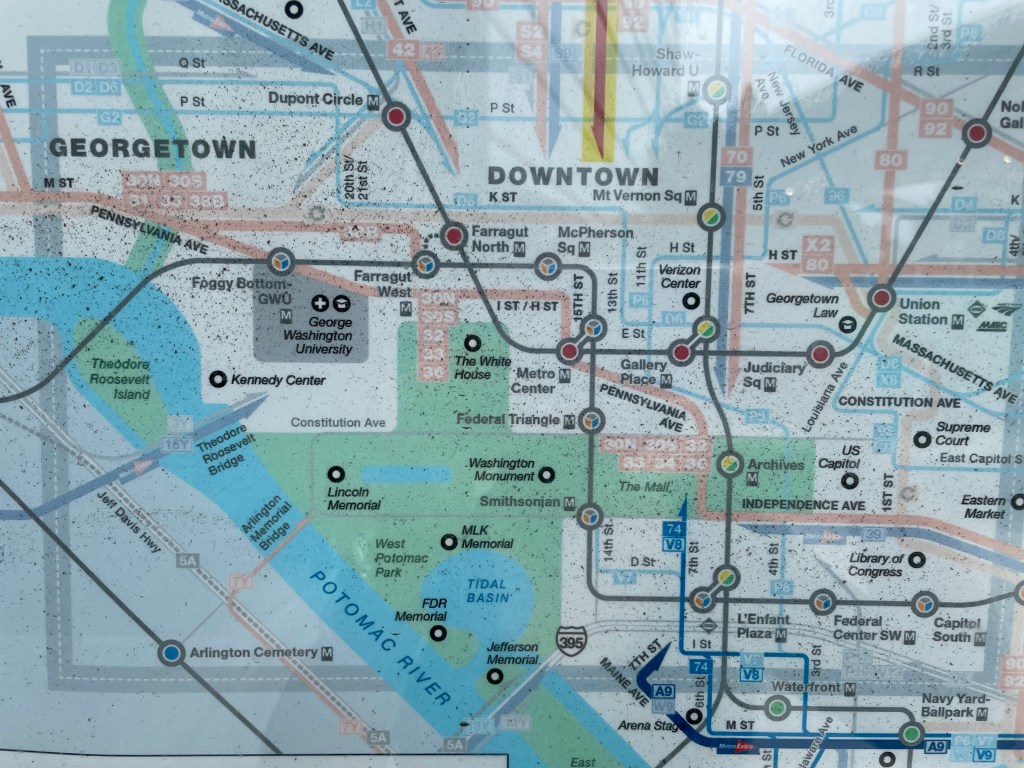
A long layover on the way to Berlin gave me an opportunity to visit the Capitol Mall with plenty of time. It was reassuring to know that the Metro is finally, after over 50 years, being used as intended. In the early days, it was a white elephant and far too ahead of its time. The waffled concrete stations have held up well and are a signature system in terms of durability and aesthetic longevity.
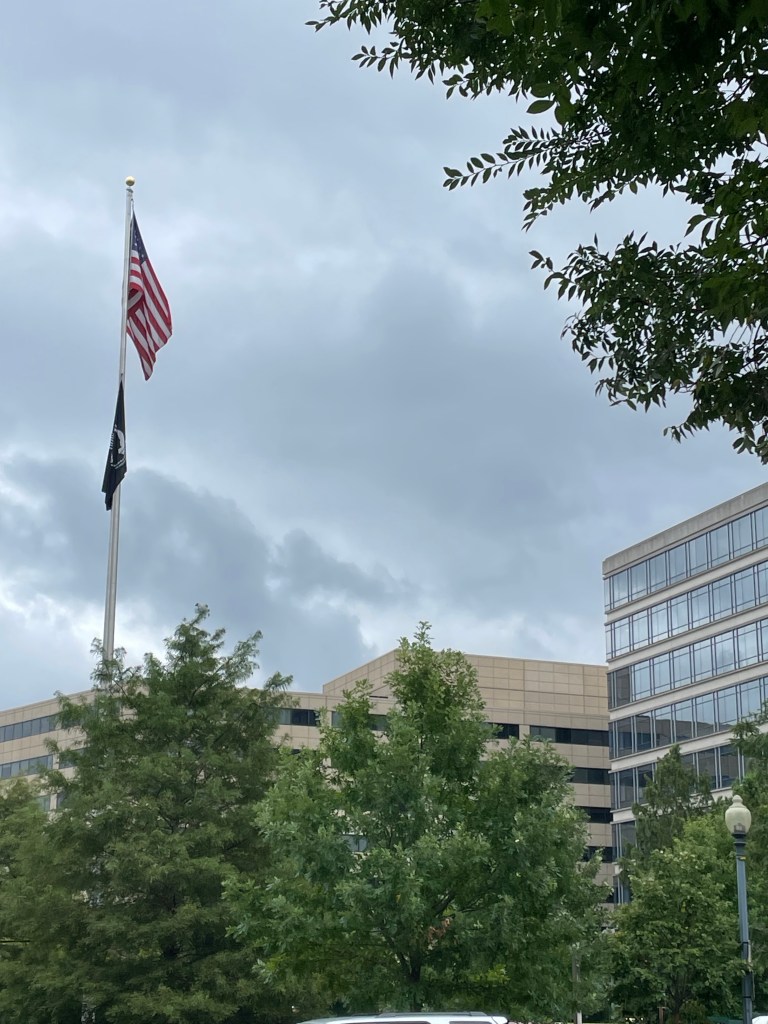
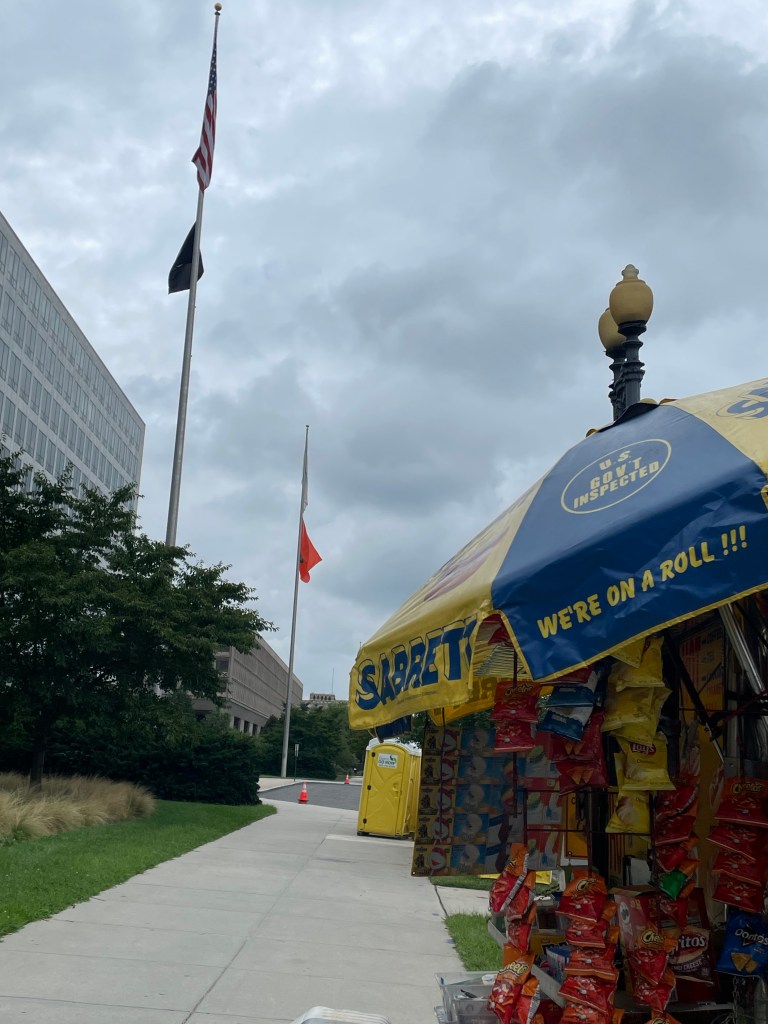
I had never noticed so many flags speckled throughout the capitol previously. Despite the dour circumstances of recent elections, seeing these iconic symbols restored some of my faith in American democracy.
The beauty and wealth of the nation was clearly evident throughout the mall. Wide vistas, free national museums of every imaginable persuasion and the lush landscaping afforded by the hot and humid South all contributed to this exciting discovery.
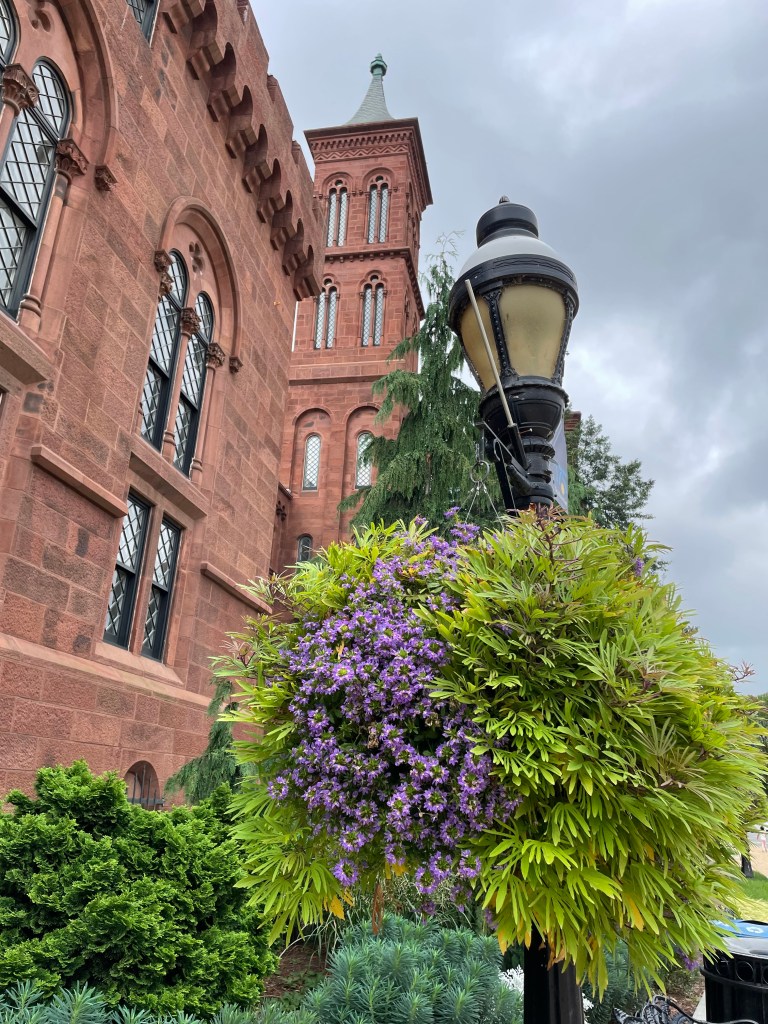
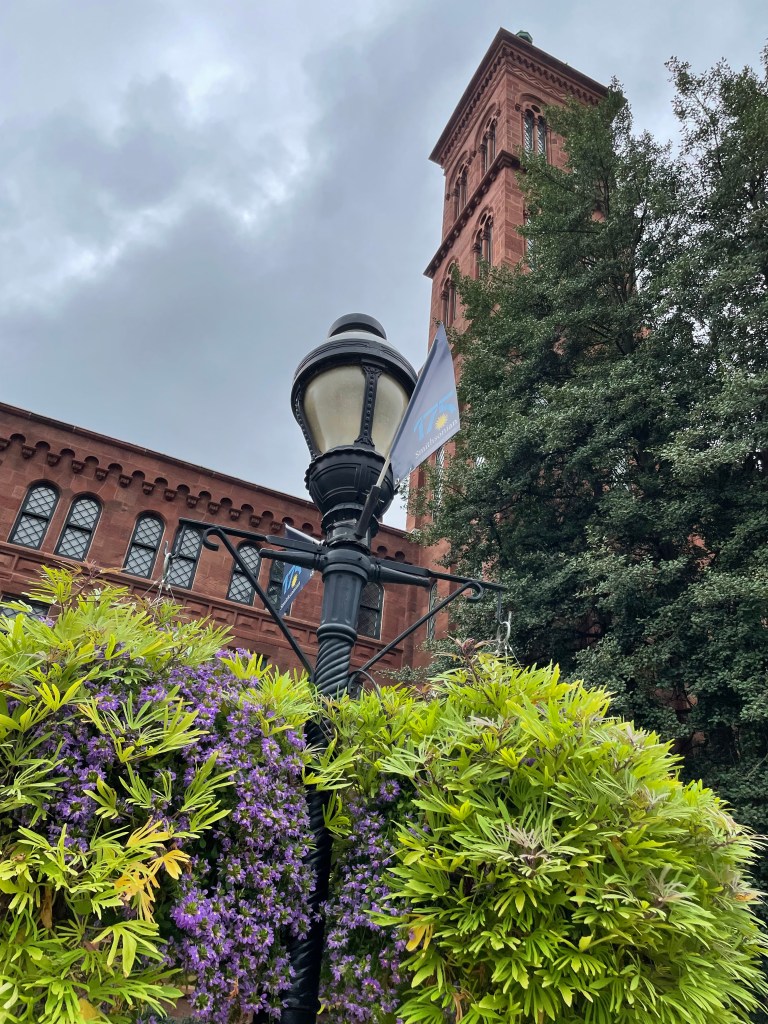
Buildings seem to boast their well-kept grounds and renovated facelifts. The historic Smithsonian sandstone palace, closed for renovation, contrasted with nearby giant modernistic office buildings, polished and sparkling.
A day-long, single purpose journey didn’t give me a proper perspective on the real life and times of Washington, DC. I had seen some of that on previous trips. Instead, my goal for the day was to tackle two museums on the mall as quickly and effortlessly as possible.
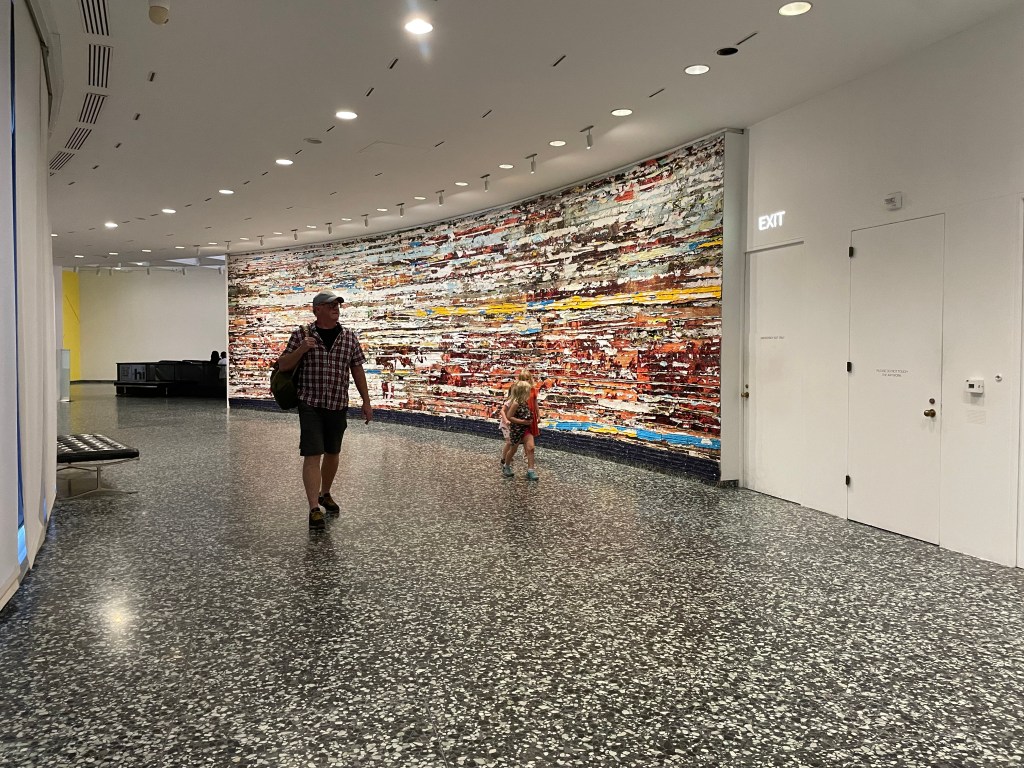
The donut-shaped Hirschhorn Art Museum reminded me how awkward flat paintings look in a building with curved walls. Wall segments managed to divided spaces successfully, however. An exhibition by women was an unexpected find.
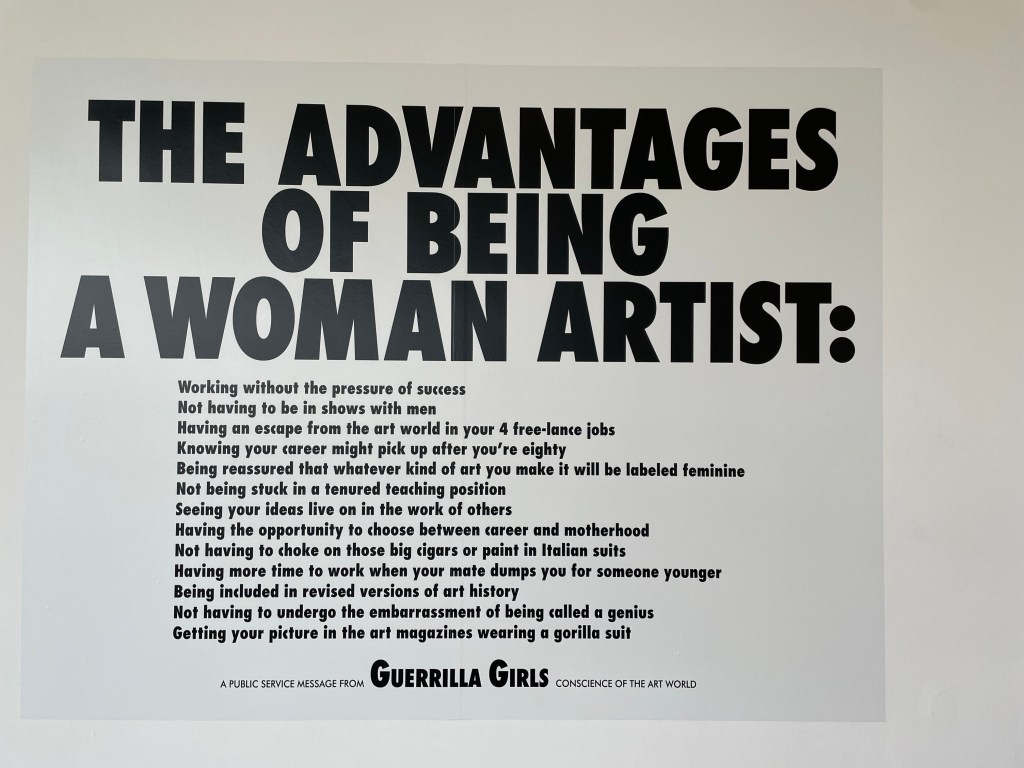
Every exhibition has a story to tell. In this case, it focused on the male-dominated control of the art we see in museums. An overwhelming proportion of artistic work is produced by men and funded by men. The manifesto by Guerrilla Girls made the message very clear. In response, the Hirschhorn has committed to rectifying this disparity by increasing works and exhibitions by women artists. Two of the pieces I particularly enjoyed are represented below.
Radiating and glimmering pieceCurved walls limit works that can be displayedFlexibility in a woman’s body
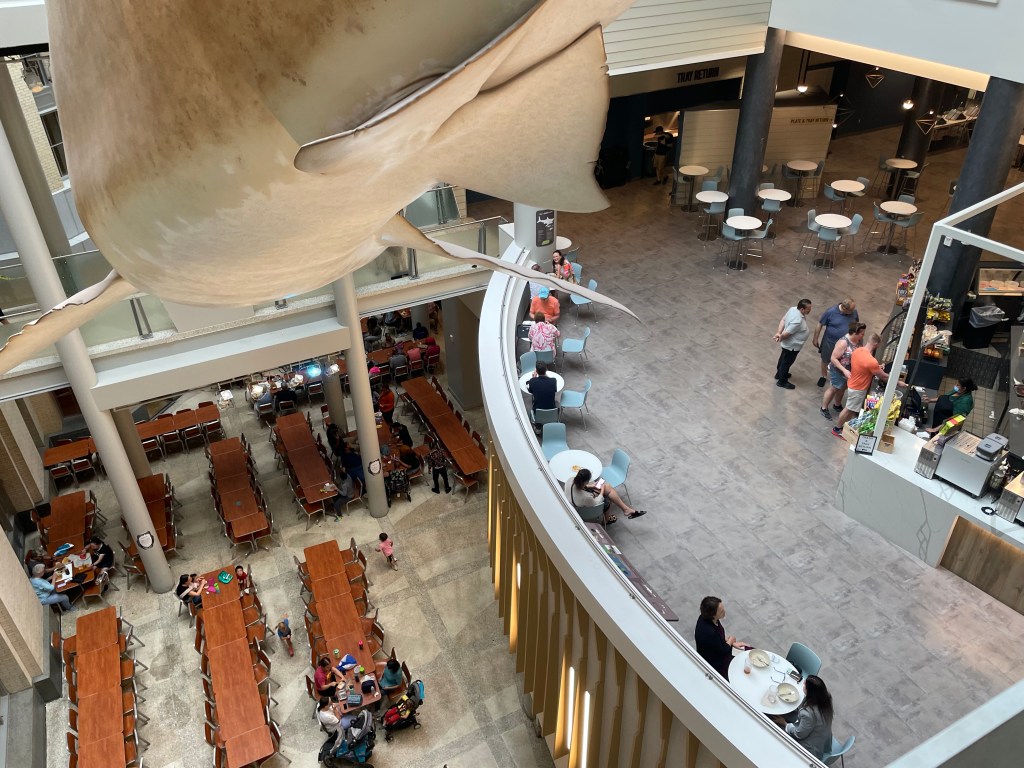
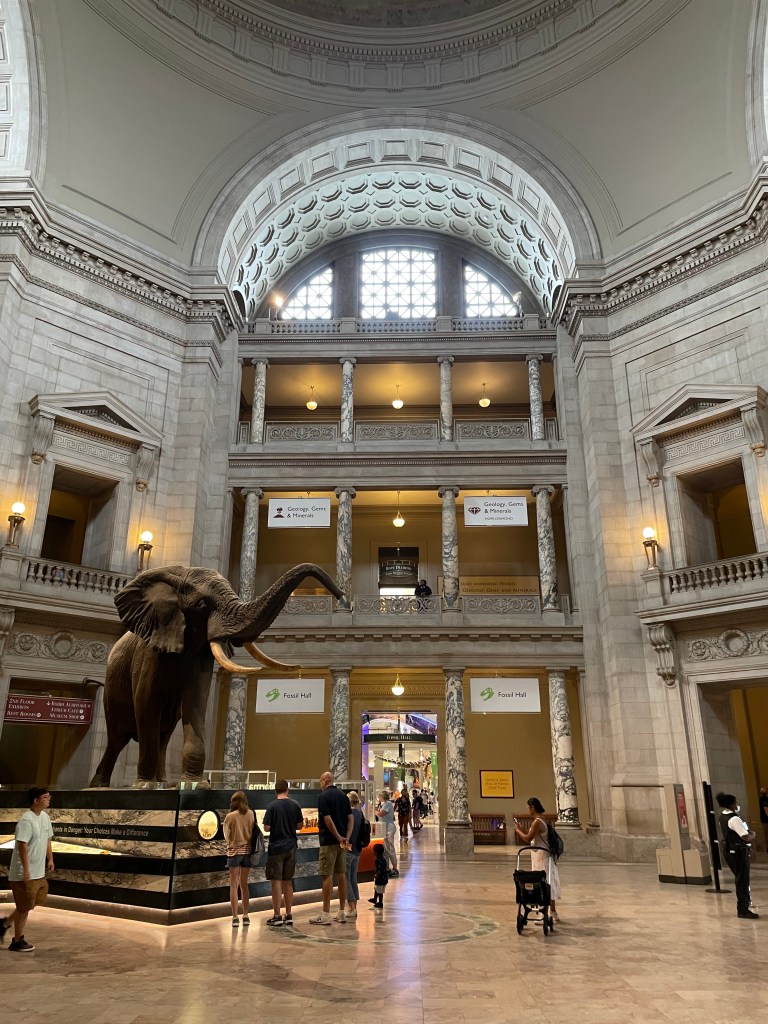
The Natural History Museum was a first timer for me. It wasn’t until I marveled over exhibitions in London and Berlin that I realized our own garden variety is no slouch. Great displays on man’s emergence from the ocean and evolution from other primates were well communicated in that very down-to-earth American style of gee-gosh.
Plan View of lower levelsThe main rotunda
This real-time image shows how fast the world is increasing in population and where–watch the total population at the top
I splurged and used award miles for my first Polaris flight transatlantic from DC to Berlin. It lasted just short of eight hours and was enough time to fully appreciate the fully reclining cocoons.
Prenzlauer Berg in Berlin, Germany
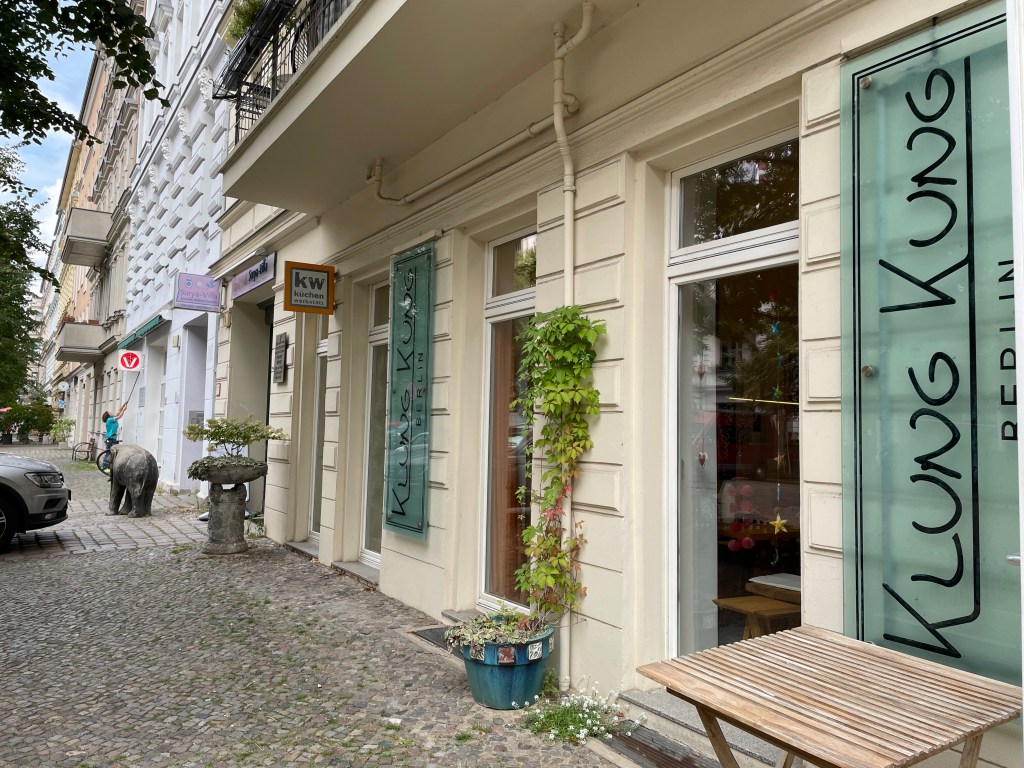
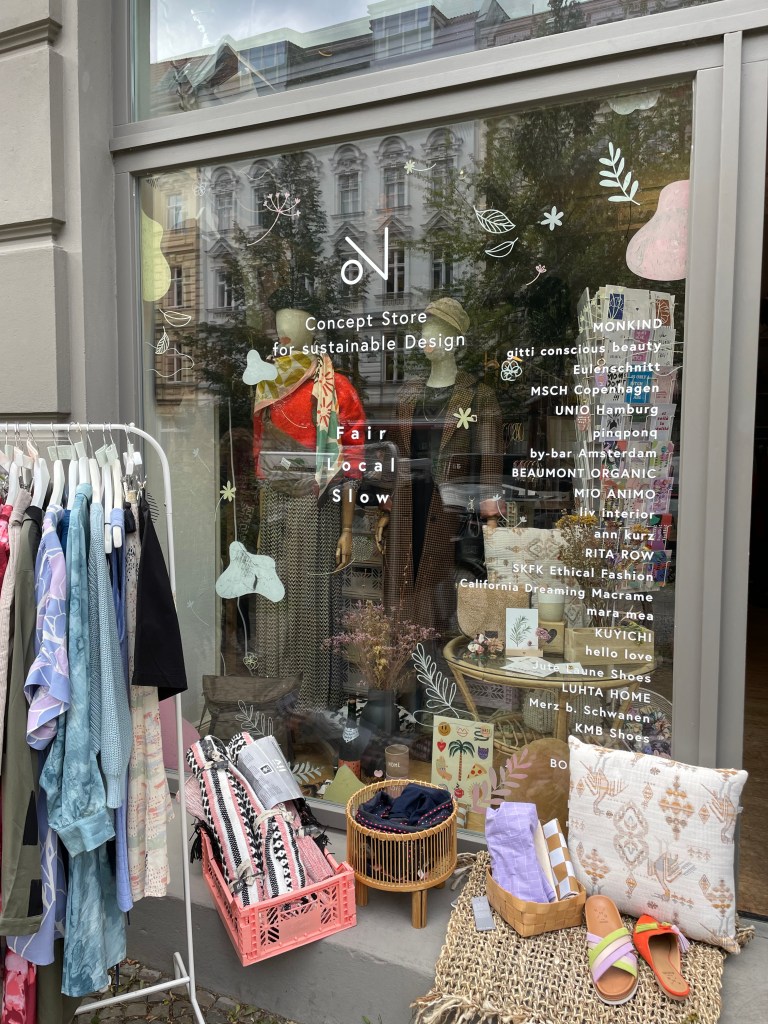
After an early morning arrival, I headed to my AirBNB in the convenient Prenzlauer Berg neighborhood in Northeast Central Berlin. This district captures young thriving interests in sustainable, gluten-free, organic, and S-L-O-W living. Shops, cafes, and services are directed to these new ventures.
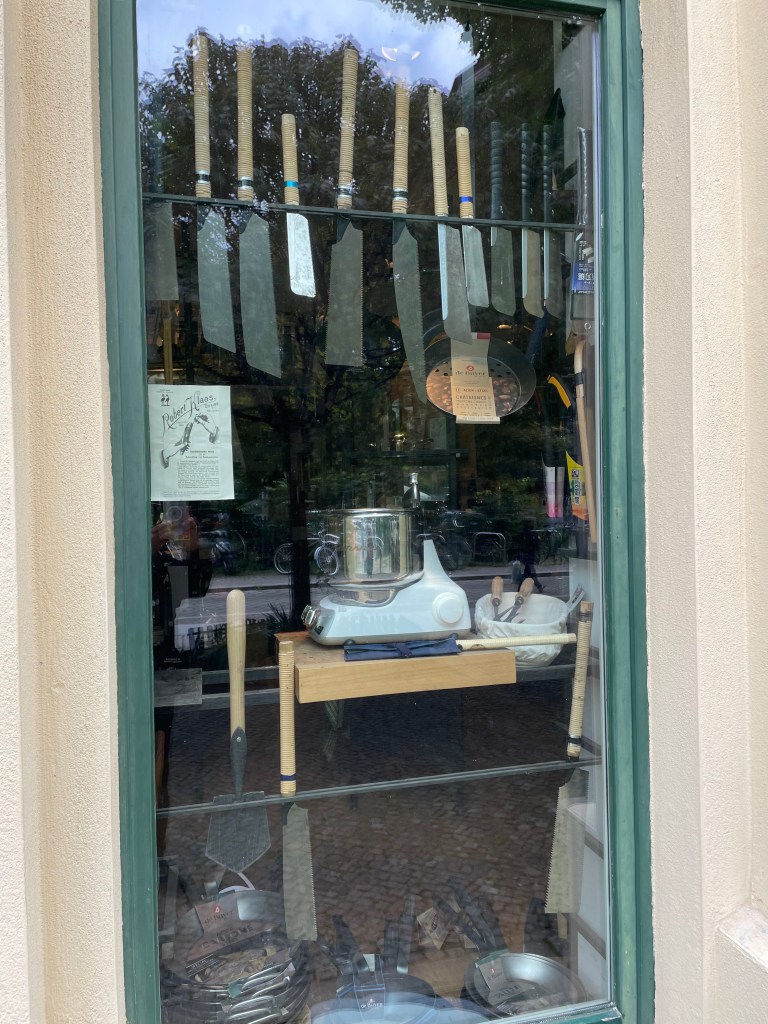
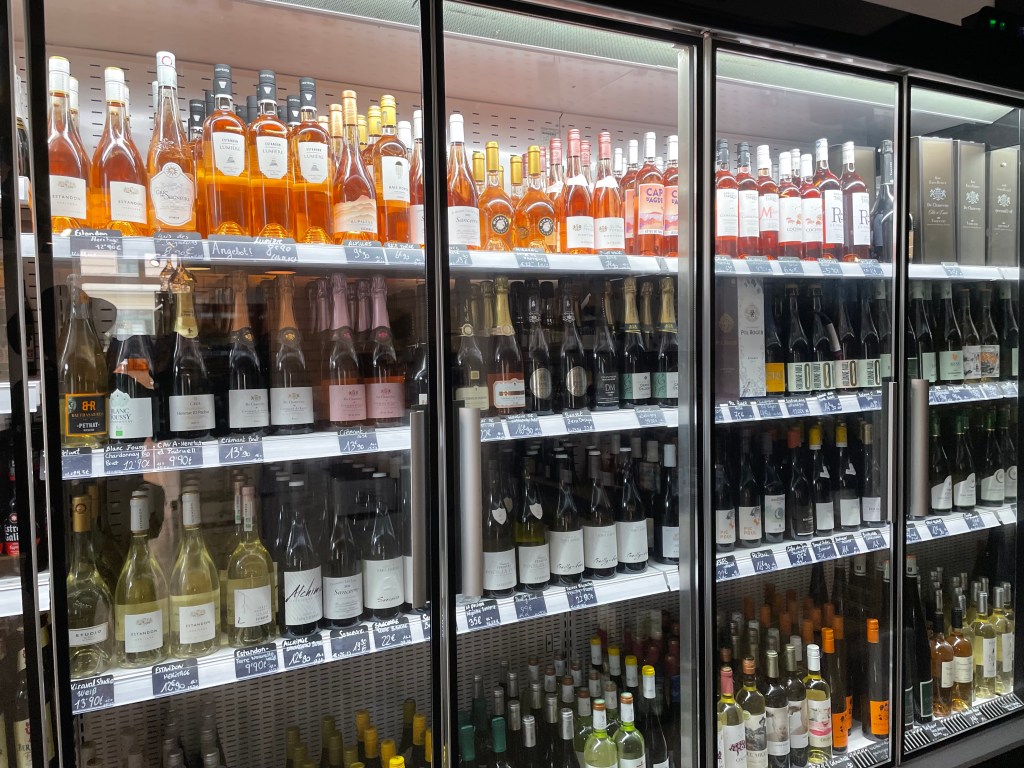
Trendy shops line neighborhood streetshand made knivesGourmet Wines under 20 eurosSustainable, natural materials
What makes Berlin so fascinating and intense, as in other European cities, is the integration of history within modern living.
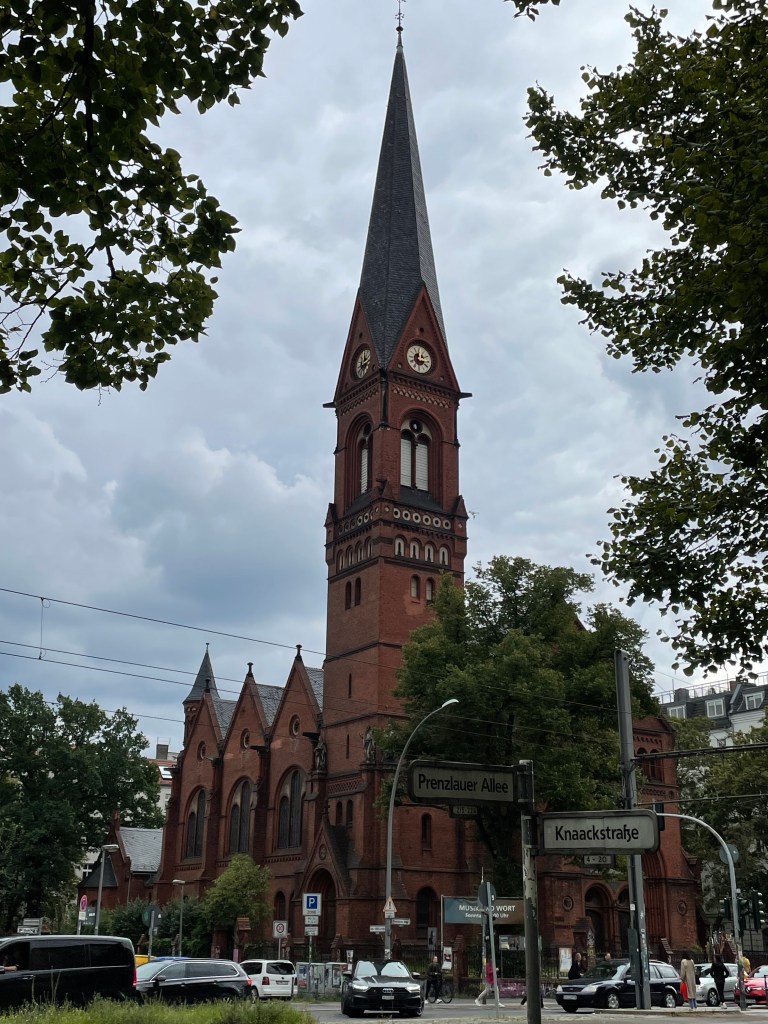
Here, the water tower, a local church with a huge slate steeple, and the closely guarded Jewish synagogue provide history and context for new developments in Prenzlauerberg. I stopped to ponder the brass plates inscribed on one of the cobbled streets. The tragic story as many others was told: a family of five, including a mother, her two grown children, and a young granddaughter all met the same fate.
Coming up: Sketching in Berlin with 1000 other participants
Some of you may be wondering what has been happening since the last post a woeful six months ago. We are in recovery mode, letting the development of the ADU settle, occupying the glorious space, and focussing on the exterior landscaping and entrance to the unit.
Homeowners always seem to ask themselves why they didn’t do the landscaping sooner. While funds are usually stretched to the limit, committing to getting maximum benefit and value from what’s left is the order of the day. The effect and the rewards are immediate and immensely satisfying. We’ve come a long way to fulfilling our goals for developing multi-generational housing, remaining in place, and potential rental, so it was important to complete the project with landscaping.
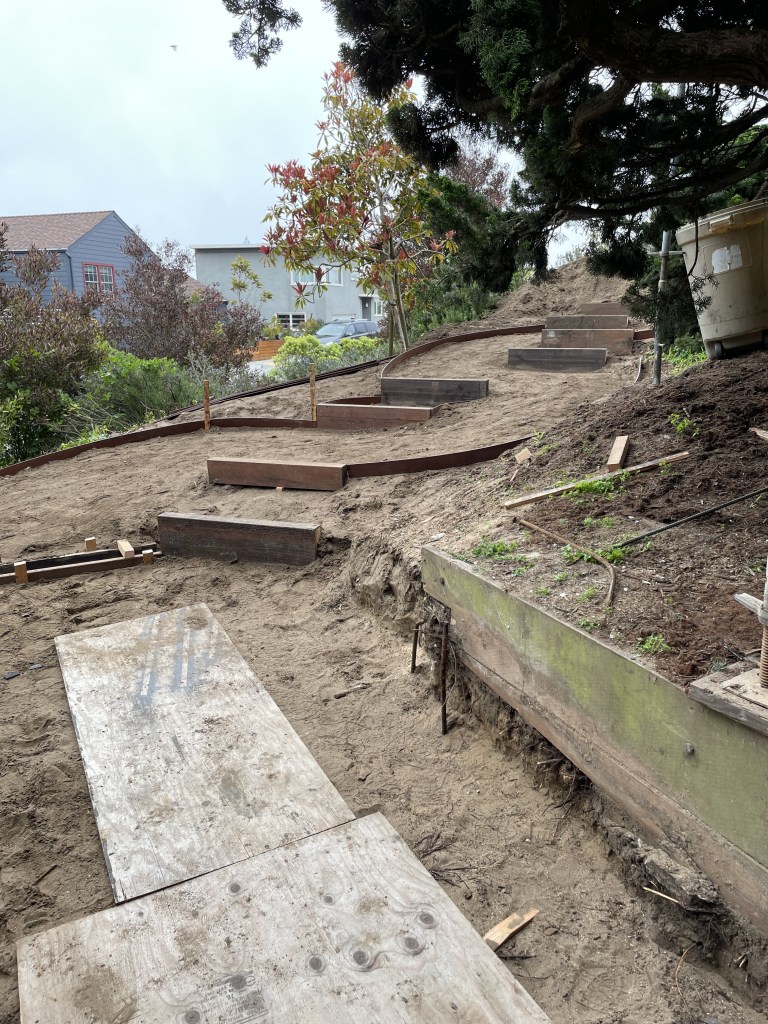
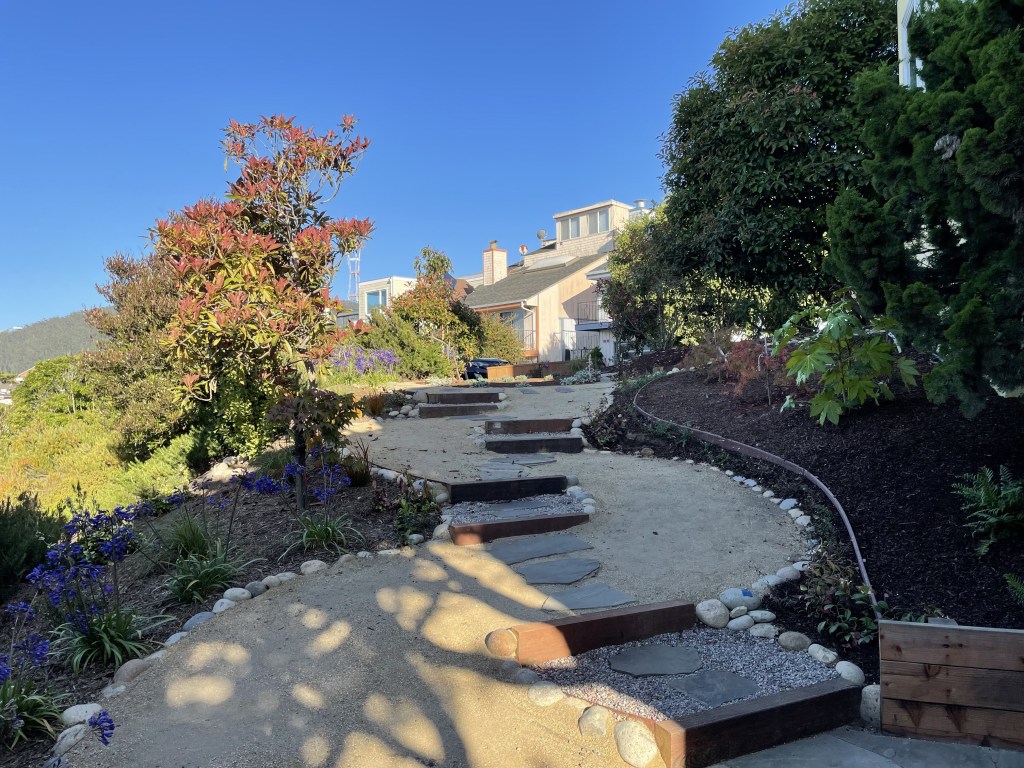
The first task at hand was to create a design . To a large extent, the original concept developed twenty years earlier for a path to the rear yard was reactivated to forge a safe path from the street to the ADU entrance. About 100 feet from the sidewalk to the entrance, an intertwined path down the hill served two purposes: a ramp that could be used by strollers (and wheelchairs maybe!) and a set of gentle steps for a more direct route.
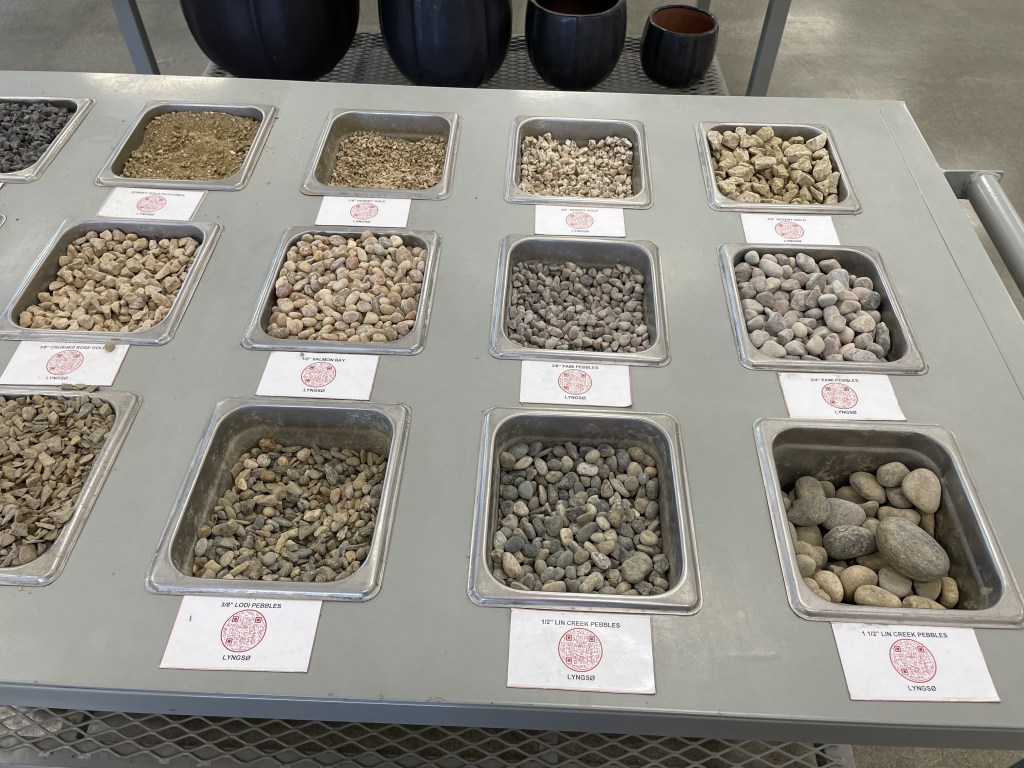
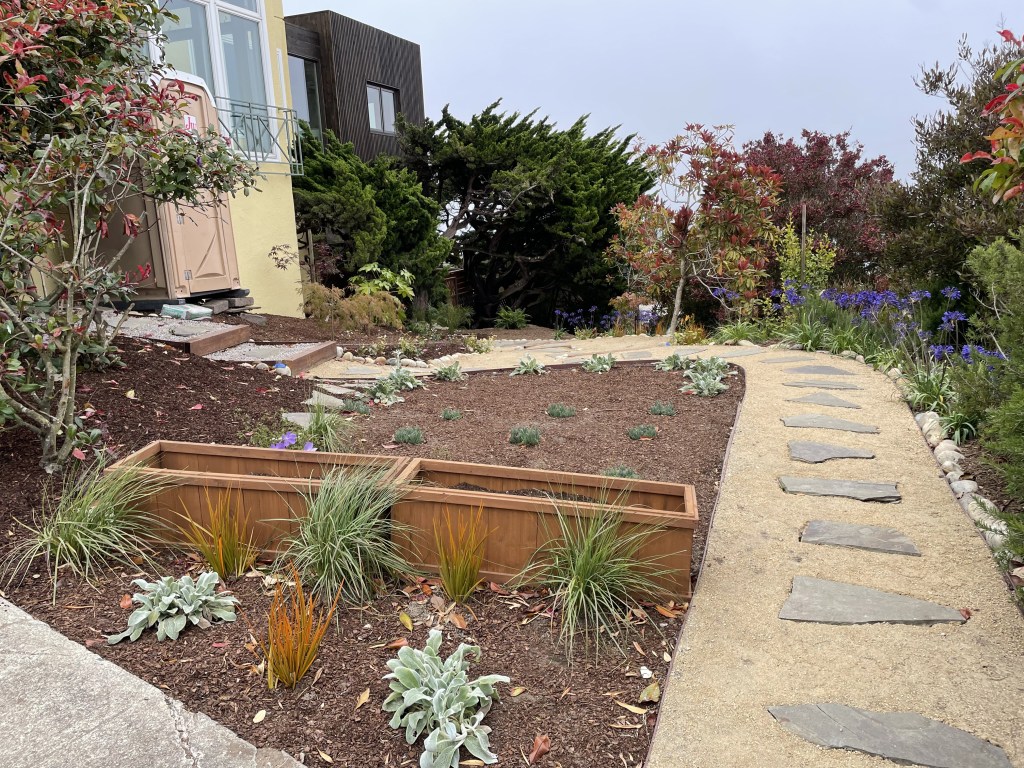
With this idea in mind, the best hardscape finishes suitable for each path were contemplated. What to use? Wood? Metal? Stone? After many trips to Lyngso, a stone supplier in San Carlos, and Broadmoor in South San Francisco, decisions were made: wooden railway ties for steps were integrated with rounded Pami pebbles in between. Compressed sand with additive for stabilization was chosen for the ramp. Irregular pieces of flagstones were imbedded in the sand between the steps to match the flagstone entry area.
Pami PebblesSandGravel choices–oh my!Our designated lot of flagstone
Seeing huge shards of flagstone in varying color ranges was thrilling and terrifying. What type? What color? Does it match other materials on the exterior of the building? I did know one thing. In terms of durability, it was going to outlast any of us! Fortunately, having a deadline forced the decision so the landscape contractor wasn’t kept waiting. You have to look at the brighter side of life to avoid fear of flying.
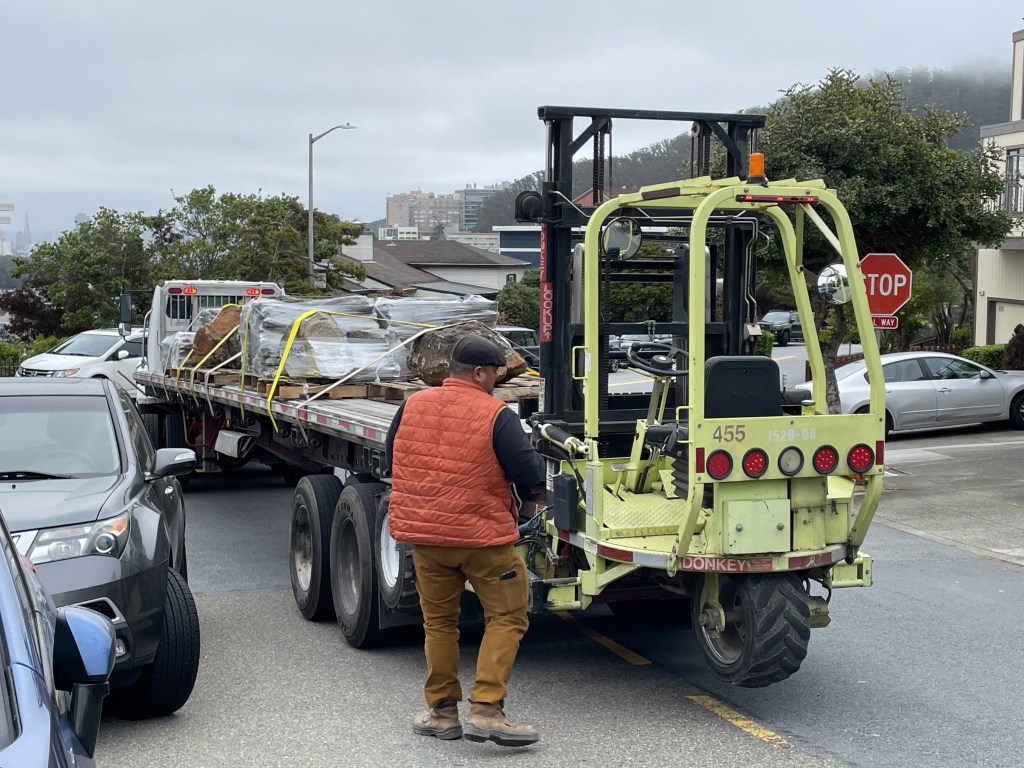
The minimum order required 2 Tons, so highs school match kicked in to calculate area and weight. Materials including mini boulders, gravel, sand, and pebbles were delivered to the job site, making our plot look like a quarry.
Thanks to good friend, landscape pro and sketch buddy Mary Swanson, she helped me with some additional heavy lifting. Scores of plant tpyes and positions needed coordination and planning. Her skill, foresight and insight were a godsend.
Landscape architects not only have to know a million species of plant life and their botanical names, but they also must fully comprehend the nature and performance of these living creatures. A command of hardscapes are also in their toolkit. When you serve as owner, you come to appreciate the necessity of getting such good professional advice.
GingkoFernsJapanes MaplesLibertia at Pacific Nurseries
After numerous trips to Pacific Nursery, a wholesaler, all the plant materials were selected and ordered. Exotic names like Alogyne Heugera, Libertia Peregrine, and Dicksonian Antartica were ordered, along with a Gingko, Japanese Maples, and a host of more commonly known ferns, agapanthus, and lavender.
The height of trees became a major stumbling point. Views from windows needed to be preserved, and inadvertent interference from treetops could block views of the city and the Golden Gate Bridge. The ultimate height of each new tree was checked before being planted to ensure that no sightlines would be blocked.
The flagstone and stone delivery was almost as exciting as the first timber delivery for the house. The earthworks required shaping the windy path to follow the natural grade. Once the flagstone was laid at the entry, it was alot easier to visualize connecting the path from the street to the front door.
Delivery of Stone to job siteFlagstone DeliveryCreating the pathDrainage DetailLaying out StepsUnderlayment for ramp
Newly planted trees and plants need time to grow into their element. We are happy and relieved to complete this final phase of the project and declare victory after an intense couple of years! We love our development and thank all who participated, especially J&J and Felix Associates. We hope you will come to visit us soon!
View from the entrance to the streetFrom the streetPath up the steps with rampEntrance to ADU
News Flash!!!
Stay tuned for another trip to my favorite country: on to Germany for a three-day sketch fest in Berlin and three weeks of opera and concert performances in Berlin, Leipzig and Hamburg! Watch for the next post in a week!









































































 travelswithmyselfandothers.com